


Genesis 47:31
Bible text: King James Version (1769 Blayney text) · Public domain
Bible text: Berean Standard Bible · Public domain
Bible text: American Standard Version (1901) · Public domain
Bible text: World English Bible, Messianic edition · Public domain
Bible text: Geneva Bible (1599) · Public domain
Bible text: Young's Literal Translation · Public domain
- וַיֹּאמֶרvai·Yo·merand he saidH559Conj-w ¦ V-Qal-ConsecImperf-3msVerb Qal Consecutive Imperfect 3rd Singular Masculineוַandיֹּאמֶרhe said
- הִשָּׁבְעָהhi·sha·ve·'Ahswear an oath !H7650V-Niphal-Imp-2ms ¦ SfxVerb Niphal Imperative 2nd Singular Masculineהִשָּׁבְעָswear an oathה!
- לִיLito mePrep-l ¦ 1csSuffix Personal 1st Singular common genderלִtoיme
- וַיִּשָּׁבַעvai·yi·sha·Va'and he swore an oathH7650Conj-w ¦ V-Niphal-ConsecImperf-3msVerb Niphal Consecutive Imperfect 3rd Singular Masculineוַandיִּשָּׁבַעhe swore an oath
- לוֹloto himPrep-l ¦ 3msSuffix Personal 3rd Singular Masculineלtoוֹhim
- וַיִּשְׁתַּחוּvai·yish·Ta·chuand he bowed downH7812Conj-w ¦ V-Hishtaphel-ConsecImperf-3msVerb Hishtaphel Consecutive Imperfect 3rd Singular Masculineוַandיִּשְׁתַּחוּhe bowed down
- יִשְׂרָאֵלYis·ra·'ElIsraelH3478N-proper-mNoun Proper Masculine
- עַל'alonH5921PrepPreposition
- רֹאשׁrosh[the] head ofH7218N-mscNoun Singular Masculine Construct
- הַמִּטָּהha·mi·Tahthe bedH4296Art ¦ N-fsNoun Singular Feminine Absoluteהַtheמִּטָּהbed
English is a literal word-by-word gloss of the Hebrew, not the KJV's wording. Why?
This is the original text the KJV's translators worked from — each Hebrew word with its own literal English meaning in this verse, prepared by scholars at Tyndale House, Cambridge. The KJV translates whole sentences, not word by word, so its wording differs: one Hebrew word can become several English words, and the KJV may choose “the LORD” where the gloss reads “Yahweh”. Both are faithful — they answer different questions. For the KJV's own rendering, switch to the KJV text.
Details
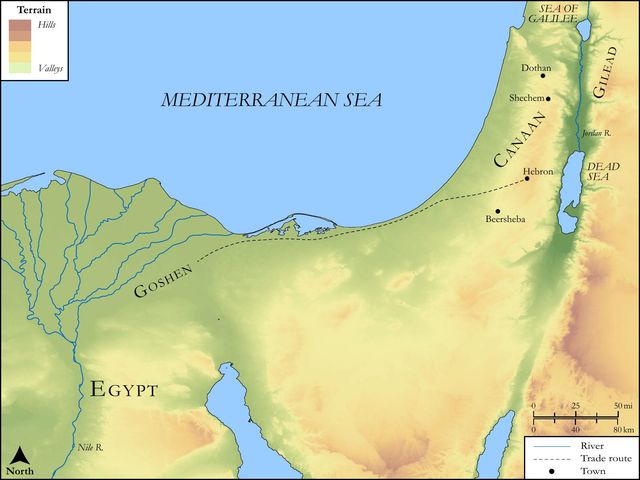
See on the biblical-era maps


Study this verse
Public-domain commentary
Matthew Henry
From his Commentary on the Whole Bible. Henry comments on passages, not single verses — this entry covers Genesis 47:27–31.
Observe, 1. The comfort Jacob lived in (Gen 47:27, Gen 47:28); while the Egyptians were impoverished in their own land, Jacob was replenished in a strange land. He lived seventeen years after he came into Egypt, far beyond his own expectation. Seventeen years he had nourished Joseph (for so old he was when he was sold from him, Gen 37:2), and now, by way of requital, seventeen years Joseph nourished him. Observe how kindly Providence ordered Jacob's affairs, that when he was old, and least able to bear care or fatigue, he had least occasion for it, being well provided for by his son without his own forecast. Thus God considers the frame of his people. 2. The care Jacob died in. At last the time drew nigh that Israel must die, Gen 47:29. Israel, a prince with God, that had power over the angel and prevailed, yet must yield to death. There is no remedy, he must die: it is appointed for all men, therefore for him; and there is no discharge in that war. Joseph supplied him with bread, that he might not die by famine; but this did not secure him from dying by age or sickness. He died by degrees; his candle was not blown out, but gradually burnt down to the socket, so that he saw, at some distance, the time drawing nigh. Note, It is an improvable advantage to see the approach of death before we feel its arrests, that we may be quickened to do what our hand finds to do with all our might: however, it is not far from any of us. Now Jacob's care, as he saw the day approaching, was about his burial, not the pomp of it (he was no way solicitous about that), but the place of it. (1.) He would be buried in Canaan. This he resolved on, not from mere humour, because Canaan was the land of his nativity, but in faith, because it was the land of promise (which he desired thus, as it were, to keep possession of, till the time should come when his posterity should be masters of it), and because it was a type of heaven, that better country which he that said these things declared plainly that he was in expectation of, Heb 11:14. He aimed at a good land, which would be his rest and bliss on the other side death. (2.) He would have Joseph sworn to bring him thither to be buried (Gen 47:29, Gen 47:31), that Joseph, being under such a solemn obligation to do it, might have that to answer to the objections which otherwise might have been made against it, and for the greater satisfaction of Jacob now in his dying minutes. Nothing will better help to make a death-bed easy than the certain prospect of a rest in Canaan after death. (3.) When this was done Israel bowed himself upon the bed's head, yielding himself, as it were, to the stroke of death ("Now let it come, and it shall be welcome"), or worshipping God, as it is explained, Heb 11:21, giving God thanks for all his favours, and particularly for this, that Joseph was ready, not only to put his hand upon his eyes to close them, but under his thigh to give him the satisfaction he desired concerning his burial. Thus those that go down to the dust should, with humble thankfulness, bow before God, the God of their mercies, Psa 22:29.
Historical interpretation
Historical reception
1 surviving comment on this verse from the historical church.
(Chapter 47, Verse 31) And he said to him, swear to me. And he swore to him: and Israel worshipped against the top of his staff. And in this place, some falsely simulate that Jacob worshipped the top of Joseph's scepter, because he honored his son and worshipped his power, when in Hebrew it is read very differently: And Israel worshipped, he said, at the head of the bed: which means, after his son had sworn to him confidently about the request he had made, he worshipped God against the head of his bed. Indeed, as a holy and devoted man dedicated to God, oppressed by old age, he had his bed positioned in such a way that he himself, in the posture of one lying down, was ready for prayer without any difficulty.
Continue studying Genesis 47:31 across the web’s major study libraries — every link below opens this exact verse, chapter, or book on the destination site.
Read & Compare
 BibleGatewayThis verse in more than 200 translations and 70 languages.
 Bible.comThe YouVersion reader — hundreds of translations, reading plans, and highlights.
 ESV.orgCrossway's official English Standard Version reader.
 NET BibleThe NET translation with 60,000+ translators' notes on every rendering decision.
 STEP BibleTyndale House's free study tool — original text, vocabulary, and scholarly resources.
 BibliaLogos Bible Software's free web reader.
 USCCBThe New American Bible (Revised Edition) with the U.S. bishops' study notes.
Commentaries
 BibleHub CommentariesDozens of classic commentaries on this verse, gathered on one page.
 StudyLightMore than 100 commentary sets — the largest collection on the web.
 BibleRefPlain-English commentary on what this verse means, verse by verse.
 Enduring WordDavid Guzik's free commentary on this chapter, widely used by Bible teachers.
 Bible Study ToolsVerse commentary alongside Greek and Hebrew study aids.
Original Language & Research
- BibleHub InterlinearThe verse word by word — original language, transliteration, and English.
- BibleHub LexiconEvery word's original-language definition and Strong's entry.
 Blue Letter BibleDeep-study tools — Strong's numbers, concordance, and word studies.
 SefariaThe Hebrew text with Rashi and centuries of Jewish commentary.
Sermons, Hymns & Audio


TrulyRandomVerse is not affiliated with these sites and doesn’t control their content. They’re linked because they’re genuinely useful.
Summary
Genesis 47:31 records the poignant conclusion of a vital exchange between Jacob and his son Joseph, where Jacob secures a solemn oath for his burial in the Promised Land. This verse profoundly encapsulates Jacob's unwavering faith in God's covenant promises, even as he faces his imminent death, culminating in an act of deep worship and gratitude that underscores his trust in divine faithfulness.
Context
ShowHideLiterary Context
This verse immediately follows Jacob's earnest request to Joseph in Genesis 47:29-30. Sensing his impending death, Jacob summons Joseph and makes him promise not to bury him in Egypt, but instead to carry his body back to the land of Canaan, to be laid with his forefathers, Abraham and Isaac, in the cave of Machpelah. Joseph's agreement to this sacred vow leads directly to Jacob's final act of worship recorded in verse 31, providing a powerful narrative resolution to this deeply personal and covenantally significant interaction. The passage sets the stage for Jacob's final blessings upon his sons and the subsequent exodus from Egypt, emphasizing the continuity of God's promises despite the family's temporary sojourn.
Historical & Cultural Context
In Scripture, the taking of an oath was a profoundly serious and binding commitment, often invoking divine witness to ensure its fulfillment. Jacob's insistence on an oath from Joseph, rather than a mere promise, highlights the immense importance he placed on his burial in Canaan. Burial practices were deeply significant, reflecting beliefs about identity, lineage, and the afterlife. To be buried with one's ancestors in the ancestral land was a powerful statement of belonging and continuity. Furthermore, the act of bowing was a common gesture of respect, homage, or worship. Jacob's specific posture, bowing "upon the bed's head," suggests a physical weakness that necessitated leaning, yet still conveyed profound reverence, akin to the description found in Hebrews 11:21.
Key Themes
ShowHideGenesis 47:31 contributes significantly to several overarching themes within the book of Genesis and the broader Pentateuch. It powerfully illustrates covenant faithfulness, as Jacob's desire for burial in Canaan is a tangible expression of his enduring faith in God's promise of the land to his descendants, a promise reiterated to Abraham (Genesis 12:7), Isaac (Genesis 26:3), and Jacob himself (Genesis 28:13-15). The verse also highlights the theme of hope beyond death, as Jacob's focus on his burial place transcends his immediate circumstances and points to a belief in God's ultimate fulfillment of promises, even if it extends beyond one's lifetime. Finally, Jacob's concluding act of worship underscores the theme of gratitude and reverence towards God, even in the face of physical decline and impending death.
Exposition and Analysis
ShowHideKey Word Analysis
ShowHideThis name, given to Jacob after his wrestling match with God in Genesis 32:28, means "he will rule as God." Its use here, rather than "Jacob," emphasizes his identity as the patriarch of the covenant people, highlighting the theological significance of his final act. It underscores that this is not merely a personal wish, but an act of faith from the one through whom God's promises to the nation would flow.
Derived from a root meaning "to seven oneself," this verb signifies taking an oath, as if by repeating a declaration seven times for emphasis and solemnity. Joseph's act of swearing confirms the binding nature of his commitment to Jacob, demonstrating the gravity with which such promises were made and received among the patriarchs, often invoking divine witness.
This primitive root means "to depress" or "prostrate," especially in homage to royalty or God. While it can denote respect, in this context, given Jacob's advanced age, his impending death, and the fulfillment of his profound desire, it carries a strong connotation of worship and thanksgiving to God. It signifies a humble, reverent posture of adoration.
Verse Breakdown
ShowHide"And he said, Swear unto me."
Jacob's request for an oath from Joseph is not a mere suggestion but a solemn command, indicating the immense importance he placed on his burial in Canaan. This demand underscores Jacob's profound faith in God's covenant promise of the land, desiring his physical resting place to be a tangible testament to that future hope. It reflects a patriarch securing the continuity of the divine promise through his lineage.
"And he sware unto him."
Joseph's immediate compliance demonstrates deep filial piety and unwavering loyalty to his aging father. Despite his high position as Pharaoh's prime minister, Joseph humbly honors his father's final wish, acknowledging the sacred and binding nature of the oath. This act provides Jacob with the assurance he sought, confirming the solemnity of their agreement.
"And Israel bowed himself upon the bed's head."
This culminating act is rich with theological significance. The use of "Israel" rather than "Jacob" emphasizes his identity as the patriarch of God's chosen people. His bowing, likely leaning on his staff as Hebrews 11:21 clarifies, is an act of profound worship and thanksgiving to God. It signifies his peace in Joseph's promise, his deep trust in God's faithfulness throughout his life, and his final acknowledgment of God's sovereignty over his life and the future of his descendants. It is a beautiful picture of a life concluding in worship, trusting in God's ultimate plan.
Literary Devices
ShowHideThe verse employs Symbolism and Irony. The act of Jacob bowing "upon the bed's head" is symbolic of his profound worship and gratitude, even in physical weakness. It represents a final, powerful affirmation of faith in God's covenant promises, transcending his immediate circumstances of being in a foreign land and facing death. The "bed's head" itself can symbolize the end of his earthly journey, yet his posture points to a hope beyond this life. There is also a subtle Irony in Jacob's physical prostration: though he is weak and dying, his spirit is strong, and his act of worship is a powerful demonstration of spiritual vitality and trust in God's ultimate control, even as his body fails. This contrasts his earlier life of striving and wrestling, culminating in a posture of humble submission and gratitude.
Theological and Thematic Connections
ShowHideGenesis 47:31 serves as a powerful theological statement about the enduring nature of God's covenant and the patriarch's unwavering faith. Jacob's insistence on burial in Canaan is not merely a sentimental wish, but a profound act of faith, affirming his belief in God's promise of the land to his descendants. It signifies his conviction that God would indeed bring his people back to the land, and his bones resting there would serve as a tangible sign of this future hope and the ultimate fulfillment of God's promises. This act of faith, culminating in worship, underscores that true hope transcends immediate circumstances and even death itself, finding its anchor in the faithfulness of God. It also highlights the sacredness of oaths and the importance of filial piety within the covenant community.
Reflection and Application
ShowHideGenesis 47:31 offers profound lessons for believers today, serving as a powerful testament to Jacob's enduring faith. Even in the face of death, Jacob looked beyond his immediate circumstances in Egypt to the greater promise of God concerning the land of Canaan. This act reminds us of the importance of maintaining unwavering faith in God's promises, even when they seem distant, delayed, or when life's end approaches. It encourages us to live with an eternal perspective, trusting in God's ultimate plan and His faithfulness to His Word, rather than being consumed by present difficulties or the certainty of physical death. Furthermore, this passage underscores the sacredness of our commitments, the honoring of family bonds, and the profound beauty of concluding one's life in an attitude of worship and gratitude towards God, regardless of physical weakness. It challenges us to consider how our lives, even in their final moments, can bear witness to the faithfulness of God.
Questions for Reflection
ShowHideFAQ
ShowHideWhy was Jacob's burial place so important to him?
ShowHideJacob's desire to be buried in Canaan, rather than Egypt, was a profound expression of his faith in God's covenant promise of the land to his descendants. It was not merely a sentimental wish but a theological statement. By desiring burial in Canaan, Jacob affirmed his belief that God would indeed bring his people back to the land, and his resting place would serve as a tangible sign of this future hope and the ultimate fulfillment of God's promises to Abraham, Isaac, and himself. This commitment is further emphasized by Joseph's later instruction for his own bones to be carried out of Egypt, as recorded in Genesis 50:25.
What does 'bowed himself upon the bed's head' signify?
ShowHideThe phrase "bowed himself" (Hebrew: shâchâh) primarily denotes an act of worship or reverence. While Jacob was on his deathbed, likely leaning on his staff for support (as confirmed by Hebrews 11:21), his bowing was an act of profound gratitude and adoration towards God. It signified his thanksgiving for God's faithfulness throughout his life, for Joseph's promise to bury him in the promised land, and his final act of worship before his passing, demonstrating his trust in God's sovereign plan and his peace in the face of death.
Christ-Centered Fulfillment
ShowHideJacob's unwavering faith in God's promise of the land, culminating in his final act of worship, beautifully prefigures the ultimate hope and inheritance found in Christ. While Jacob looked to an earthly promised land as a sign of God's faithfulness, the New Testament reveals that this earthly inheritance points to a greater, heavenly country (Hebrews 11:13-16), a spiritual inheritance that is imperishable, undefiled, and unfading, kept in heaven for believers (1 Peter 1:4). Jacob's act of faith, leaning on his staff and worshipping, foreshadows the believer's complete reliance on Christ for salvation and the ultimate rest and inheritance in Him. His desire to be gathered to his people in the promised land finds its true fulfillment in the gathering of all believers into the eternal presence of God through the atoning work of Jesus Christ, who is our ultimate rest (Matthew 11:28-30) and the "Amen," the faithful and true witness, in whom all God's promises are "Yes" and "Amen" (2 Corinthians 1:20). Thus, Jacob's deathbed worship becomes a prophetic echo of the worship due to the One who secures our eternal inheritance.