


Genesis 47:28
Bible text: King James Version (1769 Blayney text) · Public domain
Bible text: Berean Standard Bible · Public domain
Bible text: American Standard Version (1901) · Public domain
Bible text: World English Bible, Messianic edition · Public domain
Bible text: Geneva Bible (1599) · Public domain
Bible text: Young's Literal Translation · Public domain
- וַיְחִיvay·Chiand he livedH2421Conj-w ¦ V-Qal-ConsecImperf-3msVerb Qal Consecutive Imperfect 3rd Singular Masculineוַandיְחִיhe lived
- יַעֲקֹבya·'a·KoJacobH3290N-proper-mNoun Proper Masculine
- בְּאֶרֶץbe·'E·retzin [the] land ofH776Prep-b ¦ N-fscNoun Singular Feminine Constructבְּinאֶרֶץ[the] land of
- מִצְרַיִםmitz·Ra·yimEgyptH4714N-properNoun Proper Location
- שְׁבַעshe·Va'seven-H7651Adj-cscAdjective Numerical Singular common gender Construct
- עֶשְׂרֵה'es·RehteenH6240Adj-cscAdjective Numerical Singular common gender Construct
- שָׁנָהsha·Nahyear[s]H8141N-fsNoun Singular Feminine Absolute
- וַיְהִיvay·Hiand it wasH1961Conj-w ¦ V-Qal-ConsecImperf-3msVerb Qal Consecutive Imperfect 3rd Singular Masculineוַandיְהִיit was
- יְמֵיye·mei[the] days ofH3117N-mpcNoun Plural Masculine Construct
- יַעֲקֹבya·'a·KoJacobH3290N-proper-mNoun Proper Masculine
- שְׁנֵיshe·Nei[the] years ofH8141N-mpcNoun Plural Masculine Construct
- חַיָּיוchai·Yavhis lifeH2416N-mpc ¦ 3msNoun Plural Masculine Constructחַיָּיlifeוhis
- שֶׁבַעShe·va'sevenH7651Adj-csAdjective Numerical Singular common gender Absolute
- שָׁנִיםsha·NimyearsH8141N-mpNoun Plural Masculine Absolute
- וְאַרְבָּעִיםve·'ar·ba·'Imand fortyH705Conj-w ¦ Adj-mpAdjective Numerical Plural Masculine Absoluteוְandאַרְבָּעִיםforty
- וּמְאַתu·me·'Atand one hundredH3967Conj-w ¦ Adj-fscAdjective Numerical Singular Feminine Constructוּandמְאַתone hundred
- שָׁנָהsha·Nahyear[s]H8141N-fsNoun Singular Feminine Absolute
English is a literal word-by-word gloss of the Hebrew, not the KJV's wording. Why?
This is the original text the KJV's translators worked from — each Hebrew word with its own literal English meaning in this verse, prepared by scholars at Tyndale House, Cambridge. The KJV translates whole sentences, not word by word, so its wording differs: one Hebrew word can become several English words, and the KJV may choose “the LORD” where the gloss reads “Yahweh”. Both are faithful — they answer different questions. For the KJV's own rendering, switch to the KJV text.
Details
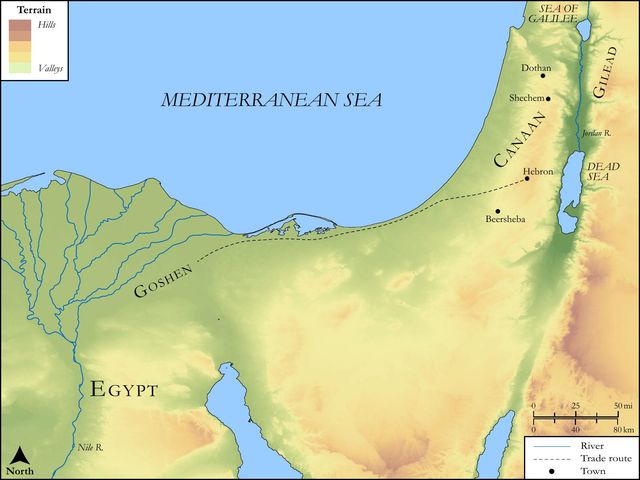
See on the biblical-era maps


Study this verse
Public-domain commentary
Matthew Henry
From his Commentary on the Whole Bible. Henry comments on passages, not single verses — this entry covers Genesis 47:27–31.
Observe, 1. The comfort Jacob lived in (Gen 47:27, Gen 47:28); while the Egyptians were impoverished in their own land, Jacob was replenished in a strange land. He lived seventeen years after he came into Egypt, far beyond his own expectation. Seventeen years he had nourished Joseph (for so old he was when he was sold from him, Gen 37:2), and now, by way of requital, seventeen years Joseph nourished him. Observe how kindly Providence ordered Jacob's affairs, that when he was old, and least able to bear care or fatigue, he had least occasion for it, being well provided for by his son without his own forecast. Thus God considers the frame of his people. 2. The care Jacob died in. At last the time drew nigh that Israel must die, Gen 47:29. Israel, a prince with God, that had power over the angel and prevailed, yet must yield to death. There is no remedy, he must die: it is appointed for all men, therefore for him; and there is no discharge in that war. Joseph supplied him with bread, that he might not die by famine; but this did not secure him from dying by age or sickness. He died by degrees; his candle was not blown out, but gradually burnt down to the socket, so that he saw, at some distance, the time drawing nigh. Note, It is an improvable advantage to see the approach of death before we feel its arrests, that we may be quickened to do what our hand finds to do with all our might: however, it is not far from any of us. Now Jacob's care, as he saw the day approaching, was about his burial, not the pomp of it (he was no way solicitous about that), but the place of it. (1.) He would be buried in Canaan. This he resolved on, not from mere humour, because Canaan was the land of his nativity, but in faith, because it was the land of promise (which he desired thus, as it were, to keep possession of, till the time should come when his posterity should be masters of it), and because it was a type of heaven, that better country which he that said these things declared plainly that he was in expectation of, Heb 11:14. He aimed at a good land, which would be his rest and bliss on the other side death. (2.) He would have Joseph sworn to bring him thither to be buried (Gen 47:29, Gen 47:31), that Joseph, being under such a solemn obligation to do it, might have that to answer to the objections which otherwise might have been made against it, and for the greater satisfaction of Jacob now in his dying minutes. Nothing will better help to make a death-bed easy than the certain prospect of a rest in Canaan after death. (3.) When this was done Israel bowed himself upon the bed's head, yielding himself, as it were, to the stroke of death ("Now let it come, and it shall be welcome"), or worshipping God, as it is explained, Heb 11:21, giving God thanks for all his favours, and particularly for this, that Joseph was ready, not only to put his hand upon his eyes to close them, but under his thigh to give him the satisfaction he desired concerning his burial. Thus those that go down to the dust should, with humble thankfulness, bow before God, the God of their mercies, Psa 22:29.
Continue studying Genesis 47:28 across the web’s major study libraries — every link below opens this exact verse, chapter, or book on the destination site.
Read & Compare
 BibleGatewayThis verse in more than 200 translations and 70 languages.
 Bible.comThe YouVersion reader — hundreds of translations, reading plans, and highlights.
 ESV.orgCrossway's official English Standard Version reader.
 NET BibleThe NET translation with 60,000+ translators' notes on every rendering decision.
 STEP BibleTyndale House's free study tool — original text, vocabulary, and scholarly resources.
 BibliaLogos Bible Software's free web reader.
 USCCBThe New American Bible (Revised Edition) with the U.S. bishops' study notes.
Commentaries
 BibleHub CommentariesDozens of classic commentaries on this verse, gathered on one page.
 StudyLightMore than 100 commentary sets — the largest collection on the web.
 BibleRefPlain-English commentary on what this verse means, verse by verse.
 Enduring WordDavid Guzik's free commentary on this chapter, widely used by Bible teachers.
 Bible Study ToolsVerse commentary alongside Greek and Hebrew study aids.
Original Language & Research
- BibleHub InterlinearThe verse word by word — original language, transliteration, and English.
- BibleHub LexiconEvery word's original-language definition and Strong's entry.
 Blue Letter BibleDeep-study tools — Strong's numbers, concordance, and word studies.
 SefariaThe Hebrew text with Rashi and centuries of Jewish commentary.
Sermons, Hymns & Audio


TrulyRandomVerse is not affiliated with these sites and doesn’t control their content. They’re linked because they’re genuinely useful.
Summary
Genesis 47:28 precisely records the final seventeen years of Jacob's life spent in Egypt, bringing his total age to one hundred forty-seven years. This verse serves as a climactic statement, marking the peaceful conclusion of the life of the last major patriarch and signifying the end of an era focused on individual covenant bearers. It simultaneously sets the stage for the exponential growth of the family of Israel within the fertile land of Goshen, preparing them for their future as a distinct nation.
Context
ShowHideLiterary Context
This verse immediately follows Jacob's blessing of Pharaoh and the establishment of his family in the land of Goshen, where Joseph provided for them during the famine. It precedes Jacob's final instructions to Joseph regarding his burial and his blessings upon Ephraim and Manasseh, and then upon all his sons in Genesis 48, Genesis 49 and Genesis 49. Functioning as an inclusio, the seventeen years Jacob spent in Egypt mirror the seventeen years Joseph spent with Jacob before being sold into slavery, bringing a sense of narrative symmetry and closure to a significant period of separation and reunion. It marks a transition point, moving the narrative focus from the individual lives of the patriarchs to the collective development of the burgeoning nation of Israel.
Historical & Cultural Context
Jacob's relocation to Egypt occurred during a severe regional famine, making Egypt, with its advanced agricultural systems sustained by the Nile, a vital refuge. The Pharaoh's generous provision of the land of Goshen, known for its rich pastures, was crucial for Jacob's family, who were primarily shepherds. In Scripture, longevity was often seen as a sign of divine favor and blessing, reflecting a person's faithfulness and God's sustained providence. The meticulous recording of lifespans and genealogies was a common practice, emphasizing lineage, inheritance, and the historical continuity of a people, which was particularly important for a covenant people like Israel.
Key Themes
ShowHideGenesis 47:28 contributes significantly to several overarching themes within the book of Genesis and the broader biblical narrative. It underscores God's Divine Providence, demonstrating His faithful care for Jacob and his family, even leading them to a foreign land to preserve them during famine, as foreshadowed by Joseph's earlier dreams and his interpretation of God's work in Genesis 45:7-8. The verse also highlights the theme of Covenant Fulfillment, as Jacob's family, now settled and secure, begins to fulfill the promise of becoming a "great nation" given to Abraham in Genesis 12:2 and reiterated to Jacob in Genesis 46:3. Furthermore, it marks a pivotal Transition to Nationhood, shifting the narrative from the individual stories of the patriarchs to the collective identity and growth of the twelve tribes of Israel, setting the stage for the dramatic events of the Exodus.
Exposition and Analysis
ShowHideGenesis 47:28 delivers a concise yet profound summary of Jacob's final earthly chapter, meticulously detailing the duration of his stay in Egypt and his culminating age. This precision is characteristic of the patriarchal narratives, emphasizing the historical veracity and divine oversight of Israel's foundational history.
Key Word Analysis
ShowHideThis primitive root means "to live, whether literally or figuratively; causatively, to revive." In this context, it signifies Jacob's continued existence and vitality during his final years, emphasizing that he was sustained and thrived, rather than merely survived, under God's providence in Egypt. It speaks to the quality of his life, a period of peace and reunion after much struggle.
Derived from the root H2421, this word means "life (or living thing), whether literally or figuratively." Coupled with "day" (H3117, yôwm), "whole age" refers to the entire span of Jacob's life. The use of chay here underscores the completeness and totality of his earthly journey, bringing to a close the narrative of the third major patriarch.
This term refers to "a year (as a revolution of time)." The repetition of "years" in the verse (seventeen years, one hundred forty and seven years) emphasizes the chronological precision and the linear progression of time, marking the final period of Jacob's life and the definitive end of his earthly sojourn. The specific number of years also highlights the divine ordering of his life's span.
Verse Breakdown
ShowHide"And Jacob lived in the land of Egypt seventeen years"
This clause establishes the duration and location of Jacob's final earthly sojourn. After a life characterized by movement, struggle, and sojourning, Jacob finds a period of settled peace and prosperity in Egypt, a land not of his inheritance but of divine provision during a time of famine. The "seventeen years" is a significant period, allowing for the consolidation and growth of his family, laying the demographic groundwork for the future nation of Israel.
"so the whole age of Jacob was an hundred forty and seven years"
This concluding statement provides the exact total of Jacob's lifespan. It signifies the completion of his earthly journey and the fulfillment of God's promises regarding his longevity. While shorter than his father Isaac (180 years) and grandfather Abraham (175 years), it was still a remarkably long life for the period, a testament to God's sustained blessing and faithfulness to His covenant with the patriarchs. This precise numerical record serves as a definitive marker, closing the chapter on Jacob's individual narrative.
Literary Devices
ShowHideThe verse employs several significant literary devices. Numerical Precision is evident in the exact counting of Jacob's years in Egypt (seventeen) and his total lifespan (one hundred forty-seven). This precision lends Verisimilitude to the narrative, grounding the sacred history in concrete, verifiable details, and emphasizing the meticulousness of the biblical record. The subtle Structural Parallelism or Inclusio created by the seventeen years Jacob spent in Egypt mirroring the seventeen years Joseph spent with Jacob before his ordeal (Genesis 37:2) provides a sense of narrative symmetry and closure, bringing Joseph's story full circle and signaling a new phase for the family. Furthermore, the verse functions as a Transitional Marker, signaling the end of the patriarchal era and the imminent shift in focus from individual covenant bearers to the collective development of the nation of Israel, implicitly foreshadowing the growth and eventual enslavement of the Israelites in Egypt.
Theological and Thematic Connections
ShowHideGenesis 47:28 serves as a powerful theological statement, emphasizing God's unwavering faithfulness and meticulous providence in the lives of His covenant people. Jacob's long life, culminating in peace and prosperity in a foreign land, underscores that God's plans unfold according to His perfect timing and sovereign design, even through unexpected circumstances like famine and relocation. This verse marks the peaceful conclusion of the patriarchal era, ensuring the continuity of the Abrahamic covenant through Jacob's twelve sons, who would become the progenitors of the twelve tribes of Israel. It highlights how God orchestrates events, even difficult ones, to fulfill His promises, transforming a nomadic clan into the foundational demographic for a future nation.
Reflection and Application
ShowHideGenesis 47:28 invites contemporary believers to reflect on the entirety of Jacob's complex life—a journey marked by struggle, deception, reconciliation, and profound encounters with God. His final years, spent in comfort and peace surrounded by his family in Egypt, serve as a powerful testament to God's enduring providence and care for His people, even when circumstances lead them to unexpected or foreign environments. This verse reminds us that God remains faithful through every season of life, guiding us to a peaceful conclusion according to His perfect will. It encourages us to trust in God's overarching plan, even when it involves challenging transitions or unfamiliar paths, knowing that He is meticulously working all things together for the good of those who love Him and are called according to His purpose, ultimately enabling us to "finish well" in our earthly journey. It challenges us to consider how our own lives, with their varied experiences, are part of a larger divine narrative, and how God's faithfulness can bring peace and purpose even in our final days.
Questions for Reflection
ShowHideFAQ
ShowHideWhy is Jacob's age so precisely recorded in this verse?
ShowHideThe precise recording of Jacob's age (147 years) and the duration of his stay in Egypt (17 years) is characteristic of the biblical narratives, particularly in Genesis. This numerical exactness emphasizes the historical nature and careful preservation of generational records within the patriarchal accounts, highlighting the importance of lineage and the fulfillment of God's promises through specific individuals. It underscores the divine oversight of history and the meticulous way God works out His covenant plans.
What is the significance of Jacob living "seventeen years" in Egypt?
ShowHideThe duration of seventeen years is notable for several reasons. Theologically, it allowed Jacob's family to grow significantly, laying the demographic groundwork for their future national identity, fulfilling God's promise to make them a "great nation" (Genesis 46:3). Narratively, it subtly mirrors the seventeen years Joseph spent with Jacob before being sold into slavery, creating a symmetrical connection that brings a sense of narrative completion and divine order to the family's story.
How does Jacob's lifespan compare to other patriarchs, and what does this signify?
ShowHideJacob lived 147 years, which was shorter than his father Isaac (180 years) and grandfather Abraham (175 years). While shorter, it was still a remarkable lifespan for the time, indicating God's continued blessing and favor. This difference in longevity does not diminish God's faithfulness but rather highlights the unique trajectory of each patriarch's life within God's broader redemptive plan, underscoring that God's promises are fulfilled according to His sovereign timing and purpose for each individual and generation.
Christ-Centered Fulfillment
ShowHideJacob's life, marked by pilgrimage, struggle, and eventual peace in a foreign land, profoundly prefigures the greater journey of faith culminating in Christ. His death in Egypt, securing the lineage through which the Messiah would come, underscores God's meticulous preservation of the covenant line, a lineage meticulously traced through Matthew 1:1-17 and Luke 3:23-38. The promise of a "great nation" given to Jacob, and the subsequent growth of Israel in Egypt, ultimately finds its spiritual and universal fulfillment not in an earthly kingdom, but in the global body of believers united in Christ, the true "seed" of Abraham (Galatians 3:16), through whom all the families of the earth are blessed (Genesis 12:3). Jacob, like all the patriarchs, lived as a "sojourner" on earth, looking forward to a "better country—a heavenly one" (Hebrews 11:13-16). Christ's perfect life, His atoning death, and His resurrection bring the ultimate "finishing well" for humanity, offering eternal peace and rest that far surpasses any earthly comfort Jacob experienced, inviting all who believe to enter into God's promised rest (Hebrews 4:9-11).