


Genesis 47:29
Bible text: King James Version (1769 Blayney text) · Public domain
Bible text: King James Version with Strong's numbers · Public domain
Bible text: Berean Standard Bible · Public domain
Bible text: American Standard Version (1901) · Public domain
Bible text: World English Bible, Messianic edition · Public domain
Bible text: Geneva Bible (1599) · Public domain
Bible text: Young's Literal Translation · Public domain
- וַיִּקְרְבוּvai·yik·re·Vuand they drew nearH7126Conj-w ¦ V-Qal-ConsecImperf-3mpVerb Qal Consecutive Imperfect 3rd Plural Masculineוַandיִּקְרְבוּthey drew near
- יְמֵיye·mei[the] days ofH3117N-mpcNoun Plural Masculine Construct
- יִשְׂרָאֵלYis·ra·'ElIsraelH3478N-proper-mNoun Proper Masculine
- לָמוּתla·Mutto dieH4191Prep-l ¦ V-Qal-InfVerb Qal Infinitive Constructלָtoמוּתdie
- וַיִּקְרָאvai·yik·Ra'and he summonedH7121Conj-w ¦ V-Qal-ConsecImperf-3msVerb Qal Consecutive Imperfect 3rd Singular Masculineוַandיִּקְרָאhe summoned
- לִבְנוֹliv·No<to> his sonH1121Prep-l ¦ N-msc ¦ 3msNoun Singular Masculine Constructלִ<to>בְנsonוֹhis
- לְיוֹסֵףle·yo·Sef<to> JosephH3130Prep-l ¦ N-proper-mNoun Proper Masculineלְ<to>יוֹסֵףJoseph
- וַיֹּאמֶרvai·Yo·merand he saidH559Conj-w ¦ V-Qal-ConsecImperf-3msVerb Qal Consecutive Imperfect 3rd Singular Masculineוַandיֹּאמֶרhe said
- לוֹloto himPrep-l ¦ 3msSuffix Personal 3rd Singular Masculineלtoוֹhim
- אִם'imifH518PrtParticle Conditional
- נָאna'pleaseH4994PrtParticle Interjection
- מָצָאתִיma·Tza·tiI have foundH4672V-Qal-Perf-1csVerb Qal Perfect 1st Singular common gender
- חֵןchenfavorH2580N-msNoun Singular Masculine Absolute
- בְּעֵינֶיךָbe·'ei·Nei·khain your viewH5869Prep-b ¦ N-fdc ¦ 2msNoun Dual Feminine Constructבְּinעֵינֶיviewךָyour
- שִׂיםsimputH7760V-Qal-Imp-2msVerb Qal Imperative 2nd Singular Masculine
- נָאna'pleaseH4994PrtParticle Interjection
- יָדְךָya·de·Khayour handH3027N-csc ¦ 2msNoun Singular common gender Constructיָדְhandךָyour
- תַּחַתTa·chatunderH8478N-mscNoun Singular Masculine Construct
- יְרֵכִיye·re·Khimy thighH3409N-fsc ¦ 1csNoun Singular Feminine Constructיְרֵכִthighיmy
- וְעָשִׂיתָve·'a·Si·taand you will doH6213Conj-w ¦ V-Qal-ConsecPerf-2msVerb Qal Consecutive Perfect 2nd Singular Masculineוְandעָשִׂיתָyou will do
- עִמָּדִי'i·ma·Diwith meH5978Prep ¦ 1csPrepositionעִמָּדִwithיme
- חֶסֶדChe·sedloyaltyH2617N-msNoun Singular Masculine Absolute
- וֶאֱמֶתve·'e·Metand faithfulnessH571Conj-w ¦ N-fsNoun Singular Feminine Absoluteוֶandאֱמֶתfaithfulness
- אַל'almay notH408NegParticle Negative
- נָאna'pleaseH4994PrtParticle Interjection
- תִקְבְּרֵנִיtik·be·Re·niyou bury meH6912V-Qal-Imperf-2ms ¦ 1csVerb Qal Imperfect 2nd Singular Masculineתִקְבְּרֵyou buryנִיme
- בְּמִצְרָיִםbe·mitz·Ra·yimin EgyptH4714Prep-b ¦ N-properNoun Proper LocationבְּinמִצְרָיִםEgypt
English is a literal word-by-word gloss of the Hebrew, not the KJV's wording. Why?
This is the original text the KJV's translators worked from — each Hebrew word with its own literal English meaning in this verse, prepared by scholars at Tyndale House, Cambridge. The KJV translates whole sentences, not word by word, so its wording differs: one Hebrew word can become several English words, and the KJV may choose “the LORD” where the gloss reads “Yahweh”. Both are faithful — they answer different questions. For the KJV's own rendering, switch to the KJV text.
Details
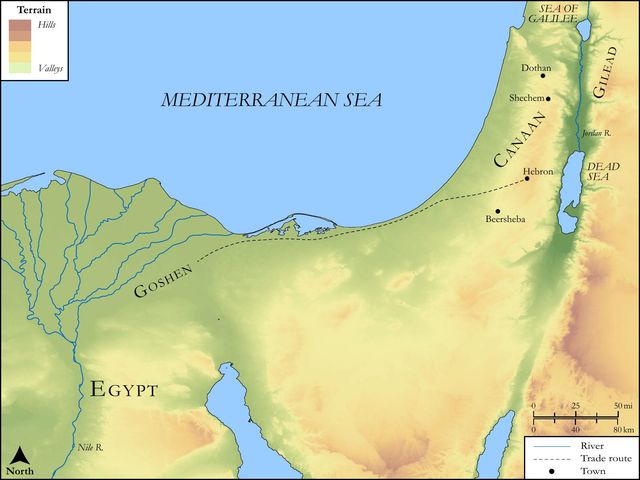
See on the biblical-era maps


Study this verse
Public-domain commentary
Matthew Henry
From his Commentary on the Whole Bible. Henry comments on passages, not single verses — this entry covers Genesis 47:27–31.
Observe, 1. The comfort Jacob lived in (Gen 47:27, Gen 47:28); while the Egyptians were impoverished in their own land, Jacob was replenished in a strange land. He lived seventeen years after he came into Egypt, far beyond his own expectation. Seventeen years he had nourished Joseph (for so old he was when he was sold from him, Gen 37:2), and now, by way of requital, seventeen years Joseph nourished him. Observe how kindly Providence ordered Jacob's affairs, that when he was old, and least able to bear care or fatigue, he had least occasion for it, being well provided for by his son without his own forecast. Thus God considers the frame of his people. 2. The care Jacob died in. At last the time drew nigh that Israel must die, Gen 47:29. Israel, a prince with God, that had power over the angel and prevailed, yet must yield to death. There is no remedy, he must die: it is appointed for all men, therefore for him; and there is no discharge in that war. Joseph supplied him with bread, that he might not die by famine; but this did not secure him from dying by age or sickness. He died by degrees; his candle was not blown out, but gradually burnt down to the socket, so that he saw, at some distance, the time drawing nigh. Note, It is an improvable advantage to see the approach of death before we feel its arrests, that we may be quickened to do what our hand finds to do with all our might: however, it is not far from any of us. Now Jacob's care, as he saw the day approaching, was about his burial, not the pomp of it (he was no way solicitous about that), but the place of it. (1.) He would be buried in Canaan. This he resolved on, not from mere humour, because Canaan was the land of his nativity, but in faith, because it was the land of promise (which he desired thus, as it were, to keep possession of, till the time should come when his posterity should be masters of it), and because it was a type of heaven, that better country which he that said these things declared plainly that he was in expectation of, Heb 11:14. He aimed at a good land, which would be his rest and bliss on the other side death. (2.) He would have Joseph sworn to bring him thither to be buried (Gen 47:29, Gen 47:31), that Joseph, being under such a solemn obligation to do it, might have that to answer to the objections which otherwise might have been made against it, and for the greater satisfaction of Jacob now in his dying minutes. Nothing will better help to make a death-bed easy than the certain prospect of a rest in Canaan after death. (3.) When this was done Israel bowed himself upon the bed's head, yielding himself, as it were, to the stroke of death ("Now let it come, and it shall be welcome"), or worshipping God, as it is explained, Heb 11:21, giving God thanks for all his favours, and particularly for this, that Joseph was ready, not only to put his hand upon his eyes to close them, but under his thigh to give him the satisfaction he desired concerning his burial. Thus those that go down to the dust should, with humble thankfulness, bow before God, the God of their mercies, Psa 22:29.
Historical interpretation
Historical reception
1 surviving comment on this verse from the historical church.
Many mean-spirited people, when we exhort them not to be overly concerned about burial or to give highest priority to having the remains of the dead brought back from foreign parts to their native land, quote this story to us, claiming that the patriarch also gave attention to it. First of all, however, as I said before, it must be remembered that the same set of values is not to be looked for at that time as it is with people of today. Second, the good man wanted this done not without reason but to let his descendants have a glimpse of the real prospect of returning themselves some day to the Promised Land.… I mean, for proof that future events become visible to the eyes of faith, listen to Jacob already calling death sleeping; he said, remember, “I want to sleep with my forebears,” Hence Paul also said, “By faith these people passed on without having received what was promised but having seen it from afar and greeted it.” How? By the eyes of faith. So let no one think Jacob’s instruction came from meanness of spirit. It was due to the times and the vision of the return that would be theirs. Acquit the good man of any blame.I mean, today when there has been a deepening of our values in the wake of Christ’s coming, it would be proper for someone to be blamed for worrying about things such as burial. Let him not think it a misfortune for someone to end his days in a foreign land or to pass from this life in solitude. After all, it is not such a person who deserves to be thought unfortunate, but the one who dies in sin, even if he dies in bed, at home, in the bosom of his family.…
For proof that nothing of the kind causes any harm to the virtuous person, learn that good people generally—I mean the prophets and the apostles—with few exceptions were buried we know not where. Some, you see, were beheaded; others were stoned and so departed this life; others suffered countless punishments of different kinds for the sake of religion, while all were martyrs for Christ. No one would dare say about such people that their death was without honor; instead, it would be in keeping with those words of sacred Scripture, “Honorable in the sight of the Lord is the death of his holy ones.” Just as it called the death of holy people honorable, so listen also to Scripture calling the death of sinners wretched: “The death of sinners is wretched.” … So even if one ends one’s life at home, in the presence of wife and children, with relatives and friends at hand, but in fact one is bereft of virtue, such a person’s death would be wretched.… Even if the person endowed with virtue falls among brigands, even if he becomes the food of wild beasts, his death would be honorable. Tell me, after all, was not the son of Zacharias beheaded? Was not Stephen the first to be bedecked in the martyr’s garland, stoned and so ended his life? Peter and Paul too: was not one beheaded, while the other, on the contrary, underwent the punishment of crucifixion and departed this life in that manner? Are they not for that reason in particular celebrated and eulogized everywhere in the world?
With all this in mind let us neither lament those who meet their end in exile nor declare blessed those who depart this life at home. Instead, following the norm of sacred Scripture, let us declare blessed those who have passed away after a life of virtue and lament those who have died in sin.… It behooves us, then, as we ponder these truths, to be attentive to virtue and strive in this present life as though in a gymnasium so that, once the contest is over, we may succeed in donning the bright crown and not have futile regrets. As long as the contest lasts, you see, it is possible, if we wish it, to shake off indifference and cling to virtue so as to succeed in attaining the crowns laid up for us.
Continue studying Genesis 47:29 across the web’s major study libraries — every link below opens this exact verse, chapter, or book on the destination site.
Read & Compare
 BibleGatewayThis verse in more than 200 translations and 70 languages.
 Bible.comThe YouVersion reader — hundreds of translations, reading plans, and highlights.
 ESV.orgCrossway's official English Standard Version reader.
 NET BibleThe NET translation with 60,000+ translators' notes on every rendering decision.
 STEP BibleTyndale House's free study tool — original text, vocabulary, and scholarly resources.
 BibliaLogos Bible Software's free web reader.
 USCCBThe New American Bible (Revised Edition) with the U.S. bishops' study notes.
Commentaries
 BibleHub CommentariesDozens of classic commentaries on this verse, gathered on one page.
 StudyLightMore than 100 commentary sets — the largest collection on the web.
 BibleRefPlain-English commentary on what this verse means, verse by verse.
 Enduring WordDavid Guzik's free commentary on this chapter, widely used by Bible teachers.
 Bible Study ToolsVerse commentary alongside Greek and Hebrew study aids.
Original Language & Research
- BibleHub InterlinearThe verse word by word — original language, transliteration, and English.
- BibleHub LexiconEvery word's original-language definition and Strong's entry.
 Blue Letter BibleDeep-study tools — Strong's numbers, concordance, and word studies.
 SefariaThe Hebrew text with Rashi and centuries of Jewish commentary.
Sermons, Hymns & Audio


TrulyRandomVerse is not affiliated with these sites and doesn’t control their content. They’re linked because they’re genuinely useful.
Summary
Genesis 47:29 captures a deeply poignant moment as Jacob, also known as Israel, senses the approach of his death after seventeen years in Egypt. He summons his beloved son Joseph, entrusting him with a solemn and binding request regarding his burial place, a plea that profoundly underscores Jacob's unwavering faith in God's covenant promises despite his temporary circumstances and the prosperity he enjoyed in Egypt.
Context
ShowHideLiterary Context
This verse marks a significant transition within the Book of Genesis. Jacob and his family have been settled in the fertile land of Goshen for seventeen years, enjoying a period of peace and prosperity under Joseph's care. The severe famine that initially brought them to Egypt has long passed. As the narrative approaches its conclusion, the focus shifts from the family's survival and growth in Egypt to the patriarch Jacob's impending death and his final instructions, which set the stage for the family's eventual return to Canaan, albeit much later in the biblical story. This passage serves as a bridge, looking back at God's faithfulness to the patriarchs and looking forward to the fulfillment of the covenant promises in the land.
Historical & Cultural Context
Among the patriarchs, burial practices were deeply significant, as Abraham's purchase of Machpelah shows, reflecting a person's identity, lineage, and hope for the afterlife. Being buried with one's ancestors in a family tomb was paramount, signifying continuity and belonging. The act of placing a hand under the thigh was a powerful and ancient custom for swearing an oath, signifying a deeply binding commitment, often invoking the reproductive organs as a symbol of the family's future and the sacredness of the lineage. For Jacob, desiring burial in Canaan, rather than the opulent land of Egypt, was a profound statement of faith, distinguishing himself from the Egyptians and aligning himself with the covenant promises given to his forefathers, Abraham and Isaac, concerning the land of Canaan.
Key Themes
ShowHideGenesis 47:29 contributes to several overarching themes in the book. It highlights the theme of Covenant Faithfulness, as Jacob's request is rooted in his belief in God's promise of the land of Canaan to his descendants (e.g., Genesis 17:8). It underscores the Sojourner Motif, portraying Jacob, like Abraham and Isaac, as a temporary resident in a foreign land, whose true home and inheritance lie elsewhere. The solemn oath also emphasizes the Weight of Promises and Oaths among the patriarchs and before God, a theme seen earlier when Abraham made his servant swear regarding Isaac's wife. Finally, it powerfully demonstrates Faith Beyond Death, as Jacob's actions, even in his final days, are driven by an enduring trust in God's future fulfillment of His Word, a faith that transcends his immediate circumstances in Egypt, as highlighted in Genesis 47:28.
Exposition and Analysis
ShowHideKey Word Analysis
ShowHideFrom the root H2580, this word signifies "graciousness," "kindness," or "favor." When Jacob says, "If now I have found grace in thy sight," he is humbly appealing to Joseph's good will and affection, seeking to secure his favor for a request of immense personal and spiritual importance. It's not a demand, but a plea for a compassionate and favorable response.
Derived from H2617, this term denotes "kindness," "loving-kindness," "mercy," or "steadfast love." It often carries the connotation of covenant loyalty or faithful devotion. Jacob is asking Joseph to act with unwavering, loyal love, reflecting a deep, enduring commitment that goes beyond mere obligation, echoing the steadfast love God shows His people.
From H571, this word means "truth," "trustworthiness," or "reliability." When paired with chêçêd, as it frequently is in Scripture (e.g., Psalm 25:10), it emphasizes integrity, faithfulness, and an unwavering adherence to a promise. Jacob desires Joseph to fulfill his request not just out of love, but with absolute sincerity and reliability.
Verse Breakdown
ShowHide"And the time drew nigh that Israel must die:"
This opening clause immediately sets a somber tone, indicating Jacob's advanced age (147 years, as mentioned in the preceding verse) and his recognition that his earthly life is drawing to a close. The use of "Israel" rather than "Jacob" here subtly elevates the moment, emphasizing his identity as the patriarch, the one who wrestled with God, and the progenitor of the chosen nation, whose life and death have national and covenantal significance.
"and he called his son Joseph, and said unto him,"
Jacob, demonstrating his wisdom and trust, summons Joseph, his most powerful and influential son in Egypt. This act highlights Joseph's unique position and the deep bond of love and respect between them. The choice of Joseph also ensures that the request has the highest possible chance of being fulfilled.
"If now I have found grace in thy sight,"
This phrase is a humble yet weighty appeal. It is a common idiom used to preface a significant request, acknowledging the authority and discretion of the one being addressed while appealing to their benevolence and affection. Jacob is not commanding, but respectfully seeking Joseph's favor and willingness to grant his dying wish.
"put, I pray thee, thy hand under my thigh,"
This instruction refers to a solemn oath-taking custom among the patriarchs, first seen when Abraham made his servant swear concerning Isaac's marriage. While its precise origin is debated, it likely involved the hip or reproductive area, symbolizing the perpetuation of the family line and the sacredness of the promise, making it an unbreakable vow that invoked the future generations and the very essence of one's being.
"and deal kindly and truly with me;"
This is the heart of Jacob's appeal for Joseph's commitment. As analyzed in the Key Word Analysis, "kindly" (chêçêd) denotes steadfast love and covenant loyalty, while "truly" (ʼemeth) signifies faithfulness and integrity. Jacob is asking Joseph to fulfill his request with unwavering devotion and absolute reliability, reflecting the divine attributes of God's own faithfulness.
"bury me not, I pray thee, in Egypt:"
This is Jacob's ultimate request, the culmination of his plea. It reveals his profound spiritual orientation and his unwavering focus on the promised land, Canaan. Despite the comfort and prosperity he enjoyed in Egypt, Jacob refused to identify it as his final resting place. His desire to be buried outside of Egypt, specifically in the family tomb in Canaan, was a powerful testament to his enduring faith in God's covenant promises concerning the land and his descendants.
Literary Devices
ShowHideThe passage effectively employs Euphemism when stating "the time drew nigh that Israel must die," a gentle way of referring to Jacob's impending death without using a harsh or direct term. Symbolism is central to the verse, particularly with the act of placing the "hand under my thigh," which symbolizes a deeply binding and sacred oath, invoking the future generations and the very essence of one's being. Furthermore, Jacob's insistence on not being buried in Egypt carries profound Symbolism, representing his unwavering faith in God's covenant promises regarding the land of Canaan and his rejection of Egypt as his ultimate home, even in death. This choice also serves as a form of Foreshadowing, hinting at the future exodus of Israel from Egypt and their eventual return to the promised land, a journey that would fulfill the very covenant Jacob clung to in his dying moments.
Theological and Thematic Connections
ShowHideJacob's final request is a powerful theological statement, demonstrating that his faith was not merely intellectual assent but a deeply lived reality that shaped his ultimate desires. His insistence on being buried in Canaan, rather than the land of his temporary prosperity, underscores the transient nature of earthly life and the enduring significance of God's covenant promises. It is a testament to the patriarchs' identity as sojourners, whose hope was fixed on a divine inheritance that transcended their current circumstances. This act of faith, even in the face of death, serves as a profound example of trusting God's Word over visible realities, affirming that God's faithfulness extends beyond one's lifetime.
Reflection and Application
ShowHideJacob's final request serves as a profound reminder of the enduring nature of faith and the paramount importance of our spiritual inheritance. Even as he faced death, Jacob's focus remained steadfastly on God's promises, not on earthly comforts or temporary security. For believers today, this verse encourages us to live with an eternal perspective, prioritizing God's Word and trusting in His faithfulness, even when our present circumstances seem to contradict His promises. It also underscores the importance of honoring commitments made to loved ones, particularly their dying wishes, as exemplified by Joseph's subsequent actions in Genesis 50:13. Furthermore, Jacob's desire to be laid to rest with his fathers, Abraham and Isaac, speaks to the significance of our spiritual legacy, reminding us that our faith, even in death, should point towards the future and the ultimate fulfillment of God's redemptive plan, a theme later highlighted in Hebrews 11:21-22.
Questions for Reflection
ShowHideFAQ
ShowHideWhy was Jacob so insistent on not being buried in Egypt?
ShowHideJacob's insistence on not being buried in Egypt was a profound act of faith and a testament to his belief in God's covenant promises. Egypt represented a temporary dwelling, a place of sojourning, while Canaan was the promised land, the eternal inheritance God had sworn to Abraham, Isaac, and Jacob (e.g., Genesis 17:8). By desiring burial in Canaan, Jacob affirmed his spiritual identity as a sojourner looking toward God's ultimate fulfillment, rather than identifying with the land of his temporary prosperity. It was a symbolic act of claiming his place in the lineage of faith and the promised future, a declaration that his true hope lay in God's faithfulness to His covenant.
What is the significance of the "hand under the thigh" oath?
ShowHideThe gesture of placing a hand under the thigh, as seen in Jacob's request to Joseph and Abraham's instruction to his servant in Genesis 24:2, was a patriarchal custom signifying an oath of the most solemn and binding nature. While its precise origin is debated, it is often understood to involve the reproductive organs, symbolizing the perpetuation of the family line and the sacredness of the promise. This made it an unbreakable vow that invoked the future generations and the very essence of one's being, ensuring the gravity and commitment of the promise made.
Christ-Centered Fulfillment
ShowHideJacob's unwavering faith, even in death, in God's promise of a physical land (Canaan) powerfully foreshadows the greater spiritual inheritance found in Christ. His desire to be buried with his fathers, looking beyond his earthly life and the temporal comforts of Egypt, points to the ultimate hope of resurrection and eternal life, which is fully realized through Jesus Christ. Christ is the true "promised land" for believers, the ultimate fulfillment of all God's promises, offering a heavenly inheritance that far surpasses any earthly territory (Hebrews 11:13-16). Jacob's trust in God's faithfulness to His word, even when the promise seemed distant, prefigures the complete fulfillment of all God's redemptive plans in the person and work of Jesus, who conquered death and opened the way to the true, eternal rest and the "inheritance that is imperishable, undefiled, and unfading, kept in heaven for you" (1 Peter 1:4). In Christ, the covenant of grace finds its ultimate expression, providing a spiritual home and an eternal future far beyond any earthly burial place (John 14:1-3).