


Genesis 50:24
- וַיֹּאמֶרvai·Yo·merand he saidH559Conj-w ¦ V-Qal-ConsecImperf-3msVerb Qal Consecutive Imperfect 3rd Singular Masculineוַandיֹּאמֶרhe said
- יוֹסֵףyo·SefJosephH3130N-proper-mNoun Proper Masculine
- אֶל'eltoH413PrepPreposition
- אֶחָיו'e·Chavhis brothersH251N-mpc ¦ 3msNoun Plural Masculine Constructאֶחָיbrothersוhis
- אָנֹכִי'a·no·KhiIH595Pro-1csPronoun Personal 1st Singular common gender
- מֵתMet[am] about to dieH4191V-Qal-Prtcpl-msVerb Qal Participle Singular Masculine Absolute
- וֵאלֹהִיםve·lo·Himand GodH430Conj-w ¦ N-mpNoun Plural Masculine AbsoluteוֵandאלֹהִיםGod
- פָּקֹדpa·Kodcertainly <to visit>H6485V-Qal-InfAbsVerb Qal Infinitive Absolute
- יִפְקֹדyif·Kodhe will visitH6485V-Qal-Imperf-3msVerb Qal Imperfect 3rd Singular Masculine
- אֶתְכֶם'et·Khem<obj.> youH853DirObjM ¦ 2mpParticle Object Indicatorאֶתְ<obj.>כֶםyou
- וְהֶעֱלָהve·he·'e·Lahand he will bring upH5927Conj-w ¦ V-Hiphil-ConsecPerf-3msVerb Hiphil Consecutive Perfect 3rd Singular Masculineוְandהֶעֱלָהhe will bring up
- אֶתְכֶם'et·Khem<obj.> youH853DirObjM ¦ 2mpParticle Object Indicatorאֶתְ<obj.>כֶםyou
- מִןminfromH4480PrepPreposition
- הָאָרֶץha·'A·retzthe landH776Art ¦ N-fsNoun Singular Feminine Absoluteהָtheאָרֶץland
- הַזֹּאתha·Zot<the> thisH2063Art ¦ PrtParticle Demonstrativeהַ<the>זֹּאתthis
- אֶל'eltoH413PrepPreposition
- הָאָרֶץha·'A·retzthe landH776Art ¦ N-fsNoun Singular Feminine Absoluteהָtheאָרֶץland
- אֲשֶׁר'a·SherwhichH834RelParticle Relative
- נִשְׁבַּעnish·Ba'he sworeH7650V-Niphal-Perf-3msVerb Niphal Perfect 3rd Singular Masculine
- לְאַבְרָהָםle·'av·ra·Hamto AbrahamH85Prep-l ¦ N-proper-mNoun Proper MasculineלְtoאַבְרָהָםAbraham
- לְיִצְחָקle·yitz·Chakto IsaacH3327Prep-l ¦ N-proper-mNoun Proper MasculineלְtoיִצְחָקIsaac
- וּלְיַעֲקֹבu·le·ya·'a·koand to JacobH3290Conj-w ¦ Prep-l ¦ N-proper-mNoun Proper MasculineוּandלְtoיַעֲקֹבJacob
English is a literal word-by-word gloss of the Hebrew, not the KJV's wording. Why?
This is the original text the KJV's translators worked from — each Hebrew word with its own literal English meaning in this verse, prepared by scholars at Tyndale House, Cambridge. The KJV translates whole sentences, not word by word, so its wording differs: one Hebrew word can become several English words, and the KJV may choose “the LORD” where the gloss reads “Yahweh”. Both are faithful — they answer different questions. For the KJV's own rendering, switch to the KJV text.
Details
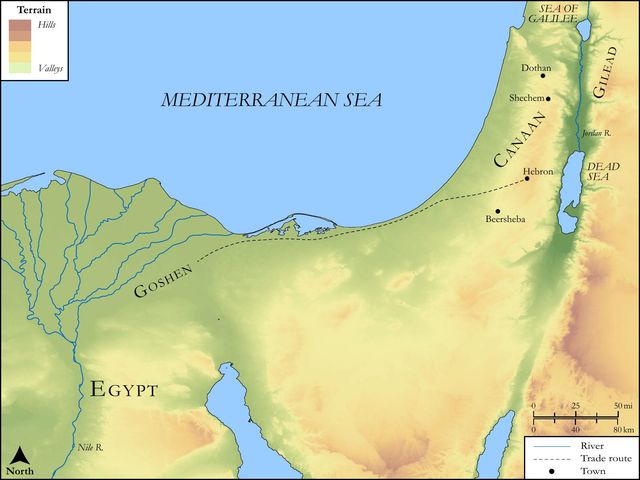
See on the biblical-era maps


Study this verse
Public-domain commentary
Matthew Henry
From his Commentary on the Whole Bible. Henry comments on passages, not single verses — this entry covers Genesis 50:22–26. His three-level outline is real structure in the source text, so it is rendered as structure.
Here is, I. The prolonging of Joseph's life in Egypt: he lived to be a hundred and ten years old, Gen 50:22. Having honoured his father, his days were long in the land which, for the present, God had given him; and it was a great mercy to his relations that God continued him so long, a support and comfort to them.
II.The building up of Joseph's family:
he lived to see his great-grand-children by both his sons (Gen 50:23), and probably he saw his two sons solemnly owned as heads of distinct tribes, equal to any of his brethren. It contributes much to the comfort of aged parents if they see their posterity in a flourishing condition, especially if with it they see peace upon Israel, Psa 128:6.
III.The last will and testament of Joseph published in the presence of his brethren, when he saw his death approaching.
Those that were properly his brethren perhaps were some of them dead before him, as several of them were older than he; but to those of them who yet survived, and to the sons of those who were gone, who stood up in their fathers' stead, he said this.
1.He comforted them with the assurance of their return to Canaan in due time: I die, but God will surely visit you, Gen 50:24. To this purport Jacob had spoken to him, Gen 48:21. Thus must we comfort others with the same comforts with which we ourselves have been comforted of God, and encourage them to rest on those promises which have been our support. Joseph was, under God, both the protector and the benefactor of his brethren; and what would become of them now that he was dying? Why, let this be their comfort, God will surely visit you. Note, God's gracious visits will serve to make up the loss of our best friends. They die; but we may live, and live comfortably, if we have the favour and presence of God with us. He bids them be confident: God will bring you out of this land, and therefore,
(1.)They must not hope to settle there, nor look upon it as their rest for ever; they must set their hearts upon the land of promise, and call that their home.
(2.)They must not fear sinking, and being ruined there; probably he foresaw the ill usage they would meet with there after his death, and therefore gives them this word of encouragement: "God will bring you in triumph out of this land at last." Herein he has an eye to the promise, Gen 15:13, Gen 15:14, and, in God's name, assures them of the performance of it.
2.For a confession of his own faith, and a confirmation of theirs, he charges them to keep him unburied till that day, that glorious day, should come, when they should be settled in the land of promise, v. 25. He makes them promise him with an oath that they would bury him in Canaan. In Egypt they buried their great men very honourably and with abundance of pomp; but Joseph prefers a significant burial in Canaan, and that deferred too almost 200 years, before a magnificent one in Egypt. Thus Joseph, by faith in the doctrine of the resurrection and the promise of Canaan, gave commandment concerning his bones, Heb 11:22. He dies in Egypt; but lays his bones at stake that God will surely visit Israel, and bring them to Canaan.
IV.The death of Joseph, and the reservation of his body for a burial in Canaan, Gen 50:26.
He was put in a coffin in Egypt, but not buried till his children had received their inheritance in Canaan, Jos 24:32. Note,
1.If the separate soul, at death, do but return to its rest with God, the matter is not great though the deserted body find not at all, or not quickly, its rest in the grave.
2.Yet care ought to be taken of the dead bodies of the saints, in the belief of their resurrection; for there is a covenant with the dust, which shall be remembered, and a commandment is given concerning the bones.
Continue studying Genesis 50:24 across the web’s major study libraries — every link below opens this exact verse, chapter, or book on the destination site.
Read & Compare
 BibleGatewayThis verse in more than 200 translations and 70 languages.
 Bible.comThe YouVersion reader — hundreds of translations, reading plans, and highlights.
 ESV.orgCrossway's official English Standard Version reader.
 NET BibleThe NET translation with 60,000+ translators' notes on every rendering decision.
 STEP BibleTyndale House's free study tool — original text, vocabulary, and scholarly resources.
 BibliaLogos Bible Software's free web reader.
 USCCBThe New American Bible (Revised Edition) with the U.S. bishops' study notes.
Commentaries
 BibleHub CommentariesDozens of classic commentaries on this verse, gathered on one page.
 StudyLightMore than 100 commentary sets — the largest collection on the web.
 BibleRefPlain-English commentary on what this verse means, verse by verse.
 Enduring WordDavid Guzik's free commentary on this chapter, widely used by Bible teachers.
 Bible Study ToolsVerse commentary alongside Greek and Hebrew study aids.
Original Language & Research
- BibleHub InterlinearThe verse word by word — original language, transliteration, and English.
- BibleHub LexiconEvery word's original-language definition and Strong's entry.
 Blue Letter BibleDeep-study tools — Strong's numbers, concordance, and word studies.
 SefariaThe Hebrew text with Rashi and centuries of Jewish commentary.
Sermons, Hymns & Audio


TrulyRandomVerse is not affiliated with these sites and doesn’t control their content. They’re linked because they’re genuinely useful.
Summary
Joseph's final words to his brothers in Genesis 50:24 serve as a profound testament to his unwavering faith and a powerful prophetic assurance. Despite his impending death and their comfortable, albeit temporary, sojourn in Egypt, Joseph declares with certainty that God will faithfully "visit" them—intervening purposefully and powerfully—to fulfill His ancient, unshakeable covenant promise to Abraham, Isaac, and Jacob by delivering their descendants from Egypt and bringing them into the promised land of Canaan.
Context
ShowHideLiterary Context
Genesis 50:24 occurs at the very end of the book of Genesis, serving as Joseph's final testament and a pivotal bridge to the book of Exodus. Following the death and burial of Jacob, Joseph reassures his brothers of his forgiveness and God's providential care (Genesis 50:15-21). His dying words then shift the narrative focus from the family's present comfort and security in Goshen to the future fulfillment of God's covenant promises. This statement, coupled with his request for his bones to be carried out of Egypt (Genesis 50:25), underscores the provisional nature of their stay in Egypt and points firmly towards their ultimate destiny in the Promised Land. It is a final act of faith and a prophetic declaration that sets the stage for the dramatic events of the Exodus.
Historical & Cultural Context
At the time of Joseph's death, the Israelites had been living in Egypt for decades, enjoying prosperity and protection under Joseph's influence. This period of peace, however, was a temporary phase in God's larger redemptive plan. In the ancient Near East, deathbed pronouncements often carried significant weight, serving as final blessings, instructions, or prophecies for the family's future. Joseph's declaration aligns with this tradition, providing a crucial spiritual anchor for his family. The concept of a "promised land" was central to the identity and hope of the patriarchal families, rooted in God's sworn oaths. Joseph's words would have resonated deeply with a people who, despite their current comfort, understood their true inheritance lay elsewhere, in the land promised to their forefathers.
Key Themes
ShowHideThis verse powerfully encapsulates several overarching themes found throughout Genesis and the Pentateuch. Foremost is the theme of God's Covenant Faithfulness, demonstrating His unwavering commitment to the promises made to Abraham, Isaac, and Jacob. It highlights Divine Sovereignty and Providence, showing God's active orchestration of history, even through periods of hardship and long waiting, to bring His purposes to fruition. Joseph's words also exemplify Faith in the Unseen, as he trusts God's future action beyond his own lifetime and current circumstances, echoing the faith of the patriarchs described in Hebrews 11. Finally, it underscores the Generational Continuity of God's Plan, where promises made to one generation are carried forward and fulfilled in subsequent ones, linking the patriarchal narratives to the future nation of Israel and the Exodus.
Exposition and Analysis
ShowHideKey Word Analysis
ShowHideThis plural form, used here with a singular verb, refers specifically to the supreme God, the Creator and Covenant-Keeper. Its use here emphasizes the ultimate divine authority and power behind the promise, assuring that it is not merely Joseph's wish but a decree from the sovereign Lord who is mighty and exceeding in His ability to fulfill His word.
Joseph's stark declaration "I die" uses a primitive root meaning "to die" literally. This acknowledgment of his own mortality serves as a powerful contrast to the enduring, living God who "will surely visit" them. It highlights the fleeting nature of human life and leadership versus the eternal, unchanging faithfulness of God, who transcends generations and individual lives to bring His purposes to pass.
This verb is crucial. While it can mean to inspect or punish, in this context, it signifies God's attentive, purposeful, and redemptive intervention. It implies God will "attend to," "care for," and actively "muster" or "charge" Himself with their deliverance. The doubling of the verb (a Hebrew idiom for emphasis, "surely visit") underscores the certainty and intentionality of God's future action, pointing directly to the powerful divine intervention that would lead to the Exodus.
Derived from a root meaning "to seven oneself," implying a complete or binding declaration, this word refers to God's solemn oath or covenant. The use of "sware" emphasizes the absolute, unbreakable nature of God's promise to Abraham, Isaac, and Jacob regarding the land. It highlights that the land promise is not a mere suggestion but a divinely guaranteed commitment, sealed by God's own integrity and faithfulness.
Verse Breakdown
ShowHide"And Joseph said unto his brethren, I die:"
Joseph, now aged 110, acknowledges his impending death, a natural end to his remarkable life. This personal statement of mortality serves as a poignant setup for the greater, eternal truth he is about to declare, shifting the focus from his own finite existence to God's infinite faithfulness.
"and God will surely visit you,"
This is the core of Joseph's prophecy. The emphatic Hebrew construction "surely visit" (פקד יפקד, paqod yipqod) underscores the absolute certainty and intentionality of God's future intervention. It is a promise that God will not forget them but will actively and powerfully intervene on their behalf, a divine visitation for deliverance and fulfillment of His promises.
"and bring you out of this land"
This clause specifies the nature of God's "visitation"—it will involve a physical exodus. "This land" refers to Egypt, where they had prospered but which was not their ultimate inheritance. This foreshadows the dramatic liberation from Egyptian bondage that would occur centuries later under Moses.
"unto the land which he sware to Abraham, to Isaac, and to Jacob."
This final phrase grounds Joseph's prophecy firmly in the foundational covenant promises made to the patriarchs. The "land" refers to Canaan, the Promised Land. By invoking the names of Abraham, Isaac, and Jacob, Joseph reminds his brothers that their future deliverance is not a new idea but the culmination of a divine oath, a sacred commitment passed down through generations, ensuring God's faithfulness to His ancestral covenant.
Literary Devices
ShowHideThe passage employs several significant literary devices. Prophecy is central, as Joseph's dying words foretell a future event—the Exodus—that would occur centuries later. This highlights God's omniscience and His ability to reveal and bring about His plans across vast spans of time. The phrase "God will surely visit you" uses an emphatic verbal construction (an infinitive absolute followed by a finite verb, paqod yipqod), which serves as a powerful form of Emphasis, underscoring the absolute certainty and divine resolve behind God's promise. There is also clear Covenant Language, particularly in the reference to the land "which he sware to Abraham, to Isaac, and to Jacob," directly echoing the foundational promises of the Abrahamic Covenant. Finally, the entire statement functions as Foreshadowing, setting the narrative stage for the book of Exodus and the subsequent history of Israel's journey to the Promised Land, demonstrating the continuity of God's redemptive plan throughout salvation history.
Theological and Thematic Connections
ShowHideJoseph's final prophecy is a profound declaration of God's unwavering covenant faithfulness. It underscores that God's promises are not contingent on human circumstances or even the death of key figures, but on His own immutable character and sovereign will. Despite the comfort and security the Israelites enjoyed in Egypt, Joseph directs their gaze beyond their immediate prosperity to God's ultimate design—their return to the land promised to their forefathers. This passage powerfully illustrates divine providence, showing God's active hand in orchestrating history, preparing a people for their inheritance, and ensuring that His sworn word will be fulfilled, no matter how long the wait or how challenging the intervening circumstances. It serves as a timeless reminder that God's plan is generational, transcending individual lives and extending through the ages to accomplish His redemptive purposes.
Reflection and Application
ShowHideJoseph's dying declaration in Genesis 50:24 offers immense encouragement and a vital lesson for believers today. It calls us to cultivate a steadfast, long-sighted faith that trusts in God's promises even when their fulfillment seems distant, unlikely, or when our current circumstances, though comfortable, are not His ultimate destination for us. Like Joseph, we are to live with an awareness that our present dwelling place might be temporary, and our true inheritance lies in God's ultimate plan. This passage challenges us to look beyond immediate gratification or security and to anchor our hope in God's eternal faithfulness. It assures us that God "visits" His people—He actively intervenes, cares, and orchestrates events to bring His purposes to fruition in His perfect timing. Our faith, therefore, should extend beyond our own lifetime, trusting that God will complete the good work He has begun, not just in our lives but also in the grand narrative of His redemptive plan for the world.
Questions for Reflection
ShowHideFAQ
ShowHideWhat does Joseph mean by "God will surely visit you"?
ShowHideThe Hebrew phrase "surely visit" (פקד יפקד, paqod yipqod) uses the verb paqad emphatically. In this context, it signifies God's active, purposeful, and redemptive intervention on behalf of His people. It means God will attend to their needs, remember His covenant, and come to deliver and fulfill His promises. It is a direct prophecy of the future Exodus from Egypt, where God would indeed "visit" them with mighty acts of salvation.
Why was Joseph's request about his bones so significant?
ShowHideJoseph's request in Genesis 50:25 that his bones be carried out of Egypt and buried in the Promised Land was a profound, tangible expression of his unwavering faith. It demonstrated his conviction that God would indeed fulfill His covenant promise to bring Israel into Canaan, even if it happened long after his death. This act served as a constant, physical reminder to his descendants of their ultimate destination and God's faithfulness. It was a testament that their true home was not in Egypt, but in the land God had sworn to their forefathers, a request faithfully honored by Moses during the Exodus.
Christ-Centered Fulfillment
ShowHideJoseph's prophecy of God's "visitation" and the ultimate return to the promised land finds its most profound and ultimate fulfillment in the person and work of Jesus Christ. While the Exodus brought physical deliverance to a physical land, Christ's advent is the supreme "visitation" of God to humanity, the very embodiment of God dwelling among His people (John 1:14). He is the true and ultimate "land" of spiritual rest and eternal inheritance for all believers, fulfilling all of God's covenant promises, for "in Him every one of God's promises is a 'Yes'" (2 Corinthians 1:20). Through His sacrificial death and glorious resurrection, Christ secures not merely an earthly inheritance but an eternal one, a heavenly country (Hebrews 11:16), establishing a new and better covenant (Hebrews 8:6). Just as Joseph's bones pointed to a future hope, Christ's resurrection is the guarantee of our future resurrection and our eternal dwelling with God in the true Promised Land, the New Heavens and New Earth (Revelation 21:1-4).