


Genesis 50:26
Bible text: King James Version (1769 Blayney text) · Public domain
Bible text: Berean Standard Bible · Public domain
Bible text: American Standard Version (1901) · Public domain
Bible text: World English Bible, Messianic edition · Public domain
Bible text: Geneva Bible (1599) · Public domain
Bible text: Young's Literal Translation · Public domain
- וַיָּמָתvai·Ya·motand he diedH4191Conj-w ¦ V-Qal-ConsecImperf-3msVerb Qal Consecutive Imperfect 3rd Singular Masculineוַandיָּמָתhe died
- יוֹסֵףyo·SefJosephH3130N-proper-mNoun Proper Masculine
- בֶּןbena son ofH1121N-mscNoun Singular Masculine Construct
- מֵאָהme·'Ahone hundredH3967Adj-fsAdjective Numerical Singular Feminine Absolute
- וָעֶשֶׂרva·'E·serand tenH6235Conj-w ¦ N-msNoun Singular Masculine Absoluteוָandעֶשֶׂרten
- שָׁנִיםsha·NimyearsH8141N-mpNoun Plural Masculine Absolute
- וַיַּחַנְטוּvai·ya·chan·Tuand people embalmedH2590Conj-w ¦ V-Qal-ConsecImperf-3mpVerb Qal Consecutive Imperfect 3rd Plural Masculineוַandיַּחַנְטוּpeople embalmed
- אֹתוֹ'o·To<obj.> himH853DirObjM ¦ 3msParticle Object Indicatorאֹת<obj.>וֹhim
- וַיִּישֶׂםvai·Yi·semand he was putH3455Conj-w ¦ V-Qal-ConsecImperf-3msVerb Qal Consecutive Imperfect 3rd Singular Masculineוַandיִּישֶׂםhe was put
- בָּאָרוֹןba·'a·Ronin the coffinH727Prep-b ¦ N-msNoun Singular Masculine Absoluteבָּin theאָרוֹןcoffin
- בְּמִצְרָיִםbe·mitz·Ra·yimin EgyptH4714Prep-b ¦ N-properNoun Proper LocationבְּinמִצְרָיִםEgypt
English is a literal word-by-word gloss of the Hebrew, not the KJV's wording. Why?
This is the original text the KJV's translators worked from — each Hebrew word with its own literal English meaning in this verse, prepared by scholars at Tyndale House, Cambridge. The KJV translates whole sentences, not word by word, so its wording differs: one Hebrew word can become several English words, and the KJV may choose “the LORD” where the gloss reads “Yahweh”. Both are faithful — they answer different questions. For the KJV's own rendering, switch to the KJV text.
Details
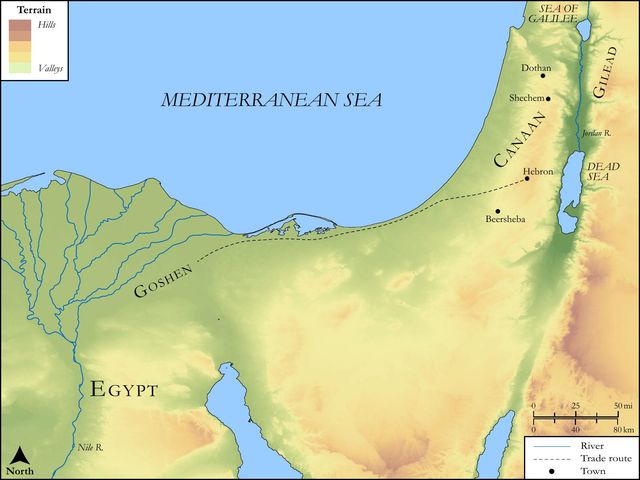
See on the biblical-era maps


Study this verse
Public-domain commentary
Matthew Henry
From his Commentary on the Whole Bible. Henry comments on passages, not single verses — this entry covers Genesis 50:22–26. His three-level outline is real structure in the source text, so it is rendered as structure.
Here is, I. The prolonging of Joseph's life in Egypt: he lived to be a hundred and ten years old, Gen 50:22. Having honoured his father, his days were long in the land which, for the present, God had given him; and it was a great mercy to his relations that God continued him so long, a support and comfort to them.
II.The building up of Joseph's family:
he lived to see his great-grand-children by both his sons (Gen 50:23), and probably he saw his two sons solemnly owned as heads of distinct tribes, equal to any of his brethren. It contributes much to the comfort of aged parents if they see their posterity in a flourishing condition, especially if with it they see peace upon Israel, Psa 128:6.
III.The last will and testament of Joseph published in the presence of his brethren, when he saw his death approaching.
Those that were properly his brethren perhaps were some of them dead before him, as several of them were older than he; but to those of them who yet survived, and to the sons of those who were gone, who stood up in their fathers' stead, he said this.
1.He comforted them with the assurance of their return to Canaan in due time: I die, but God will surely visit you, Gen 50:24. To this purport Jacob had spoken to him, Gen 48:21. Thus must we comfort others with the same comforts with which we ourselves have been comforted of God, and encourage them to rest on those promises which have been our support. Joseph was, under God, both the protector and the benefactor of his brethren; and what would become of them now that he was dying? Why, let this be their comfort, God will surely visit you. Note, God's gracious visits will serve to make up the loss of our best friends. They die; but we may live, and live comfortably, if we have the favour and presence of God with us. He bids them be confident: God will bring you out of this land, and therefore,
(1.)They must not hope to settle there, nor look upon it as their rest for ever; they must set their hearts upon the land of promise, and call that their home.
(2.)They must not fear sinking, and being ruined there; probably he foresaw the ill usage they would meet with there after his death, and therefore gives them this word of encouragement: "God will bring you in triumph out of this land at last." Herein he has an eye to the promise, Gen 15:13, Gen 15:14, and, in God's name, assures them of the performance of it.
2.For a confession of his own faith, and a confirmation of theirs, he charges them to keep him unburied till that day, that glorious day, should come, when they should be settled in the land of promise, v. 25. He makes them promise him with an oath that they would bury him in Canaan. In Egypt they buried their great men very honourably and with abundance of pomp; but Joseph prefers a significant burial in Canaan, and that deferred too almost 200 years, before a magnificent one in Egypt. Thus Joseph, by faith in the doctrine of the resurrection and the promise of Canaan, gave commandment concerning his bones, Heb 11:22. He dies in Egypt; but lays his bones at stake that God will surely visit Israel, and bring them to Canaan.
IV.The death of Joseph, and the reservation of his body for a burial in Canaan, Gen 50:26.
He was put in a coffin in Egypt, but not buried till his children had received their inheritance in Canaan, Jos 24:32. Note,
1.If the separate soul, at death, do but return to its rest with God, the matter is not great though the deserted body find not at all, or not quickly, its rest in the grave.
2.Yet care ought to be taken of the dead bodies of the saints, in the belief of their resurrection; for there is a covenant with the dust, which shall be remembered, and a commandment is given concerning the bones.
Historical interpretation
Historical reception
1 surviving comment on this verse from the historical church.
The text goes on: “Joseph passed away at one hundred and ten.” Why did it indicate to us his age too? For you to learn how long he had been entrusted with the control of Egypt. He was seventeen when he went down to Egypt, and it was when he reached the age of thirty that he appeared before Pharaoh and interpreted his dreams. Joseph then held complete control of Egypt for eighty years. Do you see how the rewards were greater than the hardships and the recompense manifold? For thirteen years he struggled with temptations, suffering servitude, that illicit accusation, ill treatment in prison. Since he nobly bore everything with thankfulness, accordingly he attained generous rewards even in the present life. Consider, after all, I ask you, that as a result of that short period that he endured servitude and imprisonment Joseph occupied a royal position for eighty years. For proof that it was by faith that he did all this and for the same motive gave directions about the transfer of his bones, listen to Paul’s words: “It was by faith that at the point of death Joseph gave a reminder about the exodus of the sons of Israel.”
Continue studying Genesis 50:26 across the web’s major study libraries — every link below opens this exact verse, chapter, or book on the destination site.
Read & Compare
 BibleGatewayThis verse in more than 200 translations and 70 languages.
 Bible.comThe YouVersion reader — hundreds of translations, reading plans, and highlights.
 ESV.orgCrossway's official English Standard Version reader.
 NET BibleThe NET translation with 60,000+ translators' notes on every rendering decision.
 STEP BibleTyndale House's free study tool — original text, vocabulary, and scholarly resources.
 BibliaLogos Bible Software's free web reader.
 USCCBThe New American Bible (Revised Edition) with the U.S. bishops' study notes.
Commentaries
 BibleHub CommentariesDozens of classic commentaries on this verse, gathered on one page.
 StudyLightMore than 100 commentary sets — the largest collection on the web.
 BibleRefPlain-English commentary on what this verse means, verse by verse.
 Enduring WordDavid Guzik's free commentary on this chapter, widely used by Bible teachers.
 Bible Study ToolsVerse commentary alongside Greek and Hebrew study aids.
Original Language & Research
- BibleHub InterlinearThe verse word by word — original language, transliteration, and English.
- BibleHub LexiconEvery word's original-language definition and Strong's entry.
 Blue Letter BibleDeep-study tools — Strong's numbers, concordance, and word studies.
 SefariaThe Hebrew text with Rashi and centuries of Jewish commentary.
Sermons, Hymns & Audio


TrulyRandomVerse is not affiliated with these sites and doesn’t control their content. They’re linked because they’re genuinely useful.
Summary
Genesis 50:26 brings the foundational book of the Bible to a poignant close, detailing the death of Joseph at the venerable age of 110, his subsequent embalming, and his placement in a coffin in Egypt. This final verse not only marks the end of the patriarchal era but also serves as a powerful testament to Joseph's enduring faith in God's covenant promises, setting the stage for the unfolding narrative of Israel's sojourn and eventual exodus from Egypt.
Context
ShowHideLiterary Context
Genesis 50:26 serves as the concluding verse of the entire Book of Genesis, providing a definitive end to the patriarchal narratives that began with Abraham in Genesis 12. Following the reconciliation of Joseph with his brothers, the blessing of Jacob's sons, and Jacob's death and burial in Canaan, this verse shifts the focus back to Joseph, whose life has dominated the latter portion of Genesis from Genesis 37 onwards. It acts as a bridge, concluding the story of the patriarchs while simultaneously foreshadowing the long period of Israelite sojourn in Egypt and their eventual deliverance, which will be the central theme of the subsequent book, Exodus. The verse directly follows Joseph's final instructions to his brothers, recorded in Genesis 50:25, where he makes them swear an oath to carry his bones out of Egypt when God visits them to bring them to the Promised Land.
Historical & Cultural Context
The practice of embalming and placing the deceased in a coffin was deeply rooted in ancient Egyptian funerary customs, reflecting their elaborate beliefs about the afterlife and the preservation of the body for eternity. Given Joseph's elevated status as vizier, second only to Pharaoh, his embalming would have been a meticulous and prestigious process, likely taking up to 70 days, as was typical for high-ranking officials. This act, though Egyptian in custom, was performed on a Hebrew patriarch, highlighting the unique position Joseph held within Egyptian society. The mention of "Egypt" as the place of his burial underscores the reality that the nascent nation of Israel was now firmly established within this foreign land, preparing for a long period of growth before their divine liberation.
Key Themes
ShowHideThis concluding verse encapsulates several key themes woven throughout Genesis. Firstly, it underscores the theme of God's Enduring Providence and Sovereignty, demonstrating how God meticulously orchestrates events, even death, to fulfill His long-term plans for His people. Joseph's life, marked by suffering, elevation, and leadership, consistently showcased God's hand at work, turning evil into good (Genesis 50:20). Secondly, it powerfully illustrates Joseph's Unwavering Faith and Hope in God's covenant promises. Despite his success and integration into Egyptian society, Joseph's final request to be buried in Canaan, as recorded in Genesis 50:25, reveals his spiritual allegiance to the land promised to Abraham, Isaac, and Jacob (Genesis 15:18-21). This act of faith, looking beyond his earthly dwelling to a future inheritance, is later commended in Hebrews 11:22. Finally, the verse marks the Transition from Patriarchal Narratives to National Identity, signaling the end of the individual family stories and the impending emergence of Israel as a distinct nation, poised for the Exodus.
Exposition and Analysis
ShowHideKey Word Analysis
ShowHideFrom the root meaning "let him add," Joseph (H3130) is the name of the central figure in the latter half of Genesis. His name is prophetic of his life's trajectory, as God continually "added" blessing, wisdom, and responsibility to him, culminating in his role as a preserver of life for his family and for Egypt. His death marks the end of an era defined by his extraordinary life and divine favor.
This primitive root (H4191) signifies "to die" literally or figuratively, or causatively "to kill." In this context, it marks the physical cessation of life for Joseph. The simplicity of the word belies the profound significance of his passing, bringing to a close a life that exemplified divine providence and human faithfulness.
This primitive root (H2590) means "to spice," "to embalm," or "to ripen." Here, it specifically refers to the process of mummification, a highly specialized and ceremonial practice in ancient Egypt. Joseph's embalming signifies the immense honor and respect accorded to him by the Egyptians, reflecting his unparalleled status as vizier, while also serving the practical purpose of preserving his body until its eventual removal to Canaan.
This word (H727) refers to a "box," "chest," or "ark." While commonly translated "coffin" here, it is notably the same Hebrew word used for the Ark of the Covenant, a sacred container. This linguistic choice might subtly elevate the significance of Joseph's resting place, hinting at his enduring importance within God's covenant plan, even in death.
Verse Breakdown
ShowHide"So Joseph died, [being] an hundred and ten years old:"
This clause states the definitive end of Joseph's earthly life and his age at death. The age of 110 years was considered an ideal and blessed lifespan in ancient Egypt, often associated with a full and prosperous life. For Joseph, this longevity underscores God's sustained favor and blessing throughout his remarkable journey, from slavery to second-in-command of Egypt. It signifies a life fully lived in God's providence, culminating in peace and the completion of his earthly purpose.
"and they embalmed him,"
This phrase describes the act of mummification performed on Joseph's body. As the vizier of Egypt, Joseph would have received the most elaborate and respectful embalming process, involving a lengthy procedure (up to 70 days) to preserve his body. This practice, though Egyptian in origin, was crucial for Joseph's specific request: to have his bones preserved until they could be carried out of Egypt to the Promised Land, as he had commanded his brothers in Genesis 50:25.
"and he was put in a coffin in Egypt."
This final clause specifies the immediate resting place for Joseph's preserved body. The use of the Hebrew word 'arōn (coffin/ark) for his container is significant, subtly elevating its status. While his body remained in Egypt, this placement was temporary, a testament to his faith that God would indeed "visit" His people and lead them out. This act of faith, looking beyond his death to the fulfillment of God's promises, is later celebrated in Hebrews 11:22, and his bones were indeed carried out by Moses nearly four centuries later, as recorded in Exodus 13:19.
Literary Devices
ShowHideThe verse employs several literary devices to convey its profound message. Foreshadowing is prominent, as Joseph's temporary burial in Egypt, with the explicit instruction for his bones to be carried out, powerfully anticipates the future Exodus of the Israelites from Egypt. This act sets the stage for the next major phase of God's redemptive plan. There is also a subtle irony in Joseph, a man who became the savior of Egypt, choosing not to be permanently buried in the land where he achieved such greatness, but rather to await transport to the land of promise, demonstrating his true allegiance. Furthermore, the use of the word 'arōn for "coffin" carries symbolism, as it is the same term used for the sacred Ark of the Covenant. This linguistic choice subtly imbues Joseph's coffin with a sense of importance and sacredness, underscoring his pivotal role in the unfolding divine narrative and his connection to God's covenant promises, even in death.
Theological and Thematic Connections
ShowHideGenesis 50:26 serves as a powerful theological capstone to the book, marking the end of the patriarchal era and the definitive establishment of Israel within Egypt, setting the stage for their growth into a nation and their eventual exodus. Joseph's death, though a natural end to a remarkable life, is imbued with profound spiritual significance, primarily highlighting his unwavering faith in God's covenant promises to Abraham, Isaac, and Jacob regarding the land of Canaan. Despite his immense power and prestige in Egypt, Joseph's final request to have his bones carried out of Egypt when God "visits" His people demonstrates his conviction that Egypt was not their permanent home, and God's faithfulness would ultimately lead them to their promised inheritance. This act of faith underscores God's meticulous providence, working through generations to fulfill His redemptive plan, ensuring that His people, though seemingly settled in a foreign land, remained focused on their ultimate destiny.
Reflection and Application
ShowHideJoseph's death and temporary burial in Egypt, coupled with his unwavering faith in God's future deliverance of his people, offer profound lessons for believers today. We are called to live with a steadfast hope in God's promises, even when their full realization seems distant or when our circumstances appear contrary to His plan. Joseph's legacy extends beyond his lifetime, demonstrating that our actions, faithfulness, and witness can have a lasting impact across generations, testifying to God's enduring faithfulness. Furthermore, the centuries-long delay in Joseph's bones reaching the Promised Land highlights God's perfect timing and sovereignty; He works out His purposes in His own way and time, often over long periods, requiring patience, trust, and an eternal perspective from His people. We, too, are often called to live in a "foreign land" (this world) while our true home and inheritance await. Joseph's example encourages us to live with an eternal perspective, trusting that God will bring all His promises to fruition in His perfect timing, even if we do not see their full realization in our lifetime. Our faith, like Joseph's, should anchor us to God's future plans, not merely our present circumstances.
Questions for Reflection
ShowHideFAQ
ShowHideWhy was Joseph embalmed if he was a Hebrew, not an Egyptian?
ShowHideJoseph was embalmed primarily due to his exceptionally high status as the vizier of Egypt. While embalming was a distinct Egyptian practice, it was a profound sign of honor and respect bestowed upon him by the Egyptians, reflecting his immense contribution to their nation. Furthermore, Joseph's embalming served a crucial practical and theological purpose for his family: it preserved his body until the time came for his bones to be carried out of Egypt to the Promised Land, as he had commanded in Genesis 50:25. This preservation was a testament to his faith in God's future deliverance of Israel.
What is the significance of Joseph's age at death, 110 years old?
ShowHideIn ancient Egyptian culture, 110 years was considered the ideal lifespan, a symbol of a complete, blessed, and prosperous life, often associated with divine favor and wisdom. For Joseph, this age signifies that he lived a full and divinely purposed life, marked by extraordinary trials and triumphs, culminating in peace. His longevity underscores God's blessing and faithfulness throughout his journey, affirming that he died having seen God's faithfulness to his family and the initial stages of the covenant promise to make them a great nation.
Christ-Centered Fulfillment
ShowHideJoseph's death, temporary burial in Egypt, and the anticipation of his bones being carried to the Promised Land powerfully foreshadow the death, burial, and resurrection of Jesus Christ, and the ultimate hope of believers. Joseph's faith in a future deliverance for his people, even beyond his own life, points to Christ's ultimate work of delivering humanity from the bondage of sin and death through His atoning sacrifice on the cross (Romans 5:8). Just as Joseph's body lay in a coffin in Egypt, a temporary resting place, awaiting a journey to the promised inheritance, Christ's body lay in the tomb, a temporary resting place, before His glorious resurrection on the third day (1 Corinthians 15:3-4). His resurrection secured for all who believe their eternal inheritance in the true Promised Land—heaven, the new heavens and new earth (Revelation 21:1-4). Joseph's story is a testament to God's faithfulness to His covenant promises, culminating in Christ, who is the ultimate fulfillment of all promises (2 Corinthians 1:20), leading His people from spiritual bondage to their eternal home with Him.