


Joshua 24:29
Bible text: King James Version (1769 Blayney text) · Public domain
Bible text: Berean Standard Bible · Public domain
Bible text: American Standard Version (1901) · Public domain
Bible text: World English Bible, Messianic edition · Public domain
Bible text: Geneva Bible (1599) · Public domain
Bible text: Young's Literal Translation · Public domain
- וַיְהִיvay·Hiand it wasH1961Conj-w ¦ V-Qal-ConsecImperf-3msVerb Qal Consecutive Imperfect 3rd Singular Masculineוַandיְהִיit was
- אַחֲרֵי'a·cha·ReiafterH310Adj-mpcAdjective Numerical Plural Masculine Construct
- הַדְּבָרִיםha·de·va·Rimthe thingsH1697Art ¦ N-mpNoun Plural Masculine Absoluteהַtheדְּבָרִיםthings
- הָאֵלֶּהha·'E·leh<the> theseH428Art ¦ PrtParticle Demonstrativeהָ<the>אֵלֶּהthese
- וַיָּמָתvai·Ya·motand he diedH4191Conj-w ¦ V-Qal-ConsecImperf-3msVerb Qal Consecutive Imperfect 3rd Singular Masculineוַandיָּמָתhe died
- יְהוֹשֻׁעַye·ho·Shu·a'JoshuaH3091N-proper-mNoun Proper Masculine
- בִּןbin[the] son ofH1121N-mscNoun Singular Masculine Construct
- נוּןnunNunH5126N-proper-mNoun Proper Masculine
- עֶבֶד'E·ved[the] servant ofH5650N-mscNoun Singular Masculine Construct
- יְהוָהYah·wehYahwehH3068N-properNoun Proper Title
- בֶּןbena son ofH1121N-mscNoun Singular Masculine Construct
- מֵאָהme·'Ahone hundredH3967Adj-fsAdjective Numerical Singular Feminine Absolute
- וָעֶשֶׂרva·'E·serand tenH6235Conj-w ¦ N-msNoun Singular Masculine Absoluteוָandעֶשֶׂרten
- שָׁנִיםsha·NimyearsH8141N-mpNoun Plural Masculine Absolute
English is a literal word-by-word gloss of the Hebrew, not the KJV's wording. Why?
This is the original text the KJV's translators worked from — each Hebrew word with its own literal English meaning in this verse, prepared by scholars at Tyndale House, Cambridge. The KJV translates whole sentences, not word by word, so its wording differs: one Hebrew word can become several English words, and the KJV may choose “the LORD” where the gloss reads “Yahweh”. Both are faithful — they answer different questions. For the KJV's own rendering, switch to the KJV text.
Details
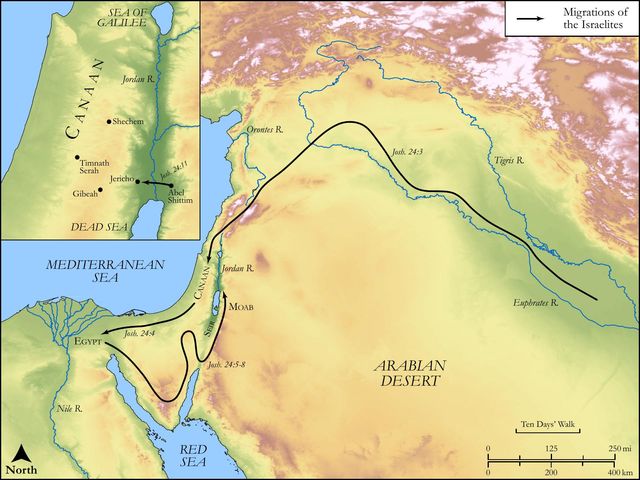
See on the biblical-era map
Study this verse
Public-domain commentary
Matthew Henry
From his Commentary on the Whole Bible. Henry comments on passages, not single verses — this entry covers Joshua 24:29–33.
This book, which began with triumphs, here ends with funerals, by which all the glory of man is stained. We have here 1. The burial of Joseph, Jos 24:32. He died about 200 years before in Egypt, but gave commandment concerning his bones, that they should not rest in their grave until Israel had rest in the land of promise; now therefore the children of Israel, who had brought this coffin full of bones with them out of Egypt, carried it along with them in all their marches through the wilderness (the two tribes of Ephraim and Manasseh, it is probable, taking particular care of it), and kept it in their camp till Canaan was perfectly reduced, now at last they deposited it in that piece of ground which his father gave him near Shechem, Gen 48:22. Probably it was upon this occasion that Joshua called for all Israel to meet him at Shechem (v. 1), to attend Joseph's coffin to the grave there, so that the sermon in this chapter served both for Joseph's funeral sermon and his own farewell sermon; and if it was, as is supposed, in the last year of his life, the occasion might very well remind him of his own death being at hand, for he was not just at the same age that his illustrious ancestor Joseph had arrived at when he died, 110 years old; compare Jos 24:29 with Gen 50:26. 2. The death and burial of Joshua, Jos 24:29, Jos 24:30. We are not told how long he lived after the coming of Israel into Canaan. Dr. Lightfoot thinks it was about seventeen years; but the Jewish chronologers generally say it was about twenty-seven or twenty-eight years. He is here called the servant of the Lord, the same title that was given to Moses (Jos 1:1) when mention was made of his death; for, though Joshua was in many respects inferior to Moses, yet in this he was equal to him, that, according as his work was, he approved himself a diligent and faithful servant of God. And he that traded with his two talents had the same approbation that he had who traded with his five. Well done, good and faithful servant. Joshua's burying-place is here said to be on the north side of the hill Gaash, or the quaking hill; the Jews say it was so called because it trembled at the burial of Joshua, to upbraid the people of Israel with their stupidity in that they did not lament the death of that great and good man as they ought to have done. Thus at the death of Christ, our Joshua, the earth quaked. The learned bishop Patrick observes that there is no mention of any days of mourning being observed for Joshua, as there were for Moses and Aaron, in which, he says, St. Hierom and others of the fathers think there is a mystery, namely, that under the law, when life and immortality were not brought to so clear a light as they are now, they had reason to mourn and weep for the death of their friends; but now that Jesus, our Joshua, has opened the kingdom of heaven, we may rather rejoice. 3. The death and burial of Eleazar the chief priest, who, it is probable, died about the same time that Joshua did, as Aaron in the same year with Moses, Jos 24:33. The Jews say that Eleazar, a little before he died, called the elders together, and gave them a charge as Joshua had done. He was buried in a hill that pertained to Phinehas his son, which came to him, not by descent, for then it would have pertained to his father first, nor had the priests any cities in Mount Ephraim, but either it fell to him by marriage, as the Jews conjecture, or it was freely bestowed upon him, to build a country seat on, by some pious Israelite that was well-affected to the priesthood, for it is here said to have been given him; and there he buried his dear father. 4. A general idea given us of the state of Israel at this time, Jos 24:31. While Joshua lived, religion was kept up among them under his care and influence; but soon after he and his contemporaries died it went to decay, so much oftentimes does one head hold up: how well is it for the gospel church that Christ, our Joshua, is still with it, by his Spirit, and will be always, even unto the end of the world!
Historical interpretation
Fourteen Centuries of Reception
2 surviving comments on this verse. Each one is dated, so this reads as a timeline rather than a list.
Select a marker to jump to its quote. Markers stagger vertically where authors wrote within a few decades of each other.
But it is now time for us to raise the standard of Joshua’s chastity. It is written that Moses had a wife. … We read that Moses, that is, the law, had a wife; show me then in the same way that Joshua the son of Nun had either wife or children, and if you can do so, I will confess that I am beaten. He certainly received the fairest spot in the division of the land of Judah and died, not in the twenties, which are ever unlucky in Scripture—by them are reckoned the years of Jacob’s service, the price of Joseph, and sundry presents which Esau who was fond of them received—but in the tens, whose praises we have often sung. And he was buried in Thamnath Sore, which means “most perfect sovereignty,” or “among those of a new covering,” to signify the crowds of virgins, covered by the Savior’s aid on Mount Ephraim, that is, the fruitful mountain; on the north of the Mountain of Gaash, which is interpreted “disturbance,” for “Mount Zion is on the sides of the north, the city of the Great King,” is ever exposed to hatred, and in every trial says “But my feet had nearly slipped.” The book which bears the name of Joshua ends with his burial. Again in the book of Judges we read of him as though he had risen and come to life again, and by way of summary his works are extolled. We read too: “So Joshua sent the people away, every man to his inheritance, that they might possess the land.” And “Israel served the Lord all the days of Joshua,” and so on. There immediately follows: “And Joshua the son of Nun, the servant of the Lord, died, being a hundred and ten years old.” Moses, moreover, only saw the land of promise; he could not enter, and “he died in the land of Moab, and the Lord buried him in the valley in the land of Moab over against Beth-peor: but no man knows of his sepulcher to this day.” Let us compare the burial of the two. Moses died in the land of Moab, Joshua in the land of Judea. The former was buried in a valley over against the house of Phogor, the translation of which is “reproach,” for the Hebrew Phogor corresponds to Priapus; the latter was buried in Mount Ephraim on the north of Mount Gaash. And in the simple expressions of the sacred Scriptures there is always a more subtle meaning. The Jews gloried in children and childbearing; and the barren woman, who had no offspring in Israel, was accursed; but blessed was he whose seed was in Zion, and his family in Jerusalem. And part of the highest blessing was, “Your wife shall be as a fruitful vine in the innermost parts of your house, your children like olive plants round about thy table.” Therefore his grave is described as placed in a valley over against the house of an idol which was in a special sense consecrated to lust. But we who fight under Joshua our leader, even to the present day, know not where Moses was buried. For we despise Phogor and all his shame, knowing that they who are in the flesh cannot please God. And the Lord before the flood had said, “My spirit shall not abide in man forever, because he is flesh.” For this reason, when Moses died, the people of Israel mourned for him, but Joshua, like one on his way to victory, was not mourned. For marriage ends at death; virginity thereafter begins to wear the crown.
And after: If Josue wrote this book, as is commonly believed, these last verses were added by Samuel, or some other prophet.
Continue studying Joshua 24:29 across the web’s major study libraries — every link below opens this exact verse, chapter, or book on the destination site.
Read & Compare
 BibleGatewayThis verse in more than 200 translations and 70 languages.
 Bible.comThe YouVersion reader — hundreds of translations, reading plans, and highlights.
 ESV.orgCrossway's official English Standard Version reader.
 NET BibleThe NET translation with 60,000+ translators' notes on every rendering decision.
 STEP BibleTyndale House's free study tool — original text, vocabulary, and scholarly resources.
 BibliaLogos Bible Software's free web reader.
 USCCBThe New American Bible (Revised Edition) with the U.S. bishops' study notes.
Commentaries
 BibleHub CommentariesDozens of classic commentaries on this verse, gathered on one page.
 StudyLightMore than 100 commentary sets — the largest collection on the web.
 BibleRefPlain-English commentary on what this verse means, verse by verse.
 Enduring WordDavid Guzik's free commentary on this chapter, widely used by Bible teachers.
 Bible Study ToolsVerse commentary alongside Greek and Hebrew study aids.
Original Language & Research
- BibleHub InterlinearThe verse word by word — original language, transliteration, and English.
- BibleHub LexiconEvery word's original-language definition and Strong's entry.
 Blue Letter BibleDeep-study tools — Strong's numbers, concordance, and word studies.
 SefariaThe Hebrew text with Rashi and centuries of Jewish commentary.
Sermons, Hymns & Audio


TrulyRandomVerse is not affiliated with these sites and doesn’t control their content. They’re linked because they’re genuinely useful.
Summary
Joshua 24:29 records the death of Joshua, the faithful and divinely appointed successor to Moses, at the advanced age of 110 years. This pivotal verse opens the closing account of the book of Joshua (24:29-33), marking the end of a significant era in Israel's history—the period of the conquest and initial settlement of the Promised Land under a unified, Spirit-led leader. It signals a profound transition, as the foundational generation that experienced the Exodus and wilderness wanderings passes away, setting the stage for the challenges of decentralization and spiritual decline that would characterize the subsequent period of the Judges.
Context
ShowHideLiterary Context
This verse opens the closing account of the book of Joshua (24:29-33), immediately following Joshua's powerful farewell address and the solemn covenant renewal ceremony at Shechem, detailed in Joshua 24:1-28. Having exhorted the Israelites to "choose this day whom you will serve" (Joshua 24:15) and secured their renewed commitment to the Lord, Joshua's death offers a conclusive end to his leadership narrative. This mirrors the death of Moses at the end of Deuteronomy, providing a symmetrical closure to the leadership narratives of these two monumental figures. It also serves as a critical bridge to the book of Judges, which opens by recounting the passing of this faithful generation, explaining the subsequent spiritual and political challenges Israel would face.
Historical & Cultural Context
Joshua's death occurred after Israel had largely settled in the land of Canaan, though the process of dispossessing all inhabitants was not yet complete. The age of 110 years was considered a full and blessed lifespan in Israel, notably shared by Joseph (Genesis 50:26). This specific age often symbolized a life completed in service and favor with God, indicating that Joshua had fulfilled his divinely appointed mission. The transition from a single, charismatic leader like Joshua to a more decentralized tribal system, as depicted in the book of Judges, represented a significant shift in Israel's governance and religious practice. The designation "servant of the LORD" was an exceptionally high honor, previously reserved almost exclusively for Moses (Deuteronomy 34:5), underscoring Joshua's unique status, his unwavering obedience, and his successful execution of God's commands throughout his leadership of Israel.
Key Themes
ShowHideJoshua's death underscores several profound themes within the book of Joshua and the broader Pentateuchal narrative. Firstly, it highlights the theme of faithful leadership and service, as Joshua is posthumously honored with the title "the servant of the LORD," signifying his complete devotion and obedience to God's will in leading Israel into their inheritance. His life exemplifies what it means to finish well, having completed his divine commission with integrity. Secondly, it marks the end of an era, the close of the foundational generation that witnessed God's mighty acts from the Exodus to the conquest. This transition to a new generation, which would face different challenges and temptations, foreshadows the cyclical pattern of obedience and apostasy that tragically unfolds in the book of Judges. Thirdly, and most importantly, it implicitly emphasizes God's enduring faithfulness and sovereignty. While human leaders pass away, God's covenant promises to Israel and His overarching plan for His people remain steadfast, demonstrating that His work is not dependent on any single individual, but on His eternal character and faithfulness, a truth woven throughout the narrative from Genesis to Joshua.
Exposition and Analysis
ShowHideKey Word Analysis
ShowHideThis term denotes a bondman, a slave, or, in a more elevated sense, a servant dedicated to a higher purpose, often in relation to God. When applied to a human leader, it signifies absolute dedication, obedience, and a life lived in complete submission to the divine will. For Joshua, it indicates his role as God's agent, faithfully executing His commands without deviation, and prioritizing God's agenda above his own.
This is the sacred, covenantal name of God, often transliterated as Yahweh. It emphasizes God's self-existence, eternal nature, and His covenant relationship with Israel. By calling Joshua the "servant of the LORD," the text highlights that Joshua's service was not to a generic deity but to the specific, personal, and sovereign God of Israel who had revealed Himself and made promises to His people.
This primitive root signifies the cessation of life, literally or figuratively. Its use here is straightforward, marking the physical end of Joshua's earthly existence. However, in the context of a biblical narrative, the death of a significant figure is rarely just a biological event; it often carries theological weight, signifying the completion of a divinely appointed task, the fulfillment of a life's purpose, and the transition of an era.
Verse Breakdown
ShowHide"And it came to pass after these things"
This introductory phrase serves as a narrative bridge, linking Joshua's death directly to the preceding events of the covenant renewal at Shechem (Joshua 24:1-28). It emphasizes the chronological and thematic sequence: Joshua faithfully completed his final acts of leadership—exhorting Israel to covenant faithfulness and securing their commitment to the Lord—before his passing. This highlights his commitment to ensuring Israel's spiritual well-being even in his final days, demonstrating a leader who "finished well."
"that Joshua the son of Nun, the servant of the LORD, died"
This clause identifies the deceased leader, Joshua, by his lineage ("son of Nun") and, most importantly, by his esteemed honorific title, "the servant of the LORD." The immediate mention of this title underscores his immense significance and the high regard in which he was held, not just by Israel, but by God Himself. His death is presented as the natural, yet profound, conclusion to a life of exemplary service, obedience, and successful fulfillment of his divine commission.
"being an hundred and ten years old"
This detail provides Joshua's age at death, emphasizing his full and blessed lifespan. The specific age of 110 is notable, as it is also the age at which Joseph died (Genesis 50:26), suggesting a symbolic connection to a life of divine favor, leadership, and the complete fulfillment of God's purposes. It signifies that Joshua completed his course, having lived a complete life in service to God and His people, receiving the blessing of longevity.
Literary Devices
ShowHideJoshua 24:29 employs several literary devices to convey its profound message. The most prominent is Epithet, specifically the honorific "the servant of the LORD." This title elevates Joshua's status, associating him with Moses and underscoring his unparalleled devotion and obedience to God. It serves as a powerful summary of his life's work and his intimate relationship with the divine. The verse also functions as a Transition, marking the definitive end of the era of conquest and unified leadership under Joshua, and setting the stage for the fragmented and often disobedient period described in the book of Judges. This transition is further emphasized by the implicit Juxtaposition between Joshua's faithful leadership and the subsequent decline of the nation, which "did not know the Lord or the work that he had done for Israel" (Judges 2:10). Finally, the mention of Joshua's age at death, 110 years, functions as Symbolism, connecting him to other patriarchs who lived long, blessed lives (like Joseph), thereby affirming divine favor and the completion of his life's mission.
Theological and Thematic Connections
ShowHideJoshua's death, though a somber event, is rich with theological significance. It powerfully illustrates the principle that while God uses human instruments to accomplish His purposes, His ultimate plan is not dependent on any single individual. Joshua, like Moses before him, was a vital leader, but his passing underscores the transience of human life and leadership in contrast to the eternal faithfulness and sovereignty of God. The title "servant of the LORD" bestowed upon Joshua highlights the biblical ideal of leadership: not self-aggrandizement, but humble, obedient service to God's will and His people. His life serves as a testament to the importance of finishing well, completing the divine commission with integrity and devotion. This verse also implicitly points to the ongoing need for spiritual leadership and the challenge of maintaining faith across generations, a theme that becomes tragically evident in the subsequent book of Judges as a new generation arises "who knew neither the LORD nor the work that he had done for Israel."
Reflection and Application
ShowHideJoshua 24:29 offers profound lessons for contemporary believers regarding faithful living, leadership, and the continuity of God's work. Joshua's life, culminating in his death at a blessed age, exemplifies what it means to finish well—to remain steadfast in one's calling, to serve God with integrity and obedience until the very end, and to leave a legacy of faith and devotion. His final acts of leadership, ensuring the covenant renewal, highlight the importance of discipling and preparing the next generation for spiritual faithfulness. While we may not all be called to lead a nation, each of us is called to be a "servant of the Lord" in our spheres of influence, faithfully stewarding the gifts and opportunities God has given us. This verse also reminds us that God's plan is greater than any individual; though leaders come and go, God's kingdom advances, calling us to trust in His unchanging character and His sovereign hand in all circumstances, even through seasons of transition and loss. It challenges us to consider what kind of spiritual legacy we are building and how we are equipping those who will come after us to walk in faithfulness.
Questions for Reflection
ShowHideFAQ
ShowHideWhy is Joshua called "the servant of the LORD" in this verse?
ShowHideJoshua is called "the servant of the LORD" (Hebrew: 'eved Yahweh' - H5650, H3068) as a profoundly significant and honorary title. This designation signifies that Joshua dedicated his entire life to God's service, acting as His faithful agent and representative. It's a title of immense respect and spiritual authority, previously and most prominently used for Moses (Deuteronomy 34:5). By bestowing this title upon Joshua, the biblical narrative affirms his unwavering obedience, his successful fulfillment of God's commission to lead Israel into the Promised Land, and his exemplary devotion throughout his life. It highlights that his leadership was characterized by submission to divine will rather than personal ambition, making him a model of faithful service.
What is the significance of Joshua dying at 110 years old?
ShowHideThe age of 110 years at death carries symbolic weight in biblical narrative, signifying a full, complete, and blessed life lived in God's favor. Notably, Joseph also died at the age of 110 (Genesis 50:26), a figure also known for his faithfulness, leadership, and instrumental role in God's plan. For Joshua, dying at this age underscores that he completed his divinely appointed task and lived out his days in service to God and Israel. It suggests that his life was not cut short but reached its natural and intended conclusion, having fulfilled all that God had purposed for him, signifying a life truly blessed and completed in divine favor.
Christ-Centered Fulfillment
ShowHideJoshua 24:29, marking the death of Israel's great leader, foreshadows and finds its ultimate fulfillment in Jesus Christ. While Joshua faithfully led Israel into a physical land of rest, his death reminds us that even the most exemplary human leaders are mortal and their work is finite. This limitation points to the need for a greater, eternal leader. Jesus, the true and ultimate "Servant of the LORD" (Isaiah 53:11), perfectly fulfilled all of God's will, not just leading His people into a land, but into an eternal, spiritual rest and inheritance that Joshua's conquest could only dimly prefigure (Hebrews 4:8-10). Joshua's death marked the end of an era and a transition to a new, often challenging, period for Israel; Christ's death on the cross, however, was not an end but the triumphant inauguration of the New Covenant, securing eternal life and true freedom for all who believe (Hebrews 9:15). Unlike Joshua, whose leadership eventually passed, Jesus' leadership is eternal, for He is "alive forevermore" (Revelation 1:18), ensuring that God's plan of salvation is eternally secured and His people are always under the care of their perfect and undying Shepherd and King (John 10:11). Joshua's life of faithful service points to the one who perfectly served and perfectly saved.