


Joshua 24:30
- וַיִּקְבְּרוּvai·yik·be·Ruand people buriedH6912Conj-w ¦ V-Qal-ConsecImperf-3mpVerb Qal Consecutive Imperfect 3rd Plural Masculineוַandיִּקְבְּרוּpeople buried
- אֹתוֹ'o·To<obj.> himH853DirObjM ¦ 3msParticle Object Indicatorאֹת<obj.>וֹhim
- בִּגְבוּלbig·Vulin [the] territory ofH1366Prep-b ¦ N-mscNoun Singular Masculine Constructבִּinגְבוּל[the] territory of
- נַחֲלָתוֹna·cha·la·Tohis inheritanceH5159N-fsc ¦ 3msNoun Singular Feminine Constructנַחֲלָתinheritanceוֹhis
- בְּתִמְנַתbe·tim·natat TimnathH8556Prep-b ¦ N-properNoun Proper LocationבְּatתִמְנַתTimnath
- סֶרַחSe·rachSerahH8556N-properNoun Proper Location
- אֲשֶׁר'a·SherwhichH834RelParticle Relative
- בְּהַרbe·har[is] in [the] hill country ofH2022Prep-b ¦ N-mscNoun Singular Masculine Constructבְּ[is] inהַר[the] hill country of
- אֶפְרָיִם'ef·Ra·yimEphraimH669N-proper-mNoun Proper Masculine
- מִצְּפוֹןmi·tze·Fonfrom [the] northH6828Prep-m ¦ N-fscNoun Singular Feminine Constructמִfromצְּפוֹן[the] north
- לְהַרle·harof [the] mountain ofH2022Prep-l ¦ N-mscNoun Singular Masculine Constructלְofהַר[the] mountain of
- גָּעַשׁGa·'ashGaashH1608N-properNoun Proper Location
English is a literal word-by-word gloss of the Hebrew, not the KJV's wording. Why?
This is the original text the KJV's translators worked from — each Hebrew word with its own literal English meaning in this verse, prepared by scholars at Tyndale House, Cambridge. The KJV translates whole sentences, not word by word, so its wording differs: one Hebrew word can become several English words, and the KJV may choose “the LORD” where the gloss reads “Yahweh”. Both are faithful — they answer different questions. For the KJV's own rendering, switch to the KJV text.
Details
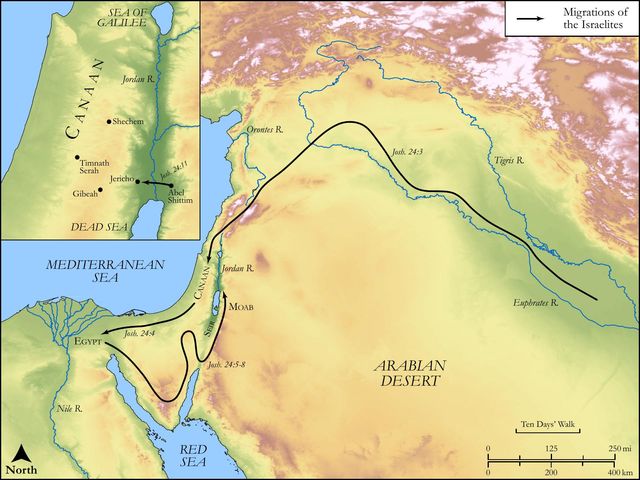
See on the biblical-era map
Study this verse
Public-domain commentary
Matthew Henry
From his Commentary on the Whole Bible. Henry comments on passages, not single verses — this entry covers Joshua 24:29–33.
This book, which began with triumphs, here ends with funerals, by which all the glory of man is stained. We have here 1. The burial of Joseph, Jos 24:32. He died about 200 years before in Egypt, but gave commandment concerning his bones, that they should not rest in their grave until Israel had rest in the land of promise; now therefore the children of Israel, who had brought this coffin full of bones with them out of Egypt, carried it along with them in all their marches through the wilderness (the two tribes of Ephraim and Manasseh, it is probable, taking particular care of it), and kept it in their camp till Canaan was perfectly reduced, now at last they deposited it in that piece of ground which his father gave him near Shechem, Gen 48:22. Probably it was upon this occasion that Joshua called for all Israel to meet him at Shechem (v. 1), to attend Joseph's coffin to the grave there, so that the sermon in this chapter served both for Joseph's funeral sermon and his own farewell sermon; and if it was, as is supposed, in the last year of his life, the occasion might very well remind him of his own death being at hand, for he was not just at the same age that his illustrious ancestor Joseph had arrived at when he died, 110 years old; compare Jos 24:29 with Gen 50:26. 2. The death and burial of Joshua, Jos 24:29, Jos 24:30. We are not told how long he lived after the coming of Israel into Canaan. Dr. Lightfoot thinks it was about seventeen years; but the Jewish chronologers generally say it was about twenty-seven or twenty-eight years. He is here called the servant of the Lord, the same title that was given to Moses (Jos 1:1) when mention was made of his death; for, though Joshua was in many respects inferior to Moses, yet in this he was equal to him, that, according as his work was, he approved himself a diligent and faithful servant of God. And he that traded with his two talents had the same approbation that he had who traded with his five. Well done, good and faithful servant. Joshua's burying-place is here said to be on the north side of the hill Gaash, or the quaking hill; the Jews say it was so called because it trembled at the burial of Joshua, to upbraid the people of Israel with their stupidity in that they did not lament the death of that great and good man as they ought to have done. Thus at the death of Christ, our Joshua, the earth quaked. The learned bishop Patrick observes that there is no mention of any days of mourning being observed for Joshua, as there were for Moses and Aaron, in which, he says, St. Hierom and others of the fathers think there is a mystery, namely, that under the law, when life and immortality were not brought to so clear a light as they are now, they had reason to mourn and weep for the death of their friends; but now that Jesus, our Joshua, has opened the kingdom of heaven, we may rather rejoice. 3. The death and burial of Eleazar the chief priest, who, it is probable, died about the same time that Joshua did, as Aaron in the same year with Moses, Jos 24:33. The Jews say that Eleazar, a little before he died, called the elders together, and gave them a charge as Joshua had done. He was buried in a hill that pertained to Phinehas his son, which came to him, not by descent, for then it would have pertained to his father first, nor had the priests any cities in Mount Ephraim, but either it fell to him by marriage, as the Jews conjecture, or it was freely bestowed upon him, to build a country seat on, by some pious Israelite that was well-affected to the priesthood, for it is here said to have been given him; and there he buried his dear father. 4. A general idea given us of the state of Israel at this time, Jos 24:31. While Joshua lived, religion was kept up among them under his care and influence; but soon after he and his contemporaries died it went to decay, so much oftentimes does one head hold up: how well is it for the gospel church that Christ, our Joshua, is still with it, by his Spirit, and will be always, even unto the end of the world!
Historical interpretation
Historical reception
1 surviving comment on this verse from the historical church.
I cannot adequately extol the mysteries of Scripture or sufficiently admire the spiritual meaning conveyed in its most simple words. We are told, for instance, that lamentation was made for Moses; yet when the funeral of Joshua is described no mention at all is made of weeping. The reason, of course, is that under Moses—that is, under the old law—all people were bound by the sentence passed on Adam’s sin, and when they descended into hell were rightly accompanied with tears. For, as the apostle says, “death reigned from Adam to Moses, even over them that had not sinned.” But under Jesus, that is, under the gospel of Christ, who has unlocked for us the gate of paradise, death is accompanied not with sorrow but with joy. The Jews go on weeping to this day; they make bare their feet, they crouch in sackcloth, they roll in ashes. And to make their superstition complete, they follow a foolish custom of the Pharisees and eat lentils, to show, it would seem, for what poor fare they have lost their birthright. Of course they are right to weep, for as they do not believe in the Lord’s resurrection they are being made ready for the advent of antichrist. But we who have put on Christ and according to the apostle are a royal and priestly race, we ought not to grieve for the dead.
Continue studying Joshua 24:30 across the web’s major study libraries — every link below opens this exact verse, chapter, or book on the destination site.
Read & Compare
 BibleGatewayThis verse in more than 200 translations and 70 languages.
 Bible.comThe YouVersion reader — hundreds of translations, reading plans, and highlights.
 ESV.orgCrossway's official English Standard Version reader.
 NET BibleThe NET translation with 60,000+ translators' notes on every rendering decision.
 STEP BibleTyndale House's free study tool — original text, vocabulary, and scholarly resources.
 BibliaLogos Bible Software's free web reader.
 USCCBThe New American Bible (Revised Edition) with the U.S. bishops' study notes.
Commentaries
 BibleHub CommentariesDozens of classic commentaries on this verse, gathered on one page.
 StudyLightMore than 100 commentary sets — the largest collection on the web.
 BibleRefPlain-English commentary on what this verse means, verse by verse.
 Enduring WordDavid Guzik's free commentary on this chapter, widely used by Bible teachers.
 Bible Study ToolsVerse commentary alongside Greek and Hebrew study aids.
Original Language & Research
- BibleHub InterlinearThe verse word by word — original language, transliteration, and English.
- BibleHub LexiconEvery word's original-language definition and Strong's entry.
 Blue Letter BibleDeep-study tools — Strong's numbers, concordance, and word studies.
 SefariaThe Hebrew text with Rashi and centuries of Jewish commentary.
Sermons, Hymns & Audio


TrulyRandomVerse is not affiliated with these sites and doesn’t control their content. They’re linked because they’re genuinely useful.
Summary
Joshua 24:30 records the solemn burial of Joshua, Israel's faithful leader, in Timnathserah, a town situated within his tribal inheritance in Mount Ephraim. This verse marks the poignant conclusion of a pivotal era in Israel's history, symbolizing the successful completion of God's promise of land and the end of the generation that entered and largely conquered Canaan. It underscores the transient nature of human leadership while affirming the enduring faithfulness of God in fulfilling His covenant promises to His people, establishing a definitive close to the book's main narrative.
Context
ShowHideLiterary Context
Joshua 24:30 serves as a crucial narrative hinge, providing the final account of Joshua's life and ministry immediately following his powerful farewell address and the covenant renewal ceremony at Shechem. In Joshua 24:1-28, Joshua recounted God's steadfast faithfulness from Abraham to the conquest, culminating in his iconic challenge: "As for me and my house, we will serve the LORD" (Joshua 24:15). The subsequent verses, Joshua 24:31-33, briefly summarize Israel's faithfulness during Joshua's lifetime and record the death of Eleazar the priest, setting a definitive end to the generation of conquest. This verse, therefore, acts as a solemn closing statement, concluding one major chapter in Israel's history and preparing the reader for the challenges and apostasy chronicled in the subsequent book of Judges.
Historical & Cultural Context
The burial of Joshua in his personal inheritance reflects significant ancient Near Eastern and Israelite customs. Burial within one's allocated land was a profound symbol of belonging, permanent possession, and the fulfillment of divine promise, especially in a culture where land was the primary expression of God's covenant blessing and security. Mount Ephraim, a central and strategically important highland region, was the tribal territory of Ephraim, Joshua's own tribe. The precise geographical markers—Timnathserah and the "hill of Gaash"—are characteristic of biblical accounts, grounding the narrative in the physical reality of the Promised Land. This meticulous detail underscores the concrete fulfillment of God's promise to provide a dwelling place for His people, emphasizing that Joshua, the one who led them into this land, now rests within his own portion of it, a testament to his successful leadership and God's faithfulness.
Key Themes
ShowHideThis verse powerfully contributes to several overarching themes within the book of Joshua and the broader Pentateuch. Primarily, it signifies the fulfillment of God's promises regarding the land. Joshua, the instrument of conquest, now rests in the very land promised to Abraham (Genesis 12:7) and delivered through divine faithfulness. It highlights the transience of human leadership and the enduring sovereignty of God; though great leaders like Joshua pass away, God's divine plan and covenant purposes continue unimpeded. Joshua's burial in his inheritance, granted to him in Joshua 19:49-50, also reinforces the theme of divine reward for faithfulness, acknowledging Joshua's unwavering obedience. Finally, it marks a crucial generational transition, concluding the era of the exodus and conquest generation and foreshadowing the subsequent challenges faced by the next generation, who "knew not the LORD, nor yet the works which he had done for Israel" (Judges 2:10).
Exposition and Analysis
ShowHideKey Word Analysis
ShowHideThis primitive root signifies the act of interring or placing a body in the ground. In the ancient world, burial was a significant ritual, often indicating respect for the deceased and a belief in some form of continued existence or connection to the land. Joshua's burial, specifically in his inheritance, underscores the finality of his earthly life and the establishment of his legacy within the promised land he helped secure.
This term is foundational to the book of Joshua, referring to something inherited, an occupancy, or a concrete heirloom. It broadly denotes an estate, patrimony, or portion. In the context of Israel, "inheritance" primarily refers to the land divinely allotted to each tribe and individual as a permanent, covenantal possession. Joshua's burial in his inheritance signifies the complete realization of God's promise of land, both for the nation and for its faithful leader, representing rest, security, and the tangible outcome of God's faithfulness.
This place name, also appearing as Timnath-heres in Judges 2:9, is derived from Hebrew roots meaning "portion of (the) sun." This name aptly describes the land given to Joshua as his personal inheritance, a generous provision for his faithful service. The slight variation in spelling between Joshua and Judges suggests either a minor linguistic difference or a later renaming, but its core meaning points to a place of significant possession and blessing, fitting for a leader who brought the nation into its inheritance.
Verse Breakdown
ShowHide"And they buried him in the border of his inheritance in Timnathserah,"
This clause states the primary action—Joshua's burial—and its precise location. The phrase "border of his inheritance" emphasizes that his burial place was not just generally within Israelite territory, but specifically within the land allocated to him as his personal possession. Timnathserah was Joshua's unique allotment, granted to him by the people at God's command after the land was divided among the tribes (Joshua 19:49-50). This detail highlights the honor bestowed upon him and the fulfillment of God's provision for His faithful servant.
"which [is] in mount Ephraim,"
This phrase further specifies the geographical location, placing Timnathserah within the tribal territory of Ephraim. Joshua himself was from the tribe of Ephraim (Numbers 13:8). Mount Ephraim was a significant highland region, central to the land of Canaan, and its mention grounds the event historically and geographically. It reinforces the idea that Joshua was buried among his own people, in his own tribal land, signifying his deep connection to the land and his lineage.
"on the north side of the hill of Gaash."
This final detail provides even greater precision, pinpointing the exact location of Joshua's tomb. Such specific geographical markers are common in biblical narratives, serving to authenticate the events and provide a concrete sense of place. The "hill of Gaash" (meaning "quaking" or "shaking") adds a unique identifier, making the burial site verifiable and memorable for the ancient audience. It signifies the permanent establishment of Joshua's legacy within the land he helped conquer and secure for Israel.
Literary Devices
ShowHideThe verse employs Geographical Specificity as a key literary device. The meticulous naming of "Timnathserah," "mount Ephraim," and "the hill of Gaash" grounds the narrative firmly in reality, lending credibility and historical weight to the account of Joshua's death and burial. This detailed geographical anchoring is characteristic of the book of Joshua, which meticulously records land divisions and boundaries, emphasizing the tangible fulfillment of God's promises. Furthermore, there is a powerful element of Closure and Transition at play. The solemn recording of Joshua's death provides a definitive conclusion to his leadership and the era of conquest, simultaneously setting the stage for the subsequent narrative of the book of Judges, which chronicles the challenges faced by the next generation. The placement of his burial within his personal inheritance also functions as potent Symbolism, representing the ultimate rest and reward for a life of faithful service to God and His people.
Theological and Thematic Connections
ShowHideJoshua 24:30 stands as a poignant reminder of the transient nature of human leadership and the enduring faithfulness of God. Just as Moses' death marked the end of an era before the entry into the land, Joshua's death signifies the conclusion of the conquest generation. Yet, God's covenant promises, particularly concerning the land, remain steadfast. Joshua's burial in his inheritance symbolizes the complete fulfillment of God's promise to provide rest and a permanent dwelling for His people, a theme that resonates throughout biblical history. It also serves as a testament to the fact that while human instruments come and go, God's divine plan progresses unhindered, emphasizing His sovereignty over all generations and His commitment to His covenant.
Reflection and Application
ShowHideJoshua's burial in his inheritance offers a powerful lesson on finishing well in our walk with God. His life was characterized by unwavering obedience and dedication, leading God's people faithfully through immense challenges and into their promised land. His final resting place, a symbol of fulfilled promise and rest, encourages us to consider the legacy we are building for the Lord. Are we living in such a way that our lives, too, will bear witness to God's faithfulness and our diligent service? This verse also underscores the importance of spiritual succession; while great leaders pass, God's work continues through new generations. It challenges us to actively invest in mentoring and discipling others, ensuring that the knowledge of the Lord and His mighty works is passed on, preventing the spiritual decline seen in the generation after Joshua. Ultimately, Joshua's rest in his earthly inheritance points us to the greater, eternal rest and inheritance promised to all who are faithful to God, reminding us to live with an eternal perspective and to seek our ultimate rest in Him, knowing that our true home is not of this world.
Questions for Reflection
ShowHideFAQ
ShowHideWhat is the significance of Joshua being buried in "Timnathserah"?
ShowHideTimnathserah (also called Timnath-heres in Judges 2:9) was Joshua's personal inheritance, a town given to him by the Israelites after the land of Canaan was divided among the tribes, as recorded in Joshua 19:49-50. Its name, possibly meaning "portion of the sun" or "portion of abundance," symbolizes the blessing and provision he received for his faithful leadership. His burial there signifies the complete fulfillment of God's promise of land not only to the nation but also to its faithful servant, marking a place of rest and established legacy within his own tribal territory of Ephraim. It underscores that God honors those who faithfully serve Him by providing for them even in their final rest.
Why are the geographical details ("mount Ephraim," "hill of Gaash") so specific?
ShowHideThe specific geographical details in Joshua 24:30 serve several important purposes. Firstly, they provide historical authentication, grounding the narrative in a verifiable physical reality, which was crucial for ancient audiences. Such precision lends credibility to the biblical account and confirms the actual distribution of the land. Secondly, these details emphasize the complete and tangible fulfillment of God's promise to give the Israelites the land. Joshua, who led them into the land, is now buried within his own specific portion of it, demonstrating the covenant's full realization. Thirdly, these details highlight Joshua's deep connection to the land he helped secure and his tribal identity within Mount Ephraim. Such meticulousness reinforces the thoroughness of the biblical record concerning the distribution and possession of the Promised Land.
Christ-Centered Fulfillment
ShowHideJoshua 24:30, while marking the end of a pivotal human leader's life, profoundly points to the ultimate and eternal leadership of Jesus Christ. Joshua, whose Hebrew name (Yeshua) is the linguistic root of Jesus, served as a powerful type of Christ, leading God's people into their promised inheritance and providing them rest from their enemies. However, Joshua's rest in Timnathserah was earthly and temporary, a foreshadowing of the perfect and eternal rest found only in Christ. Jesus is the true and greater Joshua who leads His people not into a physical, earthly inheritance, but into a heavenly one, securing for them an everlasting rest from the bondage of sin and death (Hebrews 4:8-10). Unlike Joshua, whose leadership ended in death and whose legacy required subsequent generations to uphold, Jesus' leadership culminates in His resurrection and ascension, ensuring that His work of salvation and the inheritance He provides are eternal, imperishable, and unfading (1 Peter 1:3-4). Through His atoning sacrifice, Christ has secured for us a "better country, that is, a heavenly one" (Hebrews 11:16), inviting all who believe to enter into His spiritual inheritance and eternal rest that far surpasses any earthly portion or temporary dwelling.