


Genesis 50:2
- וַיְצַוvay·Tzavand he commandedH6680Conj-w ¦ V-Piel-ConsecImperf-3msVerb Piel Consecutive Imperfect 3rd Singular Masculineוַandיְצַוhe commanded
- יוֹסֵףyo·SefJosephH3130N-proper-mNoun Proper Masculine
- אֶת'et<obj.>H853DirObjMParticle Object Indicator
- עֲבָדָיו'a·va·Davhis servantsH5650N-mpc ¦ 3msNoun Plural Masculine Constructעֲבָדָיservantsוhis
- אֶת'et<obj.>H853DirObjMParticle Object Indicator
- הָרֹפְאִיםha·Ro·fe·'Imthe physiciansH7495Art ¦ V-Qal-Prtcpl-mpVerb Qal Participle Plural Masculine Absoluteהָtheרֹפְאִיםphysicians
- לַחֲנֹטla·cha·Notto embalmH2590Prep-l ¦ V-Qal-InfVerb Qal Infinitive Constructלַtoחֲנֹטembalm
- אֶת'et<obj.>H853DirObjMParticle Object Indicator
- אָבִיו'a·Vivhis fatherH1N-msc ¦ 3msNoun Singular Masculine Constructאָבִיfatherוhis
- וַיַּחַנְטוּvai·ya·chan·Tuand they embalmedH2590Conj-w ¦ V-Qal-ConsecImperf-3mpVerb Qal Consecutive Imperfect 3rd Plural Masculineוַandיַּחַנְטוּthey embalmed
- הָרֹפְאִיםha·ro·fe·'Imthe physiciansH7495Art ¦ V-Qal-Prtcpl-mpVerb Qal Participle Plural Masculine Absoluteהָtheרֹפְאִיםphysicians
- אֶת'et<obj.>H853DirObjMParticle Object Indicator
- יִשְׂרָאֵלYis·ra·'ElIsraelH3478N-proper-mNoun Proper Masculine
English is a literal word-by-word gloss of the Hebrew, not the KJV's wording. Why?
This is the original text the KJV's translators worked from — each Hebrew word with its own literal English meaning in this verse, prepared by scholars at Tyndale House, Cambridge. The KJV translates whole sentences, not word by word, so its wording differs: one Hebrew word can become several English words, and the KJV may choose “the LORD” where the gloss reads “Yahweh”. Both are faithful — they answer different questions. For the KJV's own rendering, switch to the KJV text.
Details
See on the biblical-era maps


Study this verse
Public-domain commentary
Matthew Henry
From his Commentary on the Whole Bible. Henry comments on passages, not single verses — this entry covers Genesis 50:1–6.
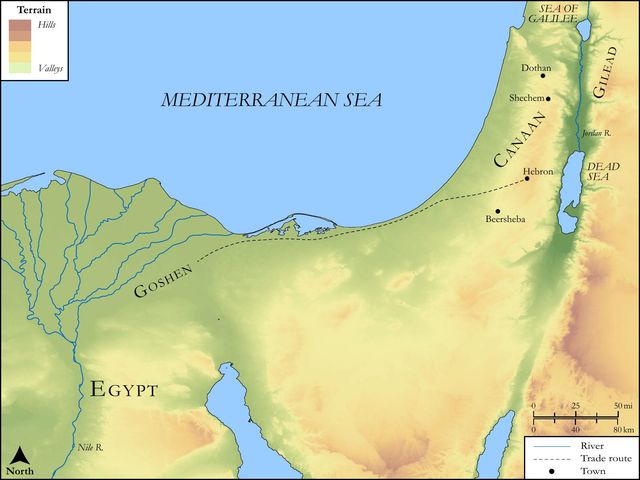
Joseph is here paying his last respects to his deceased father. 1. With tears and kisses, and all the tender expressions of a filial affection, he takes leave of the deserted body, Gen 50:1. Though Jacob was old and decrepit, and must needs die in the course of nature - though he was poor comparatively, and a constant charge to his son Joseph, yet such an affection he had for a loving father, and so sensible was he of the loss of a prudent, pious, praying father, that he could not part with him without floods of tears. Note, As it is an honour to die lamented, so it is the duty of survivors to lament the death of those who have been useful in their day, though for some time they may have survived their usefulness. The departed soul is out of the reach of our tears and kisses, but with them it is proper to show our respect to the poor body, of which we look for a glorious and joyful resurrection. Thus Joseph showed his faith in God, and love to his father, by kissing his pale and cold lips, and so giving an affectionate farewell. Probably the rest of Jacob's sons did the same, much moved, no doubt, with his dying words. 2. He ordered the body to be embalmed (Gen 50:2), not only because he died in Egypt, and that was the manner of the Egyptians, but because he was to be carried to Canaan, which would be a work of time, and therefore it was necessary the body should be preserved as well as it might be from putrefaction. See how vile our bodies are, when the soul has forsaken them; without a great deal of art, and pains, and care, they will, in a very little time, become noisome. If the body have been dead four days, by that time it is offensive. 3. He observed the ceremony of solemn mourning for him, Gen 50:3. Forty days were taken up in embalming the body, which the Egyptians (they say) had an art of doing so curiously as to preserve the very features of the face unchanged; all this time, and thirty days more, seventy in all, they either confined themselves and sat solitary, or, when they went out, appeared in the habit of close mourners, according to the decent custom of the country. Even the Egyptians, many of them, out of the great respect they had for Joseph (whose good offices done for the king and country were now fresh in remembrance), put themselves into mourning for his father: as with us, when the court goes into mourning, those of the best quality do so too. About ten weeks was the court of Egypt in mourning for Jacob. Note, What they did in state, we should do in sincerity, weep with those that weep, and mourn with those that mourn, as being ourselves also in the body. 4. He asked and obtained leave of Pharaoh to go to Canaan, thither to attend the funeral of his father, Gen 50:4-6. (1.) It was a piece of necessary respect to Pharaoh that he would not go without leave; for we may suppose that, though his charge about the corn was long since over, yet he continued a prime-minister of state, and therefore would not be so long absent from his business without licence. (2.) He observed a decorum, in employing some of the royal family, or some of the officers of the household, to intercede for this licence, either because it was not proper for him in the days of his mourning to come into the presence-chamber, or because he would not presume too much upon his own interest. Note, Modesty is a great ornament to dignity. (3.) He pleaded the obligation his father had laid upon him, by an oath, to bury him in Canaan, Gen 50:5. It was not from pride or humour, but from his regard to an indispensable duty, that he desired it. All nations reckon that oaths must be performed, and the will of the dead must be observed. (4.) He promised to return: I will come again. When we return to our own houses from burying the bodies of our relations, we say, "We have left them behind;" but, if their souls have gone to our heavenly Father's house, we may say with more reason, "They have left us behind." (5.) He obtained leave (Gen 50:6): Go and bury thy father. Pharaoh was willing his business should stand still so long; but the service of Christ is more needful, and therefore he would not allow one that had work to do for him to go first and bury his father; no, Let the dead bury their dead, Mat 8:22.
Continue studying Genesis 50:2 across the web’s major study libraries — every link below opens this exact verse, chapter, or book on the destination site.
Read & Compare
 BibleGatewayThis verse in more than 200 translations and 70 languages.
 Bible.comThe YouVersion reader — hundreds of translations, reading plans, and highlights.
 ESV.orgCrossway's official English Standard Version reader.
 NET BibleThe NET translation with 60,000+ translators' notes on every rendering decision.
 STEP BibleTyndale House's free study tool — original text, vocabulary, and scholarly resources.
 BibliaLogos Bible Software's free web reader.
 USCCBThe New American Bible (Revised Edition) with the U.S. bishops' study notes.
Commentaries
 BibleHub CommentariesDozens of classic commentaries on this verse, gathered on one page.
 StudyLightMore than 100 commentary sets — the largest collection on the web.
 BibleRefPlain-English commentary on what this verse means, verse by verse.
 Enduring WordDavid Guzik's free commentary on this chapter, widely used by Bible teachers.
 Bible Study ToolsVerse commentary alongside Greek and Hebrew study aids.
Original Language & Research
- BibleHub InterlinearThe verse word by word — original language, transliteration, and English.
- BibleHub LexiconEvery word's original-language definition and Strong's entry.
 Blue Letter BibleDeep-study tools — Strong's numbers, concordance, and word studies.
 SefariaThe Hebrew text with Rashi and centuries of Jewish commentary.
Sermons, Hymns & Audio


TrulyRandomVerse is not affiliated with these sites and doesn’t control their content. They’re linked because they’re genuinely useful.
Summary
Joseph's authoritative directive to his personal physicians to embalm his deceased father, Jacob, a command which they immediately carried out. This verse powerfully illustrates Joseph's profound filial devotion and high status within Egypt, highlighting the practical adoption of Egyptian funerary customs to facilitate Jacob's final wish of being buried in the Promised Land.
Context
ShowHideLiterary Context
This verse immediately follows the poignant account of Jacob's death in Genesis 49:33, where he gathers his sons to pronounce prophetic blessings and instructions, particularly regarding his burial in Canaan. Joseph's command in Genesis 50:2 thus initiates the fulfillment of Jacob's dying wish, setting in motion the elaborate funeral procession that will eventually take Jacob's body back to the land of his fathers. The subsequent verses detail the extensive mourning period and the journey to Canaan, culminating in Jacob's burial in the cave of Machpelah, as recorded in Genesis 50:13. This passage serves as a bridge between Jacob's life and the ongoing narrative of Joseph's final years, emphasizing the patriarchal family's deep connection to the land promised by God.
Historical & Cultural Context
The act of embalming was a distinctive and highly developed practice in ancient Egypt, central to their beliefs about the afterlife. Unlike the customary Israelite practice of immediate burial in the earth, Egyptian embalming involved a complex, lengthy process of preserving the body, often taking 70 days, as mentioned in Genesis 50:3. This ritual was typically reserved for pharaohs, nobles, and individuals of significant status. Joseph, as the vizier of Egypt (Genesis 41:40), commanded immense resources and authority, including access to the most skilled physicians. His decision to embalm Jacob reflects not a compromise of Israelite identity, but a pragmatic adoption of the prevailing cultural custom necessary for the long journey back to Canaan, ensuring the body's preservation.
Key Themes
ShowHideThis verse contributes to several overarching themes in Genesis. It underscores the theme of Filial Piety and Honor, as Joseph's actions demonstrate profound respect and love for his father, fulfilling the spirit of the commandment to honor your father and mother. It also highlights Divine Providence and Joseph's Exalted Position, showing how God's plan for Jacob's burial in the Promised Land is facilitated through Joseph's authority and influence in Egypt, a position divinely orchestrated (Genesis 45:7-8). Furthermore, it subtly touches upon the theme of Cultural Adaptation without Compromise, illustrating how the patriarchs, particularly Joseph, could navigate and utilize foreign customs for righteous purposes without abandoning their covenant identity or their hope in God's promises concerning the land of Canaan, a hope that permeates the entire book of Genesis.
Exposition and Analysis
ShowHideKey Word Analysis
ShowHideThis primitive root means to constitute, enjoin, or appoint, often implying a formal and authoritative directive. Joseph's use of this word underscores his position of power and authority within the Egyptian court, indicating that this was not a mere request but an official order given by a high-ranking official to his subordinates. It signifies his decisive leadership in fulfilling his father's final wishes.
This word primarily means to mend, cure, or heal. In the context of ancient Egypt, it refers to highly skilled medical professionals, specifically those specialized in the complex and sacred art of mummification. The presence of "his servants the physicians" highlights Joseph's access to the most advanced and specialized services available in Egypt, reflecting his immense wealth and influence.
This primitive root means to spice or ripen, and by implication, to embalm. This term specifically denotes the intricate process of preserving a body, a hallmark of Egyptian funerary rites. Its use here signifies the adoption of a distinct Egyptian custom, not as a religious conversion, but as a pragmatic means to ensure Jacob's body could withstand the long journey for burial in Canaan, fulfilling the patriarch's dying wish.
Verse Breakdown
ShowHide"And Joseph commanded his servants the physicians"
This opening clause immediately establishes Joseph's agency and authority. As the second-in-command in Egypt, he possessed the power to issue directives to specialized personnel. The phrase "his servants" indicates that these physicians were part of his personal retinue or under his direct command, emphasizing his high status and the resources at his disposal to honor his father.
"to embalm his father"
This specific instruction reveals Joseph's intent to preserve Jacob's body. Embalming was a lengthy, elaborate, and costly procedure, typically reserved for royalty and individuals of significant standing in Egyptian society. This act demonstrates Joseph's profound filial piety and his determination to provide the most honorable burial possible for Jacob, in accordance with the customs of the land where they resided, and crucially, to prepare the body for the journey back to Canaan.
"and the physicians embalmed Israel"
This concluding phrase confirms the immediate and successful execution of Joseph's command. The use of "Israel" here, rather than "Jacob," is significant. "Israel" is the covenant name given to Jacob by God (Genesis 32:28), emphasizing his unique identity as the patriarch of the chosen people, even in death and despite the use of Egyptian customs. This highlights the enduring covenant relationship between God and His people, even as they navigate foreign lands and practices.
Literary Devices
ShowHideThe verse employs Juxtaposition by placing the distinct Egyptian practice of embalming directly alongside the Israelite patriarch "Israel," highlighting the cultural adaptation occurring within the covenant family. This creates a subtle tension between foreign custom and distinct identity, ultimately resolved by the pragmatic purpose of the act—to fulfill Jacob's desire for burial in the Promised Land. There is also an element of Foreshadowing, as this event anticipates Joseph's own embalming later in Genesis 50:26, linking their fates and their shared hope for the future exodus to Canaan. The Repetition of "physicians" and "embalmed" within the short verse emphasizes the specific action and the agents involved, underscoring the professional and deliberate nature of the process.
Theological and Thematic Connections
ShowHideJoseph's meticulous care for his deceased father, extending to the adoption of an elaborate Egyptian funerary custom, serves as a powerful testament to the biblical principle of honoring one's parents. This act transcends mere cultural practice, embodying a deep respect and love that aligns with divine commands regarding familial duty. It demonstrates how believers, even in foreign cultural contexts, can act with integrity and wisdom, utilizing available resources and customs for righteous purposes without compromising their core faith or covenant identity. Joseph's actions are a model of pragmatic faith, ensuring the fulfillment of a sacred promise (Jacob's burial in Canaan) through thoughtful preparation.
Reflection and Application
ShowHideJoseph's actions in Genesis 50:2 offer profound lessons for contemporary believers. His unwavering commitment to honoring his father, even in death, by ensuring a dignified burial according to the best available means, challenges us to reflect on our own expressions of respect and care for our family, particularly our elders. Furthermore, Joseph's ability to navigate and adapt to a foreign culture, utilizing its practices for a righteous and God-honoring purpose without compromising his core identity or faith, provides a crucial paradigm for Christian engagement with the broader society. We are called to be "in the world but not of the world," discerning how to leverage cultural resources and customs for good, always with an eye toward fulfilling God's purposes and maintaining our distinct witness. This narrative also underscores the importance of diligent preparation and foresight in fulfilling commitments and pursuing God's long-term plans, even when those plans involve complex or challenging circumstances.
Questions for Reflection
ShowHideFAQ
ShowHideWhy did Joseph use Egyptian embalming practices instead of traditional Israelite burial?
ShowHideThe primary reason for Joseph's decision was pragmatic: embalming allowed Jacob's body to be preserved for the long and arduous journey from Egypt back to Canaan, fulfilling Jacob's dying wish to be buried with his ancestors in the cave of Machpelah (Genesis 49:29-32). While immediate burial was the customary Israelite practice, Joseph, as a high-ranking official in Egypt, had access to and was familiar with the advanced Egyptian methods of preservation. It was a practical adaptation to the circumstances, not a compromise of his core faith or Israelite identity, which focused more on the spiritual covenant than specific funerary rites.
Does Joseph's use of Egyptian customs imply a weakening of his faith or the family's distinct identity?
ShowHideNo, it does not. Joseph consistently demonstrated profound faith in God throughout his life, even while serving in the highly pagan Egyptian environment (Genesis 41:16). His actions here reflect a pragmatic adaptation to the cultural context, utilizing available resources and customs to fulfill a sacred family obligation (Jacob's burial wish) and a divine promise (burial in the Promised Land). The family's distinct identity was maintained through their covenant relationship with God, their endogamous marriage practices, and their eventual desire to return to Canaan, not through the rejection of all foreign customs. This illustrates a principle of cultural engagement where one can be "in the world but not of the world" (John 17:15-16).
What is the significance of Joseph himself being embalmed later in Genesis 50:26?
ShowHideJoseph's embalming, like Jacob's, was practical for preservation until the Exodus. More significantly, it symbolized his unwavering faith in God's promise that Israel would indeed return to Canaan. He instructed his descendants to carry his bones with them when they left Egypt (Genesis 50:25), a powerful act of faith that looked forward to the fulfillment of God's covenant with Abraham, Isaac, and Jacob. This act is specifically highlighted in the "Hall of Faith" in Hebrews 11:22, underscoring his confidence in God's future deliverance and the ultimate inheritance of the Promised Land.
Christ-Centered Fulfillment
ShowHideWhile Genesis 50:2 does not directly prophesy Christ, it subtly points to themes that find their ultimate fulfillment in Him. Joseph's meticulous care for his father, ensuring his proper burial and the fulfillment of his dying wish, foreshadows Christ's own perfect obedience to the Father's will, even unto death on the cross (Philippians 2:8). The act of embalming, preserving a body for a future journey and resurrection hope, implicitly anticipates the ultimate preservation and glorious resurrection found in Christ, who is the "resurrection and the life" (John 11:25-26). Just as Jacob's body was prepared for burial in the promised land, Christ's body was prepared for burial, awaiting His triumphant resurrection, which secures the hope of resurrection and eternal life for all who trust in Him (1 Corinthians 15:20-22). Joseph, in his role as a faithful son, provider, and preserver, also serves as a type of Christ, who perfectly cares for His people and ensures their ultimate inheritance in the true Promised Land, the new heavens and new earth (Revelation 21:1-4).