


Genesis 47:27
Bible text: King James Version (1769 Blayney text) · Public domain
Bible text: King James Version with Strong's numbers · Public domain
Bible text: Berean Standard Bible · Public domain
Bible text: American Standard Version (1901) · Public domain
Bible text: World English Bible, Messianic edition · Public domain
Bible text: Geneva Bible (1599) · Public domain
Bible text: Young's Literal Translation · Public domain
- וַיֵּשֶׁבvai·Ye·shevand he dweltH3427Conj-w ¦ V-Qal-ConsecImperf-3msVerb Qal Consecutive Imperfect 3rd Singular Masculineוַandיֵּשֶׁבhe dwelt
- יִשְׂרָאֵלYis·ra·'ElIsraelH3478N-proper-mNoun Proper Masculine
- בְּאֶרֶץbe·'E·retzin [the] land ofH776Prep-b ¦ N-fscNoun Singular Feminine Constructבְּinאֶרֶץ[the] land of
- מִצְרַיִםmitz·Ra·yimEgyptH4714N-properNoun Proper Location
- בְּאֶרֶץbe·'E·retzin [the] land ofH776Prep-b ¦ N-fscNoun Singular Feminine Constructבְּinאֶרֶץ[the] land of
- גֹּשֶׁןGo·shenGoshenH1657N-properNoun Proper Location
- וַיֵּאָחֲזוּvai·ye·'a·cha·Zuand they had possessionsH270Conj-w ¦ V-Niphal-ConsecImperf-3mpVerb Niphal Consecutive Imperfect 3rd Plural Masculineוַandיֵּאָחֲזוּthey had possessions
- בָהּVahin itPrep-b ¦ 3fsSuffix Personal 3rd Singular Feminineבָinהּit
- וַיִּפְרוּvai·yif·Ruand they were fruitfulH6509Conj-w ¦ V-Qal-ConsecImperf-3mpVerb Qal Consecutive Imperfect 3rd Plural Masculineוַandיִּפְרוּthey were fruitful
- וַיִּרְבּוּvai·yir·Buand they multipliedH7235Conj-w ¦ V-Qal-ConsecImperf-3mpVerb Qal Consecutive Imperfect 3rd Plural Masculineוַandיִּרְבּוּthey multiplied
- מְאֹדme·'OdexceedinglyH3966Adj-msAdjective Numerical Singular Masculine Absolute
English is a literal word-by-word gloss of the Hebrew, not the KJV's wording. Why?
This is the original text the KJV's translators worked from — each Hebrew word with its own literal English meaning in this verse, prepared by scholars at Tyndale House, Cambridge. The KJV translates whole sentences, not word by word, so its wording differs: one Hebrew word can become several English words, and the KJV may choose “the LORD” where the gloss reads “Yahweh”. Both are faithful — they answer different questions. For the KJV's own rendering, switch to the KJV text.
Details
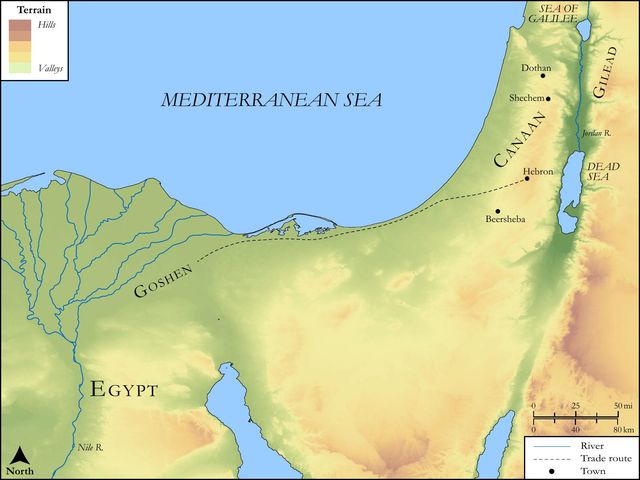
See on the biblical-era maps


Study this verse
Public-domain commentary
Matthew Henry
From his Commentary on the Whole Bible. Henry comments on passages, not single verses — this entry covers Genesis 47:27–31.
Observe, 1. The comfort Jacob lived in (Gen 47:27, Gen 47:28); while the Egyptians were impoverished in their own land, Jacob was replenished in a strange land. He lived seventeen years after he came into Egypt, far beyond his own expectation. Seventeen years he had nourished Joseph (for so old he was when he was sold from him, Gen 37:2), and now, by way of requital, seventeen years Joseph nourished him. Observe how kindly Providence ordered Jacob's affairs, that when he was old, and least able to bear care or fatigue, he had least occasion for it, being well provided for by his son without his own forecast. Thus God considers the frame of his people. 2. The care Jacob died in. At last the time drew nigh that Israel must die, Gen 47:29. Israel, a prince with God, that had power over the angel and prevailed, yet must yield to death. There is no remedy, he must die: it is appointed for all men, therefore for him; and there is no discharge in that war. Joseph supplied him with bread, that he might not die by famine; but this did not secure him from dying by age or sickness. He died by degrees; his candle was not blown out, but gradually burnt down to the socket, so that he saw, at some distance, the time drawing nigh. Note, It is an improvable advantage to see the approach of death before we feel its arrests, that we may be quickened to do what our hand finds to do with all our might: however, it is not far from any of us. Now Jacob's care, as he saw the day approaching, was about his burial, not the pomp of it (he was no way solicitous about that), but the place of it. (1.) He would be buried in Canaan. This he resolved on, not from mere humour, because Canaan was the land of his nativity, but in faith, because it was the land of promise (which he desired thus, as it were, to keep possession of, till the time should come when his posterity should be masters of it), and because it was a type of heaven, that better country which he that said these things declared plainly that he was in expectation of, Heb 11:14. He aimed at a good land, which would be his rest and bliss on the other side death. (2.) He would have Joseph sworn to bring him thither to be buried (Gen 47:29, Gen 47:31), that Joseph, being under such a solemn obligation to do it, might have that to answer to the objections which otherwise might have been made against it, and for the greater satisfaction of Jacob now in his dying minutes. Nothing will better help to make a death-bed easy than the certain prospect of a rest in Canaan after death. (3.) When this was done Israel bowed himself upon the bed's head, yielding himself, as it were, to the stroke of death ("Now let it come, and it shall be welcome"), or worshipping God, as it is explained, Heb 11:21, giving God thanks for all his favours, and particularly for this, that Joseph was ready, not only to put his hand upon his eyes to close them, but under his thigh to give him the satisfaction he desired concerning his burial. Thus those that go down to the dust should, with humble thankfulness, bow before God, the God of their mercies, Psa 22:29.
Historical interpretation
Historical reception
1 surviving comment on this verse from the historical church.
Let us see what Moses says after these words: “And Israel dwelt,” the text says, “in Egypt, in the land of Goshen.” Now “Goshen” means “proximity” or “nearness.” By this it is shown that although Israel dwells in Egypt, it is nevertheless not far from God but is close to him and near, as he himself also says: “I will go down with you into Egypt, and I will be with you.”And therefore, even if we appear to have gone down into Egypt, even if placed in the flesh we undergo the battles and struggles of this world, even if we dwell among those who are subject to Pharaoh, nevertheless if we are near God, if we live in meditation on his commandments and inquire diligently after “his precept and judgments”—for this is what it means to be always near God, to think the things which are of God, “to seek the things which are of God”3—God also will always be with us, through Christ Jesus our Lord, “to whom belongs glory forever and ever. Amen.”
Continue studying Genesis 47:27 across the web’s major study libraries — every link below opens this exact verse, chapter, or book on the destination site.
Read & Compare
 BibleGatewayThis verse in more than 200 translations and 70 languages.
 Bible.comThe YouVersion reader — hundreds of translations, reading plans, and highlights.
 ESV.orgCrossway's official English Standard Version reader.
 NET BibleThe NET translation with 60,000+ translators' notes on every rendering decision.
 STEP BibleTyndale House's free study tool — original text, vocabulary, and scholarly resources.
 BibliaLogos Bible Software's free web reader.
 USCCBThe New American Bible (Revised Edition) with the U.S. bishops' study notes.
Commentaries
 BibleHub CommentariesDozens of classic commentaries on this verse, gathered on one page.
 StudyLightMore than 100 commentary sets — the largest collection on the web.
 BibleRefPlain-English commentary on what this verse means, verse by verse.
 Enduring WordDavid Guzik's free commentary on this chapter, widely used by Bible teachers.
 Bible Study ToolsVerse commentary alongside Greek and Hebrew study aids.
Original Language & Research
- BibleHub InterlinearThe verse word by word — original language, transliteration, and English.
- BibleHub LexiconEvery word's original-language definition and Strong's entry.
 Blue Letter BibleDeep-study tools — Strong's numbers, concordance, and word studies.
 SefariaThe Hebrew text with Rashi and centuries of Jewish commentary.
Sermons, Hymns & Audio


TrulyRandomVerse is not affiliated with these sites and doesn’t control their content. They’re linked because they’re genuinely useful.
Summary
Genesis 47:27 marks a pivotal moment in the narrative of Israel's sojourn in Egypt, succinctly recording the flourishing of Jacob's family, now identified as "Israel," in the fertile region of Goshen. This verse highlights their secure settlement, the acquisition of substantial possessions, and, most significantly, their extraordinary demographic growth, transforming them from a nomadic clan into a numerous people. This divinely orchestrated expansion was a crucial step in the fulfillment of God's covenant promises, laying the demographic groundwork for their future as a nation.
Context
ShowHideLiterary Context
This verse carries forward a significant section of Genesis that began with Jacob's arrival in Egypt and his reunion with Joseph, and opens the passage on Israel's settlement and Jacob's request for burial (47:27–31). Following Joseph's wise administration during the famine, Pharaoh has granted the Israelites the best of the land, Goshen, for their settlement. The preceding verses (Genesis 47:25-26) describe Joseph's land policy for the Egyptians, establishing a system where a fifth of the produce went to Pharaoh. Genesis 47:27 then shifts focus back to Israel, providing a summary statement of their initial experience in Egypt, contrasting their prosperity with the broader Egyptian populace's submission to Pharaoh. It serves as a bridge, setting the stage for the dramatic shift in the relationship between Israel and Egypt that will unfold in the book of Exodus, where their very growth becomes a threat to the new Pharaoh.
Historical & Cultural Context
The famine described in Genesis was a widespread regional crisis, making Egypt, with its Nile-fed agriculture and Joseph's foresight, a unique haven. The land of Goshen, located in the eastern Nile Delta, was known for its rich pasturelands, making it ideal for the Israelite's pastoral economy. Its relative isolation from major Egyptian population centers and religious practices would have allowed the Israelites to maintain their distinct cultural and religious identity, preventing immediate assimilation. Pharaoh's grant of land was a common practice for loyal subjects or favored groups, and the Egyptians, generally wary of shepherds (Genesis 46:34), would have found it convenient to house the Israelites separately. This arrangement, while initially beneficial, inadvertently facilitated the Israelites' growth into a distinct, numerous people, a development that would later be viewed with suspicion by a subsequent, less benevolent Pharaoh.
Key Themes
ShowHideGenesis 47:27 powerfully reiterates several overarching themes central to the book of Genesis and the broader Pentateuch. Primarily, it underscores God's unwavering faithfulness to His covenant promises. The "multiplying exceedingly" directly echoes the repeated divine promises to Abraham, Isaac, and Jacob that their descendants would become a great nation and be innumerable (e.g., Genesis 12:2, Genesis 17:6, Genesis 35:11). Secondly, it highlights divine providence, demonstrating God's active hand in preserving and blessing His chosen people even in a foreign land and amidst a severe famine. The prosperity and rapid growth in Goshen, despite their status as sojourners, show God's provision. Finally, this verse is crucial for the theme of preparation for nationhood. This period of exponential growth was essential for the formation of the Israelite nation, laying the demographic groundwork for the Exodus and the establishment of a covenant people, a process explicitly noted later in Exodus 1:7.
Exposition and Analysis
ShowHideKey Word Analysis
ShowHideMeaning "to sit down; by implication, to dwell, to remain; causatively, to settle, to marry." Here, it signifies a secure and established residence, not merely a temporary encampment. The Israelites were not just passing through; they were settled, indicating stability and permanence in Goshen, granted by Pharaoh's decree and Joseph's arrangement.
Meaning "to seize (often with the accessory idea of holding in possession)." This word implies active acquisition and secure ownership of property, likely referring to their livestock, land rights, and other material wealth. It indicates not just survival but an increase in their economic standing and establishment within the land, signifying prosperity.
H7235 (râbâh) means "to increase (in whatever respect); to multiply." H3966 (mᵉʼôd) is an intensive adverb meaning "vehemence, i.e. vehemently; by implication, wholly, speedily, etc. (often with other words as an intensive or superlative)." The combination of these terms emphasizes an extraordinary, rapid, and divinely accelerated rate of population growth, far beyond natural expectations. This phrase directly echoes God's covenant promises of multiplication and underscores the supernatural nature of Israel's demographic explosion.
Verse Breakdown
ShowHide"And Israel dwelt in the land of Egypt, in the country of Goshen"
This clause establishes the secure and specific location of Jacob's family (now collectively referred to as "Israel") within Egypt. It highlights their transition from nomadic sojourners to a settled community, a direct result of Joseph's provision and Pharaoh's favor. Goshen, a fertile region, was ideal for their pastoral lifestyle and served as a distinct, somewhat isolated area within Egypt.
"and they had possessions therein"
This phrase indicates that the Israelites not only settled but also prospered economically. They acquired and held significant material wealth, likely in the form of livestock and other resources suitable for their livelihood. This detail underscores their flourishing condition and establishment, moving beyond mere subsistence to a state of growing prosperity.
"and grew, and multiplied exceedingly"
This culminating phrase is the theological heart of the verse. "Grew" (from pârâh, H6509, "to bear fruit") and "multiplied" (from râbâh, H7235, "to increase") are verbs often used in the context of divine blessing and covenant fulfillment. The intensifier "exceedingly" (from mᵉʼôd, H3966) emphasizes the extraordinary and rapid nature of their demographic expansion. This growth was not merely natural but divinely orchestrated, fulfilling God's promises to the patriarchs that their descendants would become numerous.
Literary Devices
ShowHideThe verse primarily employs Repetition and Hyperbole (or intensive language) to emphasize Israel's rapid growth. The pairing of "grew" (pârâh) and "multiplied" (râbâh) is a common biblical idiom for abundant increase, often associated with divine blessing, as seen in the creation mandate. The addition of the adverb "exceedingly" serves as an intensifier, pushing the description beyond mere growth to an extraordinary, almost miraculous proliferation, underscoring the divine hand at work. This emphasis on numerical expansion also functions as Foreshadowing, hinting at the immense population that would later pose a perceived threat to Pharaoh in Exodus, leading to their enslavement, and ultimately, their miraculous deliverance. The contrast between their initial prosperity and future bondage creates Dramatic Irony, as the very blessing of God becomes the catalyst for future suffering and, paradoxically, for God's greater demonstration of power.
Theological and Thematic Connections
ShowHideGenesis 47:27 stands as a powerful testament to God's unwavering faithfulness to His covenant promises, particularly the promise of numerous descendants. Despite being in a foreign land and a relatively small clan, their rapid multiplication in Goshen demonstrates God's active commitment to His word, showing that even in seemingly adverse or neutral environments, His sovereign plan continues to unfold. This period of growth was not accidental but divinely orchestrated, preparing a family for its destiny as a nation. It highlights God's ability to provide and prosper His people even when they are sojourners, setting the stage for the dramatic events of the Exodus where this numerous people would be delivered.
Reflection and Application
ShowHideGenesis 47:27 offers profound lessons for believers today, serving as a powerful reminder of God's unwavering faithfulness to His promises. Just as Israel flourished and multiplied in the land of Egypt, a place that would later become a crucible of their faith, we are reminded that God can cause us to grow and prosper spiritually, and sometimes even physically, in environments that may seem unlikely, challenging, or even hostile. This narrative encourages us to trust in God's sovereign plan and timing, recognizing that periods of quiet growth and preparation are often essential for His larger purposes to unfold. It teaches us patience and reliance on His provision, knowing that He is actively working behind the scenes, even when our circumstances appear ordinary or our progress seems slow. Our growth, like Israel's, is ultimately a testament to His power and commitment to His covenant with us.
Questions for Reflection
ShowHideFAQ
ShowHideWhy did God allow Israel to settle in Egypt, a place that would later become their bondage?
ShowHideGod's sovereign plan often involves placing His people in challenging environments to achieve His purposes. Goshen provided a fertile, isolated region for Israel to grow unhindered into a numerous nation, fulfilling His promises to Abraham. This period of growth was necessary before the Exodus, which would then demonstrate God's power and deliver His people, shaping their identity as a distinct nation. It was a divinely orchestrated "womb" for the nation of Israel, where they could multiply rapidly, as seen in Exodus 1:7, before being forged through oppression and miraculous deliverance.
How does the "multiplying exceedingly" relate to earlier divine commands?
ShowHideThe phrase directly echoes God's initial command to humanity in Genesis 1:28 to "be fruitful and multiply," and more specifically, His repeated covenant promises to Abraham (Genesis 12:2), Isaac, and Jacob (Genesis 35:11) that their descendants would become a great nation and be innumerable. Genesis 47:27 demonstrates God's faithfulness in actively fulfilling these promises, even amidst adverse conditions like famine, showcasing His commitment to His covenant.
What was the significance of Goshen as their dwelling place?
ShowHideGoshen was a fertile pastureland, ideal for the Israelites' flocks and herds, ensuring their economic sustenance and prosperity. Its location, somewhat isolated from the main Egyptian population centers and religious practices, also allowed them to maintain their distinct cultural and religious identity, preventing assimilation with the Egyptians who viewed shepherds with disdain (Genesis 46:34). This strategic placement facilitated their rapid growth while preserving their unique heritage until the time of the Exodus, serving as a protected nursery for the nascent nation.
Christ-Centered Fulfillment
ShowHideWhile Genesis 47:27 describes the physical multiplication of the Abrahamic seed in preparation for the nation of Israel, it profoundly foreshadows a greater, spiritual fulfillment in Christ. Jesus, the ultimate "seed" of Abraham (Galatians 3:16), is the one through whom God's promise of a numerous people is truly realized. Through faith in Him, people from "every nation, tribe, people and language" (Revelation 7:9) are spiritually adopted into the family of God, multiplying the spiritual descendants of Abraham far beyond any physical lineage. The growth of Israel in Goshen, divinely orchestrated and "exceedingly" abundant, thus serves as an Old Testament type for the exponential growth of the Church, the new Israel, through the power of the Holy Spirit. This spiritual multiplication, initiated at Pentecost (Acts 2:41), continues today as the gospel spreads to the ends of the earth, demonstrating God's unwavering commitment to building His kingdom and fulfilling His promise to bless all the families of the earth through Abraham's greater Seed (Genesis 12:3).