


Genesis 46:3
Bible text: King James Version (1769 Blayney text) · Public domain
Bible text: Berean Standard Bible · Public domain
Bible text: American Standard Version (1901) · Public domain
Bible text: World English Bible, Messianic edition · Public domain
Bible text: Geneva Bible (1599) · Public domain
Bible text: Young's Literal Translation · Public domain
- וַיֹּאמֶרvai·Yo·merand he saidH559Conj-w ¦ V-Qal-ConsecImperf-3msVerb Qal Consecutive Imperfect 3rd Singular Masculineוַandיֹּאמֶרhe said
- אָנֹכִי'a·no·KhiIH595Pro-1csPronoun Personal 1st Singular common gender
- הָאֵלha·'El[am] the GodH410Art ¦ N-msNoun Singular Masculine Absoluteהָ[am] theאֵלGod
- אֱלֹהֵי'e·lo·Hei[the] God ofH430N-mpcNoun Plural Masculine Construct
- אָבִיךָ'a·Vi·khayour fatherH1N-msc ¦ 2msNoun Singular Masculine Constructאָבִיfatherךָyour
- אַל'almay notH408NegParticle Negative
- תִּירָאti·Ra'you be afraidH3372V-Qal-Imperf-2msVerb Qal Imperfect 2nd Singular Masculine
- מֵרְדָהme·re·Dahfrom going downH3381Prep-m ¦ V-Qal-InfVerb Qal Infinitive Constructמֵfromרְדָהgoing down
- מִצְרַיְמָהmitz·Ray·mahEgypt towardsH4714N-proper ¦ SfxNoun Proper LocationמִצְרַיְמָEgyptהtowards
- כִּיkiforH3588PrtParticle Conditional
- לְגוֹיle·Goyinto a nationH1471Prep-l ¦ N-msNoun Singular Masculine Absoluteלְintoגוֹיa nation
- גָּדוֹלga·DolgreatH1419Adj-msAdjective Singular Masculine Absolute
- אֲשִׂימְךָ'a·si·me·KhaI will make youH7760V-Qal-Imperf-1cs ¦ 2msVerb Qal Imperfect 1st Singular common genderאֲשִׂימְI will makeךָyou
- שָׁםShamthereH8033AdvAdverb
English is a literal word-by-word gloss of the Hebrew, not the KJV's wording. Why?
This is the original text the KJV's translators worked from — each Hebrew word with its own literal English meaning in this verse, prepared by scholars at Tyndale House, Cambridge. The KJV translates whole sentences, not word by word, so its wording differs: one Hebrew word can become several English words, and the KJV may choose “the LORD” where the gloss reads “Yahweh”. Both are faithful — they answer different questions. For the KJV's own rendering, switch to the KJV text.
Details
See on the biblical-era maps


Study this verse
Public-domain commentary
Matthew Henry
From his Commentary on the Whole Bible. Henry comments on passages, not single verses — this entry covers Genesis 46:1–4. His three-level outline is real structure in the source text, so it is rendered as structure.
The divine precept is, In all thy ways acknowledge God; and the promise annexed to it is, He shall direct thy paths. Jacob has here a very great concern before him, not only a journey, but a removal, to settle in another country, a change which was very surprising to him (for he never had any other thoughts than to live and die in Canaan), and which would be of great consequence to his family for a long time to come. Now here we are told,
I.How he acknowledged God in this way.
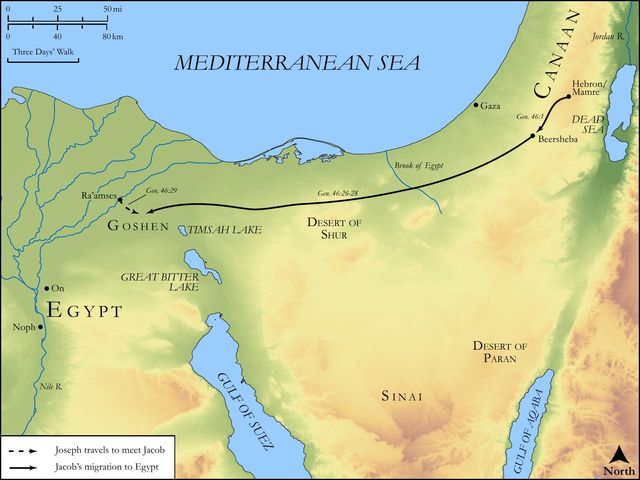
He came to Beersheba, from Hebron, where he now dwelt; and there he offered sacrifices to the God of his father Isaac, Gen 46:1. He chose that place, in remembrance of the communion which his father and grandfather had with God in that place. Abraham called on God there (Gen 21:33), so did Isaac (Gen 26:25), and therefore Jacob made it the place of his devotion, the rather because it lay in his way. In his devotion, 1. He had an eye to God as the God of his father Isaac, that is, a God in covenant with him; for by Isaac the covenant was entailed upon him. God had forbidden Isaac to go down to Egypt when there was a famine in Canaan (Gen 26:2), which perhaps Jacob calls to mind when he consults God as the God of his father Isaac, with this thought, "Lord, though I am very desirous to see Joseph, yet if thou forbid me to go down to Egypt, as thou didst my father Isaac, I will submit, and very contentedly stay where I am." 2. He offered sacrifices, extraordinary sacrifices, besides those at his stated times; these sacrifices were offered, (1.) By way of thanksgiving for the late blessed change of the face of his family, for the good news he had received concerning Joseph, and for the hopes he had of seeing him. Note, We should give God thanks for the beginnings of mercy, though they are not yet perfected; and this is a decent way of begging further mercy. (2.) By way of petition for the presence of God with him in his intended journey; he desired by these sacrifices to make his peace with God, to obtain the forgiveness of sin, that he might take no guilt along with him in this journey, for that is a bad companion. By Christ, the great sacrifice, we must reconcile ourselves to God, and offer up our requests to him. (3.) By way of consultation. The heathen consulted their oracles by sacrifice. Jacob would not go till he had asked God's leave: "Shall I go down to Egypt, or back to Hebron?" Such must be our enquiries in doubtful cases; and, though we cannot expect immediate answers from heaven, yet, if we diligently attend to the directions of the word, conscience, and providence, we shall find it is not in vain to ask counsel of God.
II.How God directed his paths:
In the visions of the night (probably the very next night after he had offered his sacrifices, as Ch2 1:7) God spoke unto him, Gen 46:2. Note, Those who desire to keep up communion with God shall find that it never fails on his side. If we speak to him as we ought, he will not fail to speak to us. God called him by name, by his old name, Jacob, Jacob, to remind him of his low estate; his present fears did scarcely become an Israel. Jacob, like one well acquainted with the visions of the Almighty, and ready to obey them, answers, "Here I am, ready to receive orders:" and what has God to say to him?
1.He renews the covenant with him: I am God, the God of thy father (Gen 46:3); that is, "I am what thou ownest me to be: thou shalt find me a God, a divine wisdom and power engaged for thee; and thou shalt find me the God of thy father, true to the covenant made with him."
2.He encourages him to make this removal of his family: Fear not to go down into Egypt. It seems, though Jacob, upon the first intelligence of Joseph's life and glory in Egypt, resolved, without any hesitation, I will go and see him; yet, upon second thoughts, he saw some difficulties in it, which he knew not well how to get over. Note, Even those changes that seem to have in them the greatest joys and hopes, yet have an alloy of cares and fears, Nulla est sincera voluptas - There is no unmingled pleasure. We must always rejoice with trembling. Jacob had many careful thoughts about this journey, which God took notice of.
(1.)He was old, 130 years old; and it is mentioned as one of the infirmities of old people that they are afraid of that which is high, and fears are in the way, Ecc 12:5. It was a long journey, and Jacob was unfit for travel, and perhaps remembered that his beloved Rachel died in a journey.
(2.)He feared lest his sons should be tainted with the idolatry of Egypt, and forget the God of their fathers, or enamoured with the pleasures of Egypt, and forget the land of promise.
(3.)Probably he thought of what God had said to Abraham concerning the bondage and affliction of his seed (Gen 15:13), and was apprehensive that his removal to Egypt would issue in that. Present satisfactions should not take us off from the consideration and prospect of future inconveniences, which possibly may arise from what now appears most promising.
(4.)He could not think of laying his bones in Egypt. But, whatever his discouragements were, this was enough to answer them all, Fear not to go down into Egypt.
3.He promises him comfort in the removal. (1.) That he should multiply in Egypt: "I will there, where thou fearest that thy family will sink and be lost, make it a great nation. That is the place Infinite Wisdom has chosen for the accomplishment of that promise." (2.) That he should have God's presence with him: I will go down with thee into Egypt. Note, Those that go whither God sends them shall certainly have God with them, and that is enough to secure them wherever they are and to silence their fears; we may safely venture even into Egypt if God go down with us. (3.) That neither he nor his should be lost in Egypt: I will surely bring thee up again. Though Jacob died in Egypt, yet this promise was fulfilled, [1.] In the bringing up of his body, to be buried in Canaan, about which, it appears, he was very solicitous, Gen 49:29, Gen 49:32. [2.] In the bringing up of his seed to be settled in Canaan. Whatever low or darksome valley we are called into at any time, we may be confident, if God go down with us into it, that he will surely bring us up again. If he go with us down to death, he will surely bring us up again to glory. (4.) That living and dying, his beloved Joseph should be a comfort to him: Joseph shall put his hand upon thine eyes. This is a promise that Joseph should live as long as he lived, that he should be with him at his death, and close his eyes with all possible tenderness and respect, as the dearest relations used to do. Probably Jacob, in the multitude of this thought within him, had been wishing that Joseph might do this last office of love for him: Ille meos oculos comprimat - Let him close my eyes; and God thus answered him in the letter of his desire. Thus God sometimes gratifies the innocent wishes of his people, and makes not only their death happy, but the very circumstances of it agreeable.
Historical interpretation
Historical reception
1 surviving comment on this verse from the historical church.
It appears fitting indeed after these things, to contemplate and look into what God says to Israel himself through the vision and how he sends him to Egypt strengthening and encouraging him as if he were setting out to some struggles. For he says, “Fear not to descend into Egypt.” This is to say, you shall contend “against principalities and powers and against the rulers of this world of this darkness”—which is figuratively called Egypt—fear not, be not afraid. But if also you wish to know the reason that you ought not fear, hear my promise: “For I will make a great nation of you there, and I will go down with you into Egypt, and I will recall you from there in the end.” He therefore with whom God shall go down into the struggles is not afraid “to go down into Egypt.” He is not afraid to approach the struggles of this world and the battles with resisting demons. For hear the apostle Paul saying, “I have labored more,” he says, “than all those, yet not I, but the grace of God with me.” But also when dissension had been stirred up against him in Jerusalem, and he performed a most brilliant struggle for the word and preaching of the Lord, the Lord stood by him and said the same things that now are said to Israel. “Fear not, Paul,” Scripture says, “for as you have testified of me in Jerusalem, so must you bear witness also at Rome.”
Continue studying Genesis 46:3 across the web’s major study libraries — every link below opens this exact verse, chapter, or book on the destination site.
Read & Compare
 BibleGatewayThis verse in more than 200 translations and 70 languages.
 Bible.comThe YouVersion reader — hundreds of translations, reading plans, and highlights.
 ESV.orgCrossway's official English Standard Version reader.
 NET BibleThe NET translation with 60,000+ translators' notes on every rendering decision.
 STEP BibleTyndale House's free study tool — original text, vocabulary, and scholarly resources.
 BibliaLogos Bible Software's free web reader.
 USCCBThe New American Bible (Revised Edition) with the U.S. bishops' study notes.
Commentaries
 BibleHub CommentariesDozens of classic commentaries on this verse, gathered on one page.
 StudyLightMore than 100 commentary sets — the largest collection on the web.
 BibleRefPlain-English commentary on what this verse means, verse by verse.
 Enduring WordDavid Guzik's free commentary on this chapter, widely used by Bible teachers.
 Bible Study ToolsVerse commentary alongside Greek and Hebrew study aids.
Original Language & Research
- BibleHub InterlinearThe verse word by word — original language, transliteration, and English.
- BibleHub LexiconEvery word's original-language definition and Strong's entry.
 Blue Letter BibleDeep-study tools — Strong's numbers, concordance, and word studies.
 SefariaThe Hebrew text with Rashi and centuries of Jewish commentary.
Sermons, Hymns & Audio


TrulyRandomVerse is not affiliated with these sites and doesn’t control their content. They’re linked because they’re genuinely useful.
Summary
In Genesis 46:3, God appears to Jacob at Beersheba, profoundly reassuring him with the command to "fear not to go down into Egypt." He identifies Himself as "God, the God of thy father," thereby reaffirming His personal covenant faithfulness across generations. This divine encounter dispels Jacob's apprehension about leaving the Promised Land and explicitly promises that God will make of his descendants a great nation in Egypt, confirming His sovereign direction for this pivotal journey and the unfolding of His redemptive plan for Israel.
Context
ShowHideLiterary Context
This verse marks a critical turning point in the Genesis narrative, immediately following Joseph's revelation to his brothers and his invitation for Jacob and his entire household to relocate to Egypt due to the severe famine gripping Canaan. Jacob, now an old man, has heard the astonishing news that Joseph is alive and ruler in Egypt (Genesis 45:26-28) and has decided to go. However, as he journeys south to Beersheba, on the very border of the Promised Land, he pauses. This pause, before crossing into a foreign land, suggests a moment of profound spiritual discernment and perhaps apprehension. God's direct intervention here provides the divine impetus and reassurance necessary for Jacob to proceed with confidence, framing the move to Egypt not as an act of desperation but as a divinely ordained step in the covenant plan.
Historical & Cultural Context
The lands of Canaan were frequently subject to famine, making Egypt, with its Nile-fed agriculture, a common refuge during such crises. However, for Jacob, leaving Canaan held immense spiritual weight. Canaan was the land promised by God to Abraham (Genesis 12:7), Isaac (Genesis 26:3), and Jacob himself (Genesis 28:13-15). To voluntarily depart from this sacred land, even for survival, could have been perceived as a breach of faith or a forfeiture of the divine promise. Beersheba itself was a significant site, a place where Abraham and Isaac had worshipped and encountered God, reinforcing its spiritual importance as a threshold. The move to Egypt, a powerful and pagan empire, also carried the risk of assimilation and loss of identity for Jacob's family, underscoring the need for divine assurance.
Key Themes
ShowHideGenesis 46:3 powerfully reinforces several overarching themes in the book of Genesis and the broader Pentateuch. It highlights Divine Providence, demonstrating God's active and sovereign control over human events, even using a famine to orchestrate the relocation of His chosen family for their preservation and future growth. The verse also underscores Covenant Faithfulness, as God reiterates His identity as "the God of thy father" and reaffirms the promise of a "great nation," directly echoing the Abrahamic Covenant. This encounter also speaks to the theme of Guidance and Assurance, as God directly addresses Jacob's fears, providing comfort and clear direction in a moment of uncertainty. Finally, it subtly introduces the theme of Growth in Adversity, foreshadowing how the family will multiply in Egypt, despite the future hardships, preparing them for their eventual return as a distinct people.
Exposition and Analysis
ShowHideKey Word Analysis
ShowHideThis term (H410) signifies strength, might, and power, often referring to the Almighty God, but also used of other deities. Here, in the context of God's self-identification, it emphasizes His supreme authority and omnipotence. When God declares, "I am God," He is asserting His absolute sovereignty and unique identity as the one true, mighty deity, capable of fulfilling His promises and guiding Jacob through any circumstance.
The primitive root (H3372) means "to fear," but also "to revere" or "to be afraid." In this context, "fear not" (a common divine imperative) directly addresses Jacob's apprehension and anxiety about the unknown, particularly leaving the Promised Land. God is not merely commanding Jacob to suppress his emotions but is providing a divine basis for confidence and trust, promising His presence and the fulfillment of His plan, thereby removing the legitimate grounds for fear.
This term (H1471) primarily refers to a foreign nation or Gentile people, but can also denote a large group or troop. In the context of the Abrahamic covenant, "great nation" consistently refers to the numerous descendants that God promised Abraham, Isaac, and now Jacob. The use of "nation" here emphasizes the numerical growth and distinct identity that Jacob's family will attain while in Egypt, fulfilling a key aspect of God's covenant promise for the formation of His chosen people.
Verse Breakdown
ShowHide"And he said, I [am] God, the God of thy father:"
This opening declaration is a profound statement of divine self-revelation and covenantal continuity. God's identification as "God" (ʼêl) underscores His absolute power and authority, while the addition "the God of thy father" (ʼĕlōhîym ʼâb) explicitly links Him to the covenant established with Abraham and Isaac. This assures Jacob that the same faithful God who guided and blessed his ancestors is actively present and committed to him, affirming the enduring nature of His promises across generations. It serves as a personal reassurance that Jacob is not venturing into the unknown alone, but under the guidance of the unchanging, covenant-keeping God.
"fear not to go down into Egypt;"
This direct divine command addresses Jacob's deepest apprehension about leaving the Promised Land. The phrase "fear not" (al-tira') is a recurring motif in Scripture, always accompanied by a reason for confidence rooted in God's presence or a specific promise. Here, it highlights God's intimate awareness of Jacob's anxieties and His readiness to provide specific, counter-intuitive direction. It implies that Jacob's hesitation was known to God, and this command provides the necessary divine endorsement for a journey that might otherwise seem to contradict the covenant promise of the land.
"for I will there make of thee a great nation:"
This promise is the divine rationale for the command to "fear not." It directly echoes and reaffirms the Abrahamic covenant's promise of numerous descendants (Genesis 12:2). It assures Jacob that even in the foreign land of Egypt, God's plan for multiplying his family would not only continue but flourish. This reveals that Jacob's move to Egypt is not merely a consequence of famine but a divinely ordained step in God's larger redemptive plan. Egypt would serve as the crucible where Jacob's descendants would grow into a mighty nation, preparing them for their eventual return to the Promised Land as a distinct and numerous people.
Literary Devices
ShowHideGenesis 46:3 is rich with significant literary devices. The most prominent is Theophany, the visible manifestation of God to humankind, as God directly appears and speaks to Jacob. This direct divine encounter underscores the gravity and importance of the message. The phrase "fear not" functions as a Divine Command or Divine Imperative, a recurring motif throughout Scripture where God directly addresses human apprehension, always followed by a reason for courage rooted in His character or promises. The identification "God, the God of thy father" is a powerful example of Covenant Language and Allusion, explicitly linking this encounter to the prior covenants with Abraham and Isaac, emphasizing God's faithfulness and the continuity of His redemptive plan. Finally, the promise "I will there make of thee a great nation" contains a subtle element of Paradox or Divine Irony, as God designates Egypt—a land that would later become a place of severe oppression for Israel—as the very place where His promise of numerical growth would be fulfilled. This foreshadows God's ability to use seemingly adverse circumstances to achieve His ultimate purposes.
Theological and Thematic Connections
ShowHideGenesis 46:3 is a profound testament to God's unwavering faithfulness, sovereign providence, and intimate care for His people. It reveals a God who is not distant but personally intervenes in the lives of His chosen, addressing their deepest fears and guiding them through seemingly illogical paths to fulfill His grand redemptive purposes. This verse underscores that God's covenant promises are not contingent on human circumstances or geographical location, but on His eternal character and power. He is the God who initiates, sustains, and brings to completion His divine plan, using even the most challenging circumstances as instruments for the growth and formation of His people.
Reflection and Application
ShowHideGenesis 46:3 offers profound comfort and practical guidance for believers navigating life's uncertainties. Just as Jacob faced the daunting prospect of leaving his ancestral land for the unknown, we too encounter moments of significant transition, fear, or doubt about God's direction. This verse reminds us that our God is intimately aware of our apprehensions; He sees our hesitations and directly addresses them with His reassuring presence and unfailing promises. When faced with decisions that require a leap of faith or a step into unfamiliar territory, we are called to remember that God's purposes often unfold in ways we don't immediately comprehend. He may lead us into "Egypts" – places or circumstances that seem counter-intuitive or even challenging – but always with a sovereign plan for our ultimate good and the fulfillment of His kingdom purposes. Our response, like Jacob's, should be one of trust and obedience, knowing that the God who was faithful to Abraham, Isaac, and Jacob is the same faithful God who guides and sustains us today, ensuring that His promises for our lives will come to fruition.
Questions for Reflection
ShowHideFAQ
ShowHideWhy was Jacob hesitant to go to Egypt?
ShowHideJacob was hesitant to leave Canaan because it was the land God had promised to his forefathers Abraham and Isaac, and subsequently to him, as the covenant land. Moving to a foreign land like Egypt, even to escape famine, would have felt like abandoning God's promise and venturing into the unknown, potentially endangering the future of his family as the chosen lineage and the inheritors of the covenant. His pause at Beersheba, a site of ancestral divine encounters, underscores his need for direct divine confirmation before proceeding.
What is the significance of God identifying as "the God of thy father"?
ShowHideThis identification is profoundly significant as it emphasizes God's personal, generational faithfulness and His unwavering commitment to the covenant established with Abraham and Isaac. By invoking the patriarchs, God reassures Jacob that the same God who guided and blessed his ancestors is the one now guiding him. This affirms the continuity and reliability of God's promises and His ongoing relationship with His chosen people, dispelling Jacob's fears about the implications of leaving the Promised Land.
How does this verse connect to the Abrahamic Covenant?
ShowHideThe promise "for I will there make of thee a great nation" directly echoes the core promise given to Abraham in Genesis 12:2 that his descendants would become a great nation. This verse confirms that even in Egypt, God's plan for the numerical growth of His people—a key component of the Abrahamic Covenant—would continue to unfold. It demonstrates God's sovereign ability to fulfill His promises regardless of geographical location or immediate circumstances, using the move to Egypt as a strategic step in the covenant's progression.
Why would God lead His people into Egypt, a place of future bondage?
ShowHideGod's plans often involve paradoxical paths. While Egypt would indeed later become a place of severe oppression and bondage for the Israelites, it was initially a place of preservation and immense growth. The time in Egypt allowed Jacob's relatively small family to multiply into a vast nation, fulfilling God's promise of numerous descendants, before they were ready to return to Canaan as a distinct and numerous people. It served as a necessary crucible for their formation and identity as God's chosen nation, preparing them for the Exodus and the establishment of the nation of Israel. God's ultimate purpose transcends immediate comfort, working through challenging circumstances for greater redemptive ends.
Christ-Centered Fulfillment
ShowHideGenesis 46:3 finds its ultimate Christ-centered fulfillment in God's unwavering commitment to His redemptive plan, which culminates in the person and work of Jesus Christ. Just as God preserved and multiplied Jacob's family in Egypt, ensuring the continuation of the covenant line through which the Messiah would come, so too does God sovereignly guide all circumstances to bring forth His Son. Christ is the ultimate "great nation" in a spiritual sense, as He gathers all who believe—from every tribe, tongue, and nation—into His kingdom, transcending physical boundaries and fulfilling the promise of a people for God (Revelation 7:9-10). Furthermore, Christ embodies the "God of thy father," being the very Son who perfectly reveals the Father (John 14:9) and fulfills all covenant promises made to Abraham and his descendants (Galatians 3:16). He is the one who leads His people through all uncertainties and "Egypts" of life, assuring them with His constant presence, "I am with you always, even unto the end of the world" (Matthew 28:20), guiding them into their eternal inheritance in Him.