


Genesis 46:34
Bible text: King James Version (1769 Blayney text) · Public domain
Bible text: King James Version with Strong's numbers · Public domain
Bible text: Berean Standard Bible · Public domain
Bible text: American Standard Version (1901) · Public domain
Bible text: World English Bible, Messianic edition · Public domain
Bible text: Geneva Bible (1599) · Public domain
Bible text: Young's Literal Translation · Public domain
- וַאֲמַרְתֶּםva·'a·mar·Temand you will sayH559Conj-w ¦ V-Qal-ConsecPerf-2mpVerb Qal Consecutive Perfect 2nd Plural Masculineוַandאֲמַרְתֶּםyou will say
- אַנְשֵׁי'an·Sheimen ofH582N-mpcNoun Plural Masculine Construct
- מִקְנֶהmik·NehlivestockH4735N-msNoun Singular Masculine Absolute
- הָיוּha·Yuthey have beenH1961V-Qal-Perf-3cpVerb Qal Perfect 3rd Plural common gender
- עֲבָדֶיךָ'a·va·Dei·khayour servantsH5650N-mpc ¦ 2msNoun Plural Masculine Constructעֲבָדֶיservantsךָyour
- מִנְּעוּרֵינוּmi·ne·'u·Rei·nusince our youth<s>H5271Prep-m ¦ N-mpc ¦ 1cpNoun Plural Masculine Constructמִsinceנְּעוּרֵיyouth<s>נוּour
- וְעַדve·'adand untilH5704Conj-w ¦ PrepPrepositionוְandעַדuntil
- עַתָּה'A·tahnowH6258AdvAdverb
- גַּםgambothH1571AdvAdverb
- אֲנַחְנוּ'a·Nach·nuweH587Pro-1cpPronoun Personal 1st Plural common gender
- גַּםgamas well asH1571AdvAdverb
- אֲבֹתֵינוּ'a·vo·Tei·nuour fathersH1N-fpc ¦ 1cpNoun Plural Feminine Constructאֲבֹתֵיfathersנוּour
- בַּעֲבוּרba·'a·Vurin order thatH5668Prep-b ¦ N-msNoun Singular Masculine Absoluteבַּinעֲבוּרorder that
- תֵּשְׁבוּte·she·Vuyou may dwellH3427V-Qal-Imperf-2mpVerb Qal Imperfect 2nd Plural Masculine
- בְּאֶרֶץbe·'E·retzin [the] land ofH776Prep-b ¦ N-fscNoun Singular Feminine Constructבְּinאֶרֶץ[the] land of
- גֹּשֶׁןGo·shenGoshenH1657N-properNoun Proper Location
- כִּיkiforH3588PrtParticle Conditional
- תוֹעֲבַתto·'a·Vat[is] [the] abomination ofH8441N-fscNoun Singular Feminine Construct
- מִצְרַיִםmitz·Ra·yimEgyptH4713N-properNoun Proper Location
- כָּלkoleveryH3605N-msNoun Singular Masculine Absolute
- רֹעֵהRo·'ehshepherd ofH7462V-Qal-Prtcpl-msVerb Qal Participle Singular Masculine Construct
- צֹאןTzonsheepH6629N-csNoun Singular common gender Absolute
English is a literal word-by-word gloss of the Hebrew, not the KJV's wording. Why?
This is the original text the KJV's translators worked from — each Hebrew word with its own literal English meaning in this verse, prepared by scholars at Tyndale House, Cambridge. The KJV translates whole sentences, not word by word, so its wording differs: one Hebrew word can become several English words, and the KJV may choose “the LORD” where the gloss reads “Yahweh”. Both are faithful — they answer different questions. For the KJV's own rendering, switch to the KJV text.
Details
See on the biblical-era maps


Study this verse
Public-domain commentary
Matthew Henry
From his Commentary on the Whole Bible. Henry comments on passages, not single verses — this entry covers Genesis 46:28–34. His three-level outline is real structure in the source text, so it is rendered as structure.
We have here, I. The joyful meeting between Jacob and his son Joseph, in which observe,
1.Jacob's prudence in sending Judah before him to Joseph, to give him notice of his arrival in Goshen. This was a piece of respect owing to the government, under the protection of which these strangers had come to put themselves, Gen 46:28. We should be very careful not to give offence to any, especially not to the higher powers.
2.Joseph's filial respect to him. He went in his chariot to met him, and, in the interview, showed,
(1.)How much he honoured him: He presented himself unto him. Note, It is the duty of children to reverence their parents, yea, though Providence, as to outward condition, has advanced them above their parents.
(2.)How much he loved him. Time did not wear out the sense of his obligations, but his tears which he shed abundantly upon his father's neck, for joy to see him, were real indications of the sincere and strong affection he had for him. See how near sorrow and joy are to each other in this world, when tears serve for the expression of both. In the other world weeping will be restrained to sorrow only; in heaven there is perfect joy, but no tears of joy: all tears, even those, shall there be wiped away, because the joys there are, as no joys are here, without any alloy. When Joseph embraced Benjamin he wept upon his neck, but when he embraced his father he wept upon his neck a good while; his brother Benjamin was dear, but his father Jacob must be dearer.
3.Jacob's great satisfaction in this meeting: Now let me die, Gen 46:30. Not but that it was further desirable to live with Joseph, and to see his honour and usefulness; but he had so much pleasure and satisfaction in this first meeting that he thought it too much to desire or expect any more in this world, where our comforts must always be imperfect. Jacob wished to die immediately, and lived seventeen years longer, which, as our lives go now, is a considerable part of a man's age. Note, Death will not always come just when we call for it, whether in a passion of sorrow or in a passion of joy. Our times are in God's hand, and not in our own; we must die just when God pleases, and not either just when we are surfeited with the pleasures of life or just when we are overwhelmed with its griefs.
II.Joseph's prudent care concerning his brethren's settlement.
It was justice to Pharaoh to let him know that such a colony had come to settle in his dominions. Note, If others repose a confidence in us, we must not be so base and disingenuous as to abuse it by imposing upon them. If Jacob and his family should come to be a charge to the Egyptians, yet it should never be said that they came among them clandestinely and by stealth. Thus Joseph took care to pay his respects to Pharaoh, Gen 46:31. But how shall he dispose of his brethren? Time was when they were contriving to get rid of him; now he is contriving to settle them to their satisfaction and advantage: This is rendering good for evil. Now,
1.He would have them to live by themselves, separate as much as might be from the Egyptians, in the land of Goshen, which lay nearest to Canaan, and which perhaps was more thinly peopled by the Egyptians, and well furnished with pastures for cattle. He desired they might live separately, that they might be in the less danger both of being infected by the vices of the Egyptians and of being insulted by the malice of the Egyptians. Shepherds, it seems, were an abomination to the Egyptians, that is, they looked upon them with contempt, and scorned to converse with them; and he would not send for his brethren to Egypt to be tramped upon. And yet,
2.He would have them to continue shepherds, and not to be ashamed to own that as their occupation before Pharaoh. He could have employed them under himself in the corn-trade, or perhaps, by his interest in the king, might have procured places for them at court or in the army, and some of them, at least, were deserving enough; but such preferments would have exposed them to the envy of the Egyptians, and would have tempted them to forget Canaan and the promise made unto their fathers; therefore he contrives to continue them in their old employment. Note,
(1.)An honest calling is no disparagement, nor ought we to account it so either in ourselves or in our relations, but rather reckon it a shame to be idle, or to have nothing to do.
(2.)It is generally best for people to abide in the callings that they have been bred to, and used to, Co1 7:24. Whatever employment or condition God, in his providence, has allotted for us, let us accommodate ourselves to it, and satisfy ourselves with it, and not mind high things. It is better to be the credit of a mean post than the shame of a high one.
Historical interpretation
Historical reception
2 surviving comments on this verse. Each one is dated, so this reads as a timeline rather than a list.
Select a marker to jump to its quote. Markers stagger vertically where authors wrote within a few decades of each other.
Joseph went out to meet his father with chariots and with many people. [Joseph] got down [from his horse] and bowed down to his father, and they wept on each other’s neck. Then Joseph commanded his brothers to say to Pharaoh, “We and our fathers are keepers of cattle,” so that they might dwell in Goshen and thus keep their distance from those who worship sheep and bulls.
Note the shrewdness with which Joseph advises them, not idly or to no purpose making these suggestions but anxious to put them in a more secure position and at the same time to ensure their assimilation among the Egyptians. You see, since they loathed and despised those who tended flocks for having no time for Egyptian wisdom, consequently he counsels them to make a pretense of their occupation so that he may plausibly apportion them the most attractive land and cause them to live in considerable prosperity.
Continue studying Genesis 46:34 across the web’s major study libraries — every link below opens this exact verse, chapter, or book on the destination site.
Read & Compare
 BibleGatewayThis verse in more than 200 translations and 70 languages.
 Bible.comThe YouVersion reader — hundreds of translations, reading plans, and highlights.
 ESV.orgCrossway's official English Standard Version reader.
 NET BibleThe NET translation with 60,000+ translators' notes on every rendering decision.
 STEP BibleTyndale House's free study tool — original text, vocabulary, and scholarly resources.
 BibliaLogos Bible Software's free web reader.
 USCCBThe New American Bible (Revised Edition) with the U.S. bishops' study notes.
Commentaries
 BibleHub CommentariesDozens of classic commentaries on this verse, gathered on one page.
 StudyLightMore than 100 commentary sets — the largest collection on the web.
 BibleRefPlain-English commentary on what this verse means, verse by verse.
 Enduring WordDavid Guzik's free commentary on this chapter, widely used by Bible teachers.
 Bible Study ToolsVerse commentary alongside Greek and Hebrew study aids.
Original Language & Research
- BibleHub InterlinearThe verse word by word — original language, transliteration, and English.
- BibleHub LexiconEvery word's original-language definition and Strong's entry.
 Blue Letter BibleDeep-study tools — Strong's numbers, concordance, and word studies.
 SefariaThe Hebrew text with Rashi and centuries of Jewish commentary.
Sermons, Hymns & Audio


TrulyRandomVerse is not affiliated with these sites and doesn’t control their content. They’re linked because they’re genuinely useful.
Summary
Genesis 46:34 records Joseph's strategic instruction to his brothers: to declare their lifelong occupation as shepherds to Pharaoh. This calculated move was designed to secure their settlement in the fertile land of Goshen, leveraging the Egyptians' cultural aversion to shepherds. Joseph's plan masterfully ensures the distinct and isolated preservation of Jacob's family, safeguarding them from assimilation and the pervasive famine, thereby laying the groundwork for their growth into the future nation of Israel.
Context
ShowHideLiterary Context
This verse is situated at a pivotal moment in the Genesis narrative, immediately following Joseph's emotional reunion with his father, Jacob, and the arrival of Jacob's entire household in Egypt. Joseph, now the second-in-command of Egypt, has orchestrated this migration due to the severe famine gripping the land. Chapters 45 and 46 detail the preparations for the family's journey and their arrival. Joseph's instructions in Genesis 46:31-34 are a crucial final step before Jacob and his sons are formally presented to Pharaoh. This strategic counsel highlights Joseph's wisdom and foresight, demonstrating his active role in ensuring the well-being and distinct identity of his family within a foreign land. The preceding verses emphasize the divine orchestration of these events, with God assuring Jacob of His presence and blessing in Egypt (e.g., Genesis 46:3-4).
Historical & Cultural Context
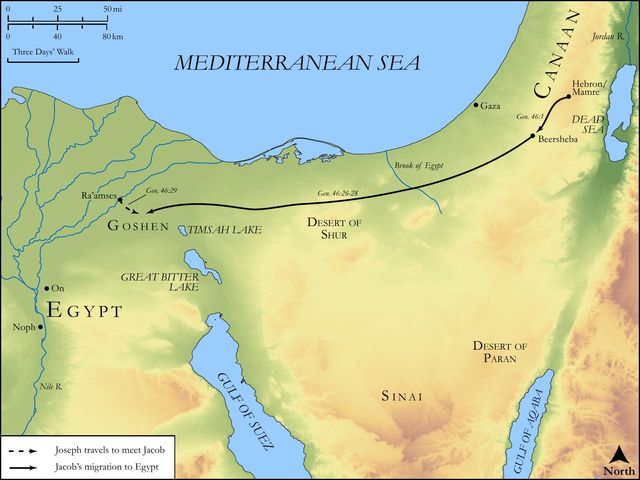
Ancient Egypt was a highly organized, agrarian society that placed great value on settled agriculture, monumental architecture, and a rigid social hierarchy. The Nile River was the lifeblood of their civilization, dictating their agricultural cycles and fostering a sedentary lifestyle. Nomadic peoples, particularly shepherds, were often viewed with suspicion, disdain, or even contempt. This aversion stemmed from several factors: their mobile lifestyle was disruptive to Egyptian settled life, their practices might involve the sacrifice of animals (like cattle) that Egyptians considered sacred or symbolic of deities, and they were often associated with foreign invaders or overlooked groups. The Hyksos, a Semitic people who had previously ruled parts of Egypt, were also associated with shepherding, which may have contributed to this prejudice. The land of Goshen, located in the eastern Nile Delta, was known for its rich pasturage, making it ideal for the Hebrews' large flocks and herds, while also providing a natural geographic buffer from the main Egyptian population centers.
Key Themes
ShowHideGenesis 46:34 contributes significantly to several overarching themes in Genesis and the broader biblical narrative. It underscores the theme of Divine Providence, as God sovereignly guides events and even human prejudices to fulfill His covenant promises to Abraham, Isaac, and Jacob, ensuring the preservation and growth of the nascent nation of Israel (e.g., Genesis 12:2). The verse also highlights the importance of Cultural Distinction and separation for God's chosen people, a theme that will become paramount during the Exodus and the giving of the Law, where Israel is called to be "a kingdom of priests and a holy nation" (Exodus 19:6). Furthermore, Joseph's wisdom exemplifies Strategic Leadership and discernment, demonstrating how human agency, guided by divine wisdom, can navigate complex socio-political landscapes to achieve God's purposes.
Exposition and Analysis
ShowHideKey Word Analysis
ShowHideThis primitive root means "to tend a flock," "to pasture it," or generally "to rule." In this context, it refers to the occupation of tending livestock, a central aspect of the Hebrew patriarchal lifestyle. The term highlights the fundamental difference in livelihood and cultural values between Jacob's family and the Egyptians, which Joseph strategically exploits.
This feminine active participle signifies "something disgusting (morally)," "an abhorrence," or "especially idolatry or (concretely) an idol." Here, it powerfully conveys the intense cultural, social, and potentially religious detestation Egyptians held for shepherds. It's not merely a dislike but a deep-seated revulsion, making the declaration of their trade a highly effective diplomatic maneuver.
A primitive root meaning "to sit down," "to remain," or "to settle." Joseph's ultimate goal in this instruction is to secure a permanent and distinct place for his family to "dwell" in Egypt, specifically in Goshen, ensuring their stability and growth away from the main Egyptian populace.
Verse Breakdown
ShowHide"That ye shall say, Thy servants' trade hath been about cattle from our youth even until now, both we, and also our fathers:"
Joseph instructs his brothers to explicitly state their ancestral occupation as herdsmen. This declaration emphasizes their deep-rooted connection to livestock, signifying a lifelong, generational commitment to this trade. It establishes their identity as distinct from the Egyptians and provides a clear reason for their need for vast grazing lands.
"that ye may dwell in the land of Goshen;"
This clause reveals the immediate purpose of Joseph's strategy: to secure settlement in Goshen. Joseph knows Goshen is ideal due to its fertile pastures and its geographical isolation from the main centers of Egyptian population and culture. This placement is crucial for the family's physical sustenance and future growth.
"for every shepherd is an abomination unto the Egyptians."
This final clause provides the critical rationale behind Joseph's instruction. It reveals his astute understanding of Egyptian cultural prejudices. By declaring themselves shepherds, Joseph ensures that Pharaoh will readily agree to settle them in a separate, isolated region, thereby avoiding cultural assimilation and potential conflict, and preserving the distinct identity of the nascent nation of Israel.
Literary Devices
ShowHideThe verse employs Strategic Diplomacy, as Joseph masterfully leverages existing cultural prejudices to achieve a desired outcome for his family. This isn't merely a factual statement but a calculated maneuver designed to manipulate Pharaoh's biases for the benefit of God's people. There is also an element of Irony at play: what is considered an "abomination" by the Egyptians becomes the very means by which God's chosen people are protected and allowed to flourish. Furthermore, the verse contains Foreshadowing, as the forced separation of the Hebrews in Goshen due to Egyptian aversion anticipates their later distinct identity as God's people, set apart from the nations, and also hints at the eventual oppression they will face in Egypt, which further solidifies their unique national identity.
Theological and Thematic Connections
ShowHideGenesis 46:34 profoundly illustrates God's meticulous providence, demonstrating how He orchestrates even the cultural biases of a foreign nation to fulfill His divine plan for His covenant people. Joseph's wisdom, guided by divine insight, ensures the preservation and growth of Jacob's family, safeguarding them from assimilation into Egyptian polytheism and culture. This strategic separation in Goshen is crucial for maintaining the distinct identity of the lineage through whom the Messiah would come, preparing them to become a great nation as promised to Abraham. It underscores that God's faithfulness extends to providing practical means for His people's survival and spiritual integrity in a hostile world.
Reflection and Application
ShowHideGenesis 46:34 offers profound insights for believers navigating a complex world. It reminds us that God is sovereign over all circumstances, even the prejudices and cultural norms of societies, and can use them for His redemptive purposes. Like Joseph, we are called to exercise wisdom and discernment in our interactions with the world, understanding its nuances and making strategic choices that protect our spiritual integrity and advance God's kingdom. This passage also powerfully underscores the importance of maintaining a distinct identity as God's people. While we are called to be "in the world," we are not to be "of the world" (John 17:14-16), and sometimes, a degree of separation or distinctness is necessary for our spiritual health, protection from corrupting influences, and preparation for God's greater plans for us. This distinction is not about isolation for isolation's sake, but about preserving our unique identity as those set apart for Christ.
Questions for Reflection
ShowHideFAQ
ShowHideWhy was shepherding considered an "abomination" to the Egyptians?
ShowHideThe term "abomination" (Hebrew: tôwʻêbah') signifies something deeply detestable or morally offensive. For the Egyptians, a settled, agrarian society with a complex religious system, nomadic shepherds were viewed with strong disdain for several reasons. Firstly, their nomadic lifestyle was perceived as uncivilized and disruptive to the Egyptians' highly organized agricultural practices. Secondly, shepherds might sacrifice animals, including cattle, which were revered or considered sacred by Egyptians, making their practices religiously offensive. Thirdly, the occupation was likely associated with lower social strata or even foreign invaders, such as the Hyksos, who had a pastoral background and had previously ruled parts of Egypt. This strong cultural and religious aversion provided a convenient and readily accepted reason for Pharaoh to keep the Hebrews separate in the land of Goshen, a strategic outcome desired by Joseph.
Christ-Centered Fulfillment
ShowHideWhile Genesis 46:34 directly concerns the preservation of Israel's lineage, it profoundly points forward to Christ in its demonstration of divine providence and the establishment of a distinct people through whom salvation would come. Just as Joseph, a type of Christ, strategically preserved his family in Goshen, ensuring the lineage from which the Messiah would descend, Christ, the ultimate Good Shepherd, gathers and preserves His flock, the Church. He sets His people apart from the world, calling them out of darkness into His marvelous light (1 Peter 2:9). Through His atoning work, Christ leads His people into a spiritual "Goshen"—a place of refuge, distinct identity, and spiritual nourishment, where they are nurtured and prepared for His eternal purposes. This divine segregation, not based on cultural prejudice but on spiritual redemption, ensures that His Church remains distinct and holy, ultimately fulfilling all the promises made to Abraham through His perfect sacrifice and the establishment of His everlasting kingdom (Hebrews 9:12).