


Genesis 47:1
Bible text: King James Version (1769 Blayney text) · Public domain
Bible text: King James Version with Strong's numbers · Public domain
Bible text: Berean Standard Bible · Public domain
Bible text: American Standard Version (1901) · Public domain
Bible text: World English Bible, Messianic edition · Public domain
Bible text: Geneva Bible (1599) · Public domain
Bible text: Young's Literal Translation · Public domain
- וַיָּבֹאvai·ya·Vo'and he wentH935Conj-w ¦ V-Qal-ConsecImperf-3msVerb Qal Consecutive Imperfect 3rd Singular Masculineוַandיָּבֹאhe went
- יוֹסֵףyo·SefJosephH3130N-proper-mNoun Proper Masculine
- וַיַּגֵּדvai·ya·Gedand he toldH5046Conj-w ¦ V-Hiphil-ConsecImperf-3msVerb Hiphil Consecutive Imperfect 3rd Singular Masculineוַandיַּגֵּדhe told
- לְפַרְעֹהle·far·'Ohto PharaohH6547Prep-l ¦ N-msNoun Title Singular Masculine AbsoluteלְtoפַרְעֹהPharaoh
- וַיֹּאמֶרvai·Yo·merand he saidH559Conj-w ¦ V-Qal-ConsecImperf-3msVerb Qal Consecutive Imperfect 3rd Singular Masculineוַandיֹּאמֶרhe said
- אָבִי'a·Vimy fatherH1N-msc ¦ 1csNoun Singular Masculine Constructאָבִfatherיmy
- וְאַחַיve·'a·Chaiand my brothersH251Conj-w ¦ N-mpc ¦ 1csNoun Plural Masculine Constructוְandאַחַbrothersיmy
- וְצֹאנָםve·tzo·Namand their flock[s]H6629Conj-w ¦ N-csc ¦ 3mpNoun Singular common gender Constructוְandצֹאנָflock[s]םtheir
- וּבְקָרָםu·ve·ka·Ramand their herd[s]H1241Conj-w ¦ N-csc ¦ 3mpNoun Singular common gender Constructוּandבְקָרָherd[s]םtheir
- וְכָלve·kholand allH3605Conj-w ¦ N-msNoun Singular Masculine Absoluteוְandכָלall
- אֲשֶׁר'a·SherthatH834RelParticle Relative
- לָהֶםla·Hem[belongs] to themPrep-l ¦ 3mpSuffix Personal 3rd Plural Masculineלָ[belongs] toהֶםthem
- בָּאוּBa·'uthey have comeH935V-Qal-Perf-3cpVerb Qal Perfect 3rd Plural common gender
- מֵאֶרֶץme·'E·retzfrom [the] land ofH776Prep-m ¦ N-fscNoun Singular Feminine Constructמֵfromאֶרֶץ[the] land of
- כְּנָעַןke·Na·'anCanaanH3667N-properNoun Proper Location
- וְהִנָּםve·hi·Namand there theyH2005Conj-w ¦ Prt ¦ 3mpParticle Interjectionוְandהִנָּthereםthey
- בְּאֶרֶץbe·'E·retz[are] in [the] land ofH776Prep-b ¦ N-fscNoun Singular Feminine Constructבְּ[are] inאֶרֶץ[the] land of
- גֹּשֶׁןGo·shenGoshenH1657N-properNoun Proper Location
English is a literal word-by-word gloss of the Hebrew, not the KJV's wording. Why?
This is the original text the KJV's translators worked from — each Hebrew word with its own literal English meaning in this verse, prepared by scholars at Tyndale House, Cambridge. The KJV translates whole sentences, not word by word, so its wording differs: one Hebrew word can become several English words, and the KJV may choose “the LORD” where the gloss reads “Yahweh”. Both are faithful — they answer different questions. For the KJV's own rendering, switch to the KJV text.
Details
See on the biblical-era maps


Study this verse
Public-domain commentary
Matthew Henry
From his Commentary on the Whole Bible. Henry comments on passages, not single verses — this entry covers Genesis 47:1–12. His four-level outline is real structure in the source text, so it is rendered as structure.
Here is, I. The respect which Joseph, as a subject, showed to his prince. Though he was his favourite, and prime-minister of state, and had had particular orders from him to send for his father down to Egypt, yet he would not suffer him to settle till he had given notice of it to Pharaoh, Gen 47:1. Christ, our Joseph, disposes of his followers in his kingdom as it is prepared of his Father, saying, It is not mine to give, Mat 20:23.
II.The respect which Joseph, as a brother, showed to his brethren, notwithstanding all the unkindness he had formerly received from them.
1.Though he was a great man, and they were comparatively mean and despicable, especially in Egypt, yet he owned them. Let those that are rich and great in the world learn hence not to overlook nor despise their poor relations. Every branch of the tree is not a top branch; but, because it is a lower branch, is it therefore not of the tree? Our Lord Jesus, like Joseph here, is not ashamed to call us brethren.
2.They being strangers and no courtiers, he introduced some of them to Pharaoh, to kiss his hand, as we say, intending thereby to put an honour upon them among the Egyptians. Thus Christ presents his brethren in the court of heaven, and improves his interest for them, though in themselves unworthy and an abomination to the Egyptians. Being presented to Pharaoh, according to the instructions which Joseph had given them, they tell him,
(1.)What was their business - that they were shepherds, Gen 47:3. Pharaoh asked them (and Joseph knew it would be one of his first questions, Gen 46:33), What is your occupation? He takes it for granted they had something to do, else Egypt should be no place for them, no harbour for idle vagrants. If they would not work, they should not eat of his bread in this time of scarcity. Note, All that have a place in the world should have an employment in it according to their capacity, some occupation or other, mental or manual. Those that need not work for their bread must yet have something to do, to keep them from idleness. Again, Magistrates should enquire into the occupation of their subjects, as those that have the care of the public welfare; for idle people are as drones in the hive, unprofitable burdens of the commonwealth.
(2.)What was their business in Egypt - to sojourn in the land (Gen 47:4), not to settle there for ever, only to sojourn there for a time, while the famine so prevailed in Canaan, which lay high, that it was not habitable for shepherds, the grass being burnt up much more than in Egypt, which lay low, and where the corn chiefly failed, while there was tolerably good pasture.
3.He obtained for them a grant of a settlement in the land of Goshen, Gen 47:5, Gen 47:6. This was an instance of Pharaoh's gratitude to Joseph; because he had been such a blessing to him and his kingdom, he would be kind to his relations, purely for his sake. He offered them preferment as shepherds over his cattle, provided they were men of activity; for it is the man who is diligent in his business that shall stand before kings. And, whatever our profession or employment is, we should aim to be excellent in it, and to prove ourselves ingenious and industrious.
III.The respect Joseph, as a son, showed to his father.
1.He presented him to Pharaoh, Gen 47:7. And here,
(1.)Pharaoh asks Jacob a common question: How old art thou? Gen 47:8. A question usually put to old men, for it is natural to us to admire old age and to reverence it (Lev 19:32), as it is very unnatural and unbecoming to despise it, Isa 3:5. Jacob's countenance, no doubt, showed him to be very old, for he had been a man of labour and sorrow; in Egypt people were not so long-lived as in Canaan, and therefore Pharaoh looks upon Jacob with wonder; he was as a show in his court. When we are reflecting upon ourselves, this should come into the account, "How old are we?"
(2.)Jacob gives Pharaoh an uncommon answer, Isa 3:9. He speaks as becomes a patriarch, with an air of seriousness, for the instruction of Pharaoh. Though our speech be not always of grace, yet it must thus be always with grace. Observe here,
[1.]He calls his life a pilgrimage, looking upon himself as a stranger in this world, and a traveller towards another world: this earth his inn, not his home. To this the apostle refers (Heb 11:13), They confessed that they were strangers and pilgrims. He not only reckoned himself a pilgrim now that he was in Egypt, a strange country in which he never was before; but his life, even in the land of his nativity, was a pilgrimage, and those who so reckon it can the better bear the inconvenience of banishment from their native soil; they are but pilgrims still, and so they were always.
[2.]He reckons his life by days; for, even so, it is soon reckoned, and we are not sure of the continuance of it for a day to an end, but may be turned out of this tabernacle at less than an hour's warning. Let us therefore number our days (Psa 90:12), and measure them, Psa 39:4.
[3.]The character he gives of them is, First, That they were few. Though he had now lived 130 years, they seemed to him but a few days, in comparison with the days of eternity, the eternal God, and the eternal state, in which a thousand years (longer than ever any man lived) are but as one day. Secondly, That they were evil. This is true concerning man in general, he is of few days, and full of trouble (Job 14:1); and, since his days are evil, it is well they are few. Jacob's life, particularly, had been made up of evil days; and the pleasantest days of his life were yet before him. Thirdly, That they were short of the days of his fathers, not so many, not so pleasant, as their days. Old age came sooner upon him than it had done upon some of his ancestors. As the young man should not be proud of his strength or beauty, so the old man should not be proud of his age, and the crown of his hoary hairs, though others justly reverence it; for those who are accounted very old attain not to the years of the patriarchs. The hoary head is a crown of glory only when it is found in the way of righteousness.
(3.)Jacob both addresses himself to Pharaoh and takes leave of him with a blessing (Gen 47:7): Jacob blessed Pharaoh, and again, Gen 47:10, which was not only an act of civility (he paid him respect and returned him thanks for his kindness), but an act of piety - he prayed for him, as one having the authority of a prophet and a patriarch. Though in worldly wealth Pharaoh was the greater, yet, in interest with God, Jacob was the greater; he was God's anointed, Psa 105:15. And a patriarch's blessing was not a thing to be despised, no, not by a potent prince. Darius valued the prayers of the church for himself and for his sons, Ezr 6:10. Pharaoh kindly received Jacob, and, whether in the name of a prophet or no, thus he had a prophet's reward, which sufficiently recompensed him, not only for his courteous converse with him, but for all the other kindnesses he showed to him and his.
2.He provided well for him and his, placed him in Goshen (Gen 47:11), nourished him and all his with food convenient for them, Gen 47:12. This bespeaks, not only Joseph a good man, who took this tender care of his poor relations, but God a good God, who raised him up for this purpose, and put him into a capacity of doing it, as Esther came to the kingdom for such a time as this. What God here did for Jacob he has, in effect, promised to do for all his, that serve him and trust in him. Psa 37:19, In the days of famine they shall be satisfied.
Continue studying Genesis 47:1 across the web’s major study libraries — every link below opens this exact verse, chapter, or book on the destination site.
Read & Compare
 BibleGatewayThis verse in more than 200 translations and 70 languages.
 Bible.comThe YouVersion reader — hundreds of translations, reading plans, and highlights.
 ESV.orgCrossway's official English Standard Version reader.
 NET BibleThe NET translation with 60,000+ translators' notes on every rendering decision.
 STEP BibleTyndale House's free study tool — original text, vocabulary, and scholarly resources.
 BibliaLogos Bible Software's free web reader.
 USCCBThe New American Bible (Revised Edition) with the U.S. bishops' study notes.
Commentaries
 BibleHub CommentariesDozens of classic commentaries on this verse, gathered on one page.
 StudyLightMore than 100 commentary sets — the largest collection on the web.
 BibleRefPlain-English commentary on what this verse means, verse by verse.
 Enduring WordDavid Guzik's free commentary on this chapter, widely used by Bible teachers.
 Bible Study ToolsVerse commentary alongside Greek and Hebrew study aids.
Original Language & Research
- BibleHub InterlinearThe verse word by word — original language, transliteration, and English.
- BibleHub LexiconEvery word's original-language definition and Strong's entry.
 Blue Letter BibleDeep-study tools — Strong's numbers, concordance, and word studies.
 SefariaThe Hebrew text with Rashi and centuries of Jewish commentary.
Sermons, Hymns & Audio


TrulyRandomVerse is not affiliated with these sites and doesn’t control their content. They’re linked because they’re genuinely useful.
Summary
Genesis 47:1 records Joseph's formal and diligent report to Pharaoh, confirming the successful arrival of his entire family—his father Jacob, his brethren, and all their extensive possessions—from the land of Canaan. This pivotal announcement solidifies their divinely orchestrated settlement in the fertile region of Goshen, marking a crucial step in the preservation and growth of the nascent nation of Israel within the secure confines of Egypt.
Context
ShowHideLiterary Context
This verse immediately follows the deeply emotional reunion of Joseph with his father Jacob and the rest of his family in Egypt, as detailed in Genesis 46. Joseph had already secured Pharaoh's permission for his family to settle in Goshen (Genesis 45:10 and Genesis 46:28-34). The preceding chapters highlight the severe famine gripping the land, Joseph's providential rise to power as Pharaoh's vizier, and his strategic planning to save both Egypt and his family from starvation. Genesis 47:1, therefore, serves as a formal administrative update, confirming the completion of the family's relocation and their establishment in the designated land, setting the stage for their interaction with Pharaoh and their subsequent growth in Egypt.
Historical & Cultural Context
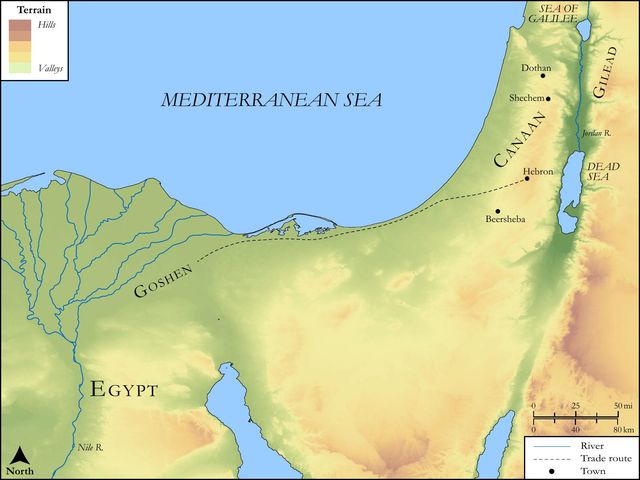
Ancient Egypt was a highly structured society with a powerful pharaoh at its apex. Official reports and adherence to royal protocol were paramount. Joseph, as the vizier, was bound by these customs, and his immediate report to Pharaoh upon his family's arrival demonstrates his respect for the king's authority and his commitment to his administrative duties. The "land of Goshen" was a specific region in the eastern Nile Delta, known for its rich pasturage, making it ideal for the pastoral lifestyle of Jacob's family, who were primarily shepherds. This geographical separation also served a cultural purpose: Egyptians viewed shepherds with disdain (Genesis 46:34), which inadvertently helped preserve the Israelites' distinct identity and prevent immediate assimilation into Egyptian polytheistic culture, crucial for their future as God's covenant people.
Key Themes
ShowHideGenesis 47:1 contributes significantly to several overarching themes in the book of Genesis and the broader biblical narrative. It underscores Divine Providence, demonstrating how God meticulously orchestrates events—from Joseph's enslavement to his rise to power and the famine—to preserve His chosen family and fulfill His covenant promises. The verse also highlights Covenant Faithfulness, as God ensures the survival and secure establishment of Jacob's descendants, the very lineage through whom the promise of a great nation (Genesis 12:2) would be realized. Furthermore, it emphasizes Joseph's Stewardship and Intercession, portraying him as the faithful agent through whom God's plan unfolds, providing for his family and securing their place of refuge. The strategic placement in Goshen also introduces the theme of Separation and Preservation of Identity, crucial for the future formation of Israel as a distinct nation before the Exodus.
Exposition and Analysis
ShowHideGenesis 47:1 provides a concise yet profoundly significant administrative report from Joseph to Pharaoh, confirming the successful relocation of Jacob's family to Egypt. This verse acts as a formal declaration, solidifying the legal and practical arrangements for the Israelites' temporary residency.
Key Word Analysis
ShowHideThis word (H5046) means "to front, i.e., stand boldly out opposite; by implication (causatively), to manifest; figuratively, to announce (always by word of mouth to one present); specifically, to expose, predict, explain, praise." Joseph's act of "telling" Pharaoh is more than a casual mention; it is a formal, direct, and official declaration, demonstrating transparency and adherence to royal protocol. It signifies Joseph's role as a reliable and responsible administrator, openly presenting the facts of his family's arrival.
This term (H1241) refers to "beef cattle or an animal of the ox family of either gender (as used for plowing); collectively, a herd." The explicit mention of "flocks" (H6629, tsôʼn, sheep or goats) and "herds" highlights the primary economic and cultural identity of Jacob's family as pastoralists. Their wealth and livelihood were intrinsically tied to their livestock, making the fertile pastures of Goshen (Genesis 47:6) essential for their survival and prosperity in Egypt. This detail underscores the practical necessity of their settlement in Goshen.
This proper noun (H1657) refers to "Goshen, the residence of the Israelites in Egypt; also a place in Palestine." Its repeated mention throughout the narrative (e.g., Genesis 45:10, Genesis 46:28) underscores its strategic importance. It was not merely a convenient location but a divinely appointed place of refuge and growth, allowing the Israelites to remain distinct from the Egyptians and multiply into a great nation, fulfilling God's covenant promises.
Verse Breakdown
ShowHide"Then Joseph came and told Pharaoh, and said,"
This opening clause establishes Joseph's immediate and formal action. As the vizier, he is responsible for informing the king about significant developments, especially those involving foreign nationals entering the land. His direct approach signifies respect for authority and his commitment to proper administrative procedure, even amidst profound personal joy.
"My father and my brethren, and their flocks, and their herds, and all that they have, are come out of the land of Canaan;"
This detailed enumeration emphasizes the totality of the family's migration. "My father and my brethren" highlights the covenant family, while "their flocks, and their herds, and all that they have" underscores their extensive possessions and pastoral identity. The phrase "come out of the land of Canaan" marks a significant geographical and historical transition, signaling their departure from the promised land, albeit temporarily, under divine guidance during a severe famine.
"and, behold, they [are] in the land of Goshen."
This final declaration confirms their successful arrival and settlement in the designated region. The word "behold" (Hebrew, hinnēh) draws attention to the accomplished fact, emphasizing the immediate reality of their presence. Goshen is explicitly named as their current location, reinforcing its significance as the place of their refuge and future growth.
Literary Devices
ShowHideThe verse employs several literary devices to convey its meaning and significance. Narration is the primary device, presenting a straightforward account of Joseph's report to Pharaoh. This direct report emphasizes the fulfillment of prior arrangements and the establishment of the Israelite family in Egypt. The detailed listing of "My father and my brethren, and their flocks, and their herds, and all that they have" functions as a form of Enumeration or Accumulation, highlighting the comprehensive nature of the family's migration and their substantial assets. This meticulous detail underscores the scale of the undertaking and the total commitment of Jacob's household to this new life in Egypt. The specific mention of "the land of Canaan" and "the land of Goshen" provides crucial Geographical Specificity, grounding the narrative in real places and emphasizing the journey from the promised land to a temporary haven. This geographical precision also subtly introduces Contrast, as the family moves from the land of promise (Canaan) to a land of temporary provision (Goshen), setting the stage for future theological developments.
Theological and Thematic Connections
ShowHideGenesis 47:1 is a powerful testament to God's meticulous Divine Providence and His unwavering Covenant Faithfulness. The entire narrative, from Joseph's suffering to his exaltation and the family's relocation, reveals God's sovereign hand orchestrating events to preserve His chosen people. The arrival of Jacob's entire household in Goshen is not merely a logistical success but a crucial step in the fulfillment of God's promise to Abraham to make his descendants into a great nation. This secure settlement in a fertile land, distinct from the Egyptians, provides the necessary environment for the family to multiply and grow, preparing them for their eventual exodus and nationhood. Joseph's role as the faithful intermediary also highlights how God uses human agents, even in foreign lands and high positions, to accomplish His redemptive purposes.
Reflection and Application
ShowHideGenesis 47:1 offers profound lessons for contemporary believers, inviting us to reflect on God's unwavering faithfulness and our role in His unfolding plan. It reminds us that even in times of severe crisis, such as widespread famine, God's providential care is active and precise. Joseph's diligent and transparent report to Pharaoh serves as a model for our own responsibilities: to act with integrity, fulfill our duties, and care for those entrusted to us, whether family, community, or those under our leadership. This passage encourages us to trust in God's sovereign orchestration of events, knowing that He is always working for the good of His people, even when circumstances seem dire or require significant relocation. Furthermore, the strategic placement of the Israelites in Goshen, allowing them to thrive while maintaining their distinct identity, challenges us to live as distinct followers of Christ in a world that often seeks to assimilate us, preserving our spiritual purity and unique calling while engaging faithfully in society.
Questions for Reflection
ShowHideFAQ
ShowHideWhy was the land of Goshen chosen for Jacob's family?
ShowHideGoshen was chosen for Jacob's family for several strategic and practical reasons. Firstly, it was a highly fertile region in the eastern Nile Delta, renowned for its rich pasturage, making it ideal for grazing the extensive livestock of Jacob's family, who were primarily shepherds. This ensured their sustenance and economic viability. Secondly, its location provided a degree of geographical and cultural separation from the main Egyptian population centers. Egyptians held shepherds in low regard (Genesis 46:34), which, ironically, served to protect the Israelites from immediate assimilation into Egyptian polytheistic culture. This separation allowed them to maintain their distinct cultural and religious practices, preserving their unique identity as God's chosen people and preparing them for their future as a separate nation. Pharaoh's willingness to grant this prime land underscored Joseph's high standing and the divine favor on the family, ensuring their secure and unhindered growth.
Christ-Centered Fulfillment
ShowHideThe arrival and preservation of Jacob's family in Goshen, meticulously orchestrated by Joseph, profoundly prefigure the redemptive work of Jesus Christ. Joseph, as a figure who provides sustenance, secures a place of safety, and intercedes for his family amidst a devastating famine, serves as a powerful type of Christ. Just as Joseph brought his brethren into a land of refuge to preserve their physical lives, so Christ brings His people into the safety of His eternal kingdom, delivering them from the spiritual famine and death caused by sin (John 6:35). The preservation of the Israelite lineage in Egypt was absolutely essential for the eventual birth of the Messiah, demonstrating God's unwavering faithfulness to His covenant promises that culminate in Jesus Christ, the ultimate Deliverer and Provider. He is the Good Shepherd who gathers His scattered sheep (John 10:11) and leads them to green pastures, ensuring their eternal security and flourishing in the spiritual Goshen of His grace. This narrative underscores that all of God's dealings with Israel were ultimately aimed at bringing forth the One through whom all nations would be blessed (Galatians 3:8).