


Genesis 47:3
Bible text: King James Version (1769 Blayney text) · Public domain
Bible text: Berean Standard Bible · Public domain
Bible text: American Standard Version (1901) · Public domain
Bible text: World English Bible, Messianic edition · Public domain
Bible text: Geneva Bible (1599) · Public domain
Bible text: Young's Literal Translation · Public domain
- וַיֹּאמֶרvai·Yo·merand he saidH559Conj-w ¦ V-Qal-ConsecImperf-3msVerb Qal Consecutive Imperfect 3rd Singular Masculineוַandיֹּאמֶרhe said
- פַּרְעֹהpar·'OhPharaohH6547N-msNoun Title Singular Masculine Absolute
- אֶל'eltoH413PrepPreposition
- אֶחָיו'e·Chavhis brothersH251N-mpc ¦ 3msNoun Plural Masculine Constructאֶחָיbrothersוhis
- מַהmahwhat?H4100InterrogPronoun Interrogative
- מַּעֲשֵׂיכֶםma·'a·sei·Khem[are] your work<s>H4639N-mpc ¦ 2mpNoun Plural Masculine Constructמַּעֲשֵׂי[are] work<s>כֶםyour
- וַיֹּאמְרוּvai·yo·me·Ruand they saidH559Conj-w ¦ V-Qal-ConsecImperf-3mpVerb Qal Consecutive Imperfect 3rd Plural Masculineוַandיֹּאמְרוּthey said
- אֶל'eltoH413PrepPreposition
- פַּרְעֹהpar·'OhPharaohH6547N-msNoun Title Singular Masculine Absolute
- רֹעֵהro·'Eh[are] herder[s] ofH7462V-Qal-Prtcpl-msVerb Qal Participle Singular Masculine Construct
- צֹאןtzoNsheepH6629N-csNoun Singular common gender Absolute
- עֲבָדֶיךָ'a·va·Dei·khayour servantsH5650N-mpc ¦ 2msNoun Plural Masculine Constructעֲבָדֶיservantsךָyour
- גַּםgambothH1571AdvAdverb
- אֲנַחְנוּ'a·Nach·nuweH587Pro-1cpPronoun Personal 1st Plural common gender
- גַּםgamas well asH1571AdvAdverb
- אֲבוֹתֵינוּ'a·vo·Tei·nuour fathersH1N-fpc ¦ 1cpNoun Plural Feminine Constructאֲבוֹתֵיfathersנוּour
English is a literal word-by-word gloss of the Hebrew, not the KJV's wording. Why?
This is the original text the KJV's translators worked from — each Hebrew word with its own literal English meaning in this verse, prepared by scholars at Tyndale House, Cambridge. The KJV translates whole sentences, not word by word, so its wording differs: one Hebrew word can become several English words, and the KJV may choose “the LORD” where the gloss reads “Yahweh”. Both are faithful — they answer different questions. For the KJV's own rendering, switch to the KJV text.
Details
See on the biblical-era maps


Study this verse
Public-domain commentary
Matthew Henry
From his Commentary on the Whole Bible. Henry comments on passages, not single verses — this entry covers Genesis 47:1–12. His four-level outline is real structure in the source text, so it is rendered as structure.
Here is, I. The respect which Joseph, as a subject, showed to his prince. Though he was his favourite, and prime-minister of state, and had had particular orders from him to send for his father down to Egypt, yet he would not suffer him to settle till he had given notice of it to Pharaoh, Gen 47:1. Christ, our Joseph, disposes of his followers in his kingdom as it is prepared of his Father, saying, It is not mine to give, Mat 20:23.
II.The respect which Joseph, as a brother, showed to his brethren, notwithstanding all the unkindness he had formerly received from them.
1.Though he was a great man, and they were comparatively mean and despicable, especially in Egypt, yet he owned them. Let those that are rich and great in the world learn hence not to overlook nor despise their poor relations. Every branch of the tree is not a top branch; but, because it is a lower branch, is it therefore not of the tree? Our Lord Jesus, like Joseph here, is not ashamed to call us brethren.
2.They being strangers and no courtiers, he introduced some of them to Pharaoh, to kiss his hand, as we say, intending thereby to put an honour upon them among the Egyptians. Thus Christ presents his brethren in the court of heaven, and improves his interest for them, though in themselves unworthy and an abomination to the Egyptians. Being presented to Pharaoh, according to the instructions which Joseph had given them, they tell him,
(1.)What was their business - that they were shepherds, Gen 47:3. Pharaoh asked them (and Joseph knew it would be one of his first questions, Gen 46:33), What is your occupation? He takes it for granted they had something to do, else Egypt should be no place for them, no harbour for idle vagrants. If they would not work, they should not eat of his bread in this time of scarcity. Note, All that have a place in the world should have an employment in it according to their capacity, some occupation or other, mental or manual. Those that need not work for their bread must yet have something to do, to keep them from idleness. Again, Magistrates should enquire into the occupation of their subjects, as those that have the care of the public welfare; for idle people are as drones in the hive, unprofitable burdens of the commonwealth.
(2.)What was their business in Egypt - to sojourn in the land (Gen 47:4), not to settle there for ever, only to sojourn there for a time, while the famine so prevailed in Canaan, which lay high, that it was not habitable for shepherds, the grass being burnt up much more than in Egypt, which lay low, and where the corn chiefly failed, while there was tolerably good pasture.
3.He obtained for them a grant of a settlement in the land of Goshen, Gen 47:5, Gen 47:6. This was an instance of Pharaoh's gratitude to Joseph; because he had been such a blessing to him and his kingdom, he would be kind to his relations, purely for his sake. He offered them preferment as shepherds over his cattle, provided they were men of activity; for it is the man who is diligent in his business that shall stand before kings. And, whatever our profession or employment is, we should aim to be excellent in it, and to prove ourselves ingenious and industrious.
III.The respect Joseph, as a son, showed to his father.
1.He presented him to Pharaoh, Gen 47:7. And here,
(1.)Pharaoh asks Jacob a common question: How old art thou? Gen 47:8. A question usually put to old men, for it is natural to us to admire old age and to reverence it (Lev 19:32), as it is very unnatural and unbecoming to despise it, Isa 3:5. Jacob's countenance, no doubt, showed him to be very old, for he had been a man of labour and sorrow; in Egypt people were not so long-lived as in Canaan, and therefore Pharaoh looks upon Jacob with wonder; he was as a show in his court. When we are reflecting upon ourselves, this should come into the account, "How old are we?"
(2.)Jacob gives Pharaoh an uncommon answer, Isa 3:9. He speaks as becomes a patriarch, with an air of seriousness, for the instruction of Pharaoh. Though our speech be not always of grace, yet it must thus be always with grace. Observe here,
[1.]He calls his life a pilgrimage, looking upon himself as a stranger in this world, and a traveller towards another world: this earth his inn, not his home. To this the apostle refers (Heb 11:13), They confessed that they were strangers and pilgrims. He not only reckoned himself a pilgrim now that he was in Egypt, a strange country in which he never was before; but his life, even in the land of his nativity, was a pilgrimage, and those who so reckon it can the better bear the inconvenience of banishment from their native soil; they are but pilgrims still, and so they were always.
[2.]He reckons his life by days; for, even so, it is soon reckoned, and we are not sure of the continuance of it for a day to an end, but may be turned out of this tabernacle at less than an hour's warning. Let us therefore number our days (Psa 90:12), and measure them, Psa 39:4.
[3.]The character he gives of them is, First, That they were few. Though he had now lived 130 years, they seemed to him but a few days, in comparison with the days of eternity, the eternal God, and the eternal state, in which a thousand years (longer than ever any man lived) are but as one day. Secondly, That they were evil. This is true concerning man in general, he is of few days, and full of trouble (Job 14:1); and, since his days are evil, it is well they are few. Jacob's life, particularly, had been made up of evil days; and the pleasantest days of his life were yet before him. Thirdly, That they were short of the days of his fathers, not so many, not so pleasant, as their days. Old age came sooner upon him than it had done upon some of his ancestors. As the young man should not be proud of his strength or beauty, so the old man should not be proud of his age, and the crown of his hoary hairs, though others justly reverence it; for those who are accounted very old attain not to the years of the patriarchs. The hoary head is a crown of glory only when it is found in the way of righteousness.
(3.)Jacob both addresses himself to Pharaoh and takes leave of him with a blessing (Gen 47:7): Jacob blessed Pharaoh, and again, Gen 47:10, which was not only an act of civility (he paid him respect and returned him thanks for his kindness), but an act of piety - he prayed for him, as one having the authority of a prophet and a patriarch. Though in worldly wealth Pharaoh was the greater, yet, in interest with God, Jacob was the greater; he was God's anointed, Psa 105:15. And a patriarch's blessing was not a thing to be despised, no, not by a potent prince. Darius valued the prayers of the church for himself and for his sons, Ezr 6:10. Pharaoh kindly received Jacob, and, whether in the name of a prophet or no, thus he had a prophet's reward, which sufficiently recompensed him, not only for his courteous converse with him, but for all the other kindnesses he showed to him and his.
2.He provided well for him and his, placed him in Goshen (Gen 47:11), nourished him and all his with food convenient for them, Gen 47:12. This bespeaks, not only Joseph a good man, who took this tender care of his poor relations, but God a good God, who raised him up for this purpose, and put him into a capacity of doing it, as Esther came to the kingdom for such a time as this. What God here did for Jacob he has, in effect, promised to do for all his, that serve him and trust in him. Psa 37:19, In the days of famine they shall be satisfied.
Continue studying Genesis 47:3 across the web’s major study libraries — every link below opens this exact verse, chapter, or book on the destination site.
Read & Compare
 BibleGatewayThis verse in more than 200 translations and 70 languages.
 Bible.comThe YouVersion reader — hundreds of translations, reading plans, and highlights.
 ESV.orgCrossway's official English Standard Version reader.
 NET BibleThe NET translation with 60,000+ translators' notes on every rendering decision.
 STEP BibleTyndale House's free study tool — original text, vocabulary, and scholarly resources.
 BibliaLogos Bible Software's free web reader.
 USCCBThe New American Bible (Revised Edition) with the U.S. bishops' study notes.
Commentaries
 BibleHub CommentariesDozens of classic commentaries on this verse, gathered on one page.
 StudyLightMore than 100 commentary sets — the largest collection on the web.
 BibleRefPlain-English commentary on what this verse means, verse by verse.
 Enduring WordDavid Guzik's free commentary on this chapter, widely used by Bible teachers.
 Bible Study ToolsVerse commentary alongside Greek and Hebrew study aids.
Original Language & Research
- BibleHub InterlinearThe verse word by word — original language, transliteration, and English.
- BibleHub LexiconEvery word's original-language definition and Strong's entry.
 Blue Letter BibleDeep-study tools — Strong's numbers, concordance, and word studies.
 SefariaThe Hebrew text with Rashi and centuries of Jewish commentary.
Sermons, Hymns & Audio


TrulyRandomVerse is not affiliated with these sites and doesn’t control their content. They’re linked because they’re genuinely useful.
Summary
Genesis 47:3 captures a pivotal exchange where Pharaoh directly inquires about the occupation of Joseph's brothers, to which they candidly respond that they are shepherds, a profession shared by their forefathers. This strategic declaration, orchestrated by Joseph, was instrumental in securing the family's distinct settlement in the fertile land of Goshen, thereby preserving their unique cultural identity and pastoral lifestyle, separate from the predominantly agricultural and urban Egyptian populace.
Context
ShowHideLiterary Context
This verse is situated within the climactic narrative of Joseph's family relocating to Egypt to survive a severe famine. Having revealed himself to his brothers and reconciled with them, Joseph orchestrates the grand reunion with his father, Jacob, and the entire household. Prior to this specific audience with Pharaoh, Joseph had strategically prepared his brothers for this encounter, specifically instructing them on what to say regarding their occupation. This immediate context, detailed in Genesis 46:28-34, highlights Joseph's foresight and his role as a divine instrument in ensuring his family's preservation and distinctiveness within Egypt. The exchange with Pharaoh in Genesis 47 is the culmination of Joseph's plan to secure a specific, separate territory for his family.
Historical & Cultural Context
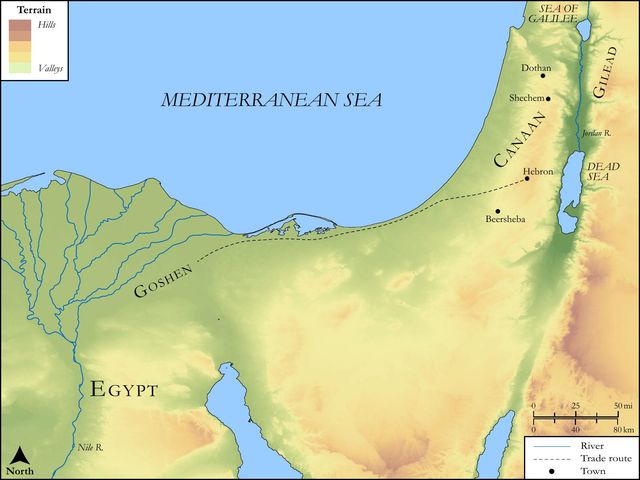
Ancient Egypt was a highly structured society, primarily agricultural, centered around the Nile River, and known for its monumental architecture and sophisticated administration. Egyptians generally held pastoralists, particularly those who tended sheep and goats, in low regard. This disdain likely stemmed from several factors: the nomadic lifestyle of shepherds contrasted sharply with the settled, agrarian Egyptian society; potential conflicts over land use between farmers and herders; and possibly negative historical experiences with foreign pastoral groups, such as the Hyksos, who had previously invaded and ruled parts of Egypt. The land of Goshen, located in the eastern Nile Delta, was geographically distinct and well-suited for grazing, making it an ideal location for a pastoral people to reside without significant interaction or conflict with the native Egyptian population.
Key Themes
ShowHideThe exchange in Genesis 47:3 contributes significantly to several overarching themes in Genesis. Divine Providence and Preservation is paramount, as God meticulously guides Joseph's actions to preserve the chosen lineage of Abraham, Isaac, and Jacob, ensuring their survival and growth into a great nation, as promised in passages like Genesis 12:2. The theme of Cultural Distinction and Separation is also prominent; by declaring their occupation as shepherds, the family leverages Egyptian cultural aversion to secure a separate territory, preventing assimilation into pagan society and preserving their unique identity as the covenant people. This separation is crucial for their future development as a nation. Furthermore, the narrative underscores God's Faithfulness and Provision, demonstrating how He provides for His people even in the direst circumstances, using human agents like Joseph and even cultural biases to accomplish His redemptive purposes.
Exposition and Analysis
ShowHideKey Word Analysis
ShowHideFrom the root meaning "to do" or "to make," this word (H4639) refers to an action, business, deed, or product. Here, it specifically denotes their professional activity or livelihood, Pharaoh's direct inquiry into their means of sustenance and societal role.
This primitive root (H7462) means "to tend a flock," "to pasture it," or "to graze." It can also extend to generally "to rule" or "to associate with." In this context, it refers to those who care for sheep or goats, guiding them to pasture, highlighting their nomadic, pastoral lifestyle.
A primitive word (H1) meaning "father" in both a literal and figurative sense, referring to a progenitor, ancestor, or even a chief. Here, it emphasizes the hereditary nature of their profession, establishing it as a long-standing family tradition and part of their ancestral identity.
Verse Breakdown
ShowHide"And Pharaoh said unto his brethren"
This opening clause establishes the direct interaction between the most powerful ruler of the land and Joseph's family. Pharaoh's engagement with them signifies their importance, likely due to Joseph's high standing. The term "his brethren" here refers to Joseph's brothers, who are now in Pharaoh's presence.
"What [is] your occupation?"
This is a direct and practical inquiry from Pharaoh, aimed at understanding the societal role and purpose of these newcomers. In Egypt, one's occupation often defined their social status and contribution, making this a standard and crucial question for assessing new inhabitants or immigrants.
"And they said unto Pharaoh, Thy servants [are] shepherds"
This is the candid and straightforward response from Joseph's brothers. By identifying themselves as "servants" (Hebrew, ʻebed' H5650), they acknowledge Pharaoh's authority, and by stating "shepherds," they declare their primary livelihood as tending flocks of sheep and goats. This declaration was not accidental but was strategically advised by Joseph.
"both we, [and] also our fathers."
This concluding phrase emphasizes the hereditary nature of their profession. It communicates that being shepherds is not merely a temporary job but a long-standing family tradition, deeply ingrained in their identity and passed down through generations. This reinforces their distinct lifestyle and heritage.
Literary Devices
ShowHideThe verse primarily employs Dialogue, presenting a direct question-and-answer exchange between Pharaoh and Joseph's brothers, which efficiently conveys crucial information about their identity and purpose. There is also an element of Foreshadowing, as the declaration of their occupation, seemingly mundane, is strategically designed by Joseph to secure their separation from the Egyptians, thereby foreshadowing their future distinct national identity and the preservation of the covenant line. Furthermore, a subtle Irony is present: what might have been perceived as a lowly or undesirable occupation by Egyptians becomes the very means by which God's chosen people are set apart and protected, ensuring their survival and growth.
Theological and Thematic Connections
ShowHideThe exchange in Genesis 47:3 powerfully illustrates God's meticulous providence, working through human circumstances and even cultural biases to fulfill His covenant promises. Joseph's strategic counsel to his brothers, leading them to declare their occupation as shepherds, was not manipulative but a divinely guided wisdom that leveraged the prevailing Egyptian cultural disdain for pastoralists. This ensured the family's segregation into Goshen, a fertile land ideal for their flocks, which was crucial for preserving their distinct identity and preventing assimilation into pagan Egyptian society. This separation was vital for the growth of Jacob's descendants into a numerous people, preparing them to become the nation of Israel, through whom the Messiah would ultimately come. God's faithfulness is evident in His provision for His people during a severe famine, demonstrating His unwavering commitment to His covenant.
Reflection and Application
ShowHideGenesis 47:3 offers profound lessons on identity, divine providence, and the wisdom of living distinctly for God's purposes. Just as Joseph's family embraced their identity as shepherds, which providentially led to their preservation and separation, believers today are called to embrace their identity in Christ—an identity that often sets them apart from the world's values and norms. This distinction is not about isolation for its own sake, but about maintaining spiritual integrity and purity, allowing God to work through our unique callings and circumstances. The narrative reminds us that God is sovereign over all details, even cultural biases, using them to achieve His greater redemptive plan. We are encouraged to trust in His meticulous care, knowing that He provides for His people, guiding their steps and making a way even in times of scarcity or adversity, all while preserving our distinct witness in a world that often seeks conformity.
Questions for Reflection
ShowHideFAQ
ShowHideWhy did Pharaoh ask about their occupation, and why was their answer significant?
ShowHidePharaoh's question about their occupation was a standard administrative inquiry to understand their societal role and how they might contribute to Egypt. Their answer, that they were shepherds, was highly significant because Egyptians generally disdained shepherds due to lifestyle differences, potential land conflicts, and historical negative associations (e.g., the Hyksos). This cultural aversion, strategically leveraged by Joseph (Genesis 46:34), ensured that Pharaoh would willingly grant them a separate land (Goshen), thereby preserving their distinct identity and preventing their assimilation into Egyptian society, which was crucial for God's long-term plan for Israel.
Did Joseph manipulate Pharaoh by instructing his brothers to declare themselves as shepherds?
ShowHideJoseph's instruction to his brothers (Genesis 46:34) was not an act of manipulation but a strategic and truthful declaration designed to achieve a specific, God-ordained outcome. He knew Pharaoh's likely reaction to shepherds and used this knowledge to secure the best possible living situation for his family—a separate, fertile region where they could thrive and maintain their distinct identity, rather than being absorbed into Egyptian culture. It was a wise and providentially guided plan to protect God's chosen lineage and ensure the fulfillment of His covenant promises.
Christ-Centered Fulfillment
ShowHideThe narrative of Genesis 47:3 and the subsequent settlement in Goshen finds its ultimate fulfillment in Christ through several profound lenses. First, the miraculous preservation of Jacob's family, the very lineage through which the Messiah would ultimately come, underscores God's meticulous, sovereign plan leading directly to the incarnation of Jesus Christ. Christ himself is the quintessential "shepherd" – not merely one who tends flocks, but the Good Shepherd (John 10:11) who lays down His life for His sheep, providing for, protecting, and leading His flock with perfect love and wisdom, far surpassing any earthly shepherd. Just as the Hebrews were set apart in Goshen to preserve their distinct identity and prepare them for nationhood, believers in Christ are called to be a distinct people, "not of the world" (John 17:16), living according to heavenly principles and a new covenant identity in Him. Furthermore, Christ embodies God's ultimate provision and faithfulness, leading His people through the "valley of the shadow of death" (Psalm 23:4) and into His eternal pastures, fulfilling the divine promise of sustenance, security, and spiritual abundance first foreshadowed in God's care for Jacob's family during the famine. He is the true bread of life (John 6:35), providing spiritual nourishment and eternal life.