


Genesis 47:2
Bible text: King James Version (1769 Blayney text) · Public domain
Bible text: Berean Standard Bible · Public domain
Bible text: American Standard Version (1901) · Public domain
Bible text: World English Bible, Messianic edition · Public domain
Bible text: Geneva Bible (1599) · Public domain
Bible text: Young's Literal Translation · Public domain
- וּמִקְצֵהu·mik·Tzehand from [the] end ofH7097Conj-w ¦ Prep-m ¦ N-mscNoun Singular Masculine Constructוּandמִfromקְצֵה[the] end of
- אֶחָיו'e·Chavhis brothersH251N-mpc ¦ 3msNoun Plural Masculine Constructאֶחָיbrothersוhis
- לָקַחla·Kachhe tookH3947V-Qal-Perf-3msVerb Qal Perfect 3rd Singular Masculine
- חֲמִשָּׁהcha·mi·ShahfiveH2568Adj-csAdjective Numerical Singular common gender Absolute
- אֲנָשִׁים'a·na·ShimmenH582N-mpNoun Plural Masculine Absolute
- וַיַּצִּגֵםvai·ya·tzi·Gemand he presented themH3322Conj-w ¦ V-Hiphil-ConsecImperf-3ms ¦ 3mpVerb Hiphil Consecutive Imperfect 3rd Singular Masculineוַandיַּצִּגֵhe presentedםthem
- לִפְנֵיlif·Nei<to> beforeH6440Prep-l ¦ N-mpcNoun Plural Masculine Constructלִ<to>פְנֵיbefore
- פַרְעֹהfar·'OhPharaohH6547N-msNoun Title Singular Masculine Absolute
English is a literal word-by-word gloss of the Hebrew, not the KJV's wording. Why?
This is the original text the KJV's translators worked from — each Hebrew word with its own literal English meaning in this verse, prepared by scholars at Tyndale House, Cambridge. The KJV translates whole sentences, not word by word, so its wording differs: one Hebrew word can become several English words, and the KJV may choose “the LORD” where the gloss reads “Yahweh”. Both are faithful — they answer different questions. For the KJV's own rendering, switch to the KJV text.
Details
See on the biblical-era maps


Study this verse
Public-domain commentary
Matthew Henry
From his Commentary on the Whole Bible. Henry comments on passages, not single verses — this entry covers Genesis 47:1–12. His four-level outline is real structure in the source text, so it is rendered as structure.
Here is, I. The respect which Joseph, as a subject, showed to his prince. Though he was his favourite, and prime-minister of state, and had had particular orders from him to send for his father down to Egypt, yet he would not suffer him to settle till he had given notice of it to Pharaoh, Gen 47:1. Christ, our Joseph, disposes of his followers in his kingdom as it is prepared of his Father, saying, It is not mine to give, Mat 20:23.
II.The respect which Joseph, as a brother, showed to his brethren, notwithstanding all the unkindness he had formerly received from them.
1.Though he was a great man, and they were comparatively mean and despicable, especially in Egypt, yet he owned them. Let those that are rich and great in the world learn hence not to overlook nor despise their poor relations. Every branch of the tree is not a top branch; but, because it is a lower branch, is it therefore not of the tree? Our Lord Jesus, like Joseph here, is not ashamed to call us brethren.
2.They being strangers and no courtiers, he introduced some of them to Pharaoh, to kiss his hand, as we say, intending thereby to put an honour upon them among the Egyptians. Thus Christ presents his brethren in the court of heaven, and improves his interest for them, though in themselves unworthy and an abomination to the Egyptians. Being presented to Pharaoh, according to the instructions which Joseph had given them, they tell him,
(1.)What was their business - that they were shepherds, Gen 47:3. Pharaoh asked them (and Joseph knew it would be one of his first questions, Gen 46:33), What is your occupation? He takes it for granted they had something to do, else Egypt should be no place for them, no harbour for idle vagrants. If they would not work, they should not eat of his bread in this time of scarcity. Note, All that have a place in the world should have an employment in it according to their capacity, some occupation or other, mental or manual. Those that need not work for their bread must yet have something to do, to keep them from idleness. Again, Magistrates should enquire into the occupation of their subjects, as those that have the care of the public welfare; for idle people are as drones in the hive, unprofitable burdens of the commonwealth.
(2.)What was their business in Egypt - to sojourn in the land (Gen 47:4), not to settle there for ever, only to sojourn there for a time, while the famine so prevailed in Canaan, which lay high, that it was not habitable for shepherds, the grass being burnt up much more than in Egypt, which lay low, and where the corn chiefly failed, while there was tolerably good pasture.
3.He obtained for them a grant of a settlement in the land of Goshen, Gen 47:5, Gen 47:6. This was an instance of Pharaoh's gratitude to Joseph; because he had been such a blessing to him and his kingdom, he would be kind to his relations, purely for his sake. He offered them preferment as shepherds over his cattle, provided they were men of activity; for it is the man who is diligent in his business that shall stand before kings. And, whatever our profession or employment is, we should aim to be excellent in it, and to prove ourselves ingenious and industrious.
III.The respect Joseph, as a son, showed to his father.
1.He presented him to Pharaoh, Gen 47:7. And here,
(1.)Pharaoh asks Jacob a common question: How old art thou? Gen 47:8. A question usually put to old men, for it is natural to us to admire old age and to reverence it (Lev 19:32), as it is very unnatural and unbecoming to despise it, Isa 3:5. Jacob's countenance, no doubt, showed him to be very old, for he had been a man of labour and sorrow; in Egypt people were not so long-lived as in Canaan, and therefore Pharaoh looks upon Jacob with wonder; he was as a show in his court. When we are reflecting upon ourselves, this should come into the account, "How old are we?"
(2.)Jacob gives Pharaoh an uncommon answer, Isa 3:9. He speaks as becomes a patriarch, with an air of seriousness, for the instruction of Pharaoh. Though our speech be not always of grace, yet it must thus be always with grace. Observe here,
[1.]He calls his life a pilgrimage, looking upon himself as a stranger in this world, and a traveller towards another world: this earth his inn, not his home. To this the apostle refers (Heb 11:13), They confessed that they were strangers and pilgrims. He not only reckoned himself a pilgrim now that he was in Egypt, a strange country in which he never was before; but his life, even in the land of his nativity, was a pilgrimage, and those who so reckon it can the better bear the inconvenience of banishment from their native soil; they are but pilgrims still, and so they were always.
[2.]He reckons his life by days; for, even so, it is soon reckoned, and we are not sure of the continuance of it for a day to an end, but may be turned out of this tabernacle at less than an hour's warning. Let us therefore number our days (Psa 90:12), and measure them, Psa 39:4.
[3.]The character he gives of them is, First, That they were few. Though he had now lived 130 years, they seemed to him but a few days, in comparison with the days of eternity, the eternal God, and the eternal state, in which a thousand years (longer than ever any man lived) are but as one day. Secondly, That they were evil. This is true concerning man in general, he is of few days, and full of trouble (Job 14:1); and, since his days are evil, it is well they are few. Jacob's life, particularly, had been made up of evil days; and the pleasantest days of his life were yet before him. Thirdly, That they were short of the days of his fathers, not so many, not so pleasant, as their days. Old age came sooner upon him than it had done upon some of his ancestors. As the young man should not be proud of his strength or beauty, so the old man should not be proud of his age, and the crown of his hoary hairs, though others justly reverence it; for those who are accounted very old attain not to the years of the patriarchs. The hoary head is a crown of glory only when it is found in the way of righteousness.
(3.)Jacob both addresses himself to Pharaoh and takes leave of him with a blessing (Gen 47:7): Jacob blessed Pharaoh, and again, Gen 47:10, which was not only an act of civility (he paid him respect and returned him thanks for his kindness), but an act of piety - he prayed for him, as one having the authority of a prophet and a patriarch. Though in worldly wealth Pharaoh was the greater, yet, in interest with God, Jacob was the greater; he was God's anointed, Psa 105:15. And a patriarch's blessing was not a thing to be despised, no, not by a potent prince. Darius valued the prayers of the church for himself and for his sons, Ezr 6:10. Pharaoh kindly received Jacob, and, whether in the name of a prophet or no, thus he had a prophet's reward, which sufficiently recompensed him, not only for his courteous converse with him, but for all the other kindnesses he showed to him and his.
2.He provided well for him and his, placed him in Goshen (Gen 47:11), nourished him and all his with food convenient for them, Gen 47:12. This bespeaks, not only Joseph a good man, who took this tender care of his poor relations, but God a good God, who raised him up for this purpose, and put him into a capacity of doing it, as Esther came to the kingdom for such a time as this. What God here did for Jacob he has, in effect, promised to do for all his, that serve him and trust in him. Psa 37:19, In the days of famine they shall be satisfied.
Continue studying Genesis 47:2 across the web’s major study libraries — every link below opens this exact verse, chapter, or book on the destination site.
Read & Compare
 BibleGatewayThis verse in more than 200 translations and 70 languages.
 Bible.comThe YouVersion reader — hundreds of translations, reading plans, and highlights.
 ESV.orgCrossway's official English Standard Version reader.
 NET BibleThe NET translation with 60,000+ translators' notes on every rendering decision.
 STEP BibleTyndale House's free study tool — original text, vocabulary, and scholarly resources.
 BibliaLogos Bible Software's free web reader.
 USCCBThe New American Bible (Revised Edition) with the U.S. bishops' study notes.
Commentaries
 BibleHub CommentariesDozens of classic commentaries on this verse, gathered on one page.
 StudyLightMore than 100 commentary sets — the largest collection on the web.
 BibleRefPlain-English commentary on what this verse means, verse by verse.
 Enduring WordDavid Guzik's free commentary on this chapter, widely used by Bible teachers.
 Bible Study ToolsVerse commentary alongside Greek and Hebrew study aids.
Original Language & Research
- BibleHub InterlinearThe verse word by word — original language, transliteration, and English.
- BibleHub LexiconEvery word's original-language definition and Strong's entry.
 Blue Letter BibleDeep-study tools — Strong's numbers, concordance, and word studies.
 SefariaThe Hebrew text with Rashi and centuries of Jewish commentary.
Sermons, Hymns & Audio


TrulyRandomVerse is not affiliated with these sites and doesn’t control their content. They’re linked because they’re genuinely useful.
Summary
Genesis 47:2 describes a pivotal moment in Joseph's stewardship of his family, where he carefully selects and formally introduces five of his brothers to Pharaoh. This strategic presentation was essential for securing the royal sanction needed for Jacob's entire household to settle permanently in the fertile region of Goshen, ensuring their protection, provision, and distinct identity amidst the severe famine gripping the land.
Context
ShowHideLiterary Context
This verse immediately follows Joseph's announcement to Pharaoh in Genesis 47:1 that his father Jacob and the entire family had arrived from Canaan and were awaiting instructions in the land of Goshen. It is a direct continuation of Joseph's meticulous plan to settle his family, fulfilling the divine promise given to Jacob at Beersheba that God would go with him to Egypt and make him a great nation there (Genesis 46:3). The presentation of these specific brothers is a crucial step in formalizing their presence and securing the necessary royal decree for their long-term settlement and sustenance, setting the stage for Pharaoh's subsequent questions and Joseph's strategic responses in the verses that follow.
Historical & Cultural Context
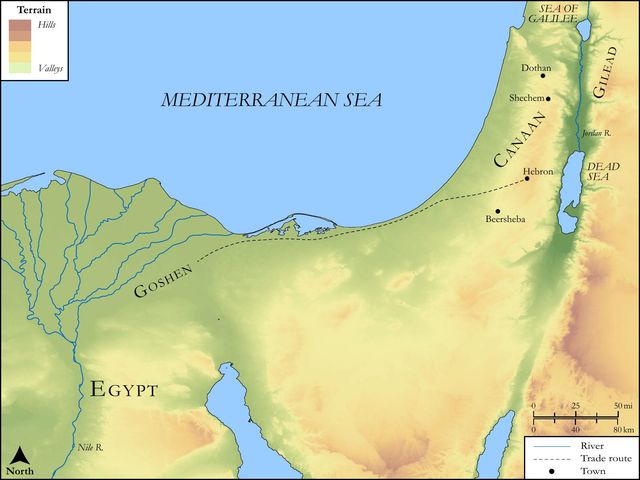
Ancient Egypt, particularly during the Second Intermediate Period (which aligns with the likely timeframe of Joseph's viziership), was a highly centralized and hierarchical society with strict court protocols. Audiences with Pharaoh, the divine king, were formal affairs. Joseph, as the vizier, understood these customs intimately. The land of Goshen, located in the eastern Nile Delta, was known for its rich pasturage, making it ideal for the Israelite's pastoral lifestyle. Egyptians, generally, held shepherds in low esteem (Genesis 46:34), which made Goshen a strategically wise choice for their settlement, allowing them to maintain their distinct identity and avoid cultural assimilation, while also being geographically separated from the main Egyptian population centers.
Key Themes
ShowHideThis verse powerfully contributes to several overarching themes within Genesis and the broader biblical narrative. It highlights Divine Providence, demonstrating God's sovereign hand orchestrating events through Joseph's wisdom to preserve the covenant family during a devastating famine, just as Joseph himself later acknowledges God's ultimate purpose in his life (Genesis 50:20). It also underscores Covenant Faithfulness, as God continues to protect and multiply the descendants of Abraham, Isaac, and Jacob, ensuring the continuation of the lineage through which the Messiah would eventually come. Furthermore, Joseph's actions exemplify Strategic Leadership and Stewardship, as he meticulously plans and executes the integration of his family into Egypt in a way that secures their welfare and preserves their distinct identity, fulfilling his role as a provident leader.
Exposition and Analysis
ShowHideKey Word Analysis
ShowHideThis verb signifies a deliberate act of taking, receiving, or selecting, often implying purpose and initiative. Here, Joseph did not merely gather but "took" or "selected" specific individuals, indicating a thoughtful and strategic choice rather than a random collection of his brothers. This highlights Joseph's active role in orchestrating the presentation.
While broadly meaning "man" or "mortal," in this context, it simply refers to adult male individuals. The significance lies not in the definition of "men" itself, but in the specific number "five" associated with them. Joseph's choice of "five men" rather than a larger group suggests a calculated approach to a formal audience with Pharaoh, making the delegation manageable and impactful.
This verb means "to place permanently," "to set," or "to cause to stand." It denotes a formal and intentional act of introduction, signifying that Joseph formally brought these men into Pharaoh's presence. This was not a casual encounter but a deliberate, official presentation designed to establish their presence and secure their status under royal authority.
Verse Breakdown
ShowHide"And he took some of his brethren,"
Joseph, acting as vizier and family head, exercises his authority and discernment by selecting a subset of his brothers. This implies a deliberate choice, not a random gathering, for a specific purpose related to the upcoming audience with Pharaoh. The phrase "some of his brethren" indicates that not all of Jacob's sons were presented at this initial, formal meeting.
"[even] five men,"
This specifies the exact number Joseph chose. The number five is not explicitly explained in the text, but it suggests a strategic decision. It was likely a manageable number for a formal audience with the king, allowing for focused interaction without overwhelming the royal court, and perhaps aligning with Egyptian court protocol or simply being a practical, representative sample of his family.
"and presented them unto Pharaoh."
This clause describes the culmination of Joseph's action: the formal introduction of these selected brothers to the highest authority in Egypt. The act of "presenting" (Hebrew yâtsag) implies causing them to stand before the king, signifying an official and respectful act of bringing them into his presence for recognition and approval. This was a crucial diplomatic step to secure the welfare and settlement of Jacob's entire family.
Literary Devices
ShowHideThe narrative in Genesis 47:2 employs several subtle but significant literary devices. Narrative Economy is evident in the precise mention of "five men" without naming them, focusing the reader's attention on the strategic action rather than individual identities. This choice also highlights Joseph's Strategic Selection, underscoring his wisdom and understanding of courtly protocol. The very act of "presenting" them, using the Hebrew verb yâtsag, emphasizes the Formal Protocol of the Egyptian court, where such introductions were not casual but highly structured and significant for establishing legal and social standing. This formal presentation also serves as a form of Foreshadowing, as it sets the stage for the Israelites' long sojourn in Egypt, a period of both preservation and eventual oppression, which would ultimately lead to their exodus and the formation of a nation.
Theological and Thematic Connections
ShowHideThis seemingly simple act of Joseph presenting his brothers to Pharaoh is deeply embedded in God's overarching plan of redemption. It is a profound demonstration of Divine Providence, where God uses human wisdom and political maneuvering to secure the future of His chosen people. The preservation of Jacob's family in Egypt, facilitated by this presentation, was not merely a matter of survival during famine but a critical step in the unfolding of God's covenant promises to Abraham, Isaac, and Jacob—promises of land, numerous descendants, and a blessing to all nations. God's faithfulness is evident in His meticulous care for the nascent nation of Israel, ensuring their growth and distinct identity even while residing in a foreign land, thereby preparing them for their eventual role in redemptive history.
Reflection and Application
ShowHideGenesis 47:2 offers valuable lessons on leadership, strategic planning, and reliance on divine providence. Joseph's actions demonstrate the importance of combining practical wisdom with faith. He didn't passively wait for things to happen but actively engaged in the necessary diplomatic steps, carefully considering the context and choosing the most effective approach. For believers today, this narrative encourages us to exercise prudence and foresight in our own spheres of influence, whether in family, professional, or ministry contexts. We are called to be diligent, thoughtful, and strategic in our endeavors, understanding that God often works through our prepared and intentional actions. Furthermore, this passage serves as a powerful reminder of God's unwavering faithfulness. Even in times of scarcity, uncertainty, or significant transition, God remains committed to His people, orchestrating events—even seemingly mundane administrative tasks—to fulfill His purposes and ensure our well-being. We are invited to trust in His sovereign care, knowing that He is always working for our good and the advancement of His kingdom.
Questions for Reflection
ShowHideFAQ
ShowHideWhy did Joseph choose "five men" to present to Pharaoh?
ShowHideThe biblical text does not explicitly state Joseph's reasoning for choosing exactly five men, but it was almost certainly a strategic decision rooted in his understanding of Egyptian court protocol and practical considerations. Presenting a small, manageable, and representative group would have been appropriate for a formal audience with the king, avoiding overwhelming Pharaoh while still effectively demonstrating the presence of his family. Some scholars suggest that five was a number of significance in Egyptian legal or administrative contexts, or simply a practical number that allowed for a focused introduction and discussion without causing undue disruption to Pharaoh's schedule. Joseph's choice underscores his wisdom and diplomatic skill in navigating the complexities of the royal court to secure a favorable reception for his family.
What was the significance of presenting his brethren to Pharaoh?
ShowHideThis formal presentation was profoundly significant for several reasons. Firstly, it secured Pharaoh's official recognition and explicit approval for Jacob's entire household to settle in Egypt, specifically in the fertile land of Goshen (Genesis 47:6). This royal decree was crucial for their legal and social standing. Secondly, it provided essential royal protection and ensured their sustenance during the severe famine, as Pharaoh subsequently instructed Joseph to provide the best of the land for them. Thirdly, by formalizing their status, it prevented them from being seen as mere transients or a threat, instead establishing them as a group under royal patronage. This was vital for their long-term preservation, growth, and the maintenance of their distinct cultural and religious identity, which was essential for their future development as God's chosen nation.
Christ-Centered Fulfillment
ShowHideThe strategic presentation of Joseph's brothers to Pharaoh, securing their place in Egypt, is a vital link in the unfolding tapestry of redemptive history, ultimately pointing to Christ. Joseph, through his wisdom and provident care, acts as a type of Christ, bringing his family into a place of safety and provision amidst a world-threatening famine. Just as Joseph provided physical sustenance and a secure dwelling for his people, Christ provides ultimate spiritual salvation and eternal rest for His own, drawing them out of the famine of sin and into the abundance of His grace (John 6:35). The preservation of this lineage—the very family of Jacob—was absolutely crucial, for from this line would eventually come the Messiah, Jesus Christ (Matthew 1:1-17). God's meticulous care in ensuring the survival and growth of Israel in Egypt, even through seemingly mundane administrative acts like this presentation, demonstrates His unwavering commitment to His covenant promises, culminating in the sending of His Son to be the Savior of the world, the true Lamb of God who takes away the sin of the world (John 1:29).