


Genesis 45:16
Bible text: King James Version (1769 Blayney text) · Public domain
Bible text: King James Version with Strong's numbers · Public domain
Bible text: Berean Standard Bible · Public domain
Bible text: American Standard Version (1901) · Public domain
Bible text: World English Bible, Messianic edition · Public domain
Bible text: Geneva Bible (1599) · Public domain
Bible text: Young's Literal Translation · Public domain
- וְהַקֹּלve·ha·Koland the soundH6963Conj-w ¦ Art ¦ N-msNoun Singular Masculine Absoluteוְandהַtheקֹּלsound
- נִשְׁמַעnish·Ma'it was heardH8085V-Niphal-Perf-3msVerb Niphal Perfect 3rd Singular Masculine
- בֵּיתbeit[the] house ofH1004N-mscNoun Singular Masculine Construct
- פַּרְעֹהpar·'OhPharaohH6547N-msNoun Title Singular Masculine Absolute
- לֵאמֹרle·Mor<to> sayingH559Prep-l ¦ V-Qal-InfVerb Qal Infinitive Constructלֵ<to>אמֹרsaying
- בָּאוּBa·'uthey have comeH935V-Qal-Perf-3cpVerb Qal Perfect 3rd Plural common gender
- אֲחֵי'a·Chei[the] brothers ofH251N-mpcNoun Plural Masculine Construct
- יוֹסֵףyo·SefJosephH3130N-proper-mNoun Proper Masculine
- וַיִּיטַבvai·yi·Tavand it was goodH3190Conj-w ¦ V-Qal-ConsecImperf-3msVerb Qal Consecutive Imperfect 3rd Singular Masculineוַandיִּיטַבit was good
- בְּעֵינֵיbe·'ei·Neiin [the] eyes ofH5869Prep-b ¦ N-fdcNoun Dual Feminine Constructבְּinעֵינֵי[the] eyes of
- פַרְעֹהfar·'OhPharaohH6547N-msNoun Title Singular Masculine Absolute
- וּבְעֵינֵיu·ve·'ei·Neiand in [the] eyes ofH5869Conj-w ¦ Prep-b ¦ N-fdcNoun Dual Feminine Constructוּandבְinעֵינֵי[the] eyes of
- עֲבָדָיו'a·va·Davhis servantsH5650N-mpc ¦ 3msNoun Plural Masculine Constructעֲבָדָיservantsוhis
English is a literal word-by-word gloss of the Hebrew, not the KJV's wording. Why?
This is the original text the KJV's translators worked from — each Hebrew word with its own literal English meaning in this verse, prepared by scholars at Tyndale House, Cambridge. The KJV translates whole sentences, not word by word, so its wording differs: one Hebrew word can become several English words, and the KJV may choose “the LORD” where the gloss reads “Yahweh”. Both are faithful — they answer different questions. For the KJV's own rendering, switch to the KJV text.
Details
See on the biblical-era maps


Study this verse
Public-domain commentary
Matthew Henry
From his Commentary on the Whole Bible. Henry comments on passages, not single verses — this entry covers Genesis 45:16–24. His three-level outline is real structure in the source text, so it is rendered as structure.
Here is, 1. The kindness of Pharaoh to Joseph, and to his relations for his sake: he bade his brethren welcome (Gen 45:16), though it was a time of scarcity, and they were likely to be a charge to him. Nay, because it pleased Pharaoh, it pleased his servants too, at least they pretended to be pleased because Pharaoh was. He engaged Joseph to send for his father down to Egypt, and promised to furnish them with all conveniences both for his removal thither and his settlement there. If the good of all the land of Egypt (as it was not better stocked than any other land, thanks to Joseph, under God) would suffice him, he was welcome to it all, it was all his own, even the fat of the land (Gen 45:18), so that they need not regard their stuff, Gen 45:20. What they had in Canaan he reckoned but stuff, in comparison with what he had for them in Egypt; and therefore if they should be constrained to leave some of that behind them, let them not be discontented; Egypt would afford them enough to make up the losses of their removal. Thus those for whom Christ intends shares in his heavenly glory ought not to regard the stuff of this world: The best of its enjoyments are but stuff, but lumber; we cannot make sure of it while we are here, much less can we carry it away with us; let us not therefore be solicitous about it, nor set our eyes or hearts upon it. There are better things reserved for us in that blessed land whither our Joseph has gone to prepare a place.
II.The kindness of Joseph to his father and brethren.
Pharaoh was respectful to Joseph, in gratitude, because he had been an instrument of much good to him and his kingdom, not only preserving it from the common calamity, but helping to make it considerable among the nations; for all their neighbours would say, "Surely the Egyptians are a wise and an understanding people, that are so well stocked in a time of scarcity." For this reason Pharaoh never thought any thing too much that he could do for Joseph. Note, There is a gratitude owing even to inferiors; and when any have shown us kindness we should study to requite it, not only to them, but to their relations. And Joseph likewise was respectful to his father and brethren in duty, because they were his near relations, though his brethren had been his enemies, and his father long a stranger.
1.He furnished them for necessity, Gen 45:21. He gave them wagons and provisions for the way, both going and coming; for we never find that Jacob was very rich, and, at this time, when the famine prevailed, we may suppose he was rather poor.
2.He furnished them for ornament and delight. To his brethren he gave two suits a piece of good clothes, to Benjamin five suits, and money besides in his pocket, Gen 45:22. To his father he sent a very handsome present of the varieties of Egypt, Gen 45:23. Note, Those that are wealthy should be generous, and devise liberal things; what is an abundance good for, but to do good with it?
3.He dismissed them with a seasonable caution: See that you fall not out by the way, Gen 45:24. He knew they were but too apt to be quarrelsome; and what had lately passed, which revived the remembrance of what they had done formerly against their brother, might give them occasion to quarrel. Joseph had observed them to contend about it, Gen 42:22. To one they would say, "It was you that first upbraided him with his dreams;" to another, "It was you that stripped him of his fine coat;" to another, "It was you that threw him into the pit," etc. Now Joseph, having forgiven them all, lays this obligation upon them, not to upbraid one another. This charge our Lord Jesus has given to us, that we love one another, that we live in peace, that whatever occurs, or whatever former occurrences are remembered, we fall not out. For,
(1.)We are brethren, we have all one Father.
(2.)We are his brethren, and we shame our relation to him who is our peace, if we fall out.
(3.)We are guilty, verily guilty, and, instead of quarrelling with one another, have a great deal of reason to fall out with ourselves.
(4.)We are, or hope to be, forgiven of God whom we have all offended, and therefore should be ready to forgive one another.
(5.)We are by the way, a way that lies through the land of Egypt, where we have many eyes upon us, that seek occasion and advantage against us, a way that leads to Canaan, where we hope to be for ever in perfect peace.
Historical interpretation
Historical reception
2 surviving comments on this verse. Each one is dated, so this reads as a timeline rather than a list.
Select a marker to jump to its quote. Markers stagger vertically where authors wrote within a few decades of each other.
When the things that needed to be said between them were finished, the doors of that judgment room were opened. The princes entered rejoicing and the army commanders full of gladness. This news was pleasing in the eyes of Pharaoh and his servants, for they had believed that he who had become like a father to Pharaoh and ruler over the freemen and princes of Egypt was no slave but was a son of a freeman from the blessed race of the house of Abraham.
And Pharaoh rejoiced because Joseph had known his brothers. From there the news spread in Pharaoh’s house, and he urged the holy Joseph to invite his brothers to come with their father. He also gives orders that their packs be filled with grain and loaded onto wagons. What can account for such consideration shown to a stranger? Only that a great mystery was being revealed, a mystery the church today does not deny. The Jews will be redeemed; the Christian people will rejoice at this union, give aid to the limit of their resources and send people to preach the good news of the kingdom of God, so that their call may come sooner.
Continue studying Genesis 45:16 across the web’s major study libraries — every link below opens this exact verse, chapter, or book on the destination site.
Read & Compare
 BibleGatewayThis verse in more than 200 translations and 70 languages.
 Bible.comThe YouVersion reader — hundreds of translations, reading plans, and highlights.
 ESV.orgCrossway's official English Standard Version reader.
 NET BibleThe NET translation with 60,000+ translators' notes on every rendering decision.
 STEP BibleTyndale House's free study tool — original text, vocabulary, and scholarly resources.
 BibliaLogos Bible Software's free web reader.
 USCCBThe New American Bible (Revised Edition) with the U.S. bishops' study notes.
Commentaries
 BibleHub CommentariesDozens of classic commentaries on this verse, gathered on one page.
 StudyLightMore than 100 commentary sets — the largest collection on the web.
 BibleRefPlain-English commentary on what this verse means, verse by verse.
 Enduring WordDavid Guzik's free commentary on this chapter, widely used by Bible teachers.
 Bible Study ToolsVerse commentary alongside Greek and Hebrew study aids.
Original Language & Research
- BibleHub InterlinearThe verse word by word — original language, transliteration, and English.
- BibleHub LexiconEvery word's original-language definition and Strong's entry.
 Blue Letter BibleDeep-study tools — Strong's numbers, concordance, and word studies.
 SefariaThe Hebrew text with Rashi and centuries of Jewish commentary.
Sermons, Hymns & Audio


TrulyRandomVerse is not affiliated with these sites and doesn’t control their content. They’re linked because they’re genuinely useful.
Summary
Genesis 45:16 marks a pivotal moment in Joseph's narrative, detailing how the news of his brothers' arrival in Egypt quickly reached Pharaoh's royal court. This public acknowledgement of Joseph's family, coupled with the immediate and enthusiastic approval from Pharaoh and his officials, signifies a crucial divine endorsement and political sanction for the next phase of God's redemptive plan to preserve and expand the nascent family of Israel, ensuring their secure settlement and future growth in Egypt.
Context
ShowHideLiterary Context
This verse immediately follows Joseph's dramatic and emotional self-revelation to his brothers in Genesis 45:1-15. Having overcome his initial grief and astonishment, Joseph instructs his brothers to return to Canaan and bring their father Jacob, their entire households, and all their possessions to Egypt, promising them the best of the land. The news spreading to Pharaoh's house is a natural and necessary consequence of Joseph's high position as vizier over all Egypt, transforming a deeply personal family reunion into a matter of state importance. The subsequent verses in Genesis 45:17-28 detail Pharaoh's generous provision for Jacob's relocation, reinforcing the significance of this royal approval.
Historical & Cultural Context
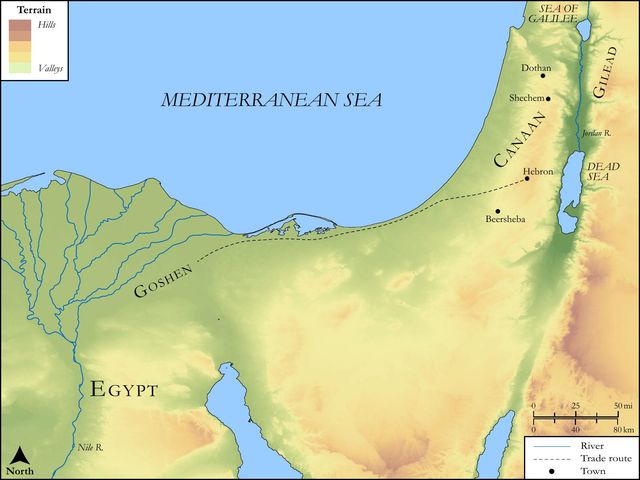
In ancient Egypt, the vizier (Joseph's position) was second only to Pharaoh, wielding immense power and influence. Any significant personal or family matter concerning such a high-ranking official would inevitably become known to the royal court, as the stability and prosperity of the nation were intricately linked to its leadership. Pharaoh's response reflects the absolute authority of the monarch, whose word was law, and whose favor could ensure the well-being and security of any group. The cultural expectation of hospitality, especially towards the family of a revered official who had saved the nation from famine, also played a role. Furthermore, the land of Goshen, where Jacob's family would settle, was known for its fertile pastures, ideal for a pastoral people like the Hebrews, and strategically located away from the main Egyptian population centers, facilitating their distinct identity and growth.
Key Themes
ShowHideGenesis 45:16 powerfully contributes to several overarching themes within the book of Genesis. It highlights Divine Providence, demonstrating how God orchestrates human events, even the actions of powerful rulers, to fulfill His purposes. Pharaoh's favorable disposition is not coincidental but a divinely guided step towards the Preservation of the Covenant Line, ensuring the survival and future growth of Jacob's descendants, through whom God's promises to Abraham, Isaac, and Jacob would be realized (Genesis 12:1-3). The verse also underscores the theme of Reconciliation and Restoration, as the family, once fractured by sin and deception, is now publicly acknowledged and welcomed at the highest level of Egyptian society, setting the stage for their complete reunion and flourishing under Joseph's care. This event also showcases God's ability to Use Human Systems and Authority to advance His redemptive plan, turning potential obstacles into avenues of blessing.
Exposition and Analysis
ShowHideKey Word Analysis
ShowHideThis word primarily means "voice" or "sound," but can also denote a "report," "proclamation," or "news." In this context, it signifies that the "sound" or "report" of Joseph's brothers' arrival was heard throughout Pharaoh's house. It emphasizes the public and official nature of the information dissemination, rather than merely Joseph's personal renown. The news was not whispered but became a matter of open knowledge within the highest echelons of power.
The phrase "it pleased Pharaoh well" is a translation of the Hebrew phrase combining H3190 (yâṭab), meaning "to be (make) well," "to do good," or "to be pleasing," and H5869 (ʻayin), which means "eye" but is often used idiomatically to express "favor," "pleasure," or "good will" (literally, "good in the eyes of"). Thus, "it pleased Pharaoh well" conveys that the news was "good in Pharaoh's eyes" or "was pleasing to Pharaoh." This is a strong expression of approval and favor, indicating a positive disposition and willingness to support Joseph's family.
Verse Breakdown
ShowHide"¶ And the fame thereof was heard in Pharaoh's house,"
This opening clause establishes the immediate and widespread impact of Joseph's family's arrival. The "fame" (or report/news) was not confined to a private circle but reached the very center of Egyptian power—Pharaoh's royal residence. This indicates that Joseph's position was so significant that his personal family affairs were considered matters of state, warranting attention from the highest authority.
"saying, Joseph's brethren are come:"
This parenthetical phrase reveals the content of the "fame" or report. The news was specific: Joseph, the revered vizier, had been reunited with his long-lost brothers. This simple declaration would have carried immense weight, given Joseph's pivotal role in saving Egypt from famine and his previously mysterious past regarding his family.
"and it pleased Pharaoh well, and his servants."
This final clause is profoundly significant. Pharaoh's positive reaction, shared by his entire court ("his servants"), signifies official endorsement and approval. This was not a casual observation but a crucial political and social sanction. Pharaoh's pleasure ensured that Joseph's family would be welcomed, provided for, and protected, laying the groundwork for their secure settlement in Egypt and their subsequent growth into a nation. This collective approval from the highest levels of Egyptian power was instrumental in facilitating God's plan for Israel.
Literary Devices
ShowHideThe verse employs several literary devices. Synecdoche is present in "Pharaoh's house," which stands for the entire royal court and administration, indicating that the news permeated the highest levels of government. The phrase "it pleased Pharaoh well" uses Idiom, as the Hebrew literally translates to "it was good in the eyes of Pharaoh," a common expression for approval or favor. There is also an element of Irony in the narrative arc; the brothers who once sought to eliminate Joseph are now the beneficiaries of his exalted status, and their arrival, which could have been a source of shame or conflict, becomes a cause for royal celebration and provision. This sets the stage for the larger Divine Irony seen in Genesis 50:20, where Joseph declares that what his brothers intended for evil, God intended for good.
Theological and Thematic Connections
ShowHideGenesis 45:16 is a powerful testament to God's meticulous and sovereign control over all circumstances, including the hearts and minds of powerful rulers. Pharaoh's favorable disposition was not coincidental but divinely orchestrated, demonstrating that God can sway even the most absolute authorities to serve His purposes. This divine influence ensures the preservation and well-being of His chosen people, highlighting His unwavering commitment to His covenant promises. The verse underscores how God works through existing political and social structures, turning what could have been a source of conflict or vulnerability into an avenue for blessing, provision, and the advancement of His redemptive plan for His people.
Reflection and Application
ShowHideGenesis 45:16 serves as a profound reminder of God's meticulous and sovereign control over all events, even those involving powerful leaders and foreign nations. For believers today, this verse encourages unwavering trust in God's provision and perfect timing, especially when circumstances seem uncertain, beyond human control, or even hostile. It assures us that God is actively working behind the scenes, using even the most unexpected channels—including political figures, societal structures, and seemingly unrelated events—to advance His good purposes for those who love Him and are called according to His design. Just as Pharaoh's heart was swayed for the good of Joseph's family, ensuring their safety and prosperity, we can trust that God orchestrates events for our ultimate well-being and the fulfillment of His kingdom plans. This should inspire us to pray for our leaders, knowing that God can use them, and to rest in the assurance that no human power can thwart His ultimate will for His people.
Questions for Reflection
ShowHideFAQ
ShowHideWhy was Pharaoh's reaction to Joseph's family so important?
ShowHidePharaoh's reaction was crucial because it provided official sanction and protection for Joseph's family. As the supreme ruler of Egypt, his approval ensured that the family would be welcomed, provided for, and allowed to settle in the fertile land of Goshen (Genesis 47:6), rather than being viewed as foreign immigrants or a potential threat. This royal endorsement was essential for the safe relocation and subsequent growth of Jacob's descendants into a numerous nation, as prophesied in God's covenant with Abraham (Genesis 12:2).
Does "fame" in this verse imply Joseph was famous for his family?
ShowHideThe Hebrew word qôwl (H6963), translated as "fame" here, more accurately means "report," "sound," or "news." It signifies that the news or report of Joseph's brothers arriving was heard throughout Pharaoh's house. While Joseph himself was certainly famous and highly esteemed due to his wisdom and his role in saving Egypt from famine (Genesis 41:39-40), the "fame" in this specific verse refers to the widespread communication of the event concerning his family, not necessarily that his family itself was famous prior to their arrival. It highlights the public nature of the family's reunion given Joseph's prominence.
Christ-Centered Fulfillment
ShowHideThe gathering of Jacob's family in Egypt under Joseph's provision, endorsed by Pharaoh, powerfully foreshadows Christ's ultimate work of gathering His people and providing for them. Just as Joseph, a type of Christ, saved his family from physical famine and brought them into a place of security and prosperity through his elevated status as vizier, so Christ, through His sacrificial death and glorious resurrection, gathers His elect from all nations and preserves them from spiritual death and eternal judgment (John 10:11). He brings them into His eternal kingdom, a place of abundant life and secure fellowship with God (John 10:27-28). Pharaoh's pleasure in Joseph's family can be seen as a dim reflection of the Father's profound pleasure in the Son, Jesus Christ, through whom all of God's covenant promises are fulfilled (2 Corinthians 1:20), and through whom His people are brought into an everlasting relationship and provision.