


Genesis 20:15
- וַיֹּאמֶרvai·Yo·merand he saidH559Conj-w ¦ V-Qal-ConsecImperf-3msVerb Qal Consecutive Imperfect 3rd Singular Masculineוַandיֹּאמֶרhe said
- אֲבִימֶלֶךְ'a·vi·Me·lekhAbimelechH40N-proper-mNoun Proper Masculine
- הִנֵּהhi·Nehthere!H2009PrtParticle Interjection
- אַרְצִי'ar·Tzimy landH776N-csc ¦ 1fsNoun Singular common gender Constructאַרְצִlandיmy
- לְפָנֶיךָle·fa·Nei·kha[is] <to> before youH6440Prep-l ¦ N-mpc ¦ 2msNoun Plural Masculine Constructלְ[is] <to>פָנֶיbeforeךָyou
- בַּטּוֹבba·Tovin the [place] goodH2896Prep-b ¦ Adj-msAdjective Singular Masculine Absoluteבַּin theטּוֹב[place] good
- בְּעֵינֶיךָbe·'ei·Nei·khain your viewH5869Prep-b ¦ N-fdc ¦ 2msNoun Dual Feminine Constructבְּinעֵינֶיviewךָyour
- שֵׁבShevdwellH3427V-Qal-Imp-2msVerb Qal Imperative 2nd Singular Masculine
English is a literal word-by-word gloss of the Hebrew, not the KJV's wording. Why?
This is the original text the KJV's translators worked from — each Hebrew word with its own literal English meaning in this verse, prepared by scholars at Tyndale House, Cambridge. The KJV translates whole sentences, not word by word, so its wording differs: one Hebrew word can become several English words, and the KJV may choose “the LORD” where the gloss reads “Yahweh”. Both are faithful — they answer different questions. For the KJV's own rendering, switch to the KJV text.
Details
See on the biblical-era maps


Study this verse
Public-domain commentary
Matthew Henry
From his Commentary on the Whole Bible. Henry comments on passages, not single verses — this entry covers Genesis 20:14–18.
Here is, I. The kindness of a prince which Abimelech showed to Abraham. See how unjust Abraham's jealousies were. He fancied that if they knew that Sarah was his wife they would kill him; but, when they did know it, instead of killing him they were kind to him, frightened at least to be so by the divine rebukes they were under. 1. He gives him his royal licence to dwell where he pleased in his country, courting his stay because he gives him his royal gifts (Gen 20:14), sheep and oxen, and (Gen 20:16) a thousand pieces of silver. This he gave when he restored Sarah, either, [1.] By way of satisfaction for the wrong he had offered to do, in taking her to his house: when the Philistines restored the ark, being plagued for detaining it, they sent a present with it. The law appointed that when restitution was made something should be added to it, Lev 6:5. Or, [2.] To engage Abraham's prayers for him; not as if prayers should be bought and sold, but we should endeavour to be kind to those of whose spiritual things we reap, Co1 9:11. Note, It is our wisdom to get and keep an interest with those that have an interest in heaven, and to make those our friends who are the friends of God. [3.] He gives to Sarah good instruction, tells her that her husband (her brother he calls him, to upbraid her with calling him so) must be to her for a covering of the eyes, that is, she must look at no other, nor desire to be looked at by any other. Note, Yoke-fellows must be to each other for a covering of the eyes. The marriage-covenant is a covenant with the eyes, like Job's, Job 31:1.
II.The kindness of a prophet which Abraham showed to Abimelech:
he prayed for him, Gen 20:17, Gen 20:18. This honour God would put upon Abraham that, though Abimelech had restored Sarah, yet the judgment he was under should be removed upon the prayer of Abraham, and not before. Thus God healed Miriam, when Moses, whom she had most affronted, prayed for her (Num 12:13), and was reconciled to Job's friends when Job, whom they had grieved, prayed for them (Job 42:8-10), and so did, as it were, give it under his hand that he was reconciled to them. Note, The prayers of good men may be a kindness to great men, and ought to be valued.
Historical interpretation
Historical reception
1 surviving comment on this verse from the historical church.
Do you see, dearly beloved, God’s inventive wisdom? I mean, the man who was fearful of death and took every means to be able to avoid it, not only did avoid it but was granted as well great confidence and became immediately famous. This, you see, is the way things are with God. Not only does he deliver from distress those who make every effort to strive boldly against the onset of temptation, but also he guarantees them such serenity in this very distress that we have complete tranquillity and achieve great material prosperity. See now the attention of the king to the just man. Not only does he show his regard with so many gifts, but also he grants him the right to occupy the land. “ ‘Behold,’ he said, ‘my land is before you; settle wherever you please.’ ” You see, once he had learned that it was on his account and through his prayers that his life had been spared, he was anxious now to shower attention in this way on him, as a benefactor and champion, the man who was a stranger, a vagabond, one completely unknown.
Continue studying Genesis 20:15 across the web’s major study libraries — every link below opens this exact verse, chapter, or book on the destination site.
Read & Compare
 BibleGatewayThis verse in more than 200 translations and 70 languages.
 Bible.comThe YouVersion reader — hundreds of translations, reading plans, and highlights.
 ESV.orgCrossway's official English Standard Version reader.
 NET BibleThe NET translation with 60,000+ translators' notes on every rendering decision.
 STEP BibleTyndale House's free study tool — original text, vocabulary, and scholarly resources.
 BibliaLogos Bible Software's free web reader.
 USCCBThe New American Bible (Revised Edition) with the U.S. bishops' study notes.
Commentaries
 BibleHub CommentariesDozens of classic commentaries on this verse, gathered on one page.
 StudyLightMore than 100 commentary sets — the largest collection on the web.
 BibleRefPlain-English commentary on what this verse means, verse by verse.
 Enduring WordDavid Guzik's free commentary on this chapter, widely used by Bible teachers.
 Bible Study ToolsVerse commentary alongside Greek and Hebrew study aids.
Original Language & Research
- BibleHub InterlinearThe verse word by word — original language, transliteration, and English.
- BibleHub LexiconEvery word's original-language definition and Strong's entry.
 Blue Letter BibleDeep-study tools — Strong's numbers, concordance, and word studies.
 SefariaThe Hebrew text with Rashi and centuries of Jewish commentary.
Sermons, Hymns & Audio


TrulyRandomVerse is not affiliated with these sites and doesn’t control their content. They’re linked because they’re genuinely useful.
Summary
Genesis 20:15 records King Abimelech's remarkable and magnanimous offer to Abraham, inviting him to settle anywhere in his land. This gesture of profound hospitality and reconciliation follows a tense confrontation where Abimelech discovered Abraham's deception regarding Sarah, yet it powerfully highlights Abimelech's integrity and God's protective providence over His covenant people despite their failings.
Context
ShowHideLiterary Context
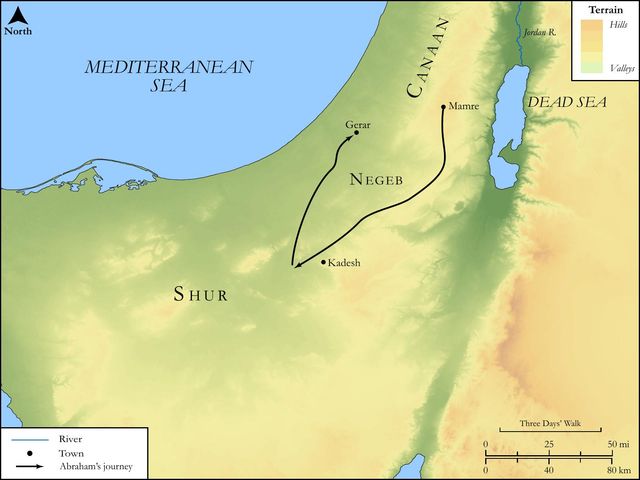
This verse is situated within the broader narrative of Genesis 20, which details Abraham's sojourn in Gerar under King Abimelech. The immediate preceding verses recount Abimelech's confrontation with Abraham after God intervened in a dream, revealing that Sarah was Abraham's wife and not merely his sister. Abraham's fear-driven deception (a repetition of a similar incident in Genesis 12) had put Sarah and Abimelech's household in jeopardy. Abimelech, having acted in innocence, was warned by God against touching Sarah. After this divine warning and his subsequent confrontation with Abraham, Abimelech's response in Genesis 20:15 is surprisingly generous, demonstrating a character of integrity and a desire for peace, despite being wronged by Abraham. This act of hospitality sets the stage for future interactions between Abraham and Abimelech, including a later covenant in Genesis 21.
Historical & Cultural Context
The ancient Near East placed immense value on hospitality, often considering it a sacred duty. Offering shelter, food, and protection to travelers or sojourners was a fundamental aspect of social and moral conduct. To violate this trust, or to refuse hospitality, could lead to severe social repercussions. Kings, in particular, were expected to embody justice and maintain order, which included extending appropriate treatment to foreign dignitaries or powerful tribal leaders like Abraham. Abimelech's offer of land was not merely polite; it was a significant gesture of political and social reconciliation, ensuring stable relations between his kingdom and Abraham's influential household. The nomadic lifestyle of Abraham and his large retinue meant that access to land, water, and grazing rights was crucial for their survival and prosperity, making Abimelech's offer exceedingly valuable.
Key Themes
ShowHideGenesis 20 contributes to several major theological and narrative themes within the book of Genesis. Foremost among them is Divine Providence and Protection, as God actively intervenes to protect Sarah and the covenant lineage, even when Abraham's faith falters. This highlights God's unwavering faithfulness to His promises, regardless of human imperfection (see Genesis 17:7). Another key theme is Human Fallibility and Deception, exemplified by Abraham's repeated fear-driven lie, which contrasts sharply with the unexpected Integrity and Righteousness displayed by Abimelech, a Gentile king. This narrative challenges the simplistic notion that righteousness is confined solely to the covenant people, demonstrating that God can work through and reveal truth to those outside the immediate covenant community. Finally, the theme of Reconciliation and Peacemaking is prominent, as Abimelech chooses to restore relations rather than retaliate, paving the way for future peaceful coexistence.
Exposition and Analysis
ShowHideAbimelech's declaration, "Behold, my land [is] before thee: dwell where it pleaseth thee," is a profound statement of unreserved hospitality and a desire for peace, especially significant given Abraham's recent deception. This is not merely an offer of temporary lodging but an invitation for Abraham and his large household to establish a permanent dwelling within Abimelech's territory.
Key Word Analysis
ShowHideFrom the roots meaning "father" and "king," this name literally means "father of (the) king" or "my father is king." In this context, it refers to the Philistine king of Gerar. His actions throughout this chapter, particularly his integrity and fear of God, elevate him beyond a mere antagonist, presenting him as a figure of surprising moral uprightness, contrasting with Abraham's fear-driven deceit.
This primitive root is used with great latitude, encompassing speaking, commanding, declaring, and even intending. Here, it denotes Abimelech's authoritative declaration, a formal pronouncement from a king. It signifies a deliberate and binding statement, not a casual remark, underscoring the weight and sincerity of his offer.
This verb primarily means "to sit down," but by implication, it extends to "to dwell," "to remain," or "to settle." It suggests establishing a permanent residence, not just temporary encampment. Abimelech's use of this word indicates a generous and open invitation for Abraham to integrate fully into the land, choosing any location for his long-term habitation.
Verse Breakdown
ShowHide"And Abimelech said,"
This opening clause establishes the speaker and the authoritative nature of the ensuing statement. It immediately shifts the narrative focus to Abimelech's response, highlighting his initiative in resolving the conflict.
"Behold, my land [is] before thee:"
The phrase "Behold" (often translated as "Look!" or "See!") draws immediate attention to the king's declaration. "My land [is] before thee" (Hebrew: l'faneykha, literally "before your face" or "at your disposal") signifies the complete availability of his domain. This is an extraordinary level of openness, especially considering Abraham's recent deception, demonstrating Abimelech's magnanimity and desire for peaceful coexistence rather than retribution.
"dwell where it pleaseth thee."
The command "dwell" (Hebrew: shev) is followed by "where it pleaseth thee" (Hebrew: b'eyneykha tov, literally "what is good in your eyes"). This grants Abraham full autonomy to select any location within Abimelech's realm that he deems suitable. It underscores the sincerity and breadth of the king's welcome, allowing Abraham to choose a place that is "good" or "agreeable" to him, emphasizing the king's desire for Abraham's comfort and satisfaction.
Literary Devices
ShowHideThe passage employs several significant literary devices. Irony is prominent, as the Gentile king, Abimelech, demonstrates greater moral integrity and sensitivity to divine warning than Abraham, the patriarch of God's chosen people. This unexpected reversal of roles highlights God's sovereign ability to work through unexpected channels and to expose human failings, even among His chosen. The theme of Hospitality is central, as Abimelech's offer extends beyond mere politeness to a genuine and comprehensive offer of security and settlement, reflecting a deeply ingrained ancient Near Eastern virtue. Furthermore, the narrative showcases Divine Providence, as God's unseen hand orchestrates events to protect Sarah and the covenant lineage, even when human actors, including Abraham, make choices rooted in fear and deception. Abimelech's actions, though seemingly independent, are ultimately shaped by God's intervention, serving His overarching redemptive plan.
Theological and Thematic Connections
ShowHideThis passage profoundly illustrates God's unwavering commitment to His covenant promises, demonstrating that His protective care is not contingent on human perfection but on His own faithfulness and sovereign will. He preserves His people and their lineage even when they falter, showcasing His ability to work through complex human interactions, including the integrity of a Gentile king, to achieve His purposes. The narrative also challenges simplistic notions of righteousness, revealing that moral uprightness and a sensitivity to divine truth can be found outside the immediate covenant community, as exemplified by Abimelech's character.
Reflection and Application
ShowHideAbimelech's response in Genesis 20:15 offers profound lessons for believers today, particularly regarding grace, hospitality, and trust in divine providence. It challenges us to cultivate a spirit of generosity and reconciliation, even towards those who may have wronged us, prioritizing peace over resentment. Abimelech's initiative, despite being the injured party, serves as a powerful model for actively pursuing restoration in relationships. Abraham's fear-driven deception, though met with God's unwavering protection, reminds us that our true security is found not in our cleverness or control, but in God's steadfast providence and His everlasting covenant. We are called to trust His faithfulness, even when circumstances seem daunting, and to embody the kind of grace that seeks to bless and reconcile, mirroring Abimelech's unexpected and profound hospitality.
Questions for Reflection
ShowHideFAQ
ShowHideWhy did Abimelech offer Abraham land after being deceived?
ShowHideAbimelech's offer demonstrates his remarkable integrity, desire for peace, and perhaps a recognition of Abraham's divine favor. Having been warned by God in a dream not to harm Sarah (see Genesis 20:3-7) and realizing Abraham's deception was born of fear rather than malice, Abimelech chose reconciliation over retribution. His actions reflect a just character and a desire to maintain good relations with a powerful figure who clearly had divine protection. This act of generosity not only resolved the immediate conflict but also laid the groundwork for a future covenant between them, as seen in Genesis 21:22-34.
Christ-Centered Fulfillment
ShowHideWhile Genesis 20:15 does not directly prophesy Christ, it beautifully illustrates God's unwavering commitment to His covenant people and His sovereign protection of the messianic line. Even when Abraham, the patriarch through whom Christ would ultimately come, displayed fear and deceit, God intervened to preserve Sarah's purity, ensuring the lineage remained unblemished. Abimelech's unexpected integrity and generous offer, prompted by divine intervention, foreshadow the broader truth that God uses all circumstances—even human failings and the actions of those outside the covenant—to advance His redemptive plan. This plan culminates in Christ Jesus, who offers the ultimate hospitality and eternal dwelling to all who believe (see John 14:2-3). Through His sacrifice, Christ provides the true "land" of spiritual rest and security, inviting us to "dwell where it pleaseth" us in His presence, a far greater and more perfect dwelling than any earthly king could offer (compare Hebrews 4:9-11). He is the true "father of the king" (Abimelech), the King of Kings, who welcomes us into His eternal kingdom (see Revelation 19:16).