


Genesis 20:17
Bible text: King James Version (1769 Blayney text) · Public domain
Bible text: Berean Standard Bible · Public domain
Bible text: American Standard Version (1901) · Public domain
Bible text: World English Bible, Messianic edition · Public domain
Bible text: Geneva Bible (1599) · Public domain
Bible text: Young's Literal Translation · Public domain
- וַיִּתְפַּלֵּלvai·yit·pa·Leland he prayedH6419Conj-w ¦ V-Hithpael-ConsecImperf-3msVerb Hithpael Consecutive Imperfect 3rd Singular Masculineוַandיִּתְפַּלֵּלhe prayed
- אַבְרָהָם'av·ra·HamAbrahamH85N-proper-mNoun Proper Masculine
- אֶל'eltoH413PrepPreposition
- הָאֱלֹהִיםha·'E·lo·Him<the> GodH430Art ¦ N-mpNoun Plural Masculine Absoluteהָ<the>אֱלֹהִיםGod
- וַיִּרְפָּאvai·yir·Pa'and he healedH7495Conj-w ¦ V-Qal-ConsecImperf-3msVerb Qal Consecutive Imperfect 3rd Singular Masculineוַandיִּרְפָּאhe healed
- אֱלֹהִים'E·lo·HimGodH430N-mpNoun Plural Masculine Absolute
- אֶת'et<obj.>H853DirObjMParticle Object Indicator
- אֲבִימֶלֶךְ'a·vi·Me·lekhAbimelechH40N-proper-mNoun Proper Masculine
- וְאֶתve·'Etand <obj.>H853Conj-w ¦ DirObjMParticle Object Indicatorוְandאֶת<obj.>
- אִשְׁתּוֹ'ish·Tohis wifeH802N-fsc ¦ 3msNoun Singular Feminine Constructאִשְׁתּwifeוֹhis
- וְאַמְהֹתָיוve·'am·ho·Tavand his female slavesH519Conj-w ¦ N-fpc ¦ 3msNoun Plural Feminine Constructוְandאַמְהֹתָיfemale slavesוhis
- וַיֵּלֵדוּvai·ye·Le·duand they bore childrenH3205Conj-w ¦ V-Qal-ConsecImperf-3mpVerb Qal Consecutive Imperfect 3rd Plural Masculineוַandיֵּלֵדוּthey bore children
English is a literal word-by-word gloss of the Hebrew, not the KJV's wording. Why?
This is the original text the KJV's translators worked from — each Hebrew word with its own literal English meaning in this verse, prepared by scholars at Tyndale House, Cambridge. The KJV translates whole sentences, not word by word, so its wording differs: one Hebrew word can become several English words, and the KJV may choose “the LORD” where the gloss reads “Yahweh”. Both are faithful — they answer different questions. For the KJV's own rendering, switch to the KJV text.
Details
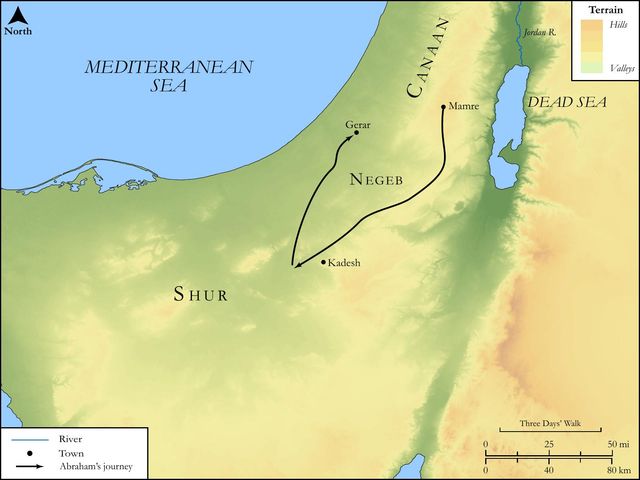
See on the biblical-era maps


Study this verse
Public-domain commentary
Matthew Henry
From his Commentary on the Whole Bible. Henry comments on passages, not single verses — this entry covers Genesis 20:14–18.
Here is, I. The kindness of a prince which Abimelech showed to Abraham. See how unjust Abraham's jealousies were. He fancied that if they knew that Sarah was his wife they would kill him; but, when they did know it, instead of killing him they were kind to him, frightened at least to be so by the divine rebukes they were under. 1. He gives him his royal licence to dwell where he pleased in his country, courting his stay because he gives him his royal gifts (Gen 20:14), sheep and oxen, and (Gen 20:16) a thousand pieces of silver. This he gave when he restored Sarah, either, [1.] By way of satisfaction for the wrong he had offered to do, in taking her to his house: when the Philistines restored the ark, being plagued for detaining it, they sent a present with it. The law appointed that when restitution was made something should be added to it, Lev 6:5. Or, [2.] To engage Abraham's prayers for him; not as if prayers should be bought and sold, but we should endeavour to be kind to those of whose spiritual things we reap, Co1 9:11. Note, It is our wisdom to get and keep an interest with those that have an interest in heaven, and to make those our friends who are the friends of God. [3.] He gives to Sarah good instruction, tells her that her husband (her brother he calls him, to upbraid her with calling him so) must be to her for a covering of the eyes, that is, she must look at no other, nor desire to be looked at by any other. Note, Yoke-fellows must be to each other for a covering of the eyes. The marriage-covenant is a covenant with the eyes, like Job's, Job 31:1.
II.The kindness of a prophet which Abraham showed to Abimelech:
he prayed for him, Gen 20:17, Gen 20:18. This honour God would put upon Abraham that, though Abimelech had restored Sarah, yet the judgment he was under should be removed upon the prayer of Abraham, and not before. Thus God healed Miriam, when Moses, whom she had most affronted, prayed for her (Num 12:13), and was reconciled to Job's friends when Job, whom they had grieved, prayed for them (Job 42:8-10), and so did, as it were, give it under his hand that he was reconciled to them. Note, The prayers of good men may be a kindness to great men, and ought to be valued.
Historical interpretation
Historical reception
2 surviving comments on this verse. Each one is dated, so this reads as a timeline rather than a list.
Select a marker to jump to its quote. Markers stagger vertically where authors wrote within a few decades of each other.
But it does not seem to me superfluous that mention is made not only of Abim-elech’s wife but also of his handmaids, especially in that place that says, “God healed them, and they bore children. For he had closed [their wombs] that they might not bear.” So far as we can perceive in such difficult passages, we think natural philosophy can be called Abimelech’s wife, but his handmaids represent the contrivances of dialectic which are diverse and various by virtue of the nature of the schools.Abraham, meanwhile, desires to share the gift of divine virtue also with the Gentiles, but it is not yet time for the grace of God to pass over from the former people to the Gentiles. For the apostle also, although under another viewpoint and figure, says nevertheless, “A woman is bound to the law so long as her husband lives; but if her husband is dead, she is loosed from the law so that she is no longer an adulteress if she is with another man.” First, therefore, the law of the letter must die so that, thus free at last, the soul may now marry the spirit and receive the marriage of the New Testament. Now this present time is the time of the calling of the Gentiles and of the death of the law, in which time free souls, at last loosed from the law of the husband, can marry a new husband, Christ.
But if you wish to be taught how the law is dead, look and see. Where now are the sacrifices? Where now is the altar? Where is the temple? Where are the purifications? Where is the celebration of the Passover? Is not the law dead in all these things? Or let those friends and defenders of the letter keep the letter of the law if they can.
According to this spiritual interpretation, therefore, Pharaoh, that is, an impure man and a destroyer, could not at all receive Sarah, that is, virtue. Later Abimelech, that is, he who was living purely and philosophically, could indeed receive her, because he was seeking “with a pure heart,” but “the time had not yet come.” Virtue therefore remains with Abraham; it remains with circumcision, until the time should come that in Christ Jesus our Lord, in whom “dwells all the fullness of deity corporeally,” complete and perfect virtue might pass over to the church of the Gentiles.
At that time, therefore, the house of Abim-elech and his handmaids, whom the Lord healed, will bear sons of the church. For this is the time in which “the barren” will bear and in which “many are the children of the desolate, more than of her who has a husband.” For the Lord opened the womb of the barren and made it fruitful, so that she bears a nation “all at once.” But also the saints cry out and say, “Lord, from fear of you we have conceived in the womb and given birth; we have produced the spirits of your salvation on the earth.” Whence also Paul likewise says, “My little children, of whom I am in labor again, until Christ be formed in you.”15
Such sons, therefore, the whole church of God produces, and such it brings forth. For “he who sows in the flesh, of the flesh also shall reap corruption.” Now the sons of the Spirit are those about whom also the apostle says, “The woman shall be saved through childbearing, if they continue in faith and purity.”17
Let the church of God therefore in this way understand the births, in this way receive the procreations, in this way uphold the deeds of the fathers with a fitting and honorable interpretation, in this way not disgrace the words of the Holy Spirit with foolish and Jewish fables but reckon them to be full of honor, full of virtue and usefulness. Otherwise, what edification will we receive when we read that Abraham, such a great patriarch, not only lied to king Abimelech but also surrendered his wife’s chastity to him? In what way does the wife of so great a patriarch edify us if she is supposed to have been exposed to defilements through marital indulgence? These things are what the Jews suppose, along with those who are friends of the letter, not of the spirit.
But we, “comparing spiritual things with spiritual,” are made spiritual in deed and understanding in Christ Jesus our Lord, “to whom belongs glory and sovereignty forever and ever. Amen.”
Unless Sarah received renewed youth in the seed that she had received, Abim-elech would not have desired a woman ninety years old. Then Abraham prayed and God healed Abimelech, his wife and his female slaves so that they bore children, because from the time [Abim-elech] had decided to marry Sarah until he returned her, pangs of childbirth struck all the women in his household; they would kneel down, but they could not give birth.
Continue studying Genesis 20:17 across the web’s major study libraries — every link below opens this exact verse, chapter, or book on the destination site.
Read & Compare
 BibleGatewayThis verse in more than 200 translations and 70 languages.
 Bible.comThe YouVersion reader — hundreds of translations, reading plans, and highlights.
 ESV.orgCrossway's official English Standard Version reader.
 NET BibleThe NET translation with 60,000+ translators' notes on every rendering decision.
 STEP BibleTyndale House's free study tool — original text, vocabulary, and scholarly resources.
 BibliaLogos Bible Software's free web reader.
 USCCBThe New American Bible (Revised Edition) with the U.S. bishops' study notes.
Commentaries
 BibleHub CommentariesDozens of classic commentaries on this verse, gathered on one page.
 StudyLightMore than 100 commentary sets — the largest collection on the web.
 BibleRefPlain-English commentary on what this verse means, verse by verse.
 Enduring WordDavid Guzik's free commentary on this chapter, widely used by Bible teachers.
 Bible Study ToolsVerse commentary alongside Greek and Hebrew study aids.
Original Language & Research
- BibleHub InterlinearThe verse word by word — original language, transliteration, and English.
- BibleHub LexiconEvery word's original-language definition and Strong's entry.
 Blue Letter BibleDeep-study tools — Strong's numbers, concordance, and word studies.
 SefariaThe Hebrew text with Rashi and centuries of Jewish commentary.
Sermons, Hymns & Audio


TrulyRandomVerse is not affiliated with these sites and doesn’t control their content. They’re linked because they’re genuinely useful.
Summary
Genesis 20:17 opens the closing scene of a challenging episode in Abraham's life, detailing God's miraculous intervention to reverse a divinely imposed barrenness upon Abimelech's household. Following Abraham's intercessory prayer, God healed Abimelech, his wife, and his maidservants, restoring their fertility. This pivotal verse powerfully underscores God's unwavering faithfulness to His covenant promises, the profound efficacy of intercessory prayer, and Abraham's distinct role as a prophet and mediator.
Context
ShowHideLiterary Context
Genesis 20:17 serves as the climax and resolution of the narrative in Genesis 20. This chapter recounts Abraham's second recorded instance of claiming his wife, Sarah, was his sister (Genesis 12:10-20), driven by fear for his life in Gerar. God directly intervenes in a dream, warning Abimelech not to touch Sarah and revealing her true identity as Abraham's wife and Abraham's status as a prophet. As a consequence of Abimelech unwittingly taking Sarah into his household, God had "fast closed up all the wombs of the house of Abimelech" (Genesis 20:18), causing barrenness. Verse 17 depicts the fulfillment of God's instruction to Abimelech in Genesis 20:7, where God declares that Abraham, as a prophet, would pray for Abimelech, and healing would follow.
Historical & Cultural Context
The setting is Gerar, a Philistine city, during the patriarchal period. In the households of the patriarchs, fertility was highly valued and often seen as a divine blessing, while barrenness was considered a curse or a sign of divine displeasure. The act of a king taking a woman into his harem, even unwittingly, was a serious matter, especially if she was married, as it could lead to severe consequences, including divine judgment. The concept of a "prophet" (Hebrew: navi') in this early period often encompassed not only one who speaks for God but also one who has a special relationship with God, capable of interceding effectively on behalf of others. The fear of death due to a beautiful wife was a real concern for patriarchs traveling in foreign lands, as rulers often exercised absolute power.
Key Themes
ShowHideThis chapter, culminating in Genesis 20:17, highlights several enduring themes. Firstly, it powerfully demonstrates God's sovereign protection of His covenant promises and the lineage through which they would be fulfilled, even despite the moral failures of His chosen instruments like Abraham. Secondly, it emphasizes the efficacy and necessity of intercessory prayer, showcasing Abraham's unique role as a prophet and mediator. Thirdly, the narrative reveals God's character as both just in judgment (closing the wombs) and merciful in restoration (healing them in response to prayer), underscoring His desire for repentance and reconciliation. Finally, it subtly underscores the importance of truthfulness and the dangers of deception, even when motivated by fear.
Exposition and Analysis
ShowHideKey Word Analysis
ShowHideA primitive root meaning "to judge (officially or mentally); by extension, to intercede, pray." In this context, it specifically refers to Abraham's act of intercession, petitioning God on behalf of Abimelech and his household. This word emphasizes the active, intentional nature of Abraham's communication with God, functioning as a mediator.
The plural form of Eloah, used here (and frequently in the Old Testament) to refer to the supreme God. Its plural form can denote majesty or the fullness of divine power. The repetition of "God" (first as the recipient of Abraham's prayer, then as the one who performs the healing) highlights His singular authority and omnipotence in both hearing prayer and enacting physical restoration.
A primitive root meaning "to mend (by stitching), i.e. (figuratively) to cure." In this context, it signifies the reversal of the divine affliction of barrenness. It implies a complete restoration of physical function, specifically the reproductive capabilities that had been supernaturally inhibited. The healing is not merely a cessation of the curse but a full return to normalcy, enabling them to "bear children."
Verse Breakdown
ShowHide"So Abraham prayed unto God"
This clause establishes Abraham's pivotal role as an intercessor, fulfilling the divine instruction given to Abimelech in Genesis 20:7. Despite his recent moral lapse in deceiving Abimelech, Abraham is still recognized by God as a prophet whose prayers are effective. This highlights God's grace and His unwavering commitment to His chosen servant.
"and God healed Abimelech, and his wife, and his maidservants"
This segment directly attributes the healing to God's sovereign action. The healing is comprehensive, extending to Abimelech himself (perhaps implying a general physical or emotional distress, or a direct affliction on him as the head of the household), his wife, and all his maidservants. This demonstrates the extent of the divine judgment (which affected all fertile females in the household) and the completeness of the divine restoration.
"and they bare [children]."
This concluding phrase emphatically confirms the full and tangible restoration of fertility. The bracketed "children" in the KJV clarifies the implication of the Hebrew verb yâlad (H3205), which means "to bear young" or "to bring forth." This outcome serves as undeniable proof that God's healing was complete and effective, reversing the barrenness and allowing the natural process of procreation to resume.
Literary Devices
ShowHideThe passage employs Narrative Resolution to bring the conflict of Genesis 20 to a satisfying close, demonstrating God's ultimate control over the situation. The immediate cause-and-effect relationship between Abraham's prayer and God's healing illustrates Divine Intervention, where God directly acts in human affairs to uphold His covenant and demonstrate His power. The use of Repetition in mentioning "God" twice in the verse ("Abraham prayed unto God: and God healed...") subtly emphasizes God as the primary agent of both the command for prayer and the subsequent miraculous healing. Furthermore, the narrative uses Foreshadowing by presenting Abraham as an intercessor, a role that anticipates the greater mediator to come.
Theological and Thematic Connections
ShowHideThis passage profoundly illustrates God's active involvement in the lives of His covenant people and those connected to them. It reveals a God who is both just in His judgments and abundant in His mercy, willing to reverse curses and bring restoration in response to faithful prayer and obedience. The efficacy of Abraham's intercession underscores the power God grants to His chosen servants, even when they are flawed, to influence divine action. This narrative serves as a powerful testament to God's unwavering faithfulness to His promises, safeguarding the lineage through which the ultimate blessing would come, despite human weakness and deception.
Reflection and Application
ShowHideGenesis 20:17 offers profound lessons for contemporary believers. It reminds us that God's faithfulness is not contingent upon our perfect performance but on His unchanging character and sovereign plan. Even when we stumble or act out of fear, as Abraham did, God remains committed to His covenant and uses even our flawed obedience for His purposes. This verse also powerfully affirms the transformative power of intercessory prayer. Abraham, despite his recent failure, was still God's chosen prophet, and his prayer was the catalyst for divine healing and restoration. This should encourage us to approach God boldly in prayer, not only for our own needs but also for others, trusting that He hears and responds according to His perfect will. Finally, Abimelech's swift obedience to God's command to seek Abraham's prayer, and Abraham's willingness to pray for those he had wronged, highlight the importance of humility, repentance, and forgiveness in resolving conflicts and restoring relationships, even when we are the ones who have been wronged.
Questions for Reflection
ShowHideFAQ
ShowHideWhy did God inflict barrenness upon Abimelech's household?
ShowHideGod closed the wombs of Abimelech's household as a direct divine judgment and protective measure. This act was to prevent Abimelech from unwittingly defiling Sarah, who was Abraham's wife and central to the covenant lineage through whom the promised seed would come (Genesis 20:3). This served as a clear sign of God's displeasure and a warning, ensuring the purity of the patriarchal line and demonstrating His sovereign protection over His covenant plan.
What does Abraham's designation as a "prophet" in this context signify?
ShowHideGod explicitly identified Abraham as a "prophet" in Genesis 20:7. This designation highlights Abraham's unique and intimate relationship with God, his role as a recipient of divine revelation, and his authority to intercede effectively on behalf of others. It underscores why God instructed Abimelech to seek Abraham's prayer for healing, affirming Abraham's spiritual authority and close communion with the Almighty.
Does this passage imply God punishes the innocent for the actions of others?
ShowHideWhile Abimelech's household suffered barrenness, the text emphasizes that Abimelech himself acted in "the integrity of his heart" (Genesis 20:6) and was unaware of Sarah's marital status. God's action was not an arbitrary punishment of the innocent but a temporary consequence and a protective measure to safeguard His covenant. It served as a means to bring about a swift resolution, demonstrate God's power, and affirm Abraham's prophetic standing, ultimately leading to restoration rather than permanent harm.
Christ-Centered Fulfillment
ShowHideGenesis 20:17, with its profound themes of intercession, divine healing, and God's faithfulness to His covenant despite human failure, finds its ultimate and most glorious fulfillment in Jesus Christ. Just as Abraham, a flawed prophet, interceded for Abimelech's household, Christ serves as our great High Priest and perfect Intercessor, continually pleading on behalf of His people before the Father (Hebrews 7:25). The physical healing and restoration of fertility in Abimelech's house powerfully foreshadow the comprehensive spiritual healing and new life that Christ brings through His atoning work on the cross, reversing the barrenness of sin and death and granting spiritual fruitfulness (John 15:5). Furthermore, God's unwavering commitment to His covenant with Abraham, even through Abraham's imperfections, points to God's perfect faithfulness in sending His Son, Jesus, as the true Seed through whom all the promises of the Abrahamic covenant are perfectly fulfilled and all nations are blessed (Galatians 3:16 and Galatians 3:29). In Christ, we find the ultimate Mediator, the source of all healing, and the faithful One who secures our eternal inheritance.