


Genesis 46:28
Bible text: King James Version (1769 Blayney text) · Public domain
Bible text: Berean Standard Bible · Public domain
Bible text: American Standard Version (1901) · Public domain
Bible text: World English Bible, Messianic edition · Public domain
Bible text: Geneva Bible (1599) · Public domain
Bible text: Young's Literal Translation · Public domain
- וְאֶתve·'Etand <obj.>H853Conj-w ¦ DirObjMParticle Object Indicatorוְandאֶת<obj.>
- יְהוּדָהye·hu·DahJudahH3063N-proper-mNoun Proper Masculine
- שָׁלַחsha·Lachhe sentH7971V-Qal-Perf-3msVerb Qal Perfect 3rd Singular Masculine
- לְפָנָיוle·fa·Nav<to> before himH6440Prep-l ¦ N-mpc ¦ 3msNoun Plural Masculine Constructלְ<to>פָנָיbeforeוhim
- אֶל'eltoH413PrepPreposition
- יוֹסֵףyo·SefJosephH3130N-proper-mNoun Proper Masculine
- לְהוֹרֹתle·ho·Rotto showH3384Prep-l ¦ V-Hiphil-InfVerb Hiphil Infinitive Constructלְtoהוֹרֹתshow
- לְפָנָיוle·fa·Nav<to> before himH6440Prep-l ¦ N-mpc ¦ 3msNoun Plural Masculine Constructלְ<to>פָנָיbeforeוhim
- גֹּשְׁנָהGo·she·nahGoshen towardsH1657N-proper ¦ SfxNoun Proper LocationגֹּשְׁנָGoshenהtowards
- וַיָּבֹאוּvai·ya·Vo·'uand they wentH935Conj-w ¦ V-Qal-ConsecImperf-3mpVerb Qal Consecutive Imperfect 3rd Plural Masculineוַandיָּבֹאוּthey went
- אַרְצָה'Ar·tzah[the] land of towardsH776N-fsc ¦ SfxNoun Singular Feminine Constructאַרְצָ[the] land ofהtowards
- גֹּשֶׁןGo·shenGoshenH1657N-properNoun Proper Location
English is a literal word-by-word gloss of the Hebrew, not the KJV's wording. Why?
This is the original text the KJV's translators worked from — each Hebrew word with its own literal English meaning in this verse, prepared by scholars at Tyndale House, Cambridge. The KJV translates whole sentences, not word by word, so its wording differs: one Hebrew word can become several English words, and the KJV may choose “the LORD” where the gloss reads “Yahweh”. Both are faithful — they answer different questions. For the KJV's own rendering, switch to the KJV text.
Details
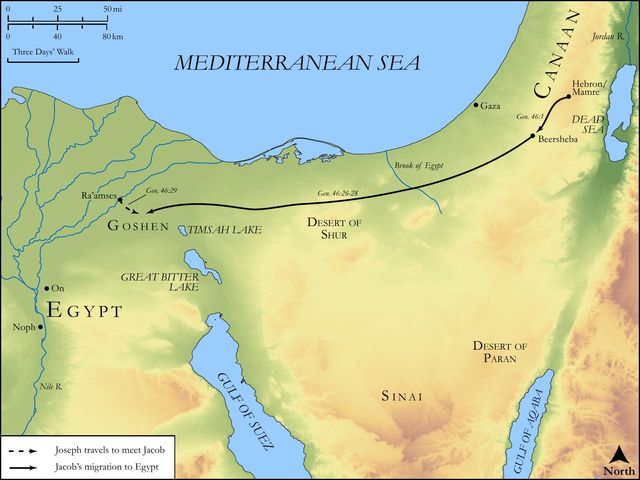
See on the biblical-era maps


Study this verse
Public-domain commentary
Matthew Henry
From his Commentary on the Whole Bible. Henry comments on passages, not single verses — this entry covers Genesis 46:28–34. His three-level outline is real structure in the source text, so it is rendered as structure.
We have here, I. The joyful meeting between Jacob and his son Joseph, in which observe,
1.Jacob's prudence in sending Judah before him to Joseph, to give him notice of his arrival in Goshen. This was a piece of respect owing to the government, under the protection of which these strangers had come to put themselves, Gen 46:28. We should be very careful not to give offence to any, especially not to the higher powers.
2.Joseph's filial respect to him. He went in his chariot to met him, and, in the interview, showed,
(1.)How much he honoured him: He presented himself unto him. Note, It is the duty of children to reverence their parents, yea, though Providence, as to outward condition, has advanced them above their parents.
(2.)How much he loved him. Time did not wear out the sense of his obligations, but his tears which he shed abundantly upon his father's neck, for joy to see him, were real indications of the sincere and strong affection he had for him. See how near sorrow and joy are to each other in this world, when tears serve for the expression of both. In the other world weeping will be restrained to sorrow only; in heaven there is perfect joy, but no tears of joy: all tears, even those, shall there be wiped away, because the joys there are, as no joys are here, without any alloy. When Joseph embraced Benjamin he wept upon his neck, but when he embraced his father he wept upon his neck a good while; his brother Benjamin was dear, but his father Jacob must be dearer.
3.Jacob's great satisfaction in this meeting: Now let me die, Gen 46:30. Not but that it was further desirable to live with Joseph, and to see his honour and usefulness; but he had so much pleasure and satisfaction in this first meeting that he thought it too much to desire or expect any more in this world, where our comforts must always be imperfect. Jacob wished to die immediately, and lived seventeen years longer, which, as our lives go now, is a considerable part of a man's age. Note, Death will not always come just when we call for it, whether in a passion of sorrow or in a passion of joy. Our times are in God's hand, and not in our own; we must die just when God pleases, and not either just when we are surfeited with the pleasures of life or just when we are overwhelmed with its griefs.
II.Joseph's prudent care concerning his brethren's settlement.
It was justice to Pharaoh to let him know that such a colony had come to settle in his dominions. Note, If others repose a confidence in us, we must not be so base and disingenuous as to abuse it by imposing upon them. If Jacob and his family should come to be a charge to the Egyptians, yet it should never be said that they came among them clandestinely and by stealth. Thus Joseph took care to pay his respects to Pharaoh, Gen 46:31. But how shall he dispose of his brethren? Time was when they were contriving to get rid of him; now he is contriving to settle them to their satisfaction and advantage: This is rendering good for evil. Now,
1.He would have them to live by themselves, separate as much as might be from the Egyptians, in the land of Goshen, which lay nearest to Canaan, and which perhaps was more thinly peopled by the Egyptians, and well furnished with pastures for cattle. He desired they might live separately, that they might be in the less danger both of being infected by the vices of the Egyptians and of being insulted by the malice of the Egyptians. Shepherds, it seems, were an abomination to the Egyptians, that is, they looked upon them with contempt, and scorned to converse with them; and he would not send for his brethren to Egypt to be tramped upon. And yet,
2.He would have them to continue shepherds, and not to be ashamed to own that as their occupation before Pharaoh. He could have employed them under himself in the corn-trade, or perhaps, by his interest in the king, might have procured places for them at court or in the army, and some of them, at least, were deserving enough; but such preferments would have exposed them to the envy of the Egyptians, and would have tempted them to forget Canaan and the promise made unto their fathers; therefore he contrives to continue them in their old employment. Note,
(1.)An honest calling is no disparagement, nor ought we to account it so either in ourselves or in our relations, but rather reckon it a shame to be idle, or to have nothing to do.
(2.)It is generally best for people to abide in the callings that they have been bred to, and used to, Co1 7:24. Whatever employment or condition God, in his providence, has allotted for us, let us accommodate ourselves to it, and satisfy ourselves with it, and not mind high things. It is better to be the credit of a mean post than the shame of a high one.
Historical interpretation
Historical reception
1 surviving comment on this verse from the historical church.
(v. 28) But Judah was sent ahead of him to Joseph, to meet him in the city of Heroum in the land of Ramesse. In Hebrew, there is no city called Heroum, nor a land called Ramesse, but only Gesen. Some Jews assert that Gesen is now called Thebaid. And what follows afterwards: He gave them the best land in Egypt, in Ramesse, which they believe to be the village called Arsenoites in ancient times.
Continue studying Genesis 46:28 across the web’s major study libraries — every link below opens this exact verse, chapter, or book on the destination site.
Read & Compare
 BibleGatewayThis verse in more than 200 translations and 70 languages.
 Bible.comThe YouVersion reader — hundreds of translations, reading plans, and highlights.
 ESV.orgCrossway's official English Standard Version reader.
 NET BibleThe NET translation with 60,000+ translators' notes on every rendering decision.
 STEP BibleTyndale House's free study tool — original text, vocabulary, and scholarly resources.
 BibliaLogos Bible Software's free web reader.
 USCCBThe New American Bible (Revised Edition) with the U.S. bishops' study notes.
Commentaries
 BibleHub CommentariesDozens of classic commentaries on this verse, gathered on one page.
 StudyLightMore than 100 commentary sets — the largest collection on the web.
 BibleRefPlain-English commentary on what this verse means, verse by verse.
 Enduring WordDavid Guzik's free commentary on this chapter, widely used by Bible teachers.
 Bible Study ToolsVerse commentary alongside Greek and Hebrew study aids.
Original Language & Research
- BibleHub InterlinearThe verse word by word — original language, transliteration, and English.
- BibleHub LexiconEvery word's original-language definition and Strong's entry.
 Blue Letter BibleDeep-study tools — Strong's numbers, concordance, and word studies.
 SefariaThe Hebrew text with Rashi and centuries of Jewish commentary.
Sermons, Hymns & Audio


TrulyRandomVerse is not affiliated with these sites and doesn’t control their content. They’re linked because they’re genuinely useful.
Summary
Genesis 46:28 marks a pivotal moment in the narrative of Jacob's migration to Egypt, detailing the strategic dispatch of Judah ahead of the family to meet Joseph. This preparatory act was crucial for receiving specific instructions regarding their settlement in Goshen, a fertile region uniquely suited for their pastoral lifestyle. The verse underscores God's meticulous providence in orchestrating the safe arrival and distinct placement of His covenant people, setting the stage for the highly anticipated reunion between Jacob and Joseph and the subsequent growth of Israel into a nation.
Context
ShowHideLiterary Context
Genesis 46:28 opens the closing stage of the narrative of Jacob's journey into Egypt, which began in Genesis 46:1. The preceding verses describe Jacob's initial hesitation to leave Canaan, overcome only by a divine assurance from God at Beersheba, promising His presence and the formation of a great nation in Egypt (Genesis 46:3-4). The chapter then lists the seventy members of Jacob's household who journeyed with him. This verse serves as the final, practical step in their arrival, ensuring a smooth transition and proper establishment, leading directly into the emotional reunion between Jacob and Joseph in Genesis 46:29-30.
Historical & Cultural Context
The famine gripping Canaan was severe, necessitating the move to Egypt, a land known for its agricultural abundance, especially along the Nile. Joseph, as the vizier of Egypt, held immense power, second only to Pharaoh. For a large family unit like Jacob's, comprising numerous individuals, livestock, and possessions, entering a foreign land, particularly one as powerful and culturally distinct as Egypt, required careful diplomatic and logistical planning. The Egyptians, with their advanced civilization and polytheistic religion, viewed shepherds with disdain (Genesis 46:34), making a designated, separate region like Goshen ideal for the Israelites to maintain their identity and livelihood without immediate cultural friction. Goshen, located in the eastern Nile Delta, was renowned for its rich pasturelands, making it a perfect fit for Jacob's pastoral family.
Key Themes
ShowHideThis verse contributes to several overarching themes in Genesis. It powerfully illustrates Divine Providence, showing God's meticulous hand in orchestrating events—from the famine to Joseph's elevation and the strategic placement of Israel—to fulfill His covenant promises to Abraham, Isaac, and Jacob (Genesis 12:2-3). The selection of Judah highlights the theme of Emerging Leadership, as Judah, despite not being the firstborn, consistently demonstrates maturity and responsibility, foreshadowing his future prominence in Israel's history and the messianic line (Genesis 49:10). Furthermore, the settlement in Goshen underscores the theme of Preservation of Identity, ensuring the nascent nation of Israel would remain distinct from Egyptian culture, allowing them to grow numerically and spiritually in preparation for their future as God's chosen people.
Exposition and Analysis
ShowHideGenesis 46:28 details the strategic foresight exercised by Jacob and Joseph in the final leg of the family's migration: "And he sent Judah before him unto Joseph, to direct his face unto Goshen; and they came into the land of Goshen." This verse is not merely a logistical note but a significant narrative detail, highlighting key relationships and divine orchestration.
Key Word Analysis
ShowHideThis verb (H7971) signifies dispatching someone for a specific purpose, often with authority or a mission. Here, Jacob "sent" Judah, indicating a deliberate and authorized delegation. It implies a trust placed in Judah to act as an emissary, carrying out a vital preparatory task for the entire family's arrival. The act of sending is purposeful and strategic, not merely a casual departure.
The root (H3384) primarily means "to flow as water," but transitively, it means "to lay or throw," and figuratively, "to point out" or "to teach." In this context, "to direct his face" (לְהוֹרֹת פָּנָיו, l'horot panav) means to instruct, guide, or show the way. Judah's mission was not just to find Joseph, but to receive precise guidance and instructions from Joseph regarding the family's settlement in Goshen, ensuring their proper reception and establishment.
This noun (H6440), always plural but used singularly, refers to the literal face, but often carries a broader meaning of presence, person, or direction. "To direct his face unto Goshen" implies directing Joseph's attention, presence, and instructions specifically towards the settlement in Goshen. It suggests a focused intent on the destination and the necessary preparations for the family's arrival there.
Verse Breakdown
ShowHide"And he sent Judah before him unto Joseph"
This clause reveals Jacob's choice of Judah as his emissary. This is highly significant, as Judah was not the firstborn (Reuben, Simeon, Levi were older) but had increasingly demonstrated leadership, responsibility, and intercession within the family, notably in the matter of Benjamin (Genesis 44:18-34). Jacob's trust in Judah, sending him ahead to the most powerful man in Egypt (Joseph), underscores Judah's emerging prominence and foreshadows his future role in the lineage of the Messiah.
"to direct his face unto Goshen"
This phrase clarifies Judah's specific mission. It was not merely to announce their arrival, but to receive detailed instructions and guidance from Joseph regarding their settlement. The emphasis on "Goshen" highlights the pre-determined and strategic nature of their destination. Joseph, having already arranged for their coming, would provide the necessary directions for their entry and establishment in this specific, fertile region. This implies a coordinated effort between Jacob and Joseph to ensure a smooth transition for the large family.
"and they came into the land of Goshen"
This final clause confirms the successful completion of the journey and the fulfillment of the plan. The entire family, following Judah's preliminary mission and Joseph's guidance, arrived safely in their designated area. This arrival is the culmination of a long and arduous journey, marking the beginning of Israel's sojourn in Egypt, a period that would profoundly shape their identity and prepare them for nationhood.
Literary Devices
ShowHideThe verse employs several literary devices. Foreshadowing is evident in Jacob's choice of Judah. This act subtly elevates Judah's status, hinting at his future leadership role and the prophetic blessing he would receive in Genesis 49:8-12, which identifies his lineage as the source of kingship and the ultimate Messiah. The specific mention of "Goshen" functions as Symbolism, representing a place of divine provision, protection, and separation. It is a sanctuary where God's people can flourish and maintain their distinct identity amidst a foreign culture. The narrative also exhibits Narrative Progression, meticulously detailing the final, crucial step in the family's journey, building anticipation for the long-awaited reunion between Jacob and Joseph, and setting the stage for the unfolding drama of Israel's sojourn and eventual exodus from Egypt.
Theological and Thematic Connections
ShowHideGenesis 46:28 is a powerful testament to God's meticulous and unwavering providence. The entire sequence, from the famine to Joseph's rise to power and the strategic settlement in Goshen, demonstrates God's sovereign hand orchestrating events to preserve His covenant people and fulfill His promises. This verse highlights the practical outworking of divine guidance, where human action (Jacob sending Judah, Joseph directing) aligns with God's overarching plan. It underscores that even in challenging circumstances like a severe famine, God is actively working to ensure the survival and flourishing of His chosen lineage, preparing them for their destiny as a great nation.
Reflection and Application
ShowHideGenesis 46:28 offers profound lessons for contemporary believers. It reminds us that God's providence is not merely a grand, abstract concept, but extends to the practical, logistical details of our lives. Just as Jacob sent Judah to secure a clear path and direction, we are called to seek wise counsel, make diligent preparations, and trust in God's guidance when navigating significant transitions or entering new phases of life. This passage encourages us to recognize that God often works through human agents, raising up unexpected leaders and using individuals in ways that might not align with conventional expectations, all for the advancement of His sovereign plan. Furthermore, the strategic placement in Goshen highlights the importance of intentional community and maintaining a distinct identity as God's people in a world that often seeks to assimilate us. We are to seek "Goshens" – places or communities where we can thrive spiritually, grow in faith, and remain set apart for God's purposes, even amidst challenging cultural landscapes.
Questions for Reflection
ShowHideFAQ
ShowHideWhy was Judah chosen to go before Jacob instead of an older brother?
ShowHideJudah's selection by Jacob was a significant indicator of his growing trustworthiness, maturity, and leadership within the family. While Reuben was the firstborn, and Simeon and Levi had demonstrated impulsive and violent tendencies in the past (Genesis 34:25-31), Judah had shown remarkable responsibility and a willingness to intercede for his family, particularly in the critical matter of Benjamin's freedom (Genesis 44:18-34). This choice by Jacob further solidified Judah's emerging prominence, foreshadowing his future role as the ancestor of the royal line from which the Messiah would come (Genesis 49:10).
What was the significance of the land of Goshen for the Israelites?
ShowHideThe land of Goshen held multifaceted significance for the Israelites. Economically, it was a highly fertile region, ideal for pasturing Jacob's large flocks and herds, ensuring their economic sustenance and allowing them to prosper. More importantly, its strategic location in the eastern Nile Delta provided a crucial separation from the main Egyptian populace. This geographical distinction allowed the Israelites to maintain their distinct cultural and religious identity, preventing immediate assimilation into Egyptian polytheistic customs and practices (Genesis 46:34). This separation was vital for their development as a unique people set apart for God's purposes, enabling them to grow into a numerous nation as part of God's covenant plan, as seen later in Exodus 1:7.
Christ-Centered Fulfillment
ShowHideThe strategic preservation of Jacob's family in Goshen, facilitated by Judah's leadership and Joseph's administrative power, is a crucial step in God's unfolding redemptive plan, directly pointing to Christ. The very survival and flourishing of the nascent nation of Israel in Egypt ensured the continuity of the covenant line through which the Messiah would ultimately come. Judah's emerging leadership in Genesis 46:28 foreshadows his pivotal role as the progenitor of the royal lineage from which Jesus, the King of Kings, would descend (Genesis 49:10; Matthew 1:2-3). God's meticulous providence in directing His people to a place of safety and growth in Goshen underscores His unwavering commitment to bring forth the Savior. Just as Goshen provided a physical refuge and sustenance for Israel, Christ offers ultimate spiritual refuge and provision for all who believe, leading them into a land of true rest and eternal inheritance (Hebrews 4:9-10; John 10:9). He is the ultimate "director" of His people's path, guiding them to their spiritual Goshen, a place of abundant life and communion with God (John 14:6).