


Genesis 46:27
Bible text: King James Version (1769 Blayney text) · Public domain
Bible text: King James Version with Strong's numbers · Public domain
Bible text: Berean Standard Bible · Public domain
Bible text: American Standard Version (1901) · Public domain
Bible text: World English Bible, Messianic edition · Public domain
Bible text: Geneva Bible (1599) · Public domain
Bible text: Young's Literal Translation · Public domain
- וּבְנֵיu·ve·Neiand [the] sons ofH1121Conj-w ¦ N-mpcNoun Plural Masculine Constructוּandבְנֵי[the] sons of
- יוֹסֵףyo·SefJosephH3130N-proper-mNoun Proper Masculine
- אֲשֶׁר'a·SherwhoH834RelParticle Relative
- יֻלַּדyu·ladit was bornH3205V-Pual-Perf-3msVerb Pual Perfect 3rd Singular Masculine
- לוֹloto himPrep-l ¦ 3msSuffix Personal 3rd Singular Masculineלtoוֹhim
- בְמִצְרַיִםve·mitz·Ra·yimin EgyptH4714Prep-b ¦ N-properNoun Proper LocationבְinמִצְרַיִםEgypt
- נֶפֶשׁNe·fesh[were] person[s]H5315N-fsNoun Singular Feminine Absolute
- שְׁנָיִםshe·Na·yimtwoH8147Adj-cdAdjective Numerical Dual common gender Absolute
- כָּלkoleveryH3605N-mscNoun Singular Masculine Construct
- הַנֶּפֶשׁha·Ne·fesh<the> personH5315Art ¦ N-fsNoun Singular Feminine Absoluteהַ<the>נֶּפֶשׁperson
- לְבֵיתle·veitof [the] household ofH1004Prep-l ¦ N-mscNoun Singular Masculine Constructלְofבֵית[the] household of
- יַעֲקֹבya·'a·KoJacobH3290N-proper-mNoun Proper Masculine
- הַבָּאָהha·Ba·'ahthat it wentH935Art ¦ V-Qal-Perf-3fsVerb Qal Perfect 3rd Singular Feminineהַthatבָּאָהit went
- מִצְרַיְמָהmitz·Ray·mahEgypt towardsH4714N-proper ¦ SfxNoun Proper LocationמִצְרַיְמָEgyptהtowards
- שִׁבְעִיםshiv·'Im[was] seventyH7657Adj-mpAdjective Numerical Plural Masculine Absolute
English is a literal word-by-word gloss of the Hebrew, not the KJV's wording. Why?
This is the original text the KJV's translators worked from — each Hebrew word with its own literal English meaning in this verse, prepared by scholars at Tyndale House, Cambridge. The KJV translates whole sentences, not word by word, so its wording differs: one Hebrew word can become several English words, and the KJV may choose “the LORD” where the gloss reads “Yahweh”. Both are faithful — they answer different questions. For the KJV's own rendering, switch to the KJV text.
Details
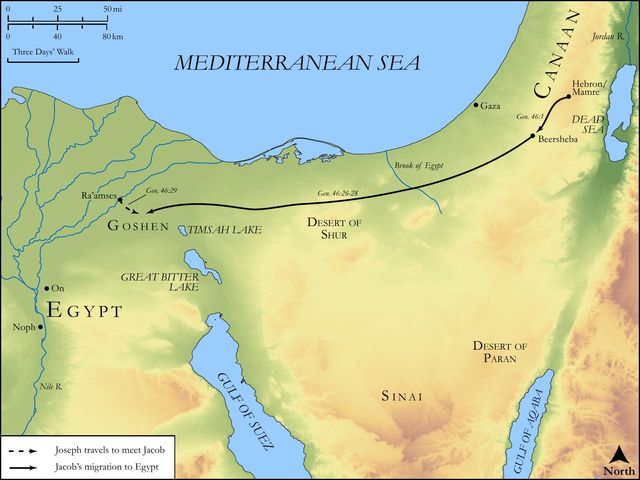
See on the biblical-era maps


Study this verse
Public-domain commentary
Matthew Henry
From his Commentary on the Whole Bible. Henry comments on passages, not single verses — this entry covers Genesis 46:5–27.
Old Jacob is here flitting. Little did he think of ever leaving Canaan; he expected, no doubt, to die in his nest, and to leave his seed in actual possession of the promised land: but Providence orders it otherwise. Note, Those that think themselves well settled may yet be unsettled in a little time. Even old people, who think of no other removal than that to the grave (which Jacob had much upon his heart, Gen 37:35; Gen 42:38), sometimes live to see great changes in their family. It is good to be ready, not only for the grave, but for whatever may happen betwixt us and the grave. Observe, 1. How Jacob was conveyed; not in a chariot, though chariots were then used, but in a wagon, Gen 46:5. Jacob had the character of a plain man, who did not affect any thing stately or magnificent; his son rode in a chariot (Gen 41:43), but a wagon would serve him. 2. The removal of what he had with him. (1.) His effects (Gen 46:6), cattle and goods; these he took with him that he might not wholly be beholden to Pharaoh for a livelihood, and that it might not afterwards be said of them, "that they came beggars to Egypt." (2.) His family, all his seed, Gen 46:7. It is probable that they had continued to live together in common with their father; and therefore when he went they all went, which perhaps they were the more willing to do, because, though they had heard that the land of Canaan was promised them, yet, to this day, they had none of it in possession. We have here a particular account of the names of Jacob's family, his sons' sons, most of whom are afterwards mentioned as heads of houses in the several tribes. See Num 26:5, etc. Bishop Patrick observes that Issachar called his eldest son Tola, which signifies a worm, probably because when he was born he was a very little weak child, a worm, and no man, not likely to live; and yet there sprang from him a very numerous offspring, Ch1 7:2. Note, Living and dying do not go by probability. The whole number that went down into Egypt was sixty-six (Gen 46:26), to which add Joseph and his two sons, who were there before, and Jacob himself, the head of the family, and you have the number of seventy, Gen 46:27. The Septuagint makes them seventy-five, and Stephen follows them (Act 7:14), the reason of which we leave to the conjecture of the critics; but let us observe, [1.] Masters of families ought to take care of all under their charge, and to provide for those of their own house food convenient both for body and soul. When Jacob himself removed to a land of plenty, he would not leave any of his children behind him to starve in a barren land. [2.] Though the accomplishment of promises is always sure, yet it is often slow. It was now 215 years since God had promised Abraham to make of him a great nation (Gen 12:2); and yet that branch of his seed on which the promise was entailed had increased only to seventy, of which this particular account is kept, that the power of God in multiplying these seventy to so vast a multitude, even in Egypt, may appear the more illustrious. When God pleases, a little one shall become a thousand, Isa 60:22.
Historical interpretation
Historical reception
4 surviving comments on this verse. Each one is dated, so this reads as a timeline rather than a list.
Select a marker to jump to its quote. Markers stagger vertically where authors wrote within a few decades of each other.
Therefore seventy-five souls go down into Egypt, just as it is written, and this in the mystical sense is the number of forgiveness. For after such great hardness, after such great sins, they would be considered unworthy unless there were granted them the forgiveness of sins. Judah—that is, the confession of sin—goes to meet Joseph. The people of the Jews that is to come sends him ahead as a forerunner of itself. So also the true Joseph, that is, “the witness and interpreter of the Godhead,” comes to meet those who before were in the possession of unbelief, because now their confession precedes them. For Christ is the interpreter of the Godhead, because “no one has at any time seen God, except the only-begotten Son, who is in the bosom of the Father; he has revealed him.” It is he who in the last times will receive the people of the Jews, by then in an advanced age and grown weary, and do so, not according to its merits but according to the election of his grace; and he will put his hand on its eyes to take away its blindness. And so he postponed its healing, so that the people who earlier did not think it should be believed might be the last to believe and might lose the prerogative of earlier election. On this account also the apostle says, “that a partial blindness has befallen Israel, until the full number of the Gentiles should enter, and thus all Israel should be saved.” And thus it is that the deeds of the patriarchs are symbols of events to come. Indeed, Jacob himself speaks to this effect to his sons: “Gather yourselves together, that I may tell you the things that shall befall you in the last days. Gather yourselves together, and hear Israel your father.”
Why did sacred Scripture indicate the number to us precisely? So that we might be in a position to know how God’s prediction took effect that said, “I will make you into a great nation there.” You see, from those seventy-five persons the people of Israel grew into six hundred thousand. You notice how it was not idly or to no purpose that it taught us the number of those that went down to Egypt, but for us to know from how few that great number came and not to lose confidence in God’s promises. I mean, when you consider that after the death of Jacob and Joseph the king of the Egyptians went to such lengths to reduce their numbers and prevent them from growing, be amazed and overcome at God’s providence and the fact that his wishes can never fail, no matter how many people try their utmost.
(Chapter XLVI, Verse 26 and following) Therefore all the souls that entered Egypt with Jacob, and those that came out of his thighs, apart from the wives of Jacob's sons, were sixty-six souls; and the sons of Joseph, who were born to him in Egypt, were nine souls. Therefore all the souls that entered Egypt with Jacob were seventy-five. It is without doubt that except for Joseph and his sons, sixty-six souls that came out of Jacob's thighs entered Egypt. For thus also, gradually through each calculated number, it is proven, and it is found in the Hebrew volumes. But what we read in the Septuagint: And the sons of Joseph, who were born to him in Egypt, were nine souls: let us know that in Hebrew, instead of nine, there are two. For Ephraim and Manasseh were born to him before Jacob entered Egypt, and before the time of famine. They were born of Aseneth, the daughter of Potiphera, in Egypt. But also that which we read above: And the sons of Manasseh became, whom the Syrian concubine gave birth to him, Machir, and Machir gave birth to Gilead; and the sons of Ephraim, the brother of Manasseh, Suthalaam, and Thaam; and the sons of Suthalaam, Edem, it is added: indeed, what we read afterwards is described as if it had happened by anticipation. For at that time when Jacob entered Egypt, Ephraim and Manasseh were not old enough to be able to have children. From this it is evident that all the souls who entered Egypt from the loins of Jacob were seventy, but afterwards sixty-six entered, and they found (Al. gave birth to) three souls in Egypt, namely Joseph with his two sons, and the seventieth was Jacob himself. In order that we do not seem to speak against the authority of Scripture, even the Seventy Interpreters translated in Deuteronomy (X, 22) that Jacob (also called Israel) entered Egypt with seventy souls. Therefore, if anyone opposes our opinion, they will make Scripture contradict itself. For the Seventy Interpreters themselves, who said that seventy-five souls, including Joseph and his descendants, entered Egypt through πρόληψις, only mentioned in Deuteronomy that seventy entered (some say 'entered'). But if the opposite is opposed to us, how is it said in the Acts of the Apostles (VII) , in the sermon of Stephen to the people, that seventy-five souls entered Egypt; the explanation is easy. For Saint Luke, who is the author of the history itself, should not have written anything contrary to that Scripture, which had already been made known to the Gentiles, when he published the volume of the Acts of the Apostles. And certainly, at that time, the authority of the Seventy Interpreters was considered greater than that of Luke, who was unknown, and despised, and not held in high esteem by the nations. However, it is generally observed that wherever the holy Apostles or Apostolic men speak to the peoples, they often make use of testimonies that had already been spread among the nations: although many report that Luke the Evangelist, as a proselyte, was ignorant of the Hebrew letters.
Therefore Jacob went down to Egypt together with seventy-five people, and his son Joseph came to meet him. After seeing him Jacob said, “I see you, son, now I can die willingly.” When Simeon, that venerable old man, called a father because of his age and not because he could father children, saw Christ because of whom he was still kept in this world as in Egypt, even though he was extremely old, said, “Master, now you are dismissing your servant in peace, according to your word; for my eyes have seen your salvation.” David’s Psalm 75, which coincides with the number of the people, proclaims, “God is known in Judea, and his name is great in Israel.” Since Israel means “he who sees God,” it is necessary that every person enlightened by grace, Jew or Greek, is freed from the slavery of Egypt, even though Pharaoh, that is, the devil, oppresses him with a heavy yoke.
Continue studying Genesis 46:27 across the web’s major study libraries — every link below opens this exact verse, chapter, or book on the destination site.
Read & Compare
 BibleGatewayThis verse in more than 200 translations and 70 languages.
 Bible.comThe YouVersion reader — hundreds of translations, reading plans, and highlights.
 ESV.orgCrossway's official English Standard Version reader.
 NET BibleThe NET translation with 60,000+ translators' notes on every rendering decision.
 STEP BibleTyndale House's free study tool — original text, vocabulary, and scholarly resources.
 BibliaLogos Bible Software's free web reader.
 USCCBThe New American Bible (Revised Edition) with the U.S. bishops' study notes.
Commentaries
 BibleHub CommentariesDozens of classic commentaries on this verse, gathered on one page.
 StudyLightMore than 100 commentary sets — the largest collection on the web.
 BibleRefPlain-English commentary on what this verse means, verse by verse.
 Enduring WordDavid Guzik's free commentary on this chapter, widely used by Bible teachers.
 Bible Study ToolsVerse commentary alongside Greek and Hebrew study aids.
Original Language & Research
- BibleHub InterlinearThe verse word by word — original language, transliteration, and English.
- BibleHub LexiconEvery word's original-language definition and Strong's entry.
 Blue Letter BibleDeep-study tools — Strong's numbers, concordance, and word studies.
 SefariaThe Hebrew text with Rashi and centuries of Jewish commentary.
Sermons, Hymns & Audio


TrulyRandomVerse is not affiliated with these sites and doesn’t control their content. They’re linked because they’re genuinely useful.
Summary
Genesis 46:27 meticulously concludes the census of Jacob's descendants, affirming that the total number of individuals from his household who journeyed into Egypt was seventy. This precise enumeration marks a foundational moment in the divine unfolding of redemptive history, signifying the humble origins from which God would miraculously raise the mighty nation of Israel, thereby demonstrating His unwavering faithfulness to the ancient covenant promises made to Abraham and Jacob regarding their innumerable progeny and the establishment of a great people.
Context
ShowHideLiterary Context
Genesis 46 details the momentous journey of Jacob (now called Israel) and his entire family into Egypt, a relocation orchestrated by divine providence amidst a severe famine and the miraculous reunion with his long-lost son, Joseph. The preceding verses, specifically Genesis 46:8-26, provide a comprehensive, genealogical list of Jacob's descendants, meticulously accounting for each individual who made the descent. Verse 27 serves as a concluding summary statement, confirming the total number of souls from Jacob's house who entered Egypt. This numerical summary sets the stage for the subsequent narrative in Exodus, where this numerically small group experiences exponential growth into a powerful nation, fulfilling God's earlier prophecies.
Historical & Cultural Context
The famine gripping Canaan and Egypt was severe, lasting seven years, as foretold by Joseph (Genesis 41:29-30). In this desperate situation, migration was a common survival strategy, but Jacob's move was unique, divinely directed. God explicitly instructed Jacob to go to Egypt, promising to make him a great nation there and to bring him back (Genesis 46:3-4). The family's settlement in Goshen, a fertile region suitable for pasturage, was strategically chosen by Joseph to ensure their isolation from Egyptian culture and their ability to thrive, preserving their distinct identity as a family unit destined for nationhood (Genesis 47:5-6).
Key Themes
ShowHideThis verse powerfully underscores several key themes woven throughout Genesis and the broader Pentateuch. Firstly, it highlights Divine Providence, as God meticulously guides every step of Jacob's family, from Joseph's enslavement to their relocation, ensuring their preservation and growth. Secondly, it is a direct Fulfillment of Covenant Promises, particularly those made to Abraham (Genesis 12:2) and reiterated to Jacob (Genesis 35:11), promising a numerous seed that would become a great nation. The seventy souls are the embryonic form of this promised multitude. Thirdly, it emphasizes the Formation of a Nation, marking the transition from a patriarchal family unit to a nascent people group, setting the stage for their miraculous multiplication in Egypt, as detailed in Exodus 1.
Exposition and Analysis
ShowHideKey Word Analysis
ShowHideThis term broadly refers to a "breathing creature," encompassing living beings, persons, or individuals. In this context, its use emphasizes the personal nature of God's meticulous accounting and care for each member of this nascent nation, rather than just a numerical count of bodies. It highlights the vitality and individual existence of each person in Jacob's household.
This word denotes a "house" in its broadest sense, extending beyond a physical dwelling to include a family, household, or even a lineage. Here, "house of Jacob" signifies the entire extended family, the patriarchal household, which is the foundational unit from which the nation of Israel would emerge. It underscores the familial and relational aspect of God's covenant people.
This precisely means "seventy." This specific numerical count is crucial. It represents the complete, divinely appointed number of individuals who formed the initial core of the Israelite nation upon their entry into Egypt. This small, precise number contrasts sharply with the vast multitude they would become, highlighting the miraculous nature of God's promise fulfillment.
Verse Breakdown
ShowHide"And the sons of Joseph, which were born him in Egypt, [were] two souls:"
This clause specifies the two grandsons of Jacob (Manasseh and Ephraim) who were already in Egypt, having been born to Joseph there. Their inclusion is vital for the total count, as they were part of Jacob's direct lineage but did not "come into Egypt" with the main contingent. This detail ensures the comprehensive nature of the census.
"all the souls of the house of Jacob, which came into Egypt, [were] threescore and ten."
This concluding statement provides the grand total of the entire family unit that migrated to Egypt. This number (70) is derived by combining the 66 direct descendants of Jacob who journeyed from Canaan (as itemized in Genesis 46:8-26), plus Jacob himself, and Joseph and his two sons who were already in Egypt. This precise total underscores the meticulous nature of the biblical record and the divine oversight of this pivotal migration.
Literary Devices
ShowHideGenesis 46:27 employs several literary devices to convey its profound significance. The most prominent is Numerical Emphasis, with the precise figure of "threescore and ten" (70) serving as a critical anchor. This specific number is not arbitrary; it signifies a complete and foundational unit, setting the stage for the exponential growth of Israel. The detailed Genealogy/Census presented in the preceding verses and summarized here serves to authenticate the lineage and establish the identity of the nascent nation. This meticulous accounting reinforces the idea of God's careful and intentional work in building His people. Furthermore, the verse functions as a form of Foreshadowing, subtly hinting at the future miraculous multiplication of the Israelites in Egypt, which will be dramatically revealed in the opening chapters of Exodus, transforming this small family into a vast multitude.
Theological and Thematic Connections
ShowHideGenesis 46:27 stands as a powerful testament to God's unwavering faithfulness and meticulous planning in the unfolding of His redemptive purposes. The arrival of Jacob's entire household in Egypt, precisely numbered at seventy souls, is not merely a historical record but a profound demonstration of God's commitment to His covenant promises. This small, vulnerable family unit represents the embryonic stage of the nation of Israel, the very seed through whom God would reveal His law, establish His kingdom, and ultimately bring forth the Messiah. God's sovereign hand is evident in every detail, from Joseph's providential rise to power to the precise enumeration of those entering Egypt, ensuring the preservation and growth of His chosen lineage despite famine and displacement.
Reflection and Application
ShowHideGenesis 46:27 offers a profound lesson in divine faithfulness and the power of small beginnings. From a seemingly insignificant family of seventy individuals, God raised a mighty nation, as vividly described in Exodus 1:7. This narrative encourages believers to place their trust in God's unwavering commitment to His promises, even when present circumstances appear challenging, or the starting point seems small and vulnerable. It teaches us that God meticulously cares for His people and orchestrates all events, even hardship and displacement, according to His perfect plan to bring about His ultimate purposes. Our faith is often tested in the "seventy" moments of our lives, where the vision seems too grand for the meager resources or the humble start. Yet, this verse reminds us that God's power is not limited by our numerical strength or apparent weakness; He delights in using the small to accomplish the magnificent, demonstrating His ability to do exceedingly more than we can imagine from the slightest of foundations.
Questions for Reflection
ShowHideFAQ
ShowHideWhy does Genesis 46:27 state 70 souls while Acts 7:14 mentions 75?
ShowHideThe apparent discrepancy between the 70 souls in Genesis 46:27 and the 75 souls mentioned by Stephen in Acts 7:14 arises from different counting methodologies and textual traditions. The Genesis account, particularly Genesis 46:26, typically counts the 66 direct descendants of Jacob who came with him from Canaan, plus Jacob himself, and Joseph and his two sons (Manasseh and Ephraim) who were already in Egypt, totaling 70. Stephen's account in Acts, which aligns with the Septuagint (the Greek translation of the Old Testament), likely includes additional family members such as the wives of Jacob's sons (though not explicitly listed in Genesis 46) or other close "kindred" who were part of the larger group associated with the move. Both accounts are considered accurate based on their specific scope and inclusion criteria, reflecting different, yet valid, ways of enumerating the family unit.
Christ-Centered Fulfillment
ShowHideThe formation of the nation of Israel, commencing with the precise count of seventy souls entering Egypt, is a pivotal step in God's overarching redemptive history that finds its ultimate culmination in Jesus Christ. This numerically small family unit was the chosen lineage, the very "seed" through whom the Messiah would come. The covenant promises made to Abraham, that he would be the father of a great nation (Genesis 12:2), and reiterated to Jacob, that a multitude of nations would spring from him (Genesis 35:11), find their ultimate fulfillment not merely in the numerical increase of a people, but in the singular "seed" who is Christ (Galatians 3:16). The miraculous preservation and exponential growth of this family in Egypt, against all odds, ensured the continuation of the messianic line, demonstrating God's sovereign hand guiding all of history towards the incarnation of His Son and the salvation offered through Jesus Christ, the true Israel, and the one in whom all God's promises are definitively "Yes" and "Amen" (2 Corinthians 1:20).