


Genesis 46:29
Bible text: King James Version (1769 Blayney text) · Public domain
Bible text: King James Version with Strong's numbers · Public domain
Bible text: Berean Standard Bible · Public domain
Bible text: American Standard Version (1901) · Public domain
Bible text: World English Bible, Messianic edition · Public domain
Bible text: Geneva Bible (1599) · Public domain
Bible text: Young's Literal Translation · Public domain
- וַיֶּאְסֹרvai·ye'·Sorand he harnessedH631Conj-w ¦ V-Qal-ConsecImperf-3msVerb Qal Consecutive Imperfect 3rd Singular Masculineוַandיֶּאְסֹרhe harnessed
- יוֹסֵףyo·SefJosephH3130N-proper-mNoun Proper Masculine
- מֶרְכַּבְתּוֹmer·kav·Tohis chariotH4818N-fsc ¦ 3msNoun Singular Feminine Constructמֶרְכַּבְתּchariotוֹhis
- וַיַּעַלvai·Ya·'aland he went upH5927Conj-w ¦ V-Qal-ConsecImperf-3msVerb Qal Consecutive Imperfect 3rd Singular Masculineוַandיַּעַלhe went up
- לִקְרַאתlik·ratto meetH7122Prep-l ¦ V-Qal-InfVerb Qal Infinitive Constructלִtoקְרַאתmeet
- יִשְׂרָאֵלYis·ra·'ElIsraelH3478N-proper-mNoun Proper Masculine
- אָבִיו'a·Vivhis fatherH1N-msc ¦ 3msNoun Singular Masculine Constructאָבִיfatherוhis
- גֹּשְׁנָהGo·she·nahGoshen towardsH1657N-proper ¦ SfxNoun Proper LocationגֹּשְׁנָGoshenהtowards
- וַיֵּרָאvai·ye·Ra'and he presented himselfH7200Conj-w ¦ V-Niphal-ConsecImperf-3msVerb Niphal Consecutive Imperfect 3rd Singular Masculineוַandיֵּרָאhe presented himself
- אֵלָיו'e·Lavto himH413Prep ¦ 3msPrepositionאֵלָיtoוhim
- וַיִּפֹּלvai·yi·Poland he fellH5307Conj-w ¦ V-Qal-ConsecImperf-3msVerb Qal Consecutive Imperfect 3rd Singular Masculineוַandיִּפֹּלhe fell
- עַל'alonH5921PrepPreposition
- צַוָּארָיוtza·va·Ravhis neck<s>H6677N-mpc ¦ 3msNoun Plural Masculine Constructצַוָּארָיneck<s>וhis
- וַיֵּבְךְּvai·Ye·vekand he weptH1058Conj-w ¦ V-Qal-ConsecImperf-3msVerb Qal Consecutive Imperfect 3rd Singular Masculineוַandיֵּבְךְּhe wept
- עַל'alonH5921PrepPreposition
- צַוָּארָיוtza·va·Ravhis neck<s>H6677N-mpc ¦ 3msNoun Plural Masculine Constructצַוָּארָיneck<s>וhis
- עוֹדodstillH5750Adj-msAdjective Numerical Singular Masculine Absolute
English is a literal word-by-word gloss of the Hebrew, not the KJV's wording. Why?
This is the original text the KJV's translators worked from — each Hebrew word with its own literal English meaning in this verse, prepared by scholars at Tyndale House, Cambridge. The KJV translates whole sentences, not word by word, so its wording differs: one Hebrew word can become several English words, and the KJV may choose “the LORD” where the gloss reads “Yahweh”. Both are faithful — they answer different questions. For the KJV's own rendering, switch to the KJV text.
Details
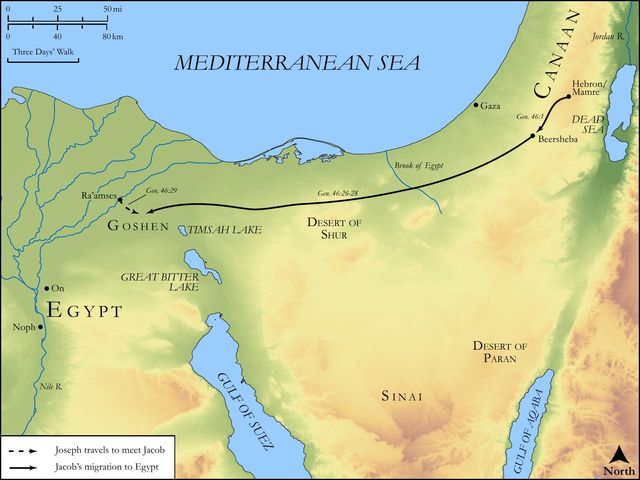
See on the biblical-era maps


Study this verse
Public-domain commentary
Matthew Henry
From his Commentary on the Whole Bible. Henry comments on passages, not single verses — this entry covers Genesis 46:28–34. His three-level outline is real structure in the source text, so it is rendered as structure.
We have here, I. The joyful meeting between Jacob and his son Joseph, in which observe,
1.Jacob's prudence in sending Judah before him to Joseph, to give him notice of his arrival in Goshen. This was a piece of respect owing to the government, under the protection of which these strangers had come to put themselves, Gen 46:28. We should be very careful not to give offence to any, especially not to the higher powers.
2.Joseph's filial respect to him. He went in his chariot to met him, and, in the interview, showed,
(1.)How much he honoured him: He presented himself unto him. Note, It is the duty of children to reverence their parents, yea, though Providence, as to outward condition, has advanced them above their parents.
(2.)How much he loved him. Time did not wear out the sense of his obligations, but his tears which he shed abundantly upon his father's neck, for joy to see him, were real indications of the sincere and strong affection he had for him. See how near sorrow and joy are to each other in this world, when tears serve for the expression of both. In the other world weeping will be restrained to sorrow only; in heaven there is perfect joy, but no tears of joy: all tears, even those, shall there be wiped away, because the joys there are, as no joys are here, without any alloy. When Joseph embraced Benjamin he wept upon his neck, but when he embraced his father he wept upon his neck a good while; his brother Benjamin was dear, but his father Jacob must be dearer.
3.Jacob's great satisfaction in this meeting: Now let me die, Gen 46:30. Not but that it was further desirable to live with Joseph, and to see his honour and usefulness; but he had so much pleasure and satisfaction in this first meeting that he thought it too much to desire or expect any more in this world, where our comforts must always be imperfect. Jacob wished to die immediately, and lived seventeen years longer, which, as our lives go now, is a considerable part of a man's age. Note, Death will not always come just when we call for it, whether in a passion of sorrow or in a passion of joy. Our times are in God's hand, and not in our own; we must die just when God pleases, and not either just when we are surfeited with the pleasures of life or just when we are overwhelmed with its griefs.
II.Joseph's prudent care concerning his brethren's settlement.
It was justice to Pharaoh to let him know that such a colony had come to settle in his dominions. Note, If others repose a confidence in us, we must not be so base and disingenuous as to abuse it by imposing upon them. If Jacob and his family should come to be a charge to the Egyptians, yet it should never be said that they came among them clandestinely and by stealth. Thus Joseph took care to pay his respects to Pharaoh, Gen 46:31. But how shall he dispose of his brethren? Time was when they were contriving to get rid of him; now he is contriving to settle them to their satisfaction and advantage: This is rendering good for evil. Now,
1.He would have them to live by themselves, separate as much as might be from the Egyptians, in the land of Goshen, which lay nearest to Canaan, and which perhaps was more thinly peopled by the Egyptians, and well furnished with pastures for cattle. He desired they might live separately, that they might be in the less danger both of being infected by the vices of the Egyptians and of being insulted by the malice of the Egyptians. Shepherds, it seems, were an abomination to the Egyptians, that is, they looked upon them with contempt, and scorned to converse with them; and he would not send for his brethren to Egypt to be tramped upon. And yet,
2.He would have them to continue shepherds, and not to be ashamed to own that as their occupation before Pharaoh. He could have employed them under himself in the corn-trade, or perhaps, by his interest in the king, might have procured places for them at court or in the army, and some of them, at least, were deserving enough; but such preferments would have exposed them to the envy of the Egyptians, and would have tempted them to forget Canaan and the promise made unto their fathers; therefore he contrives to continue them in their old employment. Note,
(1.)An honest calling is no disparagement, nor ought we to account it so either in ourselves or in our relations, but rather reckon it a shame to be idle, or to have nothing to do.
(2.)It is generally best for people to abide in the callings that they have been bred to, and used to, Co1 7:24. Whatever employment or condition God, in his providence, has allotted for us, let us accommodate ourselves to it, and satisfy ourselves with it, and not mind high things. It is better to be the credit of a mean post than the shame of a high one.
Historical interpretation
Historical reception
1 surviving comment on this verse from the historical church.
This is what I said at the outset, that in many cases an excess of joy causes the tears to flow. “He fell on his neck,” the text says, and not simply “wept” but “wept a flood of tears.” You see, immediately there came to his mind what he himself had suffered, what his father had endured on his account. Joseph thought of the great length of time that had elapsed in the meantime and the fact that, contrary to all expectation, he saw his father, and his father set eyes on his son. So he shed a flood of tears, revealing his exceeding joy and, at the same time, thanking the Lord for what had happened.
Continue studying Genesis 46:29 across the web’s major study libraries — every link below opens this exact verse, chapter, or book on the destination site.
Read & Compare
 BibleGatewayThis verse in more than 200 translations and 70 languages.
 Bible.comThe YouVersion reader — hundreds of translations, reading plans, and highlights.
 ESV.orgCrossway's official English Standard Version reader.
 NET BibleThe NET translation with 60,000+ translators' notes on every rendering decision.
 STEP BibleTyndale House's free study tool — original text, vocabulary, and scholarly resources.
 BibliaLogos Bible Software's free web reader.
 USCCBThe New American Bible (Revised Edition) with the U.S. bishops' study notes.
Commentaries
 BibleHub CommentariesDozens of classic commentaries on this verse, gathered on one page.
 StudyLightMore than 100 commentary sets — the largest collection on the web.
 BibleRefPlain-English commentary on what this verse means, verse by verse.
 Enduring WordDavid Guzik's free commentary on this chapter, widely used by Bible teachers.
 Bible Study ToolsVerse commentary alongside Greek and Hebrew study aids.
Original Language & Research
- BibleHub InterlinearThe verse word by word — original language, transliteration, and English.
- BibleHub LexiconEvery word's original-language definition and Strong's entry.
 Blue Letter BibleDeep-study tools — Strong's numbers, concordance, and word studies.
 SefariaThe Hebrew text with Rashi and centuries of Jewish commentary.
Sermons, Hymns & Audio


TrulyRandomVerse is not affiliated with these sites and doesn’t control their content. They’re linked because they’re genuinely useful.
Summary
Genesis 46:29 powerfully depicts the long-anticipated and deeply emotional reunion between Joseph, the esteemed governor of Egypt, and his aged father, Israel (Jacob), in the fertile land of Goshen. After more than two decades of separation, during which Jacob had mourned Joseph as dead, this verse captures the poignant climax of their journey and the profound embrace between father and son, marked by an overwhelming outpouring of tears, signifying immense joy, relief, and the miraculous restoration of their familial bond.
Context
ShowHideLiterary Context
This verse serves as the climactic personal reunion within the broader narrative of Joseph's life and the migration of Jacob's family to Egypt. It follows Joseph's dramatic revelation to his brothers in Genesis 45, his subsequent instructions for them to bring their father and all their households to Egypt, and Pharaoh's generous provision of the best of the land. Jacob's initial hesitation to leave Canaan, overcome by divine assurance and a vision from God in Beersheba, sets the stage for this momentous meeting. The journey itself, detailed in Genesis 46:5-28, culminates in this deeply personal encounter, fulfilling God's promise to Jacob that he would "go down to Egypt" and that Joseph would "put his hand on your eyes" (a euphemism for being present at his father's death, implying a reunion).
Historical & Cultural Context
The use of a "chariot" by Joseph is significant, reflecting his elevated status as Pharaoh's second-in-command, a position of immense power and prestige in ancient Egypt. Chariots were symbols of wealth, military might, and royal authority. Joseph's personal journey to meet his father, rather than sending servants, underscores the profound cultural importance of filial piety and the deep respect due to a patriarch. The land of Goshen, chosen by Pharaoh for Jacob's family, was strategically ideal: a fertile pastureland separate from the main Egyptian population, suitable for their pastoral lifestyle, and minimizing cultural friction. The emotional display of weeping on the neck was a common and accepted expression of deep affection, grief, or overwhelming joy, as when Esau fell on the neck of Jacob and they wept, signifying profound emotional release and reconciliation, especially after long separation or presumed loss.
Key Themes
ShowHideGenesis 46:29 powerfully encapsulates several overarching themes of the Joseph narrative and the book of Genesis. It highlights Divine Providence, demonstrating how God meticulously orchestrated events—from Joseph's betrayal and slavery to his elevation in Egypt—to preserve Jacob's family and prepare for the formation of the nation of Israel, as seen in Genesis 50:20. The verse is a profound testament to Reconciliation and Restoration, bringing healing to a family fractured by jealousy and deceit, a theme echoed throughout the patriarchal narratives. Furthermore, it marks a significant step in the Fulfillment of God's Covenant Promises to Abraham, Isaac, and Jacob, ensuring the preservation of the chosen lineage through whom the Messiah would ultimately come. The reunion also subtly alludes to the Fulfillment of Joseph's Dreams, as his family now comes under his protective care and provision in Egypt, even if not explicitly bowing in this moment.
Exposition and Analysis
ShowHideGenesis 46:29 presents a deeply emotional and pivotal moment in the biblical narrative, focusing on the long-awaited reunion of Joseph and his father, Israel. The verse is rich with details that convey the significance and intensity of this encounter.
Key Word Analysis
ShowHideThis primitive root means "to weep," often implying a deep, heartfelt outpouring of emotion, generally to bemoan or make lamentation. In this context, it signifies not just tears, but a profound release of pent-up grief, longing, and overwhelming joy. The intensity of the weeping suggests a cathartic moment, releasing years of sorrow and uncertainty.
This primitive root means "to fall" in a wide variety of applications, including physically falling upon someone or something. Here, it denotes the immediate, unreserved embrace, a physical manifestation of the intense emotion and affection Joseph felt for his father. It suggests a complete surrender to the moment, collapsing into the embrace.
This word properly denotes "iteration or continuance," used adverbially to mean "again, repeatedly, still, more." When paired with "wept," it emphasizes the prolonged and sustained nature of Joseph's crying. This was not a brief, polite greeting, but an extended period of emotional release, underscoring the depth of their separation and the magnitude of their reunion.
Verse Breakdown
ShowHide"And Joseph made ready his chariot,"
This clause highlights Joseph's high status and authority in Egypt. The chariot was a symbol of power and prestige, indicating that Joseph, despite his immense responsibilities, personally and eagerly prepared to meet his father. It underscores his filial devotion and the importance he placed on this reunion.
"and went up to meet Israel his father, to Goshen,"
Joseph's active movement "went up" (though Goshen was geographically lower than Canaan, it implies a journey of ascent in significance) to "meet" his father. This emphasizes the intentionality and eagerness of the encounter. Goshen, the designated land, becomes the sacred space for this long-awaited family restoration.
"and presented himself unto him;"
This phrase signifies Joseph's formal yet deeply personal act of revealing himself fully to his father. After years of being presumed dead and then operating through intermediaries, Joseph now stands before his father in his true identity, a moment of profound recognition and mutual acknowledgment.
"and he fell on his neck,"
This action is a powerful physical expression of overwhelming emotion. Joseph's immediate embrace, falling upon his father's neck, conveys intense affection, relief, and the breaking down of all barriers that had existed between them for so long. It is an intimate gesture of reunion and reconciliation.
"and wept on his neck a good while."
This culminating phrase captures the emotional climax. The act of weeping "on his neck" signifies closeness and shared sorrow/joy. The addition of "a good while" (Hebrew: ʻôwd) emphasizes the prolonged and sustained nature of Joseph's tears. This was not a fleeting moment but a deep, cathartic release of over two decades of grief, longing, and the profound joy of a son, once mourned as dead, being miraculously restored to his father. It speaks to the immense emotional weight of the separation and the overwhelming relief of reconciliation.
Literary Devices
ShowHideThe verse employs several powerful literary devices to convey its profound emotional impact. Pathos is central, as the vivid description of Joseph's actions and prolonged weeping evokes deep sympathy and understanding for the characters' emotional states. The Symbolism of the chariot highlights Joseph's elevated status, contrasting sharply with the raw, vulnerable emotion displayed in the embrace. The repeated phrase "on his neck" acts as a form of Repetition (specifically, Anaphora if considering the phrase structure, or simply emphasizing the physical intimacy), drawing attention to the tender, physical nature of their reunion and the depth of their connection. The phrase "a good while" functions as Hyperbole or Emphasis, underscoring the extraordinary duration and intensity of Joseph's weeping, signifying the release of years of pent-up emotion rather than a brief moment of tears. The entire scene serves as a powerful Climax to the extended narrative of separation and longing, providing a cathartic release for both characters and the reader.
Theological and Thematic Connections
ShowHideThe reunion of Joseph and Israel in Goshen is a profound theological statement, illustrating God's meticulous and sovereign hand at work throughout human history. This deeply personal moment culminates a narrative arc demonstrating that even through human sin, betrayal, and suffering, God faithfully orchestrates events to fulfill His divine purposes. It underscores that God's plan for His covenant people will prevail, even when circumstances seem dire, leading to miraculous preservation and restoration. The scene is a powerful testament to the healing power of reconciliation and the enduring nature of familial bonds under God's watchful eye, ensuring the continuation of the lineage through whom the promises to Abraham would be realized.
Reflection and Application
ShowHideThe reunion of Joseph and Jacob in Genesis 46:29 offers profound and enduring lessons for believers today. It serves as a powerful reminder that even in the midst of prolonged suffering, deep loss, and seemingly hopeless situations, God is sovereignly at work, orchestrating events behind the scenes for His ultimate good and glory. Jacob's decades of mourning and Joseph's years of hardship culminated in this moment of overwhelming joy and restoration, instilling in us the hope that God can bring beauty from ashes and turn sorrow into dancing. This narrative encourages us to trust in God's unfailing providence, even when His plan is hidden from our sight. Furthermore, the profound embrace and weeping highlight the transformative power of reconciliation, especially within families. It calls us to pursue forgiveness, to mend broken relationships, and to experience the deep healing that comes from restored bonds. Ultimately, this story strengthens our faith in God's unwavering faithfulness to His covenant promises, assuring us that He will always care for His people and bring His purposes to fruition, even through the most challenging circumstances.
Questions for Reflection
ShowHideFAQ
ShowHideWhy is the detail of Joseph weeping "a good while" significant?
ShowHideThe phrase "a good while" (Hebrew: ʻôwd, H5750) is highly significant because it emphasizes the prolonged and sustained nature of Joseph's weeping, indicating far more than a brief, polite greeting. This extended outpouring of tears signifies a profound, cathartic release of over two decades of pent-up grief, longing, and the overwhelming joy and relief that accompanied the reunion with a father he had believed he would never see again. It underscores the immense emotional weight of their separation and the magnitude of their reconciliation, marking a pivotal moment of deep healing and restoration for both Joseph and Israel. It highlights the intensity of their bond and the overwhelming emotional impact of God's providential bringing them back together.
Christ-Centered Fulfillment
ShowHideThe deeply moving reunion of Joseph and Jacob, marked by profound reconciliation and the providential preservation of God's chosen family, powerfully prefigures the greater reconciliation and salvation offered to humanity through Jesus Christ. Joseph, once rejected and sold into slavery by his own brothers, was exalted to a position of power and became the savior of his family and many nations, providing sustenance and a place of refuge during a severe famine. In a similar and far grander way, Christ, though rejected by His own people and crucified, was exalted by God and became the ultimate means of eternal life and spiritual provision for all who believe. Just as Joseph brought his estranged family into a place of safety and abundance, Jesus Christ, through His atoning sacrifice, brings humanity, estranged from God by sin, into a reconciled relationship with the Father, providing spiritual nourishment and eternal refuge in His Kingdom. This narrative in Genesis underscores God's meticulous and faithful plan to preserve a lineage through whom the Messiah would come, culminating in Christ's ultimate act of bringing humanity back into fellowship with God, fulfilling the greatest reunion and reconciliation in salvation history, as depicted in passages like 2 Corinthians 5:18-19 and Colossians 1:19-20.