


Genesis 45:21
- וַיַּעֲשׂוּvai·ya·'a·suand they didH6213Conj-w ¦ V-Qal-ConsecImperf-3mpVerb Qal Consecutive Imperfect 3rd Plural Masculineוַandיַּעֲשׂוּthey did
- כֵןkhenthusH3651AdvAdverb
- בְּנֵיbe·Nei[the] sons ofH1121N-mpcNoun Plural Masculine Construct
- יִשְׂרָאֵלYis·ra·'ElIsraelH3478N-proper-mNoun Proper Masculine
- וַיִּתֵּןvai·yi·Tenand he gaveH5414Conj-w ¦ V-Qal-ConsecImperf-3msVerb Qal Consecutive Imperfect 3rd Singular Masculineוַandיִּתֵּןhe gave
- לָהֶםla·Hemto themPrep-l ¦ 3mpSuffix Personal 3rd Plural Masculineלָtoהֶםthem
- יוֹסֵףyo·SefJosephH3130N-proper-mNoun Proper Masculine
- עֲגָלוֹתa·ga·LotcartsH5699N-fpNoun Plural Feminine Absolute
- עַל'alonH5921PrepPreposition
- פִּיpi[the] mouth ofH6310N-mscNoun Singular Masculine Construct
- פַרְעֹהfar·'OhPharaohH6547N-msNoun Title Singular Masculine Absolute
- וַיִּתֵּןvai·yi·Tenand he gaveH5414Conj-w ¦ V-Qal-ConsecImperf-3msVerb Qal Consecutive Imperfect 3rd Singular Masculineוַandיִּתֵּןhe gave
- לָהֶםla·Hemto themPrep-l ¦ 3mpSuffix Personal 3rd Plural Masculineלָtoהֶםthem
- צֵדָהtze·Dahprovision[s]H6720N-fsNoun Singular Feminine Absolute
- לַדָּרֶךְla·Da·rekhfor the journeyH1870Prep-l ¦ N-csNoun Singular common gender Absoluteלַfor theדָּרֶךְjourney
English is a literal word-by-word gloss of the Hebrew, not the KJV's wording. Why?
This is the original text the KJV's translators worked from — each Hebrew word with its own literal English meaning in this verse, prepared by scholars at Tyndale House, Cambridge. The KJV translates whole sentences, not word by word, so its wording differs: one Hebrew word can become several English words, and the KJV may choose “the LORD” where the gloss reads “Yahweh”. Both are faithful — they answer different questions. For the KJV's own rendering, switch to the KJV text.
Details
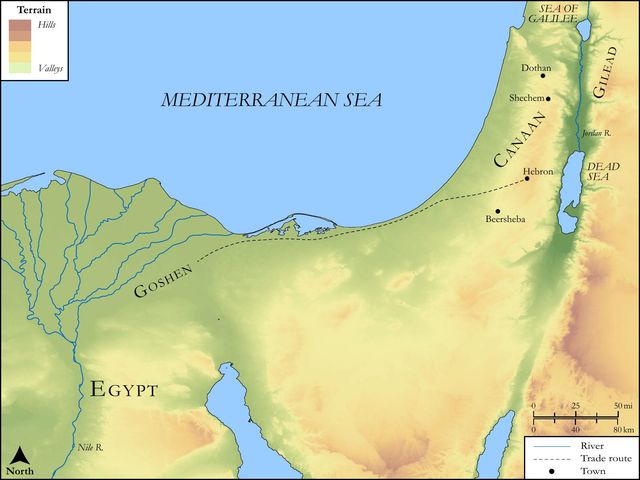
See on the biblical-era maps


Study this verse
Public-domain commentary
Matthew Henry
From his Commentary on the Whole Bible. Henry comments on passages, not single verses — this entry covers Genesis 45:16–24. His three-level outline is real structure in the source text, so it is rendered as structure.
Here is, 1. The kindness of Pharaoh to Joseph, and to his relations for his sake: he bade his brethren welcome (Gen 45:16), though it was a time of scarcity, and they were likely to be a charge to him. Nay, because it pleased Pharaoh, it pleased his servants too, at least they pretended to be pleased because Pharaoh was. He engaged Joseph to send for his father down to Egypt, and promised to furnish them with all conveniences both for his removal thither and his settlement there. If the good of all the land of Egypt (as it was not better stocked than any other land, thanks to Joseph, under God) would suffice him, he was welcome to it all, it was all his own, even the fat of the land (Gen 45:18), so that they need not regard their stuff, Gen 45:20. What they had in Canaan he reckoned but stuff, in comparison with what he had for them in Egypt; and therefore if they should be constrained to leave some of that behind them, let them not be discontented; Egypt would afford them enough to make up the losses of their removal. Thus those for whom Christ intends shares in his heavenly glory ought not to regard the stuff of this world: The best of its enjoyments are but stuff, but lumber; we cannot make sure of it while we are here, much less can we carry it away with us; let us not therefore be solicitous about it, nor set our eyes or hearts upon it. There are better things reserved for us in that blessed land whither our Joseph has gone to prepare a place.
II.The kindness of Joseph to his father and brethren.
Pharaoh was respectful to Joseph, in gratitude, because he had been an instrument of much good to him and his kingdom, not only preserving it from the common calamity, but helping to make it considerable among the nations; for all their neighbours would say, "Surely the Egyptians are a wise and an understanding people, that are so well stocked in a time of scarcity." For this reason Pharaoh never thought any thing too much that he could do for Joseph. Note, There is a gratitude owing even to inferiors; and when any have shown us kindness we should study to requite it, not only to them, but to their relations. And Joseph likewise was respectful to his father and brethren in duty, because they were his near relations, though his brethren had been his enemies, and his father long a stranger.
1.He furnished them for necessity, Gen 45:21. He gave them wagons and provisions for the way, both going and coming; for we never find that Jacob was very rich, and, at this time, when the famine prevailed, we may suppose he was rather poor.
2.He furnished them for ornament and delight. To his brethren he gave two suits a piece of good clothes, to Benjamin five suits, and money besides in his pocket, Gen 45:22. To his father he sent a very handsome present of the varieties of Egypt, Gen 45:23. Note, Those that are wealthy should be generous, and devise liberal things; what is an abundance good for, but to do good with it?
3.He dismissed them with a seasonable caution: See that you fall not out by the way, Gen 45:24. He knew they were but too apt to be quarrelsome; and what had lately passed, which revived the remembrance of what they had done formerly against their brother, might give them occasion to quarrel. Joseph had observed them to contend about it, Gen 42:22. To one they would say, "It was you that first upbraided him with his dreams;" to another, "It was you that stripped him of his fine coat;" to another, "It was you that threw him into the pit," etc. Now Joseph, having forgiven them all, lays this obligation upon them, not to upbraid one another. This charge our Lord Jesus has given to us, that we love one another, that we live in peace, that whatever occurs, or whatever former occurrences are remembered, we fall not out. For,
(1.)We are brethren, we have all one Father.
(2.)We are his brethren, and we shame our relation to him who is our peace, if we fall out.
(3.)We are guilty, verily guilty, and, instead of quarrelling with one another, have a great deal of reason to fall out with ourselves.
(4.)We are, or hope to be, forgiven of God whom we have all offended, and therefore should be ready to forgive one another.
(5.)We are by the way, a way that lies through the land of Egypt, where we have many eyes upon us, that seek occasion and advantage against us, a way that leads to Canaan, where we hope to be for ever in perfect peace.
Historical interpretation
Historical reception
1 surviving comment on this verse from the historical church.
(v. 21) And he gave them food along the way. The word Seda, which here everyone with one voice translates as 'provisions' (ἐπισιτισμὸν in Greek), is also found in the Psalter. For where our translation reads, 'I will abundantly bless her widow' (Ps. 132:15), (although in most manuscripts it is written as 'widow,' which is χήρα in Greek, some read it as 'prey,' θήραν), in Hebrew it has Seda, which means 'provisions.' Furthermore, the word 'θήραν' can more often refer to hunting than to crops, although it is the custom of the Egyptians to also call crops 'θήραν', which is now corrupted to 'atheran'.
Continue studying Genesis 45:21 across the web’s major study libraries — every link below opens this exact verse, chapter, or book on the destination site.
Read & Compare
 BibleGatewayThis verse in more than 200 translations and 70 languages.
 Bible.comThe YouVersion reader — hundreds of translations, reading plans, and highlights.
 ESV.orgCrossway's official English Standard Version reader.
 NET BibleThe NET translation with 60,000+ translators' notes on every rendering decision.
 STEP BibleTyndale House's free study tool — original text, vocabulary, and scholarly resources.
 BibliaLogos Bible Software's free web reader.
 USCCBThe New American Bible (Revised Edition) with the U.S. bishops' study notes.
Commentaries
 BibleHub CommentariesDozens of classic commentaries on this verse, gathered on one page.
 StudyLightMore than 100 commentary sets — the largest collection on the web.
 BibleRefPlain-English commentary on what this verse means, verse by verse.
 Enduring WordDavid Guzik's free commentary on this chapter, widely used by Bible teachers.
 Bible Study ToolsVerse commentary alongside Greek and Hebrew study aids.
Original Language & Research
- BibleHub InterlinearThe verse word by word — original language, transliteration, and English.
- BibleHub LexiconEvery word's original-language definition and Strong's entry.
 Blue Letter BibleDeep-study tools — Strong's numbers, concordance, and word studies.
 SefariaThe Hebrew text with Rashi and centuries of Jewish commentary.
Sermons, Hymns & Audio


TrulyRandomVerse is not affiliated with these sites and doesn’t control their content. They’re linked because they’re genuinely useful.
Summary
Genesis 45:21 records the immediate and obedient response of Joseph's brothers to Pharaoh's gracious invitation to relocate to Egypt. This pivotal verse details Joseph's swift action in providing essential wagons and abundant provisions, ensuring the practical means for Jacob's entire household to undertake the significant journey from Canaan to the fertile land of Goshen, thereby securing their survival amidst the severe famine.
Context
ShowHideLiterary Context
This verse is situated at a crucial turning point in the Joseph narrative, immediately following Joseph's emotional self-revelation to his brothers in Genesis 45:1-15. The news of Joseph's identity and reconciliation reaches Pharaoh, who, in his immense gratitude and esteem for Joseph, extends an unprecedented invitation for Jacob's entire family to settle in the "best of the land" of Egypt, specifically Goshen, and to enjoy its bounty (Genesis 45:16-20). Genesis 45:21 serves as the practical implementation of this royal decree, detailing the brothers' compliance and Joseph's provision, which directly precedes Jacob's journey to Egypt in Genesis 46. It marks the transition from the emotional climax of reconciliation to the logistical preparations for the family's migration.
Historical & Cultural Context
During this period, Egypt was a dominant power, renowned for its agricultural wealth, particularly in the fertile Nile Delta region, which included Goshen. The provision of wagons (ʻăgâlâh, H5699) was a significant act of royal generosity, as such vehicles were costly and primarily used by royalty or for military purposes. For a nomadic family like Jacob's, these heavy, two-wheeled carts were essential for transporting women, children, the elderly, and their limited possessions over the considerable distance from Canaan to Egypt. The famine, which had afflicted the entire region for several years (Genesis 41:56-57), made sustenance and safe travel incredibly challenging. Pharaoh's "commandment" (peh, H6310) carried the weight of absolute authority, and his provision of provisions (tsêydâh, H6720) for the journey underscored the comprehensive nature of his hospitality and the high regard he held for Joseph.
Key Themes
ShowHideGenesis 45:21 underscores several profound themes. Firstly, it powerfully illustrates Divine Providence, demonstrating how God's sovereign plan unfolds through human actions, even those of a pagan king like Pharaoh, to preserve His covenant people. The famine, intended by God to test and shape His people, becomes the very mechanism for their relocation and preservation. Secondly, the verse highlights the theme of Reconciliation and Restoration, as the practical provision for the family's journey is a direct outcome of the healing of the fractured relationship between Joseph and his brothers. This act of provision signifies the tangible blessings that flow from forgiveness and restored family unity. Lastly, it emphasizes God's Abundant Provision in times of dire need, showcasing His faithfulness to supply beyond mere necessity, transforming a situation of potential despair into one of flourishing and security for Jacob's lineage, ultimately paving the way for the nation of Israel to grow in Egypt, as foretold in Genesis 15:13-16.
Exposition and Analysis
ShowHideKey Word Analysis
ShowHideA primitive root meaning "to do or make, in the broadest sense and widest application." In this context, it signifies the immediate and active compliance of the children of Israel. It denotes not merely passive agreement but the tangible execution of the instructions given, highlighting their prompt obedience and the shift in their posture towards Joseph and the divine plan.
Meaning "something revolving, i.e., a wheeled vehicle; cart, chariot, wagon." This term refers to substantial, often two-wheeled, carts suitable for heavy transport. Their provision by Pharaoh, through Joseph, was a significant and costly gift, emphasizing the royal backing and the comprehensive nature of the relocation, intended for the comfort and safety of the women, children, and elderly, as well as their belongings.
Meaning "food; meat, provision, venison, victuals." This word encompasses all necessary supplies for a journey, including food, water, and other essentials. Its inclusion highlights the meticulous care taken to ensure the family's well-being during their travel, reflecting not only Pharaoh's generosity but also Joseph's foresight and God's overarching providence in sustaining His people.
Verse Breakdown
ShowHide"And the children of Israel did so:"
This opening clause signifies the immediate and willing compliance of Joseph's brothers. Having just experienced the profound reconciliation with Joseph and heard Pharaoh's generous invitation, their response is one of ready obedience. This marks a significant transformation from their previous fear and treachery, indicating a newfound trust in Joseph's leadership and the divine plan unfolding before them. Their action is a crucial step in the unfolding narrative, directly enabling the family's migration to Egypt.
"and Joseph gave them wagons, according to the commandment of Pharaoh,"
This clause details Joseph's active role in facilitating the move, acting as Pharaoh's trusted administrator. The provision of "wagons" was a substantial and necessary gift for a large family undertaking a long journey, especially given the famine conditions. The phrase "according to the commandment of Pharaoh" underscores the royal authority behind this provision, highlighting Pharaoh's extraordinary favor towards Joseph and, by extension, his family. This act is a tangible manifestation of the king's generosity and Joseph's high standing in Egypt.
"and gave them provision for the way."
This final clause emphasizes the comprehensive nature of the care extended to Jacob's family. Beyond the means of transport, Joseph also supplied all necessary "provision" (food, water, supplies) for their journey. This detail ensures that the family would be well-sustained and comfortable during their travel from Canaan to Egypt, reflecting meticulous planning and abundant care. This act of provision, orchestrated by Joseph under Pharaoh's authority, serves as a powerful symbol of God's overarching providence, transforming a situation of famine and potential despair into one of salvation and flourishing for Jacob's entire lineage.
Literary Devices
ShowHideThe verse employs several literary devices to convey its meaning and significance. Emphasis is achieved through the repetition of "gave them," highlighting Joseph's active role as the provider, acting on behalf of Pharaoh. This repetition underscores the lavishness and comprehensiveness of the provisions. Symbolism is present in the "wagons" and "provision," which are not merely practical items but symbolize God's meticulous care and abundant supply for His people, even in the midst of famine. They represent the means by which God ensures the preservation and future flourishing of the covenant family. Furthermore, there is an element of Divine Irony, as the very brother sold into slavery is now the one providing the means of salvation and sustenance for his family, demonstrating God's ability to turn evil intentions into redemptive outcomes.
Theological and Thematic Connections
ShowHideGenesis 45:21 stands as a powerful testament to God's meticulous and abundant providence, particularly in His preservation of the covenant lineage. This verse is not merely a logistical detail but a demonstration of how God orchestrates circumstances, even through the actions of a pagan ruler and a formerly estranged son, to fulfill His promises. The provision of wagons and sustenance for Jacob's family in a time of severe famine illustrates God's faithfulness to His people, ensuring their survival and growth so that His redemptive plan, culminating in the Messiah, can continue to unfold. It highlights that God's care is both comprehensive and timely, meeting physical needs as a precursor to spiritual purposes.
Reflection and Application
ShowHideGenesis 45:21 offers profound lessons for contemporary believers, inviting us to reflect on the nature of God's provision and our response to His leading. In a world often marked by uncertainty and scarcity, this passage reminds us that God's care for His people is not only sufficient but often lavish, exceeding our expectations and perfectly tailored to our needs. Just as He provided for Jacob's family through unexpected means and an unlikely human instrument, we are called to cultivate a deep trust in His sovereign plan, knowing that He works all things for our ultimate good and His glory. This verse also underscores the transformative power of reconciliation; the tangible blessings of provision and peace flow directly from the healing of fractured relationships. It challenges us to pursue forgiveness and restoration within our own families and communities, recognizing that such acts can unlock divine blessings and facilitate God's purposes in our lives.
Questions for Reflection
ShowHideFAQ
ShowHideWhy was Pharaoh so generous to Joseph's family?
ShowHidePharaoh's extraordinary generosity stemmed primarily from the immense favor Joseph had found in his eyes. Joseph had not only accurately interpreted Pharaoh's dreams, saving Egypt from a devastating seven-year famine, but had also proven to be an exceptionally wise and capable administrator, effectively managing the nation's resources (Genesis 41:39-40). Pharaoh recognized that blessing Joseph's family was a way to honor Joseph and secure the well-being of the man who had become indispensable to his kingdom. This generosity also reflects God's blessing upon Joseph, extending to his entire family, demonstrating how God can use even pagan rulers to accomplish His divine purposes.
Did Jacob's family have a choice in moving to Egypt?
ShowHideWhile Pharaoh's invitation was a generous offer of refuge and provision during a severe famine, it was also presented with the weight of a royal command through Joseph, who conveyed Pharaoh's desire for them to settle in the "best of the land" (Genesis 45:18). Given the dire circumstances in Canaan—the severe famine that threatened their very survival—and the promise of abundant provision and fertile land in Egypt, accepting the offer was the most practical and life-sustaining choice available to them. The phrase "And the children of Israel did so" (Genesis 45:21) indicates their ready compliance, recognizing the necessity and immense benefit of the move for their survival and future flourishing.
Christ-Centered Fulfillment
ShowHideGenesis 45:21, with its profound themes of abundant provision, preservation, and the gathering of a scattered family, finds its ultimate and most glorious fulfillment in Jesus Christ. Just as Joseph, once rejected and sold, became the means of salvation and sustenance for his family during a time of physical famine, so Christ, the greater Joseph, was rejected and sacrificed, yet through His atoning work, He provides eternal life and spiritual nourishment for all who believe, saving humanity from the spiritual famine of sin and death. The wagons and provisions given by Joseph symbolize the comprehensive and lavish care God extends to His people, a care fully realized in Christ, who not only provides for our deepest needs but is the provision itself—the Bread of Life who satisfies our spiritual hunger and the Good Shepherd who leads and sustains His flock. Through His redemptive work on the cross, Christ gathers His scattered people from every nation, bringing them into the secure "land" of His eternal kingdom, ensuring their ultimate preservation and everlasting well-being, far surpassing any earthly provision. He is the one who says, "Come to me, all who labor and are heavy laden, and I will give you rest."