


Genesis 45:19
- וְאַתָּהve·'a·Tahand youH859Conj-w ¦ Pro-2msPronoun Personal 2nd Singular Masculineוְandאַתָּהyou
- צֻוֵּיתָהtzu·Vei·tahyou are commandedH6680V-Pual-Perf-2msVerb Pual Perfect 2nd Singular Masculine
- זֹאתzotthisH2063PrtParticle Demonstrative
- עֲשׂוּ'a·SudoH6213V-Qal-Imp-2mpVerb Qal Imperative 2nd Plural Masculine
- קְחוּke·chutakeH3947V-Qal-Imp-2mpVerb Qal Imperative 2nd Plural Masculine
- לָכֶםla·Khemfor yourselvesPrep-l ¦ 2mpSuffix Personal 2nd Plural Masculineלָforכֶםyourselves
- מֵאֶרֶץme·'E·retzfrom [the] land ofH776Prep-m ¦ N-fscNoun Singular Feminine Constructמֵfromאֶרֶץ[the] land of
- מִצְרַיִםmitz·Ra·yimEgyptH4714N-properNoun Proper Location
- עֲגָלוֹתa·ga·LotcartsH5699N-fpNoun Plural Feminine Absolute
- לְטַפְּכֶםle·ta·pe·Khemfor your little one[s]H2945Prep-l ¦ N-msc ¦ 2mpNoun Singular Masculine Constructלְforטַפְּlittle one[s]כֶםyour
- וְלִנְשֵׁיכֶםve·lin·shei·Khemand for your wivesH802Conj-w ¦ Prep-l ¦ N-mpc ¦ 2mpNoun Plural Masculine Constructוְandלִforנְשֵׁיwivesכֶםyour
- וּנְשָׂאתֶםu·ne·sa·Temand you will carryH5375Conj-w ¦ V-Qal-ConsecPerf-2mpVerb Qal Consecutive Perfect 2nd Plural Masculineוּandנְשָׂאתֶםyou will carry
- אֶת'et<obj.>H853DirObjMParticle Object Indicator
- אֲבִיכֶם'a·vi·Khemyour fatherH1N-msc ¦ 2mpNoun Singular Masculine Constructאֲבִיfatherכֶםyour
- וּבָאתֶםu·va·Temand you will comeH935Conj-w ¦ V-Qal-ConsecPerf-2mpVerb Qal Consecutive Perfect 2nd Plural Masculineוּandבָאתֶםyou will come
English is a literal word-by-word gloss of the Hebrew, not the KJV's wording. Why?
This is the original text the KJV's translators worked from — each Hebrew word with its own literal English meaning in this verse, prepared by scholars at Tyndale House, Cambridge. The KJV translates whole sentences, not word by word, so its wording differs: one Hebrew word can become several English words, and the KJV may choose “the LORD” where the gloss reads “Yahweh”. Both are faithful — they answer different questions. For the KJV's own rendering, switch to the KJV text.
Details
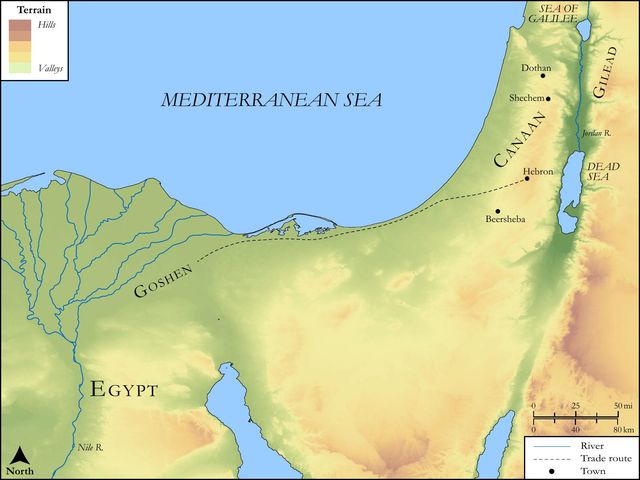
See on the biblical-era maps


Study this verse
Public-domain commentary
Matthew Henry
From his Commentary on the Whole Bible. Henry comments on passages, not single verses — this entry covers Genesis 45:16–24. His three-level outline is real structure in the source text, so it is rendered as structure.
Here is, 1. The kindness of Pharaoh to Joseph, and to his relations for his sake: he bade his brethren welcome (Gen 45:16), though it was a time of scarcity, and they were likely to be a charge to him. Nay, because it pleased Pharaoh, it pleased his servants too, at least they pretended to be pleased because Pharaoh was. He engaged Joseph to send for his father down to Egypt, and promised to furnish them with all conveniences both for his removal thither and his settlement there. If the good of all the land of Egypt (as it was not better stocked than any other land, thanks to Joseph, under God) would suffice him, he was welcome to it all, it was all his own, even the fat of the land (Gen 45:18), so that they need not regard their stuff, Gen 45:20. What they had in Canaan he reckoned but stuff, in comparison with what he had for them in Egypt; and therefore if they should be constrained to leave some of that behind them, let them not be discontented; Egypt would afford them enough to make up the losses of their removal. Thus those for whom Christ intends shares in his heavenly glory ought not to regard the stuff of this world: The best of its enjoyments are but stuff, but lumber; we cannot make sure of it while we are here, much less can we carry it away with us; let us not therefore be solicitous about it, nor set our eyes or hearts upon it. There are better things reserved for us in that blessed land whither our Joseph has gone to prepare a place.
II.The kindness of Joseph to his father and brethren.
Pharaoh was respectful to Joseph, in gratitude, because he had been an instrument of much good to him and his kingdom, not only preserving it from the common calamity, but helping to make it considerable among the nations; for all their neighbours would say, "Surely the Egyptians are a wise and an understanding people, that are so well stocked in a time of scarcity." For this reason Pharaoh never thought any thing too much that he could do for Joseph. Note, There is a gratitude owing even to inferiors; and when any have shown us kindness we should study to requite it, not only to them, but to their relations. And Joseph likewise was respectful to his father and brethren in duty, because they were his near relations, though his brethren had been his enemies, and his father long a stranger.
1.He furnished them for necessity, Gen 45:21. He gave them wagons and provisions for the way, both going and coming; for we never find that Jacob was very rich, and, at this time, when the famine prevailed, we may suppose he was rather poor.
2.He furnished them for ornament and delight. To his brethren he gave two suits a piece of good clothes, to Benjamin five suits, and money besides in his pocket, Gen 45:22. To his father he sent a very handsome present of the varieties of Egypt, Gen 45:23. Note, Those that are wealthy should be generous, and devise liberal things; what is an abundance good for, but to do good with it?
3.He dismissed them with a seasonable caution: See that you fall not out by the way, Gen 45:24. He knew they were but too apt to be quarrelsome; and what had lately passed, which revived the remembrance of what they had done formerly against their brother, might give them occasion to quarrel. Joseph had observed them to contend about it, Gen 42:22. To one they would say, "It was you that first upbraided him with his dreams;" to another, "It was you that stripped him of his fine coat;" to another, "It was you that threw him into the pit," etc. Now Joseph, having forgiven them all, lays this obligation upon them, not to upbraid one another. This charge our Lord Jesus has given to us, that we love one another, that we live in peace, that whatever occurs, or whatever former occurrences are remembered, we fall not out. For,
(1.)We are brethren, we have all one Father.
(2.)We are his brethren, and we shame our relation to him who is our peace, if we fall out.
(3.)We are guilty, verily guilty, and, instead of quarrelling with one another, have a great deal of reason to fall out with ourselves.
(4.)We are, or hope to be, forgiven of God whom we have all offended, and therefore should be ready to forgive one another.
(5.)We are by the way, a way that lies through the land of Egypt, where we have many eyes upon us, that seek occasion and advantage against us, a way that leads to Canaan, where we hope to be for ever in perfect peace.
Continue studying Genesis 45:19 across the web’s major study libraries — every link below opens this exact verse, chapter, or book on the destination site.
Read & Compare
 BibleGatewayThis verse in more than 200 translations and 70 languages.
 Bible.comThe YouVersion reader — hundreds of translations, reading plans, and highlights.
 ESV.orgCrossway's official English Standard Version reader.
 NET BibleThe NET translation with 60,000+ translators' notes on every rendering decision.
 STEP BibleTyndale House's free study tool — original text, vocabulary, and scholarly resources.
 BibliaLogos Bible Software's free web reader.
 USCCBThe New American Bible (Revised Edition) with the U.S. bishops' study notes.
Commentaries
 BibleHub CommentariesDozens of classic commentaries on this verse, gathered on one page.
 StudyLightMore than 100 commentary sets — the largest collection on the web.
 BibleRefPlain-English commentary on what this verse means, verse by verse.
 Enduring WordDavid Guzik's free commentary on this chapter, widely used by Bible teachers.
 Bible Study ToolsVerse commentary alongside Greek and Hebrew study aids.
Original Language & Research
- BibleHub InterlinearThe verse word by word — original language, transliteration, and English.
- BibleHub LexiconEvery word's original-language definition and Strong's entry.
 Blue Letter BibleDeep-study tools — Strong's numbers, concordance, and word studies.
 SefariaThe Hebrew text with Rashi and centuries of Jewish commentary.
Sermons, Hymns & Audio


TrulyRandomVerse is not affiliated with these sites and doesn’t control their content. They’re linked because they’re genuinely useful.
Summary
Genesis 45:19 records Pharaoh's explicit and authoritative command, relayed through Joseph, for Jacob's entire family to relocate to Egypt. This directive includes the generous provision of wagons for the comfortable transport of their children and wives, along with a direct instruction to bring their aged father, Jacob. This act underscores Pharaoh's exceptional favor towards Joseph and serves as a crucial step in God's intricate plan to preserve His covenant people during a severe famine, setting the stage for Israel's growth in Egypt.
Context
ShowHideLiterary Context
Genesis 45:19 is situated at a dramatic high point in the Joseph narrative, immediately following Joseph's emotional revelation of his identity to his brothers. The preceding verses detail Joseph's forgiveness and his explanation that God intended their actions for good, to preserve life. Pharaoh, having heard of Joseph's family, responds with extraordinary generosity, promising them "the good of all the land of Egypt" (Genesis 45:18). Verse 19 then articulates the practical means by which this promise will be fulfilled, outlining the specific provisions and instructions for the family's relocation. This command sets the immediate stage for the patriarch Jacob's journey to Egypt and the subsequent settlement of the nascent nation of Israel in Goshen, detailed in Genesis 46.
Historical & Cultural Context
During the time of the patriarchs, Egypt was a dominant power, renowned for its agricultural abundance, especially in times of famine, due to the Nile River's annual inundation. Pharaoh's authority was absolute, and his commands were law. The provision of "wagons" (or carts) was a significant gesture, as these were not common for personal travel but primarily used for heavy transport or military purposes. Their provision by the royal court for a foreign family underscored immense royal favor and wealth. Such a journey from Canaan to Egypt was arduous, spanning hundreds of miles, making comfortable and safe transport for women, children, and the elderly patriarch crucial. The famine, which had already lasted two years with five more predicted (Genesis 45:6), made relocation to Egypt a matter of survival, aligning with God's providential care for His chosen family.
Key Themes
ShowHideThis verse powerfully illustrates several overarching themes in Genesis and the broader biblical narrative. Firstly, it highlights Divine Providence, demonstrating how God orchestrates seemingly secular events and human decisions (like Pharaoh's generosity) to fulfill His covenant purposes and preserve His people. Secondly, it emphasizes God's Comprehensive Provision, showcasing His commitment to meeting the physical and material needs of His chosen family, even in times of severe crisis. The wagons and the promise of the "good of the land" are tangible expressions of this. Thirdly, the passage underscores the Importance of Family and Generational Continuity within God's plan. The explicit mention of "little ones," "wives," and "father" emphasizes the preservation of the entire family unit, which is foundational to the unfolding of God's covenant with Abraham, Isaac, and Jacob, ensuring the lineage through which the Messiah would eventually come. This move to Egypt is a critical step in the formation of the nation of Israel, as promised in Genesis 12:2.
Exposition and Analysis
ShowHideKey Word Analysis
ShowHideThis primitive root means "to constitute, enjoin," or "to appoint, (for-)bid, (give a) charge, (give a, give in, send with) command(-er, -ment), send a messenger, put, (set) in order." In this context, it signifies an authoritative and official decree from Pharaoh, communicated through Joseph. It's not a suggestion but a binding order, emphasizing the weight and certainty of the instruction.
This word refers to "something revolving, i.e. a wheeled vehicle; cart, chariot, wagon." The provision of these vehicles by Pharaoh was a significant and costly gift, indicating royal favor and an extraordinary logistical provision. These were essential for transporting a large family, including the vulnerable, over a considerable distance, highlighting the comprehensive nature of Pharaoh's (and ultimately God's) care.
This term refers to "a family (mostly used collectively in the singular); (little) children (ones), families." The specific mention of "little ones" (children) alongside "wives" underscores the compassionate and holistic nature of the provision. It highlights the concern for the most vulnerable members of the family, ensuring their comfort and safety during the arduous journey, and emphasizing the preservation of the future generations of the covenant people.
Verse Breakdown
ShowHide"Now thou art commanded, this do ye;"
This opening clause establishes the authoritative nature of the instruction. The passive "thou art commanded" (referring to Joseph, who then relays it to his brothers) emphasizes that this is a direct decree from Pharaoh. The subsequent imperative "this do ye" (plural) directs the brothers to immediately comply with the following instructions, underscoring the urgency and non-negotiable nature of the royal order.
"take you wagons out of the land of Egypt"
This specifies the means of transport. The "wagons" are to be taken "out of the land of Egypt," meaning they are to be provided by Pharaoh's administration from Egypt's resources. This highlights the extraordinary generosity and comprehensive provision being extended to Joseph's family, ensuring they have the necessary logistical support for the long journey from Canaan.
"for your little ones, and for your wives,"
This clause clarifies the primary beneficiaries and purpose of the wagons. The explicit mention of "little ones" (children) and "wives" underscores the concern for the most vulnerable members of the family. It ensures their comfort and safety during the arduous journey, preventing them from having to walk and protecting them from the elements and dangers of travel. This detail emphasizes the holistic care for the entire family unit.
"and bring your father, and come."
This final imperative emphasizes the central figure to be brought: Jacob, the patriarch. The command to "bring your father" highlights the importance of family unity and the preservation of the covenant lineage. The concluding "and come" serves as a final, overarching command for the entire family to relocate to Egypt, signaling the culmination of Joseph's plan to reunite with his family and God's plan to bring His people to a place of sustenance during the famine.
Literary Devices
ShowHideGenesis 45:19 employs several literary devices to convey its message effectively. The most prominent is Direct Command or Imperative Language, seen in phrases like "thou art commanded," "this do ye," "take you wagons," "bring your father," and "come." This strong, authoritative tone reflects Pharaoh's absolute power and the urgency of the situation, ensuring no misinterpretation of his will. There is also an element of Emphasis through Detail, as the verse meticulously lists the beneficiaries ("little ones," "wives," "father") and the specific provision ("wagons"), underscoring the comprehensive nature of Pharaoh's generosity and the meticulous planning involved. The provision of wagons can be seen as Symbolism for divine provision and care, as Pharaoh, though a pagan ruler, becomes an instrument of God's overarching plan to preserve His covenant family. The entire passage also functions as a Foreshadowing of Israel's future sojourn in Egypt, a period of both protection and eventual oppression, ultimately leading to the Exodus.
Theological and Thematic Connections
ShowHideThis verse is a profound testament to God's sovereign hand, demonstrating how He orchestrates even the actions of powerful secular rulers to fulfill His divine purposes. Pharaoh's command, seemingly an act of human generosity, is a clear manifestation of God's meticulous plan to preserve Jacob's family and bring them to Egypt, where they would multiply into a great nation, fulfilling His covenant promises to Abraham, Isaac, and Jacob. God's comprehensive provision, seen in the gift of wagons and the promise of the best of the land, assures His people that He will meet their every need, often in surprising and abundant ways. The emphasis on bringing the entire family—from the "little ones" to the "father"—underscores the biblical value of family unity, the care for all generations, and the preservation of the covenant lineage through which God's redemptive plan would unfold.
Reflection and Application
ShowHideGenesis 45:19 offers profound encouragement for believers today, reminding us of God's comprehensive and often unexpected provision. Just as Pharaoh, a powerful pagan ruler, became an unwitting instrument of God's care for Jacob's family, we are called to trust in God's sovereign hand to orchestrate circumstances for our good, even when our path seems uncertain or daunting. This passage reassures us that God is actively involved in the details of our lives, providing for our practical needs, often through means we might not anticipate. It challenges us to look beyond immediate circumstances and recognize God's overarching plan at work. Furthermore, the emphasis on bringing the entire family—children, wives, and the elderly father—reinforces the enduring biblical value of family unity and intergenerational care. We are called to prioritize the well-being and spiritual nourishment of our loved ones, recognizing that God's plan often unfolds through the family unit, and that caring for all generations within our sphere of influence is a vital expression of our faith and love.
Questions for Reflection
ShowHideFAQ
ShowHideWhy was Pharaoh so generous to Joseph's family?
ShowHidePharaoh's extraordinary generosity stemmed primarily from his profound respect and gratitude for Joseph. Joseph had not only accurately interpreted Pharaoh's dreams but had also implemented a brilliant famine management strategy that saved Egypt from ruin. Recognizing Joseph's unparalleled wisdom, integrity, and indispensable service, Pharaoh extended this lavish provision to Joseph's entire family as a direct honor to his trusted vizier. It also served Pharaoh's practical interest in securing Joseph's continued loyalty and service, ensuring the stability and prosperity of his kingdom.
What is the significance of the "wagons" being provided by Pharaoh?
ShowHideThe provision of "wagons" was highly significant because it represented a substantial and costly gift, indicative of royal favor and wealth. In that era, such wheeled vehicles were not common for personal travel but were primarily used for heavy transport. Their provision by the royal court for Joseph's family demonstrated Pharaoh's commitment to ensuring the comfort and safe passage of Jacob, his elderly father, along with numerous women, children, and their possessions, over the long and arduous journey from Canaan to Egypt. This specific provision highlights the comprehensive nature of God's provision working through human agents, addressing a critical logistical need for the survival and relocation of His chosen people.
Christ-Centered Fulfillment
ShowHideThe journey of Jacob's family to Egypt, facilitated by Pharaoh's provision and Joseph's intercession, powerfully prefigures the greater journey of God's people into spiritual safety and abundant provision through Christ. Just as Joseph, the beloved son, provided a place of refuge and sustenance for his family during a time of famine, Jesus Christ, the ultimate Son, serves as the divine Provider and Intercessor, bringing His people into the kingdom of God, a place of ultimate security and spiritual nourishment (John 6:35). The lavish provision of wagons and the promise of the "good of the land" foreshadow the immeasurable spiritual blessings (Ephesians 1:3) and the abundant life (John 10:10) that believers receive in Christ. He gathers His scattered children (Matthew 23:37), brings them into His eternal family (Galatians 3:26-29), and ensures their preservation and ultimate inheritance in the heavenly Canaan, a land flowing with spiritual milk and honey, far surpassing the temporary "good of Egypt."