


Genesis 31:17
Bible text: King James Version (1769 Blayney text) · Public domain
Bible text: Berean Standard Bible · Public domain
Bible text: American Standard Version (1901) · Public domain
Bible text: World English Bible, Messianic edition · Public domain
Bible text: Geneva Bible (1599) · Public domain
Bible text: Young's Literal Translation · Public domain
- וַיָּקָםvai·Ya·komand he aroseH6965Conj-w ¦ V-Qal-ConsecImperf-3msVerb Qal Consecutive Imperfect 3rd Singular Masculineוַandיָּקָםhe arose
- יַעֲקֹבya·'a·KoJacobH3290N-proper-mNoun Proper Masculine
- וַיִּשָּׂאvai·yi·Sa'and he lifted upH5375Conj-w ¦ V-Qal-ConsecImperf-3msVerb Qal Consecutive Imperfect 3rd Singular Masculineוַandיִּשָּׂאhe lifted up
- אֶת'et<obj.>H853DirObjMParticle Object Indicator
- בָּנָיוba·Navhis childrenH1121N-mpc ¦ 3msNoun Plural Masculine Constructבָּנָיchildrenוhis
- וְאֶתve·'Etand <obj.>H853Conj-w ¦ DirObjMParticle Object Indicatorוְandאֶת<obj.>
- נָשָׁיוna·Shavhis wivesH802N-mpc ¦ 3msNoun Plural Masculine Constructנָשָׁיwivesוhis
- עַל'alonH5921PrepPreposition
- הַגְּמַלִּיםha·ge·ma·Lim<the> camelsH1581Art ¦ N-cpNoun Plural common gender Absoluteהַ<the>גְּמַלִּיםcamels
English is a literal word-by-word gloss of the Hebrew, not the KJV's wording. Why?
This is the original text the KJV's translators worked from — each Hebrew word with its own literal English meaning in this verse, prepared by scholars at Tyndale House, Cambridge. The KJV translates whole sentences, not word by word, so its wording differs: one Hebrew word can become several English words, and the KJV may choose “the LORD” where the gloss reads “Yahweh”. Both are faithful — they answer different questions. For the KJV's own rendering, switch to the KJV text.
Details
See on the biblical-era maps


Study this verse
Public-domain commentary
Matthew Henry
From his Commentary on the Whole Bible. Henry comments on passages, not single verses — this entry covers Genesis 31:17–24. His two-level outline is real structure in the source text, so it is rendered as structure.
Here is, I. Jacob's flight from Laban. We may suppose he had been long considering of it, and casting about in his mind respecting it; but when now, at last, God had given him positive orders to go, he made no delay, nor was he disobedient to the heavenly vision. The first opportunity that offered itself he laid hold of, when Laban was shearing his sheep (Gen 31:19), that part of his flock which was in the hands of his sons three days' journey off. Now, 1. It is certain that it was lawful for Jacob to leave his service suddenly, without giving a quarter's warning. It was not only justified by the particular instructions God gave him, but warranted by the fundamental law of self-preservation, which directs us, when we are in danger, to shift for our own safety, as far as we can do it without wronging our consciences. 2. It was his prudence to steal away unawares to Laban, lest, if Laban had known, he should have hindered him or plundered him. 3. It was honestly done to take no more than his own with him, the cattle of his getting, Gen 31:18. He took what Providence gave him, and was content with that, and would not take the repair of his damages into his own hands. Yet Rachel was not so honest as her husband; she stole her father's images (Gen 31:19) and carried them away with her. The Hebrew calls them teraphiam. Some think they were only little representations of the ancestors of the family, in statues or pictures, which Rachel had a particular fondness for, and was desirous to have with her, now that she was going into another country. It should rather seem that they were images for a religious use, penates, household-gods, either worshipped or consulted as oracles; and we are willing to hope (with bishop Patrick) that she took them away not out of covetousness of the rich metal they were made of, much less for her own use, or out of any superstitious fear lest Laban, by consulting his teraphim, might know which way they had gone (Jacob, no doubt, dwelt with his wives as a man of knowledge, and they were better taught than so), but out of a design hereby to convince her father of the folly of his regard to those as gods which could not secure themselves, Isa 46:1, Isa 46:2.
II.Laban's pursuit of Jacob.
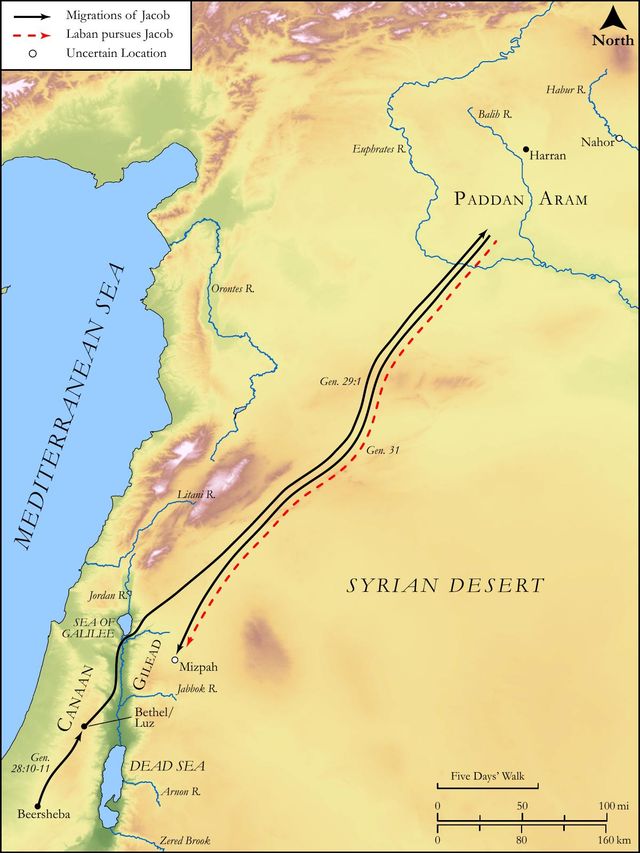
Tidings were brought him, on the third day, that Jacob had fled; he immediately raises the whole clan, takes his brethren, that is, the relations of his family, that were all in his interests, and pursues Jacob (as Pharaoh and his Egyptians afterwards pursued the seed of Jacob), to bring him back into bondage again, or with design to strip him of what he had. Seven days' journey he marched in pursuit of him, Gen 31:23. He would not have taken half the pains to have visited his best friends. But the truth is bad men will do more to serve their sinful passions than good men will to serve their just affections, and are more vehement in their anger than in their love. Well, at length Laban, overtook him, and the very night before he came up with him God interposed in the quarrel, rebuked Laban and sheltered Jacob, charging Laban not to speak unto him either good or bad (Gen 31:24), that is, to say nothing against his going on with his journey, for that it proceeded from the Lord. The same Hebraism we have, Gen 24:50. Laban, during his seven day's march, had been full of rage against Jacob, and was now full of hopes that his lust should be satisfied upon him (Exo 15:9); but God comes to him, and with one word ties his hands, though he does not turn his heart. Note,
1.In a dream, and in slumberings upon the bed, God has ways of opening the ears of men, and sealing their instruction, Job 33:15, Job 33:16. Thus he admonishes men by their consciences, in secret whispers, which the man of wisdom will hear and heed.
2.The safety of good men is very much owing to the hold God has of the consciences of bad men and the access he has to them.
3.God sometimes appears wonderfully for the deliverance of his people when they are upon the very brink of ruin. The Jews were saved from Haman's plot when the king's decree drew hear to be put in execution, Est 9:1.
Historical interpretation
Historical reception
1 surviving comment on this verse from the historical church.
Consider, I ask you, the good man’s noble resolve in quelling every sentiment of fear or reluctance when responding to the command of the Lord. I mean, when he saw Laban’s attitude was not promising, he refrained from confronting him as before; instead, he discharged the direction from the Lord by taking his wives and children and making tracks.
Continue studying Genesis 31:17 across the web’s major study libraries — every link below opens this exact verse, chapter, or book on the destination site.
Read & Compare
 BibleGatewayThis verse in more than 200 translations and 70 languages.
 Bible.comThe YouVersion reader — hundreds of translations, reading plans, and highlights.
 ESV.orgCrossway's official English Standard Version reader.
 NET BibleThe NET translation with 60,000+ translators' notes on every rendering decision.
 STEP BibleTyndale House's free study tool — original text, vocabulary, and scholarly resources.
 BibliaLogos Bible Software's free web reader.
 USCCBThe New American Bible (Revised Edition) with the U.S. bishops' study notes.
Commentaries
 BibleHub CommentariesDozens of classic commentaries on this verse, gathered on one page.
 StudyLightMore than 100 commentary sets — the largest collection on the web.
 BibleRefPlain-English commentary on what this verse means, verse by verse.
 Enduring WordDavid Guzik's free commentary on this chapter, widely used by Bible teachers.
 Bible Study ToolsVerse commentary alongside Greek and Hebrew study aids.
Original Language & Research
- BibleHub InterlinearThe verse word by word — original language, transliteration, and English.
- BibleHub LexiconEvery word's original-language definition and Strong's entry.
 Blue Letter BibleDeep-study tools — Strong's numbers, concordance, and word studies.
 SefariaThe Hebrew text with Rashi and centuries of Jewish commentary.
Sermons, Hymns & Audio


TrulyRandomVerse is not affiliated with these sites and doesn’t control their content. They’re linked because they’re genuinely useful.
Summary
Genesis 31:17 marks the decisive moment Jacob initiates his departure from Laban's household, preparing his extensive family—his sons and his wives—by setting them upon camels for the arduous journey back to the promised land of Canaan, in direct obedience to God's recent command and with the full consent of his household. This action signifies the tangible beginning of a new chapter in Jacob's life, moving him closer to the fulfillment of God's covenant promises.
Context
ShowHideLiterary Context
This verse is the immediate action following a period of intense relational strain and divine intervention. Prior to this, Laban's sons had openly expressed resentment towards Jacob's prosperity, attributing it to their father's diminished wealth (Genesis 31:1-2). Amidst this growing hostility, God directly commanded Jacob to "return unto the land of thy fathers, and to thy kindred; and I will be with thee" (Genesis 31:3). Jacob then prudently consulted with Leah and Rachel, who, having suffered from Laban's deceit and recognizing God's hand in Jacob's prosperity, wholeheartedly agreed to the departure (Genesis 31:4-16). Thus, Genesis 31:17 is not an impulsive act but the calculated, obedient execution of a divinely ordained plan, supported by his family, setting the stage for the dramatic flight from Laban and the subsequent confrontation with Esau.
Historical & Cultural Context
Jacob's journey takes place within the patriarchal period, where extended families functioned as economic and social units, and lineage was paramount for covenantal promises. The practice of polygamy, as seen in Jacob's two wives and two concubines, was common, though often a source of familial tension. Travel in this era, especially long distances across semi-arid regions, relied heavily on domesticated animals like camels, which were indispensable for carrying people, goods, and provisions. The concept of "returning to the land of thy fathers" was deeply significant, emphasizing ancestral ties and God's promise of a specific land to Abraham's descendants. Furthermore, the cultural norms of hospitality and familial obligation, which Laban repeatedly exploited, underscore the necessity of Jacob's strategic, if not secretive, departure to secure his family and possessions from further manipulation.
Key Themes
ShowHideGenesis 31:17 contributes to several overarching themes within the book of Genesis and the broader biblical narrative. Firstly, it highlights the theme of Divine Guidance and Obedience, as Jacob's departure is a direct response to God's command, echoing the call of Abraham to leave his homeland in Genesis 12:1. Secondly, it underscores God's Faithfulness to His Covenant Promises, particularly the promise to be with Jacob and bring him back to the land, first given at Bethel in Genesis 28:15 and reiterated in Genesis 31:3. Thirdly, the emphasis on "his sons and his wives" reinforces the Importance of Family and Progeny in God's redemptive plan, as these individuals represent the nascent nation of Israel. Finally, this verse marks a significant Transition and New Beginning for Jacob, moving him from a period of servitude and conflict with Laban towards his destiny in Canaan, a journey fraught with challenges but ultimately guided by divine providence.
Exposition and Analysis
ShowHideKey Word Analysis
ShowHideA primitive root meaning "to rise (in various applications, literal, figurative, intensive and causative)." In this context, it signifies more than merely standing; it denotes a decisive, resolute action, the initiation of a significant undertaking. Jacob's "rising up" indicates his immediate and purposeful response to God's command, demonstrating readiness and determination.
A primitive root meaning "to lift, in a great variety of applications, literal and figurative, absolute and relative." Here, it specifically means "to set upon" or "to cause to ride." This word vividly portrays Jacob's practical and active role in preparing his family for the journey, physically placing them onto the beasts of burden. It implies the effort and responsibility he undertook for his household's welfare.
Apparently from a root (gāmal) in the sense of labor or burden-bearing. A "camel" is an animal specifically suited for long-distance travel and carrying heavy loads in arid environments. Its mention grounds the narrative in the practical realities of ancient travel, highlighting the logistical scale of Jacob's move and the essential role these animals played in the nomadic life of the patriarchs.
Verse Breakdown
ShowHide"Then Jacob rose up,"
This phrase signifies Jacob's immediate and decisive action. Following God's explicit command to return to Canaan and his wives' agreement, Jacob does not hesitate. The verb "rose up" (Hebrew qûwm) implies a purposeful and determined initiation of the journey, marking the tangible beginning of his departure. It underscores his obedience and readiness to act upon divine instruction.
"and set his sons and his wives"
This clause highlights Jacob's comprehensive responsibility for his entire family unit. The mention of "sons and wives" (which includes Leah, Rachel, Bilhah, and Zilpah, and all their children) emphasizes that this was a collective endeavor, involving the future progenitors of the twelve tribes of Israel. Jacob, as the patriarch, meticulously ensures that every member of his extensive household is prepared and accounted for, demonstrating his leadership and care.
"upon camels;"
This detail specifies the mode of transport for the journey. Camels were the primary means of long-distance travel and cargo conveyance in the lands of the patriarchs, especially across challenging terrain. This practical detail underscores the immense logistical effort involved in moving such a large family and their vast possessions. It grounds the narrative in the realities of the time, painting a picture of a well-organized, albeit clandestine, exodus.
Literary Devices
ShowHideThe verse employs several literary devices to convey its meaning and impact. The use of strong Action Verbs like "rose up" (qûwm) and "set" (nâsâʼ) immediately conveys Jacob's decisiveness and the tangible commencement of his journey. These verbs are not passive but active, indicating purposeful movement and preparation. Furthermore, the phrase "his sons and his wives" functions as a Merism (or a form of Synecdoche), where two distinct parts are named to represent the whole. By mentioning "sons" and "wives," the text encompasses Jacob's entire household, including his concubines and all his children, emphasizing the completeness of his family's involvement in this momentous transition. Finally, the "camels" themselves can be seen as Symbolism, representing not only the practical means of travel but also the burdens, the nomadic lifestyle, and the journey of faith that Jacob and his family were undertaking as they moved towards the fulfillment of God's promises in the promised land.
Theological and Thematic Connections
ShowHideJacob's decisive action in Genesis 31:17 serves as a powerful testament to the themes of divine guidance and human obedience. His immediate preparation to leave Laban's household is a direct response to God's command, illustrating that true faith involves not just hearing God's word but acting upon it, even when the path ahead is uncertain or fraught with potential conflict. This moment reinforces God's active involvement in the lives of His covenant people, orchestrating events to bring about His purposes. It also highlights the importance of family in God's redemptive plan, as the entire household participates in this journey of faith, carrying forward the lineage through which the covenant promises would ultimately be fulfilled. This departure is a crucial step in the unfolding narrative of God's faithfulness to His covenant with Abraham, Isaac, and Jacob, moving the patriarch closer to his destiny in the promised land.
Reflection and Application
ShowHideGenesis 31:17 offers profound insights for contemporary believers regarding the nature of faith and obedience. Jacob's prompt and comprehensive action, following a clear divine directive and the consensus of his family, teaches us the importance of decisive obedience when God's will becomes evident. In our own lives, when we perceive God calling us to a new season, a difficult transition, or a specific act of faith, this verse encourages us to "rise up" and act with purpose, rather than procrastinating or succumbing to fear. Jacob's meticulous preparation of his "sons and his wives upon camels" also reminds us to consider the practical implications of our obedience, involving our families and ensuring their well-being in our walk of faith. Just as Jacob's journey was a step towards his destiny, our acts of obedience, however challenging, are often pivotal moments that lead us closer to God's ultimate purposes for our lives and the lives of those connected to us.
Questions for Reflection
ShowHideFAQ
ShowHideWhy did Jacob leave Laban secretly?
ShowHideJacob's departure from Laban was indeed clandestine, as detailed in Genesis 31:20-21. This secrecy was a prudent and necessary measure given Laban's manipulative and deceitful character. Laban had repeatedly changed Jacob's wages (ten times, according to Genesis 31:7), and his sons harbored resentment towards Jacob's prosperity, viewing it as a loss to their family. God had commanded Jacob to return to Canaan (Genesis 31:3), but a direct, open departure would likely have been met with resistance, attempts to retain Jacob's family and possessions, or even violence. Jacob's secret departure, while seemingly deceptive, was an act of obedience to God's command and a strategic move to protect his family and the wealth that God had blessed him with, ensuring their safe passage away from Laban's control.
Christ-Centered Fulfillment
ShowHideJacob's obedient departure from Laban's house, a place characterized by servitude, deception, and familial strife, to return to the promised land at God's express command, serves as a powerful foreshadowing of the greater spiritual journey of salvation found in Christ. Just as Jacob was called out of a difficult and oppressive situation to inherit a divine promise, so too are believers called by Christ to leave the bondage of sin and the world's systems, entering into the spiritual promised land of God's kingdom and eternal rest. Christ Himself is the ultimate fulfillment of God's promises to the patriarchs, the true "Way" who leads His people through all transitions and challenges (John 14:6). He is the one who guides us out of spiritual Egypt (bondage) into the promised land of communion with God, reconciling us to the Father (2 Corinthians 5:17-19). Through Christ, we are given a new identity and a new inheritance, far surpassing the earthly land Jacob sought, ultimately leading us to the heavenly city, "whose architect and builder is God" (Hebrews 11:8-10). Jacob's act of faith-filled obedience, therefore, points to the ultimate obedience of Christ, who, by His sacrifice, secures our true and lasting exodus into God's eternal presence.