


Genesis 45:27
- וַיְדַבְּרוּvay·da·be·Ruand they spokeH1696Conj-w ¦ V-Piel-ConsecImperf-3mpVerb Piel Consecutive Imperfect 3rd Plural Masculineוַandיְדַבְּרוּthey spoke
- אֵלָיו'e·Lavto himH413Prep ¦ 3msPrepositionאֵלָיtoוhim
- אֵת'et<obj.>H853DirObjMParticle Object Indicator
- כָּלkolallH3605N-mscNoun Singular Masculine Construct
- דִּבְרֵיdiv·Rei[the] words ofH1697N-mpcNoun Plural Masculine Construct
- יוֹסֵףyo·SefJosephH3130N-proper-mNoun Proper Masculine
- אֲשֶׁר'a·SherwhichH834RelParticle Relative
- דִּבֶּרdi·Berhe had spokenH1696V-Piel-Perf-3msVerb Piel Perfect 3rd Singular Masculine
- אֲלֵהֶם'a·le·Hemto themH413Prep ¦ 3mpPrepositionאֲלֵtoהֶםthem
- וַיַּרְאvai·yaR'and he sawH7200Conj-w ¦ V-Qal-ConsecImperf-3msVerb Qal Consecutive Imperfect 3rd Singular Masculineוַandיַּרְאhe saw
- אֶת'et<obj.>H853DirObjMParticle Object Indicator
- הָעֲגָלוֹתha·'a·ga·Lotthe cartsH5699Art ¦ N-fpNoun Plural Feminine Absoluteהָtheעֲגָלוֹתcarts
- אֲשֶׁר'a·SherwhichH834RelParticle Relative
- שָׁלַחsha·Lachhe had sentH7971V-Qal-Perf-3msVerb Qal Perfect 3rd Singular Masculine
- יוֹסֵףyo·SefJosephH3130N-proper-mNoun Proper Masculine
- לָשֵׂאתla·Setto carryH5375Prep-l ¦ V-Qal-InfVerb Qal Infinitive Constructלָtoשֵׂאתcarry
- אֹתוֹ'o·To<obj.> himH853DirObjM ¦ 3msParticle Object Indicatorאֹת<obj.>וֹhim
- וַתְּחִיva·te·Chiand it livedH2421Conj-w ¦ V-Qal-ConsecImperf-3fsVerb Qal Consecutive Imperfect 3rd Singular Feminineוַandתְּחִיit lived
- רוּחַRu·ach[the] spirit ofH7307N-fscNoun Singular Feminine Construct
- יַעֲקֹבya·'a·KoJacobH3290N-proper-mNoun Proper Masculine
- אֲבִיהֶם'a·vi·Hemtheir fatherH1N-msc ¦ 3mpNoun Singular Masculine Constructאֲבִיfatherהֶםtheir
English is a literal word-by-word gloss of the Hebrew, not the KJV's wording. Why?
This is the original text the KJV's translators worked from — each Hebrew word with its own literal English meaning in this verse, prepared by scholars at Tyndale House, Cambridge. The KJV translates whole sentences, not word by word, so its wording differs: one Hebrew word can become several English words, and the KJV may choose “the LORD” where the gloss reads “Yahweh”. Both are faithful — they answer different questions. For the KJV's own rendering, switch to the KJV text.
Details
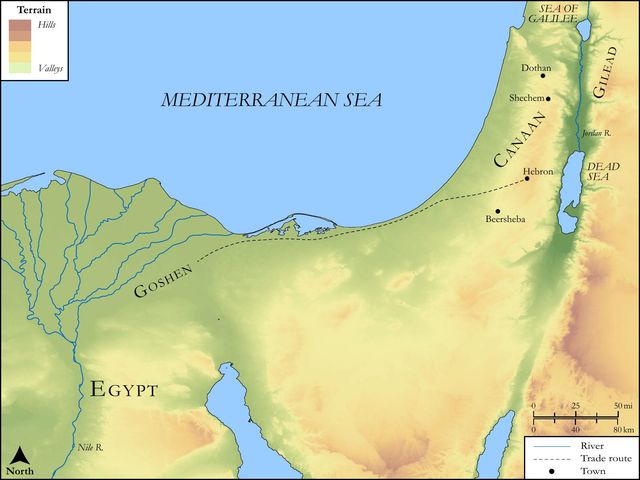
See on the biblical-era maps


Study this verse
Public-domain commentary
Matthew Henry
From his Commentary on the Whole Bible. Henry comments on passages, not single verses — this entry covers Genesis 45:25–28.
We have here the good news brought to Jacob. 1. The relation of it, at first, sunk his spirits. When, without any preamble, his sons came in, crying, Joseph is yet alive, each striving which should first proclaim it, perhaps he thought they bantered him, and the affront grieved him; or the very mention of Joseph's name revived his sorrow, so that his heart fainted, Gen 45:26. It was a good while before he came to himself. He was in such care and fear about the rest of them that at this time it would have been joy enough to him to hear that Simeon was released, and that Benjamin had come safely home (for he had been ready to despair concerning both these); but to hear that Joseph is alive is too good news to be true; he faints, for he believes it not. Note, We faint, because we do not believe; David himself had fainted if he had not believed, Psa 27:13. 2. The confirmation of it, by degrees, revived his spirit. Jacob had easily believed his sons formerly when they told him, Joseph is dead; but he can hardly believe them now that they tell him, Joseph is alive. Weak and tender spirits are influenced more by fear than hope, and are more apt to receive impressions that are discouraging than those that are encouraging. But at length Jacob is convinced of the truth of the story, especially when he sees the wagons which were sent to carry him (for seeing is believing), then his spirit revived. Death is as the wagons which are sent to fetch us to Christ: the very sight of it approaching should revive us. Now Jacob is called Israel (Gen 45:28), for he begins to recover his wonted vigour. (1.) It pleases him to think that Joseph is alive. He says nothing of Joseph's glory, of which they told him; it was enough to him that Joseph was alive. Note, Those that would be content with less degrees of comfort are best prepared for greater. (2.) It pleases him to think of going to see him. Though he was old, and the journey long, yet he would go to see Joseph, because Joseph's business would not permit him to come to see him. Observe, He says, "I will go and see him," not, "I will go and live with him;" Jacob was old, and did not expect to live long; "But I will go and see him before I die, and then let me depart in peace; let my eyes be refreshed with this sight before they are closed, and then it is enough, I need no more to make me happy in this world." Note, It is good for us all to make death familiar to us, and to speak of it as near, that we may think how little we have to do before we die, that we may do it with all our might, and may enjoy our comforts as those that must quickly die, and leave them.
Historical interpretation
Two Centuries of Reception
4 surviving comments on this verse. Each one is dated, so this reads as a timeline rather than a list.
Select a marker to jump to its quote. Markers stagger vertically where authors wrote within a few decades of each other.
But not even this is to be neglected idly, that the text says not the soul, but the spirit as its better part, was revived or rekindled. For indeed the brightness of the light that was in him, even if it was not completely extinguished then when his sons showed him Joseph’s robe stained with the blood of a kid. He could be deceived by their lie, so that “he tore his garments and put sackcloth on his loins and mourned his son, nor did he wish at all to be consoled,” but said, “I go down to my son into the nether world, mourning.” Even if then, as we said, the light in him had not been completely extinguished, nevertheless it had been darkened in the greatest degree because he could be deceived, because he could tear his garments, because he could mourn by mistake, because he could call on death, because he desired to go down into the nether world, mourning. On account of these things, therefore, he now revives and “rekindles his spirit,” because it followed logically that hearing the truth would rekindle and restore the light that the deceit of a lie had obscured in him.
What Latin expresses by saying: “his spirit was revived,” is written in Greek anezōpyrēsen. This means not so much to revive as to rekindle, so to speak, and reignite. This expression is usually used when, perhaps in some material, the fire fails to the point that it appears to be extinguished; and if perhaps it is renewed when kindling has been added, it is said to have been rekindled. Or if the light of a lamp should reach the point that it is thought to have gone out, if perhaps it be revived when oil has been poured in; although the expression is less refined, the lamp is said to have been rekindled. One will speak similarly also of a torch or other lights of this kind.This expression seems to indicate something like this also in Jacob. As long as he was far from Joseph and received no information about his life, his spirit had failed in him, as it were, and the light which was in him had been darkened, as the kindling already failed. But when those who reported to him about Joseph’s life came, that is, those who said that “the life was the light of all people,” he rekindles his spirit in himself, and the brightness of the true light is renewed in him.
When they told Jacob about the honor of Joseph, about the wisdom with which he administered his affairs and about how their last judgment was more bitter than the first, their father asked them and said, “Did you not ask Joseph how or why he went down to Egypt?” Then, when they all looked at each other and did not know what to say, Judah opened his mouth and said to his father, “We are recalling our crime today before our father.” Because of the dreams of Joseph, Joseph’s brothers thought, in their simplicity, that you and they would soon serve him as slaves. They also imagined, in their foolishness, that “it was better that he alone should be the servant than that we and our father should serve him as slaves.” They did this because they took pity on you and on Benjamin and not because you loved Joseph. “You also loved Benjamin, but because he did not say that we would become servants to him, all of us love him. Forgive us then for having humiliated Joseph, for it is on account of our humiliating him that he has come to this exalted state.” Their father then accepted their apology and said to them, “Because of the good news about Joseph by which you have brought me joy, this offense, which caused me great suffering when I heard it, is forgiven you.”
Despite these words and the fact that they brought what he had sent, the carts and the gifts sent by Joseph, only with difficulty did they succeed in convincing their father that what they had told him was a lie. In fact, when Jacob saw the carts that had been sent to carry him down to Egypt, “he gained new life,” the text says. This old graybeard, all stooped and bent, suddenly takes on new vigor and heart: observe the text says, “he gained new life.” What is the force of “he gained new life”? Just as the light of the lamp, when the supply of oil runs out and the light is on the point of going out, suddenly emits a brighter flame … when someone puts in a little oil, in just the same way this old man … on the point of expiring from disappointment … next learned that Joseph was alive and was in charge of Egypt. Seeing the carts, “he gained new life,” the text says. From being old, Jacob became young; he put aside the cloud of disappointment; he repelled the storm in his mind and then found himself at peace, with God disposing everything so that the good man should enjoy relief from all these awful trials and share the happiness of his son. In particular, the dream was to be fulfilled that Jacob himself had interpreted in the words, “Do you mean to say that I and your mother and your brothers will come to bow to the ground before you?”
Continue studying Genesis 45:27 across the web’s major study libraries — every link below opens this exact verse, chapter, or book on the destination site.
Read & Compare
 BibleGatewayThis verse in more than 200 translations and 70 languages.
 Bible.comThe YouVersion reader — hundreds of translations, reading plans, and highlights.
 ESV.orgCrossway's official English Standard Version reader.
 NET BibleThe NET translation with 60,000+ translators' notes on every rendering decision.
 STEP BibleTyndale House's free study tool — original text, vocabulary, and scholarly resources.
 BibliaLogos Bible Software's free web reader.
 USCCBThe New American Bible (Revised Edition) with the U.S. bishops' study notes.
Commentaries
 BibleHub CommentariesDozens of classic commentaries on this verse, gathered on one page.
 StudyLightMore than 100 commentary sets — the largest collection on the web.
 BibleRefPlain-English commentary on what this verse means, verse by verse.
 Enduring WordDavid Guzik's free commentary on this chapter, widely used by Bible teachers.
 Bible Study ToolsVerse commentary alongside Greek and Hebrew study aids.
Original Language & Research
- BibleHub InterlinearThe verse word by word — original language, transliteration, and English.
- BibleHub LexiconEvery word's original-language definition and Strong's entry.
 Blue Letter BibleDeep-study tools — Strong's numbers, concordance, and word studies.
 SefariaThe Hebrew text with Rashi and centuries of Jewish commentary.
Sermons, Hymns & Audio


TrulyRandomVerse is not affiliated with these sites and doesn’t control their content. They’re linked because they’re genuinely useful.
Summary
Genesis 45:27 captures the profound moment when Jacob, having heard the astonishing news of Joseph's survival and seeing the tangible proof of the wagons sent from Egypt, experienced a dramatic spiritual and emotional revival. This pivotal verse marks the culmination of Joseph's revelation to his brothers and the beginning of Jacob's journey to Egypt, signifying the miraculous restoration of a family long fractured by grief and deceit, and setting the stage for God's continued covenantal plan for Israel.
Context
ShowHideLiterary Context
Genesis 45:27 is the climax of Joseph's grand revelation to his brothers, which began in Genesis 45:1. After twenty-two years of separation and presumed death, Joseph has unveiled his identity, forgiven his brothers, and assured them of God's sovereign hand in his suffering and exaltation (Genesis 45:5-8). He then instructs them to return to Canaan, bring their father Jacob and all their households to Egypt, promising to sustain them through the remaining years of famine (Genesis 45:9-11). Joseph provides wagons for the journey and provisions, emphasizing the urgency and reality of his invitation. This verse specifically details the brothers' relaying of this incredible news to Jacob and Jacob's initial, disbelieving reaction, which is then transformed by the sight of the wagons. It directly precedes Jacob's decision to go to Egypt, a momentous step in the patriarchal narrative.
Historical & Cultural Context
The setting is ancient Canaan, a land experiencing severe famine, as described throughout Genesis 41, Genesis 42, Genesis 43, Genesis 44, Genesis 45, Genesis 46, Genesis 47. Wagons (Hebrew: ʻăgâlâh) were not common modes of transport for ordinary people in Canaan but were used for heavy loads or by those of high status. The fact that Joseph, a high-ranking official in Egypt, sent wagons would have immediately conveyed the authenticity and importance of the message, as well as the wealth and authority of the sender. For Jacob, who had lived a pastoral, nomadic life, these Egyptian wagons would have been a striking sight, representing a foreign power and the undeniable reality of his son's position. The cultural expectation of deep familial bonds and the profound grief associated with the loss of a son, particularly a favorite like Joseph, underscore the emotional weight of Jacob's long-held sorrow, making the news of Joseph's survival almost too incredible to accept without tangible proof.
Key Themes
ShowHideThis verse powerfully contributes to several overarching themes in Genesis. The primary theme is Divine Providence and Sovereignty, showcasing God's meticulous orchestration of events, even through human sin and suffering (Joseph's sale into slavery), to preserve His chosen family and fulfill His covenant promises. Jacob's long-held grief and the miraculous reversal highlight the theme of Restoration and Renewed Hope, demonstrating God's ability to bring life and joy out of despair. The tangible evidence of the wagons underscores the theme of Faith and Confirmation, illustrating how God often provides concrete signs to bolster belief in the face of the incredible. Finally, the impending reunion of Jacob and Joseph, facilitated by Joseph's forgiveness, reinforces the theme of Reconciliation and Familial Unity, crucial for the formation of the nascent nation of Israel, which would descend from Jacob's twelve sons.
Exposition and Analysis
ShowHideKey Word Analysis
ShowHideThis term signifies more than just spoken utterances; it encompasses matters, things, affairs, and even decrees or reports. Here, it refers to the totality of Joseph's message—his identity, his position, his forgiveness, and his invitation. The brothers relayed not just a few sentences but the full "matter" of Joseph's life and intentions, which was so incredible it was difficult for Jacob to process.
Meaning a wheeled vehicle, cart, or chariot. These were not mere conveyances but significant, tangible proof of Joseph's message. In a culture where such vehicles were associated with status and official business, the wagons served as undeniable, physical confirmation of Joseph's power and the veracity of his brothers' astonishing tale. They were a visual, undeniable sign that transcended the realm of mere words, breaking through Jacob's disbelief.
A primitive root meaning "to live," "to be restored to life," or "to be quickened." This is a profoundly significant term. It implies far more than a simple uplift in mood; it suggests a deep, life-giving renewal. For over two decades, Jacob's spirit had been in a state of profound sorrow, effectively "dead" to joy and hope due to his mourning for Joseph. The news, confirmed by the wagons, literally brought his spirit back to life, transforming his deep despair into overwhelming joy and renewed vitality.
Verse Breakdown
ShowHide"And they told him all the words of Joseph, which he had said unto them:"
This clause describes the initial communication from Joseph's brothers to their father, Jacob. They faithfully relayed the entire message Joseph had given them, encompassing his revelation, his exalted position in Egypt, his forgiveness, and his invitation for the family to relocate. However, the sheer magnitude and improbability of this news—Joseph, long presumed dead, now alive and a powerful ruler—initially overwhelmed Jacob, who likely struggled to believe it due to his prolonged and deep grief.
"and when he saw the wagons which Joseph had sent to carry him,"
This marks the turning point in Jacob's reaction. The verbal testimony of his sons, while true, was insufficient to penetrate his disbelief. The sight of the wagons, however, served as concrete, undeniable evidence. These were not ordinary carts but official Egyptian conveyances, tangible proof of Joseph's power and the authenticity of the message. This physical confirmation was the catalyst that allowed Jacob's heart to finally accept the incredible truth.
"the spirit of Jacob their father revived:"
This climactic phrase describes the profound impact of the realization on Jacob. The Hebrew word for "revived" (H2421, châyâh) signifies a restoration to life. For years, Jacob had been spiritually and emotionally "dead" due to his inconsolable grief over Joseph. The sight of the wagons, confirming Joseph's life and success, literally brought his spirit back to life, transforming his deep despair into overwhelming joy, renewed vitality, and an eager anticipation for the future.
Literary Devices
ShowHideThe verse effectively employs Narrative Progression to build suspense and deliver a powerful emotional climax. It moves from the verbal report, which initially fails to convince Jacob, to the visual evidence of the wagons, which triggers a dramatic shift. This use of Sensory Detail (seeing the wagons) is crucial, as it provides the tangible proof necessary to overcome Jacob's long-held despair. The phrase "the spirit of Jacob their father revived" is a powerful Metaphor, indicating not a literal death and resurrection, but a profound spiritual and emotional resuscitation from a state of deep grief and hopelessness to one of renewed life, joy, and vitality. This also serves as Foreshadowing, hinting at the eventual physical and spiritual revival of the entire nation of Israel in Egypt and beyond.
Theological and Thematic Connections
ShowHideGenesis 45:27 stands as a powerful testament to God's meticulous and compassionate providence, demonstrating how He orchestrates events, even through profound suffering and human sin, to bring about His redemptive purposes and restore what was lost. Jacob's "revived spirit" is a vivid illustration of God's ability to transform deep despair into overflowing joy and new life, underscoring the theme of restoration that runs throughout biblical history. It reminds us that even when circumstances seem hopeless, God is at work, often in ways beyond our comprehension, to fulfill His promises and bring about ultimate good.
Reflection and Application
ShowHideGenesis 45:27 offers a profound and comforting message for believers navigating seasons of prolonged sorrow, loss, or despair. Jacob's twenty-year grief over Joseph seemed insurmountable, yet God, in His perfect timing and through His intricate providence, brought about a miraculous reversal. This narrative encourages us to cultivate an enduring hope, even when circumstances appear bleak or when the news we long for seems too good to be true. Just as the tangible sight of the wagons confirmed the incredible news for Jacob, so too does God often provide concrete confirmations—whether through His Word, answered prayer, or providential circumstances—to strengthen our faith and reassure us of His presence and purposes. This verse calls us to trust in God's sovereign plan, even when it involves periods of waiting and suffering, knowing that He is capable of bringing revival and joy to the most desolate of spirits and restoring what was once thought lost forever. It also highlights the transformative power of reconciliation and forgiveness, mirroring God's own restorative work in our lives.
Questions for Reflection
ShowHideFAQ
ShowHideWhat does "the spirit of Jacob their father revived" truly mean?
ShowHideThe phrase "the spirit of Jacob their father revived" signifies a dramatic and profound transformation from deep despair and emotional paralysis to renewed life, joy, and vitality. The Hebrew word châyâh (H2421), translated "revived," literally means "to live," "to be restored to life," or "to be quickened." For over two decades, Jacob had been in a state of profound grief, effectively "dead" to joy and hope due to his mourning for Joseph (Genesis 37:35). The news, confirmed by the sight of the wagons, literally brought his spirit back to life, transforming his long-held sorrow into overwhelming relief, happiness, and an eager anticipation for the future. It was not merely a temporary uplift in mood but a fundamental, life-altering shift.
Why were the wagons so important if Jacob's sons had already told him the news?
ShowHideWhile Jacob's sons verbally conveyed the incredible news of Joseph's survival and exaltation, the sheer improbability of the story, coupled with Jacob's deep and prolonged grief, made it difficult for him to believe. For a heart burdened by over two decades of sorrow, mere words were insufficient to penetrate his disbelief. The sight of the wagons (H5699, ʻăgâlâh) provided tangible, undeniable proof. These were not ordinary carts but official Egyptian conveyances, serving as concrete confirmation of Joseph's high status and the veracity of his brothers' astonishing account. This physical evidence validated their words, allowing Jacob's weary heart to finally accept the truth and experience the profound spiritual and emotional revival described in the verse. The wagons were a divine provision, a visible sign to strengthen Jacob's faith.
Christ-Centered Fulfillment
ShowHideGenesis 45:27, with Jacob's spirit being "revived" at the news and tangible proof of Joseph's life, powerfully foreshadows the new life and spiritual revival available through Jesus Christ. Just as Joseph, once thought dead and mourned, was exalted to a position of power to save his family from famine, so too was Christ, though crucified and buried, raised from the dead and exalted to the right hand of God, bringing salvation and eternal life to all who believe (Romans 6:4). Our own spirits, once "dead in trespasses and sins" (Ephesians 2:1), are "quickened" or "revived" by the good news of the Gospel and the tangible evidence of God's grace, culminating in the indwelling of the Holy Spirit (Ephesians 2:5). This reunion of Jacob and Joseph, turning sorrow into unspeakable joy, mirrors the ultimate reconciliation and restoration God offers humanity through the sacrificial love and resurrection power of His Son, Jesus, who brings us out of spiritual death into abundant and everlasting life (John 10:10).