


Genesis 45:26
Bible text: King James Version (1769 Blayney text) · Public domain
Bible text: Berean Standard Bible · Public domain
Bible text: American Standard Version (1901) · Public domain
Bible text: World English Bible, Messianic edition · Public domain
Bible text: Geneva Bible (1599) · Public domain
Bible text: Young's Literal Translation · Public domain
- וַיַּגִּדוּvai·ya·Gi·duand they toldH5046Conj-w ¦ V-Hiphil-ConsecImperf-3mpVerb Hiphil Consecutive Imperfect 3rd Plural Masculineוַandיַּגִּדוּthey told
- לוֹloto himPrep-l ¦ 3msSuffix Personal 3rd Singular Masculineלtoוֹhim
- לֵאמֹרle·Mor<to> sayingH559Prep-l ¦ V-Qal-InfVerb Qal Infinitive Constructלֵ<to>אמֹרsaying
- עוֹדodstillH5750Adj-msAdjective Numerical Singular Masculine Absolute
- יוֹסֵףyo·SefJosephH3130N-proper-mNoun Proper Masculine
- חַיChai[is] aliveH2416Adj-msAdjective Singular Masculine Absolute
- וְכִיve·khiand thatH3588Conj-w ¦ PrtParticle Conditionalוְandכִיthat
- הוּאhu'heH1931Pro-3msPronoun Personal 3rd Singular Masculine
- מֹשֵׁלmo·Shel[is] rulingH4910V-Qal-Prtcpl-msVerb Qal Participle Singular Masculine Absolute
- בְּכָלbe·kholover allH3605Prep-b ¦ N-mscNoun Singular Masculine Constructבְּoverכָלall
- אֶרֶץ'E·retz[the] land ofH776N-fscNoun Singular Feminine Construct
- מִצְרָיִםmitz·Ra·yimEgyptH4714N-properNoun Proper Location
- וַיָּפָגvai·Ya·fogand it grew numbH6313Conj-w ¦ V-Qal-ConsecImperf-3msVerb Qal Consecutive Imperfect 3rd Singular Masculineוַandיָּפָגit grew numb
- לִבּוֹli·Bohis heartH3820N-msc ¦ 3msNoun Singular Masculine Constructלִבּheartוֹhis
- כִּיkiforH3588PrtParticle Conditional
- לֹאlo'notH3808NegParticle Negative
- הֶאֱמִיןhe·'e·Minhe believedH539V-Hiphil-Perf-3msVerb Hiphil Perfect 3rd Singular Masculine
- לָהֶםla·Hem<to> themPrep-l ¦ 3mpSuffix Personal 3rd Plural Masculineלָ<to>הֶםthem
English is a literal word-by-word gloss of the Hebrew, not the KJV's wording. Why?
This is the original text the KJV's translators worked from — each Hebrew word with its own literal English meaning in this verse, prepared by scholars at Tyndale House, Cambridge. The KJV translates whole sentences, not word by word, so its wording differs: one Hebrew word can become several English words, and the KJV may choose “the LORD” where the gloss reads “Yahweh”. Both are faithful — they answer different questions. For the KJV's own rendering, switch to the KJV text.
Details
See on the biblical-era maps


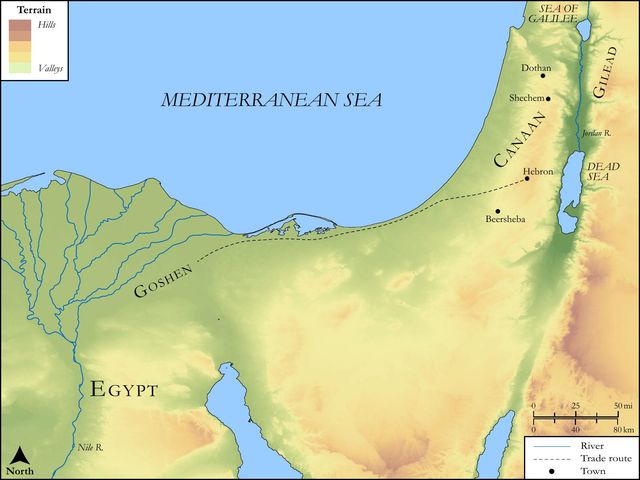
Study this verse
Public-domain commentary
Matthew Henry
From his Commentary on the Whole Bible. Henry comments on passages, not single verses — this entry covers Genesis 45:25–28.
We have here the good news brought to Jacob. 1. The relation of it, at first, sunk his spirits. When, without any preamble, his sons came in, crying, Joseph is yet alive, each striving which should first proclaim it, perhaps he thought they bantered him, and the affront grieved him; or the very mention of Joseph's name revived his sorrow, so that his heart fainted, Gen 45:26. It was a good while before he came to himself. He was in such care and fear about the rest of them that at this time it would have been joy enough to him to hear that Simeon was released, and that Benjamin had come safely home (for he had been ready to despair concerning both these); but to hear that Joseph is alive is too good news to be true; he faints, for he believes it not. Note, We faint, because we do not believe; David himself had fainted if he had not believed, Psa 27:13. 2. The confirmation of it, by degrees, revived his spirit. Jacob had easily believed his sons formerly when they told him, Joseph is dead; but he can hardly believe them now that they tell him, Joseph is alive. Weak and tender spirits are influenced more by fear than hope, and are more apt to receive impressions that are discouraging than those that are encouraging. But at length Jacob is convinced of the truth of the story, especially when he sees the wagons which were sent to carry him (for seeing is believing), then his spirit revived. Death is as the wagons which are sent to fetch us to Christ: the very sight of it approaching should revive us. Now Jacob is called Israel (Gen 45:28), for he begins to recover his wonted vigour. (1.) It pleases him to think that Joseph is alive. He says nothing of Joseph's glory, of which they told him; it was enough to him that Joseph was alive. Note, Those that would be content with less degrees of comfort are best prepared for greater. (2.) It pleases him to think of going to see him. Though he was old, and the journey long, yet he would go to see Joseph, because Joseph's business would not permit him to come to see him. Observe, He says, "I will go and see him," not, "I will go and live with him;" Jacob was old, and did not expect to live long; "But I will go and see him before I die, and then let me depart in peace; let my eyes be refreshed with this sight before they are closed, and then it is enough, I need no more to make me happy in this world." Note, It is good for us all to make death familiar to us, and to speak of it as near, that we may think how little we have to do before we die, that we may do it with all our might, and may enjoy our comforts as those that must quickly die, and leave them.
Historical interpretation
Two Centuries of Reception
4 surviving comments on this verse. Each one is dated, so this reads as a timeline rather than a list.
Select a marker to jump to its quote. Markers stagger vertically where authors wrote within a few decades of each other.
But Jacob is excited not only about the fact that he has heard that “Joseph his son is living,” but also especially about that which has been announced to him that it is Joseph who holds “dominion over all Egypt.”For the fact that he has reduced Egypt to his rule is truly great to him. For to tread on lust, to flee luxury and to suppress and curb all the pleasures of the body, this is what it means to have “dominion over all Egypt.” And this is what is considered great and held in admiration by Israel.
But if there is someone who should subject at least some vices of the body but yield to others and be subject to them, it is not said correctly of him that he holds “dominion over the whole land of Egypt,” but, for example, he will appear to hold dominion over one, perhaps, or two or three cities. But Joseph, whom no bodily lust ruled, was prince and lord “of all Egypt.”
I do not understand these words to have been said in the usual sense. For if, for example, we should assume that he could have been overcome with lust and sinned with his master’s wife, I do not think that this would have been announced about him by the patriarchs to his father Jacob: “Your son Joseph is living.” For if he had done this, without doubt he would not be living. For “the soul that sins, the same shall die.”23But Susanna also teaches the same things when she says, “I am straitened on every side. For if I do this thing—that is, if I sin—it is death to me; and if I do not do it, I shall not escape your hands.” Notice, therefore, that she too understood that there is death in sin.
But also the judgment revealed by God to the first man contains the same things when he says, “But on the day that you shall eat of it you shall die the death.” For as soon as he has transgressed the commandment, he is dead. For the soul that has sinned is dead, and the serpent, which said, “You shall not die the death,” is shown to have deceived him.
And these words have been about that which was said by the sons of Israel to Jacob: “Your son Joseph is living.”
We surely notice how the Scripture says that he is alive and ruler of the whole land, for he opened his storehouses of spiritual grace and gave the abundance to all people. But when the apostles spoke this way, the Jews did not believe them; rather, they laid hands on them and thrust the preachers of salvation into prison. On this account also it is written of Jacob, “He was greatly frightened in heart,” for he did not believe his sons. He was greatly frightened from love of an unbelieving people, but afterward he came to recognize Christ’s deeds. Won over by the mighty benefactions and mighty works, he revived and said, “It is a great thing for me, if my son Joseph is still alive. I will go and see him, before I die.” The first and greatest foundation of faith is belief in the resurrection of Christ. For whosoever believes Christ has been restored to life, quickly searches for him, comes to him with devotion and worships God with his inmost heart. Indeed, he believes that he himself will not die if he has faith in the source of his resurrection.
Who could describe the joy he experienced then on learning that Joseph was alive and in fact enjoyed such wonderful fame? You know, of course, that it is unexpected blessings that give rise to the keenest surge of enjoyment. Well, in this case the person he thought for so many years had become the prey of wild beasts he now learned had attained complete authority over Egypt; so how could he fail to be dumbfounded by the greatness of his joy? After all, what is caused by excessive despair is often the effect also of extreme rejoicing. We can see many people shedding tears from exceeding joy, whereas others are frequently rendered speechless when they see things they did not expect to happen, and suddenly behold alive those they thought to be dead.
Continue studying Genesis 45:26 across the web’s major study libraries — every link below opens this exact verse, chapter, or book on the destination site.
Read & Compare
 BibleGatewayThis verse in more than 200 translations and 70 languages.
 Bible.comThe YouVersion reader — hundreds of translations, reading plans, and highlights.
 ESV.orgCrossway's official English Standard Version reader.
 NET BibleThe NET translation with 60,000+ translators' notes on every rendering decision.
 STEP BibleTyndale House's free study tool — original text, vocabulary, and scholarly resources.
 BibliaLogos Bible Software's free web reader.
 USCCBThe New American Bible (Revised Edition) with the U.S. bishops' study notes.
Commentaries
 BibleHub CommentariesDozens of classic commentaries on this verse, gathered on one page.
 StudyLightMore than 100 commentary sets — the largest collection on the web.
 BibleRefPlain-English commentary on what this verse means, verse by verse.
 Enduring WordDavid Guzik's free commentary on this chapter, widely used by Bible teachers.
 Bible Study ToolsVerse commentary alongside Greek and Hebrew study aids.
Original Language & Research
- BibleHub InterlinearThe verse word by word — original language, transliteration, and English.
- BibleHub LexiconEvery word's original-language definition and Strong's entry.
 Blue Letter BibleDeep-study tools — Strong's numbers, concordance, and word studies.
 SefariaThe Hebrew text with Rashi and centuries of Jewish commentary.
Sermons, Hymns & Audio


TrulyRandomVerse is not affiliated with these sites and doesn’t control their content. They’re linked because they’re genuinely useful.
Summary
Genesis 45:26 powerfully captures the climactic moment when Joseph's brothers finally relayed the astonishing news to their aged father, Jacob, that Joseph was not only alive but held the highest position of authority as governor over all the land of Egypt. This revelation, coming after more than two decades of Jacob mourning his beloved son as dead, struck him with such profound shock and disbelief that his heart "fainted," rendering him momentarily stunned and unable to process the overwhelming, unexpected joy.
Context
ShowHideLiterary Context
This verse serves as the dramatic culmination of the Joseph narrative, specifically following Joseph's emotional self-revelation to his brothers in Genesis 45:1-15. After revealing his identity and explaining God's providential hand in his rise to power, Joseph instructs his brothers to return to Canaan and bring their father, Jacob, and their entire families to Egypt, promising to sustain them through the remaining years of famine (Genesis 45:16-25). The brothers are given wagons and provisions for the journey, a tangible sign of Joseph's wealth and position. Genesis 45:26 then describes the brothers' arrival back in Canaan and their delivery of this life-altering news to Jacob, setting the stage for the family's migration to Egypt and the reunion that Jacob had long believed impossible.
Historical & Cultural Context
Egypt was a highly structured society with a powerful pharaoh at its head. The concept of a "governor" (often a vizier or prime minister) holding immense power, second only to the monarch, was well-established. Famine was a recurring and devastating threat in this agrarian society, making control over grain supplies paramount for survival. The family unit and lineage were central to identity and survival, especially for nomadic peoples like Jacob's family. Jacob's profound grief for Joseph, persisting for over twenty years (Genesis 37:33-35), reflects the deep emotional bonds within the patriarchal family and the cultural expectation of mourning a lost child. The brothers' journey back to Canaan from Egypt would have been a significant undertaking, underscoring the urgency and importance of their message.
Key Themes
ShowHideGenesis 45:26 powerfully contributes to several overarching themes within the book of Genesis and the broader biblical narrative. It highlights the theme of Divine Providence and Sovereignty, demonstrating how God orchestrates seemingly disparate and often tragic events—like Joseph's enslavement—for His ultimate redemptive purposes, ultimately preserving the covenant family and fulfilling His promises (Genesis 50:20). The verse also underscores the theme of Reconciliation and Forgiveness, as the long-standing estrangement and deception within Jacob's family are now confronted with the possibility of a joyous reunion. Furthermore, Jacob's initial disbelief speaks to the theme of Faith and Doubt, illustrating the human struggle to accept even the most miraculous good news when it contradicts deeply ingrained sorrow or perceived reality, a theme also seen in the disciples' reaction to the resurrection news in Luke 24:41.
Exposition and Analysis
ShowHideKey Word Analysis
ShowHideThis verb means "to front, i.e., stand boldly out opposite; by implication (causatively), to manifest; figuratively to announce (always by word of mouth to one present); specifically, to expose, predict, explain, praise." Here, it signifies the brothers' direct and emphatic declaration of the astonishing news to Jacob. It's not a casual mention but a bold, face-to-face announcement of a truth that would profoundly challenge Jacob's long-held reality.
This primitive root means "to be sluggish; cease, be feeble, faint, be slacked." In this context, when applied to Jacob's heart, it describes a state of emotional and mental paralysis, a sudden cessation of normal function due to overwhelming shock. It suggests his heart grew numb or unresponsive, not necessarily a physical collapse, but a profound internal stupor where his faculties were temporarily "slacked" or unable to process the magnitude of the news.
This primitive root means "to build up or support; to foster as a parent or nurse; figuratively to render (or be) firm or faithful, to trust or believe, to be permanent or quiet." Jacob's "not believing" them indicates a lack of firmness or stability in his acceptance of their words. His heart could not "build up" or "support" the idea, meaning he found it impossible to trust or affirm the truth of their declaration due to its incredible nature and the deeply entrenched sorrow he had carried for decades.
Verse Breakdown
ShowHide"And told him, saying, Joseph [is] yet alive"
The brothers, having returned from Egypt, deliver the news they had been sent to convey. The first part of their message, "Joseph is yet alive," would have been utterly shocking. For over twenty years, Jacob had mourned Joseph as dead, believing he had been torn apart by a wild beast. This statement directly contradicts Jacob's long-held, deeply painful reality, presenting a miraculous reversal of fortune that would have been almost impossible to comprehend.
"and he [is] governor over all the land of Egypt."
The second part of the news adds an even more astounding layer to the revelation. Not only is Joseph alive, but he holds the second-highest position of power in the most formidable nation of that day. This status would have been beyond Jacob's wildest imagination, transforming Joseph from a presumed victim of tragedy into a powerful ruler. This detail underscores the divine elevation of Joseph and the incredible extent of God's providential work.
"And Jacob's heart fainted, for he believed them not."
Jacob's immediate, visceral reaction to this overwhelming news is one of profound shock and disbelief. The Hebrew phrase "Jacob's heart fainted" (וַיָּפָג לִבּוֹ, vayyafag libbo) indicates that his heart became numb, paralyzed, or ceased to function normally due to the sheer magnitude of the information. It was not necessarily a physical fainting spell but a deep emotional and mental stupor, a temporary inability to process such an incredible reversal of his long-held sorrow. His disbelief stemmed from the sheer improbability of the claim, given the depth and duration of his mourning, highlighting how deeply ingrained his grief had become.
Literary Devices
ShowHideThe verse employs several powerful literary devices. Irony is prominent, as the very sons who perpetrated the lie about Joseph's death are now the bearers of the truth of his life and exaltation. This reversal of roles adds a poignant layer to the narrative. Hyperbole is evident in the description of Jacob's heart "fainting"; while not necessarily a literal physical collapse, it vividly conveys the extreme emotional and mental shock that rendered him momentarily unresponsive. This use of exaggerated language emphasizes the overwhelming nature of the news. Furthermore, Pathos is powerfully evoked, drawing on the reader's understanding of Jacob's decades of profound grief. The sudden shift from deep sorrow to the possibility of unimaginable joy creates a dramatic emotional tension, making Jacob's initial disbelief a deeply human and relatable response to a miracle that seems too good to be true.
Theological and Thematic Connections
ShowHideGenesis 45:26 serves as a profound testament to God's intricate and often surprising plan working through human circumstances. What began as an act of profound evil—the brothers' betrayal and sale of Joseph into slavery—was transformed by God into a means of preservation and family reunion, demonstrating that God can use human sin for His ultimate good and the fulfillment of His divine purposes. Jacob's long sorrow is confronted by an unimaginable joy, a powerful illustration of God's ability to bring about astonishing reversals and redemption even after prolonged periods of despair. This moment underscores God's unwavering faithfulness to His covenant promises, as the preservation of Jacob's family through Joseph's elevation in Egypt is crucial for the continuation of the covenant line, ensuring the future of the nation from whom the Messiah would come. Jacob's initial disbelief, despite the source of the news being his own sons, highlights the human tendency to cling to established narratives of sorrow or hardship, making it difficult to embrace even good news when it seems too extraordinary to be true, yet God's tangible provision (the wagons and supplies) ultimately overcomes his doubt.
Reflection and Application
ShowHideGenesis 45:26 offers a profound lesson on the nature of hope, the unexpected turns of divine providence, and God's unwavering faithfulness, even in the face of human doubt. Jacob's decades of mourning for Joseph, a sorrow so deeply ingrained that it made even miraculous good news seem unbelievable, serves as a powerful reminder that we, too, can become accustomed to our hardships or resigned to our sorrows. This passage encourages us to remain open to God's unexpected workings, trusting that His plans, though often hidden and unfolding over long periods, are always for our ultimate good and the fulfillment of His purposes. Just as Jacob's family was preserved from famine through Joseph's elevation, we are reminded of God's enduring care for His people, even in the midst of trials and despair, calling us to a deeper trust in His perfect timing and redemptive power. It challenges us to examine our own hearts: are we sometimes so fixated on past pain or present difficulties that we struggle to believe God for the impossible, for the joy that seems too good to be true?
Questions for Reflection
ShowHideFAQ
ShowHideWhy did Jacob initially disbelieve his sons?
ShowHideJacob's disbelief stemmed from the profound and prolonged grief he had experienced for over two decades, having been convinced that Joseph was dead, likely devoured by a wild beast (Genesis 37:33). The news that Joseph was not only alive but also the powerful governor of Egypt was so overwhelmingly contrary to his deeply ingrained sorrow and the apparent reality he had accepted that his mind and heart were initially unable to process such an astonishing reversal of fortune. It was simply too good and too unexpected to be true in his immediate perception, a common human reaction when confronted with news that defies long-held pain or expectation.
What is the significance of Jacob's "fainting heart"?
ShowHideThe phrase "Jacob's heart fainted" (Hebrew: vayyafag libbo, from H6313 pûwg) does not necessarily imply a physical fainting spell but rather a profound emotional and mental paralysis or numbness. It signifies that his heart became cold, still, or unresponsive due to the sheer shock and disbelief. It illustrates the overwhelming impact of the news, causing a temporary shutdown of his ability to comprehend or accept the incredible revelation after so many years of resigned sorrow. It was a moment of utter stupefaction, where the magnitude of the news temporarily overwhelmed his capacity to react.
Christ-Centered Fulfillment
ShowHideThe story of Joseph, culminating in this dramatic reunion and Jacob's initial disbelief giving way to joyous acceptance, serves as a powerful prefigurement of Christ and His redemptive work. Joseph, though innocent, was betrayed by his own brothers, sold into slavery, and seemingly abandoned to death, yet he was ultimately exalted to a position of unparalleled power in Egypt, not for his own sake, but to save his family and the world from famine. Similarly, Jesus, the perfect Son, was betrayed by His own people, unjustly condemned to death, and seemingly defeated, yet He was resurrected and exalted to the right hand of God (Acts 2:33), not for His own benefit, but to be the Savior of all who believe, providing spiritual sustenance and eternal life (John 6:35). Just as Joseph brought reconciliation and preservation to his estranged family, gathering them into Egypt, Christ brings reconciliation between a holy God and sinful humanity, gathering His scattered people into one family through His redemptive work on the cross (Ephesians 2:13-16). Jacob's initial disbelief and subsequent joy mirror humanity's struggle to grasp the magnitude of God's salvation through Christ, a truth so glorious it seems almost too good to be true, yet it is the ultimate fulfillment of God's covenant promises.