


Genesis 37:33
- וַיַּכִּירָהּvai·ya·ki·Rahand he recognized itH5234Conj-w ¦ V-Hiphil-ConsecImperf-3ms ¦ 3fsVerb Hiphil Consecutive Imperfect 3rd Singular Masculineוַandיַּכִּירָhe recognizedהּit
- וַיֹּאמֶרvai·Yo·merand he saidH559Conj-w ¦ V-Qal-ConsecImperf-3msVerb Qal Consecutive Imperfect 3rd Singular Masculineוַandיֹּאמֶרhe said
- כְּתֹנֶתke·To·net[it is] [the] long garment ofH3801N-fscNoun Singular Feminine Construct
- בְּנִיbe·Nimy sonH1121N-msc ¦ 1csNoun Singular Masculine Constructבְּנִsonיmy
- חַיָּהchai·Yahan animalH2416N-fsNoun Singular Feminine Absolute
- רָעָהra·'AhwildH7451Adj-fsAdjective Singular Feminine Absolute
- אֲכָלָתְהוּ'a·kha·La·te·huit has eaten himH398V-Qal-Perf-3fs ¦ 3msVerb Qal Perfect 3rd Singular Feminineאֲכָלָתְit has eatenהוּhim
- טָרֹףta·Rofcertainly <to tear>H2963V-Qal-InfAbsVerb Qal Infinitive Absolute
- טֹרַףto·Rafhe has been torn to piecesH2963V-Pual-Perf-3msVerb Pual Perfect 3rd Singular Masculine
- יוֹסֵףyo·SefJosephH3130N-proper-mNoun Proper Masculine
English is a literal word-by-word gloss of the Hebrew, not the KJV's wording. Why?
This is the original text the KJV's translators worked from — each Hebrew word with its own literal English meaning in this verse, prepared by scholars at Tyndale House, Cambridge. The KJV translates whole sentences, not word by word, so its wording differs: one Hebrew word can become several English words, and the KJV may choose “the LORD” where the gloss reads “Yahweh”. Both are faithful — they answer different questions. For the KJV's own rendering, switch to the KJV text.
Details
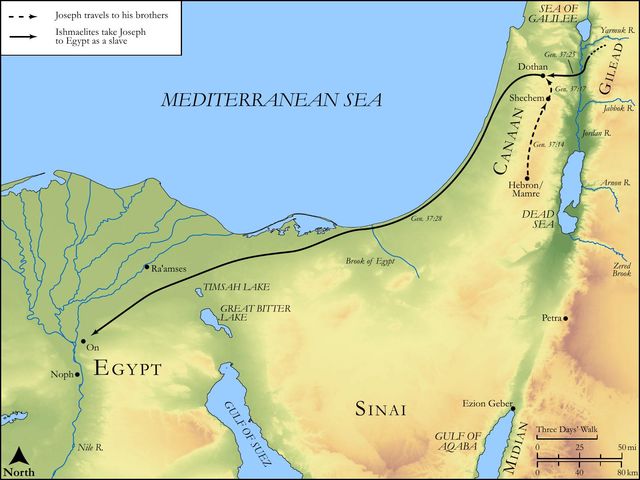
See on the biblical-era map


Study this verse
Public-domain commentary
Matthew Henry
From his Commentary on the Whole Bible. Henry comments on passages, not single verses — this entry covers Genesis 37:31–36. His four-level outline is real structure in the source text, so it is rendered as structure.
I.Joseph would soon be missed, great enquiry would be made for him, and therefore his brethren have a further design, to make the world believe that Joseph was torn in pieces by a wild beast; and this they did,
1.To clear themselves, that they might not be suspected to have done him any mischief. Note, We have all learned of Adam to cover our transgression, Job 31:33. When the devil has taught men to commit one sin, he then teaches them to conceal it with another, theft and murder with lying and perjury; but he that covers his sin shall not prosper long. Joseph's brethren kept their own and one another's counsel for some time, but their villany came to light at last, and it is here published to the world, and the remembrance of it transmitted to every age.
2.To grieve their good father. It seems designed by them on purpose to be revenged upon him for his distinguishing love of Joseph. It was contrived on purpose to create the utmost vexation to him. They sent him Joseph's coat of many colours, with one colour more than it had had, a bloody colour, Gen 37:32. They pretended they had found it in the fields, and Jacob himself must be scornfully asked, Is this thy son's coat? Now the badge of his honour is the discovery of his fate; and it is rashly inferred from the bloody coat that Joseph, without doubt, is rent in pieces. Love is always apt to fear the worst concerning the person beloved; there is a love that casteth out fear, but that is a perfect love. Now let those that know the heart of a parent suppose the agonies of poor Jacob, and put their souls into his soul's stead. How strongly does he represent to himself the direful idea of Joseph's misery! Sleeping or waking, he imagines he sees the wild beast setting upon Joseph, thinks he hears his piteous shrieks when the lion roared against him, makes himself tremble and grow chill, many a time, when he fancies how the beast sucked his blood, tore him limb from limb, and left no remains of him, but the coat of many colours, to carry the tidings. And no doubt it added no little to the grief that he had exposed him, by sending him, and sending him all alone, on this dangerous journey, which proved so fatal to him. This cuts him to the heart, and he is ready to look upon himself as an accessory to the death of his son. Now,
(1.)Endeavours were used to comfort him. His sons basely pretended to do it (Gen 37:35); but miserable hypocritical comforters were they all. Had they really desired to comfort him, they might easily have done it, by telling him the truth, "Joseph is alive, he is indeed sold into Egypt, but it will be an easy thing to send thither and ransom him." This would have loosened his sackcloth, and girded him with gladness presently. I wonder their countenances did not betray their guilt, and with what face they could pretend to condole with Jacob on the death of Joseph, when they knew he was alive. Note, The heart is strangely hardened by the deceitfulness of sin. But,
(2.)It was all in vain: Jacob refused to be comforted, Gen 37:35. He was an obstinate mourner, resolved to go down to the grave mourning. It was not a sudden transport of passion, like that of David, Would God I had died for thee, my son, my son! But, like Job, he hardened himself in sorrow. Note,
[1.]Great affection to any creature does not prepare for so much the greater affliction, when it is either removed from us or embittered to us. Inordinate love commonly ends in immoderate grief; as much as the sway of the pendulum throws one way, so much it will throw the other way.
[2.]Those consult neither the comfort of their souls nor the credit of their religion that are determined in their sorrow upon any occasion whatsoever. We must never say, "We will go to our grave mourning," because we know not what joyful days Providence may yet reserve for us, and it is our wisdom and duty to accommodate ourselves to Providence.
[3.]We often perplex ourselves with imaginary troubles. We fancy things worse than they are, and then afflict ourselves more than we need. Sometimes there needs no more to comfort us than to undeceive us: it is good to hope the best.
II.The Ishmaelites and Midianites having bought Joseph only to make their market of him, here we have him sold again (with gain enough to the merchants, no doubt) to Potiphar, Gen 37:36. Jacob was lamenting the loss of his life; had he known all he would have lamented, though not so passionately, the loss of liberty. Shall Jacob's freeborn son exchange the best robe of his family for the livery of an Egyptian lord, and all the marks of servitude? How soon was the land of Egypt made a house of bondage to the seed of Jacob! Note, It is the wisdom of parents not to bring up their children too delicately, because they know not to what hardships and mortifications Providence may reduce them before they die. Jacob little thought that ever his beloved Joseph would be thus bought and sold for a servant.
Continue studying Genesis 37:33 across the web’s major study libraries — every link below opens this exact verse, chapter, or book on the destination site.
Read & Compare
 BibleGatewayThis verse in more than 200 translations and 70 languages.
 Bible.comThe YouVersion reader — hundreds of translations, reading plans, and highlights.
 ESV.orgCrossway's official English Standard Version reader.
 NET BibleThe NET translation with 60,000+ translators' notes on every rendering decision.
 STEP BibleTyndale House's free study tool — original text, vocabulary, and scholarly resources.
 BibliaLogos Bible Software's free web reader.
 USCCBThe New American Bible (Revised Edition) with the U.S. bishops' study notes.
Commentaries
 BibleHub CommentariesDozens of classic commentaries on this verse, gathered on one page.
 StudyLightMore than 100 commentary sets — the largest collection on the web.
 BibleRefPlain-English commentary on what this verse means, verse by verse.
 Enduring WordDavid Guzik's free commentary on this chapter, widely used by Bible teachers.
 Bible Study ToolsVerse commentary alongside Greek and Hebrew study aids.
Original Language & Research
- BibleHub InterlinearThe verse word by word — original language, transliteration, and English.
- BibleHub LexiconEvery word's original-language definition and Strong's entry.
 Blue Letter BibleDeep-study tools — Strong's numbers, concordance, and word studies.
 SefariaThe Hebrew text with Rashi and centuries of Jewish commentary.
Sermons, Hymns & Audio


TrulyRandomVerse is not affiliated with these sites and doesn’t control their content. They’re linked because they’re genuinely useful.
Summary
Genesis 37:33 records the devastating moment Jacob identifies Joseph's blood-stained tunic, leading him to the heartbreaking conclusion that his beloved son has been brutally killed. His immediate and absolute declaration, "Joseph is without doubt rent in pieces," encapsulates the profound grief and despair that would consume him for years, highlighting the success of his other sons' cruel deception and marking a pivotal point of sorrow and misunderstanding in the patriarchal narrative.
Context
ShowHideLiterary Context
This poignant verse is the climax of the brothers' elaborate deception designed to conceal their sale of Joseph into slavery. Immediately preceding this, Joseph's brothers, having sold him to passing Ishmaelites/Midianites, take his distinctive tunic of many colors, dip it in goat's blood, and bring it to their father, Jacob. Their calculated act is a direct consequence of their deep-seated jealousy and hatred for Joseph, fueled by Jacob's favoritism and Joseph's prophetic dreams. Jacob's reaction in this verse sets the stage for a long period of mourning and familial estrangement, which will only begin to heal decades later with Joseph's eventual revelation to his family in Egypt.
Historical & Cultural Context
In ancient Near Eastern patriarchal societies, a father's grief over a lost son, especially a favored one, was profound and culturally expressed through public mourning, tearing of garments, and wearing sackcloth. The "coat of many colors" (or "long-sleeved robe," depending on translation) was not merely a garment but a symbol of Jacob's special affection and perhaps an indication of Joseph's elevated status as an heir or manager, a role typically reserved for the firstborn. The act of a wild beast devouring a person was a common and terrifying reality in the pastoral and wilderness regions of Canaan, making Jacob's conclusion culturally plausible and deeply horrifying.
Key Themes
ShowHideGenesis 37:33 powerfully contributes to several overarching themes within the book of Genesis and the broader biblical narrative. It underscores the destructive power of sin, particularly the jealousy and deception exhibited by Joseph's brothers, demonstrating how familial discord can lead to devastating consequences, as seen throughout the narrative of Jacob's family. The verse also highlights human fallibility and limited perspective, as Jacob, despite his wisdom, is entirely misled by appearances, unable to see beyond the fabricated evidence. Paradoxically, this tragic event also serves as a crucial, albeit painful, step in the unfolding of divine sovereignty, as God orchestrates even human evil to bring about His ultimate redemptive purposes, a truth later articulated by Joseph himself in Genesis 50:20.
Exposition and Analysis
ShowHideKey Word Analysis
ShowHideMeaning "a son (as a builder of the family name), in the widest sense (of literal and figurative relationship, including grandson, subject, nation, quality or condition, etc., (like father or brother), etc.)." Jacob's immediate identification of the coat as belonging to "my son" underscores the deeply personal and relational nature of his grief. Joseph was not just a child, but a "builder of the family name," a direct descendant and a source of future hope, making his perceived loss all the more devastating.
Meaning "alive; hence, raw (flesh); fresh (plant, water, year), strong; also (as noun, especially in the feminine singular and masculine plural) life (or living thing), whether literally or figuratively; [phrase] age, alive, appetite, (wild) beast." The term "beast" here refers specifically to a wild, living creature, emphasizing the brutal and untamed nature of the perceived attack. Jacob's immediate assumption of a "wild beast" (often implied by context) highlights the violent and uncontrollable force he believes responsible for Joseph's demise.
A primitive root meaning "to pluck off or pull to pieces; causatively to supply with food (as in morsels); catch, [idiom] without doubt, feed, ravin, rend in pieces, [idiom] surely, tear (in pieces)." The Hebrew phrase ṭārop ṭōrap (טָרֹף טֹרַף) uses an infinitive absolute construction, which intensely emphasizes the verb. It conveys a sense of complete, irreversible, and violent destruction. Jacob's declaration signifies not merely death, but a total dismemberment, leaving no body to mourn or bury, thus amplifying the horror and finality of his perceived loss.
Verse Breakdown
ShowHide"And he knew it"
This clause highlights Jacob's immediate and unequivocal recognition of the garment. The "it" refers specifically to Joseph's distinctive tunic, which Jacob had given him, symbolizing his favoritism. This recognition is the crucial trigger for his subsequent despair, as the sight of the blood-stained garment instantly confirms his worst fears.
"and said, It is my son's coat"
Jacob's verbalization confirms his identification of the coat. The possessive "my son's" underscores the deep personal connection and the profound sense of ownership and love he had for Joseph, making the perceived loss intensely personal and painful.
"an evil beast hath devoured him"
Based on the blood-stained coat and the violent nature of the damage, Jacob immediately concludes the cause of Joseph's death. The phrase "evil beast" (Hebrew: ḥayyāh rā‘āh) implies a savage, predatory animal, painting a vivid and terrifying picture of Joseph's supposed end. The verb "devoured" (H398, ʼâkal) further emphasizes the complete consumption, leaving nothing behind.
"Joseph is without doubt rent in pieces"
This is Jacob's final, absolute, and most despairing declaration. The phrase "without doubt rent in pieces" (Hebrew: ṭārop ṭōrap) is an emphatic infinitive absolute construction, conveying absolute certainty and the complete, violent dismemberment of Joseph's body. It signifies not just death, but a brutal, irreversible destruction, leaving no hope for recovery or even a proper burial, plunging Jacob into inconsolable grief.
Literary Devices
ShowHideThe verse employs several powerful literary devices to convey Jacob's anguish and the tragic nature of the event. The most prominent is Hyperbole in Jacob's declaration, "Joseph is without doubt rent in pieces." While a wild animal might kill and consume, the emphatic "rent in pieces" (the infinitive absolute ṭārop ṭōrap) conveys a sense of utter destruction and dismemberment that amplifies his horror and despair beyond mere death. There is also profound Pathos, as the narrative evokes intense pity and sorrow for Jacob, who is a victim of his sons' cruel deception. The Symbolism of Joseph's coat, initially a sign of favor, is tragically transformed into an emblem of death and loss through the brothers' manipulation. Finally, the scene is rich with Dramatic Irony, as the audience knows the truth of Joseph's survival, while Jacob remains tragically ignorant, intensifying the emotional impact of his grief.
Theological and Thematic Connections
ShowHideGenesis 37:33 stands as a stark illustration of the destructive ripple effects of human sin, particularly jealousy and deception, within the most intimate of relationships. Jacob's profound grief, though based on a lie, is genuine and highlights the immense pain that unchecked animosity can inflict. This moment, born of human wickedness, paradoxically becomes a crucial, albeit painful, step in God's overarching plan for the preservation of Jacob's family and the nascent nation of Israel. It demonstrates how divine sovereignty can work through, and even redeem, the darkest acts of human evil, weaving them into a larger tapestry of redemption and purpose.
Reflection and Application
ShowHideGenesis 37:33 serves as a poignant reminder of the profound and far-reaching consequences of sin, particularly the corrosive effects of jealousy and the devastating pain inflicted by deception within families. Jacob's immediate and overwhelming despair in the face of what he believes to be Joseph's brutal death challenges us to examine our own reactions to tragedy and loss. It highlights the human tendency to draw absolute conclusions based on incomplete or manipulated information, leading to unnecessary suffering. While we may experience deep sorrow and uncertainty in life's trials, this narrative ultimately points to a greater truth: even through the darkest moments of human sin and suffering, God can be at work behind the scenes, weaving together circumstances for a greater redemptive purpose. We are called to cultivate discernment, resist the temptation to deceive, and trust in God's sovereign hand even when circumstances seem most dire, remembering that His plans often unfold in ways we cannot immediately comprehend.
Questions for Reflection
ShowHideFAQ
ShowHideWhy did Jacob so readily believe his sons' lie?
ShowHideJacob's immediate and absolute belief stemmed from a confluence of factors. First, his profound love for Joseph made him vulnerable to such a devastating blow. Second, the visual evidence of the blood-stained "coat of many colors" (or "long-sleeved robe"), which he had personally given to Joseph, was incredibly compelling and difficult to dispute. Third, the brothers' presentation of the coat was calculated and dramatic, exploiting Jacob's deepest fears. The emphatic Hebrew phrase ṭārop ṭōrap, translated as "without doubt rent in pieces," conveyed an absolute, undeniable destruction, leaving no room for doubt in Jacob's mind that Joseph had been utterly devoured by a wild beast. He was overwhelmed by the apparent proof and his own emotional attachment.
What is the significance of the "coat of many colours" in this narrative?
ShowHideThe "coat of many colours" (or "long-sleeved robe") was more than just a garment; it was a potent symbol of Jacob's overt favoritism towards Joseph, setting him apart from his brothers. In ancient Near Eastern culture, such a garment could signify a special status, perhaps indicating Joseph as an heir or a manager in his father's household, roles typically reserved for the firstborn. This preferential treatment fueled the intense jealousy and resentment among Joseph's brothers, leading to their conspiracy against him. By taking this specific, blood-stained garment and presenting it to Jacob, the brothers not only provided "proof" of Joseph's demise but also symbolically destroyed the object that represented their father's preferential love, thus inflicting maximum emotional pain and ensuring their deception was believed. This act was a direct assault on Jacob's affections and a calculated move to remove the symbol of their brother's perceived superiority.
Christ-Centered Fulfillment
ShowHideThe profound grief of Jacob over Joseph, an innocent son seemingly "lost" through betrayal and deception, powerfully foreshadows the ultimate story of redemption found in Jesus Christ. Just as Joseph, though innocent and favored by his father, was cast out by his brothers and seemingly "dead" to his family, only to be exalted in Egypt and become a savior for them and many others, so too was Jesus, the Beloved Son of God, betrayed by His own people, rejected, and crucified. His death brought profound grief to His disciples and followers, yet it was not the end. Through His glorious resurrection, Christ, like Joseph, was exalted to the highest place, becoming the true and eternal Savior, not just for a family or a nation, but for all humanity who believe in Him. The "loss" of Joseph led to the preservation of the nascent nation of Israel, ensuring the lineage through which the Messiah would come, just as the "loss" of Christ on the cross led to the eternal salvation and preservation of all who believe. This narrative beautifully illustrates God's sovereign hand working through human sin and suffering—even betrayal and perceived death—to bring about His ultimate redemptive plan, culminating in the resurrection and ascension of Christ, who now sits at the right hand of God, interceding for His people, just as Joseph interceded for his family in Egypt (compare Romans 8:34 with Genesis 45:7-8).