


Genesis 46:30
Bible text: King James Version (1769 Blayney text) · Public domain
Bible text: Berean Standard Bible · Public domain
Bible text: American Standard Version (1901) · Public domain
Bible text: World English Bible, Messianic edition · Public domain
Bible text: Geneva Bible (1599) · Public domain
Bible text: Young's Literal Translation · Public domain
- וַיֹּאמֶרvai·Yo·merand he saidH559Conj-w ¦ V-Qal-ConsecImperf-3msVerb Qal Consecutive Imperfect 3rd Singular Masculineוַandיֹּאמֶרhe said
- יִשְׂרָאֵלYis·ra·'ElIsraelH3478N-proper-mNoun Proper Masculine
- אֶל'eltoH413PrepPreposition
- יוֹסֵףyo·SefJosephH3130N-proper-mNoun Proper Masculine
- אָמוּתָה'a·Mu·tahlet me dieH4191V-Qal-Imperf-1csVerb Qal Imperfect 1st Singular common gender
- הַפָּעַםha·Pa·'amthis timeH6471Art ¦ N-fsNoun Singular Feminine Absoluteהַthisפָּעַםtime
- אַחֲרֵי'a·cha·ReiafterH310Adj-mpcAdjective Numerical Plural Masculine Construct
- רְאוֹתִיre·'o·TiI have seenH7200V-Qal-Inf ¦ 1csVerb Qal Infinitive Constructרְאוֹתִhave seenיI
- אֶת'et<obj.>H853DirObjMParticle Object Indicator
- פָּנֶיךָpa·Nei·khayour faceH6440N-mpc ¦ 2msNoun Plural Masculine Constructפָּנֶיfaceךָyour
- כִּיkithatH3588PrtParticle Conditional
- עוֹדְךָ'od·Khastill youH5750Adj-msc ¦ 2msAdjective Numerical Singular Masculine Constructעוֹדְstillךָyou
- חָיChai[are] aliveH2416Adj-msAdjective Singular Masculine Absolute
English is a literal word-by-word gloss of the Hebrew, not the KJV's wording. Why?
This is the original text the KJV's translators worked from — each Hebrew word with its own literal English meaning in this verse, prepared by scholars at Tyndale House, Cambridge. The KJV translates whole sentences, not word by word, so its wording differs: one Hebrew word can become several English words, and the KJV may choose “the LORD” where the gloss reads “Yahweh”. Both are faithful — they answer different questions. For the KJV's own rendering, switch to the KJV text.
Details
See on the biblical-era maps


Study this verse
Public-domain commentary
Matthew Henry
From his Commentary on the Whole Bible. Henry comments on passages, not single verses — this entry covers Genesis 46:28–34. His three-level outline is real structure in the source text, so it is rendered as structure.
We have here, I. The joyful meeting between Jacob and his son Joseph, in which observe,
1.Jacob's prudence in sending Judah before him to Joseph, to give him notice of his arrival in Goshen. This was a piece of respect owing to the government, under the protection of which these strangers had come to put themselves, Gen 46:28. We should be very careful not to give offence to any, especially not to the higher powers.
2.Joseph's filial respect to him. He went in his chariot to met him, and, in the interview, showed,
(1.)How much he honoured him: He presented himself unto him. Note, It is the duty of children to reverence their parents, yea, though Providence, as to outward condition, has advanced them above their parents.
(2.)How much he loved him. Time did not wear out the sense of his obligations, but his tears which he shed abundantly upon his father's neck, for joy to see him, were real indications of the sincere and strong affection he had for him. See how near sorrow and joy are to each other in this world, when tears serve for the expression of both. In the other world weeping will be restrained to sorrow only; in heaven there is perfect joy, but no tears of joy: all tears, even those, shall there be wiped away, because the joys there are, as no joys are here, without any alloy. When Joseph embraced Benjamin he wept upon his neck, but when he embraced his father he wept upon his neck a good while; his brother Benjamin was dear, but his father Jacob must be dearer.
3.Jacob's great satisfaction in this meeting: Now let me die, Gen 46:30. Not but that it was further desirable to live with Joseph, and to see his honour and usefulness; but he had so much pleasure and satisfaction in this first meeting that he thought it too much to desire or expect any more in this world, where our comforts must always be imperfect. Jacob wished to die immediately, and lived seventeen years longer, which, as our lives go now, is a considerable part of a man's age. Note, Death will not always come just when we call for it, whether in a passion of sorrow or in a passion of joy. Our times are in God's hand, and not in our own; we must die just when God pleases, and not either just when we are surfeited with the pleasures of life or just when we are overwhelmed with its griefs.
II.Joseph's prudent care concerning his brethren's settlement.
It was justice to Pharaoh to let him know that such a colony had come to settle in his dominions. Note, If others repose a confidence in us, we must not be so base and disingenuous as to abuse it by imposing upon them. If Jacob and his family should come to be a charge to the Egyptians, yet it should never be said that they came among them clandestinely and by stealth. Thus Joseph took care to pay his respects to Pharaoh, Gen 46:31. But how shall he dispose of his brethren? Time was when they were contriving to get rid of him; now he is contriving to settle them to their satisfaction and advantage: This is rendering good for evil. Now,
1.He would have them to live by themselves, separate as much as might be from the Egyptians, in the land of Goshen, which lay nearest to Canaan, and which perhaps was more thinly peopled by the Egyptians, and well furnished with pastures for cattle. He desired they might live separately, that they might be in the less danger both of being infected by the vices of the Egyptians and of being insulted by the malice of the Egyptians. Shepherds, it seems, were an abomination to the Egyptians, that is, they looked upon them with contempt, and scorned to converse with them; and he would not send for his brethren to Egypt to be tramped upon. And yet,
2.He would have them to continue shepherds, and not to be ashamed to own that as their occupation before Pharaoh. He could have employed them under himself in the corn-trade, or perhaps, by his interest in the king, might have procured places for them at court or in the army, and some of them, at least, were deserving enough; but such preferments would have exposed them to the envy of the Egyptians, and would have tempted them to forget Canaan and the promise made unto their fathers; therefore he contrives to continue them in their old employment. Note,
(1.)An honest calling is no disparagement, nor ought we to account it so either in ourselves or in our relations, but rather reckon it a shame to be idle, or to have nothing to do.
(2.)It is generally best for people to abide in the callings that they have been bred to, and used to, Co1 7:24. Whatever employment or condition God, in his providence, has allotted for us, let us accommodate ourselves to it, and satisfy ourselves with it, and not mind high things. It is better to be the credit of a mean post than the shame of a high one.
Continue studying Genesis 46:30 across the web’s major study libraries — every link below opens this exact verse, chapter, or book on the destination site.
Read & Compare
 BibleGatewayThis verse in more than 200 translations and 70 languages.
 Bible.comThe YouVersion reader — hundreds of translations, reading plans, and highlights.
 ESV.orgCrossway's official English Standard Version reader.
 NET BibleThe NET translation with 60,000+ translators' notes on every rendering decision.
 STEP BibleTyndale House's free study tool — original text, vocabulary, and scholarly resources.
 BibliaLogos Bible Software's free web reader.
 USCCBThe New American Bible (Revised Edition) with the U.S. bishops' study notes.
Commentaries
 BibleHub CommentariesDozens of classic commentaries on this verse, gathered on one page.
 StudyLightMore than 100 commentary sets — the largest collection on the web.
 BibleRefPlain-English commentary on what this verse means, verse by verse.
 Enduring WordDavid Guzik's free commentary on this chapter, widely used by Bible teachers.
 Bible Study ToolsVerse commentary alongside Greek and Hebrew study aids.
Original Language & Research
- BibleHub InterlinearThe verse word by word — original language, transliteration, and English.
- BibleHub LexiconEvery word's original-language definition and Strong's entry.
 Blue Letter BibleDeep-study tools — Strong's numbers, concordance, and word studies.
 SefariaThe Hebrew text with Rashi and centuries of Jewish commentary.
Sermons, Hymns & Audio


TrulyRandomVerse is not affiliated with these sites and doesn’t control their content. They’re linked because they’re genuinely useful.
Summary
Genesis 46:30 encapsulates the overwhelming emotional climax of Jacob's decades-long separation from his beloved son Joseph. After believing Joseph to be dead, Jacob's declaration upon seeing him alive in Egypt—"Now let me die, since I have seen thy face, because thou [art] yet alive"—expresses profound contentment and the fulfillment of his deepest earthly desire. This verse marks the joyful culmination of a complex family saga, signifying a moment of ultimate satisfaction for the patriarch as his family is reunited and poised to begin a new chapter in the land of Goshen under divine providence.
Context
ShowHideLiterary Context
This verse serves as the emotional crescendo of the Joseph narrative, which spans from Genesis 37 through Genesis 50. Following Joseph's dramatic revelation of his identity to his brothers in Genesis 45:1-15, Pharaoh's generous invitation for Jacob's entire family to settle in Egypt (Genesis 45:16-20), and Jacob's initial disbelief turned joyous acceptance upon seeing the wagons Joseph sent (Genesis 45:26-28), the narrative builds toward this long-awaited reunion. Before the actual encounter, God reaffirms His covenant promises to Jacob at Beersheba, assuring him of His presence and blessing for the journey to Egypt and the future nation that would descend from him (Genesis 46:1-4). The immediate verses leading up to Genesis 46:30 describe Jacob's journey and Joseph's preparation to meet his father, setting the stage for this deeply moving personal and theological moment.
Historical & Cultural Context
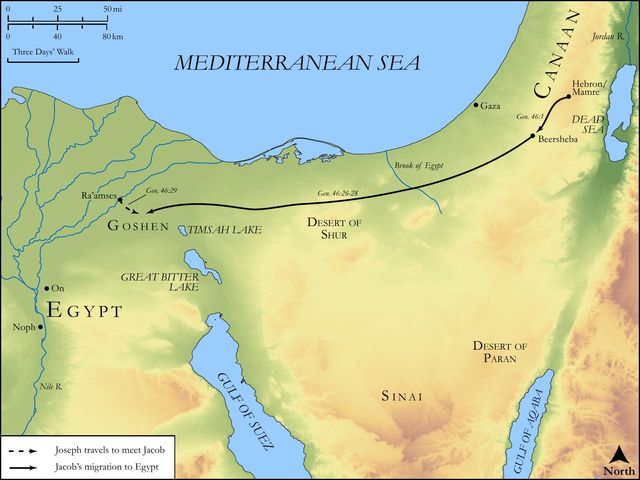
The setting is ancient Egypt during a severe famine, a period when the Nile's failure to flood would devastate agricultural societies. Joseph's rise to power as vizier (second-in-command) was unprecedented for a foreigner, reflecting divine intervention and Pharaoh's recognition of his wisdom. The move of Jacob's family to Egypt, specifically to the fertile land of Goshen (Genesis 46:28-29), was not merely a survival strategy but a pivotal moment in the formation of the Israelite nation. Goshen, located in the eastern Delta, was ideal for their pastoral lifestyle and provided a degree of separation from the Egyptians, allowing them to grow into a distinct people. Culturally, the reunion of a father and a long-lost son, especially one believed dead, would evoke immense emotional outpouring, as family ties and lineage were paramount in the house of Jacob. Jacob's statement reflects a common ancient sentiment where the fulfillment of a life's deepest desire could lead to a readiness to depart in peace.
Key Themes
ShowHideGenesis 46:30 powerfully contributes to several overarching themes in the book of Genesis. Foremost is Divine Providence, demonstrating how God meticulously orchestrates seemingly disparate events—Joseph's sale into slavery (Genesis 37:28), his imprisonment (Genesis 39:20), and his rise to power (Genesis 41:40-44)—to fulfill His ultimate purpose of preserving the covenant family and establishing a nation. The theme of Reconciliation and Restoration is also central, as the deep wounds of family betrayal and separation are healed, culminating in a joyous reunion that foreshadows broader spiritual restoration. Furthermore, the verse highlights Profound Joy and the Fulfillment of Desire, as Jacob's declaration signifies the ultimate contentment found in witnessing God's faithfulness and the restoration of what was lost, bringing a sense of completion to his life's journey. This moment underscores the triumph of God's plan over human sin and suffering, leading to a glorious outcome.
Exposition and Analysis
ShowHideKey Word Analysis
ShowHideThis word, while literally meaning "to die," is used here in a hyperbolic or idiomatic sense. It expresses profound satisfaction and the completion of a life's purpose or deepest desire, rather than a literal wish for immediate death. It conveys a sense of "now I can die content" or "my life's greatest longing has been fulfilled."
This term refers to the physical face, but in this context, it signifies personal presence, intimate encounter, and recognition. To "see thy face" implies a direct, undeniable, and deeply personal reunion, confirming Joseph's identity and existence in a way that no report or gift could. It emphasizes the reality and tangibility of the long-awaited encounter.
Meaning "living" or "life," this word is crucial as it directly contrasts with Jacob's decades-long belief that Joseph was dead. The confirmation that Joseph is "yet alive" transforms Jacob's prolonged grief into overwhelming joy and relief, underscoring the miraculous and unexpected nature of this reunion. It signifies vitality, existence, and the reversal of what was perceived as an irreversible loss.
Verse Breakdown
ShowHide"And Israel said unto Joseph,"
This opening sets the scene for a direct, personal address from the patriarch, Jacob (now also called Israel, emphasizing his covenant identity), to his son Joseph. The formal address underscores the gravity and emotional weight of the words that follow, marking a pivotal moment in their relationship and the family narrative.
"Now let me die,"
This is the core of Jacob's emotional outburst. As analyzed in the key word section, it is an expression of ultimate contentment and fulfillment. It conveys that having experienced this profound joy, his life's greatest desire has been met, and he is now ready for whatever comes next, even death, without regret or unfulfilled longing. It is not a literal death wish but a hyperbolic declaration of complete satisfaction.
"since I have seen thy face,"
This clause provides the immediate reason for Jacob's profound statement. The physical act of seeing Joseph's face, a direct and undeniable encounter, confirms the reality of his son's survival. For Jacob, who had mourned Joseph as dead for so long, this visual confirmation brings an end to his prolonged sorrow and ushers in an overwhelming sense of peace and joy.
"because thou art yet alive."
This final clause reiterates and reinforces the reason for Jacob's contentment, emphasizing the miraculous nature of Joseph's continued existence. The word "yet" ('ôwd) highlights the passage of time and the unexpected persistence of life against all odds, underscoring the divine hand that preserved Joseph and brought about this reunion. It is the simple, profound truth that Joseph lives that brings Jacob's heart to rest.
Literary Devices
ShowHideGenesis 46:30 employs several powerful literary devices to convey its emotional and theological weight. The most prominent is Hyperbole, seen in Jacob's declaration, "Now let me die." This is not a literal desire for death but an exaggerated expression of extreme satisfaction and contentment, indicating that his greatest earthly desire has been fulfilled. The verse also functions as a Climax within the larger Joseph narrative, marking the emotional peak of the long-awaited reunion and the resolution of decades of separation and grief. There is an element of Irony in the narrative arc: Joseph's initial "death" (via his brothers' deception) ultimately leads to the preservation of his family and the fulfillment of God's promises, transforming perceived tragedy into salvation. Furthermore, the act of "seeing thy face" carries Symbolism, representing not just physical sight but full recognition, reconciliation, and the restoration of a broken relationship. This simple act signifies the end of sorrow and the dawn of a new, joyful reality for Jacob.
THEOLOGICAL AND THEMATIC CONNECTIONS
ShowHideJacob's declaration in Genesis 46:30 is a poignant testament to God's faithfulness and sovereign plan, demonstrating His ability to bring about profound good and restoration even from the depths of human sin and suffering. The long years of Jacob's grief, fueled by the belief that Joseph was dead, are dramatically transformed into overwhelming joy by the miraculous revelation of Joseph's survival and prosperity. This reunion not only heals deep family wounds but also ensures the preservation of the covenant lineage, through which God's promises to Abraham, Isaac, and Jacob would continue to unfold. It underscores the biblical theme that God works through all circumstances, even the most painful, to accomplish His redemptive purposes, ultimately leading to reconciliation and the fulfillment of His divine will.
Reflection and Application
ShowHideGenesis 46:30 offers profound lessons for believers navigating life's complexities. Jacob's journey from decades of inconsolable grief to overwhelming joy upon seeing Joseph alive reminds us that even in the longest and darkest seasons of suffering, God's redemptive plan is at work. It encourages us to cultivate patient endurance, trusting that God can transform our deepest sorrows into unexpected triumphs and bring about reconciliation where relationships seem irrevocably broken. This verse also highlights the immense value of restored relationships and the profound satisfaction that comes from forgiveness and reunion, mirroring the spiritual restoration we experience through Christ. Jacob's contentment challenges us to find our ultimate satisfaction not in earthly achievements, but in the fulfillment of God's promises and the restoration of what truly matters, whether it be family bonds or our relationship with God. It invites us to reflect on what brings us such deep joy that we could say, "Now my life is complete."
Questions for Reflection
ShowHideFAQ
ShowHideWhat does Jacob mean by "Now let me die" in this context?
ShowHideJacob's statement, "Now let me die," is not a literal death wish but a powerful, hyperbolic expression of extreme satisfaction and profound contentment. It signifies that his greatest earthly desire—to see his beloved son Joseph alive again—has been fulfilled, bringing him such immense joy and peace that he feels his life's purpose has been completed. It is an idiom indicating that nothing more could add to his happiness, and he is ready to depart in peace, having witnessed this miracle. This sentiment is echoed in the New Testament by Simeon, who, upon seeing the infant Jesus, declared, "Lord, now lettest thou thy servant depart in peace, according to thy word: For mine eyes have seen thy salvation" (Luke 2:29-30).
Why is Jacob also referred to as Israel in this verse?
ShowHideJacob's name was supernaturally changed to Israel by God after he wrestled with an angel (or God Himself) at Peniel, signifying his new identity as one who "struggles with God" and prevails (Genesis 32:28). Both names are used interchangeably throughout the biblical narrative, often highlighting different aspects of his character or role. In Genesis 46:30, the use of "Israel" emphasizes his identity as the patriarch of the nascent nation and the bearer of God's covenant promises. It underscores the national and redemptive significance of this family reunion, as the lineage through whom God's promises would be fulfilled is being preserved and established in Egypt.
How does Joseph's story, culminating in this reunion, demonstrate God's providence?
ShowHideJoseph's entire life story, from being sold into slavery by his jealous brothers (Genesis 37:28) to his unjust imprisonment (Genesis 39:20) and subsequent rise to becoming the second-in-command in Egypt (Genesis 41:40-44), is a profound testament to God's meticulous providence. What seemed like a series of misfortunes and human wickedness was orchestrated by God for a divine purpose: to preserve Jacob's family and the covenant lineage during a severe famine, ensuring the survival of the future nation of Israel. This reunion in Genesis 46:30 is the joyful and tangible culmination of God's faithful and sovereign plan to bring good out of evil, demonstrating that even human sin can be woven into God's larger redemptive tapestry (Genesis 50:20).
Christ-Centered Fulfillment
ShowHideThe deeply emotional reunion of Jacob and Joseph in Genesis 46:30 serves as a powerful and multi-faceted foreshadowing of God's ultimate plan of reconciliation and restoration through Jesus Christ. Just as Joseph, once believed dead and lost to his father, was found alive and became the savior of his family, so too Christ, through His sacrificial death and glorious resurrection, brings spiritual life and salvation to those who were spiritually dead and separated from God by sin (Ephesians 2:1-5). This event highlights God's unwavering faithfulness in preserving the lineage of Abraham, Isaac, and Jacob, ensuring that the promised Messiah would indeed come forth from this very family, fulfilling ancient prophecies (Galatians 3:16). The overwhelming joy and profound contentment expressed by Jacob upon seeing Joseph alive anticipate the even greater joy of believers in being reconciled to God through Christ, experiencing a spiritual reunion that transcends earthly sorrow and leads to eternal life and perfect contentment in His presence (John 14:6; 2 Corinthians 5:18-19). Joseph, as a type of Christ, saves his people from famine, just as Jesus saves His people from spiritual death, bringing them into a place of abundance and security in His kingdom (John 10:10).