


Genesis 45:28
Bible text: King James Version (1769 Blayney text) · Public domain
Bible text: Berean Standard Bible · Public domain
Bible text: American Standard Version (1901) · Public domain
Bible text: World English Bible, Messianic edition · Public domain
Bible text: Geneva Bible (1599) · Public domain
Bible text: Young's Literal Translation · Public domain
- וַיֹּאמֶרvai·Yo·merand he saidH559Conj-w ¦ V-Qal-ConsecImperf-3msVerb Qal Consecutive Imperfect 3rd Singular Masculineוַandיֹּאמֶרhe said
- יִשְׂרָאֵלYis·ra·'ElIsraelH3478N-proper-mNoun Proper Masculine
- רַבravenoughH7227Adj-msAdjective Singular Masculine Absolute
- עוֹד'odstillH5750Adj-msAdjective Numerical Singular Masculine Absolute
- יוֹסֵףyo·SefJosephH3130N-proper-mNoun Proper Masculine
- בְּנִיbe·Nimy sonH1121N-msc ¦ 1csNoun Singular Masculine Constructבְּנִsonיmy
- חָיChai[is] aliveH2416Adj-msAdjective Singular Masculine Absolute
- אֵלְכָה'e·le·KhahI will goH1980V-Qal-Imperf-1csVerb Qal Imperfect 1st Singular common gender
- וְאֶרְאֶנּוּve·'er·'E·nuso I may see himH7200Conj-w ¦ V-Qal-ConjImperf-1cs ¦ 3msVerb Qal Conjunction+Imperfect 1st Singular common genderוְsoאֶרְאֶI may seeנּוּhim
- בְּטֶרֶםbe·Te·rem<in> beforeH2962Prep-b ¦ Adj-csAdjective Numerical Singular common gender Absoluteבְּ<in>טֶרֶםbefore
- אָמוּת'a·MutI will dieH4191V-Qal-Imperf-1csVerb Qal Imperfect 1st Singular common gender
English is a literal word-by-word gloss of the Hebrew, not the KJV's wording. Why?
This is the original text the KJV's translators worked from — each Hebrew word with its own literal English meaning in this verse, prepared by scholars at Tyndale House, Cambridge. The KJV translates whole sentences, not word by word, so its wording differs: one Hebrew word can become several English words, and the KJV may choose “the LORD” where the gloss reads “Yahweh”. Both are faithful — they answer different questions. For the KJV's own rendering, switch to the KJV text.
Details
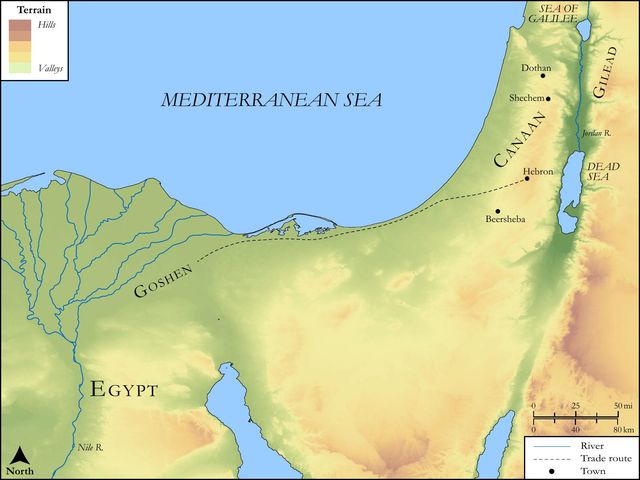
See on the biblical-era maps


Study this verse
Public-domain commentary
Matthew Henry
From his Commentary on the Whole Bible. Henry comments on passages, not single verses — this entry covers Genesis 45:25–28.
We have here the good news brought to Jacob. 1. The relation of it, at first, sunk his spirits. When, without any preamble, his sons came in, crying, Joseph is yet alive, each striving which should first proclaim it, perhaps he thought they bantered him, and the affront grieved him; or the very mention of Joseph's name revived his sorrow, so that his heart fainted, Gen 45:26. It was a good while before he came to himself. He was in such care and fear about the rest of them that at this time it would have been joy enough to him to hear that Simeon was released, and that Benjamin had come safely home (for he had been ready to despair concerning both these); but to hear that Joseph is alive is too good news to be true; he faints, for he believes it not. Note, We faint, because we do not believe; David himself had fainted if he had not believed, Psa 27:13. 2. The confirmation of it, by degrees, revived his spirit. Jacob had easily believed his sons formerly when they told him, Joseph is dead; but he can hardly believe them now that they tell him, Joseph is alive. Weak and tender spirits are influenced more by fear than hope, and are more apt to receive impressions that are discouraging than those that are encouraging. But at length Jacob is convinced of the truth of the story, especially when he sees the wagons which were sent to carry him (for seeing is believing), then his spirit revived. Death is as the wagons which are sent to fetch us to Christ: the very sight of it approaching should revive us. Now Jacob is called Israel (Gen 45:28), for he begins to recover his wonted vigour. (1.) It pleases him to think that Joseph is alive. He says nothing of Joseph's glory, of which they told him; it was enough to him that Joseph was alive. Note, Those that would be content with less degrees of comfort are best prepared for greater. (2.) It pleases him to think of going to see him. Though he was old, and the journey long, yet he would go to see Joseph, because Joseph's business would not permit him to come to see him. Observe, He says, "I will go and see him," not, "I will go and live with him;" Jacob was old, and did not expect to live long; "But I will go and see him before I die, and then let me depart in peace; let my eyes be refreshed with this sight before they are closed, and then it is enough, I need no more to make me happy in this world." Note, It is good for us all to make death familiar to us, and to speak of it as near, that we may think how little we have to do before we die, that we may do it with all our might, and may enjoy our comforts as those that must quickly die, and leave them.
Historical interpretation
Two Centuries of Reception
2 surviving comments on this verse. Each one is dated, so this reads as a timeline rather than a list.
Select a marker to jump to its quote. Markers stagger vertically where authors wrote within a few decades of each other.
But because occasionally the divine fire can be extinguished even in the saints and faithful, hear the apostle Paul warning these who were worthy to receive gifts of the Spirit and grace, and saying, “Do not extinguish the Spirit.” The Scripture says of Jacob, therefore, “And Jacob rekindled his spirit, and Israel said, ‘It is a great thing for me if my son Joseph is still living,’ ” as if he has experienced something like that which Paul warned against and has renewed himself through those words that had been spoken to him about Joseph’s life.But this also should be noticed, that he who “rekindled his spirit,” meaning, of course, that spirit which seemed almost extinguished, is said to be Jacob. But he who says, “It is a great thing for me if my son Joseph is living,” as if he understands and sees that the life which is in the spiritual Joseph is great, is no longer called Jacob but Israel, as it were, he who sees in his mind the true life which is Christ, the true God.
“So let us hasten now so that I may savor something of our meeting before I die. I mean, already the news has dumbfounded me, has banished an old man’s weakness and invigorated my resolve; so once I have the good fortune to meet him and enjoy the consummation of joy, I shall then bring my life to a close.” Without delay the good man took to the road, showing all haste and anxiety to see the object of his desire and gaze upon him, dead for so many years and become the prey of wild beasts, as he thought, and now made king of Egypt.
Continue studying Genesis 45:28 across the web’s major study libraries — every link below opens this exact verse, chapter, or book on the destination site.
Read & Compare
 BibleGatewayThis verse in more than 200 translations and 70 languages.
 Bible.comThe YouVersion reader — hundreds of translations, reading plans, and highlights.
 ESV.orgCrossway's official English Standard Version reader.
 NET BibleThe NET translation with 60,000+ translators' notes on every rendering decision.
 STEP BibleTyndale House's free study tool — original text, vocabulary, and scholarly resources.
 BibliaLogos Bible Software's free web reader.
 USCCBThe New American Bible (Revised Edition) with the U.S. bishops' study notes.
Commentaries
 BibleHub CommentariesDozens of classic commentaries on this verse, gathered on one page.
 StudyLightMore than 100 commentary sets — the largest collection on the web.
 BibleRefPlain-English commentary on what this verse means, verse by verse.
 Enduring WordDavid Guzik's free commentary on this chapter, widely used by Bible teachers.
 Bible Study ToolsVerse commentary alongside Greek and Hebrew study aids.
Original Language & Research
- BibleHub InterlinearThe verse word by word — original language, transliteration, and English.
- BibleHub LexiconEvery word's original-language definition and Strong's entry.
 Blue Letter BibleDeep-study tools — Strong's numbers, concordance, and word studies.
 SefariaThe Hebrew text with Rashi and centuries of Jewish commentary.
Sermons, Hymns & Audio


TrulyRandomVerse is not affiliated with these sites and doesn’t control their content. They’re linked because they’re genuinely useful.
Summary
Genesis 45:28 captures the profound emotional climax of Jacob's life, as he receives the astonishing news that his long-lost son Joseph is not only alive but holds a position of immense power in Egypt. This pivotal verse marks a dramatic shift from decades of deep sorrow and despair to an overwhelming surge of joy, renewed hope, and an immediate, fervent desire for reunion with his beloved son before his own life concludes.
Context
ShowHideLiterary Context
This verse serves as the emotional and narrative culmination of a long and painful family saga that began over two decades earlier with Joseph's sale into slavery by his jealous brothers, a deception that led Jacob to believe his favored son was dead Genesis 37:28-35. The preceding verses describe the brothers' return from Egypt, bearing not only grain but the incredible, initially unbelievable, news of Joseph's survival and his status as Egypt's second-in-command. Jacob's heart "fainted" and he "believed them not" upon first hearing Genesis 45:26, but seeing the wagons and provisions Joseph sent for his relocation served as tangible evidence, reviving his spirit and leading to the powerful declaration in this verse. It sets the stage for the entire family's migration to Egypt, fulfilling earlier divine promises and ensuring the preservation of the covenant line.
Historical & Cultural Context
The narrative unfolds against the backdrop of a severe famine gripping the entire region, a common and devastating occurrence in those lands that often led to mass migrations in search of sustenance. Egypt, with its fertile Nile Delta, was a traditional granary and a refuge during such crises, as seen in the story of Abraham Genesis 12:10. The concept of a vizier or prime minister (like Joseph) holding immense power, second only to the Pharaoh, was a well-established administrative structure in ancient Egypt, allowing a skilled administrator to manage the nation's resources effectively. The emphasis on family and lineage was paramount in this culture, making Jacob's prolonged grief over Joseph's presumed death, and his subsequent joy at his discovery, deeply relatable within the societal norms of the time. The journey to Egypt with all possessions and family members was a significant undertaking, reflecting the gravity of Joseph's invitation and the family's desperation.
Key Themes
ShowHideGenesis 45:28 profoundly contributes to several overarching themes within the book of Genesis and the broader biblical narrative. Firstly, it highlights Divine Providence and Sovereignty, demonstrating how God orchestrates seemingly tragic events—Joseph's betrayal, slavery, and imprisonment—for a greater redemptive purpose: the preservation of Jacob's family and the covenant line Genesis 50:20. Secondly, it powerfully illustrates Restoration and Reconciliation, as the fractured family, torn apart by jealousy and deceit, is brought back together, and deep wounds begin to heal. This reunion foreshadows the ultimate reconciliation God brings about. Thirdly, the verse underscores the triumph of Hope over Despair, as Jacob's long-held sorrow is dramatically transformed into overwhelming joy, breathing new life and purpose into his final years, echoing the transformative power of God's intervention in human lives. Finally, it reinforces God's Faithfulness to His Covenant Promises, as the survival and prosperity of Jacob's family in Egypt are crucial for the eventual formation of the nation of Israel, through whom God's promises to Abraham, Isaac, and Jacob would be fulfilled Genesis 46:3-4.
Exposition and Analysis
ShowHideGenesis 45:28 encapsulates the climax of Jacob's emotional journey, moving from profound grief to overwhelming joy. The simple yet potent declaration reveals the depth of his relief and the rekindling of a hope long extinguished.
Key Word Analysis
ShowHideFrom the root meaning "he will rule as God," this is the symbolic name given to Jacob after his wrestling with God Genesis 32:28. Its use here, rather than "Jacob," is highly significant. It emphasizes that this moment of profound family restoration and the unfolding of God's providential plan is not merely a personal event for Jacob but a pivotal moment for the covenant people, highlighting his spiritual identity and his role as the patriarch of God's chosen nation.
This term carries a rich meaning beyond mere sufficiency. In this context, it conveys a profound sense of completion, satisfaction, and ultimate relief. It is an exclamation signifying that this single piece of news—Joseph's survival—is so overwhelmingly good and satisfying that it outweighs all the past decades of sorrow, loss, and despair. It implies that nothing else is needed to make his remaining life meaningful; this news alone is sufficient to fill his heart with joy and purpose.
Derived from the root "to live," this word signifies not just physical existence but often vitality, freshness, and strength. For Jacob, who had mourned Joseph as dead for over two decades, the word "alive" represents a complete reversal of his reality. It signifies the restoration of life, hope, and the future for him and his entire family, transforming his outlook from one of impending death to renewed purpose.
Verse Breakdown
ShowHide"And Israel said,"
This opening phrase sets the stage for Jacob's momentous declaration. The use of "Israel" rather than "Jacob" is deliberate, underscoring the spiritual and national significance of this moment. It is the patriarch, the head of the covenant family, who speaks, signifying a turning point for the nascent nation.
"[It is] enough;"
This exclamation, rab in Hebrew, is deeply emotive. It signifies a profound sense of satisfaction, completion, and overwhelming relief. It's not just "that's sufficient," but rather, "this is all I need," or "this is more than I could have hoped for." It indicates that the news of Joseph's life has completely overshadowed and negated all the prior years of grief and despair.
"Joseph my son [is] yet alive:"
This is the core of the revelation and the source of Jacob's transformation. For twenty-two agonizing years, Jacob had believed his beloved son was dead, a victim of a wild beast Genesis 37:33. The reality that Joseph is not only alive but thriving shatters this long-held sorrow, replacing it with an almost unbelievable truth that revitalizes his entire being.
"I will go and see him before I die."
This declaration is a powerful expression of Jacob's rekindled will to live. His life had been marked by a readiness to die in sorrow, but now, with Joseph's survival confirmed, a new, vibrant purpose emerges. The desire to see Joseph before his death becomes his ultimate, immediate goal, demonstrating a complete reversal of his previous despair and a passionate embrace of the future.
Literary Devices
ShowHideGenesis 45:28 employs several powerful literary devices. The shift from "Jacob" to Israel functions as a potent form of Symbolism, indicating a moment of profound spiritual and covenantal significance rather than merely a personal, emotional reaction. It highlights the divine hand at work in the family's destiny. The phrase "[It is] enough" serves as a dramatic Exclamation or Apostrophe, directly expressing Jacob's overwhelming emotional state and the profound sense of finality and satisfaction he experiences. Furthermore, the entire narrative arc leading to this verse is a masterful display of Dramatic Irony, as the reader has known Joseph's fate for chapters, while Jacob has remained in agonizing ignorance. This creates a powerful release of tension when Jacob finally receives the truth, culminating in this verse. The verse also marks a significant Turning Point or Peripeteia in the narrative, reversing decades of sorrow and setting the stage for the family's migration to Egypt and the next phase of God's covenant plan.
Theological and Thematic Connections
ShowHideGenesis 45:28 stands as a powerful testament to God's unfailing providence and sovereign control over all circumstances, even the most painful and seemingly chaotic. Jacob's long years of grief, Joseph's suffering as a slave and prisoner, and the severe regional famine were all woven into God's intricate tapestry to preserve the covenant family and fulfill His promises. This verse encapsulates the themes of divine reversal, where deep sorrow is transformed into overwhelming joy, and the lost is found, paving the way for reconciliation and the continuation of God's redemptive plan for humanity through the lineage of Israel. It reminds us that God's purposes are often worked out through unexpected and challenging paths, ultimately for the good of His people and the glory of His name.
Reflection and Application
ShowHideJacob's profound experience in Genesis 45:28 offers enduring lessons for believers today. His two decades of deep sorrow remind us that even prolonged suffering and unanswered questions can be part of God's larger, often hidden, divine narrative. Just as Jacob's hope was rekindled in a seemingly impossible situation, we are encouraged to persevere in faith and trust in God's perfect timing and sovereign providence, even when circumstances appear bleak or our prayers seem unanswered. This narrative powerfully demonstrates God's ability to turn our deepest sorrows into profound joy and to fulfill His purposes through unexpected means, echoing the truth that He causes all things to work together for good for those who love Him Romans 8:28. It calls us to embrace hope in the unseen, knowing that God is always at work, bringing about His perfect will, and that His ultimate plan for restoration and reconciliation will always prevail, transforming our despair into a vibrant, purposeful life.
Questions for Reflection
ShowHideFAQ
ShowHideWhy is Jacob referred to as "Israel" in this verse?
ShowHideThe use of "Israel" (the name God gave Jacob after his wrestling match in [Genesis 32:28 "Jacob Wrestles with God"]) rather than "Jacob" often signifies a moment of spiritual significance, covenant fulfillment, or when the patriarch is acting in his capacity as the head of God's chosen people. In this context, it emphasizes that this profound family reunion and restoration is not merely a personal event but a crucial step in God's overarching plan for the nation of Israel, ensuring the survival and growth of the covenant people through whom His promises would be fulfilled.
What is the deeper meaning of Jacob's exclamation, "[It is] enough"?
ShowHideThe Hebrew word Rab (רַב), translated as "[It is] enough," conveys far more than mere sufficiency. It expresses a profound sense of satisfaction, completion, and overwhelming relief. It signifies that the news of Joseph's survival is so incredibly good and satisfying that it completely overshadows and negates all the previous years of grief and despair. It implies that this single piece of news is sufficient to make his remaining life meaningful and joyful, requiring nothing further to bring him contentment and purpose. It is an exclamation of profound spiritual and emotional fulfillment.
How does this verse demonstrate God's providence?
ShowHideThis verse is a powerful testament to God's providence because it shows how He orchestrated events over more than two decades—including Joseph's betrayal by his brothers, his sale into slavery, his unjust imprisonment, and a severe regional famine—to bring about Joseph's elevation to power and, ultimately, the preservation of Jacob's entire family. Jacob's despair over Joseph's supposed death Genesis 37:33-35 was part of a larger divine plan that he could not see, culminating in this moment of joyous revelation that saved his entire household and ensured the continuation of the covenant line, fulfilling God's promises to Abraham, Isaac, and Jacob.
Christ-Centered Fulfillment
ShowHideThe dramatic reversal of Jacob's sorrow into overwhelming joy upon learning Joseph was alive serves as a profound Old Testament type pointing to the greater hope and reconciliation found in Christ. Just as Jacob believed his son was lost forever, humanity was spiritually dead and separated from God due to sin, living in a state of despair. Joseph, who was "lost" and then found, saving his family from physical death and famine, powerfully foreshadows Jesus Christ, the ultimate Deliverer. Christ, our greater Joseph, was "cut off" and died, was buried, and then gloriously rose again, becoming the Savior who reconciles humanity to God 2 Corinthians 5:18-19. Jacob's declaration, "[It is] enough," upon seeing Joseph's life, reflects the ultimate satisfaction, peace, and abundance believers find in knowing that Christ is alive and has secured eternal life and reconciliation for all who believe Romans 5:8. Through His sacrifice and resurrection, Jesus transforms our spiritual despair into everlasting joy and purpose, bringing us from death to life and making us children of God, fulfilling the deepest longings of the human heart John 1:12.