


Genesis 12:10
Bible text: King James Version (1769 Blayney text) · Public domain
Bible text: Berean Standard Bible · Public domain
Bible text: American Standard Version (1901) · Public domain
Bible text: World English Bible, Messianic edition · Public domain
Bible text: Geneva Bible (1599) · Public domain
Bible text: Young's Literal Translation · Public domain
- וַיְהִיvay·Hiand it wasH1961Conj-w ¦ V-Qal-ConsecImperf-3msVerb Qal Consecutive Imperfect 3rd Singular Masculineוַandיְהִיit was
- רָעָבra·'Ava famineH7458N-msNoun Singular Masculine Absolute
- בָּאָרֶץba·'A·retzin the landH776Prep-b ¦ N-fsNoun Singular Feminine Absoluteבָּin theאָרֶץland
- וַיֵּרֶדvai·Ye·redand he went downH3381Conj-w ¦ V-Qal-ConsecImperf-3msVerb Qal Consecutive Imperfect 3rd Singular Masculineוַandיֵּרֶדhe went down
- אַבְרָם'av·RamAbramH87N-proper-mNoun Proper Masculine
- מִצְרַיְמָהmitz·Ray·mahEgypt towardsH4714N-proper ¦ SfxNoun Proper LocationמִצְרַיְמָEgyptהtowards
- לָגוּרla·Gurto sojournH1481Prep-l ¦ V-Qal-InfVerb Qal Infinitive Constructלָtoגוּרsojourn
- שָׁםShamthereH8033AdvAdverb
- כִּיkiforH3588PrtParticle Conditional
- כָבֵדkha·Ved[was] heavyH3515Adj-msAdjective Singular Masculine Absolute
- הָרָעָבha·ra·'Avthe famineH7458Art ¦ N-msNoun Singular Masculine Absoluteהָtheרָעָבfamine
- בָּאָרֶץba·'A·retzin the landH776Prep-b ¦ N-fsNoun Singular Feminine Absoluteבָּin theאָרֶץland
English is a literal word-by-word gloss of the Hebrew, not the KJV's wording. Why?
This is the original text the KJV's translators worked from — each Hebrew word with its own literal English meaning in this verse, prepared by scholars at Tyndale House, Cambridge. The KJV translates whole sentences, not word by word, so its wording differs: one Hebrew word can become several English words, and the KJV may choose “the LORD” where the gloss reads “Yahweh”. Both are faithful — they answer different questions. For the KJV's own rendering, switch to the KJV text.
Details
See on the biblical-era maps


Study this verse
Public-domain commentary
Matthew Henry
From his Commentary on the Whole Bible. Henry comments on passages, not single verses — this entry covers Genesis 12:10–13. His two-level outline is real structure in the source text, so it is rendered as structure.
Here is, I. A famine in the land of Canaan, a grievous famine. That fruitful land was turned into barrenness, not only to punish the iniquity of the Canaanites who dwelt therein, but to exercise the faith of Abram who sojourned therein; and a very sore trial it was; it tried what he would think, 1. Of God that brought him thither, whether he would not be ready to say with his murmuring seed that he was brought forth to be killed with hunger, Exo 16:3. Nothing short of a strong faith could keep up god thoughts of God under such a providence. 2. Of the land of promise, whether he would think the grant of it worth the accepting, and a valuable consideration for the relinquishing of his own country, when, for aught that now appeared, it was a land that ate up the inhabitants. Now he was tried whether he could preserve an unshaken confidence that the God who brought him to Canaan would maintain him there, and whether he could rejoice in him as the God of his salvation when the fig-tree did not blossom, Hab 3:17, Hab 3:18. Note, (1.) Strong faith is commonly exercised with divers temptations, that it may be found to praise, and honour, and glory, Pe1 1:6, Pe1 1:7. (2.) It pleases God sometimes to try those with great afflictions who are but young beginners in religion. (3.) It is possible for a man to be in the way of duty, and in the way to happiness, and yet meet with great troubles and disappointments.
II.Abram's removal into Egypt, upon occasion of this famine.
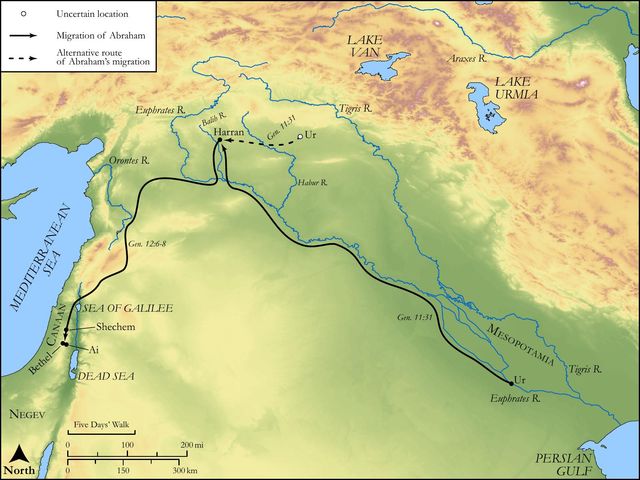
See how wisely God provides that there should be plenty in one place when there was scarcity in another, that, as members of the great body, we may not say to one another, I have no need of you. God's providence took care there should be a supply in Egypt, and Abram's prudence made use of the opportunity; for we tempt God, and do not trust him, if, in the time of distress, we use not the means he has graciously provided for our preservation: We must not expect needless miracles. But that which is especially observable here, to the praise of Abram, is that he did not offer to return, upon this occasion, to the country from which he came out, nor so much as towards it. The land of his nativity lay north-east from Canaan; and therefore, when he must, for a time, quit Canaan, he chooses to go to Egypt, which lay south-west, the contrary way, that he might not so much as seem to look back. See Heb 11:15, Heb 11:16. Further observe, When he went down into Egypt, it was to sojourn there, not to dwell there. Note,
1.Though Providence, for a time, may cast us into bad places, yet we ought to tarry there no longer than needs must; we may sojourn where we may not settle.
2.A good man, while he is on this side heaven, wherever he is, is but a sojourner.
III.A great fault which Abram was guilty of, in denying his wife, and pretending that she was his sister.
The scripture is impartial in relating the misdeeds of the most celebrated saints, which are recorded, not for our imitation, but for our admonition, that he who thinks he stands may take heed lest he fall.
1.His fault was dissembling his relation to Sarai, equivocating concerning it, and teaching his wife, and probably all his attendants, to do so too. What he said was, in a sense, true (Gen 20:12), but with a purpose to deceive; he so concealed a further truth as in effect to deny it, and to expose thereby both his wife and the Egyptians to sin.
2.That which was at the bottom of it was a jealous timorous fancy he had that some of the Egyptians would be so charmed with the beauty of Sarai (Egypt producing few such beauties) that, if they should know he was her husband, they would find some way or other to take him off, that they might marry her. He presumes they would rather be guilty of murder than adultery, such a heinous crime was it then accounted and such a sacred regard was paid to the marriage bond; hence he infers, without any good reason, They will kill me. Note, The fear of man brings a snare, and many are driven to sin by the dread of death, Luk 12:4, Luk 12:5. The grace Abram was most eminent for was faith; and yet he thus fell through unbelief and distrust of the divine Providence, even after God had appeared to him twice. Alas! what will become of the willows, when the cedars are thus shaken?
Historical interpretation
Three Centuries of Reception
2 surviving comments on this verse. Each one is dated, so this reads as a timeline rather than a list.
Select a marker to jump to its quote. Markers stagger vertically where authors wrote within a few decades of each other.
The content on the literal level is clear. As for the spiritual meaning, it is this. Those who are wise in God are above the earth, since they are not of the earth. A famine then came over the earth, because for those who are concerned about earthly things, there often occurs a famine in this sense, that they no longer hear the word of the Lord. Then, if they are worthy of it, the Word is given back to them one day.Thus Abraham went to Egypt to “sojourn” there, not to dwell there, because he had sympathy for the victims of the famine. Likewise Daniel and his companions did not come to Babylon because of sins they had committed but to aid the people who had been deported there on account of their own sins.
Now there was a famine in the land, and Abram went down to Egypt to sojourn there. After receiving the promises of blessing, after entering the land of promise, after building an altar to the Lord there, after invoking His name, Abraham is tested by famine, and such a great famine that he left the land which he had received in promise as soon as he saw and visited it. But Isaac and Jacob, and his sons, also left the same land of promise, driven by similar necessity. As the Psalmist sings, they passed from nation to nation and from one kingdom to another people (Psalm 105:13). This was believed to have happened not by chance, but by divine providence, so that both they and all the heirs of the same promise would understand that they received the gifts of divine blessing in such a way that in this life they would endure labor and temporal affliction, but in the future, they would expect everlasting rest and happiness. This was also to illustrate that the land of Canaan was promised to Abraham and his seed in such a way that it signified more the inheritance of the heavenly fatherland, of which it is written: "The righteous shall inherit the land and dwell upon it forever" (Psalm 37:29). This is clearly not said about the land of this world, which is common to both the righteous and the wicked, since it is narrated that it will be possessed forever by the righteous alone. Therefore, the land of Canaan is promised to Abraham and his seed, and after the long toil of Egyptian servitude, it is restored by Joshua as a leader, to mystically suggest that the heavenly fatherland promised to us will be restored through Jesus Christ our Lord after the affliction of present exile. But even in that land of Canaan, the children of the promise never ceased laboring or fighting against enemies, so they would understand, as we have said, that they should seek another fatherland beyond this one, where they will truly enjoy heavenly blessing and eternal rest. This divine providence also aligns with the fact that Abraham, while sojourning in Egypt, was endangered because of his wife; but he was helped by divine protection so that he would not be harmed, thus making it clear that not only general worldly evils, such as famine, disease, and captivity, would just men endure along with the reprobates in this life, but they would also suffer specific tribulations from the reprobates themselves, from which they would receive rewards in the future unknown to the reprobates. It follows.
Continue studying Genesis 12:10 across the web’s major study libraries — every link below opens this exact verse, chapter, or book on the destination site.
Read & Compare
 BibleGatewayThis verse in more than 200 translations and 70 languages.
 Bible.comThe YouVersion reader — hundreds of translations, reading plans, and highlights.
 ESV.orgCrossway's official English Standard Version reader.
 NET BibleThe NET translation with 60,000+ translators' notes on every rendering decision.
 STEP BibleTyndale House's free study tool — original text, vocabulary, and scholarly resources.
 BibliaLogos Bible Software's free web reader.
 USCCBThe New American Bible (Revised Edition) with the U.S. bishops' study notes.
Commentaries
 BibleHub CommentariesDozens of classic commentaries on this verse, gathered on one page.
 StudyLightMore than 100 commentary sets — the largest collection on the web.
 BibleRefPlain-English commentary on what this verse means, verse by verse.
 Enduring WordDavid Guzik's free commentary on this chapter, widely used by Bible teachers.
 Bible Study ToolsVerse commentary alongside Greek and Hebrew study aids.
Original Language & Research
- BibleHub InterlinearThe verse word by word — original language, transliteration, and English.
- BibleHub LexiconEvery word's original-language definition and Strong's entry.
 Blue Letter BibleDeep-study tools — Strong's numbers, concordance, and word studies.
 SefariaThe Hebrew text with Rashi and centuries of Jewish commentary.
Sermons, Hymns & Audio


TrulyRandomVerse is not affiliated with these sites and doesn’t control their content. They’re linked because they’re genuinely useful.
Summary
Genesis 12:10 marks an immediate and profound test of Abram's nascent faith and obedience, as a severe famine strikes the very land God had just promised him. This unforeseen and grievous hardship compels Abram to seek refuge and sustenance in Egypt, a decision driven by immediate necessity for his household's survival, yet one made without explicit divine instruction, setting the stage for subsequent challenges to his faith.
Context
ShowHideLiterary Context
This verse follows directly on the heels of God's momentous call to Abram in Genesis 12:1, commanding him to leave his homeland for a land God would show him. This divine summons was accompanied by magnificent promises of a great nation, blessing, and universal blessing through him (Genesis 12:2-3). Abram's faithful response involved journeying to Canaan, where he built altars and called upon the name of the Lord (Genesis 12:7-8). The sudden appearance of a "grievous famine" in the very land of promise immediately after these profound divine encounters and acts of worship introduces a stark and unexpected contrast, highlighting the immediate challenges faced by those who walk by faith. It sets a precedent for the trials that often accompany divine blessing and calling in the biblical narrative.
Historical & Cultural Context
Famines were a recurring and devastating reality in the lands of the patriarchs, often caused by insufficient rainfall, pestilence, or political instability. Canaan, while fertile, was susceptible to drought, unlike Egypt, which benefited from the predictable annual inundation of the Nile River. Egypt was renowned as the granary of the lands round about, a reliable source of food even during widespread regional famines. Therefore, it was a common practice for people in Canaan and surrounding areas to "go down" to Egypt during times of scarcity, as seen later with Jacob's family (Genesis 42:1-2). Abram's decision, while seemingly pragmatic and culturally common, is notable because it occurs so soon after a direct divine directive to remain in the promised land, raising questions about his reliance on God's provision versus human ingenuity.
Key Themes
ShowHideGenesis 12:10 contributes significantly to several overarching themes in the book of Genesis and the broader biblical narrative. Firstly, it introduces the theme of testing and trials of faith, demonstrating that divine promises do not exempt believers from hardship, but rather often lead them into situations where their faith is refined. Secondly, it highlights the tension between divine guidance and human initiative, showcasing Abram's practical, yet potentially unguided, response to crisis. This tension recurs throughout Abram's journey and underscores the complexity of living by faith. Thirdly, the famine itself serves as a reminder of God's sovereign control over creation and circumstances, even those that appear detrimental, often using them to shape character and reveal deeper truths about His faithfulness. Finally, it subtly foreshadows the future sojourn of Abram's descendants in Egypt, a pivotal event in Israel's history that begins with a similar motivation of seeking refuge from famine (Genesis 46:1-7).
Exposition and Analysis
ShowHideKey Word Analysis
ShowHideThis word (H7458) denotes hunger, dearth, or a widespread lack of food. Its repetition in the verse ("famine in the land"..."famine was grievous in the land") underscores the severity and pervasiveness of the crisis. It signifies a profound scarcity that threatened life, compelling drastic measures for survival.
The verb (H3381) literally means "to descend" or "go downwards." This is not merely a geographical description (Canaan is higher in elevation than Egypt's Nile Valley) but also carries a symbolic weight. In biblical narratives, "going down" can sometimes imply a spiritual descent or a move away from God's direct presence or instruction, setting a tone for the challenges Abram would face in Egypt.
This adjective (H3515) means "heavy," "weighty," or "severe." When applied to the famine, it emphasizes its oppressive and burdensome nature. It was not a mild inconvenience but a deeply distressing and life-threatening condition, necessitating immediate and significant action.
Verse Breakdown
ShowHide"¶ And there was a famine in the land:"
This opening clause immediately introduces the central conflict. The "land" refers to Canaan, the very territory God had just promised to Abram. The sudden appearance of famine so soon after receiving such grand promises creates a jarring juxtaposition, highlighting the immediate and unexpected trials that can accompany a life of faith.
"and Abram went down into Egypt to sojourn there;"
Faced with the dire circumstances, Abram takes a decisive action. "Went down into Egypt" indicates a geographical descent from the highlands of Canaan to the fertile Nile Valley. The phrase "to sojourn there" (from H1481, gûwr) implies a temporary stay, a guest-like residence, rather than a permanent relocation. This suggests Abram's intention was to find temporary relief and then return, though the narrative does not record him seeking God's explicit permission for this move.
"for the famine [was] grievous in the land."
This concluding clause reiterates and amplifies the reason for Abram's departure. The repetition of "famine in the land" reinforces its severity, and the addition of "grievous" (H3515, kâbêd) stresses its extreme, burdensome, and life-threatening nature. This clause serves as a powerful justification for Abram's actions from a human perspective, yet it simultaneously sets the stage for the moral compromises and dangers he would face in Egypt.
Literary Devices
ShowHideThe verse employs several literary devices to convey its meaning and impact. Repetition is evident in the phrase "famine in the land," which appears at both the beginning and end of the verse, emphasizing the pervasive and inescapable nature of the crisis. This repetition underscores the dire circumstances driving Abram's decision. There is also an element of Irony, as the "promised land," a place of divine blessing and future inheritance, immediately presents a life-threatening scarcity. This unexpected hardship serves as an early test of faith. Furthermore, the narrative employs Foreshadowing, as Abram's "going down into Egypt to sojourn" due to famine subtly anticipates the much larger and longer sojourn of his descendants in Egypt centuries later, also initiated by famine, which would ultimately lead to their enslavement and miraculous deliverance.
Theological and Thematic Connections
ShowHideGenesis 12:10 powerfully illustrates that God's promises do not guarantee an absence of hardship; rather, they often usher believers into contexts where their faith is refined through trials. Abram's immediate encounter with a severe famine in the very land promised to him highlights the reality that walking with God often involves navigating difficult circumstances that test one's reliance on divine provision versus human expediency. While Abram's decision to go to Egypt was a practical response to a life-threatening situation, the text's silence on his seeking God's counsel implicitly raises questions about the balance between human prudence and divine guidance, setting the stage for subsequent events that reveal the complexities of imperfect faith. Nevertheless, God's sovereign plan remains unthwarted, demonstrating His ability to work through human choices, even those made outside explicit divine command, to achieve His ultimate purposes.
Reflection and Application
ShowHideGenesis 12:10 offers profound insights for contemporary believers, reminding us that following God's call does not exempt us from life's "famines"—unexpected trials, crises, or periods of scarcity. The immediate onset of famine in the promised land challenges any simplistic notion that obedience guarantees an easy path. This verse prompts us to deeply reflect on our own responses when faced with adversity: do we, like Abram, instinctively resort to what seems most practical and expedient from a purely human perspective, or do we first and foremost seek God's specific guidance and trust in His provision, even when circumstances appear dire? Abram's journey underscores the vital importance of cultivating a habit of seeking divine wisdom in all our decisions, especially during times of uncertainty and hardship, rather than relying solely on our own ingenuity or the world's perceived solutions. It calls us to a deeper dependence on God, acknowledging that His ways are higher than ours and His provision often comes in unexpected forms, requiring faith to perceive and receive.
Questions for Reflection
ShowHideFAQ
ShowHideDoes Abram's decision to go to Egypt indicate a lack of faith?
ShowHideWhile the text does not explicitly state that Abram sought God's counsel before going to Egypt, and subsequent events (like the incident with Pharaoh in Genesis 12:11-20) reveal complications arising from this decision, it's not necessarily an outright "lack of faith." It highlights the complexity of human response to crisis. Going to Egypt during a famine was a common and practical survival strategy for those in Canaan, as Egypt's Nile-fed agriculture made it a reliable granary. However, for a patriarch under a direct divine covenant, it also serves as a subtle lesson on the importance of seeking God's specific guidance even in seemingly practical matters, especially when under a divine covenant and having just received profound promises. It shows that even great figures of faith can act on human reasoning rather than explicit divine instruction.
Why would God allow a famine in the land He just promised to Abram?
ShowHideGod's allowance of the famine, immediately after His promises to Abram, serves several profound purposes within the biblical narrative and theological understanding. Firstly, it acts as an immediate test of Abram's nascent faith, demonstrating that divine blessing and promises do not preclude hardship, but often invite it as a means of refinement. Secondly, it serves to shape Abram's character, teaching him greater dependence on God's provision and guidance, even when circumstances seem dire. Thirdly, it sets the stage for future interactions and lessons, showing that God's sovereign plan can incorporate and even utilize human trials and imperfect responses to achieve His ultimate purposes. This famine also foreshadows the future sojourn of Abram's descendants in Egypt, a crucial part of God's plan for the formation of Israel. Ultimately, it underscores that God's ways are often mysterious, using adversity to deepen faith and reveal His faithfulness.
Christ-Centered Fulfillment
ShowHideWhile Genesis 12:10 depicts Abram's human response to a physical famine, it subtly foreshadows the greater truth of God's ultimate provision for humanity's deepest need in Christ. Just as Abram sought temporary refuge from a physical scarcity in Egypt, humanity faces a profound spiritual famine—a desperate need for life, truth, and sustenance that no human effort or earthly "breadbasket" can truly satisfy. Jesus, the "Bread of Life" (John 6:35), offers eternal nourishment and true refuge from the spiritual desolation of sin and death. He declares, "I am the living bread which came down from heaven: if any man eat of this bread, he shall live for ever" (John 6:51). His coming fulfills the deeper need for divine provision, not just for physical survival, but for eternal life, demonstrating God's steadfast faithfulness to His promises, even when human faith falters or seeks its own way. He is the ultimate fulfillment of God's provision in the face of humanity's spiritual hunger, offering living water that quenches thirst forever (John 4:13-14) and inviting all who are thirsty to come and buy without money (Isaiah 55:1-2).