


John 16:22
Bible text: King James Version (1769 Blayney text) · Public domain
Bible text: King James Version with Strong's numbers · Public domain
Bible text: Berean Standard Bible · Public domain
Bible text: American Standard Version (1901) · Public domain
Bible text: World English Bible, Messianic edition · Public domain
Bible text: Geneva Bible (1599) · Public domain
Bible text: Young's Literal Translation · Public domain
- ΚαὶKaiAlsoG2532CONJConjunction
- ὑμεῖςhumeisyou yourselvesG4771P-2NPPersonal pronoun Nominative 2nd Plural
- οὖνounthereforeG3767CONJConjunction
- νῦνnunnowG3568ADVAdverb
- μὲνmenindeedG3303PRTParticle or Disjunctive
- λύπηνlupēngriefG3077N-ASFNoun Accusative Singular Feminine
- ἔχετεechetehaveG2192V-PAI-2PVerb Present Active Indicative 2nd Plural
- πάλινpalinagainG3825ADVAdverb
- δὲdehoweverG1161CONJConjunction
- ὄψομαιopsomaiI will seeG3708V-FDI-1SVerb Future Middle Deponent Indicative 1st Singular
- ὑμᾶςhumasyouG4771P-2APPersonal pronoun Accusative 2nd Plural
- καὶkaiandG2532CONJConjunction
- χαρήσεταιcharēsetaiwill rejoiceG5463V-2FOI-3SVerb 2nd Future Passive Deponent Indicative 3rd Singular
- ὑμῶνhumōnyourG4771P-2GPPersonal pronoun Genitive 2nd Plural
- ἡhē<the>G3588T-NSFDefinite article Nominative Singular Feminine
- καρδίαkardiaheartG2588N-NSFNoun Nominative Singular Feminine
- καὶkaiandG2532CONJConjunction
- τὴνtēntheG3588T-ASFDefinite article Accusative Singular Feminine
- χαρὰνcharanjoyG5479N-ASFNoun Accusative Singular Feminine
- ὑμῶνhumōnof youG4771P-2GPPersonal pronoun Genitive 2nd Plural
- οὐδεὶςoudeisno [one]G3762A-NSMAdjective Nominative Singular Masculine
- αἴρειaireido takeG142V-PAI-3SVerb Present Active Indicative 3rd Singular
- ἀφ᾽aph᾽fromG575PREPPreposition
- ὑμῶνhumōnyouG4771P-2GPPersonal pronoun Genitive 2nd Plural
English is a literal word-by-word gloss of the Greek, not the KJV's wording. Why?
This is the original text the KJV's translators worked from — each Greek word with its own literal English meaning in this verse, prepared by scholars at Tyndale House, Cambridge. The KJV translates whole sentences, not word by word, so its wording differs: one Greek word can become several English words, and the KJV may choose “charity” where the gloss reads “love”. Both are faithful — they answer different questions. For the KJV's own rendering, switch to the KJV text.
Details
See on the biblical-era maps
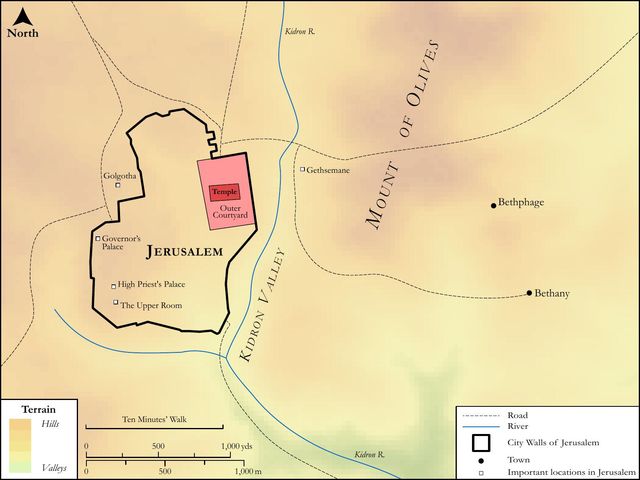

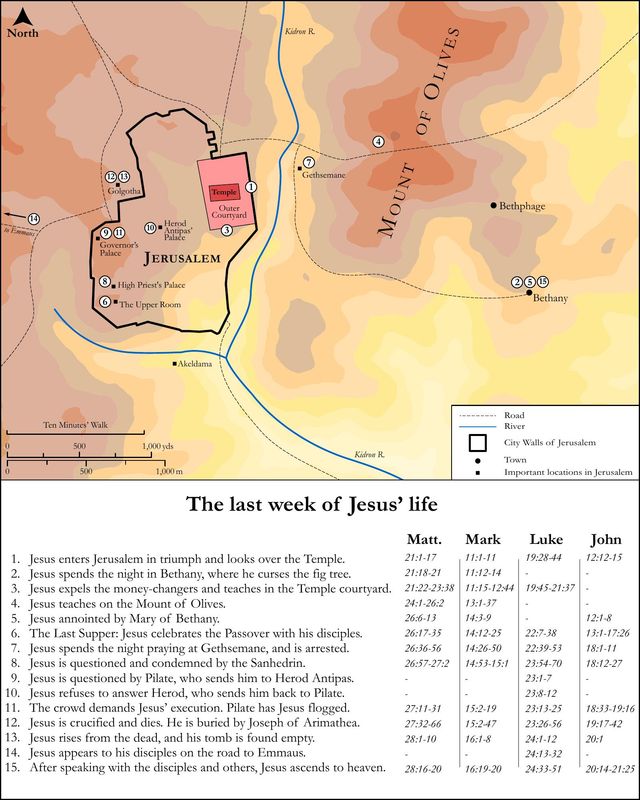
Study this verse
Public-domain commentary
Matthew Henry
From his Commentary on the Whole Bible. Henry comments on passages, not single verses — this entry covers John 16:16–22. His four-level outline is real structure in the source text, so it is rendered as structure.
Our Lord Jesus, for the comfort of his sorrowful disciples, here promises that he would visit them again.
I.Observe the intimation he gave them of the comfort he designed them, Joh 16:16. Here he tells them,
1.That they should now shortly lose the sight of him: A little while, and you that have seen me so long, and still desire to see me, shall not see me; and therefore, if they had any good question to ask him, they must ask quickly, for he was now taking his leave of them. Note, It is good to consider how near to a period our seasons of grace are, that we may be quickened to improve them while they are continued. Now our eyes see our teachers, see the days of the Son of man; but, perhaps, yet a little while, and we shall not see them. They lost the sight of Christ,
(1.)At his death, when he withdrew from this world, and never after showed himself openly in it. The most that death does to our Christian friends is to take them out of our sight, not out of being, not out of bliss, but out of all relation to us, only out of sight, and then not out of mind.
(2.)At his ascension, when he withdrew from them (from those who, after his resurrection, had for some time conversed with him), out of their sight; a cloud received him, and, though they looked up steadfastly after him, they saw him no more, Act 1:9, Act 1:10; Kg2 2:12. See Co2 5:16.
2.That yet they should speedily recover the sight of him; Again a little while, and you shall see me, and therefore you ought not to sorrow as those that have no hope. His farewell was not a final farewell; they should see him again,
(1.)At his resurrection, soon after his death, when he showed himself alive, by many infallible proofs, and this in a very little while, not forty hours. See Hos 6:2.
(2.)By the pouring out of the Spirit, soon after his ascension, which scattered the mists of ignorance and mistake they were almost lost in, and gave them a much clearer insight into the mysteries of Christ's gospel than they had yet had. The Spirit's coming was Christ's visit to his disciples, not a transient but a permanent one, and such a visit as abundantly retrieved the sight of him.
(3.)At his second coming. They saw him again as they removed one by one to him at death, and they shall see him together at the end of time, when he shall come in the clouds, and every eye shall see him. It might be truly said of this that it was but a little while, and they should see him; for what are the days of time, to the days of eternity? Pe2 3:8, Pe2 3:9.
3.He assigns the reason: "Because I go to the Father; and therefore," (1.) "I must leave you for a time, because my business calls me to the upper world, and you must be content to spare me, for really my business is yours." (2.) "Therefore you shall see me again shortly, for the Father will not detain me to your prejudice. If I go upon your errand, you shall see me again as soon as my business is done, as soon as is convenient."
It should seem, all this refers rather to his going away at death, and return at his resurrection, than his going away at the ascension, and his return at the end of time; for it was his death that was their grief, not his ascension (Luk 24:52), and between his death and resurrection it was indeed a little while. And it may be read, not, yet a little while (it is not eti mikron, as it is Joh 12:35), but mikron - for a little while you shall not see me, namely, the three days of his lying in the grave; and again, for a little while you shall see me, namely, the forty days between his resurrection and ascension. Thus we may say of our ministers and Christian friends, Yet a little while, and we shall not see them, either they must leave us or we must leave them, but it is certain that we must part shortly, and yet not part for ever. It is but a good night to those whom we hope to see with joy in the morning.
II.The perplexity of the disciples upon the intimation given them; they were at a loss what to make of it (Joh 16:17, Joh 16:18); Some of them said, softly, among themselves, either some of the weakest, that were least able, or some of the most inquisitive, that were most desirous, to understand him, What is this that he saith to us? Though Christ had often spoken to this purport before, yet still they were in the dark; though precept be upon precept, it is in vain, unless God gave the understanding. Now see here,
1.The disciples' weakness, in that they could not understand so plain a saying, to which Christ had already given them a key, having told them so often in plain terms that he should be killed, and the third day rise again; yet, say they, We cannot tell what he saith; for,
(1.)Sorrow had filled their heart, and made them unapt to receive the impressions of comfort. The darkness of ignorance and the darkness of melancholy commonly increase and thicken one another; mistakes cause griefs, and then griefs confirm mistakes.
(2.)The notion of Christ's secular kingdom was so deeply rooted in them that they could make no sense at all of those sayings of his which they knew not how to reconcile with that notion. When we think the scripture must be made to agree with the false ideas we have imbibed, no wonder that we complain of difficulty; but when our reasonings are captivated to revelation, the matter becomes easy.
(3.)It should seem, that which puzzled them was the little while. If he must go at least, yet they could not conceive how he should leave them quickly, when his stay hitherto had been so short, and so little while, comparatively. Thus it is hard for us to represent to ourselves that change as near which yet we know will come certainly, and may come suddenly. When we are told, Yet a little while and we must go hence, yet a little while and we must give up our account, we know not how to digest it; for we always took the vision to be for a great while to come, Eze 12:27.
2.Their willingness to be instructed. When they were at a loss about the meaning of Christ's words, they conferred together upon it, and asked help of one another. By mutual converse about divine things we both borrow the light of others and improve our own. Observe how exactly they repeat Christ's words. Though we cannot fully solve every difficulty we meet with in scripture, yet we must not therefore throw it by, but revolve what we cannot explain, and wait till God shall reveal even this unto us.
III.The further explication of what Christ had said.
1.See here why Christ explained it (Joh 16:19); because he knew they were desirous to ask him, and designed it. Note, The knots we cannot untie we must bring to him who alone can give an understanding. Christ knew they were desirous to ask him, but were bashful and ashamed to ask. Note, Christ takes cognizance of pious desires, though they be not as yet offered up, the groanings that cannot be uttered, and even anticipates them with the blessings of his goodness. Christ instructed those who he knew were desirous to ask him, though they did not ask. Before we call, he answers. Another reason why Christ explained it was because he observed them canvassing this matter among themselves: "Do you enquire this among yourselves? Well, I will make it easy to you." This intimates to us who they are that Christ will teach:
(1.)The humble, that confess their ignorance, for so much their enquiry implied.
(2.)The diligent, that use the means they have: "Do you enquire? You shall be taught. To him that hath shall be given."
2.See here how he explained it; not by a nice and critical descant upon the words, but by bringing the thing more closely to them; he had told them of not seeing him, and seeing him, and they did not apprehend the meaning, and therefore he explains it by their sorrowing and rejoicing, because we commonly measure things according as they affect us (Joh 16:20): You shall weep and lament, for my departure, but the world shall rejoice in it; and you shall be sorrowful, while I am absent, but, upon my return to you, your sorrow will be turned into joy. But he says nothing of the little while, because he saw that this perplexed them more than any thing; and it is of no consequence to us to know the times and the seasons. Note, Believers have joy or sorrow according as they have or have not a sight of Christ, and the tokens of his presence with them.
(1.)What Christ says here, and in Joh 16:21, Joh 16:22, of their sorrow and joy, is primarily to be understood of the present state and circumstances of the disciples, and so we have,
[1.]Their grief foretold: You shall weep and lament, and you shall be sorrowful. The sufferings of Christ could not but be the sorrow of his disciples. They wept for him because they loved him; the pain of our friend is a pain to ourselves; when they slept, it was for sorrow, Luk 22:45. They wept for themselves, and their own loss, and the sad apprehensions they had of what would become of them when he was gone. It could not but be a grief to lose him for whom they had left their all, and from whom they had expected so much. Christ has given notice to his disciples beforehand to expect sorrow, that they may treasure up comforts accordingly.
[2.]The world's rejoicing at the same time: But the world shall rejoice. That which is the grief of saints is the joy of sinners. First, Those that are strangers to Christ will continue in their carnal mirth, and not at all interest themselves in their sorrows. It is nothing to them that pass by, Lam 1:12. Nay, Secondly, Those that are enemies to Christ will rejoice because they hope they have conquered him, and ruined his interest. When the chief priests had Christ upon the cross, we may suppose they made merry over him, as those that dwell on earth over the slain witnesses, Rev 11:10. Let it be no surprise to us if we see others triumphing, when we are trembling for the ark.
[3.]The return of joy to them in due time: But your sorrow shall be turned into joy. As the joy of the hypocrite, so the sorrow of the true Christian, is but for a moment. The disciples were glad when they saw the Lord. His resurrection was life from the dead to them, and their sorrow for Christ's sufferings was turned into a joy of such a nature as could not be damped and embittered by any sufferings of their own. They were sorrowful, and yet always rejoicing (Co2 6:10), had sorrowful lives and yet joyful hearts.
(2.)It is applicable to all the faithful followers of the Lamb, and describes the common case of Christians.
[1.]Their condition and disposition are both mournful; sorrows are their lot, and seriousness is their temper: those that are acquainted with Christ must, as he was, be acquainted with grief; they weep and lament for that which others make light of, their own sins, and the sins of those about them; they mourn with sufferers that mourn, and mourn for sinners that mourn not for themselves.
[2.]The world, at the same time, goes away with all the mirth; they laugh now, and spend their days so jovially that one would think they neither knew sorrow nor feared it. Carnal mirth and pleasures are surely none of the best things, for then the worst men would not have so large a share of them, and the favourites of heaven be such strangers to them.
[3.]Spiritual mourning will shortly be turned into eternal rejoicing. Gladness is sown for the upright in heart, that sow tears, and without doubt they will shortly reap in joy. Their sorrow will not only be followed with joy, but turned into it; for the most precious comforts take rise from pious griefs. Thus he illustrates by a similitude taken from a woman in travail, to whose sorrows he compares those of his disciples, for their encouragement; for it is the will of Christ that his people should be a comforted people.
First, Here is the similitude or parable itself (Joh 16:21): A woman, we know, when she is in travail, hath sorrow, she is in exquisite pain, because her hour is come, the hour which nature and providence have fixed, which she has expected, and cannot escape; but as soon as she is delivered of the child, provided she be safely delivered, and the child be, though a Jabez (Ch1 4:9), yet not a Benoni (Gen 35:18), then she remembers no more the anguish, her groans and complaints are over, and the after - pains are more easily borne, for joy that a man is born into the world, anthrōpos, one of the human race, a child, be it son or daughter, for the word signifies either. Observe,
a.The fruit of the curse, in the sorrow and pain of a woman in travail, according to the sentence (Gen 3:16), In sorrow shalt thou bring forth. These pains are extreme, the greatest griefs and pains are compared to them (Psa 48:6; Isa 13:3; Jer 4:31; Jer 6:24), and they are inevitable, Th1 5:3. See what this world is; all its roses are surrounded with thorns, all the children of men are upon this account foolish children, that they are the heaviness of her that bore them from the very first. This comes of sin.
b.The fruit of the blessing, in the joy there is for a child born into the world. If God had not preserved the blessing in force after the fall, Be fruitful and multiply, parents could never have looked upon their children with any comfort; but what is the fruit of a blessing is matter of joy; the birth of a living child is, (a.) The parents' joy; it makes them very glad, Jer 20:15. Though children are certain cares, uncertain comforts, and often prove the greatest crosses, yet it is natural to us to rejoice at their birth. Could we be sure that our children, like John, would be filled with the Holy Ghost, we might, indeed, like his parents, have joy and gladness in their birth, Luk 1:14, Luk 1:15. But when we consider, not only that they are born in sin, but, as it is expressed, that they are born into the world, a world of snares and a vale of tears, we shall see reason to rejoice with trembling, lest it should prove better for them that they had never been born. (b.) It is such joy as makes the anguish not to be remembered, or remembered as waters that pass away, Job 11:16. Haec olim meminisse juvabit. Gen 41:51. Now this is very proper to set forth, [a.] The sorrows of Christ's disciples in this world; they are like travailing pains, sure and sharp, but not to last long, and in order to a joyful product; they are in pain to be delivered, as the church is described (Rev 12:2), and the whole creation, Rom 8:22. And, [b.] Their joys after these sorrows, which will wipe away all tears, for the former things are passed away, Rev 21:4. When they are born into that blessed world, and reap the fruit of all their services and sorrows, the toil and anguish of this world will be no more remembered, as Christ's were not, when he saw of the travail of his soul abundantly to his satisfaction, Isa 53:11.
Secondly, The application of the similitude (Joh 16:22): "You now have sorrow, and are likely to have more, but I will see you again, and you me, and then all will be well."
a.Here again he tells them of their sorrow: "You now therefore have sorrow; therefore, because I am leaving you," as is intimated in the antithesis, I will see you again. Note, Christ's withdrawings are just cause of grief to his disciples. If he hide his face, they cannot be troubled. When the sun sets, the sun-flower will hang the head. And Christ takes notice of these griefs, has a bottle for the tears, and a book for the sighs, of all gracious mourners.
b.He, more largely than before, assures them of a return of joy, Psa 30:5, Psa 30:11. He himself went through his own griefs, and bore ours, for the joy that was set before him; and he would have us encourage ourselves with the same prospect. Three things recommend the joy: - (a.) The cause of it: "I will see you again. I will make you a kind and friendly visit, to enquire after you, and minister comfort to you." Note, [a.] Christ will graciously return to those that wait for him, though for a small moment he has seemed to forsake them, Isa 54:7. Men, when they are exalted, will scarcely look upon their inferiors; but the exalted Jesus will visit his disciples. They shall not only see him in his glory, but he will see them in their meanness. [b.] Christ's returns are returns of joy to all his disciples. When clouded evidences are cleared up and interrupted communion is revived, then is the mouth filled with laughter. (b.) The cordiality of it: Your heart shall rejoice. Divine consolation put gladness into the heart. Joy in the heart is solid, and not flashy; it is secret, and that which a stranger does not intermeddle with; it is sweet, and gives a good man satisfaction in himself; it is sure, and not easily broken in upon. Christ's disciples should heartily rejoice in his returns, sincerely and greatly. (c.) The continuance of it: Your joy no man taketh from you. Men will attempt to take their joy from them; they would if they could; but they shall not prevail. Some understand it of the eternal joy of those that are glorified; those that have entered into the joy of the Lord shall go no more out. Our joys on earth we are liable to be robbed of by a thousand accidents, but heavenly joys are everlasting. I rather understand it of the spiritual joys of those that are sanctified, particularly the apostles' joy in their apostleship. Thanks be to God, says Paul, in the name of the rest, who always causes us to triumph, Co2 2:14. A malicious world would have taken it from them, they would have lost it; but, when they took everything else from them, they could not take this; as sorrowful, yet always rejoicing. They could not rob them of their joy, because they could not separate them from the love of Christ, could not rob them of their God, nor of their treasure in heaven.
Historical interpretation
Five Centuries of Reception
12 surviving comments on this verse. Each one is dated, so this reads as a timeline rather than a list.
Select a marker to jump to its quote. Markers stagger vertically where authors wrote within a few decades of each other.
So many persecutions the soul suffers daily, with so many risks is the heart wearied, and yet it delights to abide here long among the devil's weapons, although it should rather be our craving and wish to hasten to Christ by the aid of a quicker death; as He Himself instructs us, and says, "Verily, verily, I say unto you, That ye shall weep and lament, but the world shall rejoice; and ye shall be sorrowful, but your sorrow shall be turned into joy."11 Who would not desire to be without sadness? who would not hasten to attain to joy? But when our sadness shall be turned into joy, the Lord Himself again declares, when He says, "I will see you again, and your heart shall rejoice; and your joy no man shall take from you."12 Since, therefore, to see Christ is to rejoice, and we cannot have joy unless when we shall see Christ, what blindness of mind or what folly is it to love the world's afflictions, and punishments, and tears, and not rather to hasten to the joy which can never be taken away!
Nothing is wont so to cast down the soul that is anguished and possessed by deep despondency, as when words which cause pain are continually dwelt upon. Why then did Christ, after saying, "I go," and, "Hereafter I will not speak with you," continually dwell on the same subject, saying "A little while, and ye shall not see Me, because I go to Him that sent Me"? When He had recovered them by His words concerning the Spirit, He again casteth down their courage. Wherefore doth He this? He testeth their feelings, and rendereth them more proved, and well accustometh them by hearing sad things, manfully to bear separation from Him; for they who had practiced this when spoken of in words, were likely in actions also, easily to bear it afterwards. And if one enquire closely, this very thing is a consolation, the saying that, "I go to the Father." For it is the expression of One, who declares that He shall not perish, but that His end is a kind of translation. He addeth too another consolation; for He saith not merely, "A little while, and ye shall not see Me," but also, "A little while, and ye shall see Me"; showing that He will both come to them again, and that their separation would be but for a little while, and His presence with them continual.
And He said not, that the pain shall pass away only, but, "she doth not even remember it," so great is the joy which succeedeth; so also shall it be with the Saints. And yet the woman doth not rejoice because "a man hath come into the world," but because a son hath been born to her; since, had this been the case, nothing would have hindered the barren from rejoicing over another who beareth. Why then spake He thus? Because He introduced this example for this purpose only, to show that sorrow is for a season, but joy lasting: and to show that (death) is a translation unto life; and to show the great profit of their pangs. He said not, "a child hath been born," but, "A man." For to my mind He here alludeth to His own Resurrection, and that He should be born not unto that death which bare the birth-pang, but unto the Kingdom. Therefore He said not, "a child hath been born unto her," but, "A man hath been born into the world."
"And ye now therefore have sorrow-but I will see you again, and your sorrow shall be turned into joy." Then, to show that He shall die no more, He saith, "And no man taketh it from you. And in that day ye shall ask Me nothing." Again He proveth nothing else by these words, but that He is from God. "For then ye shall for the time to come know all things." But what is, "Ye shall not ask Me"? "Ye shall need no intercessor, but it is sufficient that ye call on My Name, and so gain all things."
(Hom. lxxix) Our Lord after having relieved the spirits of the disciples by the promise of the Holy Spirit, again depresses them: A little while, and ye shall not see Me. He does this to accustom them to the mention of His departure, in order that they may bear it well, when it does come. For nothing so quiets the troubled mind, as the continued recurrence to the subject of its grief.
(Hom. lxxix. 1) But then, if one examines, these are words of consolation: Because I go to the Father. For they show that His death was only a translation: and more consolation follows: And again, a little while, and ye shall see Me: an intimation this that He would return, and after a short separation, come and live with them for ever.
(Hom. lxxix. 1) Either sorrow had confused their minds, or the obscurity of the words themselves prevented their understanding them, and made them appear contradictory. If we shall see Thee, they say, how goest Thou? If Thou goest, how shall we see Thee? What is this that He saith unto us, A little while? We cannot tell what He saith.
(Hom. lxxix) Then He shows that sorrow brings forth joy, short sorrow infinite joy, by an example from nature; A woman when she is in travail hath sorrow, because her hour is come; but as soon as she is delivered of the child, she remembereth no more the anguish, for joy that a man is born into the world.
(Hom. lxxix) By this example He also intimates that He loosens the chains of death, and creates men anew. He does not say however that she should not have tribulation, but that she should not remember it; so great is the joy which follows. And so is it with the saints. He saith not, that a boy is born, but that a man, a tacit allusion to His own resurrection.
"A woman when she is in travail hath sorrow." And He hath used a comparison which the Prophets also use continually, likening despondencies to the exceeding pains of childbirth. But what He saith is of this kind: "Travail pains shall lay hold on you, but the pang of childbirth is the cause of joy"; both confirming His words relative to the Resurrection, and showing that the departing hence is like passing from the womb into the light of day. As though He had said, "Marvel not that I bring you to your advantage through such sorrow, since even a mother to become a mother, passeth in like manner through pain." Here also He implieth something mystical, that He hath loosened the travail pangs of death, and caused a new man to be born of them.
"If," saith one of them, "we shall see Thee, whither goest Thou? And if Thou goest, how shall we see Thee?" Therefore they say, "We cannot tell what He saith." That He was about to depart, they knew; but they knew not that He would shortly come to them. On which account He rebuketh them, because they did not understand His saying. For, desiring to infix in them the doctrine concerning His death, what saith He? "Verily, verily, I say unto you, That ye shall weep and lament"-which belonged to the Death and the Cross-"but the world shall rejoice." Because by reason of their not desiring His death, they quickly ran into the belief that He would not die, and then when they heard that He would die, cast about, not knowing what that "little" meant, He saith, "Ye shall mourn and lament." "But your sorrow shall be turned into joy." Then having shown that after grief comes joy, and that grief gendereth joy, and that grief is short, but the pleasure endless, He passeth to a common example.
For I think that His words, "But I will see you again, and your heart shall rejoice, and your joy no man taketh from you," are not to be referred to the time of His resurrection, and when He showed them His flesh to be looked at and handled; but rather to that of which He had already said, "He that loveth me, shall be loved of my Father; and I will love him, and will manifest myself to him." For He had already risen, He had already shown Himself to them in the flesh, and He was already sitting at the right hand of the Father, when that same Apostle John, whose Gospel this is, says in his epistle, "Beloved, now are we the sons of God; and it doth not yet appear what we shall be: but we know that, when He shall be manifested, we shall be like Him; for we shall see Him as He is." That vision belongs not to this life, but to the future; and is not temporal, but eternal. "And this is life eternal," in the words of Him who is that life, "that they might know Thee the only true God, and Jesus Christ, whom Thou hast sent." Of this vision and knowledge the apostle says, "Now we see through a glass, in a riddle; but then face to face: now I know in part; but then shall I know even as also I am known." At present the Church is in travail with the longing for this fruit of all her labor, but then she shall bring to the birth in its actual contemplation; now she travails in birth with groaning, then shall she bring forth in joy; now she travails in birth through her prayers, then shall she bring forth in her praises.
But when He said, "Your joy no man taketh from you," for their joy was Jesus Himself, there is implied what was said by the apostle, "Christ, being raised from the dead, dieth no more; and death shall have no more dominion over Him."
(Tr. c. 1) The meaning of these words however was obscure, before their fulfilment; Then said some of His disciples among themselves, What is this that He saith unto us, A little while, and ye shall not see Me: and again, a little while, and ye shall see Me: and, Because I go to the Father.
(Tr. ci. 1) For above, because He did not say, A little while, but simply, I go to the Father, He seemed to speak plainly. But what to them was obscure at the time, but by and by manifested, is manifest to us. For in a little while He suffered, and they did not see Him; and again, in a little while He rose again, and they saw Him. He says, And ye shall see Me no more; for the mortal Christ they saw no more.
(Tr. ci) Which must be understood thus, viz. that the disciples sorrowed at their Lord's death, and then immediately rejoiced at His resurrection. The world (i. e. the enemies of Christ, who put Him to death) rejoiced just when the disciples sorrowed, i. e. at His death: Ye shall weep and lament, but the world shall rejoice; and ye shall be sorrowful, but your sorrow shall be turned into joy.
(Tr. ci) This comparison does not seem difficult to understand. It was one which lay near at hand, and He Himself immediately shows its application. And ye now therefore have sorrow; but I will see you again, and your heart shall rejoice. The bringing forth is compared to sorrow, the birth to joy, which is especially true in the birth of a boy. And your joy no man taketh from you: their joy is Christ. This agrees with what the Apostle saith, Christ being risen from the dead dieth no more. (Rom. 6:9)
(Tr. ci. 6) To this joy it is better to refer what was said above, A little while and ye shall not see Me, and again, a little while and ye shall see Me. For the whole space of time that this world continues is but a little while. Because I go to the Father, refers to the former clause, a little while and ye shall not see Me, not to the latter, a little while and ye shall see Me. His going to the Father was the reason why they would not see Him. So to them who then saw Him in the body He says, A little while and ye shall not see Me; for He was about to go to the Father, and mortals would thenceforth never see Him again, as they saw Him now. The next words, A little while and ye shall see Me, are a promise to the whole Church. For this little while appears long to us while it is passing, but when it is finished we shall then see how little a time it has been.
(Tr. ci. 6) Nor yet in this bringing forth of joy, are we entirely without joy to lighten our sorrow, but, as the Apostle saith, we rejoice in hope: (Rom. 12:12) for even the woman, to whom we are compared, rejoiceth more for her future offspring, than she sorrows for her present pain.
(Tr. ci. 5) This fruit indeed the Church now yearneth for in travail, but then will enjoy in her delivery. And it is a male child, because all active duties are for the sake of devotion; for that only is free which is desired for its own sake, not for any thing else, and action is for this end. This is the end which satisfies and is eternal: for nothing can satisfy but what is itself the ultimate end. Wherefore of them it is well said, Your joy no man taketh from you.
In like manner then will your suffering also not fail to meet its reward. For you will rejoice when you see a new child born into the world, incorruptible and beyond the reach of death. Plainly He alludes to Himself here. He tells them that the joy of heart that they will have in Him cannot be taken away from them or lost. For, as Paul says, or rather as the Very Truth Itself implies, having died once for all, He dieth no more. The joy of heart then that rests upon Him hath in very truth a sure foundation. For, if we mourned at His death, who shall take from us our joy, now that we know that He lives and will be alive for evermore----He Who gives and ordains for us all spiritual blessings? No man then "taketh their joy" from the Saints, as our Saviour says; but they who nailed Him to the Cross were bereft of their joy once and for ever. For now that His suffering is ended, which they thought an occasion for rejoicing, sorrow will be their portion of inevitable necessity.
I will see you again, i. e. I will take you to Myself. Or, I will see you again, i. e. I shall appear again and be seen by you; and your heart shall rejoice.
Continue studying John 16:22 across the web’s major study libraries — every link below opens this exact verse, chapter, or book on the destination site.
Read & Compare
 BibleGatewayThis verse in more than 200 translations and 70 languages.
 Bible.comThe YouVersion reader — hundreds of translations, reading plans, and highlights.
 ESV.orgCrossway's official English Standard Version reader.
 NET BibleThe NET translation with 60,000+ translators' notes on every rendering decision.
 STEP BibleTyndale House's free study tool — original text, vocabulary, and scholarly resources.
 BibliaLogos Bible Software's free web reader.
 USCCBThe New American Bible (Revised Edition) with the U.S. bishops' study notes.
Commentaries
 BibleHub CommentariesDozens of classic commentaries on this verse, gathered on one page.
 StudyLightMore than 100 commentary sets — the largest collection on the web.
 BibleRefPlain-English commentary on what this verse means, verse by verse.
 Enduring WordDavid Guzik's free commentary on this chapter, widely used by Bible teachers.
 Bible Study ToolsVerse commentary alongside Greek and Hebrew study aids.
Original Language & Research
- BibleHub InterlinearThe verse word by word — original language, transliteration, and English.
- BibleHub LexiconEvery word's original-language definition and Strong's entry.
 Blue Letter BibleDeep-study tools — Strong's numbers, concordance, and word studies.
 CNTR CollationThe earliest Greek manuscripts of this verse, collated letter by letter.
Sermons, Hymns & Audio


TrulyRandomVerse is not affiliated with these sites and doesn’t control their content. They’re linked because they’re genuinely useful.
Summary
John 16:22 is a profound promise from Jesus to His disciples, delivered during the intimate setting of the Last Supper discourse. It speaks to the transformation of their impending sorrow into an unshakeable and eternal joy, a joy rooted in His victorious return and secured by His divine power.
CONTEXT
ShowHideLiterary Context: This verse is nestled within Jesus' extensive farewell discourse, spanning John 13-17. Specifically, John 16 focuses on preparing the disciples for His departure, the coming of the Holy Spirit, and the world's hostility. Jesus has just used the vivid analogy of a woman in labor in John 16:21, explaining that her intense sorrow during childbirth is quickly forgotten in the joy of a new life. This sets the immediate stage for John 16:22, directly applying that principle to their impending grief over His crucifixion and subsequent joy at His resurrection and ultimate return. The discourse is marked by themes of comfort, promise, and the assurance of God's presence even in absence.
Historical & Cultural Context: The setting is Jerusalem, likely in an upper room, during the Passover Feast. This was a time of immense spiritual and national anticipation for the Jewish people, yet Jesus was reinterpreting the traditional understanding of the Messiah's kingdom. The disciples, expecting a political king, were about to witness their hopes shattered by His crucifixion. Their sorrow would be compounded by fear of persecution from Jewish authorities and Roman power, as they were followers of a condemned man. The concept of a suffering Messiah was alien to their cultural expectations, making Jesus' words about sorrow and subsequent joy particularly challenging yet profoundly comforting in their context. The promise of "seeing again" would have resonated with their eschatological hopes, though its immediate fulfillment would be unexpected.
Key Themes:
Exposition and Analysis
ShowHideKey Word Analysis
ShowHideThis word denotes deep grief, distress, or sadness. It accurately describes the emotional state the disciples would soon face upon Jesus' crucifixion and departure. It signifies a profound inner pain, not merely superficial disappointment.
This verb implies a gazing with wide-open eyes, as at something remarkable, differing from mere observation. It suggests a profound, impactful vision, underscoring the significance of Jesus' post-resurrection appearances which would transform their grief into awe and joy.
This term signifies cheerfulness or calm delight. It describes a deep, inner gladness that is not dependent on external circumstances but is rooted in a profound spiritual reality. This joy is a gift, a fruit of God's grace, and is intrinsically linked to the presence and promises of Christ.
Verse Breakdown
ShowHide"And ye now therefore have sorrow"
This clause directly addresses the disciples' present state and immediate future. The "now therefore" (G3568 nŷn and G3767 oûn) emphasizes the imminence and certainty of their impending grief. Jesus acknowledges their current distress and the profound sorrow (G3077 lypē) they will experience due to His departure and crucifixion, validating their emotional turmoil before offering comfort.
"but I will see you again"
The particle "but" (G1161 dé) introduces a sharp contrast and a pivotal promise. Jesus assures them of a future encounter. While this primarily refers to His resurrection appearances, it also carries the broader implication of His ultimate return. This promise is the turning point, transforming the prospect of sorrow into one of hope and anticipation.
"and your heart shall rejoice"
This describes the profound internal transformation that will occur upon His return. The "heart" (G2588 kardía) refers to the core of their being—their thoughts, feelings, and will. Their deepest emotional center, previously afflicted with sorrow, will now be filled with overflowing joy (G5463 chaírō), a joy that is complete and deeply satisfying.
"and your joy no man taketh from you"
This powerful declaration underscores the supernatural and secure nature of the promised joy. The phrase "no man" (G3762 oudeís) emphasizes its divine origin and invulnerability to external forces, human opposition, or worldly circumstances. The verb "taketh" (G142 aírō), meaning to lift up or take away, highlights that this joy is not fleeting or conditional; it is a permanent possession, secured by Christ's victory.
Literary Devices
ShowHideThe most prominent device in John 16:22 is the stark Contrast between "sorrow" and "joy." Jesus sets up a clear dichotomy, emphasizing the transition from a temporary state of grief to a permanent state of gladness. This contrast is reinforced by the preceding analogy of childbirth in John 16:21, where the pain of labor is contrasted with the joy of a newborn child. The phrase "no man taketh from you" can be seen as a form of Hyperbole, emphasizing the absolute and unassailable nature of the joy Christ bestows. While human experiences can certainly bring temporary sadness, the underlying, divinely-rooted joy remains untouched and cannot be ultimately eradicated by any external force or human adversary. Furthermore, the "heart" (G2588 kardía) is used as a Metaphor for the inner person, the seat of emotions, intellect, and will. When Jesus says "your heart shall rejoice," He is not speaking merely of superficial happiness, but of a deep, pervasive gladness that permeates the very core of their being.
Theological and Thematic Connections
ShowHideThe promise of John 16:22 encapsulates a profound theological truth woven throughout Scripture: God's redemptive plan often involves a journey through suffering to ultimate glory and joy. This pattern is evident from the Old Testament narratives of exile and return, to the prophetic promises of a new heavens and new earth. Jesus' words here establish His resurrection as the pivotal event that transforms human despair into divine delight, demonstrating His sovereignty over sorrow and death. The joy He promises is not a fleeting emotion but a spiritual state, a foretaste of the eternal joy found in His presence, secured by His victory over sin and death. It is a joy that transcends circumstances because its source is the unchangeable character and victorious work of God Himself.
Reflection and Application
ShowHideFor believers today, John 16:22 serves as a powerful anchor in a world filled with tribulation. It reminds us that our present sufferings, no matter how intense or prolonged, are temporary. Just as the disciples' grief was transformed by the resurrection, our hope is fixed on the ultimate triumph of Christ and His promised return. This verse encourages us to cultivate a Christ-centered perspective on joy, understanding that true gladness is not contingent upon favorable circumstances but flows from our secure relationship with Jesus. It empowers us to face adversity with resilience, knowing that the joy that comes from Him is unassailable, a divine gift that no earthly power or personal tragedy can ultimately diminish or remove. This deep-seated joy enables us to persevere, offering a testimony to the world of the enduring hope found only in Christ.
Questions for Reflection
ShowHideFAQ
ShowHideWhat is the "sorrow" Jesus refers to in John 16:22?
ShowHideThe "sorrow" (G3077 lypē) Jesus refers to is the profound grief and distress the disciples would experience due to His imminent departure, crucifixion, and death. They would feel abandoned, confused, and fearful, as their hopes for an earthly kingdom led by Jesus seemed to be shattered. This sorrow is distinct from mere sadness; it encompasses deep emotional pain and a sense of loss, as described in John 16:6.
How does Jesus "see you again" and bring joy?
ShowHideThe primary fulfillment of "I will see you again" (G3700 optánomai) refers to Jesus' post-resurrection appearances to His disciples. After His crucifixion, He appeared to them multiple times, transforming their fear and sorrow into overwhelming joy and belief, as vividly depicted in John 20:20. Beyond this immediate fulfillment, the promise also carries eschatological significance, pointing to His ultimate return at the end of the age, which will bring eternal, unadulterated joy to all believers (Acts 1:11).
What makes this joy "no man taketh from you"?
ShowHideThe joy promised in John 16:22 is not a fleeting emotion based on circumstances, but a deep, spiritual reality rooted in a secure relationship with Jesus Christ. Its source is divine, not human or circumstantial. Because it is a gift from God, secured by Christ's victory over sin and death, no external force—no persecution, suffering, or worldly tribulation—can ultimately diminish or remove it. It is an internal, abiding joy that transcends outward circumstances, a fruit of the Holy Spirit (Galatians 5:22) that is eternally secure.
Christ-Centered Fulfillment
ShowHideJohn 16:22 finds its ultimate Christ-centered fulfillment in the person and work of Jesus Christ, who perfectly embodies the transformation of sorrow into unassailable joy. His own journey from the anguish of Gethsemane and the cross—where He bore the sorrow of the world's sin (Isaiah 53:3-5)—to the triumph of His resurrection, provides the foundational pattern for all believer's experience. The "seeing again" is not merely a reunion but a revelation of His victorious Lordship, confirming His identity as the resurrection and the life. The joy promised is a direct result of His accomplished work on the cross, which secured reconciliation with God and eternal life. This joy is not earned but freely given through His grace, a spiritual inheritance that flows from His presence through the indwelling Holy Spirit (John 14:16-18). Thus, the disciples' joy, and indeed the joy of all believers, is intrinsically tied to Christ's victory over sin, death, and the grave, making it a joy that no earthly power or tribulation can ever truly "take away" (Romans 8:38-39). It is a joy rooted in the finished work of the Lamb of God who takes away the sin of the world, a joy that anticipates His glorious return (Titus 2:13).