


Jeremiah 6:24
Bible text: King James Version (1769 Blayney text) · Public domain
Bible text: Berean Standard Bible · Public domain
Bible text: American Standard Version (1901) · Public domain
Bible text: World English Bible, Messianic edition · Public domain
Bible text: Geneva Bible (1599) · Public domain
Bible text: Young's Literal Translation · Public domain
- שָׁמַעְנוּsha·Ma'·nuwe heardH8085V-Qal-Perf-1cpVerb Qal Perfect 1st Plural common gender
- אֶת'et<obj.>H853DirObjMParticle Object Indicator
- שָׁמְעוֹsha·me·'O[the] report of itH8089N-msc ¦ 3msNoun Singular Masculine Constructשָׁמְע[the] report ofוֹit
- רָפוּra·Futhey hung limpH7503V-Qal-Perf-3cpVerb Qal Perfect 3rd Plural common gender
- יָדֵינוּya·Dei·nuour handsH3027N-cdc ¦ 1cpNoun Dual common gender Constructיָדֵיhandsנוּour
- צָרָהtza·RahdistressH6869N-fsNoun Singular Feminine Absolute
- הֶחֱזִיקַתְנוּhe·che·zi·Kat·nuit took hold of usH2388V-Hiphil-Perf-3fs ¦ 1cpVerb Hiphil Perfect 3rd Singular Feminineהֶחֱזִיקַתְit took hold ofנוּus
- חִילchilanguishH2427N-msNoun Singular Masculine Absolute
- כַּיּוֹלֵדָהkai·yo·le·Dahlike <the> [woman] giving birthH3205Prep-k ¦ V-Qal-Prtcpl-fsVerb Qal Participle Singular Feminine Absoluteכַּlike <the>יּוֹלֵדָה[woman] giving birth
English is a literal word-by-word gloss of the Hebrew, not the KJV's wording. Why?
This is the original text the KJV's translators worked from — each Hebrew word with its own literal English meaning in this verse, prepared by scholars at Tyndale House, Cambridge. The KJV translates whole sentences, not word by word, so its wording differs: one Hebrew word can become several English words, and the KJV may choose “the LORD” where the gloss reads “Yahweh”. Both are faithful — they answer different questions. For the KJV's own rendering, switch to the KJV text.
Details
See on the biblical-era map
Study this verse
Public-domain commentary
Matthew Henry
From his Commentary on the Whole Bible. Henry comments on passages, not single verses — this entry covers Jeremiah 6:18–30. His three-level outline is real structure in the source text, so it is rendered as structure.
Here, I. God appeals to all the neighbours, nay, to the whole world, concerning the equity of his proceedings against Judah and Jerusalem (Jer 6:18, Jer 6:19): "Hear, you nations, and know particularly, O congregation of the mighty, the great men of the nations, that take cognizance of the affairs of states about you and make remarks upon them. Observe now what is doing among those of Judah and Jerusalem; you hear of the desolations brought upon them, the earth rings of it, trembles under it; you all wonder that I should bring evil upon this people, that are in covenant with me, that profess relation to me, that have worshipped me, and been highly favoured by me; you are ready to ask, Wherefore has the Lord done thus to this land? Deu 29:24. Know then," 1. "That it is the natural product of their devices. The evil brought upon them is the fruit of their thought. They thought to strengthen themselves by their alliance with foreigners, and by that very thing they weakened and diminished themselves, they betrayed and exposed themselves." 2. "That it is the just punishment of their disobedience and rebellion. God does but execute upon them the curse of the law for their violation of its commands. It is because they have not hearkened to my words nor to my law, nor regarded a word I have said to them, but rejected it all. They would never have been ruined thus by the judgments of God's hand if they had not refused to be ruled by the judgments of his mouth: therefore you cannot say that they have any wrong done them."
II.God rejects their plea, by which they insisted upon their external services as sufficient to atone for all their sins.
Alas! it is a frivolous plea (Jer 6:20): "To what purpose come there to me incense and sweet cane, to be burnt for a perfume on the golden altar, though it was the best of the kind, and far-fetched? What care I for your burnt-offerings and your sacrifices?" They not only cannot profit God (no sacrifice does, Psa 50:9), but they do not please him, for none does this but the sacrifice of the upright; that of the wicked is an abomination to him. Sacrifice and incense were appointed to excite their repentance, and to direct them to a Mediator, and assist their faith in him. Where this good use was made of them they were acceptable, God had respect to them and to those that offered them. But when they were offered with an opinion that thereby they made God their debtor, and purchased a license to go on in sin, they were so far from being pleasing to God that they were a provocation to him.
III.He foretels the desolation that was now coming upon them.
1.God designs their ruin because they hate to be reformed (Jer 6:21): I will lay stumbling-blocks before this people, occasions of falling not into sin, but into trouble. Those whom God has marked for destruction he perplexes and embarrasses in their counsels, and obstructs and retards all the methods they take for their own safety. The parties of the enemy, which they met with wherever they went, were stumbling-blocks to them; in ever corner they stumbled upon them and were dashed to pieces by them: The fathers and the sons together shall fall upon them; neither the fathers with their wisdom, nor the sons with their strength and courage, shall escape them, or get over them. The sons that sinned with their fathers fall with them. Even the neighbour and his friend shall perish and not be able to help either themselves or one another.
2.He will make use of the Chaldeans as instruments of it; for whatever work God has to do he will find out proper instruments for the doing of it. This is a people fetched from the north, from the sides of the earth. Babylon itself lay a great way off northward; and some of the countries that were subject to the king of Babylon, out of which his army was levied, lay much further. These must be employed in this service, Jer 6:22, Jer 6:23. For,
(1.)It is a people very numerous, a great nation, which will make their invasion the more formidable.
(2.)It is a warlike people. They lay hold on bow and spear, and at this time know how to use them, for they are used to them. They ride upon horses, and therefore they march the more swiftly, and in battle press the harder. No nation had yet brought into the field a better cavalry that the Chaldeans.
(3.)It is a barbarous people. They are cruel and have no mercy, being greedy of prey and flushed with victory. They take a pride in frightening all about them; their voice roars like the sea. And,
(4.)They have a particular design upon Judah and Jerusalem, in hopes greatly to enrich themselves with the spoil of that famous country. They are set in array against thee, O daughter of Zion! The sins of God's professing people make them an easy prey to those that are God's enemies as well as theirs.
IV.He describes the very great consternation which Judah and Jerusalem should be in upon the approach of this formidable enemy, Jer 6:24-26.
1.They own themselves in a fright, upon the first intelligence brought them of the approach of the enemy: "When we have but heard the fame thereof our hands wax feeble, and we have no heart to make any resistance; anguish has taken hold of us, and we are immediately in an extremity of pain, like that of a woman in travail." Note, Sense of guilt quite dispirits men, upon the approach of any threatening trouble. What can those hope to do for themselves who have made God their enemy?
2.They confine themselves by consent to their houses, not daring to show their heads abroad; for, though they could not but expect that the sword of the enemy would at last find them out there, yet they would rather die tamely and meanly there than run any venture, either by fight or flight, to help themselves. Thus they say one to another, "Go not forth into the field, no not to fetch in your provision thence, nor walk by the way; dare not to go to church or market, it is at your peril if you do, for the sword of the enemy, and the fear of it, are on every side; the highways are unoccupied, as in Jael's time," Jdg 5:6. Let this remind us, when we travel the roads in safety and there is none to make us afraid, to bless God for our share in the public tranquillity.
3.The prophet calls upon them sadly to lament the desolations that were coming upon them. He was himself the lamenting prophet, and called upon his people to join with him in his lamentations: "O daughter of my people, hear they God calling thee to weeping and mourning, and answer his call: do not only put on sackcloth for a day, but gird it on for thy constant wear; do not only put ashes on thy head, but wallow thyself in ashes; put thyself into close mourning, and use all the tokens of bitter lamentation, not forced and for show only, but with the greatest sincerity, as parents mourn for an only son, and think themselves comfortless because they are childless. Thus do thou lament for the spoiler that suddenly comes upon us. Though he has not come yet, he is coming, the decree has gone forth: let us therefore meet the execution of it with a suitable sadness." As saints may rejoice in hope of God's mercies, though they see them only in the promise, so sinners must mourn for fear of God's judgments, though they see them only in the threatenings.
V.He constitutes the prophet a judge over this people that now stand upon their trial:
as Jer 1:10, I have set thee over the nations; so here, I have set thee for a tower, or as a sentinel, or a watchman, upon a tower, among my people, as an inspector of their actions, that thou mayest know, and try their way, Jer 6:27. Not that God needed any to inform him concerning them; on the contrary, the prophet knew little of them in comparison but by the spirit of prophecy. But thus God appeals to the prophet himself, and his own observation concerning their character, that he might be fully satisfied in the equity of God's proceedings against them and with the more assurance give them warning of the judgments coming. God set him for a tower, conspicuous to all and attacked by many, but made him a fortress, a strong tower, gave him courage to stem the tide and bear the shock of their displeasure. Those that will be faithful reprovers have need to be firm as fortresses. Now in trying their way he will find two things: - 1. That they are wretchedly debauched (Jer 6:28): They are all grievous revolters, revolters of revolters (so the word is), the worst of revolters, as a servant of servants is the meanest servant. They have a revolting heart, have deeply revolted, and revolt more and more. They seemed to start fair, but they revolt and start back. They walk with slanders; they make nothing of belying and backbiting one another, nay, they make a perfect trade of it; it is their constant course, and they govern themselves by the slanders they hear, hating those that they hear ill-spoken of, though ever so unjustly. They are brass and iron, base metals, and there is nothing in them that is valuable. They were as silver and gold, but they have degenerated. Nay, as they are all revolters, so they are all corrupters, not only debauched themselves, but industrious to debauch others, to corrupt them as they themselves are corrupt; nay, to make them seven times more the children of hell than themselves. It is often so; sinners soon become tempters. 2. That they would never be reclaimed and reformed; it was in vain to think of reforming them, for various methods had been tried with them, and all to no purpose, Jer 6:29, Jer 6:30. He compares them to ore that was supposed to have some good metal in it, and was therefore put into the furnace by the refiner, who used all his art, and took abundance of pains, about it, but it proved all dross, nothing of any value could be extracted out of it. God by his prophets and by his providences had used the most proper means to refine this people and to purify them from their wickedness; but it was all in vain. By the continual preaching of the word, and in a series of afflictions, they had been kept in a constant fire, but all to no purpose. The bellows have been still kept so near the fire, to blow it, that they are burnt with the heat of it, or they are quite worn out with long use and thrown into the fire as good for nothing. The prophets have preached their throats sore with crying aloud against the sins of Israel, and yet they are not convinced and humbled. The lead, which was then used in refining silver, as quicksilver is now, is consumed of the fire, and has not done its work. The founder melts in vain; his labour is lost, for the wicked are not plucked away, no care is taken to separate between the precious and the vile, to purge out the old leaven, to cast out of communion those who, being corrupt themselves, are in danger of infecting others. Or, Their wickednesses are not removed (so some read it); they are still as bad as ever, and nothing will prevail to part between them and their sins. They will not be brought off from their idolatries and immoralities by all they have heard, and all they have felt, of the wrath of God against them; and therefore that doom is passed upon them (Jer 6:30): Reprobate silver shall they be called, useless and worthless; they glitter as if they had some silver in them, but there is nothing of real virtue or goodness to be found among them; and for this reason the Lord has rejected them. He will no more own them as his people, nor look for any good from them; he will take them away like dross (Psa 119:119), and prepare a consuming fire for those that would not be purified by a refining fire. By this it appears, (1.) That God has no pleasure in the death and ruin of sinners, for he tries all ways and methods with them to prevent their destruction and qualify them for salvation. Both his ordinances and his providences have a tendency this way, to part between them and their sins; and yet with many it is all lost labour. We have piped unto you, and you have not danced; we have mourned unto you, and you have not wept. Therefore, (2.) God will be justified in the death of sinners and all the blame will lie upon themselves. He did not reject them till he had used all proper means to reform them; did not cast them off so long as there was any hope of them, nor abandon them as dross till it appeared that they were reprobate silver.
Historical interpretation
Historical reception
1 surviving comment on this verse from the historical church.
(Verse 24.) We have heard his fame: our hands are weak; distress has seized us, like the pain of childbirth. The people responded to the Prophet, or rather, through the Prophet, the Lord has threatened the Babylonians: before they come, they will be overcome with fear, unable to lift their hands, and distress will grip them like the pain of childbirth; in this pain, they affirm that nothing is more severe than what they have experienced.
Continue studying Jeremiah 6:24 across the web’s major study libraries — every link below opens this exact verse, chapter, or book on the destination site.
Read & Compare
 BibleGatewayThis verse in more than 200 translations and 70 languages.
 Bible.comThe YouVersion reader — hundreds of translations, reading plans, and highlights.
 ESV.orgCrossway's official English Standard Version reader.
 NET BibleThe NET translation with 60,000+ translators' notes on every rendering decision.
 STEP BibleTyndale House's free study tool — original text, vocabulary, and scholarly resources.
 BibliaLogos Bible Software's free web reader.
 USCCBThe New American Bible (Revised Edition) with the U.S. bishops' study notes.
Commentaries
 BibleHub CommentariesDozens of classic commentaries on this verse, gathered on one page.
 StudyLightMore than 100 commentary sets — the largest collection on the web.
 BibleRefPlain-English commentary on what this verse means, verse by verse.
 Enduring WordDavid Guzik's free commentary on this chapter, widely used by Bible teachers.
 Bible Study ToolsVerse commentary alongside Greek and Hebrew study aids.
Original Language & Research
- BibleHub InterlinearThe verse word by word — original language, transliteration, and English.
- BibleHub LexiconEvery word's original-language definition and Strong's entry.
 Blue Letter BibleDeep-study tools — Strong's numbers, concordance, and word studies.
 SefariaThe Hebrew text with Rashi and centuries of Jewish commentary.
Sermons, Hymns & Audio


TrulyRandomVerse is not affiliated with these sites and doesn’t control their content. They’re linked because they’re genuinely useful.
Summary
Jeremiah 6:24 powerfully encapsulates the profound terror and debilitating despair gripping the people of Judah as they receive news of an impending, overwhelming invasion. This verse vividly portrays the immediate, visceral reaction to the approaching threat, characterized by physical weakness, intense emotional and physical suffering, and an inescapable sense of doom, likened to the unavoidable and agonizing pains of childbirth. It underscores the dire consequences of Judah's persistent rebellion and the terrifying reality of divine judgment.
Context
ShowHideLiterary Context
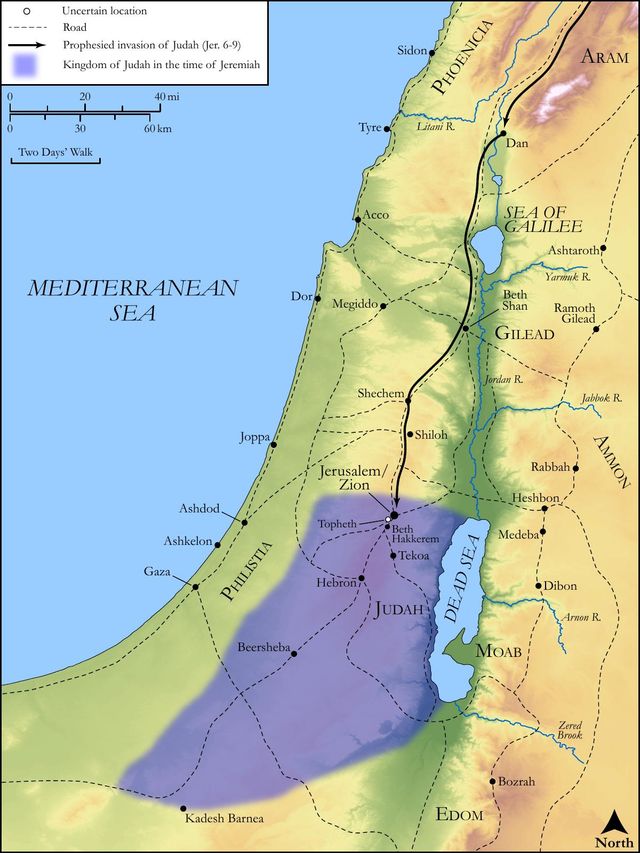
Jeremiah 6 is a chapter saturated with pronouncements of judgment against Jerusalem, detailing the coming invasion from the North, widely understood to be the Neo-Babylonian Empire. The preceding verses Jeremiah 6:22-23 describe the formidable nature of this enemy—a cruel and numerous people armed for war, whose approach is heralded by a great noise. Jeremiah 6:24, therefore, serves as the immediate, visceral response of the inhabitants of Judah to this terrifying news, illustrating the psychological and physical impact of the prophesied judgment. It transitions from the description of the aggressor to the desperate plight of the besieged, setting the stage for subsequent laments and further warnings in the book, such as the earnest call to repentance found in Jeremiah 7:3-7.
Historical & Cultural Context
At the time of Jeremiah's prophecy (late 7th to early 6th century BCE), the geopolitical landscape was dominated by the rising power of the Neo-Babylonian Empire, which was rapidly eclipsing Assyria. Judah, caught between regional powers, had largely abandoned its covenant with Yahweh, engaging in widespread idolatry and oppression. The "fame thereof" refers to the growing reputation of the Babylonian army, known for its ruthless efficiency and devastating conquests. Culturally, the "hands waxing feeble" signifies a complete loss of courage, strength, and the ability to fight or even defend oneself, a common idiom for paralysis in the face of overwhelming fear. The metaphor of "a woman in travail" was a powerful and universally understood image for unavoidable, intense, and escalating pain, often used in prophetic literature to describe the severity of divine judgment, as seen in Isaiah 13:8.
Key Themes
ShowHideThis verse powerfully contributes to several key themes prevalent in Jeremiah and the broader prophetic tradition. Firstly, it highlights the inevitability and severity of divine judgment for covenant unfaithfulness; the terror described is a direct consequence of Judah's rebellion. Secondly, it underscores the paralyzing effect of overwhelming fear and despair when facing an inescapable threat, demonstrating how spiritual complacency can lead to utter helplessness. Thirdly, the imagery of "travail" emphasizes the unavoidable and intense suffering that accompanies God's righteous wrath, serving as a stark warning to those who ignore prophetic calls to repentance. This theme of judgment is woven throughout Jeremiah, often contrasted with the promise of future restoration for a repentant remnant, as glimpsed in passages like the promise of the New Covenant in Jeremiah 31:31-34.
Exposition and Analysis
ShowHideKey Word Analysis
ShowHideA primitive root meaning "to slacken (in many applications, literal or figurative); abate, cease, fail, (be) faint, be (wax) feeble." In this context, it describes a profound physical and psychological weakening, a complete loss of strength, courage, and resolve. The hands, typically symbols of power and action, become utterly useless, signifying paralysis and inability to resist or fight.
Feminine of צַר; meaning "tightness (i.e. figuratively, trouble); transitively, a female rival: adversary, adversity, affliction, anguish, distress, tribulation, trouble." This word conveys a sense of being hemmed in, constricted, or in a tight spot with no escape. It denotes a comprehensive and pervasive state of distress, not merely a fleeting emotion but a deep, oppressive suffering that grips the entire being.
And (feminine) חִילָה; from חוּל; meaning "a throe (expectant of childbirth); pain, pang, sorrow." This term specifically refers to the intense, writhing, and unavoidable pains associated with childbirth. Its use here immediately sets up the powerful metaphor that follows, emphasizing the severity, suddenness, and escalating nature of the suffering that has seized the people, much like the inescapable process of labor.
Verse Breakdown
ShowHide"We have heard the fame thereof"
This clause indicates that the news of the approaching enemy, specifically the formidable Babylonian army, has reached Judah. "Fame" here refers to the terrifying reputation and overwhelming power of this invading force, which precedes their physical arrival and instills immediate dread and panic among the populace.
"our hands wax feeble"
This phrase vividly portrays the physical and psychological impact of the news. The "hands" (Hebrew, yâd, H3027), symbolizing strength, capability, and action, are described as "waxing feeble" (Hebrew, râphâh, H7503). This signifies a complete collapse of courage, an inability to prepare for battle, or even to flee, leaving the people utterly helpless and paralyzed by fear.
"anguish hath taken hold of us, and pain"
This describes the overwhelming emotional and physical distress that has seized the people. "Anguish" (Hebrew, tsârâh, H6869) denotes a deep, constricting trouble, while "pain" (Hebrew, chîyl, H2427) specifically points to the intense, writhing throes. The phrase "hath taken hold" (Hebrew, châzaq, H2388) emphasizes that this suffering is not merely felt but has forcefully seized and gripped them, from which there is no escape.
"as of a woman in travail"
This powerful simile compares the people's anguish and pain to the excruciating and unavoidable suffering of a woman in childbirth. It highlights the suddenness, intensity, inevitability, and escalating nature of the distress. Just as a woman cannot escape labor pains once they begin, Judah cannot escape the impending judgment, which will be agonizing and all-consuming.
Literary Devices
ShowHideJeremiah 6:24 employs several potent literary devices to convey the depth of Judah's terror and the severity of the impending judgment. The most prominent is the Simile, comparing the people's anguish to "pain, as of a woman in travail." This is a highly effective and common biblical metaphor for intense, unavoidable, and escalating suffering, frequently associated with divine judgment or the "birth pains" of a new era. It evokes a visceral sense of helplessness and agony. Hyperbole is also present in the phrase "our hands wax feeble," which exaggerates the physical incapacitation to emphasize the complete psychological paralysis and loss of courage among the people. The "hands" represent their ability to act, and their feebleness suggests utter powerlessness. Furthermore, Personification is used when "anguish hath taken hold of us," giving the abstract concept of anguish an active, forceful quality, as if it were a physical entity seizing and gripping its victims. This reinforces the idea that the distress is overwhelming and inescapable.
Theological and Thematic Connections
ShowHideJeremiah 6:24 serves as a stark theological declaration of the consequences of persistent disobedience and the terrifying reality of divine judgment. It demonstrates that God, in His justice, allows the natural and spiritual consequences of sin to unfold, often through the agency of human nations. The overwhelming fear and anguish described are not random misfortunes but the direct, inevitable fruit of Judah's unfaithfulness to their covenant with Yahweh. This verse underscores God's sovereignty over history and nations, using even pagan empires as instruments of His righteous judgment. It highlights the prophetic warning that ignoring divine appeals for repentance leads to inescapable suffering, emphasizing that true peace and security are found only in faithfulness to God.
Reflection and Application
ShowHideJeremiah 6:24 offers timeless lessons for all who hear God's word. It serves as a powerful reminder that ignoring divine warnings and persisting in spiritual rebellion inevitably leads to profound distress and judgment. While the immediate context is historical, the principle remains: unaddressed sin and unrepentant hearts invite a spiritual "travail" that can be agonizing and inescapable. This verse calls us to a posture of humility and responsiveness to God's voice, urging us not to wait until the "fame" of impending spiritual consequences becomes a paralyzing reality. It challenges us to examine our own lives for areas of disobedience and spiritual apathy, prompting us to seek repentance and reconciliation with God before the "anguish" takes hold. The fear described in the verse, though born of judgment, can also serve as a catalyst for genuine repentance and a renewed commitment to walking in God's ways, recognizing that true security lies in His mercy and faithfulness, not in human strength or denial.
Questions for Reflection
ShowHideFAQ
ShowHideWhat is the "fame thereof" referring to in Jeremiah 6:24?
ShowHideThe "fame thereof" refers to the terrifying reputation and overwhelming military might of the approaching enemy, specifically the Neo-Babylonian Empire. News of their ruthless conquests and formidable army had spread throughout the region, instilling widespread dread. This "fame" was not just a rumor but a well-known reality that preceded their physical arrival, causing immediate panic and despair among the people of Judah, as described in the preceding verses of Jeremiah 6:22-23.
Why is "a woman in travail" used as a metaphor for the people's suffering?
ShowHideThe metaphor of "a woman in travail" is a powerful biblical image used to convey intense, unavoidable, and escalating pain. Childbirth pains are universally understood as agonizing, all-consuming, and a process that, once begun, cannot be stopped or escaped until its completion. By comparing Judah's anguish to this, the prophet emphasizes the severity, suddenness, and inevitability of the divine judgment that has seized them. It highlights that their suffering is not merely an inconvenience but a profound, visceral experience from which there is no escape, much like the "birth pains" described by Jesus concerning the end times in Matthew 24:8.
How does this verse relate to Judah's spiritual state?
ShowHideJeremiah 6:24 is a direct consequence of Judah's persistent spiritual rebellion and unfaithfulness to God's covenant. Throughout Jeremiah, the prophet repeatedly warns Judah about their idolatry, oppression, and refusal to repent. The "anguish" and "pain" described in this verse are not arbitrary punishments but the just outcome of their spiritual choices. They had ignored God's repeated calls to return to Him, as seen in passages like Jeremiah 3:6-10, and now faced the terrifying reality of His judgment, which manifested through the invasion of a foreign power.
Christ-Centered Fulfillment
ShowHideWhile Jeremiah 6:24 vividly portrays the anguish of Judah under divine judgment, it also points forward to the ultimate resolution of human suffering and sin in Christ. The "anguish" and "pain, as of a woman in travail," that gripped Judah foreshadow the profound suffering and "birth pains" that Christ Himself would endure, not for His own sin, but for the sins of humanity. On the cross, Jesus experienced an anguish far deeper than any earthly travail, bearing the full weight of God's righteous wrath against sin, as prophesied in passages like Isaiah 53:3-5. His cry, "My God, my God, why have you forsaken me?" (Matthew 27:46), echoes a unique and unparalleled travail. Through His suffering, Christ absorbed the judgment that humanity deserved, offering deliverance from the "anguish" of sin and its consequences. For those who trust in Him, the terrifying "fame" of judgment is replaced by the glorious "fame" of the gospel, and the "feeble hands" of despair are strengthened by the power of His resurrection, leading to a new creation that groans in hopeful anticipation, not in dread, for its full redemption, as Romans 8:22-23 beautifully describes.