


Jeremiah 6:25
Bible text: King James Version (1769 Blayney text) · Public domain
Bible text: Berean Standard Bible · Public domain
Bible text: American Standard Version (1901) · Public domain
Bible text: World English Bible, Messianic edition · Public domain
Bible text: Geneva Bible (1599) · Public domain
Bible text: Young's Literal Translation · Public domain
- אַל'almay notH408NegParticle Negative
- תֵּצְאוּte·tze·'iyou go outH3318V-Qal-Imperf-2mpVerb Qal Imperfect 2nd Plural Masculine
- הַשָּׂדֶהha·sa·Dehthe fieldH7704Art ¦ N-msNoun Singular Masculine Absoluteהַtheשָּׂדֶהfield
- וּבַדֶּרֶךְu·va·De·rekhand on the roadH1870Conj-w ¦ Prep-b ¦ N-csNoun Singular common gender Absoluteוּandבַon theדֶּרֶךְroad
- אַל'almau notH408NegParticle Negative
- תֵּלֵכוּte·le·khiyou walkH1980V-Qal-Imperf-2mpVerb Qal Imperfect 2nd Plural Masculine
- כִּיkiforH3588PrtParticle Conditional
- חֶרֶבChe·reva swordH2719N-fsNoun Singular Feminine Absolute
- לְאֹיֵבle·'o·Yev[belongs] to [the] enemyH341Prep-l ¦ V-Qal-Prtcpl-msVerb Qal Participle Singular Masculine Absoluteלְ[belongs] toאֹיֵב[the] enemy
- מָגוֹרma·GorterrorH4032N-msNoun Singular Masculine Absolute
- מִסָּבִיבmi·sa·Viv[is] from round aboutH5439Prep-m ¦ N-csNoun Singular common gender Absoluteמִ[is] fromסָּבִיבround about
English is a literal word-by-word gloss of the Hebrew, not the KJV's wording. Why?
This is the original text the KJV's translators worked from — each Hebrew word with its own literal English meaning in this verse, prepared by scholars at Tyndale House, Cambridge. The KJV translates whole sentences, not word by word, so its wording differs: one Hebrew word can become several English words, and the KJV may choose “the LORD” where the gloss reads “Yahweh”. Both are faithful — they answer different questions. For the KJV's own rendering, switch to the KJV text.
Details
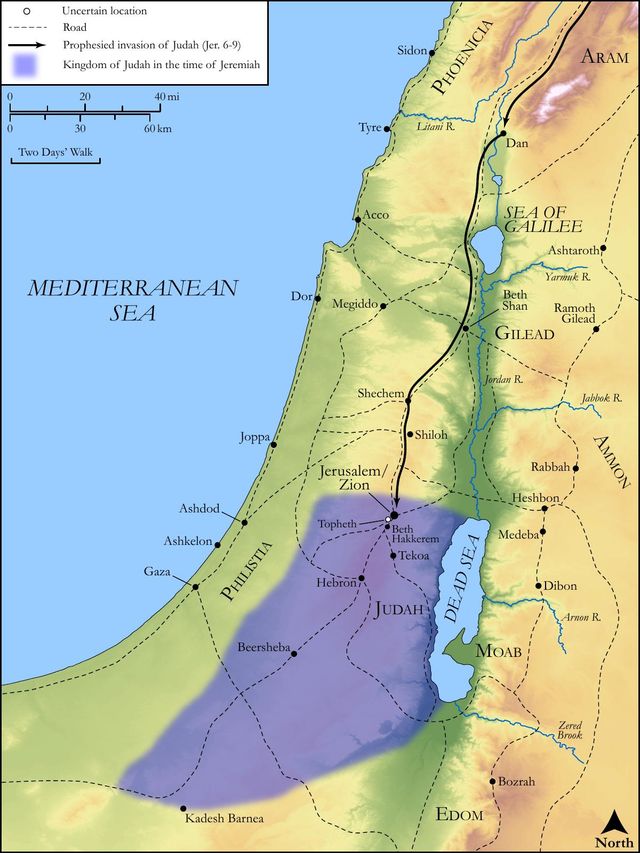
See on the biblical-era map
Study this verse
Public-domain commentary
Matthew Henry
From his Commentary on the Whole Bible. Henry comments on passages, not single verses — this entry covers Jeremiah 6:18–30. His three-level outline is real structure in the source text, so it is rendered as structure.
Here, I. God appeals to all the neighbours, nay, to the whole world, concerning the equity of his proceedings against Judah and Jerusalem (Jer 6:18, Jer 6:19): "Hear, you nations, and know particularly, O congregation of the mighty, the great men of the nations, that take cognizance of the affairs of states about you and make remarks upon them. Observe now what is doing among those of Judah and Jerusalem; you hear of the desolations brought upon them, the earth rings of it, trembles under it; you all wonder that I should bring evil upon this people, that are in covenant with me, that profess relation to me, that have worshipped me, and been highly favoured by me; you are ready to ask, Wherefore has the Lord done thus to this land? Deu 29:24. Know then," 1. "That it is the natural product of their devices. The evil brought upon them is the fruit of their thought. They thought to strengthen themselves by their alliance with foreigners, and by that very thing they weakened and diminished themselves, they betrayed and exposed themselves." 2. "That it is the just punishment of their disobedience and rebellion. God does but execute upon them the curse of the law for their violation of its commands. It is because they have not hearkened to my words nor to my law, nor regarded a word I have said to them, but rejected it all. They would never have been ruined thus by the judgments of God's hand if they had not refused to be ruled by the judgments of his mouth: therefore you cannot say that they have any wrong done them."
II.God rejects their plea, by which they insisted upon their external services as sufficient to atone for all their sins.
Alas! it is a frivolous plea (Jer 6:20): "To what purpose come there to me incense and sweet cane, to be burnt for a perfume on the golden altar, though it was the best of the kind, and far-fetched? What care I for your burnt-offerings and your sacrifices?" They not only cannot profit God (no sacrifice does, Psa 50:9), but they do not please him, for none does this but the sacrifice of the upright; that of the wicked is an abomination to him. Sacrifice and incense were appointed to excite their repentance, and to direct them to a Mediator, and assist their faith in him. Where this good use was made of them they were acceptable, God had respect to them and to those that offered them. But when they were offered with an opinion that thereby they made God their debtor, and purchased a license to go on in sin, they were so far from being pleasing to God that they were a provocation to him.
III.He foretels the desolation that was now coming upon them.
1.God designs their ruin because they hate to be reformed (Jer 6:21): I will lay stumbling-blocks before this people, occasions of falling not into sin, but into trouble. Those whom God has marked for destruction he perplexes and embarrasses in their counsels, and obstructs and retards all the methods they take for their own safety. The parties of the enemy, which they met with wherever they went, were stumbling-blocks to them; in ever corner they stumbled upon them and were dashed to pieces by them: The fathers and the sons together shall fall upon them; neither the fathers with their wisdom, nor the sons with their strength and courage, shall escape them, or get over them. The sons that sinned with their fathers fall with them. Even the neighbour and his friend shall perish and not be able to help either themselves or one another.
2.He will make use of the Chaldeans as instruments of it; for whatever work God has to do he will find out proper instruments for the doing of it. This is a people fetched from the north, from the sides of the earth. Babylon itself lay a great way off northward; and some of the countries that were subject to the king of Babylon, out of which his army was levied, lay much further. These must be employed in this service, Jer 6:22, Jer 6:23. For,
(1.)It is a people very numerous, a great nation, which will make their invasion the more formidable.
(2.)It is a warlike people. They lay hold on bow and spear, and at this time know how to use them, for they are used to them. They ride upon horses, and therefore they march the more swiftly, and in battle press the harder. No nation had yet brought into the field a better cavalry that the Chaldeans.
(3.)It is a barbarous people. They are cruel and have no mercy, being greedy of prey and flushed with victory. They take a pride in frightening all about them; their voice roars like the sea. And,
(4.)They have a particular design upon Judah and Jerusalem, in hopes greatly to enrich themselves with the spoil of that famous country. They are set in array against thee, O daughter of Zion! The sins of God's professing people make them an easy prey to those that are God's enemies as well as theirs.
IV.He describes the very great consternation which Judah and Jerusalem should be in upon the approach of this formidable enemy, Jer 6:24-26.
1.They own themselves in a fright, upon the first intelligence brought them of the approach of the enemy: "When we have but heard the fame thereof our hands wax feeble, and we have no heart to make any resistance; anguish has taken hold of us, and we are immediately in an extremity of pain, like that of a woman in travail." Note, Sense of guilt quite dispirits men, upon the approach of any threatening trouble. What can those hope to do for themselves who have made God their enemy?
2.They confine themselves by consent to their houses, not daring to show their heads abroad; for, though they could not but expect that the sword of the enemy would at last find them out there, yet they would rather die tamely and meanly there than run any venture, either by fight or flight, to help themselves. Thus they say one to another, "Go not forth into the field, no not to fetch in your provision thence, nor walk by the way; dare not to go to church or market, it is at your peril if you do, for the sword of the enemy, and the fear of it, are on every side; the highways are unoccupied, as in Jael's time," Jdg 5:6. Let this remind us, when we travel the roads in safety and there is none to make us afraid, to bless God for our share in the public tranquillity.
3.The prophet calls upon them sadly to lament the desolations that were coming upon them. He was himself the lamenting prophet, and called upon his people to join with him in his lamentations: "O daughter of my people, hear they God calling thee to weeping and mourning, and answer his call: do not only put on sackcloth for a day, but gird it on for thy constant wear; do not only put ashes on thy head, but wallow thyself in ashes; put thyself into close mourning, and use all the tokens of bitter lamentation, not forced and for show only, but with the greatest sincerity, as parents mourn for an only son, and think themselves comfortless because they are childless. Thus do thou lament for the spoiler that suddenly comes upon us. Though he has not come yet, he is coming, the decree has gone forth: let us therefore meet the execution of it with a suitable sadness." As saints may rejoice in hope of God's mercies, though they see them only in the promise, so sinners must mourn for fear of God's judgments, though they see them only in the threatenings.
V.He constitutes the prophet a judge over this people that now stand upon their trial:
as Jer 1:10, I have set thee over the nations; so here, I have set thee for a tower, or as a sentinel, or a watchman, upon a tower, among my people, as an inspector of their actions, that thou mayest know, and try their way, Jer 6:27. Not that God needed any to inform him concerning them; on the contrary, the prophet knew little of them in comparison but by the spirit of prophecy. But thus God appeals to the prophet himself, and his own observation concerning their character, that he might be fully satisfied in the equity of God's proceedings against them and with the more assurance give them warning of the judgments coming. God set him for a tower, conspicuous to all and attacked by many, but made him a fortress, a strong tower, gave him courage to stem the tide and bear the shock of their displeasure. Those that will be faithful reprovers have need to be firm as fortresses. Now in trying their way he will find two things: - 1. That they are wretchedly debauched (Jer 6:28): They are all grievous revolters, revolters of revolters (so the word is), the worst of revolters, as a servant of servants is the meanest servant. They have a revolting heart, have deeply revolted, and revolt more and more. They seemed to start fair, but they revolt and start back. They walk with slanders; they make nothing of belying and backbiting one another, nay, they make a perfect trade of it; it is their constant course, and they govern themselves by the slanders they hear, hating those that they hear ill-spoken of, though ever so unjustly. They are brass and iron, base metals, and there is nothing in them that is valuable. They were as silver and gold, but they have degenerated. Nay, as they are all revolters, so they are all corrupters, not only debauched themselves, but industrious to debauch others, to corrupt them as they themselves are corrupt; nay, to make them seven times more the children of hell than themselves. It is often so; sinners soon become tempters. 2. That they would never be reclaimed and reformed; it was in vain to think of reforming them, for various methods had been tried with them, and all to no purpose, Jer 6:29, Jer 6:30. He compares them to ore that was supposed to have some good metal in it, and was therefore put into the furnace by the refiner, who used all his art, and took abundance of pains, about it, but it proved all dross, nothing of any value could be extracted out of it. God by his prophets and by his providences had used the most proper means to refine this people and to purify them from their wickedness; but it was all in vain. By the continual preaching of the word, and in a series of afflictions, they had been kept in a constant fire, but all to no purpose. The bellows have been still kept so near the fire, to blow it, that they are burnt with the heat of it, or they are quite worn out with long use and thrown into the fire as good for nothing. The prophets have preached their throats sore with crying aloud against the sins of Israel, and yet they are not convinced and humbled. The lead, which was then used in refining silver, as quicksilver is now, is consumed of the fire, and has not done its work. The founder melts in vain; his labour is lost, for the wicked are not plucked away, no care is taken to separate between the precious and the vile, to purge out the old leaven, to cast out of communion those who, being corrupt themselves, are in danger of infecting others. Or, Their wickednesses are not removed (so some read it); they are still as bad as ever, and nothing will prevail to part between them and their sins. They will not be brought off from their idolatries and immoralities by all they have heard, and all they have felt, of the wrath of God against them; and therefore that doom is passed upon them (Jer 6:30): Reprobate silver shall they be called, useless and worthless; they glitter as if they had some silver in them, but there is nothing of real virtue or goodness to be found among them; and for this reason the Lord has rejected them. He will no more own them as his people, nor look for any good from them; he will take them away like dross (Psa 119:119), and prepare a consuming fire for those that would not be purified by a refining fire. By this it appears, (1.) That God has no pleasure in the death and ruin of sinners, for he tries all ways and methods with them to prevent their destruction and qualify them for salvation. Both his ordinances and his providences have a tendency this way, to part between them and their sins; and yet with many it is all lost labour. We have piped unto you, and you have not danced; we have mourned unto you, and you have not wept. Therefore, (2.) God will be justified in the death of sinners and all the blame will lie upon themselves. He did not reject them till he had used all proper means to reform them; did not cast them off so long as there was any hope of them, nor abandon them as dross till it appeared that they were reprobate silver.
Historical interpretation
Historical reception
1 surviving comment on this verse from the historical church.
(Verse 25.) Do not go out to the fields, and do not walk on the road, for the sword of the enemy is all around. The Gospel teaches (Matthew 24) that we should not go out into the field or descend from the height of roofs, but rather listen to this: 'Escape to the mountain to be saved' (Genesis 19:17). We are instructed in Isaiah and Micah (Isaiah 2, Micah 4) to run to and climb to this mountain. According to the literal meaning, we are commanded not to go outside or leave the walls, but to protect ourselves with strong fortifications.
Continue studying Jeremiah 6:25 across the web’s major study libraries — every link below opens this exact verse, chapter, or book on the destination site.
Read & Compare
 BibleGatewayThis verse in more than 200 translations and 70 languages.
 Bible.comThe YouVersion reader — hundreds of translations, reading plans, and highlights.
 ESV.orgCrossway's official English Standard Version reader.
 NET BibleThe NET translation with 60,000+ translators' notes on every rendering decision.
 STEP BibleTyndale House's free study tool — original text, vocabulary, and scholarly resources.
 BibliaLogos Bible Software's free web reader.
 USCCBThe New American Bible (Revised Edition) with the U.S. bishops' study notes.
Commentaries
 BibleHub CommentariesDozens of classic commentaries on this verse, gathered on one page.
 StudyLightMore than 100 commentary sets — the largest collection on the web.
 BibleRefPlain-English commentary on what this verse means, verse by verse.
 Enduring WordDavid Guzik's free commentary on this chapter, widely used by Bible teachers.
 Bible Study ToolsVerse commentary alongside Greek and Hebrew study aids.
Original Language & Research
- BibleHub InterlinearThe verse word by word — original language, transliteration, and English.
- BibleHub LexiconEvery word's original-language definition and Strong's entry.
 Blue Letter BibleDeep-study tools — Strong's numbers, concordance, and word studies.
 SefariaThe Hebrew text with Rashi and centuries of Jewish commentary.
Sermons, Hymns & Audio


TrulyRandomVerse is not affiliated with these sites and doesn’t control their content. They’re linked because they’re genuinely useful.
Summary
Jeremiah 6:25 delivers a stark prophetic warning to the inhabitants of Judah and Jerusalem, forbidding them from venturing outside their dwellings into the open countryside or public roads. This prohibition underscores the pervasive and inescapable danger posed by an impending invasion, where the "sword of the enemy" and overwhelming "fear" would be present "on every side." The verse vividly portrays a society under siege, where ordinary life ceases, and terror becomes the dominant reality, serving as a grim consequence of the nation's persistent disobedience to God.
Context
ShowHideLiterary Context
Jeremiah 6 is a pivotal chapter within the prophet's early ministry, primarily focused on God's impending judgment against Judah and Jerusalem for their idolatry and unfaithfulness. The preceding verses, particularly Jeremiah 6:22-24, graphically describe the approach of a formidable and merciless army from the north, historically identified as the Babylonians. This immediate context sets the stage for the dire warning in verse 25, which shifts from a general description of the enemy to a direct, personal instruction to the people, emphasizing the immediate and tangible threat to their daily lives. The verse functions as a vivid illustration of the breakdown of public safety and order that accompanies divine judgment, a theme consistent with the broader warnings throughout Jeremiah 6.
Historical & Cultural Context
The prophecy of Jeremiah 6:25 is set against the backdrop of the late 7th and early 6th centuries BCE, a period of immense geopolitical upheaval. The Neo-Babylonian Empire was rapidly asserting its dominance, posing an existential threat to the kingdom of Judah. Jerusalem, though a fortified city, relied on its surrounding agricultural lands and trade routes for sustenance and commerce. The "field" (sadeh) refers to the open cultivated areas outside the city walls, while "the way" (derek) signifies public roads and pathways. For the people of Judah, venturing into these areas was essential for daily life—farming, travel, and trade. The warning in this verse highlights the complete disruption of normal life, indicating that the enemy's presence would be so widespread and terrifying that even these fundamental activities would become deadly. The cultural understanding of warfare at the time involved not just sieges of cities but also widespread devastation of the countryside and the terrorization of the populace, as seen in the Assyrian invasions of Israel and Judah.
Key Themes
ShowHideJeremiah 6:25 powerfully contributes to several overarching themes found throughout the book of Jeremiah and the prophetic literature. Firstly, it emphasizes the pervasive nature of divine judgment, illustrating how God's righteous wrath, though often delayed, ultimately brings comprehensive consequences for persistent sin. The "sword of the enemy" is not merely a human threat but an instrument in God's sovereign hand, a theme evident in other judgment passages like Jeremiah 5:15-17. Secondly, the verse highlights the inescapable terror and loss of peace that accompany such judgment. The phrase "fear is on every side" (mâgôwr missāvîv) becomes a chilling motif in Jeremiah, underscoring the psychological torment and widespread dread that would grip the nation, a stark contrast to the shalom (peace) that God desired for His people. Finally, it serves as a stark reminder of the consequences of unheeded warnings and spiritual rebellion, as Judah had repeatedly refused to listen to God's prophets and return to Him, a lament found throughout Jeremiah's prophetic ministry and specifically in passages like Jeremiah 6:8.
Exposition and Analysis
ShowHideKey Word Analysis
ShowHideThis primitive root means "to go out" or "to bring out" in a wide variety of applications. In Jeremiah 6:25, it specifically denotes the act of exiting a place of relative safety, such as a dwelling or the city itself, into the open and vulnerable "field." It implies a deliberate movement into an exposed environment, which is now deemed perilous due to the pervasive threat.
This term refers to a "cutting instrument" or "sharp implement," primarily a "sword." It is a powerful symbol of warfare, violence, and destruction. In this context, "the sword of the enemy" is a metonymy for the invading army itself and the lethal force they wield, signifying immediate physical danger and potential death. It represents the instrument of divine judgment.
This word denotes "fright" or "terror," encompassing both the objective source of fear and the subjective experience of it. In Jeremiah 6:25, combined with "on every side," it emphasizes the pervasive, overwhelming, and inescapable psychological dread that would accompany the physical threat of the enemy, paralyzing the populace and stripping away any sense of security.
Verse Breakdown
ShowHide"Go not forth into the field"
This is a direct, imperative prohibition, warning the inhabitants against leaving the security of their homes or the city walls to venture into the open agricultural lands. The "field" (sâdeh) represents vulnerability and exposure to the enemy, indicating that the countryside is no longer safe for daily activities like farming or foraging.
"nor walk by the way"
This clause extends the prohibition to include public roads and pathways (derek). It implies that even the established routes for travel and commerce are no longer safe, indicating a complete breakdown of public order and the omnipresence of danger. This highlights the severe disruption of normal life and movement.
"for the sword of the enemy"
This phrase provides the grim justification for the preceding warnings. The "sword" (chereb) here symbolizes the armed forces of the invading Babylonians, who are the "enemy" (ʼôyêb). It highlights the immediate, violent, and lethal threat they pose, serving as the primary physical instrument of the impending judgment.
"[and] fear [is] on every side"
This concluding clause describes the psychological and pervasive consequence of the invasion. The "fear" (mâgôwr) is not localized but "on every side" (çâbîyb), meaning it is omnipresent, encircling, and inescapable, creating a state of utter terror and helplessness. This emphasizes the comprehensive nature of the dread, affecting every aspect of life.
Literary Devices
ShowHideJeremiah 6:25 employs several potent literary devices to convey its urgent and terrifying message. The use of Imperative Mood in "Go not forth" and "nor walk" creates a direct, urgent, and authoritative tone, emphasizing the immediate and non-negotiable nature of the warning. Metonymy is evident in "the sword of the enemy," where the "sword" stands in for the entire invading army and their destructive power, making the threat tangible and immediate. The phrase "fear is on every side" utilizes Hyperbole to underscore the overwhelming and pervasive nature of the terror, suggesting that no place offers refuge from the psychological dread. This also functions as vivid Imagery, painting a desolate picture of a land consumed by danger and fear. The Parallelism between "into the field" and "by the way" emphasizes the comprehensive nature of the threat, indicating that no public space, whether rural or arterial, is safe. This rhetorical structure reinforces the inescapable quality of the impending judgment.
Theological and Thematic Connections
ShowHideJeremiah 6:25 serves as a profound theological statement on the consequences of national apostasy and the nature of divine judgment. It reveals that God, in His sovereignty, can use even hostile foreign powers as instruments of His righteous wrath against a disobedient people. The "sword of the enemy" is not merely a random act of aggression but a divinely permitted, if not directed, means of bringing about the promised curses for covenant unfaithfulness. The pervasive "fear on every side" is a direct result of Judah's rejection of God's protective presence, demonstrating that true security is found only in obedience and reliance on Him. This verse underscores the principle that persistent sin leads to a loss of peace, security, and ultimately, a state of terror and vulnerability, fulfilling the warnings given in the Mosaic Covenant.
Reflection and Application
ShowHideJeremiah 6:25, though rooted in ancient Judah's historical crisis, offers timeless insights for believers today. It serves as a potent reminder that persistent disobedience, whether personal or societal, carries grave consequences, often manifesting as a loss of peace and an increase in anxiety and vulnerability. The "field" and "way" can symbolize areas of our lives where we might carelessly venture without divine wisdom or protection, leading us into spiritual or physical peril. In a world often characterized by global unrest, economic uncertainty, and personal anxieties, the phrase "fear is on every side" can resonate deeply. This verse calls us to spiritual vigilance, urging us to heed God's warnings, repent of our sins, and seek refuge in His unfailing presence. It challenges us to examine where we place our trust for security—is it in worldly systems, or in the sovereign God who alone can provide true peace amidst the storms? Ultimately, it compels us to recognize that while danger may surround us, our ultimate safety and freedom from paralyzing fear are found only in drawing near to the Lord and walking in His ways.
Questions for Reflection
ShowHideFAQ
ShowHideWhat is the "sword of the enemy" referring to in this verse?
ShowHideThe "sword of the enemy" in Jeremiah 6:25 refers specifically to the invading Neo-Babylonian army. Throughout Jeremiah's prophecies, the Babylonians are depicted as God's chosen instrument of judgment against Judah for their idolatry and unfaithfulness. The "sword" symbolizes the brutal and destructive power they would unleash upon the land, bringing widespread death and devastation. It signifies not just a military threat, but a divinely ordained consequence for Judah's persistent rebellion against God's covenant.
Why is "fear on every side" such a significant phrase in Jeremiah?
ShowHideThe phrase "fear on every side" (Hebrew: mâgôwr missāvîv) is highly significant because it is a recurring motif in the book of Jeremiah, emphasizing the pervasive and inescapable terror that would grip Judah. It vividly describes the psychological impact of the impending judgment, where dread would be omnipresent and paralyzing. This phrase is so central that it is even applied as a nickname to Jeremiah himself in Jeremiah 20:10, where his prophetic messages of doom made him a source of "terror on every side" to those who heard him. It powerfully conveys the complete loss of peace and security that resulted from the nation's rebellion against God and their subsequent vulnerability to external threats.
Christ-Centered Fulfillment
ShowHideWhile Jeremiah 6:25 vividly portrays the consequences of sin and the terror of divine judgment, its ultimate fulfillment and spiritual resolution are found in Jesus Christ. The "fear on every side" that plagued ancient Judah, born of their separation from God and the resulting vulnerability to judgment, finds its deepest answer in the atoning work of Christ. Humanity, alienated from God by sin, faced an even greater "sword of the enemy"—spiritual death and eternal separation. However, Jesus, the perfect Lamb of God, willingly bore the full weight of God's righteous judgment on the cross, allowing the "sword" of divine wrath to fall upon Him instead of us (Zechariah 13:7). Through His sacrifice, He delivers us from the domain of darkness and transfers us into His kingdom, freeing us from the ultimate fear of death and condemnation (Colossians 1:13-14 and Hebrews 2:14-15). In Christ, believers find true refuge and peace, even when the world around them is filled with tribulation, for He has overcome the world (John 16:33). The fear that once encompassed humanity is now dispelled by the perfect love of God made manifest in Jesus, who offers a security and peace that the world cannot provide, ensuring that for those in Him, there is now no condemnation (Romans 8:1).