


Isaiah 21:3
- עַל'althere-H5921PrepPreposition
- כֵּןKen-foreH3651AdvAdverb
- מָלְאוּmal·'Uthey are fullH4390V-Qal-Perf-3cpVerb Qal Perfect 3rd Plural common gender
- מָתְנַיma·te·Naimy loinsH4975N-mdc ¦ 1csNoun Dual Masculine Constructמָתְנַloinsיmy
- חַלְחָלָהchal·cha·LahanguishH2479N-fsNoun Singular Feminine Absolute
- צִירִיםtzi·RimpangsH6735N-mpNoun Plural Masculine Absolute
- אֲחָזוּנִי'a·cha·Zu·nithey have seized meH270V-Qal-Perf-3cp ¦ 1csVerb Qal Perfect 3rd Plural common genderאֲחָזוּthey have seizedנִיme
- כְּצִירֵיke·tzi·Reilike [the] pangs ofH6735Prep-k ¦ N-mpcNoun Plural Masculine Constructכְּlikeצִירֵי[the] pangs of
- יוֹלֵדָהyo·le·Dah[a woman who] gives birthH3205V-Qal-Prtcpl-fsVerb Qal Participle Singular Feminine Absolute
- נַעֲוֵיתִיna·'a·Vei·tiI am bent overH5753V-Niphal-Perf-1csVerb Niphal Perfect 1st Singular common gender
- מִשְּׁמֹעַmi·she·Mo·a'from hearingH8085Prep-m ¦ V-Qal-InfVerb Qal Infinitive Constructמִfromשְּׁמֹעַhearing
- נִבְהַלְתִּיniv·Hal·tiI am terrifiedH926V-Niphal-Perf-1csVerb Niphal Perfect 1st Singular common gender
- מֵרְאוֹתme·re·'otfrom seeingH7200Prep-m ¦ V-Qal-InfVerb Qal Infinitive Constructמֵfromרְאוֹתseeing
English is a literal word-by-word gloss of the Hebrew, not the KJV's wording. Why?
This is the original text the KJV's translators worked from — each Hebrew word with its own literal English meaning in this verse, prepared by scholars at Tyndale House, Cambridge. The KJV translates whole sentences, not word by word, so its wording differs: one Hebrew word can become several English words, and the KJV may choose “the LORD” where the gloss reads “Yahweh”. Both are faithful — they answer different questions. For the KJV's own rendering, switch to the KJV text.
Details
See on the biblical-era map
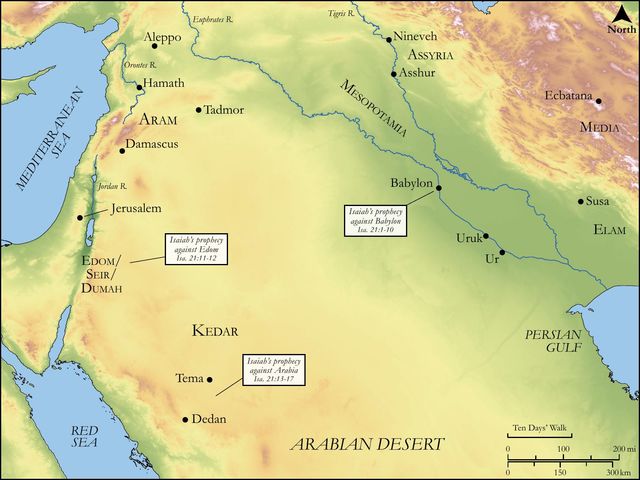
Study this verse
Public-domain commentary
Matthew Henry
From his Commentary on the Whole Bible. Henry comments on passages, not single verses — this entry covers Isaiah 21:1–10. His three-level outline is real structure in the source text, so it is rendered as structure.
We had one burden of Babylon before (ch. 13); here we have another prediction of its fall. God saw fit thus to possess his people with the belief of this event by line upon line, because Babylon sometimes pretended to be a friend to them (as Isa 39:1), and God would hereby warn them not to trust to that friendship, and sometimes was really an enemy to them, and God would hereby warn them not to be afraid of that enmity. Babylon is marked for ruin; and all that believe God's prophets can, through that glass, see it tottering, see it tumbling, even when with an eye of sense they see it flourishing and sitting as a queen. Babylon is here called the desert or plain of the sea; for it was a flat country, and full of lakes, or loughs (as they call them in Ireland), like little seas, and was abundantly watered with the many streams of the river Euphrates. Babylon did but lately begin to be famous, Nineveh having outshone it while the monarchy was in the Assyrian hands; but in a little time it became the lady of kingdoms; and, before it arrived at that pitch of eminency which it was at in Nebuchadnezzar's time, God by this prophet plainly foretold its fall, again and again, that his people might not be terrified at its rise, nor despair of relief in due time when they were its prisoners, Job 5:3; Psa 37:35, Psa 37:36. Some think it is here called a desert because, though it was now a populous city, it should in time be made a desert. And therefore the destruction of Babylon is so often prophesied of by this evangelical prophet, because it was typical of the destruction of the man of sin, the great enemy of the New Testament church, which is foretold in the Revelation in many expressions borrowed from these prophecies, which therefore must be consulted and collated by those who would understand the prophecy of that book. Here is,
I.The powerful irruption and descent which the Medes and Persians should make upon Babylon (Isa 21:1, Isa 21:2):
They will come from the desert, from a terrible land. The northern parts of Media and Persia, where their soldiers were mostly bred, was waste and mountainous, terrible to strangers that were to pass through it and producing soldiers that were very formidable. Elam (that is, Persia) is summoned to go up against Babylon, and, in conjunction with the forces of Media, to besiege it. When God has work of this kind to do he will find, though it be in a desert, in a terrible land, proper instruments to be employed in it. These forces come as whirlwinds from the south, so suddenly, so strongly, so terribly, such a mighty noise shall they make, and throw down every thing that stands in their way. As is usual in such a case, some deserters will go over to them: The treacherous dealers will deal treacherously. Historians tell us of Gadatas and Gobryas, two great officers of the king of Babylon, that went over to Cyrus, and, being well acquainted with all the avenues of the city, led a party directly to the palace, where Belshazzar was slain. Thus with the help of the treacherous dealers the spoilers spoiled. Some read it thus: There shall be a deceiver of that deceiver, Babylon, and a spoiler of that spoiler, or, which comes all to one, The treacherous dealer has found one that deals treacherously, and the spoiler one that spoils, as it is expounded, Isa 33:1. The Persians shall pay the Babylonians in their own coin; those that by fraud and violence, cheating and plundering, unrighteous wars and deceitful treaties, have made a prey of their neighbours, shall meet with their match, and by the same methods shall themselves be made a prey of.
II.The different impressions made hereby upon those concerned in Babylon.
1.To the poor oppressed captives it would be welcome news; for they had been told long ago that Babylon's destroyer would be their deliverer, and therefore, "when they hear that Elam and Media are coming up to besiege Babylon, all their sighing will be made to cease; they shall no longer mingle their tears with Euphrates' streams, but resume their harps, and smile when they remember Zion, which, before, they wept at the thought of." For the sighing of the needy the God of pity will arise in due time (Psa 12:5); he will break the yoke from all their neck, will remove the rod of the wicked from off their lot, and so make their sighing to cease.
2.To the proud oppressors it would be a grievous vision (Isa 21:2), particularly to the king of Babylon for the time being, and it should seem that he it is who is here brought in sadly lamenting his inevitable fate (Isa 21:3, Isa 21:4): Therefore are my loins filled with pain; pangs have taken hold upon me, etc., which was literally fulfilled in Belshazzar, for that very night in which his city was taken, and himself slain, upon the sight of a hand writing mystic characters upon the wall his countenance was changed and his thoughts troubled him, so that the joints of his loins were loosed and his knees smote one against another, Dan 5:6. And yet that was but the beginning of sorrows. Daniel's deciphering the writing could not but increase his terror, and the alarm which immediately followed of the executioners at the door would be the completing of it. And those words, The night of my pleasure has he turned into fear to me, plainly refer to that aggravating circumstance of Belshazzar's fall that he was slain on that night when he was in the height of his mirth and jollity, with his cups and concubines about him and a thousand of his lords revelling with him; that night of his pleasure, when he promised himself an undisturbed unallayed enjoyment of the most exquisite gratifications of sense, with a particular defiance of God and religion in the profanation of the temple vessels, was the night that was turned into all this fear. Let this give an effectual check to vain mirth and sensual pleasures, and forbid us ever to lay the reins on the neck of them - that we know not what heaviness the mirth may end in, nor how soon laughter may be turned into mourning; but this we know that for all these things God shall bring us into judgment; let us therefore mix trembling always with our joys.
III.A representation of the posture in which Babylon should be found when the enemy should surprise it - all in festival gaiety (Isa 21:5):
"Prepare the table with all manner of dainties. Set the guards; let them watch in the watch-tower while we eat and drink securely and make merry; and, if any alarm should be given, the princes shall arise and anoint the shield, and be in readiness to give the enemy a warm reception." Thus secure are they, and thus do they gird on the harness with as much joy as if they were putting it off.
IV.A description of the alarm which should be given to Babylon upon its being forced by Cyrus and Darius.
The Lord, in vision, showed the prophet the watchman set in his watch-tower, near the watch-tower, near the palace, as is usual in times of danger; the king ordered those about him to post a sentinel in the most advantageous place for discovery, and, according to the duty of a watchman, let him declare what he sees, Isa 21:6. We read of watchmen thus set to receive intelligence in the story of David (Sa2 18:24), and in the story of Jehu, Kg2 9:17. This watchman here discovered a chariot with a couple of horsemen attending it, in which we may suppose the commander-in-chief to ride. He then saw another chariot drawn by asses or mules, which were much in use among the Persians, and a chariot drawn by camels, which were likewise much in use among the Medes; so that (as Grotius thinks) these two chariots signify the two nations combined against Babylon, or rather these chariots come to bring tidings to the palace; compare Jer 51:31, Jer 51:32. One post shall run to meet another, and one messenger to meet another, to show the king of Babylon that his city is taken at one end while he is revelling at the other end and knows nothing of the matter. The watchman, seeing these chariots at some distance, hearkened diligently with much heed, to receive the first tidings. And (Isa 21:8) he cried, A lion; this word, coming out of a watchman's mouth, no doubt gave them a certain sound, and every body knew the meaning of it, though we do not know it now. It is likely that it was intended to raise attention: he that has an ear to hear, let him hear, as when a lion roars. Or he cried as a lion, very loud and in good earnest, the occasion being very urgent. And what has he to say?
1.He professes his constancy to the post assigned him: "I stand, my lord, continually upon the watch-tower, and have never discovered any thing material till just now; all seemed safe and quiet." Some make it to be a complaint of the people of God that they had long expected the downfall of Babylon, according to the prophecy, and it had not yet come; but withal a resolution to continue waiting; as Hab 2:1, I will stand upon my watch, and set me upon the tower, to see what will be the issue of the present providences.
2.He gives notice of the discoveries he had made (Isa 21:9): Here comes a chariot of men with a couple of horsemen, a vision representing the enemy's entry into the city with all their force or the tidings brought to the royal palace of it.
V.A certain account is at length given of the overthrow of Babylon.
He in the chariot answered and said (when he heard the watchman speak), Babylon has fallen, has fallen; or God answered thus to the prophet enquiring concerning the issue of these affairs: "It has now come to this, Babylon has surely and irrecoverably fallen. Babylon's business is done now. All the graven images of her gods he has broken unto the ground." Babylon was the mother of harlots (that is, of idolatry), which was one of the grounds of God's quarrel with her; but her idols should now be so far from protecting her that some of them should be broken down to the ground, and others of them, that were worth carrying way, should go into captivity, and be a burden to the beasts that carried them, Isa 46:1, Isa 46:2.
VI.Notice is given to the people of God, who were then captives in Babylon, that this prophecy of the downfall of Babylon was particularly intended for their comfort and encouragement, and they might depend upon it that it should be accomplished in due season, Isa 21:10. Observe,
1.The title the prophet gives them in God's name: O my threshing, and the corn of my floor! The prophet calls them his, because they were his countrymen, and such as he had a particular interest in and concern for; but he speaks it as from God, and directs his speech to those that were Israelites indeed, the faithful in the land. Note,
(1.)The church is God's floor, in which the most valuable fruits and products of this earth are, as it were, gathered together and laid up.
(2.)True believers are the corn of God's floor. Hypocrites are but as the chaff and straw, which take up a great deal of room, but are of small value, with which the wheat is now mixed, but from which it shall be shortly and for ever separated.
(3.)The corn of God's floor must expect to be threshed by afflictions and persecutions. God's Israel of old was afflicted from her youth, often under the plougher's plough (Psa 129:3) and the thresher's flail.
(4.)Even then God owns it for his threshing; it is his still; nay, the threshing of it is by his appointment, and under his restraint and direction. The threshers could have no power against it but what was given them from above.
2.The assurance he gives them of the truth of what he had delivered to them, which therefore they might build their hopes upon: That which I have heard of the Lord of hosts, the God of Israel - that, and nothing else, that, and no fiction or fancy of my own - have I declared unto you. Note, In all events concerning the church, past, present, and to come, we must have an eye to God both as the Lord of hosts and as the God of Israel, who has power enough to do any thing for his church and grace enough to do every thing that is for her good, and to the words of his prophets, as words received from the Lord. As they dare not smother any thing which he has entrusted them to declare, so they dare not declare any thing as from him which he has not made known to them, Co1 11:23.
Historical interpretation
Historical reception
2 surviving comments on this verse. Each one is dated, so this reads as a timeline rather than a list.
(Verse 3, 4.) Therefore my loins are filled with pain: anguish has taken hold of me, like the anguish of a woman in labor: I am bowed down when I hear it, I am troubled when I see it. My heart is faint, darkness has overwhelmed me. Babylon, my beloved, has become a wonder to me. The prophets are therefore obscured, because many individuals are changed in them. Therefore now the voice of Isaiah is introduced mourning for Babylon in a prophetic spirit, because such great evils are about to come upon her, that the one who narrates, overcome by fear, is unable to burst forth into words, seeing the bloodshed of such a multitude: and moved by the affection of mercy (for indeed he speaks of humans), he grieves no less than a woman wailing in childbirth; but he is troubled and fearful, and falling to the ground, with dim eyes he knows not what he is saying. But for the name that we translate as Babylon, in Hebrew it is read Neseph Esci (); and it is the very word that we placed at the beginning of the Babylonian Oneris, on the dark mountain: for it is written Neseph for dark or gloomy. And this city is specifically called thus, because of its height and the erect summit of pride reaching up to heaven.
(Chapter 21—Verse 1 and following) The burden of the desert of the sea. As hurricanes come from the south, it comes from the desert, from a fearful land. A harsh vision has been revealed to me: he who is unbelieving acts unfaithfully, and he who is a plunderer lays waste. Rise up, Elam, besiege Media: I have caused all their groaning to cease. Therefore my loins are filled with pain: distress has gripped me, like the distress of a woman in labor. 70: Vision of the desert of the sea. Just as a storm passes through the desert, coming from the desert. A vision of horror has been announced to me from the land of distress: the transgressor transgresses, and the unjust acts unjustly. The Elamites are against me, and the messengers of Persia come: now I groan and console myself: therefore my loins are filled with anguish, sorrows have seized me, like a woman in labor. What seems to us according to History we have said briefly: now let us grasp the summary of tropologies. A vision, or a burden against this world, is seen as the sea: and it is seen by the Prophet, how great temptations this world is full of. However, as to why the sea is called a world (not to mention many other things), I am content with one testimony from the Psalms: Those who go down to the sea in ships, who do business on great waters, they have seen the works of the Lord, and his wonders in the deep (Psalm 107:23). For those who work in this world do the work of God, and with the Prophet they say: Come into the deep sea, they themselves see his wonders in the deep; and having been delivered from temptations and distress, they say they have heard a terrible and harsh vision. But this very storm comes from the desert, in which the Lord was tempted (Matthew IV), and Israel suffered from the bites of serpents and the stings of scorpions (Numbers XXI). And when it comes, it passes through and goes by; and then he who endures understands that only the transgressor transgresses and only the wicked acts wickedly. Therefore, if we are overwhelmed by the waves of the sea and if a fierce storm overtakes us, it is because of our own vice, for we were transgressors and wicked before the storm. And what he says is this: Against me the Elamites and the ambassadors of the Persians come, here the meaning is: the Elamites interpret with contempt, the Persians try. Therefore, let those come who are accustomed to despise, to scorn, and to try; but I will lament, and my groaning will be my consolation. But even my loins are filled with distress, and I have been seized by pains like a woman in labor, so that I may conceive and give birth from the fear of the Lord, and make his spirit of salvation come upon the earth. But according to the Hebrew, the whirlwinds and storms come from the desert and from the dreadful land, where there is no inhabitant, God is not present, and everything is earthly. And whoever is unbelieving acts in accordance with his unbelief, and the devastator lays waste. Therefore, he speaks boldly against his adversaries, saying, 'Ascend, Elam; lay siege to the Medes!' I have caused every groaning of the desert sea and the dreadful land, and the harshest vision that was announced to cease. Because my loins are filled with repentance, not with pleasure as before, but with sorrow, and I will say no more: My loins are filled with illusions. (Ps. XXXVII, 7). For anguish and tribulation have taken hold of me, as it is wont to hold a woman in labor. The Vulgate edition and the Hebrew text differ greatly in this place; therefore, we will briefly examine both, lest we leave ourselves an opportunity for captious fault-finding.
Continue studying Isaiah 21:3 across the web’s major study libraries — every link below opens this exact verse, chapter, or book on the destination site.
Read & Compare
 BibleGatewayThis verse in more than 200 translations and 70 languages.
 Bible.comThe YouVersion reader — hundreds of translations, reading plans, and highlights.
 ESV.orgCrossway's official English Standard Version reader.
 NET BibleThe NET translation with 60,000+ translators' notes on every rendering decision.
 STEP BibleTyndale House's free study tool — original text, vocabulary, and scholarly resources.
 BibliaLogos Bible Software's free web reader.
 USCCBThe New American Bible (Revised Edition) with the U.S. bishops' study notes.
Commentaries
 BibleHub CommentariesDozens of classic commentaries on this verse, gathered on one page.
 StudyLightMore than 100 commentary sets — the largest collection on the web.
 BibleRefPlain-English commentary on what this verse means, verse by verse.
 Enduring WordDavid Guzik's free commentary on this chapter, widely used by Bible teachers.
 Bible Study ToolsVerse commentary alongside Greek and Hebrew study aids.
Original Language & Research
- BibleHub InterlinearThe verse word by word — original language, transliteration, and English.
- BibleHub LexiconEvery word's original-language definition and Strong's entry.
 Blue Letter BibleDeep-study tools — Strong's numbers, concordance, and word studies.
 SefariaThe Hebrew text with Rashi and centuries of Jewish commentary.
Sermons, Hymns & Audio


TrulyRandomVerse is not affiliated with these sites and doesn’t control their content. They’re linked because they’re genuinely useful.
Summary
Isaiah 21:3 powerfully captures the prophet Isaiah's profound and visceral anguish upon receiving a divine revelation concerning the impending, devastating fall of Babylon. His physical and emotional collapse, vividly likened to the excruciating pain of a woman in childbirth, underscores the overwhelming burden of God's righteous judgment, demonstrating not only the terrifying severity of the coming destruction but also the deep empathetic suffering of the prophet tasked with conveying such a weighty and somber message.
Context
ShowHideLiterary Context
This verse is strategically placed within a series of prophetic oracles, often referred to as "burdens" (Hebrew: massa), which are found in Isaiah chapters 13-23. Specifically, Isaiah 21:1 initiates this particular oracle, cryptically designating it as "the burden of the desert of the sea," a symbolic reference to Babylon. The immediate preceding verses, Isaiah 21:1-2, describe a terrifying vision of treachery and desolation, portraying Elam and Media rising against Babylon. Isaiah's intense personal reaction in verse 3 directly follows this horrific preview, indicating that his profound pain and distress are a direct, empathetic response to the detailed and devastating vision of Babylon's impending destruction and the chaos it will unleash. This personal anguish serves to authenticate the vision's severity and highlights the prophet's deep, personal engagement with the divine message.
Historical & Cultural Context
The prophecy in Isaiah 21 concerns the formidable city of Babylon, a dominant imperial power in the ancient Near East, renowned for its immense wealth, military might, and pervasive idolatry. While Babylon would later conquer Judah, this specific oracle most likely refers to its momentous fall to the Medes and Persians under Cyrus the Great in 539 BC, an event that dramatically reshaped the geopolitical landscape of the ancient world. The enigmatic phrase "desert of the sea" is a symbolic and perhaps ironic reference to Babylon, possibly alluding to its location in the marshy plains of Mesopotamia, prone to flooding from the Euphrates and Tigris rivers, or metaphorically describing it as a vast, turbulent "sea" of humanity destined for desolation. Prophetic "burdens" were a common literary form in ancient Israel, signifying a heavy divine message, often one of impending judgment, that weighed profoundly upon the prophet's spirit. The comparison of suffering to "childbirth pangs" was a widely understood and potent idiom in the ancient world for unavoidable, intense, and sudden suffering, frequently employed in the Old Testament to describe the onset of divine judgment or a great, inescapable crisis.
Key Themes
ShowHideIsaiah 21:3 powerfully contributes to several overarching themes present within the book of Isaiah and biblical prophecy as a whole. Firstly, it vividly illustrates Prophetic Anguish and Empathy, demonstrating that God's chosen messengers often bore the immense emotional and even physical weight of the messages they were commissioned to deliver. Isaiah's agony is not merely an intellectual comprehension but a profound, empathetic identification with the future suffering of those involved in the judgment, even the enemies of God's people, a sentiment echoed in Jeremiah 4:19. Secondly, the verse underscores The Weight of Divine Revelation, emphasizing that receiving and truly comprehending God's truth, particularly concerning impending judgment, can be an overwhelming, distressing, and even physically debilitating experience. The prophet is "bowed down" and "dismayed" by the sheer severity of what he hears and sees, indicating the profound and transformative impact of God's holy word (compare Habakkuk 3:16). Finally, the intensity of Isaiah's reaction serves as a powerful indicator of the Severity and Certainty of Impending Judgment and Destruction. The vision is so terrifying and absolute that it physically afflicts the one who beholds it, signaling the absolute certainty and horror of Babylon's ultimate downfall, a theme reverberating throughout other prophetic books concerning God's judgment on proud and idolatrous nations (e.g., Jeremiah 50-51).
Exposition and Analysis
ShowHideKey Word Analysis
ShowHideThis feminine noun (H2479) is derived from a root meaning "writhing" and specifically denotes the agony of childbirth. By implication, it also signifies terror and great suffering. Its use here emphasizes the intense, gripping, and unavoidable nature of the prophet's distress, mirroring the physical contortions and emotional anguish associated with labor.
This noun (H6735), appearing twice in the verse, refers to a throe or a sharp, acute pain, often linked to physical or mental pressure. When explicitly paired with "travaileth," it unequivocally evokes the contractions of childbirth, symbolizing a sudden, overwhelming, and progressively intense suffering that leads to an inevitable and often dramatic outcome. The repetition of the word reinforces the overwhelming severity and inescapable nature of the pain.
As a primitive root (H926), this verb signifies an inward trembling or palpitation, leading to a state of being suddenly alarmed, agitated, or even hastened anxiously. Isaiah's dismay is a profound psychological and emotional shock, indicating a state of being utterly overwhelmed and terrified by the vision's content, causing internal turmoil and external agitation.
Verse Breakdown
ShowHide"Therefore are my loins filled with pain:"
The prophet directly attributes his profound physical suffering to the divine revelation he has received. His "loins" (H4975), metaphorically the seat of strength, vitality, and procreation, are described as being "filled" (H4390), indicating a complete saturation and overwhelming inundation with pain. This is a profound, total bodily response, suggesting that the burden is not merely intellectual or emotional but has permeated his very being, incapacitating him.
"pangs have taken hold upon me, as the pangs of a woman that travaileth:"
This powerful and vivid simile compares Isaiah's agony to the inescapable, excruciating, and progressively intense pain of childbirth. The "pangs" (H6735) have "taken hold" (H270) of him, emphasizing their gripping, unavoidable, and relentless nature. This imagery conveys the suddenness, the overwhelming intensity, and the inevitable outcome associated with the impending divine judgment.
"I was bowed down at the hearing [of it];"
The prophet describes a physical collapse, being "bowed down" (H5753), a posture indicative of weakness, defeat, profound grief, or overwhelming burden. This reaction is specifically tied to "the hearing" (H8085) of the prophetic message, indicating the terrifying and incapacitating nature of the divine pronouncement itself, which has struck him with immense force.
"I was dismayed at the seeing [of it]."
Complementing the auditory impact, the "seeing" (H7200) of the vision also causes him to be "dismayed" (H926). This dual sensory experience — both hearing the divine pronouncement and seeing the terrifying vision — underscores the comprehensive and utterly overwhelming nature of the revelation, leading to a state of profound shock, agitation, and internal trembling.
Literary Devices
ShowHideIsaiah 21:3 is rich in Sensory Imagery, vividly depicting the prophet's extreme physical and emotional distress through explicit descriptions of pain, the act of hearing, and the act of seeing. The central Simile comparing his suffering to "the pangs of a woman that travaileth" is exceptionally potent. This comparison, a common biblical idiom, is employed here with powerful effect to convey the sudden, unavoidable, and excruciating nature of the pain, emphasizing its progressive intensity and the inevitable, often catastrophic, outcome it portends. The use of Hyperbole in describing the prophet's extreme physical reaction ("my loins filled with pain," "I was bowed down," "I was dismayed") effectively underscores the immense gravity and terror of the divine revelation. Furthermore, the phrase "pangs have taken hold upon me" contains an element of Personification, as if the pain itself is an active, living agent seizing and gripping the prophet. These literary devices collectively amplify the sense of overwhelming dread and the profound, debilitating burden placed upon the prophet as he apprehends the future judgment.
Theological and Thematic Connections
ShowHideIsaiah's profound anguish in this verse serves as a stark and visceral reminder of the gravity of divine judgment and the empathetic burden often carried by those who faithfully proclaim God's truth. It highlights that God's justice is not an abstract concept but a terrifying reality that can evoke deep distress, even in His chosen messengers. This prophetic suffering underscores the holiness of God and the seriousness of sin, which necessitates such severe and devastating consequences. Furthermore, it reveals a God who, while perfectly just, is not indifferent to the suffering that results from judgment, allowing His prophet to experience a measure of that pain as a testament to its reality. This profound empathy in the prophet foreshadows a deeper divine empathy for humanity's plight, even as judgment unfolds.
Reflection and Application
ShowHideIsaiah's visceral reaction to the prophecy of Babylon's fall challenges us to consider our own response to God's word, especially its more difficult truths concerning sin, judgment, and suffering. It calls us beyond a mere intellectual assent to a deeper, more empathetic, and transformative engagement. Just as Isaiah was "bowed down" and "dismayed," we too should allow the weight of God's holiness and the profound consequences of rebellion to deeply affect us, fostering a healthy and reverent fear of the Lord and a profound compassion for a world desperately in need of redemption. This passage encourages us to cultivate genuine empathy for those who face the consequences of their choices, even when those consequences are deserved, and to pray earnestly for repentance and mercy. It also serves as a poignant reminder to honor and support spiritual leaders who often carry heavy burdens as they faithfully convey God's truth, witnessing spiritual realities and their profound implications that may be unseen by others. Ultimately, while the judgment is severe and terrifying, the underlying purpose of such prophecies is often to call people to repentance and to highlight God's unwavering justice, which ultimately paves the way for His glorious salvation for all who turn to Him in faith.
Questions for Reflection
ShowHideFAQ
ShowHideWhy was Isaiah in such extreme pain and distress over the fall of Babylon, an enemy nation?
ShowHideIsaiah's profound anguish was not primarily sympathy for Babylon itself, but rather a deep, empathetic, and visceral response to the sheer horror and devastation that God's righteous judgment would unleash. As a prophet, he was granted a divine vision (H7200, râʼâh) and heard a divine pronouncement (H8085, shâmaʼ) that allowed him to perceive the future reality with extraordinary clarity and intensity. This direct encounter with the severity of God's holy wrath and the ensuing chaos was so overwhelming that it manifested physically, causing him to be "filled with pain" (H4390, mâlêʼ with H2479, chalchâlâh') and "dismayed" (H926, bâhal). His suffering underscores the immense gravity of sin and judgment, demonstrating the weighty responsibility of conveying God's messages, even those against His enemies, and highlighting the prophet's profound identification with the divine perspective on justice and its terrifying consequences.
What is the significance of comparing Isaiah's pain to "the pangs of a woman that travaileth"?
ShowHideThis powerful simile (H6735, tsîyr with H3205, yâlad) is a frequently used and highly evocative idiom in the Old Testament to describe sudden, unavoidable, and intensely excruciating pain. It emphasizes several key aspects of the coming judgment: the agonizing nature of the suffering, its progressive and unrelenting intensity, its absolute inevitability, and the fact that it leads to a definitive, often dramatic, and irreversible outcome. In the context of divine judgment, it signifies that the coming destruction is not only severe but also inescapable, arriving with a sudden, overwhelming, and gripping force, much like labor pains that seize a woman without warning and culminate in a birth. This vivid imagery underscores the absolute certainty, terror, and transformative power of Babylon's impending fall.
Christ-Centered Fulfillment
ShowHideWhile Isaiah's anguish in Isaiah 21:3 powerfully reveals the prophet's empathetic burden in proclaiming divine judgment, it ultimately points forward to the ultimate burden-bearer, Jesus Christ. Isaiah, as a human prophet, experienced a measure of the pain and dismay (H926, bâhal) associated with God's righteous judgment against sin. Yet, Christ, as the eternal Son of God, would not merely witness judgment but would bear it in its fullness. The "pangs" (H6735, tsîyr) that took hold of Isaiah foreshadow the infinitely greater "pangs" that took hold of Jesus in the Garden of Gethsemane, where His soul was "very sorrowful, even to death" (Matthew 26:38). There, He was "bowed down" (H5753, ʻâvâh) under the immense weight of the world's sin, experiencing an agony so profound that it caused Him to sweat drops of blood (Luke 22:44). On the cross, Jesus became sin for us (2 Corinthians 5:21), fully absorbing the divine wrath and judgment that humanity deserved. His suffering was the ultimate fulfillment of the prophetic burden, as He, the Lamb of God, truly "takes away the sin of the world" (John 1:29). Thus, Isaiah's pain, though real and profound, serves as a dim reflection of the immeasurable, redemptive suffering Christ endured to secure salvation and deliver humanity from the very judgment that caused the prophet such dismay.