


Jeremiah 49:24
- רָפְתָהra·fe·Tahit will be disheartenedH7503V-Qal-Perf-3fsVerb Qal Perfect 3rd Singular Feminine
- דַמֶּשֶׂקda·Me·sekDamascusH1834N-properNoun Proper Location
- הִפְנְתָהhif·ne·Tahit will turn backH6437V-Hiphil-Perf-3fsVerb Hiphil Perfect 3rd Singular Feminine
- לָנוּסla·Nusto fleeH5127Prep-l ¦ V-Qal-InfVerb Qal Infinitive Constructלָtoנוּסflee
- וְרֶטֶטve·Re·tetand panicH7374Conj-w ¦ N-msNoun Singular Masculine Absoluteוְandרֶטֶטpanic
- הֶחֱזִיקָהhe·che·Zi·kahit will take holdH2388V-Hiphil-Perf-3fsVerb Hiphil Perfect 3rd Singular Feminine
- צָרָהtza·RahdistressH6869N-fsNoun Singular Feminine Absolute
- וַחֲבָלִיםva·cha·va·Limand painsH2256Conj-w ¦ N-mpNoun Plural Masculine Absoluteוַandחֲבָלִיםpains
- אֲחָזַתָּה'a·cha·Za·tahit will seize itH270V-Qal-Perf-3fs ¦ 3fsVerb Qal Perfect 3rd Singular Feminineאֲחָזַתָּit will seizeהit
- כַּיּוֹלֵדָהkai·yo·le·Dahlike <the> [woman] giving birthH3205Prep-k ¦ V-Qal-Prtcpl-fsVerb Qal Participle Singular Feminine Absoluteכַּlike <the>יּוֹלֵדָה[woman] giving birth
English is a literal word-by-word gloss of the Hebrew, not the KJV's wording. Why?
This is the original text the KJV's translators worked from — each Hebrew word with its own literal English meaning in this verse, prepared by scholars at Tyndale House, Cambridge. The KJV translates whole sentences, not word by word, so its wording differs: one Hebrew word can become several English words, and the KJV may choose “the LORD” where the gloss reads “Yahweh”. Both are faithful — they answer different questions. For the KJV's own rendering, switch to the KJV text.
Details
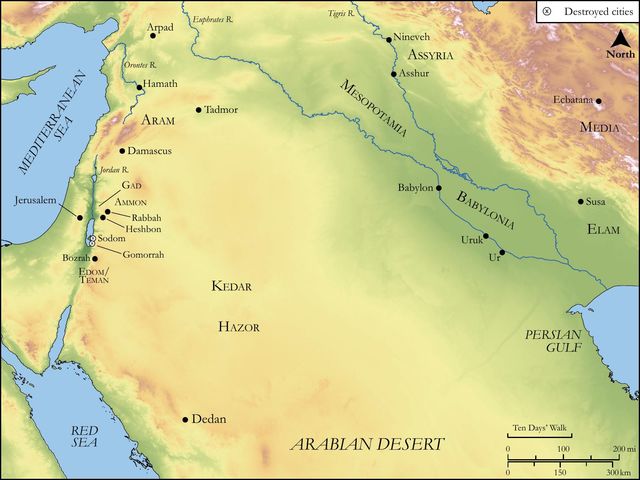
See on the biblical-era map
Study this verse
Public-domain commentary
Matthew Henry
From his Commentary on the Whole Bible. Henry comments on passages, not single verses — this entry covers Jeremiah 49:23–27.
The kingdom of Syria lay north of Canaan, as that of Edom lay south, and thither we must now remove and take a view of the approaching fate of that kingdom, which had been often vexatious to the Israel of God. Damascus was the metropolis of that kingdom, and the ruin of the whole is supposed in the ruin of that: yet Hamath and Arpad, two other considerable cities, are names (Jer 49:23), and the palaces of Ben-hadad, which he built, are particularly marked for ruin, Jer 49:27; see also Amo 1:4. Some think Ben-hadad (the son of Hadad, either their idol, or one of their ancient kings, whence the rest descended) was a common name of the kings of Syria, as Pharaoh of the kings of Egypt. Now observe concerning the judgment of Damascus, 1. It begins with a terrible fright and faint-heartedness. They hear evil tidings, that the king of Babylon, with all his force, is coming against them, and they are confounded; they know not what measures to take for their own safety, their souls are melted, they are faint-hearted, they have no spirit left them, they are like the troubled sea, that cannot be quiet (Isa 57:20), or like men in a storm at sea (Psa 107:26); or the sorrow that begins in the city shall go to the sea-coast, Jer 49:23. See how easily God can dispirit those nations that have been most celebrated for valour. Damascus now waxes feeble (Jer 49:24), a city that thought she could look the most formidable enemy in the face now turns herself to flee, and owns it is to no more purpose to think of contending with her fate than for a woman in labour to contend with her pains, which she cannot escape, but must yield to. It was a city of praise (Jer 49:25), not praise to God, but to herself, a city much commended and admired by all strangers that visited it. It was a city of joy, where there was an affluence and confluence of all the delights of the sons of men, and abundance of mirth in the enjoyment of them. We read it (though there is no necessity for this) the city of my joy, which the prophet himself had sometimes visited with pleasure. Or it may be the speech of the king lamenting the ruin of the city of his joy. But now it is all overwhelmed with fear and grief. Note, Those deceive themselves who place their happiness in carnal joys; for God in his providence can soon cast a damp upon them and put an end to them. He can soon make a city of praise to be a reproach and a city of joy to be a terror to itself. 2. It ends with a terrible fall and fire. (1.) The inhabitants are slain (Jer 49:26): The young men, who should fight the enemy and defend the city, shall fall by the sword in her streets; and all the men of war, mighty men, expert in war, and engaged in the service of their country, shall be cut off. (2.) The city is laid in ashes (Jer 49:27): The fire is kindled by the besiegers in the wall, but it shall devour all before it, the palaces of Ben-hadad particularly, where so much mischief had formerly been hatched against God's Israel, for which it is now thus visited.
Continue studying Jeremiah 49:24 across the web’s major study libraries — every link below opens this exact verse, chapter, or book on the destination site.
Read & Compare
 BibleGatewayThis verse in more than 200 translations and 70 languages.
 Bible.comThe YouVersion reader — hundreds of translations, reading plans, and highlights.
 ESV.orgCrossway's official English Standard Version reader.
 NET BibleThe NET translation with 60,000+ translators' notes on every rendering decision.
 STEP BibleTyndale House's free study tool — original text, vocabulary, and scholarly resources.
 BibliaLogos Bible Software's free web reader.
 USCCBThe New American Bible (Revised Edition) with the U.S. bishops' study notes.
Commentaries
 BibleHub CommentariesDozens of classic commentaries on this verse, gathered on one page.
 StudyLightMore than 100 commentary sets — the largest collection on the web.
 BibleRefPlain-English commentary on what this verse means, verse by verse.
 Enduring WordDavid Guzik's free commentary on this chapter, widely used by Bible teachers.
 Bible Study ToolsVerse commentary alongside Greek and Hebrew study aids.
Original Language & Research
- BibleHub InterlinearThe verse word by word — original language, transliteration, and English.
- BibleHub LexiconEvery word's original-language definition and Strong's entry.
 Blue Letter BibleDeep-study tools — Strong's numbers, concordance, and word studies.
 SefariaThe Hebrew text with Rashi and centuries of Jewish commentary.
Sermons, Hymns & Audio


TrulyRandomVerse is not affiliated with these sites and doesn’t control their content. They’re linked because they’re genuinely useful.
Summary
Jeremiah 49:24 delivers a stark prophetic oracle against Damascus, the ancient capital of Aram (Syria), vividly portraying its sudden and catastrophic collapse under divine judgment. The once-formidable city is depicted as utterly losing its strength, attempting a desperate yet futile escape, and being overwhelmed by an inescapable wave of terror. This profound anguish and sorrow are powerfully likened to the excruciating and unavoidable pains of a woman in childbirth, underscoring the severity, immediacy, and absolute inevitability of its prophetic downfall.
Context
ShowHideLiterary Context
Jeremiah 49:24 is situated within a significant block of prophecies against foreign nations (Jeremiah 46-51), a common feature in prophetic books that underscores Yahweh's universal sovereignty. This section demonstrates that God's authority extends far beyond Israel, encompassing all peoples and empires. Preceding this oracle are judgments against powerful entities like Egypt (Jeremiah 46) and the Philistines (Jeremiah 47). The immediate chapter, Jeremiah 49, details a series of pronouncements against Ammon, Edom, and then Aram/Damascus, followed by a prophecy against Elam. This systematic progression of judgments emphasizes God's comprehensive plan for justice and His absolute control over the geopolitical landscape of the ancient Near East, reinforcing the profound message that no nation, regardless of its perceived might, is exempt from divine accountability.
Historical & Cultural Context
Damascus was one of the oldest continuously inhabited cities and a pivotal regional power in the ancient Near East, frequently interacting with and often opposing Israel throughout its history. Its strategic location on major trade routes contributed to its considerable wealth, military strength, and political influence. Jeremiah's prophetic ministry occurred during a tumultuous period (late 7th to early 6th century BCE), marked by the ascendance of the Neo-Babylonian Empire under Nebuchadnezzar. God frequently employed powerful empires like Babylon as instruments of His judgment, not only against His covenant people but also against surrounding nations. The prophecy against Damascus would have been understood by its original audience as a declaration of its impending subjugation, most likely by the Babylonians, mirroring the fate of other regional powers. Culturally, the imagery of a woman in travail was a universally recognized and deeply visceral metaphor for sudden, intense, and unavoidable distress, making the prophecy's impact immediate and profoundly affecting.
Key Themes
ShowHideThis verse powerfully contributes to several overarching themes prevalent in Jeremiah and broader prophetic literature. Firstly, it emphatically underscores the theme of Divine Judgment and Sovereignty, asserting God's absolute authority over all nations, not merely Israel. No earthly power, irrespective of its perceived strength or ancient heritage, can ultimately withstand His sovereign will, as vividly illustrated by the broader judgments against nations such as Moab (Jeremiah 48) and Ammon (Jeremiah 49:1-6). Secondly, it highlights the Inevitability of Prophecy, demonstrating with chilling certainty that God's declared word will unfailingly come to pass. Damascus's sudden feebleness and desperate flight are depicted not as possibilities, but as an inescapable destiny. Thirdly, the vivid and visceral imagery emphasizes the Overwhelming Nature of Fear and Anguish that accompanies divine judgment, portraying not merely a military defeat but a complete psychological and emotional collapse. Finally, the Simile of a Woman in Travail is a potent thematic element, frequently employed in prophetic literature (e.g., Isaiah 13:8 and Jeremiah 6:24) to convey sudden, intense, and unavoidable pain, signifying the birth of a new, often painful, reality brought about by God's decree.
Exposition and Analysis
ShowHideKey Word Analysis
ShowHideMeaning "to slacken (in many applications, literal or figurative); abate, cease, consume, draw (toward evening), fail, (be) faint, be (wax) feeble, forsake, idle, leave, let alone (go, down), (be) slack, stay, be still, be slothful, (be) weak(-en)." This word powerfully conveys Damascus's complete loss of strength, resolve, and vitality, indicating a profound and irreversible decline from its former power and ability to resist.
Meaning "to fasten upon; hence, to seize, be strong (figuratively, courageous, causatively strengthen, cure, help, repair, fortify), obstinate; to bind, restrain, conquer." While often denoting strength or fortification, in this context, it describes fear "fastening upon" or "seizing" Damascus, indicating an overwhelming and inescapable grip of terror that has completely incapacitated the city, robbing it of all courage.
Meaning "a rope (as twisted)... a noose (as of cords); figuratively, a company (as if tied together); also a throe (especially of parturition); also ruin." This word, frequently translated as "ropes" or "bands," here specifically refers to "throes" or "birth pangs," directly linking the city's anguish to the intense, constricting, and unavoidable pain of childbirth. This connection is fundamental to understanding the profound simile that follows.
Verse Breakdown
ShowHide"Damascus is waxed feeble"
This opening clause immediately establishes the city's dire and weakened state. Despite its historical strength and prominence as a regional power, Damascus is depicted as having lost its vigor, becoming weak, ineffective, and unable to defend itself. This feebleness is a direct consequence of divine judgment, stripping the city of its former capacity and resolve.
"and turneth herself to flee"
This phrase vividly illustrates Damascus's desperate and ultimately futile attempt to escape the impending doom. The personification of the city turning to flee emphasizes its utter panic and the recognition of an overwhelming, irresistible threat from which its only perceived option is flight, even if it proves to be a hopeless endeavor.
"and fear hath seized on her"
Here, the abstract concept of "fear" is powerfully personified as an active, oppressive force that has taken an inescapable hold of Damascus. This signifies an internal collapse, where terror is not merely an emotion but a paralyzing power that has gripped the city, robbing its inhabitants of courage, reason, and the will to resist. The fear is not external but has become an intrinsic, consuming part of the city's experience.
"anguish and sorrows have taken her"
This clause further intensifies the description of the city's profound suffering. "Anguish" (tsârâh) denotes a sense of tightness, distress, or tribulation, while "sorrows" (chebel) specifically refers to the intense, constricting pains associated with childbirth. The active verb "taken" (ʼâchaz, H270) reinforces the idea that these afflictions have seized and utterly possessed the city, leaving it completely helpless and overwhelmed.
"as a woman in travail"
This powerful and deeply evocative simile provides the ultimate descriptor of Damascus's agony. The pain of childbirth is universally known for its sudden onset, overwhelming intensity, and unavoidable nature. By comparing Damascus's suffering to this excruciating experience, the prophet conveys that the city's downfall will be agonizing, inescapable, and will come upon it with the irresistible force and inevitability of labor pains, bringing forth a new, profoundly painful reality.
Literary Devices
ShowHideJeremiah 49:24 masterfully employs several potent literary devices to convey the devastating impact of God's judgment on Damascus. Personification is central to the verse, as Damascus is portrayed not merely as a place but as an active entity that "waxed feeble," "turneth herself to flee," and is seized by "fear," "anguish," and "sorrows." This imbues the city with a human-like experience of terror and suffering, making the prophecy profoundly more emotionally resonant and immediate. The most striking device is the Simile, "as a woman in travail." This comparison is a recurring and powerful prophetic motif, used to describe sudden, intense, and unavoidable pain or judgment. It evokes the visceral image of excruciating, inescapable labor pains, emphasizing the severity, inevitability, and transformative nature of Damascus's downfall. Furthermore, the cumulative effect of "fear hath seized on her" and "anguish and sorrows have taken her" creates a sense of Hyperbole, exaggerating the extent of the city's distress to underscore the totality of its collapse, both physically and psychologically. The rapid succession of verbs describing Damascus's decline and flight also contributes to a powerful sense of Urgency and the swiftness of its impending doom.
Theological and Thematic Connections
ShowHideThis verse profoundly underscores the foundational biblical truth of God's universal sovereignty and His righteous judgment over all nations. It serves as a powerful and humbling reminder that no earthly power, however ancient, wealthy, or militarily formidable, can ultimately defy the will of the Almighty. Damascus, often a symbol of human pride, self-reliance, and oppressive strength, is brought low not solely by a greater human empire, but by the divine decree that orchestrates historical events. The overwhelming fear and anguish described reflect the terror of standing exposed before a holy God, a terror that far surpasses any human conflict or military defeat. This judgment is not arbitrary but is often presented as a just consequence of a nation's persistent wickedness, idolatry, and oppression, aligning seamlessly with the broader prophetic message that God holds all humanity accountable for their actions and will bring justice upon the earth.
Reflection and Application
ShowHideJeremiah 49:24 offers profound and enduring lessons for believers and for humanity across all generations. It serves as a stark reminder that all human institutions, governments, and empires, no matter how powerful or seemingly enduring, are ultimately transient and subject to the sovereign will of God. In a world where nations often boast of their strength, technological prowess, and self-sufficiency, this prophecy profoundly humbles human pride, asserting that true security, lasting peace, and ultimate flourishing are found only in humble submission to the Creator. For the believer, it instills unwavering confidence in God's ultimate control over history, assuring us that even amidst global turmoil, political upheaval, and the rise and fall of earthly powers, His purposes will prevail. It calls us to trust in His perfect justice and to place our hope not in fleeting earthly kingdoms, but in the eternal, unshakable kingdom of God. Furthermore, the vivid imagery of unavoidable anguish should prompt us to seriously consider the gravity of unrepentant sin, both individually and corporately, and to seek God's mercy, wisdom, and righteousness rather than relying on our own strength, strategies, or perceived invincibility.
Questions for Reflection
ShowHideFAQ
ShowHideWhat is the significance of Damascus being "waxed feeble" and "turneth herself to flee"?
ShowHideThis imagery signifies a complete and sudden loss of vitality, strength, and courage, both physical and psychological. Damascus, historically a powerful and often defiant city, is depicted as losing its ability to resist or even stand its ground. "Waxed feeble" (from the Hebrew râphâh') means to slacken, grow weak, or fail, indicating an internal collapse of resolve and a profound enfeeblement. "Turneth herself to flee" (from pânâh' and nûwç') portrays a desperate, panicked attempt at escape, highlighting the overwhelming nature of the threat and the city's recognition of its own utter helplessness. It's a prophetic picture of a once-mighty entity reduced to absolute vulnerability and flight, stripped of its former glory and power.
Why is the simile "as a woman in travail" used to describe Damascus's suffering?
ShowHideThe comparison to a "woman in travail" (Hebrew yâlad' and chebel') is a common and profoundly potent prophetic motif used to describe sudden, intense, and utterly unavoidable pain. The pains of childbirth are universally known for their overwhelming nature, their inevitability, and the fact that once they begin, there is no escape until the process is complete. By using this powerful simile, Jeremiah emphasizes that Damascus's impending judgment will be excruciating, come upon it unexpectedly and with overwhelming force, and be utterly inescapable, leading to a profound and agonizing transformation or "birth" of a new, painful reality for the city. This vivid imagery is also used in other prophecies, such as Isaiah 21:3 and 1 Thessalonians 5:3, to describe the sudden and inescapable nature of divine judgment or the "Day of the Lord."
Christ-Centered Fulfillment
ShowHideWhile Jeremiah 49:24 directly pronounces a specific historical judgment on an earthly city, its profound imagery and underlying theological principles find their ultimate and comprehensive Christ-centered fulfillment. The prophecy of Damascus's sudden feebleness, overwhelming anguish, and inevitable collapse foreshadows the ultimate triumph of Christ over all earthly powers, spiritual forces, and human rebellion that oppose God. Just as Damascus, a symbol of human strength, pride, and defiance, is brought to its knees, so too will every knee ultimately bow and every tongue confess that Jesus Christ is Lord, to the glory of God the Father (Philippians 2:10-11). The "fear" and "anguish" seizing Damascus prefigure the terror that will grip those who reject Christ when He returns in glory to judge the living and the dead, a day when kings and great men will hide themselves from the wrath of the Lamb (Revelation 6:15-17). Moreover, the imagery of "sorrows" and "travail" is transformed and given new meaning in the New Testament. While it speaks of judgment for the wicked, it also speaks of the "birth pangs" of a new creation and the coming kingdom of God, which, though accompanied by tribulation and suffering, ultimately brings forth the glorious reign of Christ and the liberation of all creation (Romans 8:22-23). Jesus Himself spoke of these "birth pains" as signs preceding His return, indicating that the world's suffering and turmoil are leading to a new spiritual reality and the consummation of His kingdom (Matthew 24:8). Thus, the judgment on Damascus, a specific historical event, points to the universal and ultimate victory of the Lamb of God, who alone has the authority to bring down all opposing powers and establish His eternal kingdom, where for His redeemed, there will be no more sorrow, pain, or tears (Revelation 21:4).