


Jeremiah 49:26
- לָכֵןla·Khen<to> thereforeH3651Prep-l ¦ AdvAdverbלָ<to>כֵןtherefore
- יִפְּלוּyi·pe·Luthey will fallH5307V-Qal-Imperf-3mpVerb Qal Imperfect 3rd Plural Masculine
- בַחוּרֶיהָva·chu·Rei·haits young menH970N-mpc ¦ 3fsNoun Plural Masculine Constructבַחוּרֶיyoung menהָits
- בִּרְחֹבֹתֶיהָbir·cho·Tei·hain its open placesH7339Prep-b ¦ N-fpc ¦ 3fsNoun Plural Feminine Constructבִּinרְחֹבֹתֶיopen placesהָits
- וְכָלve·kholand allH3605Conj-w ¦ N-mscNoun Singular Masculine Constructוְandכָלall
- אַנְשֵׁי'an·Shei[the] men ofH582N-mpcNoun Plural Masculine Construct
- הַמִּלְחָמָהha·mil·cha·Mah<the> warH4421Art ¦ N-fsNoun Singular Feminine Absoluteהַ<the>מִּלְחָמָהwar
- יִדַּמּוּyi·Da·muthey will be silencedH1826V-Niphal-Imperf-3mpVerb Niphal Imperfect 3rd Plural Masculine
- בַּיּוֹםbai·Yomin the dayH3117Prep-b ¦ N-msNoun Singular Masculine Absoluteבַּin theיּוֹםday
- הַהוּאha·Hu'<the> thatH1931Art ¦ Pro-3msPronoun Personal 3rd Singular Masculineהַ<the>הוּאthat
- נְאֻםne·'Um[the] utterance ofH5002N-mscNoun Singular Masculine Construct
- יְהוָהYah·wehYahwehH3068N-properNoun Proper Title
- צְבָאוֹתtze·va·'otof hostsH6635N-fpNoun Plural Feminine Absolute
English is a literal word-by-word gloss of the Hebrew, not the KJV's wording. Why?
This is the original text the KJV's translators worked from — each Hebrew word with its own literal English meaning in this verse, prepared by scholars at Tyndale House, Cambridge. The KJV translates whole sentences, not word by word, so its wording differs: one Hebrew word can become several English words, and the KJV may choose “the LORD” where the gloss reads “Yahweh”. Both are faithful — they answer different questions. For the KJV's own rendering, switch to the KJV text.
Details
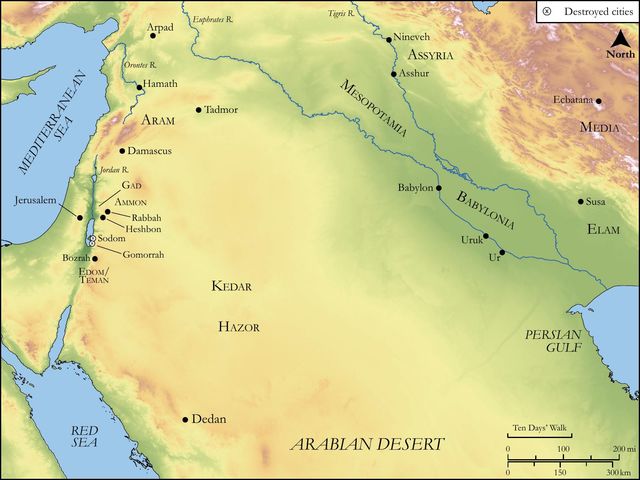
See on the biblical-era map
Study this verse
Public-domain commentary
Matthew Henry
From his Commentary on the Whole Bible. Henry comments on passages, not single verses — this entry covers Jeremiah 49:23–27.
The kingdom of Syria lay north of Canaan, as that of Edom lay south, and thither we must now remove and take a view of the approaching fate of that kingdom, which had been often vexatious to the Israel of God. Damascus was the metropolis of that kingdom, and the ruin of the whole is supposed in the ruin of that: yet Hamath and Arpad, two other considerable cities, are names (Jer 49:23), and the palaces of Ben-hadad, which he built, are particularly marked for ruin, Jer 49:27; see also Amo 1:4. Some think Ben-hadad (the son of Hadad, either their idol, or one of their ancient kings, whence the rest descended) was a common name of the kings of Syria, as Pharaoh of the kings of Egypt. Now observe concerning the judgment of Damascus, 1. It begins with a terrible fright and faint-heartedness. They hear evil tidings, that the king of Babylon, with all his force, is coming against them, and they are confounded; they know not what measures to take for their own safety, their souls are melted, they are faint-hearted, they have no spirit left them, they are like the troubled sea, that cannot be quiet (Isa 57:20), or like men in a storm at sea (Psa 107:26); or the sorrow that begins in the city shall go to the sea-coast, Jer 49:23. See how easily God can dispirit those nations that have been most celebrated for valour. Damascus now waxes feeble (Jer 49:24), a city that thought she could look the most formidable enemy in the face now turns herself to flee, and owns it is to no more purpose to think of contending with her fate than for a woman in labour to contend with her pains, which she cannot escape, but must yield to. It was a city of praise (Jer 49:25), not praise to God, but to herself, a city much commended and admired by all strangers that visited it. It was a city of joy, where there was an affluence and confluence of all the delights of the sons of men, and abundance of mirth in the enjoyment of them. We read it (though there is no necessity for this) the city of my joy, which the prophet himself had sometimes visited with pleasure. Or it may be the speech of the king lamenting the ruin of the city of his joy. But now it is all overwhelmed with fear and grief. Note, Those deceive themselves who place their happiness in carnal joys; for God in his providence can soon cast a damp upon them and put an end to them. He can soon make a city of praise to be a reproach and a city of joy to be a terror to itself. 2. It ends with a terrible fall and fire. (1.) The inhabitants are slain (Jer 49:26): The young men, who should fight the enemy and defend the city, shall fall by the sword in her streets; and all the men of war, mighty men, expert in war, and engaged in the service of their country, shall be cut off. (2.) The city is laid in ashes (Jer 49:27): The fire is kindled by the besiegers in the wall, but it shall devour all before it, the palaces of Ben-hadad particularly, where so much mischief had formerly been hatched against God's Israel, for which it is now thus visited.
Continue studying Jeremiah 49:26 across the web’s major study libraries — every link below opens this exact verse, chapter, or book on the destination site.
Read & Compare
 BibleGatewayThis verse in more than 200 translations and 70 languages.
 Bible.comThe YouVersion reader — hundreds of translations, reading plans, and highlights.
 ESV.orgCrossway's official English Standard Version reader.
 NET BibleThe NET translation with 60,000+ translators' notes on every rendering decision.
 STEP BibleTyndale House's free study tool — original text, vocabulary, and scholarly resources.
 BibliaLogos Bible Software's free web reader.
 USCCBThe New American Bible (Revised Edition) with the U.S. bishops' study notes.
Commentaries
 BibleHub CommentariesDozens of classic commentaries on this verse, gathered on one page.
 StudyLightMore than 100 commentary sets — the largest collection on the web.
 BibleRefPlain-English commentary on what this verse means, verse by verse.
 Enduring WordDavid Guzik's free commentary on this chapter, widely used by Bible teachers.
 Bible Study ToolsVerse commentary alongside Greek and Hebrew study aids.
Original Language & Research
- BibleHub InterlinearThe verse word by word — original language, transliteration, and English.
- BibleHub LexiconEvery word's original-language definition and Strong's entry.
 Blue Letter BibleDeep-study tools — Strong's numbers, concordance, and word studies.
 SefariaThe Hebrew text with Rashi and centuries of Jewish commentary.
Sermons, Hymns & Audio


TrulyRandomVerse is not affiliated with these sites and doesn’t control their content. They’re linked because they’re genuinely useful.
Summary
Jeremiah 49:26 delivers a stark divine pronouncement of judgment against the nation of Ammon, foretelling a catastrophic military and demographic collapse. It declares that their most vital segment—their young men—will perish violently in their own urban centers, while all their seasoned warriors will be utterly annihilated on a specific, divinely appointed day of reckoning. This solemn declaration, sealed by the authoritative phrase "saith the LORD of hosts," underscores the absolute certainty and divine origin of the devastating defeat and national ruin awaiting Ammon, a direct consequence of their hubris and aggression.
Context
ShowHideLiterary Context
Jeremiah 49:26 is the climactic statement within a detailed oracle against Ammon, which spans Jeremiah 49:1-6. This specific prophecy is part of a larger collection of oracles against foreign nations found in Jeremiah 46-51. The preceding verses in the Ammonite oracle meticulously outline the reasons for God's judgment: Ammon's arrogant pride, their misplaced trust in their wealth, and their unjust occupation of the territory belonging to Gad, a tribe of Israel. The prophecy details the desolation of their capital, Rabbah, and the subsequent exile or destruction of its inhabitants. Verse 26, therefore, serves as a powerful and definitive summary of the complete military and demographic ruin that will befall them, emphasizing the totality and public nature of the impending judgment.
Historical & Cultural Context
The Ammonites were a Semitic people, descendants of Lot through his younger daughter, as recorded in Genesis 19:38. They inhabited the Transjordanian region, specifically the area east of the Jordan River, with their capital city, Rabbah, now modern Amman, Jordan. Throughout their history, the Ammonites were frequent adversaries of Israel, engaging in numerous border disputes, military conflicts, and cultural clashes. A significant aspect of their wickedness, often condemned by the prophets, was their worship of the idol Molech, which notoriously involved child sacrifice. Their national pride, highlighted in Jeremiah 49:4, stemmed from their perceived impregnability and their considerable wealth, leading them to rely on their own strength rather than on the Lord. The "streets" mentioned in the verse refer to the broad public squares or thoroughfares of their cities, where such a public downfall would be particularly humiliating and visible, signifying the complete breakdown of civil order and national defense.
Key Themes
ShowHideThis verse profoundly contributes to several overarching themes prevalent in the book of Jeremiah and the broader prophetic literature. Firstly, it powerfully underscores the theme of Divine Judgment against nations for their wickedness, pride, and opposition to God's people. The specific nature of the judgment—the perishing of young men and the cutting off of men of war—illustrates a complete and devastating military defeat and demographic collapse, signifying the irreversible end of Ammon's national strength and identity. Secondly, it highlights the Consequences of Pride and Idolatry, as Ammon's downfall is directly linked to their arrogance and self-reliance, a recurring motif throughout the Old Testament, famously encapsulated in Proverbs 16:18. Finally, the concluding phrase "saith the LORD of hosts" reinforces the Certainty and Authority of Prophecy, emphasizing that these pronouncements are not mere human predictions but divinely ordained decrees from the sovereign God who controls the destinies of all peoples, as declared in Isaiah 46:10.
Exposition and Analysis
ShowHideKey Word Analysis
ShowHideThis primitive root (H5307) signifies a wide range of applications, including to fall, cease, die, be cast down, or perish. In the context of "young men" and "in her streets," it denotes a violent, irreversible collapse, specifically referring to the death of the young men in battle or as a direct result of the invasion. It conveys not merely defeat, but utter destruction and loss of life, emphasizing the finality of Ammon's military and demographic demise.
This root (H1826) implies to be dumb, astonished, to stop, or to perish. Here, when applied to "men of war," it specifically means to be brought to an end, to cease to exist, or to be utterly destroyed. It signifies their complete eradication, rendering them incapable of further resistance or existence. This term reinforces the totality of the military defeat, leaving no survivors to continue the fight and ensuring the complete cessation of Ammon's martial power.
This is a profound and significant divine title (H3068, H6635) emphasizing God's supreme power and authority. Yᵉhôvâh refers to the self-existent, eternal God, the covenant God of Israel. Tsâbâʼ means a mass of persons, especially an army or host, or a campaign. Together, "LORD of hosts" portrays God as the supreme commander of heavenly armies and all creation, the ultimate warrior who marshals forces (both spiritual and earthly) to execute His will. Its inclusion here underscores that the judgment on Ammon is not merely a human conflict but a divine decree, executed by the Almighty God who controls all forces and guarantees the prophecy's fulfillment.
Verse Breakdown
ShowHide"Therefore her young men shall fall in her streets"
This clause pronounces a devastating blow to the future and vitality of the Ammonite nation. "Young men" (Hebrew: bâchûwr, H970) refers to the prime of their male population, those capable of bearing arms, defending the nation, and perpetuating its lineage. Their "falling in her streets" (Hebrew: rᵉchôb, H7339) signifies a public, widespread, and humiliating defeat, likely occurring in battle within their own cities. This vivid image conveys massive casualties and the loss of the next generation, speaking to the utter desolation that will sweep through their urban centers, leaving them vulnerable and without hope for the future.
"and all the men of war shall be cut off in that day"
This expands on the previous clause, emphasizing the complete annihilation of Ammon's military might. "Men of war" (Hebrew: ʼĕnôwsh milchâmâh, H582, H4421) refers to their seasoned soldiers, the backbone of their defense and their current fighting force. To be "cut off" (Hebrew: dâmam, H1826) means they will be eliminated, silenced, or perish entirely, signifying their absolute destruction. The phrase "in that day" (Hebrew: yôwm, H3117) points to a specific, divinely appointed time of judgment, implying a decisive and inescapable moment when God's wrath will be fully executed against their military forces, leaving no capacity for resistance.
"saith the LORD of hosts"
This concluding phrase (Hebrew: nᵉʼum Yᵉhôvâh tsâbâʼ, H5002, H3068, H6635) serves as a divine oracle formula, stamping the entire pronouncement with absolute authority and certainty. It is not merely Jeremiah's words, but the direct declaration of Yahweh, the Almighty God who commands all heavenly and earthly armies. This declaration guarantees the fulfillment of the prophecy, assuring the reader that the judgment against Ammon is inevitable and will be executed by the sovereign power of God, whose word cannot fail.
Literary Devices
ShowHideJeremiah 49:26 masterfully employs several potent literary devices to convey the certainty and severity of God's impending judgment. Hyperbole is evident in the sweeping statement that "all the men of war shall be cut off," which, while perhaps not literally every single warrior, emphasizes the near-total destruction of Ammon's military capacity and the completeness of their defeat. Metonymy is present in the use of "young men" and "men of war" to represent the entire nation's strength, future, and ability to defend itself; their demise signifies the nation's collapse and the end of its national identity. The phrase "in her streets" serves as powerful Imagery, painting a vivid picture of public devastation and humiliation occurring within their own cities, rather than merely on a distant battlefield. This detail underscores the inescapable and humiliating nature of the judgment. Finally, the concluding Divine Oracle Formula, "saith the LORD of hosts," functions as a powerful Affirmation of Divine Authority, underscoring the absolute certainty and divine origin of the prophecy, leaving no doubt as to its inevitable fulfillment and the omnipotence of the One who declares it.
Theological and Thematic Connections
ShowHideJeremiah 49:26 powerfully illustrates God's unwavering justice and sovereignty over all nations. It demonstrates that no earthly power, military might, or perceived security can stand against the divine decree. The judgment on Ammon, rooted in their pride, idolatry, and aggression against God's people, serves as a timeless theological principle: sin, particularly arrogance and self-reliance apart from God, inevitably leads to divine consequences. This specific prophecy highlights that God is not merely concerned with Israel but exercises universal dominion, holding all peoples accountable to His righteous standards. The "day" of judgment for Ammon foreshadows a broader biblical theme of a day of reckoning for all who defy God, reminding us that ultimately, all authority belongs to the LORD of hosts, who will execute His righteous judgment upon all who oppose His will.
Reflection and Application
ShowHideWhile Jeremiah 49:26 speaks of a historical judgment on an ancient nation, its underlying principles resonate deeply with contemporary life and faith. It serves as a stark reminder that pride, whether expressed in personal achievements, national strength, or material wealth, is a dangerous and ultimately futile foundation upon which to build one's security. True security and lasting peace are found not in human might or self-reliance, but in humble submission to the sovereign God. For individuals, this means acknowledging our profound dependence on God, resisting the temptation to boast in our own abilities or possessions, and diligently seeking justice and righteousness in all our interactions. For nations and societies, it is a sobering call to recognize that ultimate authority rests with the Creator, and that policies rooted in arrogance, oppression, or disregard for divine principles will ultimately face divine reckoning. The verse challenges each of us to examine where our trust truly lies and to align our lives, and our communities, with the just and righteous character of the LORD of hosts, for His word is certain and His judgment is sure.
Questions for Reflection
ShowHideFAQ
ShowHideWho were the Ammonites and why did God judge them so harshly?
ShowHideThe Ammonites were a Semitic people descended from Lot, Abraham's nephew, who settled in the Transjordanian region, east of the Jordan River. Historically, they were frequent adversaries of Israel, often engaging in territorial disputes and military conflicts. God's judgment against them, as seen throughout Jeremiah 49, was primarily due to their intense pride, their misplaced trust in their own wealth and strength rather than God, and their aggression, including their encroachment upon Israelite territory (specifically Gad). Their worship of pagan idols like Molech, which notoriously involved child sacrifice, also contributed significantly to their wickedness in God's eyes. The harshness of the judgment reflects the severity of their defiance against God and their persistent hostility towards His chosen people.
What is the significance of the title "LORD of hosts" in this verse?
ShowHideThe title "LORD of hosts" (Hebrew: Yahweh Sabaoth) is profoundly significant. "Yahweh" is God's covenant name, signifying His self-existence, eternal nature, and faithfulness. "Sabaoth" means "armies" or "hosts," referring to both heavenly armies (angels) and earthly armies, as well as the celestial bodies. When God is called "LORD of hosts," it emphasizes His supreme power, authority, and sovereignty as the commander of all forces in heaven and on earth. In Jeremiah 49:26, its inclusion underscores that the judgment against Ammon is not a mere human conflict but a divinely ordained decree, executed by the Almighty God who controls all things and guarantees the fulfillment of His word. It assures the reader that God has the absolute power and the unwavering will to bring about what He has declared.
Christ-Centered Fulfillment
ShowHideWhile Jeremiah 49:26 speaks of a temporal, national judgment, it finds its ultimate Christ-centered fulfillment in the broader biblical narrative of God's sovereign judgment and the establishment of His eternal kingdom. The "day" of judgment for Ammon foreshadows the ultimate "Day of the Lord" when all earthly powers, human pride, and rebellion against God will be fully exposed and brought to an end before the perfect reign of Christ. Just as the young men and men of war of Ammon fell, so too will all who trust in their own strength and rebel against God ultimately face the righteous judgment of the King of Kings. However, in Christ, this theme of judgment is profoundly transformed by grace. Jesus, the true Lamb of God who takes away the sin of the world, bore the full wrath of God's judgment on the cross, becoming the ultimate "man of war" who triumphed over sin, death, and spiritual principalities not by earthly might, but by sacrificial love and resurrection power (Colossians 2:15). For those who are in Christ, the judgment pronounced against the proud and rebellious has already been satisfied through His atoning work, and they are brought into His eternal kingdom, where there is no more falling or being cut off, but everlasting life and peace (Romans 8:1). He is the true "LORD of hosts" who leads His people not to destruction, but to eternal victory and a glorious inheritance (Revelation 19:11-16).