


Jeremiah 51:4
Bible text: King James Version (1769 Blayney text) · Public domain
Bible text: Berean Standard Bible · Public domain
Bible text: American Standard Version (1901) · Public domain
Bible text: World English Bible, Messianic edition · Public domain
Bible text: Geneva Bible (1599) · Public domain
Bible text: Young's Literal Translation · Public domain
- וְנָפְלוּve·na·fe·Luand they will fallH5307Conj-w ¦ V-Qal-ConsecPerf-3cpVerb Qal Consecutive Perfect 3rd Plural common genderוְandנָפְלוּthey will fall
- חֲלָלִיםcha·la·LimslainH2491Adj-mpAdjective Plural Masculine Absolute
- בְּאֶרֶץbe·'E·retzin [the] land ofH776Prep-b ¦ N-fscNoun Singular Feminine Constructבְּinאֶרֶץ[the] land of
- כַּשְׂדִּיםkas·Dim[the] ChaldeansH3778N-properNoun Proper Location
- וּמְדֻקָּרִיםu·me·du·ka·Rimand pierced throughH1856Conj-w ¦ V-Pual-PassPrtcpl-mpVerb Pual Participle Passive Plural Masculine Absoluteוּandמְדֻקָּרִיםpierced through
- בְּחוּצוֹתֶיהָbe·chu·tzo·Tei·hain its streetsH2351Prep-b ¦ N-fpc ¦ 3fsNoun Plural Feminine Constructבְּinחוּצוֹתֶיstreetsהָits
English is a literal word-by-word gloss of the Hebrew, not the KJV's wording. Why?
This is the original text the KJV's translators worked from — each Hebrew word with its own literal English meaning in this verse, prepared by scholars at Tyndale House, Cambridge. The KJV translates whole sentences, not word by word, so its wording differs: one Hebrew word can become several English words, and the KJV may choose “the LORD” where the gloss reads “Yahweh”. Both are faithful — they answer different questions. For the KJV's own rendering, switch to the KJV text.
Details
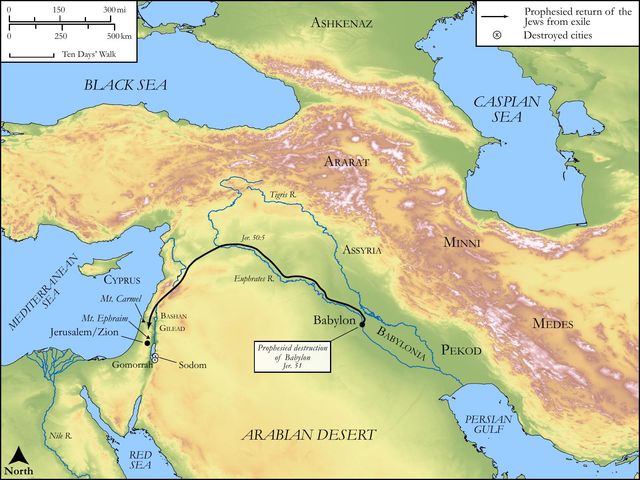
See on the biblical-era map
Study this verse
Public-domain commentary
Matthew Henry
From his Commentary on the Whole Bible. Henry comments on passages, not single verses — this entry covers Jeremiah 51:1–58. His two-level outline is real structure in the source text, so it is rendered as structure.
The particulars of this copious prophecy are dispersed and interwoven, and the same things left and returned to so often that it could not well be divided into parts, but we must endeavor to collect them under their proper heads. Let us then observe here,
I.An acknowledgment of the great pomp and power that Babylon had been in and the use that God in his providence had made of it (Jer 51:7):
Babylon hath been a golden cup, a rich and glorious empire, a golden city (Isa 14:4), a head of gold (Dan 2:38), filled with all good things, as a cup with wine. Nay, she had been a golden cup in the Lord's hand; he had in a particular manner filled and favoured her with blessings; he had made the earth drunk with this cup; some were intoxicated with her pleasures and debauched by her, others intoxicated with her terrors and destroyed by her. In both senses the New Testament Babylon is said to have made the kings of the earth drunk, Rev 17:2; Rev 18:3. Babylon had also been God's battle-axe; it was so at this time, when Jeremiah prophesied, and was likely to be yet more so, Jer 51:20. The forces of Babylon were God's weapons of war, tools in his hand, with which he broke in pieces, and knocked down, nations and kingdoms, - horses and chariots, which are so much the strength of kingdoms (Jer 51:21), - man and woman, young and old, with which kingdoms are replenished (Jer 51:22), - the shepherd and his flock, the husbandman and his oxen, with which kingdoms are maintained and supplied, Jer 51:23. Such havoc as this the Chaldeans had made when God employed them as instruments of his wrath for the chastising of the nations; and yet now Babylon itself must fall. Note, Those that have carried all before them a great while will yet at length meet with their match, and their day also will come to fall; the rod will itself be thrown into the fire at last. Nor can any think it will exempt them from God's judgments that they have been instrumental in executing his judgments on others.
II.A just complaint made of Babylon, and a charge drawn up against her by the Israel of God.
1. She is complained of for her incorrigible wickedness (Jer 51:9): We would have healed Babylon, but she is not healed. The people of God that were captives among the Babylonians endeavoured, according to the instructions given them (Jer 10:11), to convince them of the folly of their idolatry, but they could not do it; still they doted as much as ever upon their graven images, and therefore the Israelites resolved to quit them and go to their own country. Yet some understand this as spoken by the forces they had hired for their assistance, declaring that they had done their best to save her from ruin, but that it was all to no purpose, and therefore they might as well go home to their respective countries; "for her judgment reaches unto heaven, and it is in vain to withstand it or think to avert it." 2. She is complained of for her inveterate malice against Israel. Other nations had been hardly used by the Chaldeans, but Israel only complains to God of it, and with confidence appeals to him (Jer 51:34, Jer 51:35): "The king of Babylon has devoured me, and crushed me, and never thought he could do enough ruin to me; he has emptied me of all that was valuable, has swallowed me up as a dragon, or whale, swallows up the little fish by shoals; he has filled his belly, filled his treasures, with my delicates, with all my pleasant things, and has cast me out, cast me away as a vessel in which there is no pleasure; and now let them be accountable for all this." Zion and Jerusalem shall say, "Let the violence done to me and my children, that are my own flesh, and pieces of myself, and all the blood of my people, which they have shed like water, be upon them; let the guilt of it lie upon them, and let it be required at their hands." Note, Ruin is not far off from those that lie under the guilt of wrong done to God's people.
III.Judgment given upon this appeal by the righteous Judge of heaven and earth, on behalf of Israel against Babylon.
he sits in the throne judging right, is ready to receive complaints, and answers (Jer 51:36): "I will plead thy cause. Leave it with me; I will in due time plead it effectually and take vengeance for thee, and every drop of Jerusalem's blood shall be accounted for with interest." Israel and Judah seemed to have been neglected and forgotten, but God had an eye to them, Jer 51:5. It is true their land was filled with sin against the Holy One of Israel. They were a provoking people and their sings were a great offence to God, as a holy God, and as their God, their Holy One; and therefore he justly delivered them up into the hands of their enemies, and might justly have abandoned them and left them to perish in their hands; but God deals better with them than they deserve, and, notwithstanding their iniquities and his severities, Israel is not forsaken, is not cast off, though he be cast out, but is owned and looked after by his God, by the Lord of hosts. God is his God still, and will act for him as the Lord of hosts, a God of power. Note, Though God's people may have broken his laws and fallen under his rebukes, yet it does not therefore follow that they are thrown out of covenant; but God's care of them and love to them will flourish again, Psa 89:30-33. The Chaldeans thought they should never be called to an account for what they had done against God's Israel; but there is a time fixed for vengeance, Jer 51:6. We cannot expect it should come sooner than the time fixed, but then it will come; he will render unto Babylon a recompence, for the avenging of Israel is the vengeance of the Lord, who espouses their cause; it is the vengeance of his temple, Jer 51:11, as before, Jer 50:28. The Lord God of recompences, the God to whom vengeance belongs, will surely requite (Jer 51:56), will pay them home; he will render unto Babylon all the evil they have done in Zion (Jer 51:24); he will return it in the sight of his people. They shall have the satisfaction to see their cause pleaded with jealousy. They shall not only live to see those judgments brought upon Babylon, but they shall plainly see them to be the punishment of the wrong they have done to Zion; any man may see it, and say, Verily there is a God that judges in the earth; for just as Babylon has caused the slain of Israel to fall, has not only slain those that were found in arms, but all without distinction, even all the land (almost all were put to the sword), so at Babylon shall fall the slain not only of the city, but of all the country, Jer 51:49. Cyrus shall measure to the Chaldeans the same that they measured to the Jews, so that every observer may discern that God is recompensing them for what they did against his people; but Zion's children shall in a particular manner triumph in it (Jer 51:10): The Lord has brought forth our righteousness; he has appeared in our behalf against those that dealt unjustly with us, and has given us redress; he has also made it to appear that he is reconciled to us and that we are yet in his eyes a righteous nation. Let it therefore be spoken of to his praise: Come and let us declare in Zion the work of the Lord our God, that others may be invited to join with us in praising him.
IV.A declaration of the greatness and sovereignty of that God who espouses Zion's cause and undertakes to reckon with this proud and potent enemy, Jer 51:14. It is the Lord of hosts that has said it, that has sworn it, has sworn it by himself (for he could swear by no greater), that he will fill Babylon with vast and incredible numbers of the enemy's forces, will fill it with men as with caterpillars, that shall overpower it will multitudes, and need only to lift up a shout against it, for that shall be so terrible as to dispirit all the inhabitants and make them an easy prey to this numerous army. But who, and where, is he that can break so powerful a kingdom as Babylon? The prophet gives an account of him from the description he had formerly given of him, and of his sovereignty and victory over all pretenders (Jer 10:12-16), which was there intended for the conviction of the Babylonian idolaters and the confirmation of God's Israel in the faith and worship of the God of Israel; and it is here repeated to show that God will convince those by his judgments who would not be convinced by his word that he is God over all. Let not any doubt but that he who has determined to destroy Babylon is able to make his words good, for, 1. he is the God that made the world (Jer 51:15), and therefore nothing is too hard for him to do; it is in his name that our help stands, and on him our hope is built. 2. He has the command of all the creatures that he has made (Jer 51:16); his providence is a continued creation. He has wind and rain at his disposal. if he speak the word, there is a multitude of waters in the heavens (and it is a wonder how they hang there), fed by vapours out of the earth, and it is a wonder how they ascend thence. Lightnings and rain seem contraries, as fire and water, and yet they are produced together; and the wind, which seems arbitrary in its motions, and we know not whence it comes, is yet, we are sure, brought out of his treasuries. 3. The idols that oppose the accomplishment of his word are a mere sham and their worshippers brutish people, Jer 51:17, Jer 51:18. The idols are falsehood, they are vanity, they are the work of errors; when they come to be visited (to be examined and enquired into) they perish, that is, their reputation sinks and they appear to be nothing; and those that make them are like unto them. But between the God of Israel and these gods of the heathen there is no comparison (Jer 51:19): The portion of Jacob is not like them; the God who speaks this and will do it is the former of all things and the Lord of all hosts, and therefore can do what he will; and there is a near relation between him and his people, for he is their portion and they are his; they put a confidence in him as their portion and he is pleased to take a complacency in them and a particular care of them as the lot of his inheritance; and therefore he will do what is best for them. The repetition of these things here, which were said before, intimates both the certainty and the importance of them, and obliges us to take special notice of them; God hath spoken once; yea, twice have we heard this, that power belongs to God, power to destroy the most formidable enemies of his church; and if God thus speak once, yea, twice, we are inexcusable if we do not perceive it and attend to it.
V.A description of the instruments that are to be employed in this service.
God has raised up the spirit of the kings of the Medes (Jer 51:11), Darius and Cyrus, who come against Babylon by a divine instinct; for God's device is against Babylon to destroy it. They do it, but God devised it, he designed it; they are but accomplishing his purpose, and acting as he directed. Note, God's counsel shall stand, and according to it all hearts shall move. Those whom God employs against Babylon are compared (Jer 51:1) to a destroying wind, which either by its coldness blasts the fruits of the earth or by its fierceness blows down all before it. This wind is brought out of God's treasuries (Jer 51:16), and it is here said to be raised up against those that dwell in the midst of the Chaldeans, those of other nations that inhabit among them and are incorporated with them. The Chaldeans rise up against God by falling down before idols, and against them God will raise up destroyers, for he will be too hard for those that contend with him. These enemies are compared to fanners (Jer 51:2), who shall drive them away as chaff is driven away by the fan. The Chaldeans had been fanners to winnow God's people (Jer 15:7) and to empty them, and now they shall themselves be in like manner despoiled and dispersed.
VI.An ample commission given them to destroy and lay all waste.
Let them bend their bow against the archers of the Chaldeans (Jer 51:3) and not spare her young men, but utterly destroy them, for the Lord has both devised and done what he spoke against Babylon, Jer 51:12. This may animate the instruments he employs, but assuring them of success. The methods they take are such as God has devised and therefore they shall surely prosper; what he has spoken shall be done, for he himself will do it; and therefore let all necessary preparations be made. This they are called to, Jer 51:27, Jer 51:28. Let a standard be set up, under which to enlist soldiers for this expedition; let a trumpet be blown to call men together to it and animate them in it; let the nations, out of which Cyrus's army is to be raised, prepare their recruits; let the kingdoms of Ararat, and Minni, and Ashkenaz, of Armenia, both the higher and the lower, and of Ascania, about Phrygia and Bithynia, send in their quota of men for his service; let general officers be appointed and the cavalry advance; let the horses come up in great numbers, as the caterpillars, and come, like them, leaping and pawing in the valley; let them lay the country waste, as caterpillars do (Joe 1:4), especially rough caterpillars; let the kings and captains prepare nations against Babylon, for the service is great and there is occasion for many hands to be employed it.
VII.The weakness of the Chaldeans, and their inability to make head against this threatening destroying force.
When God employed them against other nations they had spirit and strength to act offensively, and went on with admirable resolution, conquering and to conquer; but now that it comes to their turn to be reckoned with all their might and courage are gone, their hearts fail them, and none of all their men of might and mettle have found their hands to act so much as defensively. They are called upon here to prepare for action, but it is ironically and in an upbraiding way (Jer 51:11): Make bright the arrows, which have grown rusty through disuse; gather the shields, which in a long time of peace and security have been scattered and thrown out of the way (Jer 51:12); set up the standard upon the walls of Babylon, upon the towers on those walls, to summon all that owed suit and service to that mother-city, now to come in to her assistance; let them make the watch as strong as they can, and appoint the sentinels to their respective posts, and prepare ambushes for the reception of the enemy. This intimates that they would be found very secure and remiss, and would need to be thus quickened (and they were so to such a degree that they were in the midst of their revels when the city was taken), but that all their preparations should come to no purpose. Whoever will may call them to it, but they shall have no heart to come at the call, Jer 51:29. The whole land shall tremble, and sorrow (a universal consternation) shall seize upon them; for they shall see both the irresistible arm and the irreversible counsel and decree of God against them. They shall see that God is making Babylon a desolation, and therein is performing what he has purposed; and then the mighty men of Babylon have forborne to fight, Jer 51:30. God having taken away their strength and spirit, so that they have remained in their holds, not daring so much as to peep forth, the might both of their hearts and of their hands fails; they become as timorous as women, so that the enemy has, without any resistance, burnt her dwelling-places and broken her bars. It is to the same purport with Jer 51:56-58. When the spoiler comes upon Babylon her mighty men, who should make head against him, are immediately taken, their weapons of war fail them, every one of their bows is broken and stands them in no stead. Their politics fail them; they call councils of war, but their princes and captains, who sit in council to concert measures for the common safety, are made drunk; they are as men intoxicated through stupidity or despair; they can form no right notions of things; they stagger and are unsteady in their counsels and resolves, and dash one against another, and, like drunken men, fall out among themselves. At length they sleep a perpetual sleep, and never awake from their wine, the wine of God's wrath, for it is to them an opiate that lays them into a fatal lethargy. The walls of their city fail them, Jer 51:58. When the enemy had found ways to ford Euphrates, which was thought impassable, yet surely, think they, the walls are impregnable, they are the broad walls of Babylon or (as the margin reads it), the walls of broad Babylon. The compass of the city, within the walls, was 385 furlongs, some say 480, that is, about sixty miles; the walls were 200 cubits high, and fifty cubits broad, so that two chariots might easily pass by one another upon them. Some say that there was a threefold wall about the inner city and the like about the outer, and that the stones of the wall, being laid in pitch instead of mortar (Gen 11:3), were scarcely separable; and yet these shall be utterly broken, and the high gates and towers shall be burnt, and the people that are employed in the defence of the city shall labour in vain in the fire; they shall quite tire themselves, but shall do no good.
VIII.The destruction that shall be made of Babylon by these invaders.
1.It is a certain destruction; the doom has passed and it cannot be reversed; a divine power is engaged against it, which cannot be resisted (Jer 51:8): Babylon is fallen and destroyed, is as sure to fall, to fall into destruction, as if it were fallen and destroyed already; though when Jeremiah prophesied this, and many a year after, it was in the height of its power and greatness. God declares, God appears against Babylon (Jer 51:25): Behold, I am against thee; and those cannot stand long whom God is against. He will stretch out his hand upon it, a hand which no creature can bear the weight of nor withstand the force of. It is his purpose, which shall be performed, that Babylon must be a desolation, Jer 51:29.
2.It is a righteous destruction. Babylon has made herself meet for it, and therefore cannot fail to meet with it. For (Jer 51:25) Babylon has been a destroying mountain, very lofty and bulky as a mountain, and destroying all the earth, as the stones that are tumbled from high mountains spoil the grounds about them; but now it shall itself be rolled down from its rocks, which were as the foundations on which it stood. It shall be levelled, its pomp and power broken. It is now a burning mountain, like Aetna and the other volcanoes, that throw out fire, to the terror of all about them. But it shall be a burnt mountain; it shall at length have consumed itself, and shall remain a heap of ashes. So will this world be at the end of time. Again (Jer 51:33), "Babylon is like a threshing-floor, in which the people of God have been long threshed, as sheaves in the floor; but now the time has come that she shall herself be threshed and her sheaves in her; her princes and great men, and all her inhabitants, shall be beaten in their own land, as in the threshing-floor. The threshing-floor is prepared. Babylon is by sin made meet to be a seat of war, and her people, like corn in harvest, are ripe for destruction," Rev 14:15; Mic 4:12.
3.It is an unavoidable destruction. Babylon seems to be well-fenced and fortified against it: She dwells upon many waters (Jer 51:13); the situation of her country is such that it seems inaccessible, it is so surrounded, and the march of an enemy into it so embarrassed, by rivers. In allusion to this, the New Testament Babylon is said to sit upon many waters, that is, to rule over many nations, as the other Babylon did, Rev 17:15. Babylon is abundant in treasures; and yet "thy end has come, and neither they waters nor thy wealth shall secure thee." This end that comes shall be the measure of thy covetousness; it shall be the stint of thy gettings, it shall set bounds to thy ambition and avarice, which otherwise would have ben boundless. God, by the destruction of Babylon, said to its proud waves, Hitherto shall you come, and no further. Note, if men will not set a measure to their covetousness by wisdom and grace, God will set a measure to it by his judgments. Babylon, thinking herself very safe and very great, was very proud; but she will be deceived (Jer 51:53): Though Babylon should mount her walls and palaces up to heaven, and though (because what is high is apt to totter) she should take care to fortify the height of her strength, yet all will not do; God will send spoilers against her, that shall break through her strength and bring down her height.
4.It is a gradual destruction, which, if they had pleased, they might have foreseen and had warning of; for (Jer 51:46) "A rumor will come one year that Cyrus is making vast preparations for war, and after that, in another year, shall come a rumour that his design is upon Babylon, and he is steering his course that way;" so that when he was a great way off they might have sent and desired conditions of peace; but they were too proud, too secure, to do that, and their hearts were hardened to their destruction.
5.Yet, when it comes, it is a surprising destruction: Babylon has suddenly fallen (Jer 51:8); the destruction came upon them when they did not think of it and was perfected in a little time, as that of the New Testament Babylon - in one hour, Rev 18:17. The king of Babylon, who should have been observing the approaches of the enemy, was himself at such a distance from the place where the attack was made that it was a great while ere he had notice that the city was taken; so that those who were posted near the place sent one messenger, one courier, after another, with advice of it, Jer 51:31. The foot-posts shall meet at the court from several quarters with this intelligence to the king of Babylon that his city is taken at one end, and there is nothing to obstruct the progress of the conquerors, but they will be at the other end quickly. They are to tell him that the enemy has seized the passes (Jer 51:32), the forts or blockades upon the river, and that, having got over the river, he has set fire to the reeds on the river side, to alarm and terrify the city, so that all the men of war are affrighted and have thrown down their arms and surrendered at discretion. The messengers come, like Job's, one upon the heels of another, with these tidings, which are immediately confirmed with a witness by the enemies' being in the palace and slaying the king himself, Dan 5:30. That profane feast which they were celebrating at the very time when the city was taken, which was both an evidence of their strange security and a great advantage to the enemy, seems here to be referred to (Jer 51:38, Jer 51:39): They shall roar together like lions, as men in their revels do, when the wine has got into their heads. They call it singing; but in scripture-language, and in the language of sober men, it is called yelling like lions' whelps. It is probable that they were drinking confusion to Cyrus and his army with loud huzzas. Well, says God, in their heat, when they are inflamed (Isa 5:11) and their heads are hot with hard drinking, I will make their feasts, I will give them their portion. They have passed their cup round; now the cup of the Lord's right hand shall be turned unto them (Hab 2:15, Hab 2:16), a cup of fury, which shall make them drunk that they may rejoice (or rather that they may revel it) and sleep a perpetual sleep; let them be as merry as they can with that bitter cup, but it shall lay them to sleep never to wake more (as Jer 51:57); for on that night, in the midst of the jollity, was Belshazzar slain.
6.It is to be a universal destruction. God will make thorough work of it; for, as he will perform what he has purposed, so he will perfect what he has begun. The slain shall fall in great abundance throughout the land of the Chaldeans; multitudes shall be thrust through in her streets, Jer 51:4. They are brought down like lambs to the slaughter (Jer 51:40), in such great numbers, so easily, and the enemies make no more of killing them than the butcher does of killing lambs. The strength of the enemy, and their invading them, are here compared to an irruption and inundation of waters (Jer 51:42): The sea has come up upon Babylon, which, when it has once broken through its bounds, there is no fence against, so that she is covered with the multitude of its waves, overpowered by a numerous army; her cities then become a desolation, an uninhabited uncultivated desert, Jer 51:43.
7.It is a destruction that shall reach the gods of Babylon, the idols and images, and fall with a particular weight upon them. "In token that the whole land shall be confounded and all her slain shall fall and that throughout all the country the wounded shall groan, I will do judgment upon her graven images," Jer 51:47 and again Jer 51:52. All must needs perish if their gods perish, from whom they expect protection. Though the invaders are themselves idolaters, yet they shall destroy the images and temples of the gods of Babylon, as an earnest of the abolishing of all counterfeit deities. Bel was the principal idol that the Babylonians worshipped, and therefore that is by name here marked for destruction (Jer 51:44): I will punish Bel, that great devourer, that image to which such abundance of sacrifices are offered and such rich spoils dedicated, and to whose temple there is such a vast resort. He shall disgorge what he has so greedily regaled himself with. God will bring forth out of his temple all the wealth laid up there, Job 20:15. His altars shall be forsaken, none shall regard him any more, and so that idol which was thought to be a wall to Babylon shall fall and fail them.
8.It shall be a final destruction. You may take balm for her pain, but in vain; she that would not be healed by the word of God shall not be healed by his providence, Jer 51:8, Jer 51:9. Babylon shall become heaps (Jer 51:37), and, to complete its infamy, no use shall be made even of the ruins of Babylon, so execrable shall they be, and attended with such ill omens (Jer 51:26): They shall not take of thee a stone for a corner, nor a stone for foundations. People shall not care for having any thing to do with Babylon, or whatever belonged to it. Or it denotes that there shall be nothing left in Babylon on which to ground any hopes or attempts of raising it into a kingdom again; for, as it follows here, it shall be desolate for ever. St. Jerome says that in his time, though the ruins of Babylon's walls were to be seen, yet the ground enclosed by them was a forest of wild beasts.
IX.Here is a call to God's people to go out of Babylon.
It is their wisdom, when the ruin is approaching, to quit the city and retire into the country (Jer 51:6): "Flee out of the midst of Babylon, and get into some remote corner, that you may save your lives, and may not be cut off in her iniquity." When God's judgments are abroad it is good to get as far as we can from those against whom they are levelled, as Israel from the tents of Korah. This agrees with the advice Christ gave his disciples, with reference to the destruction of Jerusalem. Let those who shall be in Judea flee to the mountains, Mat 24:16. It is their wisdom to get out of the midst of Babylon, lest they be involved, if not in her ruins, yet in her fears (Jer 51:45, Jer 51:46): Lest your heart faint, and you fear for the rumour that shall be heard in the land. Though God had told them that Cyrus should be their deliverer, and Babylon's destruction their deliverance, yet they had been told also that in the peace thereof they should have peace, and therefore the alarms given to Babylon would put them into a fright, and perhaps they might not have faith and consideration enough to suppress those fears, for which reason they are here advised to get out of the hearing of the alarms. Note, Those who have not grace enough to keep their temper in temptation should have wisdom enough to keep out of the way of temptation. But this is not all; it is not only their wisdom to quit the city when the ruin is approaching, but it is their duty to quit the country too when the ruin is accomplished, and they are set at liberty by the pulling down of the prison over their heads. This they are told, Jer 51:50, Jer 51:51 : "You Israelites, who have escaped the sword of the Chaldeans your oppressors, and of the Persians their destroyers, now that the year of release has come, go away, stand not still; hasten to your own country again, however you may be comfortably seated in Babylon, for this is not your rest, but Canaan is." 1. He puts them in mind of the inducements they had to return: "Remember the Lord afar off, his presence with you now, though you are here afar off from your native soil; his presence with your fathers formerly in the temple, though you are now afar off from the ruins of it." Note, Wherever we are, in the greatest depths, at the greatest distances, we may and must remember the Lord our God; and in the time of the greatest fears and hopes it is seasonable to remember the Lord. "And let Jerusalem come into your mind. Though it be now in ruins, yet favour its dust (Psa 102:14); though few of you ever saw it, yet believe the report you have had concerning it from those that wept when they remembered Zion; and think of Jerusalem until you come up to a resolution to make the best of your way thither." Note, When the city of our solemnities is out of sight, yet it must not be out of mind; and it will be of great use to us, in our journey through this world, to let the heavenly Jerusalem come often into our mind. 2. He takes notice of the discouragement which the returning captives labour under (Jer 51:51); being reminded of Jerusalem, they cry out, "We are confounded; we cannot bear the thought of it; shame covers our faces at the mention of it, for we have heard of the reproach of the sanctuary, that is profaned and ruined by strangers; how can we think of it with any pleasure?" To this he answers (Jer 51:52) that the God of Israel will now triumph over the gods of Babylon, and so that reproach will be for ever rolled away. Note, The believing prospect of Jerusalem's recovery will keep us from being ashamed of Jerusalem's ruins.
X.Here is the diversified feeling excited by Babylon's fall, and it is the same that we have with respect to the New Testament Babylon, Rev 18:9, Rev 18:19.
1.Some shall lament the destruction of Babylon. There is the sound of a cry, a great outcry coming from Babylon (Jer 51:54), lamenting this great destruction, the voice of mourning, because the Lord has destroyed the voice of the multitude, that great voice of mirth which used to be heard in Babylon, Jer 51:55. We are told what they shall say in their lamentations (Jer 51:41): "How is Sheshach taken, and how are we mistaken concerning her! How is that city surprised and become an astonishment among the nations that was the praise, and glory, and admiration of the whole earth!" See how that may fall into a general contempt which has been universally cried up.
2.Yet some shall rejoice in Babylon's fall, not as it is the misery of their fellow-creatures, but as it is the manifestation of the righteous judgment of God and as it opens the way for the release of God's captives; upon these accounts the heaven and the earth, and all that is in both, shall sing for Babylon (Jer 51:48); the church in heaven and the church on earth shall give to God the glory of his righteousness, and take notice of it with thankfulness to his praise. Babylon's ruin is Zion's praise.
Continue studying Jeremiah 51:4 across the web’s major study libraries — every link below opens this exact verse, chapter, or book on the destination site.
Read & Compare
 BibleGatewayThis verse in more than 200 translations and 70 languages.
 Bible.comThe YouVersion reader — hundreds of translations, reading plans, and highlights.
 ESV.orgCrossway's official English Standard Version reader.
 NET BibleThe NET translation with 60,000+ translators' notes on every rendering decision.
 STEP BibleTyndale House's free study tool — original text, vocabulary, and scholarly resources.
 BibliaLogos Bible Software's free web reader.
 USCCBThe New American Bible (Revised Edition) with the U.S. bishops' study notes.
Commentaries
 BibleHub CommentariesDozens of classic commentaries on this verse, gathered on one page.
 StudyLightMore than 100 commentary sets — the largest collection on the web.
 BibleRefPlain-English commentary on what this verse means, verse by verse.
 Enduring WordDavid Guzik's free commentary on this chapter, widely used by Bible teachers.
 Bible Study ToolsVerse commentary alongside Greek and Hebrew study aids.
Original Language & Research
- BibleHub InterlinearThe verse word by word — original language, transliteration, and English.
- BibleHub LexiconEvery word's original-language definition and Strong's entry.
 Blue Letter BibleDeep-study tools — Strong's numbers, concordance, and word studies.
 SefariaThe Hebrew text with Rashi and centuries of Jewish commentary.
Sermons, Hymns & Audio


TrulyRandomVerse is not affiliated with these sites and doesn’t control their content. They’re linked because they’re genuinely useful.
Summary
Jeremiah 51:4 serves as a potent prophetic declaration, foretelling the comprehensive and devastating judgment awaiting Babylon, the oppressive empire that had brought Judah into captivity. This verse vividly depicts widespread carnage and destruction, emphasizing that death will not be confined to battlefields but will permeate every corner of the land of the Chaldeans, even its bustling streets. It underscores God's unwavering commitment to justice, His absolute sovereignty over nations, and the certain fulfillment of His word against those who proudly oppose His purposes and oppress His people.
Context
ShowHideLiterary Context
Jeremiah 51:4 is strategically placed within a lengthy and detailed prophetic oracle against Babylon, encompassing chapters 50 and 51 of the book of Jeremiah. These chapters function as a divine counter-narrative to Babylon's perceived invincibility, following Jeremiah's sustained warnings to Judah about their impending exile. After the destruction of Jerusalem and the deportation of its inhabitants in 586 BC, these prophecies against Babylon offer a profound message of hope and assurance to the exiled Israelites. They articulate God's sovereign control over nations, promising that the very empire God used as an instrument of judgment against Judah would, in turn, face its own, even more severe, divine retribution. The immediate verses preceding Jeremiah 51:4 describe the Lord's determination to punish Babylon for its pride and violence against Israel, declaring that "her time has come, the time for her to be punished" (Jeremiah 50:29-32). The verses following continue to detail the extent of Babylon's downfall, including the drying up of its waters, the shattering of its idols, and the complete desolation of its land (Jeremiah 51:6-8).
Historical & Cultural Context
At the time of this prophecy, Babylon, under the Neo-Babylonian Empire, stood as the dominant superpower among the nations. Led by the Chaldean dynasty, it had conquered Judah, destroyed Jerusalem, and exiled its people. The "Chaldeans" were the ruling ethnic group, renowned for their formidable military, impressive architectural feats like the Ishtar Gate and the Hanging Gardens, and their advanced astrological practices. Babylon represented the pinnacle of human power, pride, and idolatry. From a human perspective, the prophecy of its fall would have seemed utterly improbable, given its massive walls, strategic location, and vast resources. However, the historical context also includes the rising power of the Medes and Persians, who, under Cyrus the Great, would eventually fulfill these prophecies in 539 BC. The imagery of "slain" and "thrust through" reflects the brutal realities of ancient warfare, where conquest often involved widespread slaughter, not only of combatants but also of civilians, especially in the streets and homes of a besieged city, ensuring a complete and terrifying subjugation.
Key Themes
ShowHideJeremiah 51:4 contributes significantly to several overarching themes within the book of Jeremiah and the broader prophetic literature. Firstly, it powerfully illustrates the theme of Divine Retribution and Justice. Babylon, having acted with excessive cruelty and pride beyond God's intended use as a disciplinary tool for Judah, now faces the full weight of divine wrath. The Lord declares, "I will repay Babylon and all the inhabitants of Chaldea for all the evil they have done in Zion" (Jeremiah 51:24). Secondly, the verse highlights God's Sovereignty over Nations. It demonstrates that no earthly power, no matter how great or seemingly invincible, is beyond the reach of God's judgment. He raises up and casts down empires according to His righteous will, as seen in Daniel 2:21. Thirdly, it reinforces the theme of Prophetic Fulfillment and the Reliability of God's Word. The detailed nature of the prophecy, including the specific imagery of death in the streets, assured both the original audience and subsequent generations that God's declarations are certain to come to pass, providing profound comfort and hope to the oppressed. This certainty is a recurring motif, emphasizing that "the word of the Lord will stand forever" (Isaiah 40:8).
Exposition and Analysis
ShowHideKey Word Analysis
ShowHideThis term refers to those who are "pierced (especially to death)" or "polluted." It often denotes individuals killed in battle or by violence, emphasizing a state of being fatally wounded or desecrated. In this context, it highlights the widespread death that will befall Babylon, not merely as casualties of war but as those who have met a violent, definitive end, often left unburied or profaned, signifying a complete and dishonorable demise.
This primitive root signifies "to fall" in a vast array of applications, including literal falling, ceasing, dying, or being overthrown. Here, it vividly portrays the collapse and demise of Babylon's inhabitants, indicating a sudden, inescapable, and widespread descent into death. It underscores the complete cessation of life and power for those affected, symbolizing the utter collapse of the nation's strength and population.
This root means "to stab," "pierce," or "wound." It specifically describes a violent penetration, typically by a weapon like a sword or spear. The use of this term alongside "slain" intensifies the imagery of brutal, agonizing deaths, suggesting that many will suffer direct, fatal wounds in the streets, emphasizing the personal, gruesome, and inescapable nature of the destruction. It speaks to the intimate horror of the judgment.
Verse Breakdown
ShowHide"Thus the slain shall fall in the land of the Chaldeans"
This clause pronounces a divine decree of widespread death upon the inhabitants of Babylonia, specifically identifying the "Chaldeans" as the recipients of this judgment. "The slain" (Hebrew chalalim) refers to those killed, often in battle or by violence, indicating a large-scale loss of life. The verb "shall fall" (Hebrew yippelu) emphasizes the inevitability and sheer number of casualties, suggesting bodies collapsing en masse across the entire territory of Babylon. This signifies a comprehensive judgment that will engulf the nation, not sparing its populace, but rather decimating it across its breadth.
"and [they that are] thrust through in her streets"
This second clause amplifies and specifies the nature and location of the carnage, intensifying the grim imagery. "Thrust through" (Hebrew medukkarim) denotes individuals pierced or stabbed, typically by a weapon, highlighting the violent and personal nature of the deaths. The mention of "her streets" (Hebrew chûwtsoteha) indicates that the violence will not be confined to battlefields or the periphery but will penetrate the very heart of Babylonian cities, spilling into public spaces and thoroughfares. This emphasizes the totality of the destruction and the lack of refuge or safety for its inhabitants, underscoring the pervasive and inescapable nature of God's judgment.
Literary Devices
ShowHideJeremiah 51:4 employs several potent literary devices to convey its message of impending doom and the severity of divine judgment. Imagery is central, painting a vivid and gruesome picture of "the slain" and "thrust through" bodies falling in the "land of the Chaldeans" and "her streets." This graphic depiction appeals directly to the reader's senses, making the horror of Babylon's destruction palpable and immediate. The verse exhibits strong Parallelism in its two clauses, where the second clause ("and [they that are] thrust through in her streets") echoes and intensifies the first ("Thus the slain shall fall in the land of the Chaldeans"). This reinforcing structure ensures the message of pervasive death and destruction is deeply impressed upon the audience. Furthermore, the verse utilizes Hyperbole to emphasize the overwhelming scale of the catastrophe; while not every single person would literally be slain in the streets, the language conveys an overwhelming and inescapable judgment that will affect the entire nation. The specificity of "streets" also serves as Synecdoche, where a part (the public thoroughfares) represents the whole (the entire urban and national landscape), underscoring that no place will be safe or untouched by the divine judgment.
Theological and Thematic Connections
ShowHideJeremiah 51:4 stands as a stark theological statement on God's unwavering commitment to justice and His absolute sovereignty over all nations. It proclaims that even the mightiest empires, when they become instruments of oppression and pride, will ultimately face divine reckoning. This prophecy served as both a solemn warning to Babylon and a profound source of comfort and vindication for the exiled Israelites, assuring them that their suffering was seen by God and that their oppressors would not go unpunished. It underscores the biblical principle that God holds nations accountable for their actions, particularly their treatment of His people and their defiance of His moral order. The fall of Babylon, as depicted here, is a powerful historical example of God's righteous judgment being poured out upon a proud and wicked kingdom, demonstrating that divine justice, though sometimes delayed, is always certain.
Reflection and Application
ShowHideJeremiah 51:4, while describing a historical judgment, offers profound and enduring lessons for believers today. It serves as a powerful reminder that God is ultimately just and sovereign over all human affairs, including the rise and fall of nations. In a world often marked by injustice, oppression, and seemingly unchecked power, this verse provides a beacon of hope, assuring us that no tyranny, no system of evil, and no act of cruelty is beyond God's sight or His eventual judgment. It calls us to trust in His perfect timing and His righteous character, even when circumstances seem bleak and evil appears to triumph. For those who feel oppressed or witness great evil, it offers profound comfort that God sees, hears the cries of His people, and will act decisively. For those in positions of power, it serves as a solemn warning against pride, cruelty, and the abuse of authority, reminding us that accountability before God is inescapable. Ultimately, this passage encourages us to align ourselves with God's justice, to pray for righteousness to prevail in our world, and to live with a confident expectation that His kingdom will ultimately prevail over all earthly powers and systems.
Questions for Reflection
ShowHideFAQ
ShowHideWhat does "Chaldeans" refer to in this verse?
ShowHideIn Jeremiah 51:4, "Chaldeans" refers to the inhabitants of Babylonia, specifically the dominant ethnic group of the Neo-Babylonian Empire. This empire was the preeminent power among the nations in the time of Jeremiah, responsible for the destruction of Jerusalem and the exile of Judah. The term is often used interchangeably with "Babylon" or "Babylonians" in the prophetic books to denote the oppressive empire that God was judging. The prophecies against the Chaldeans, such as those found throughout Jeremiah 50-51, highlight God's sovereign control over nations and His unwavering commitment to bringing justice to His people.
Why is God's judgment against Babylon so severe?
ShowHideGod's judgment against Babylon is depicted as severe for several interconnected reasons. Firstly, Babylon acted with excessive cruelty and pride in its conquest, going far beyond God's intended purpose for using them as an instrument of discipline against Judah. They plundered God's temple, boasted against the Lord, and showed no mercy (Jeremiah 50:28). Secondly, Babylon was a pervasive symbol of idolatry and defiance against the one true God, leading many nations astray with its false gods and spiritual wickedness (Jeremiah 51:7). Thirdly, the severity of the judgment underscores God's unwavering commitment to justice for His oppressed people, demonstrating that He hears their cries and will ultimately avenge them (Jeremiah 50:33-34). The comprehensive destruction described in Jeremiah 51:4 and throughout chapters 50-51 serves as a powerful testament to God's righteous character and His absolute sovereignty over all earthly powers.
Christ-Centered Fulfillment
ShowHideWhile Jeremiah 51:4 directly prophesies the historical fall of literal Babylon, its theological undercurrents find profound Christ-centered fulfillment in the broader biblical narrative of God's ultimate victory over all opposing powers. Babylon, in its pride, oppression, and idolatry, becomes a prototype for all earthly systems and spiritual forces that defy God and persecute His people. The judgment pronounced here foreshadows the definitive triumph of Christ over the forces of sin, death, and spiritual Babylon, as depicted in the New Testament. Just as the slain fell in Babylon's streets, Christ's sacrifice on the cross became the ultimate act of God's judgment against sin, where the "Lamb of God" was "thrust through" for our transgressions, bearing the full weight of divine wrath on our behalf (Isaiah 53:5). His resurrection then signified the decisive overthrow of spiritual powers that held humanity captive, echoing the fall of Babylon's dominion and proclaiming His victory over the grave (Colossians 2:15). Furthermore, the ultimate and complete destruction of spiritual Babylon, described vividly in Revelation 18, is accomplished through the righteous judgment of Christ, the King of kings and Lord of lords. His return will bring about the final vindication of God's people and the complete eradication of all evil, fulfilling the promise that every oppressive rule will ultimately fall before the glorious and eternal reign of the resurrected Christ (Revelation 19:11-16).