


Ezekiel 27:27
Bible text: King James Version (1769 Blayney text) · Public domain
Bible text: King James Version with Strong's numbers · Public domain
Bible text: Berean Standard Bible · Public domain
Bible text: American Standard Version (1901) · Public domain
Bible text: World English Bible, Messianic edition · Public domain
Bible text: Geneva Bible (1599) · Public domain
Bible text: Young's Literal Translation · Public domain
- הוֹנֵךְho·neKhyour wealthH1952N-msc ¦ 2fsNoun Singular Masculine Constructהוֹנֵwealthךְyour
- וְעִזְבוֹנַיִךְve·'iz·vo·Na·yikhand your waresH5801Conj-w ¦ N-mpc ¦ 2fsNoun Plural Masculine Constructוְandעִזְבוֹנַיִwaresךְyour
- מַעֲרָבֵךְma·'a·ra·Vekhyour merchandiseH4627N-msc ¦ 2fsNoun Singular Masculine Constructמַעֲרָבֵmerchandiseךְyour
- מַלָּחַיִךְma·la·Cha·yikhyour marinersH4419N-mpc ¦ 2fsNoun Plural Masculine Constructמַלָּחַיִmarinersךְyour
- וְחֹבְלָיִךְve·choe·La·yikhand your sailorsH2259Conj-w ¦ N-mpc ¦ 2fsNoun Plural Masculine Constructוְandחֹבְלָיִsailorsךְyour
- מַחֲזִיקֵיma·cha·zi·Kei[the] repairers ofH2388V-Hiphil-Prtcpl-mpVerb Hiphil Participle Plural Masculine Construct
- בִדְקֵךvid·Kekhyour leaksH919N-msc ¦ 2fsNoun Singular Masculine Constructבִדְקֵleaksךyour
- וְעֹרְבֵיve·'o·re·Veiand [the] traders ofH6148Conj-w ¦ V-Qal-Prtcpl-mpVerb Qal Participle Plural Masculine Constructוְandעֹרְבֵי[the] traders of
- מַעֲרָבֵךְMa·'a·ra·vekhyour merchandiseH4627N-msc ¦ 2fsNoun Singular Masculine Constructמַעֲרָבֵmerchandiseךְyour
- וְכָלve·kholand allH3605Conj-w ¦ N-mscNoun Singular Masculine Constructוְandכָלall
- אַנְשֵׁי'an·Shei[the] men ofH582N-mpcNoun Plural Masculine Construct
- מִלְחַמְתֵּךְmil·cham·Tekhyour warH4421N-fsc ¦ 2fsNoun Singular Feminine Constructמִלְחַמְתֵּwarךְyour
- אֲשֶׁר'a·SherwhoH834RelParticle Relative
- בָּךְBakh[were] in youPrep-b ¦ 2fsSuffix Personal 2nd Singular Feminineבָּ[were] inךְyou
- וּבְכָלu·ve·Kholand with allH3605Conj-w ¦ Prep-b ¦ N-mscNoun Singular Masculine Constructוּandבְwithכָלall
- קְהָלֵךְke·ha·leKhyour companyH6951N-msc ¦ 2fsNoun Singular Masculine Constructקְהָלֵcompanyךְyour
- אֲשֶׁר'a·SherwhichH834RelParticle Relative
- בְּתוֹכֵךְbe·to·Khekh[was] in [the] midst of youH8432Prep-b ¦ N-msc ¦ 2fsNoun Singular Masculine Constructבְּ[was] inתוֹכֵ[the] midst ofךְyou
- יִפְּלוּyi·pe·Luthey will fallH5307V-Qal-Imperf-3mpVerb Qal Imperfect 3rd Plural Masculine
- בְּלֵבbe·Levin [the] heart ofH3820Prep-b ¦ N-mscNoun Singular Masculine Constructבְּinלֵב[the] heart of
- יַמִּיםya·Mim[the] seasH3220N-mpNoun Plural Masculine Absolute
- בְּיוֹםbe·Yomon [the] day ofH3117Prep-b ¦ N-mscNoun Singular Masculine Constructבְּonיוֹם[the] day of
- מַפַּלְתֵּךְma·pal·Tekhyour downfallH4658N-fsc ¦ 2fsNoun Singular Feminine Constructמַפַּלְתֵּdownfallךְyour
English is a literal word-by-word gloss of the Hebrew, not the KJV's wording. Why?
This is the original text the KJV's translators worked from — each Hebrew word with its own literal English meaning in this verse, prepared by scholars at Tyndale House, Cambridge. The KJV translates whole sentences, not word by word, so its wording differs: one Hebrew word can become several English words, and the KJV may choose “the LORD” where the gloss reads “Yahweh”. Both are faithful — they answer different questions. For the KJV's own rendering, switch to the KJV text.
Details
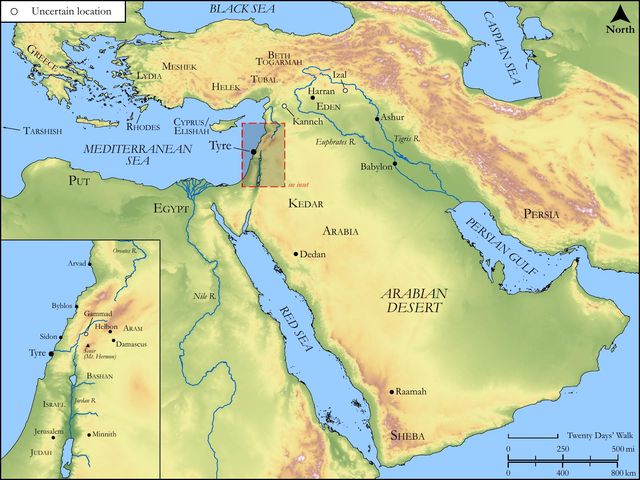
See on the biblical-era map
Study this verse
Public-domain commentary
Matthew Henry
From his Commentary on the Whole Bible. Henry comments on passages, not single verses — this entry covers Ezekiel 27:26–36.
We have seen Tyre flourishing; here we have Tyre falling, and great is the fall of it, so much the greater for its having made such a figure in the world. Note, The most mighty and magnificent kingdoms and states, sooner or later, have their day to come down. They have their period; and, when they are in their zenith, they will begin to decline. But the destruction of Tyre was sudden. Her sun went down at noon. And all her wealth and grandeur, pomp and power, did but aggravate her ruin, and make it the more grievous to herself and astonishing to all about her. Now observe here, 1. How the ruin of Tyrus will be brought about, Eze 27:26. She is as a great ship richly laden, that is split or sunk by the indiscretion of her steersmen: Thy rowers have themselves brought thee into great and dangerous waters; the governors of the city, and those that had the management of their public affairs, by some mismanagement or other involved them in that war with the Chaldeans which was the ruin of their state. By their insolence, by some affront given to the Chaldeans or some attempt made upon them, in confidence of their own ability to contend with them, they provoked Nebuchadnezzar to make a descent upon them, and, by their obstinacy in standing it out to the last, enraged him to such a degree that he determined on the ruin of their state, and, like an east wind, broke them in the midst of the seas. Note, It is ill with a people when those that sit at the stern, instead of putting them into the harbour, run them aground. 2. How great and general the ruin will be. All her wealth shall be buried with her, her riches, her fairs, and her merchandise (Eze 27:27); all that had any dependence upon her, and dealings with her, in trade, in war, in conversation, shall ball with her into the midst of the seas, in the day of her ruin. Note, Those who make creatures their confidence, place their happiness in their interest in them and rest their hopes upon them, will of course fall with them; happy therefore are those that have the God of Jacob for their help, and whose hope is in the Lord their God, who lives for ever. 3. What sad lamentation would be made for the destruction of Tyre. The pilots, her princes and governors, when they see how wretchedly they have mismanaged and how much they have contributed to their own ruin, shall cry out so loud as to make even the suburbs shake (Eze 27:28), such a vexation shall it be to them to reflect upon their own bad conduct. The inferior officers, that were as the mariners of the state, shall be forced to come down from their respective posts (Eze 27:29), and they shall cry out against thee, as having deceived them, in not proving so well able to hold out as they thought thou hadst been; they shall cry bitterly for the common ruin, and their own share in it. They shall use all the most solemn expressions of grief; they shall cast dust on their heads, in indignation against themselves, shall wallow themselves in ashes, as having bid a final farewell to all ease and pleasure; they shall make themselves bald (Eze 27:31), with tearing their hair; and, according to the custom of great mourners, those shall gird themselves with sackcloth who used to wear find linen, and, instead of merry songs, they shall weep with bitterness of heart. Note, Losses and crosses are very grievous, and hard to be borne, to those that have long been wallowing in pleasure and sleeping in carnal security. 4. How Tyre should be upbraided with her former honour and prosperity (Eze 27:32, Eze 27:33); she that was Tyrus the renowned shall now be called Tyrus the destroyed in the midst of the sea. "What city is like Tyre? Did ever any city come down from such a height of prosperity to such a depth of adversity? Time was when thy wares, those of thy own making and those that passed through thy hands, went forth out of the seas, and were exported to all parts of the world; then thou filledst many people, and didst enrich the kings of the earth and their kingdoms." The Tyrians, though they bore such a sway in trade, were yet, it seems, fair merchants, and let their neighbours not only live, but thrive by them. All that dealt with them were gainers; they did not cheat or oppress the people, but did enrich them with the multitude of their merchandise. "But now those that used to be enriched by thee shall be ruined with thee" (as is usual in trade); "when thou shalt be broken, and all thou hast is seized on, all thy company shall fall too," Eze 27:34. There is an end of Tyre, that made such a noise and bustle in the world. This great blaze goes out in a snuff. 5. How the fall of Tyre should be matter of terror to some and laughter to others, according as they were differently interested and affected. Some shall be sorely afraid, and shall be troubled (Eze 27:35), concluding it will be their own turn to fall next. Others shall hiss at her (Eze 27:36), shall ridicule her pride, and vanity, and bad management, and think her ruin just. She triumphed in Jerusalem's fall, and there are those that will triumph in hers. When God casts his judgments on the sinner men also shall clap their hands at him and shall hiss him out of his place, Job 27:22, Job 27:23. Is this the city which men called the perfection of beauty?
Historical interpretation
Historical reception
3 surviving comments on this verse. Each one is dated, so this reads as a timeline rather than a list.
(Verse 35, 36, and following) And I will bring you into a desert of peoples, and there I will judge you face to face. Just as I contended with your fathers in the desert of the land of Egypt, so I will judge you, says the Lord. And I will subject you to my scepter, and I will bring you into the bonds of the covenant, and I will choose from among you the transgressors and the wicked: from their place of residence I will bring them out, and they will not enter the land of Israel, and you will know that I am the Lord. Thus says the Lord: I will do for you who are in Babylon, and now serve idols, what I did for your ancestors in Egypt. I will lead you into the desert of the peoples, and there I will judge you face to face, just as I contended with them in judgment when they came out of Egypt. And after I have judged you, I will subject you to my scepter and rule, and I will make a covenant with you and bring you into your land with the bonds of love, so that bound by my love, you will never be able to depart from me. But I will choose from among you the transgressors and the wicked, who persist in the hardness of their hearts in evil deeds, not for possession, but for rejection. And I will indeed bring them out of the land of their dwelling, so that when they are brought out, they will not enter the land of Israel; but they will perish in various regions. And by the distinction between good and evil, you shall know that I am the Lord, who judges all things. The rest of the discourse hastens, and we briefly go through each point, in order to provide only the meaning to the readers.
(Verse 27). Your sailors (or rowers), and your pilots, who held your goods and led your people: and your warriors who were in you, with all your multitude that is in your midst, will fall in the heart of the sea on the day of your ruin. We read about the sailors or rowers of the city of Tyre, the Sidonians, and the Aradians, about whom it has already been said; and according to the Septuagint edition, the counselors of Byblos, which is called Gebal in Hebrew: and also its warriors, Persians, Lydians, and Libyans, who will all fall and be shown to be nothing, when Tyre falls and all its glory comes to an end in ruins. However, the multitude which the Seventy translated as 'commixtionis', except for the leaders, signifies the common people; who without the name of positions, are crushed with similar judgement. And the prophecy is mixed between the city and the ship, so that from one you may understand the other: and yet both pertain to the end of the age, and to a shipwreck.
(Verse 27, 29 onwards) Therefore speak to the house of Israel, son of man, and tell them: Thus says the Lord God: Moreover, your fathers have blasphemed against me and have treated me with contempt, even as they spurned me. And I brought them into the land that I had lifted my hand to give them ((Vulgate adds: that land)): they saw every high hill and every leafy tree, and there they offered their sacrifices and presented there the irritation of their offerings, and they placed there the fragrance of their sweetness, and they poured out their ((Vulgate is silent on this)) libations there. And I said to them, 'What is the high place to which you are going?' And its name was called the High Place until this day. Therefore speak to the house of Israel, son of man, and say to them, 'Thus says the Lord God: As for your fathers, they have provoked Me to anger by their iniquities, by the fact that they have fallen away from Me. So I brought them into the land that I had lifted My hand in an oath to give them.' They saw every high hill and every leafy tree, and there they offered their sacrifices. They also presented there the provocation of their gifts, and they set there their pleasing aroma, and they poured out there their drink offerings. And I said to them: What is abbana, because you enter there? And they called its name abbana until this day. I wanted, he said, to scatter them in the wilderness, and to give them not good precepts, so that they would sacrifice to idols what they should have offered to me, and consecrate all their first-fruits to them by fire, so that I might kill them and destroy them. But when he says, I wanted, he shows that he did not do what he wanted. And that which follows: 'And they shall know that I am the Lord,' is not found in the Septuagint. For it did not seem fitting to them to know after their destruction that he himself is the Lord. But you, son of man, speak again to them, that is, to the elders of the house of Israel, who have come to inquire of you: Your fathers, from whom you have descended, have also blasphemed against me and held me in contempt; after I brought them into the land which I had given them to possess, they turned against me to provoke me. For when they saw every high hill and leafy tree, they would sacrifice on the mountains and in the groves and thickets, and offer victims to the idols, and pour out libations. And when I saw this, I said to them: What is this, Bama? for it is called high: or why do you enter into such a place which you have chosen for yourselves in all the hills, so that even today these places are called Bamoth, and the ancient error retains its original name? Regarding Bama, which we translate as excelsum, there is an error in the Septuagint edition, where it is written as ἀββανὰ, which does not resonate in the Hebrew language. Bama can mean 'in which' if the two syllables are divided into two words, but in the present context, that sense does not fit. However, wherever it is written in the Books of Kings and Chronicles: 'The people still sacrificed and offered incense on the high places,' Bama in the singular and Bamoth in the plural mean 'high places.'
Continue studying Ezekiel 27:27 across the web’s major study libraries — every link below opens this exact verse, chapter, or book on the destination site.
Read & Compare
 BibleGatewayThis verse in more than 200 translations and 70 languages.
 Bible.comThe YouVersion reader — hundreds of translations, reading plans, and highlights.
 ESV.orgCrossway's official English Standard Version reader.
 NET BibleThe NET translation with 60,000+ translators' notes on every rendering decision.
 STEP BibleTyndale House's free study tool — original text, vocabulary, and scholarly resources.
 BibliaLogos Bible Software's free web reader.
 USCCBThe New American Bible (Revised Edition) with the U.S. bishops' study notes.
Commentaries
 BibleHub CommentariesDozens of classic commentaries on this verse, gathered on one page.
 StudyLightMore than 100 commentary sets — the largest collection on the web.
 BibleRefPlain-English commentary on what this verse means, verse by verse.
 Enduring WordDavid Guzik's free commentary on this chapter, widely used by Bible teachers.
 Bible Study ToolsVerse commentary alongside Greek and Hebrew study aids.
Original Language & Research
- BibleHub InterlinearThe verse word by word — original language, transliteration, and English.
- BibleHub LexiconEvery word's original-language definition and Strong's entry.
 Blue Letter BibleDeep-study tools — Strong's numbers, concordance, and word studies.
 SefariaThe Hebrew text with Rashi and centuries of Jewish commentary.
Sermons, Hymns & Audio


TrulyRandomVerse is not affiliated with these sites and doesn’t control their content. They’re linked because they’re genuinely useful.
Summary
Ezekiel 27:27 delivers a stark and climactic prophecy foretelling the utter destruction of Tyre, the magnificent maritime city. This verse encapsulates the comprehensive downfall of all that defined Tyre's power and pride: its immense wealth, intricate trade networks, highly skilled human capital, and formidable military might. It declares that every component of its perceived invincibility—from its material possessions to its most specialized personnel—would tragically "fall into the midst of the seas," symbolizing a complete, irreversible, and overwhelming ruin, akin to a grand vessel sinking into the very waters that once sustained its global empire.
Context
ShowHideLiterary Context
Ezekiel 27:27 is situated within a sustained prophetic lament (chapters 26-28) directed against Tyre, a dominant Phoenician city-state. Chapter 27, in particular, employs an elaborate and extended metaphor portraying Tyre as a majestic merchant ship, meticulously detailing its construction, its diverse international crew, its vast array of merchandise, and its far-reaching trade routes. This verse serves as the devastating climax of this nautical allegory, depicting the ship's catastrophic and irreversible shipwreck. Following this lament, chapter 28 shifts focus to a prophecy against the Prince of Tyre, exposing his hubris and blasphemous claim to divinity, thereby revealing the spiritual root of Tyre's impending destruction. The entire lament serves as a powerful demonstration of God's absolute sovereignty and His impending judgment over all earthly powers, especially those characterized by pride, exploitation, and self-sufficiency.
Historical & Cultural Context
Tyre was an ancient and exceptionally powerful Phoenician city-state, strategically positioned on the eastern Mediterranean coast. It consisted of both a mainland settlement and a formidable island fortress, making it notoriously difficult to conquer. Renowned for its unparalleled maritime prowess, Tyre cultivated an expansive trading empire that stretched across the Mediterranean, dealing in a wide spectrum of goods, from exotic luxuries to essential commodities. Its wealth was legendary, and its skilled artisans—including master shipbuilders, seasoned mariners, and expert calkers—were highly esteemed and sought after among the nations. The prophecy in Ezekiel specifically targets Tyre's profound hubris, its misplaced reliance on its economic and military might, and its arrogant belief in its own invincibility. Historically, Tyre endured significant sieges, most notably a thirteen-year siege by Nebuchadnezzar II of Babylon, referenced in Ezekiel 29:17-20, and later its ultimate destruction by Alexander the Great.
Key Themes
ShowHideThis verse powerfully contributes to several overarching themes prevalent in Ezekiel and the broader prophetic corpus. Firstly, it underscores the transience and ultimate futility of earthly riches and power. Tyre's vast wealth, sophisticated trade networks, and formidable military strength are meticulously enumerated only to be declared destined for destruction, illustrating that human achievements, when divorced from divine acknowledgment, are inherently ephemeral. This resonates profoundly with warnings found in passages like Proverbs 23:5 which speaks of riches taking flight. Secondly, it highlights divine judgment on pride and self-sufficiency. Tyre's comprehensive downfall is depicted as a direct consequence of its arrogance, believing its economic and naval might rendered it impervious to divine reckoning, a theme powerfully echoed in the judgment against the Prince of Tyre in Ezekiel 28:1-10. Thirdly, the verse emphasizes the comprehensive nature of God's judgment. The exhaustive list of Tyre's assets—from its "riches" and "merchandise" to its "mariners," "pilots," "calkers," and "men of war"—underscores that no aspect of its greatness would be spared from the impending "ruin." This total collapse serves as a stark reminder of God's absolute sovereignty over all nations and their ultimate accountability to Him, a concept consistently articulated throughout the prophetic books, such as in Isaiah 13 concerning Babylon's fall.
Exposition and Analysis
ShowHideKey Word Analysis
ShowHideDerived from a root conveying "strength" or "power," hôwn specifically denotes "wealth," "substance," or "possessions." In this context, it refers to the immense accumulation of material prosperity, capital, and valuable assets that formed the bedrock of Tyre's global economic dominance. Its placement at the beginning of the enumerated list immediately establishes the primary source of Tyre's pride and the central target of its impending judgment, signifying the collapse of its entire economic foundation.
This term, an active participle, refers to a "sailor" or "shipmaster," specifically one highly skilled in handling ropes and navigating vessels. The inclusion of "pilots" highlights the indispensable human expertise and specialized knowledge that were absolutely crucial to Tyre's unparalleled maritime operations. Their presence underscores the city's sophisticated naval infrastructure and the vital role of its skilled personnel in maintaining its vast trade empire. Their inclusion in the list of those who will "fall" emphasizes that even the most expert human capabilities and ingenuity cannot avert divine judgment.
This primitive root verb signifies "to fall" in a wide array of applications, encompassing concepts such as "to be cast down," "to cease," "to die," or "to perish." Here, it powerfully conveys the catastrophic, irreversible, and complete nature of Tyre's demise. It is not merely a defeat or a temporary setback, but a total collapse and disappearance, mirroring the imagery of a magnificent ship sinking into the depths. The choice of this verb underscores the inevitability and totality of the destruction, leaving no hope of recovery or restoration.
Verse Breakdown
ShowHide"Thy riches, and thy fairs, thy merchandise, thy mariners, and thy pilots, thy calkers, and the occupiers of thy merchandise, and all thy men of war, that [are] in thee, and in all thy company which [is] in the midst of thee"
This extensive opening clause functions as a comprehensive catalog, meticulously listing every facet of Tyre's assets and the human elements that constituted its power and identity. It encompasses its material wealth ("riches," "merchandise"), its economic infrastructure ("fairs," "occupiers of thy merchandise"), its highly skilled labor force ("mariners," "pilots," "calkers"), and its formidable military might ("men of war"). The concluding phrase, "that are in thee, and in all thy company which is in the midst of thee," powerfully emphasizes the internal and collective nature of these elements, signifying that the entire fabric of Tyrian society, its supporting network, and its very essence will be engulfed in the coming ruin.
"shall fall into the midst of the seas in the day of thy ruin"
This concluding clause delivers the devastating and definitive verdict. The verb "shall fall" (Hebrew nâphal) denotes a complete, sudden, and irreversible collapse. The vivid imagery of falling "into the midst of the seas" is profoundly evocative, bringing to its climactic conclusion the extended ship metaphor from earlier in the chapter. It implies that Tyre, once the undisputed master of the seas, will be swallowed and consumed by them, disappearing without a trace, its former glory submerged in oblivion. The phrase "in the day of thy ruin" underscores the certainty, appointed timing, and comprehensive nature of this catastrophic event, emphasizing that its destruction is a divinely ordained and total judgment.
Literary Devices
ShowHideEzekiel 27:27 masterfully employs several literary devices to convey its profound and impactful message. The overarching device is Metaphor, where the entire city of Tyre is personified and intricately depicted as a magnificent, globally-connected merchant ship that ultimately suffers a catastrophic shipwreck. This verse represents the climactic moment of this extended metaphor, vividly portraying the sinking of the ship and all its precious contents. Enumeration or Cataloging is prominently used through the exhaustive listing of Tyre's diverse assets: "riches, and thy fairs, thy merchandise, thy mariners, and thy pilots, thy calkers, and the occupiers of thy merchandise, and all thy men of war." This detailed inventory not only emphasizes the vastness and complexity of Tyre's empire but simultaneously highlights the comprehensive nature of its impending destruction, ensuring no aspect of its strength or identity is overlooked in its downfall. The phrase "shall fall into the midst of the seas" utilizes powerful Imagery, creating a vivid mental picture of total submersion and disappearance, symbolizing complete obliteration and loss of identity. This imagery also carries profound Symbolism, where the sea, once the very source of Tyre's power, wealth, and global reach, ironically becomes the instrument of its demise, representing oblivion, overwhelming divine judgment, and the ultimate futility of human endeavors built on transient foundations.
Theological and Thematic Connections
ShowHideEzekiel 27:27 serves as a profound theological statement on the absolute sovereignty of God over all nations and the inherently transient nature of human power and prosperity. It underscores the timeless biblical principle that reliance on material wealth, military might, or human ingenuity, when divorced from a humble acknowledgment of God, inevitably leads to ruin. Tyre's comprehensive fall is a stark reminder that earthly empires, no matter how grand, opulent, or seemingly impregnable, are ultimately subject to divine judgment, especially when pride and self-sufficiency replace humility and dependence on the Creator. This passage calls humanity to a radical recognition that true security, lasting value, and enduring significance are not found in accumulating perishable treasures but in aligning with the eternal purposes of the Creator and cultivating a relationship with Him.
Reflection and Application
ShowHideEzekiel 27:27 offers a timeless and profoundly sobering reflection for individuals, communities, and nations alike. It challenges us to critically examine the ultimate source of our trust and where we derive our sense of security and identity. In a world that frequently equates success with material accumulation, economic prowess, or technological advancement, this verse serves as a powerful counter-narrative, reminding us that all earthly foundations are inherently temporary and ultimately subject to decay and divine judgment. The comprehensive ruin of Tyre, encompassing every aspect of its greatness, compels us to confront the inherent fragility of human endeavors and the ultimate futility of building our lives on transient riches. This passage calls for a radical reorientation of our values, urging us to cultivate genuine humility, acknowledge God's absolute sovereignty, and invest our lives in what truly lasts—spiritual riches, righteous living, and an eternal relationship with our Creator. This perspective fosters a spirit of contentment and liberates us from the endless, exhausting pursuit of fleeting worldly achievements, directing our gaze toward the enduring and unshakeable kingdom of God.
Questions for Reflection
ShowHideFAQ
ShowHideWhat was the significance of Tyre's maritime power to its identity and downfall?
ShowHideTyre's maritime power was absolutely central to its identity, immense wealth, and far-reaching influence. As the preeminent Phoenician city, it was renowned for its unparalleled shipbuilding prowess, expert navigation, and extensive trade networks that spanned the isles of the sea. Chapter 27 of Ezekiel vividly portrays Tyre as a magnificent ship, meticulously constructed with the finest materials and expertly crewed by skilled mariners from many nations, symbolizing its global reach and economic dominance. Its downfall, therefore, is powerfully depicted as a catastrophic shipwreck, where all its "riches, and thy fairs, thy merchandise, thy mariners, and thy pilots" are swallowed by the sea. This profound imagery underscores that the very source of its pride and power ultimately became the instrument of its destruction, a powerful testament to the transience of earthly might when not aligned with divine will, as seen in the lament over Tyre's desolation in Ezekiel 27:36.
How does this prophecy against Tyre relate to other prophecies of judgment in the Bible?
ShowHideThe prophecy against Tyre in Ezekiel 27:27, and indeed chapters 26-28, is highly consistent with other biblical prophecies of judgment against proud, oppressive, and self-sufficient nations. Like Babylon in Isaiah 13 or Egypt in Ezekiel 29, Tyre is judged for its arrogance, its misplaced reliance on its own strength, and often for its opposition to God's people or His purposes. A common thread woven throughout these prophecies is the theme of divine sovereignty: God demonstrates His absolute control over all earthly powers, bringing down the proud and exalting the humble. The detailed enumeration of Tyre's assets and its comprehensive ruin also strikingly parallels the lament over "Babylon the Great" in Revelation 18, which describes the dramatic collapse of a vast commercial empire and the lament of its merchants, reflecting profoundly similar themes of material wealth, global trade, and ultimate divine judgment.
Christ-Centered Fulfillment
ShowHideThe catastrophic fall of Tyre, as vividly detailed in Ezekiel 27:27, serves as a powerful Old Testament type, foreshadowing the ultimate judgment against all human systems and empires built on pride, self-sufficiency, and the fleeting accumulation of material wealth, apart from God. While Tyre's ruin was a historical event, its spiritual significance points to the broader biblical narrative of a world under the pervasive curse of sin and awaiting final redemption or decisive judgment. Christ is the ultimate answer to the transient nature of Tyre's "riches" and "merchandise." He teaches us to lay up "treasures in heaven, where neither moth nor rust destroys and where thieves do not break in and steal" (Matthew 6:20), contrasting sharply with the perishable wealth of Tyre. The "ruin" of Tyre, swallowed by the sea, stands in stark contrast to the eternal security and unshakeable kingdom offered in Christ. He is the true "Pilot" and "Shipmaster" who infallibly guides His people to an unshakeable kingdom (Hebrews 12:28), not one built on perishable goods or human might. In Christ, the ultimate "man of war" who triumphed over sin, death, and all spiritual powers on the cross (Colossians 2:15), believers find their true security, lasting inheritance, and spiritual wealth—a treasure that can never "fall into the midst of the seas" but endures for eternity in His glorious presence (Ephesians 1:11).