


Ezekiel 27:28
Bible text: King James Version (1769 Blayney text) · Public domain
Bible text: Berean Standard Bible · Public domain
Bible text: American Standard Version (1901) · Public domain
Bible text: World English Bible, Messianic edition · Public domain
Bible text: Geneva Bible (1599) · Public domain
Bible text: Young's Literal Translation · Public domain
- לְקוֹלle·Kolto [the] sound ofH6963Prep-l ¦ N-mscNoun Singular Masculine Constructלְtoקוֹל[the] sound of
- זַעֲקַתza·'a·Kat[the] outcry ofH2201N-fscNoun Singular Feminine Construct
- חֹבְלָיִךְchoe·La·yikhyour sailorsH2259N-mpc ¦ 2fsNoun Plural Masculine Constructחֹבְלָיִsailorsךְyour
- יִרְעֲשׁוּyir·'a·Shuthey will quakeH7493V-Qal-Imperf-3mpVerb Qal Imperfect 3rd Plural Masculine
- מִגְרֹשׁוֹתmig·ro·ShotpasturelandsH4054N-fpNoun Plural Feminine Absolute
English is a literal word-by-word gloss of the Hebrew, not the KJV's wording. Why?
This is the original text the KJV's translators worked from — each Hebrew word with its own literal English meaning in this verse, prepared by scholars at Tyndale House, Cambridge. The KJV translates whole sentences, not word by word, so its wording differs: one Hebrew word can become several English words, and the KJV may choose “the LORD” where the gloss reads “Yahweh”. Both are faithful — they answer different questions. For the KJV's own rendering, switch to the KJV text.
Details
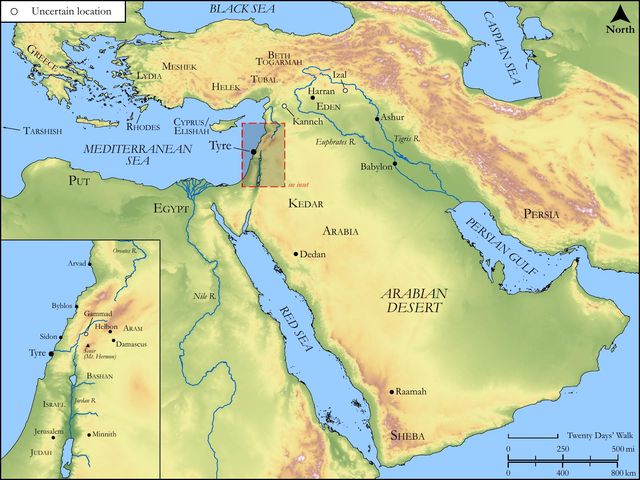
See on the biblical-era map
Study this verse
Public-domain commentary
Matthew Henry
From his Commentary on the Whole Bible. Henry comments on passages, not single verses — this entry covers Ezekiel 27:26–36.
We have seen Tyre flourishing; here we have Tyre falling, and great is the fall of it, so much the greater for its having made such a figure in the world. Note, The most mighty and magnificent kingdoms and states, sooner or later, have their day to come down. They have their period; and, when they are in their zenith, they will begin to decline. But the destruction of Tyre was sudden. Her sun went down at noon. And all her wealth and grandeur, pomp and power, did but aggravate her ruin, and make it the more grievous to herself and astonishing to all about her. Now observe here, 1. How the ruin of Tyrus will be brought about, Eze 27:26. She is as a great ship richly laden, that is split or sunk by the indiscretion of her steersmen: Thy rowers have themselves brought thee into great and dangerous waters; the governors of the city, and those that had the management of their public affairs, by some mismanagement or other involved them in that war with the Chaldeans which was the ruin of their state. By their insolence, by some affront given to the Chaldeans or some attempt made upon them, in confidence of their own ability to contend with them, they provoked Nebuchadnezzar to make a descent upon them, and, by their obstinacy in standing it out to the last, enraged him to such a degree that he determined on the ruin of their state, and, like an east wind, broke them in the midst of the seas. Note, It is ill with a people when those that sit at the stern, instead of putting them into the harbour, run them aground. 2. How great and general the ruin will be. All her wealth shall be buried with her, her riches, her fairs, and her merchandise (Eze 27:27); all that had any dependence upon her, and dealings with her, in trade, in war, in conversation, shall ball with her into the midst of the seas, in the day of her ruin. Note, Those who make creatures their confidence, place their happiness in their interest in them and rest their hopes upon them, will of course fall with them; happy therefore are those that have the God of Jacob for their help, and whose hope is in the Lord their God, who lives for ever. 3. What sad lamentation would be made for the destruction of Tyre. The pilots, her princes and governors, when they see how wretchedly they have mismanaged and how much they have contributed to their own ruin, shall cry out so loud as to make even the suburbs shake (Eze 27:28), such a vexation shall it be to them to reflect upon their own bad conduct. The inferior officers, that were as the mariners of the state, shall be forced to come down from their respective posts (Eze 27:29), and they shall cry out against thee, as having deceived them, in not proving so well able to hold out as they thought thou hadst been; they shall cry bitterly for the common ruin, and their own share in it. They shall use all the most solemn expressions of grief; they shall cast dust on their heads, in indignation against themselves, shall wallow themselves in ashes, as having bid a final farewell to all ease and pleasure; they shall make themselves bald (Eze 27:31), with tearing their hair; and, according to the custom of great mourners, those shall gird themselves with sackcloth who used to wear find linen, and, instead of merry songs, they shall weep with bitterness of heart. Note, Losses and crosses are very grievous, and hard to be borne, to those that have long been wallowing in pleasure and sleeping in carnal security. 4. How Tyre should be upbraided with her former honour and prosperity (Eze 27:32, Eze 27:33); she that was Tyrus the renowned shall now be called Tyrus the destroyed in the midst of the sea. "What city is like Tyre? Did ever any city come down from such a height of prosperity to such a depth of adversity? Time was when thy wares, those of thy own making and those that passed through thy hands, went forth out of the seas, and were exported to all parts of the world; then thou filledst many people, and didst enrich the kings of the earth and their kingdoms." The Tyrians, though they bore such a sway in trade, were yet, it seems, fair merchants, and let their neighbours not only live, but thrive by them. All that dealt with them were gainers; they did not cheat or oppress the people, but did enrich them with the multitude of their merchandise. "But now those that used to be enriched by thee shall be ruined with thee" (as is usual in trade); "when thou shalt be broken, and all thou hast is seized on, all thy company shall fall too," Eze 27:34. There is an end of Tyre, that made such a noise and bustle in the world. This great blaze goes out in a snuff. 5. How the fall of Tyre should be matter of terror to some and laughter to others, according as they were differently interested and affected. Some shall be sorely afraid, and shall be troubled (Eze 27:35), concluding it will be their own turn to fall next. Others shall hiss at her (Eze 27:36), shall ridicule her pride, and vanity, and bad management, and think her ruin just. She triumphed in Jerusalem's fall, and there are those that will triumph in hers. When God casts his judgments on the sinner men also shall clap their hands at him and shall hiss him out of his place, Job 27:22, Job 27:23. Is this the city which men called the perfection of beauty?
Historical interpretation
Historical reception
3 surviving comments on this verse. Each one is dated, so this reads as a timeline rather than a list.
(Verse 35, 36, and following) And I will bring you into a desert of peoples, and there I will judge you face to face. Just as I contended with your fathers in the desert of the land of Egypt, so I will judge you, says the Lord. And I will subject you to my scepter, and I will bring you into the bonds of the covenant, and I will choose from among you the transgressors and the wicked: from their place of residence I will bring them out, and they will not enter the land of Israel, and you will know that I am the Lord. Thus says the Lord: I will do for you who are in Babylon, and now serve idols, what I did for your ancestors in Egypt. I will lead you into the desert of the peoples, and there I will judge you face to face, just as I contended with them in judgment when they came out of Egypt. And after I have judged you, I will subject you to my scepter and rule, and I will make a covenant with you and bring you into your land with the bonds of love, so that bound by my love, you will never be able to depart from me. But I will choose from among you the transgressors and the wicked, who persist in the hardness of their hearts in evil deeds, not for possession, but for rejection. And I will indeed bring them out of the land of their dwelling, so that when they are brought out, they will not enter the land of Israel; but they will perish in various regions. And by the distinction between good and evil, you shall know that I am the Lord, who judges all things. The rest of the discourse hastens, and we briefly go through each point, in order to provide only the meaning to the readers.
(Verse 28, 29) From the sound of the shouting of your helmsmen, the fleets will be thrown into confusion, and all who held the oar will come down from their ships. The sailors, and all the helmsmen of the sea, the shipmasters and the rowers, will stand on land, and they will wail loudly over you, and cry out bitterly. They will throw dust on their heads, and cover themselves with ashes (or spread ashes on themselves). And what follows: They will shave their heads because of you, and put on sackcloth; they will weep for you with bitter mourning, and take up a lamentation over you. In the Septuagint it is not found, but it is added in the Theodotian Edition. When Tyre falls, its governors will be troubled, and they will descend from their ships, and oarsmen and sailors and rowers, and all the governors of the sea, tossed by the waves, will finally stand on solid ground; and they will lament with a loud voice over it, which they previously enriched with their merchandise, and they will signify the bitterness of their minds with a clamor: and they will also throw dust or dirt on their heads, repenting of their earthly deeds. And they shall be sprinkled with ashes or calves, according to the Law (Num. XX), in order to be purified: or certainly they shall lay ashes upon themselves, according to that which is said to Jerusalem: Scatter the earth upon thy head, and lay ash beneath thee, and make lamentation (Jerem. VI, 16). And in the Gospel it is written: If these signs had been done in Tyre and Sidon, they would have done penance long ago in sackcloth and ashes (Luc. X, 13). And the Psalmist says: I have eaten ashes like bread (Psal. CI, 10). And they shave their head over Tyre, and they make baldness, which usually happens in mourning, at that time when the magnitude of sorrow has excluded all joy. But the apostles' hair was numbered, because they had consecrated their hair like the Nazarenes to the Lord (Matthew 10; Luke 6). And as long as Samson had hair, he possessed strength, but when his hair was cut off, he was captured by the Philistines (Judges 16). But when it is said, and they shall gird themselves with sackcloth, the old lust of the loins is condemned, so that those who lived in pleasures may afterwards live in austerity and hardness, repenting. The people of Nineveh had sackcloth. And again, it is said to Jerusalem: 'Wail to me like a bride wearing sackcloth, grieving for her husband as a virgin.' And they will mourn for you, it says, with bitter weeping. For it is better to enter the house of mourning than the house of feasting, so that they may mourn for Tyre and sing a mournful song, as the following Scripture adds. But in order to know the progress of those who mourn the falling, and who dwelled before in the heart of the sea, let the prophets teach us by their example: they themselves are commanded to mourn for Tyre, so that, after the time of repentance is fulfilled, it may be restored to its former state, and, taking up the lyre, may sound forth for the Lord. Read Isaiah. Some, though ridiculous (but still worth reading), interpret governors as bishops of heretics, counselors as priests, helmsmen as archdeacons, rowers and sailors as deacons, and carriers refer to the whole people. If they had added the devil as the shipmaster, they would have completed the tragedy. All of them will wail together and cry bitterly, and they will repent after they sense the shipwreck of their own ship and stand on land, and they will lose all the splendor of the false name of knowledge. And instead of joy and happiness, they will mark repentance with bitterness in their hearts.
(Verse 27, 29 onwards) Therefore speak to the house of Israel, son of man, and tell them: Thus says the Lord God: Moreover, your fathers have blasphemed against me and have treated me with contempt, even as they spurned me. And I brought them into the land that I had lifted my hand to give them ((Vulgate adds: that land)): they saw every high hill and every leafy tree, and there they offered their sacrifices and presented there the irritation of their offerings, and they placed there the fragrance of their sweetness, and they poured out their ((Vulgate is silent on this)) libations there. And I said to them, 'What is the high place to which you are going?' And its name was called the High Place until this day. Therefore speak to the house of Israel, son of man, and say to them, 'Thus says the Lord God: As for your fathers, they have provoked Me to anger by their iniquities, by the fact that they have fallen away from Me. So I brought them into the land that I had lifted My hand in an oath to give them.' They saw every high hill and every leafy tree, and there they offered their sacrifices. They also presented there the provocation of their gifts, and they set there their pleasing aroma, and they poured out there their drink offerings. And I said to them: What is abbana, because you enter there? And they called its name abbana until this day. I wanted, he said, to scatter them in the wilderness, and to give them not good precepts, so that they would sacrifice to idols what they should have offered to me, and consecrate all their first-fruits to them by fire, so that I might kill them and destroy them. But when he says, I wanted, he shows that he did not do what he wanted. And that which follows: 'And they shall know that I am the Lord,' is not found in the Septuagint. For it did not seem fitting to them to know after their destruction that he himself is the Lord. But you, son of man, speak again to them, that is, to the elders of the house of Israel, who have come to inquire of you: Your fathers, from whom you have descended, have also blasphemed against me and held me in contempt; after I brought them into the land which I had given them to possess, they turned against me to provoke me. For when they saw every high hill and leafy tree, they would sacrifice on the mountains and in the groves and thickets, and offer victims to the idols, and pour out libations. And when I saw this, I said to them: What is this, Bama? for it is called high: or why do you enter into such a place which you have chosen for yourselves in all the hills, so that even today these places are called Bamoth, and the ancient error retains its original name? Regarding Bama, which we translate as excelsum, there is an error in the Septuagint edition, where it is written as ἀββανὰ, which does not resonate in the Hebrew language. Bama can mean 'in which' if the two syllables are divided into two words, but in the present context, that sense does not fit. However, wherever it is written in the Books of Kings and Chronicles: 'The people still sacrificed and offered incense on the high places,' Bama in the singular and Bamoth in the plural mean 'high places.'
Continue studying Ezekiel 27:28 across the web’s major study libraries — every link below opens this exact verse, chapter, or book on the destination site.
Read & Compare
 BibleGatewayThis verse in more than 200 translations and 70 languages.
 Bible.comThe YouVersion reader — hundreds of translations, reading plans, and highlights.
 ESV.orgCrossway's official English Standard Version reader.
 NET BibleThe NET translation with 60,000+ translators' notes on every rendering decision.
 STEP BibleTyndale House's free study tool — original text, vocabulary, and scholarly resources.
 BibliaLogos Bible Software's free web reader.
 USCCBThe New American Bible (Revised Edition) with the U.S. bishops' study notes.
Commentaries
 BibleHub CommentariesDozens of classic commentaries on this verse, gathered on one page.
 StudyLightMore than 100 commentary sets — the largest collection on the web.
 BibleRefPlain-English commentary on what this verse means, verse by verse.
 Enduring WordDavid Guzik's free commentary on this chapter, widely used by Bible teachers.
 Bible Study ToolsVerse commentary alongside Greek and Hebrew study aids.
Original Language & Research
- BibleHub InterlinearThe verse word by word — original language, transliteration, and English.
- BibleHub LexiconEvery word's original-language definition and Strong's entry.
 Blue Letter BibleDeep-study tools — Strong's numbers, concordance, and word studies.
 SefariaThe Hebrew text with Rashi and centuries of Jewish commentary.
Sermons, Hymns & Audio


TrulyRandomVerse is not affiliated with these sites and doesn’t control their content. They’re linked because they’re genuinely useful.
Summary
Ezekiel 27:28 powerfully concludes the prophetic dirge against Tyre, vividly portraying the immediate and widespread panic that accompanies its catastrophic downfall. As the once-mighty maritime empire collapses, the verse depicts the profound despair and utter helplessness of its leaders and all who depended on its prosperity. It illustrates how the shockwaves of divine judgment would extend far beyond the city's immediate walls, affecting even its outlying territories, marking a dramatic and irreversible shift from detailing Tyre's former glory to foretelling its sudden and devastating demise.
Context
ShowHideLiterary Context
Ezekiel 27:28 is strategically placed at the climax of an elaborate and extended prophetic lament, or dirge, directed against the city of Tyre, spanning Ezekiel chapters 26-28. Specifically, chapter 27 masterfully employs the metaphor of Tyre as a magnificent, meticulously constructed ship, built from the finest materials and crewed by a diverse array of skilled personnel from numerous nations, symbolizing its unparalleled commercial reach and naval dominance. The preceding verses meticulously detail Tyre's immense wealth, extensive trade networks, and impressive array of goods and human resources, painting a picture of seemingly unassailable prosperity and self-sufficiency. However, the narrative takes an abrupt and dramatic turn in Ezekiel 27:26-27, shifting the imagery to a catastrophic shipwreck, which signals the city's impending and total destruction. Verse 28 then describes the immediate and visceral aftermath of this disaster, focusing on the widespread terror and the profound despair of its leaders, thereby culminating the judgment pronounced earlier in Ezekiel 26:7-14.
Historical & Cultural Context
Ancient Tyre was a preeminent Phoenician city-state, celebrated for its maritime prowess, naval strength, and vast commercial empire. Its strategic location on the Mediterranean coast, initially as an island fortress, made it an indispensable hub for international trade routes, enabling it to accumulate immense wealth through an extensive network of colonies and trading partners. The "pilots" (shipmasters, navigators) mentioned in the verse were highly skilled and indispensable professionals, representing the very engine of Tyre's economic prosperity and reflecting the city's existential reliance on seafaring. The cultural context of this prophetic lament underscores the deep-seated pride and self-reliance that characterized Tyre, which, in the biblical prophetic tradition, consistently precedes divine judgment. The vivid imagery of a ship and its crew would have resonated powerfully with Ezekiel's original audience, immediately conveying the total collapse of an entity whose very identity and existence were inextricably linked to the sea. The "suburbs" (Hebrew: migrâsh), referring to the open fields or pasturelands surrounding the fortified city, emphasize that the devastation would not be confined to the urban core but would extend to its agricultural dependencies and outlying communities, thereby affecting every facet of Tyre's economy and all who were connected to it.
Key Themes
ShowHideThis verse serves as a powerful articulation of several pivotal themes within Ezekiel's prophecy and the broader biblical metanarrative. Firstly, it profoundly underscores the widespread impact of divine judgment, demonstrating that the consequences of Tyre's fall would ripple outwards, affecting not only its inhabitants but also its dependencies and all nations who had profited from its extensive trade. Secondly, it highlights the inherent fragility and transient nature of earthly power and wealth. Despite its seemingly impregnable position and immense riches, Tyre is revealed as utterly vulnerable to God's sovereign decree, serving as a potent warning against human pride and self-reliance—a theme powerfully echoed in other prophetic laments over powerful cities, such as the fall of Babylon described in Revelation 18. Thirdly, the "cry of thy pilots" vividly symbolizes the utter despair and helplessness of human leadership and expertise when confronted with divine wrath. All their accumulated skill, strategic planning, and vast wealth prove utterly useless, emphasizing the ultimate sovereignty of God over all nations and human enterprises, a foundational truth consistently proclaimed throughout the entire book of Ezekiel.
Exposition and Analysis
ShowHideKey Word Analysis
ShowHideThis term (H4054) refers to the open spaces, pasturelands, or common grounds immediately surrounding a city. Its use in Ezekiel 27:28 indicates that the terror and devastation of Tyre's fall would extend beyond its fortified urban walls, impacting even its agricultural lands and outlying communities. This signifies the comprehensive and all-encompassing nature of the calamity, affecting every aspect of Tyre's domain.
This primitive root (H7493) denotes an undulation or trembling, particularly through fear; to quake, tremble, or be moved. It vividly conveys the profound physical and emotional tremor that would seize the surrounding areas, suggesting a deep and unsettling disturbance akin to an earthquake, caused by the sheer magnitude of Tyre's collapse and the terror it inspired.
This active participle (H2259) specifically refers to a sailor or shipmaster, literally one who handles ropes. In the elaborate metaphor of Tyre as a magnificent ship, these "pilots" represent the skilled navigators and principal leaders who steered its immense commercial success. Their "cry" signifies that even those at the helm, possessing the greatest expertise and responsibility for Tyre's prosperity, are utterly helpless and overcome by panic in the face of divine judgment.
Verse Breakdown
ShowHide"The suburbs shall shake"
This opening clause immediately conveys the widespread and profound impact of Tyre's impending judgment. The "suburbs" (Hebrew: migrâsh) are the open areas and pasturelands surrounding the fortified city, implying that the shockwaves of its fall would not be contained within its urban core but would extend to its agricultural lands and outlying communities. The verb "shake" (Hebrew: râʻash) suggests a violent trembling and profound disturbance, indicating that the terror and devastation would be felt far and wide, unsettling the very foundations of the surrounding region and all who depended on Tyre.
"at the sound of the cry of thy pilots"
This phrase specifies the immediate and audible cause of the widespread shaking: the desperate expression of extreme distress. The "sound" (Hebrew: qôwl) of the "cry" (Hebrew: zᵉʻâqâh) implies a loud, piercing wail of anguish, alarm, and utter despair. The source of this desperate outcry is identified as "thy pilots" (Hebrew: chôbêl), the skilled shipmasters and leaders who guided Tyre's vast commercial enterprise. In the metaphor of Tyre as a ship, they represent the city's elite, its decision-makers, and those most responsible for its prosperity. Their collective "cry" signifies their complete helplessness and panic in the face of God's judgment, demonstrating that all their expertise, wealth, and strategic planning are rendered utterly useless. This highlights the ultimate futility of human strength and wisdom when confronted with divine power and judgment.
Literary Devices
ShowHideEzekiel 27:28 employs several potent literary devices to convey the overwhelming magnitude and emotional impact of Tyre's fall. Personification is central, as the "suburbs" are depicted as capable of "shaking" at an audible sound, imbuing the inanimate surroundings with a visceral and empathetic reaction to the city's demise. This amplifies the sense of widespread terror and instability. Auditory Imagery is powerfully utilized, focusing on the "sound of the cry" of the pilots, which allows the reader to almost hear the piercing wail of despair. This auditory element contrasts sharply with the earlier descriptions of Tyre's bustling, confident trade, emphasizing the dramatic shift to chaos. The verb "shake" (Hebrew râʻash) also functions as Hyperbole, suggesting a tremor so profound it affects the very ground, underscoring the overwhelming and catastrophic nature of the divine judgment. Furthermore, the "pilots" serve as a central Metaphor for Tyre's leaders and those responsible for its economic and political direction, their desperate cries symbolizing the complete collapse of all human wisdom, control, and power in the face of God's unyielding sovereignty.
Theological and Thematic Connections
ShowHideEzekiel 27:28 serves as a profound theological statement on the transient nature of earthly power, wealth, and human ingenuity when confronted with divine judgment. It underscores the biblical principle that pride and self-sufficiency, particularly when built upon exploitation, injustice, or a disregard for God's righteousness, inevitably lead to a devastating and comprehensive fall. The widespread shaking and the despairing cries of the "pilots" illustrate that God's judgment is not confined to the immediate source of sin but is comprehensive, affecting all who are intertwined with its system and benefit from its corruption. This passage powerfully reminds us that true security and lasting prosperity are found not in accumulating worldly riches or relying on human strength and wisdom, but in humble submission to the sovereign God who alone holds the destiny of nations and individuals in His hands.
Reflection and Application
ShowHideEzekiel 27:28 offers a timeless and sobering reflection for individuals and societies today, urging us to critically examine the foundations upon which we build our lives and aspirations. Are we, like ancient Tyre, investing our primary trust and energy in fleeting earthly achievements, accumulating wealth, and relying on human wisdom and ingenuity? Or are we seeking to build upon an enduring foundation, acknowledging God's ultimate sovereignty and aligning our lives with His righteous and eternal principles? The widespread impact of Tyre's judgment, causing even its "suburbs" to shake and its "pilots" to cry out in despair, serves as a powerful reminder that systems built on pride, injustice, or self-sufficiency are inherently fragile and ultimately unsustainable. When divine judgment or the inevitable consequences of human folly manifest, whether individually or corporately, they can dismantle even the most formidable human constructs, leaving those who once felt secure in utter helplessness. This passage calls us to cultivate profound humility, to recognize the ephemeral nature of worldly success, and to place our ultimate hope and security in the unshakeable kingdom of God, which alone endures forever and offers true, lasting peace.
Questions for Reflection
ShowHideFAQ
ShowHideWhat does "the suburbs shall shake" signify in this verse?
ShowHideThe phrase "the suburbs shall shake" signifies the profound and widespread impact of Tyre's downfall. The "suburbs" (Hebrew: migrâsh) refer to the open areas, pasturelands, or outlying communities surrounding the fortified city. Their shaking indicates that the terror, devastation, and economic collapse caused by Tyre's destruction would not be confined to its immediate urban center but would ripple outwards, affecting all its dependencies, agricultural lands, and those who relied on its prosperity. It conveys a sense of universal shock and instability, as if the very ground beneath them was trembling due to the magnitude of the catastrophe, much like the shaking of the nations described in Haggai 2:7.
Who are "thy pilots" and why is their cry significant?
ShowHide"Thy pilots" (Hebrew: chôbêl) refer to the skilled shipmasters, navigators, and leaders of Tyre. In the elaborate metaphor of Tyre as a magnificent ship, these pilots represent the city's elite, its decision-makers, and those responsible for guiding its immense commercial and political success. Their "cry" (Hebrew: zᵉʻâqâh, a loud, distressed wail) is highly significant because it symbolizes their utter despair, helplessness, and the ultimate futility of all their human wisdom, skill, and accumulated wealth in the face of divine judgment. It demonstrates that even those who were at the helm of this mighty empire, once confident and in control, are now overwhelmed by panic and unable to avert the impending doom, highlighting the ultimate sovereignty of God over all human endeavors, as seen in passages like Psalm 33:10-11.
Christ-Centered Fulfillment
ShowHideWhile Ezekiel 27:28 directly prophesies the historical judgment upon the powerful city of Tyre, its profound themes find rich Christ-centered fulfillment in the broader biblical narrative of God's sovereign rule, the ultimate triumph of His eternal kingdom, and the fleeting nature of all earthly powers. The vivid imagery of the shaking "suburbs" and the despairing "cry of thy pilots" foreshadows the ultimate shaking of all things that can be shaken, as powerfully described in Hebrews 12:26-27, so that only the unshakeable kingdom of God remains. The dramatic fall of Tyre, a quintessential symbol of human pride, self-sufficient economic power, and worldly glory, points to the ultimate demise of all systems and empires that oppose God's righteous rule, culminating in the final, comprehensive judgment of "Babylon the Great" in Revelation 18, where kings, merchants, and shipmasters lament its destruction. In stark contrast to Tyre's transient and ultimately shattered glory, Christ establishes an eternal kingdom that will never be destroyed (Daniel 2:44). He is the true and eternal "Pilot" who steers His people through the storms of life, not with human wisdom that ultimately fails, but with divine power and perfect love, leading them to the secure harbor of salvation. His definitive victory on the cross and His glorious resurrection demonstrate that all earthly powers, even death itself, are ultimately subject to His supreme authority (Colossians 2:15). Thus, the profound despair and helplessness of Tyre's pilots stand in stark contrast to the enduring hope, security, and ultimate victory found only in Christ, the one who holds all things together (Colossians 1:17) and whose righteous reign will have no end.