


Ezekiel 27:35
- כֹּלkolallH3605N-mscNoun Singular Masculine Construct
- יֹשְׁבֵיyo·she·Vei[the] inhabitants ofH3427V-Qal-Prtcpl-mpVerb Qal Participle Plural Masculine Construct
- הָאִיִּיםha·'i·Yimthe islandsH339Art ¦ N-mpNoun Plural Masculine Absoluteהָtheאִיִּיםislands
- שָׁמְמוּsha·me·Muthey have been appalledH8074V-Qal-Perf-3cpVerb Qal Perfect 3rd Plural common gender
- עָלָיִךְ'a·La·yikhon youH5921Prep ¦ 2fsPrepositionעָלָיִonךְyou
- וּמַלְכֵיהֶםu·mal·khei·Hemand their kingsH4428Conj-w ¦ N-mpc ¦ 3mpNoun Plural Masculine Constructוּandמַלְכֵיkingsהֶםtheir
- שָׂעֲרוּSa·'a·ruthey have shudderedH8175V-Qal-Perf-3cpVerb Qal Perfect 3rd Plural common gender
- שַׂעַרSa·'arshudderingH8178N-msNoun Singular Masculine Absolute
- רָעֲמוּra·'a·Muthey have been disconcertedH7481V-Qal-Perf-3cpVerb Qal Perfect 3rd Plural common gender
- פָּנִיםpa·NimfacesH6440N-mpNoun Plural Masculine Absolute
English is a literal word-by-word gloss of the Hebrew, not the KJV's wording. Why?
This is the original text the KJV's translators worked from — each Hebrew word with its own literal English meaning in this verse, prepared by scholars at Tyndale House, Cambridge. The KJV translates whole sentences, not word by word, so its wording differs: one Hebrew word can become several English words, and the KJV may choose “the LORD” where the gloss reads “Yahweh”. Both are faithful — they answer different questions. For the KJV's own rendering, switch to the KJV text.
Details
See on the biblical-era map
Study this verse
Public-domain commentary
Matthew Henry
From his Commentary on the Whole Bible. Henry comments on passages, not single verses — this entry covers Ezekiel 27:26–36.
We have seen Tyre flourishing; here we have Tyre falling, and great is the fall of it, so much the greater for its having made such a figure in the world. Note, The most mighty and magnificent kingdoms and states, sooner or later, have their day to come down. They have their period; and, when they are in their zenith, they will begin to decline. But the destruction of Tyre was sudden. Her sun went down at noon. And all her wealth and grandeur, pomp and power, did but aggravate her ruin, and make it the more grievous to herself and astonishing to all about her. Now observe here, 1. How the ruin of Tyrus will be brought about, Eze 27:26. She is as a great ship richly laden, that is split or sunk by the indiscretion of her steersmen: Thy rowers have themselves brought thee into great and dangerous waters; the governors of the city, and those that had the management of their public affairs, by some mismanagement or other involved them in that war with the Chaldeans which was the ruin of their state. By their insolence, by some affront given to the Chaldeans or some attempt made upon them, in confidence of their own ability to contend with them, they provoked Nebuchadnezzar to make a descent upon them, and, by their obstinacy in standing it out to the last, enraged him to such a degree that he determined on the ruin of their state, and, like an east wind, broke them in the midst of the seas. Note, It is ill with a people when those that sit at the stern, instead of putting them into the harbour, run them aground. 2. How great and general the ruin will be. All her wealth shall be buried with her, her riches, her fairs, and her merchandise (Eze 27:27); all that had any dependence upon her, and dealings with her, in trade, in war, in conversation, shall ball with her into the midst of the seas, in the day of her ruin. Note, Those who make creatures their confidence, place their happiness in their interest in them and rest their hopes upon them, will of course fall with them; happy therefore are those that have the God of Jacob for their help, and whose hope is in the Lord their God, who lives for ever. 3. What sad lamentation would be made for the destruction of Tyre. The pilots, her princes and governors, when they see how wretchedly they have mismanaged and how much they have contributed to their own ruin, shall cry out so loud as to make even the suburbs shake (Eze 27:28), such a vexation shall it be to them to reflect upon their own bad conduct. The inferior officers, that were as the mariners of the state, shall be forced to come down from their respective posts (Eze 27:29), and they shall cry out against thee, as having deceived them, in not proving so well able to hold out as they thought thou hadst been; they shall cry bitterly for the common ruin, and their own share in it. They shall use all the most solemn expressions of grief; they shall cast dust on their heads, in indignation against themselves, shall wallow themselves in ashes, as having bid a final farewell to all ease and pleasure; they shall make themselves bald (Eze 27:31), with tearing their hair; and, according to the custom of great mourners, those shall gird themselves with sackcloth who used to wear find linen, and, instead of merry songs, they shall weep with bitterness of heart. Note, Losses and crosses are very grievous, and hard to be borne, to those that have long been wallowing in pleasure and sleeping in carnal security. 4. How Tyre should be upbraided with her former honour and prosperity (Eze 27:32, Eze 27:33); she that was Tyrus the renowned shall now be called Tyrus the destroyed in the midst of the sea. "What city is like Tyre? Did ever any city come down from such a height of prosperity to such a depth of adversity? Time was when thy wares, those of thy own making and those that passed through thy hands, went forth out of the seas, and were exported to all parts of the world; then thou filledst many people, and didst enrich the kings of the earth and their kingdoms." The Tyrians, though they bore such a sway in trade, were yet, it seems, fair merchants, and let their neighbours not only live, but thrive by them. All that dealt with them were gainers; they did not cheat or oppress the people, but did enrich them with the multitude of their merchandise. "But now those that used to be enriched by thee shall be ruined with thee" (as is usual in trade); "when thou shalt be broken, and all thou hast is seized on, all thy company shall fall too," Eze 27:34. There is an end of Tyre, that made such a noise and bustle in the world. This great blaze goes out in a snuff. 5. How the fall of Tyre should be matter of terror to some and laughter to others, according as they were differently interested and affected. Some shall be sorely afraid, and shall be troubled (Eze 27:35), concluding it will be their own turn to fall next. Others shall hiss at her (Eze 27:36), shall ridicule her pride, and vanity, and bad management, and think her ruin just. She triumphed in Jerusalem's fall, and there are those that will triumph in hers. When God casts his judgments on the sinner men also shall clap their hands at him and shall hiss him out of his place, Job 27:22, Job 27:23. Is this the city which men called the perfection of beauty?
Historical interpretation
Historical reception
3 surviving comments on this verse. Each one is dated, so this reads as a timeline rather than a list.
(Verse 35, 36, and following) And I will bring you into a desert of peoples, and there I will judge you face to face. Just as I contended with your fathers in the desert of the land of Egypt, so I will judge you, says the Lord. And I will subject you to my scepter, and I will bring you into the bonds of the covenant, and I will choose from among you the transgressors and the wicked: from their place of residence I will bring them out, and they will not enter the land of Israel, and you will know that I am the Lord. Thus says the Lord: I will do for you who are in Babylon, and now serve idols, what I did for your ancestors in Egypt. I will lead you into the desert of the peoples, and there I will judge you face to face, just as I contended with them in judgment when they came out of Egypt. And after I have judged you, I will subject you to my scepter and rule, and I will make a covenant with you and bring you into your land with the bonds of love, so that bound by my love, you will never be able to depart from me. But I will choose from among you the transgressors and the wicked, who persist in the hardness of their hearts in evil deeds, not for possession, but for rejection. And I will indeed bring them out of the land of their dwelling, so that when they are brought out, they will not enter the land of Israel; but they will perish in various regions. And by the distinction between good and evil, you shall know that I am the Lord, who judges all things. The rest of the discourse hastens, and we briefly go through each point, in order to provide only the meaning to the readers.
(Verse 33 and following) What is like Tyre, that has become silent (or has been silenced) in the middle of the sea? (Which is not found in the Septuagint.) Who, in the outcome of your dealings (or what reward you received) from the sea, enriched many peoples? In the abundance of your wealth, and with the multitude of your people, you made many kings wealthy. Now you are broken by the sea (or in the sea) in the depths of the waters, your wealth (or your trading) and all your multitude, which was in your midst, have fallen. All the inhabitants of the islands were astonished (or crushed) over you, and all their kings were struck (or turned mad) by the tempest, they changed their countenance (or wept). The merchants of the nations (or peoples) hissed at you, you were brought down to nothingness (or made into ruins), and you will no longer exist (Vulg. remains silent) forever (or for eternity). Captains, sailors, helmsmen, and passengers, in the mourning of Tyre, will remember these things, which so silenced other cities that they had no confidence to speak; and they heard that Gospel saying, Be silent, and be dumb (Mark 4:39). And concerning the Psalms: But to the sinner God said, Why do you declare my justices, and take my covenant in thy mouth? (Ps. XLVI, 16) How rich has Tyre become with so many goods! And why have you sought so much with such great labor, that you gather perishable things through days and nights of shipwreck? Indeed, you have filled many peoples and enriched kings with your wealth, of whom it is written: The kings of the earth stood, and the princes met together against the Lord and against his Christ (Psalm II, 2). But now you are crushed in the sea, and in the depths of the waters, just as it is written about Pharaoh: The chariots of Pharaoh and his army he has cast into the sea (Exodus XV, 4). He was submerged in the deep like a stone, and he could say: I have come into the deep of the sea, and the tempest has submerged me (Psalm XIV, 4). All the islands, or the inhabitants of the islands, that are battered by the waves of this world, will be astonished at you, and their kings, struck by the storm, will sense their own demise. They will imitate the voice of the snake, hissing and saying: You have been reduced to nothing, or you have been made into destruction; so that you have not had the nature of destruction, but the will. And you will not be. But if he had said this until now, a great question would arise, how it was not, which we now see as built. But from what follows, 'Forever', it shows the time of one age, which is reckoned to be around 70 years in the circle of a man's life. Whether you will not be to God, as the Apostle says: 'He calls things that are not as though they were' (Rom. 4:17). And the prophet Isaiah: 'Behold, they shall be confounded and ashamed, all your adversaries.' (Isaiah 41:11). For they will be as if they were not (Isa. XLI, 11): And Esther according to the Seventy Interpreters: Do not give your scepter to those who are not (Esther XIV, 11). And in the psalm: Let me be refreshed before I go away, and I shall be no more (Ps. XXXV, 14). We have already mentioned in what sense these testimonies should be understood. However, all these things can be referred to the person of heretics, who, in the contrition of Tyre and the shipwreck, feel their error and, placed in the midst of the sea, desire to free their souls and mourn the ill-gotten riches, with which they have enriched many kings, namely their patriarchs, and the common people, whose wealth will be destroyed in the midst of the sea. The inhabitants of all the islands (if, however, we want to interpret what has been said in a positive way) will also be astonished at the destruction of Tyre, and the kings of all the islands, being as it were struck by a storm, will change their faces, or at least show the grief of their hearts with weeping and tears, and they will testify to the magnitude of their astonishment with wonder and hissing, declaring how she has become nothing and perished, she who promised salvation to many nations. And furthermore, it will not be, at any certain time, that we interpret αἰῶνα as meaning 'age'; but forever, because the same word signifies both.
(Verse 27, 29 onwards) Therefore speak to the house of Israel, son of man, and tell them: Thus says the Lord God: Moreover, your fathers have blasphemed against me and have treated me with contempt, even as they spurned me. And I brought them into the land that I had lifted my hand to give them ((Vulgate adds: that land)): they saw every high hill and every leafy tree, and there they offered their sacrifices and presented there the irritation of their offerings, and they placed there the fragrance of their sweetness, and they poured out their ((Vulgate is silent on this)) libations there. And I said to them, 'What is the high place to which you are going?' And its name was called the High Place until this day. Therefore speak to the house of Israel, son of man, and say to them, 'Thus says the Lord God: As for your fathers, they have provoked Me to anger by their iniquities, by the fact that they have fallen away from Me. So I brought them into the land that I had lifted My hand in an oath to give them.' They saw every high hill and every leafy tree, and there they offered their sacrifices. They also presented there the provocation of their gifts, and they set there their pleasing aroma, and they poured out there their drink offerings. And I said to them: What is abbana, because you enter there? And they called its name abbana until this day. I wanted, he said, to scatter them in the wilderness, and to give them not good precepts, so that they would sacrifice to idols what they should have offered to me, and consecrate all their first-fruits to them by fire, so that I might kill them and destroy them. But when he says, I wanted, he shows that he did not do what he wanted. And that which follows: 'And they shall know that I am the Lord,' is not found in the Septuagint. For it did not seem fitting to them to know after their destruction that he himself is the Lord. But you, son of man, speak again to them, that is, to the elders of the house of Israel, who have come to inquire of you: Your fathers, from whom you have descended, have also blasphemed against me and held me in contempt; after I brought them into the land which I had given them to possess, they turned against me to provoke me. For when they saw every high hill and leafy tree, they would sacrifice on the mountains and in the groves and thickets, and offer victims to the idols, and pour out libations. And when I saw this, I said to them: What is this, Bama? for it is called high: or why do you enter into such a place which you have chosen for yourselves in all the hills, so that even today these places are called Bamoth, and the ancient error retains its original name? Regarding Bama, which we translate as excelsum, there is an error in the Septuagint edition, where it is written as ἀββανὰ, which does not resonate in the Hebrew language. Bama can mean 'in which' if the two syllables are divided into two words, but in the present context, that sense does not fit. However, wherever it is written in the Books of Kings and Chronicles: 'The people still sacrificed and offered incense on the high places,' Bama in the singular and Bamoth in the plural mean 'high places.'
Continue studying Ezekiel 27:35 across the web’s major study libraries — every link below opens this exact verse, chapter, or book on the destination site.
Read & Compare
 BibleGatewayThis verse in more than 200 translations and 70 languages.
 Bible.comThe YouVersion reader — hundreds of translations, reading plans, and highlights.
 ESV.orgCrossway's official English Standard Version reader.
 NET BibleThe NET translation with 60,000+ translators' notes on every rendering decision.
 STEP BibleTyndale House's free study tool — original text, vocabulary, and scholarly resources.
 BibliaLogos Bible Software's free web reader.
 USCCBThe New American Bible (Revised Edition) with the U.S. bishops' study notes.
Commentaries
 BibleHub CommentariesDozens of classic commentaries on this verse, gathered on one page.
 StudyLightMore than 100 commentary sets — the largest collection on the web.
 BibleRefPlain-English commentary on what this verse means, verse by verse.
 Enduring WordDavid Guzik's free commentary on this chapter, widely used by Bible teachers.
 Bible Study ToolsVerse commentary alongside Greek and Hebrew study aids.
Original Language & Research
- BibleHub InterlinearThe verse word by word — original language, transliteration, and English.
- BibleHub LexiconEvery word's original-language definition and Strong's entry.
 Blue Letter BibleDeep-study tools — Strong's numbers, concordance, and word studies.
 SefariaThe Hebrew text with Rashi and centuries of Jewish commentary.
Sermons, Hymns & Audio


TrulyRandomVerse is not affiliated with these sites and doesn’t control their content. They’re linked because they’re genuinely useful.
Summary
This verse powerfully depicts the profound global shock and overwhelming fear that will seize the maritime nations and their rulers upon the catastrophic downfall of Tyre. Once an unrivaled commercial and naval powerhouse, Tyre's demise serves as the climactic fulfillment of a divine lament, demonstrating that the collapse of such a dominant economic entity would send reverberations of astonishment and terror across all who were connected to or competed with it, thereby revealing the ultimate fragility of earthly power in the face of God's sovereign judgment.
Context
ShowHideLiterary Context
Ezekiel 27:35 is strategically positioned near the culmination of an elaborate prophetic lament against Tyre, which spans Ezekiel chapters 26 through 28. Specifically, Ezekiel 27 masterfully employs the extended metaphor of Tyre as a magnificent, perfectly crafted merchant ship, built from the finest materials and manned by skilled mariners from across the known world. The preceding verses meticulously detail Tyre's unparalleled wealth, its extensive network of trading partners, and its formidable maritime strength, painting a vivid picture of a seemingly invincible empire. Verse 35, therefore, serves as the dramatic climax of this nautical allegory, depicting the moment the "ship" is utterly wrecked at sea, and the subsequent, widespread horror that grips those who witness its demise. It underscores that Tyre's fall is not merely an internal collapse but an event of global significance, particularly for other seafaring nations and their rulers, who now confront the devastating reality of its destruction.
Historical & Cultural Context
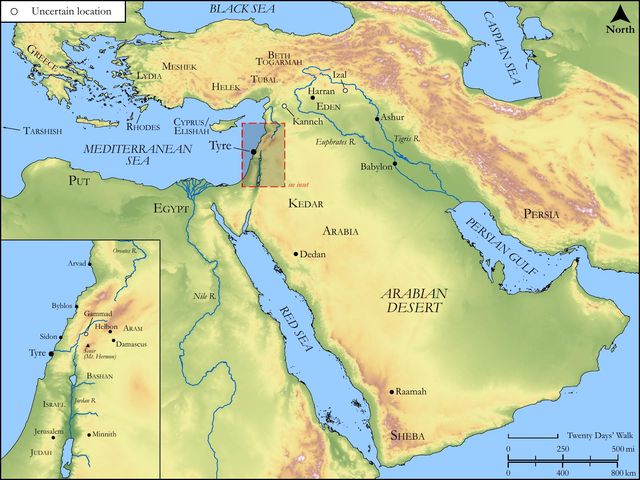
Tyre was a preeminent Phoenician city-state, strategically located on the eastern Mediterranean coast, renowned for its immense wealth, extensive trade networks, and formidable naval power. Its unique geography, originally an island city, made it an ideal hub for international commerce, connecting the ancient Near East with the broader Mediterranean world through its prized purple dye, cedar timber, and diverse array of goods. The "isles" mentioned in the verse refer to the numerous coastal regions, islands, and maritime nations that engaged in trade with Tyre or were significantly influenced by its economic dominance. The reaction described—astonishment, fear, and troubled countenances—reflects the profound impact that the collapse of such a central economic pillar would have on the highly interconnected ancient world, disrupting established trade routes, shifting geopolitical power dynamics, and causing widespread economic upheaval. This was a city whose influence was felt from the distant shores of Tarshish in the west to the Arabian deserts in the east, making its prophesied fall a truly global event for its time.
Key Themes
ShowHideThis verse powerfully contributes to several major themes found throughout the book of Ezekiel and the broader prophetic literature. Firstly, it highlights Divine Judgment and God's ultimate sovereignty over all nations. Tyre, in its immense pride and self-sufficiency, exemplified by the king's boast in Ezekiel 28:2, believed itself invincible, yet is brought low by God's decree, demonstrating that even the most powerful human kingdoms are subject to His will and justice. Secondly, it emphasizes the Widespread Impact of Judgment. The "inhabitants of the isles" and "their kings" represent the far-reaching influence of Tyre and, consequently, the global implications of its destruction. Their reaction signifies that Tyre's fall was not an isolated event but a shocking demonstration of divine power that resonated across the entire maritime world. Lastly, the theme of Fear and Dismay is prominent. The description of kings being "sore afraid" and "troubled in their countenance" indicates a deep-seated terror and visible distress, perhaps born from the sudden realization of their own vulnerability in the face of such overwhelming destruction, mirroring the lamentations over the fall of Babylon in Revelation 18.
Exposition and Analysis
ShowHideKey Word Analysis
ShowHideA primitive root meaning "to sit down," "to dwell," or "to remain." In this context, it refers to those who are settled residents of the coastal regions and islands. This emphasizes that the widespread astonishment affects not merely transient traders but the very fabric of society in these maritime lands, underscoring the deep and lasting impact of Tyre's collapse on established populations.
A primitive root meaning "to stun," "grow numb," "devastate," or "stupefy." This word conveys a profound sense of shock, horror, and desolation that leaves one utterly aghast and dumbfounded. It signifies more than mere surprise; it is a deep, unsettling wonder that reflects the unimaginable scale and suddenness of Tyre's destruction, leaving observers in a state of numb disbelief.
A plural noun (always singular in meaning) derived from a root meaning "to turn," referring to "the face" or "the part that turns." This term denotes the visible expression of one's face, which serves as a window to inner emotions. The phrase "troubled in their countenance" indicates a visible manifestation of fear, confusion, and dismay etched onto their faces, a public and undeniable display of terror that contrasts sharply with the typical composure expected of kings and powerful figures.
Verse Breakdown
ShowHide"All the inhabitants of the isles shall be astonished at thee,"
This initial clause establishes the universal and profound reaction to Tyre's demise. "Inhabitants of the isles" refers to the peoples of the coastal regions and islands, emphasizing the entire maritime world that was intricately connected to Tyre through trade and influence. Their "astonishment" (Hebrew: H8074, shâmêm') signifies a deep, unsettling shock and horror at the sudden and complete destruction of what was perceived as an invincible commercial and naval power.
"and their kings shall be sore afraid,"
This expands the scope of the reaction to specifically include the rulers of these maritime nations. The kings, who typically project strength, composure, and control, are depicted as "sore afraid." The Hebrew term for "sore" (H8178, saʻar') connotes a tempest or terror, intensifying the fear (H8175, sâʻar') to a trembling, overwhelming dread. This highlights the profound political and strategic implications of Tyre's fall, as these powerful rulers recognize the vulnerability of their own kingdoms and the instability introduced by such a cataclysmic event.
"they shall be troubled in [their] countenance."
This final clause describes the visible manifestation of their terror and inner turmoil. "Troubled" (Hebrew: H7481, râʻam') implies violent agitation, a shaking or trembling, often associated with thunder. When applied to "countenance" (Hebrew: H6440, pânîym'), it paints a vivid picture of faces contorted by fear, dismay, and confusion. It suggests a public, undeniable display of inner turmoil, indicating that the shock of Tyre's fall was so immense that it visibly altered the expressions of even the most powerful individuals, stripping them of their regal composure.
Literary Devices
ShowHideEzekiel 27:35 employs several powerful literary devices to convey the profound and far-reaching impact of Tyre's fall. Hyperbole is evident in the sweeping statement "All the inhabitants of the isles," emphasizing the universal and far-reaching nature of the shock, though it may not imply a literal, exhaustive enumeration of every single person. This exaggeration serves to highlight the immense influence Tyre wielded and the global reverberations of its collapse. Personification is subtly used by attributing human emotions like astonishment, fear, and troubled countenances to the collective "inhabitants of the isles" and "their kings," allowing the reader to grasp the widespread emotional turmoil. The vivid imagery of "troubled in their countenance" creates a strong sense of Pathos, evoking empathy and understanding for the deep distress experienced by those witnessing such a cataclysmic event. Furthermore, the entire chapter, culminating in this verse, functions as a powerful Lament, a poetic form traditionally used to mourn loss and express profound grief, which amplifies the tragedy and the irreversible nature of Tyre's destruction.
Theological and Thematic Connections
ShowHideEzekiel 27:35 stands as a potent theological statement about the transience of all earthly power and the unwavering, absolute sovereignty of God. It underscores that no nation, however wealthy, strategically positioned, or militarily formidable, is beyond the reach of divine judgment. Tyre's fall is a stark reminder that unchecked pride and self-sufficiency, particularly when they lead to exploitation, injustice, and rebellion against God's moral order, inevitably lead to destruction. The astonishment of the "isles" and their kings is a testament to God's ability to humble the proud and demonstrate His supreme control over all human affairs, orchestrating events to fulfill His righteous purposes. This judgment is not merely punitive but also profoundly revelatory, exposing the ultimate fragility and ephemerality of human constructs and redirecting focus to the enduring, unshakeable power of the Almighty.
Reflection and Application
ShowHideEzekiel 27:35 offers timeless lessons for individuals and nations today, reminding us that true security and lasting prosperity are not found in material wealth, strategic advantage, or human ingenuity, but in humble submission to the Almighty God. The astonishment and fear gripping the maritime world serve as a powerful warning against the dangers of unchecked pride, self-reliance, and the relentless pursuit of commercial gain at the expense of justice and righteousness. It challenges us to examine where we place our ultimate trust and to recognize that even the most formidable human empires and economic systems are transient and vulnerable to divine intervention. This passage calls us to cultivate humility, to live with an acute awareness of divine justice, and to remember that God remains sovereign over all circumstances, even when chaos seems to reign. Our appropriate response should be one of reverence and a healthy fear of the Lord, recognizing that His hand is continually at work in history, bringing low the proud and exalting the humble, ensuring His purposes prevail.
Questions for Reflection
ShowHideFAQ
ShowHideWhy were the "isles" and their kings so affected by Tyre's fall?
ShowHideThe "isles" refer to the coastal regions and maritime nations that were deeply intertwined with Tyre's vast commercial empire. Tyre was the dominant economic and naval power of its time, serving as a central hub for international trade, connecting diverse regions across the Mediterranean. Its fall meant the catastrophic collapse of established trade routes, widespread economic instability, and a significant shift in geopolitical power. The kings and inhabitants were "astonished" and "sore afraid" because they witnessed the sudden and complete destruction of a seemingly invincible entity. This would have had profound economic, political, and psychological repercussions for their own kingdoms and livelihoods. It was a stark demonstration that no earthly power was immune to such a fate, causing them to fear for their own security and future, much like the lament of merchants and kings over Babylon in Revelation 18.
What does "troubled in their countenance" imply about their reaction?
ShowHide"Troubled in their countenance" (Hebrew: râʻam pânîym) implies a visible and profound manifestation of inner turmoil, fear, and dismay etched onto their faces. It's more than just an internal feeling; it's a physical reaction where their expressions are contorted, agitated, or visibly distressed by the shock and terror. This phrase suggests that the impact of Tyre's destruction was so overwhelming that it robbed these powerful kings and inhabitants of their composure, revealing their deep-seated fear and confusion to all. It paints a vivid picture of public, undeniable distress, underscoring the severity of the event and its psychological toll on those who witnessed it. This visible distress contrasts sharply with the typical stoicism expected of rulers, highlighting the unprecedented and terrifying nature of Tyre's demise.
Christ-Centered Fulfillment
ShowHideEzekiel 27:35, while describing the judgment of an ancient city, points forward to a greater reality fulfilled in Christ. The astonishment and fear of the world's kings and merchants at Tyre's demise powerfully foreshadow the ultimate shaking of all earthly kingdoms and powers at the revelation of God's final, righteous judgment, which culminates in the return of Christ. Just as Tyre's commercial might and pride led to its inevitable downfall, so too will all human systems built on self-sufficiency, the idolatry of wealth, and opposition to God's reign ultimately crumble. The "Lamb of God" (John 1:29), who came not with earthly pomp or military might but in profound humility, will ultimately establish a kingdom that is "not of this world" (John 18:36), a kingdom that "shall never be destroyed" (Daniel 2:44). The fear gripping the maritime nations in Ezekiel can be seen as a prophetic shadow of the universal awe and terror that will seize all who have rejected God when they face the glorious and formidable presence of Christ at His second coming (Revelation 6:15-17). Ultimately, the fall of Tyre serves as a prophetic type, reminding us that only in Christ is true and lasting security found, and that His reign, unlike any earthly empire, will endure forever in the New Jerusalem, where there is no need for sun or moon, "for the glory of God gives it light, and the Lamb is its lamp" (Revelation 21:23).