


Isaiah 28:19
- מִדֵּיmi·Deias often asH1767Prep-m ¦ N-mscNoun Singular Masculine Constructמִasדֵּיoften as
- עָבְרוֹa·ve·Ropasses by itH5674V-Qal-Inf ¦ 3msVerb Qal Infinitive Constructעָבְרpasses byוֹit
- יִקַּחyi·Kachit will takeH3947V-Qal-Imperf-3msVerb Qal Imperfect 3rd Singular Masculine
- אֶתְכֶם'et·Khem<obj.> youH853DirObjM ¦ 2mpParticle Object Indicatorאֶתְ<obj.>כֶםyou
- כִּיkiforH3588PrtParticle Conditional
- בַבֹּקֶרva·Bo·kerin the morningH1242Prep-b ¦ N-msNoun Singular Masculine Absoluteבַin theבֹּקֶרmorning
- בַּבֹּקֶרba·Bo·kerin the morningH1242Prep-b ¦ N-msNoun Singular Masculine Absoluteבַּin theבֹּקֶרmorning
- יַעֲבֹרya·'a·Vorit will pass byH5674V-Qal-Imperf-3msVerb Qal Imperfect 3rd Singular Masculine
- בַּיּוֹםbai·Yomin the dayH3117Prep-b ¦ N-msNoun Singular Masculine Absoluteבַּin theיּוֹםday
- וּבַלָּיְלָהu·va·La·ye·lahand in the nightH3915Conj-w ¦ Prep-b ¦ N-msNoun Singular Masculine Absoluteוּandבַin theלָּיְלָהnight
- וְהָיָהve·ha·Yahand it will beH1961Conj-w ¦ V-Qal-ConsecPerf-3msVerb Qal Consecutive Perfect 3rd Singular Masculineוְandהָיָהit will be
- רַקrakonlyH7535AdvAdverb
- זְוָעָהze·va·'AhterrorH2113N-fsNoun Singular Feminine Absolute
- הָבִיןha·Vinto understandH995V-Hiphil-InfVerb Hiphil Infinitive Construct
- שְׁמוּעָהshe·mu·'Ah[the] messageH8052N-fsNoun Singular Feminine Absolute
English is a literal word-by-word gloss of the Hebrew, not the KJV's wording. Why?
This is the original text the KJV's translators worked from — each Hebrew word with its own literal English meaning in this verse, prepared by scholars at Tyndale House, Cambridge. The KJV translates whole sentences, not word by word, so its wording differs: one Hebrew word can become several English words, and the KJV may choose “the LORD” where the gloss reads “Yahweh”. Both are faithful — they answer different questions. For the KJV's own rendering, switch to the KJV text.
Details
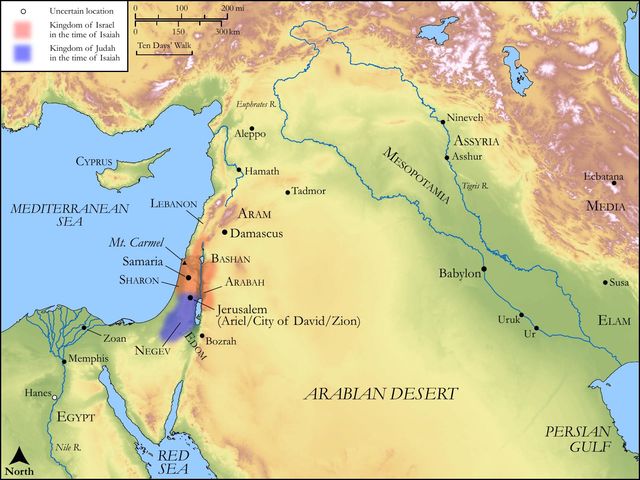
See on the biblical-era map
Study this verse
Public-domain commentary
Matthew Henry
From his Commentary on the Whole Bible. Henry comments on passages, not single verses — this entry covers Isaiah 28:14–22. His four-level outline is real structure in the source text, so it is rendered as structure.
The prophet, having reproved those that made a jest of the word of God, here goes on to reprove those that made a jest of the judgments of God, and set them at defiance; for he is a jealous God, and will not suffer either his ordinances or his providences to be brought into contempt. He addressed himself to the scornful men who ruled in Jerusalem, who were the magistrates of the city, Isa 28:14. It is bad with a people when their thrones of judgment become the seats of the scornful, when rulers are scorners; but that the rulers of Jerusalem should be men of such a character, that they should make light of God's judgments and scorn to take notice of the tokens of his displeasure, is very sad. Who will be mourners in Zion if they are scorners? Observe,
I.How these scornful men lulled themselves asleep in carnal security, and even challenged God Almighty to do his worst (Isa 28:15) You have said, We have made a covenant with death and the grave. They thought themselves as sure of their lives, even when the most destroying judgments were abroad, as if they had made a bargain with death, upon a valuable consideration, not to come till they sent for him or not to take them away by any violence, but by old age. If we be at peace with God, and have made a covenant with him, we have in effect made a covenant with death that it shall come in the fittest time, that whenever it comes, it shall be no terror to us, nor do us any real damage; death is ours if we be Christ's (Co1 3:22, Co1 3:23): but to think of making death our friend, or being in league with it, while by sin we are making God our enemy and are at war with him, is the greatest absurdity that can be. It was fond conceit which these scorners had, "When the overflowing scourge shall pass through our country, and others shall fall under it, yet it shall not come to us, not reach us, though it extend far, not bear us down, though it is an overflowing scourge." It is the greatest folly imaginable for impenitent sinners to think that either in this world or the other they shall fare better than their neighbours. But what is the ground of their confidence? Why, truly, We have made lies our refuge. Either,
1.Those things which the prophets told them would be lies and falsehood to them and would deceive, but which they themselves looked upon as substantial fences. The protection of their idols, the promises with which their false prophets soothed them, their policy, their wealth, their interest in the people; these they confided in, and not in God; nay, these they confided in against God. Or,
2.Those things which should be lies and falsehood to the enemy, who was flagellum Dei - the scourge of God, the overflowing scourge; they would secure themselves by imposing upon the enemy with their stratagems of war, or their feigned submissions in treaties of peace. The rest of the cities of Judah were taken because they made an obstinate defence; but the rulers of Jerusalem hope to succeed better. They think themselves greater politicians than those of the country towns; they will compliment the king of Assyria with a promise to surrender their city, or to become tributaries to him, with a purpose at the same time to shake off his yoke as soon as the danger is over, not caring though they be found liars to him, as the expression is, Deu 33:29. Note, Those put a cheat upon themselves that think to gain their point by putting cheats upon those they deal with. Those that pursue their designs by trick and fraud, by mean and paltry shifts, may perhaps compasss them, but cannot expect comfort in them. Honesty is the best policy. But such refuges as these are those driven to that depart from God, and throw themselves out of his protection.
II.How God, by the prophet, awakens them out of this sleep, and shows them the folly of their security.
1.He tells them upon what grounds they might be secure. He does not disturb their false confidences, till he has first shown them a firm bottom on which they may repose themselves (Isa 28:16): Behold, I lay in Zion for a foundation a stone. This foundation is,
(1.)The promises of God in general - his word, upon which he has caused his people to hope - his covenant with Abraham, that he would be a God to him and his; this is a foundation, a foundation of stone, firm and lasting, for faith to build upon; it is a tried stone, for all the saints have stayed themselves upon it and it never failed them.
(2.)The promise of Christ in particular; for to him this is expressly applied in the New Testament, Pe1 2:6-8. He is that stone which has become the head of the corner. The great promise of the Messiah and his kingdom, which was to begin at Jerusalem, was sufficient to make God's people easy in the worst of times; for they knew well that till he came the sceptre should not depart from Judah. Zion shall continue while this foundation is yet to be laid there. "Thus saith the Lord Jehovah, for the comfort of those that dare not make lies their refuge, Behold, and look upon me as one that has undertaken to lay in Zion a Stone," Jesus Christ is a foundation of God's laying. This is the Lord's doing. He is laid in Zion, in the church, in the holy hill. He is a tried stone, a trying stone (so some), a touch-stone, that shall distinguish between true and counterfeit. He is a precious stone, for such are the foundations of the New Jerusalem (Rev 21:19), a corner-stone, in whom the sides of the building are united, the head-stone of the corner. And he that believes these promises, and rests upon them, shall not make haste, shall not run to and fro in a hurry, as men at their wits' end, shall not be shifting hither and thither for his own safety, nor be driven to his feet by any terrors, as the wicked man is said to be (Job 18:11), but with a fixed heart shall quietly wait the event, saying, Welcome the will of God. He shall not make haste in his expectations, so as to anticipate the time set in the divine counsels, but, though it tarry, will wait the appointed hour, knowing that he that shall come will come, and will not tarry. He that believes will not make more haste than good speed, but be satisfied that God's time is the best time, and wait with patience for it. The apostle from the Septuagint explains this, Pe1 2:6. He that believes on him shall not be confounded; his expectations shall not be frustrated, but far out-done.
2.He tells them that upon the grounds which they now built on they could not be safe, but their confidences would certainly fail them (Isa 28:17): Judgment will I lay to the line, and righteousness to the plummet. This denotes,
(1.)The building up of his church; having laid the foundation (Isa 28:16), he will raise the structure, as builders do, by line and plummet, Zac 4:10. Righteousness shall be the line and judgment the plummet. The church, being grounded on Christ, shall be formed and reformed by the scripture, the standing rule of judgment and righteousness. Judgment shall return unto righteousness, Psa 94:15. Or,
(2.)The punishing of the church's enemies, against whom he will proceed in strict justice, according to the threatenings of the law. He will give them their deserts, and bring upon them the judgments they have challenged, but in wisdom too, and by an exact rule, that the tares may not be plucked up with the wheat. And when God comes thus to execute judgment,
[1.]These scornful men will be made ashamed of the vain hopes with which they had deluded themselves. First, They designed to make lies their refuge; but it will indeed prove a refuge of lies, which the hail shall sweep away, that tempest of hail spoken of Isa 28:2. Those that make lies their refuge build upon the sand, and the building will fall when the storm comes, and bury the builder in the ruins of it. Those that make any thing their hiding place but Christ shall find that the waters will overflow it, as every shelter but the ark was over-topped and overthrown by the waters of the deluge. Such is the hope of the hypocrite; this will come of all his confidences. Secondly, They boasted of a covenant with death, and an agreement with the grave; but it shall be disannulled, as made without his consent who has the keys and sovereign command of hell and death. Those do but delude themselves that think by any wiles to evade the judgments of God. Thirdly, They fancied that when the overflowing scourge should pass through the land it should not come near them; but the prophet tells them that then, when others were falling by the common calamity, they should not only share in it, but should be trodden down by it: "You shall be to it for a treading down; it shall triumph over you as much as over any other, and you shall become its easy prey." They are further told (Isa 28:19), 1. That it shall begin with them; they shall be so far from escaping it that they shall be the first that shall fall by it: "From the time it goes forth it shall take you, as if it came on purpose to seize you." 2. That it shall pursue them closely: "Morning by morning shall it pass over; as duly as the day returns you shall hear of some desolation or other made by it; for divine justice will follow its blow; you shall never be safe nor easy by day nor by night; there shall be a pestilence walking in darkness and a destruction wasting at noonday." 3. That there shall be no avoiding it: "The understanding of the report of its approach shall not give you any opportunity to make your escape, for there shall be no way of escape open; but it shall be only a vexation, you shall see it coming, and not see how to help yourselves." Or, "The very report of it at a distance will be a terror to you; what then will the thing itself be?" Evil tidings are a terror and vexation to scorners, but he whose heart is fixed, trusting in God, is not afraid of them; whereas, when the overflowing scourge comes, then all the comforts and confidences of scorners fail them, Isa 28:20. (1.) That in which they thought to repose themselves reaches not to the length of their expectations: The bed is shorter than that a man can stretch himself upon it, so that he is forced to cramp and contract himself. (2.) That in which they thought to shelter themselves proves insufficient to answer the intention: The covering is narrower than that a man can wrap himself in it. Those that do not build upon Christ as their foundation, but rest in a righteousness of their own, will prove in the end thus to have deceived themselves; they can never be easy, safe, nor warm; the bed is too short, the covering is too narrow; like our first parents' fig-leaves, the shame of their nakedness will still appear.
[2.]God will be glorified in the accomplishment of his counsels, Isa 28:21. When God comes to contend with these scorners, First, He will do his work, and bring to pass his act, he will work for his own honour and glory, according to his own purpose; the work shall appear to all that see it to be the work of God as the righteous Judge of the earth. Secondly, He will do it now against his people, as formerly he did it against their enemies, by which his justice will appear to be impartial; he will now rise up against Jerusalem as, in David's time, against the Philistines in Mount Perazim (Sa2 5:20), and as, in Joshua's time, against the Canaanites in the valley of Gibeon. If those that profess themselves members of God's church by their pride and scornfulness make themselves like Philistines and Canaanites, they must expect to be dealt with as such. Thirdly, This will be his strange work, his strange act, his foreign deed. It is work that he is backward to: he rather delights in showing mercy, and does not afflict willingly. It is work that he is not used to as to his own people; he protects and favours them. It is a strange work indeed if he turn to be their enemy and fight against them, ch. 63:10. It is a work that all the neighbours will stand amazed at (Deu 29:24), and therefore the ruins of Jerusalem are said to be an astonishment, Jer 25:18.
Lastly, We have the use and application of all this (Isa 28:22): "Therefore be you not mockers; dare not to ridicule either the reproofs of God's word or the approaches of his judgments." Mocking the messengers of the Lord was Jerusalem's measure-filling sin. The consideration of the judgments of God that are coming upon hypocritical professors should effectually silence mockers, and make them serious: "Be you not mockers, lest your bands be made strong, both the bands by which you are bound under the dominion of sin" (for there is little hope of the conversion of mockers) "and the bands by which you are bound over to the judgments of God." God has bands of justice strong enough to hold those that break all the bonds of his law asunder and cast away all his cord from them. Let not these mockers make light of divine threatenings, for the prophet (who is one of those with whom the secret of the Lord is) assures them that the Lord God of hosts has, in his hearing, determined a consumption upon the whole earth; and can they think to escape? or shall their unbelief invalidate the threatening?
Historical interpretation
Two Centuries of Reception
3 surviving comments on this verse. Each one is dated, so this reads as a timeline rather than a list.
Select a marker to jump to its quote. Markers stagger vertically where authors wrote within a few decades of each other.
Every time is suitable for your ablution, since any time may be your death. With Paul I shout to you with that loud voice, “Behold now is the accepted time; behold now is the day of salvation”;56 and that now does not point to any one time but is every present moment. And again “Awake, you that sleep, and Christ shall give you light,” dispelling the darkness of sin. For as Isaiah says, “In the night hope is evil,” and it is more profitable to be received in the morning.
(Verse 16 and following). Thus says the Lord God: Behold, I will send in the foundations of Zion a tested, corner, precious stone, founded on a foundation: he who believes shall not hurry. And I will put judgment in the balance, and justice in the measure: and hail will overthrow the hope of lies, and the covering waters will flood. And your covenant with death shall be abolished, and your pact with Hell shall not stand; when the overflowing scourge passes through, you shall be trampled. When it passes by, it will seize you; for it will pass through in the morning, in the day and at night, and its vexation will only give understanding to the ear: For the bed is too narrow for one to stretch out on, and the covering is too small to wrap oneself in. Therefore, thus says the Lord: Behold, I will lay in Zion a precious stone, a chosen, cornerstone, and whoever believes in it will not be put to shame. And I will set judgment as hope; but my mercy as a burden, and those who believe in vain falsehood, for the storm will not pass through us, and it will not take away from us the testament of death, and your hope will not remain in hell. If the coming storm passes, you will be trampled by it; when it passes, it will lift you up in the morning, it will pass in the morning; day and night there will be the worst of hope. Learn to listen, you who are in tribulation: we cannot fight, for we ourselves are weak to be gathered. I had said, he says, to you: Listen to the word of the Lord, men who mock, or troubled rulers of my people, and do not have a covenant with death, nor an agreement with the underworld, who, despising my commandments, have put your hope in lies, and boasting, or rather despairing, say: with lies we will be protected. Therefore, the merciful and compassionate Lord, patient and greatly merciful (Ps. 145), says that he will send an elected, tested, precious, and corner stone into the foundations of Zion for those who do not want it. About which the Apostle also speaks: Like a wise architect, I have laid the foundation (I Cor. III, 10); and again: For no one can lay any other foundation than the one that's been laid, which is Christ Jesus (Ibid., 11). This stone is truly and again called a stone, just as in Leviticus, a man is called man twice and a corner stone, because it has united the people of the Circumcision and the Gentiles, about which it is also said in the psalm: The stone which the builders rejected, has become the head of the corner (Ps. CXVII, 22). But these are the builders and masons, who are now called deceivers and leaders of the people who are in Jerusalem. Concerning this stone, we read in Daniel that it was cut from a mountain without hands, and it filled the whole earth (Dan. II): because the divine dispensation of the divine seed assumed a human body, and the fullness of Divinity dwelt in it bodily. Upon this stone, which is also called rock, Christ built the Church, and according to the Hebrew, he established the foundation on a firm rock, on which anyone who believes will not be put to shame, or, according to the Hebrew, will not hasten, lest the coming of Christ appear slow to him. For if it delays according to Habakkuk, let no one despair: for it will surely come, and it will fulfill its promises (Hab. II). And God also promises to put judgment in Him: For the Father does not judge anyone, but he has given all judgment to the Son (John V, 22). And justice or mercy in measure, in order to render to each according to his works, and to temper justice and mercy with each other, according to what we also read in the Psalms: Mercy and truth have met each other: justice and peace have kissed (Ps. LXXXIV, 11). He also says that your hope and falsehood, that is, the devil, the father of all falsehood, will overthrow the hailstorm of my punishments. And the protection, under which you thought you would be safe, a powerful storm and a multitude of waters will destroy, so that the friendship and treaty that you had with death and with Hell, that is, with the devil, may perish eternally. And the whip or storm, of which you said: 'When the overwhelming whip passes, it will not come upon us' - it will come, and you will be trodden down by it, that is, you will suffer all the torments that you believed you would never endure in despair. For always the wrath of the Lord will fall upon you, and you will feel it both in times of prosperity and adversity, and cruel death will ravage you. What shall I say about punishments? Fear of punishments alone and the dread of torments will correct you for salvation, and will make you understand your evils. And when you have been tormented, then you will know that my Prophets have spoken the truth. And what follows: For the bed is made narrow, so that one falls out, and the short cloak cannot cover both, it has the sense which we read in the Apostle: You cannot drink the cup of the Lord and the cup of devils. You cannot partake of the table of the Lord and the table of demons (2 Corinthians 10:20, 21); and elsewhere: What fellowship does righteousness have with iniquity? What communion does light have with darkness? What agreement does Christ have with Belial? What part does a believer have with an unbeliever? What agreement does the temple of God have with idols (2 Corinthians 6:14, 15)? However, he speaks under the metaphor of a most chaste husband, who says to his adulterous wife: One bed cannot contain both me and an adulterer, and a short cloak cannot cover both a husband and an adulterer. Therefore, Jerusalem, to whom in Ezekiel under the guise of a wife speaking, her adulteries are spoken of (Ezek. XVI, 21), and whom in Hosea at the beginning is called a harlot and an adulteress (Hos. III), if you wish to be united with my embraces, cast away idols: if you serve idols, you cannot have me. According to the Hebrew. Furthermore, as for what is read in the LXX: Learn to hear, you who are troubled: we cannot fight, but we ourselves are weak so that we may gather together. I completely do not know the meaning of this, and how it is connected to the previous context. Unless perhaps the divine speech speaks to the leaders of the people and encourages them to have hope in God, and not in death and hell, and teaches them to listen to the prophecies of the prophets, and they respond that they cannot fight against opposing powers due to the weakness of their strength, nor gather among the people of God.
Now righteous people conceive a dread of God before his indignation is stirred up against them; they fear him at rest, lest they should feel him as moved. But, on the other hand, the wicked then for the first time fear to be smitten when they are under the rod, and terror then rouses them from the sleep of their insensibility when vengeance is troubling them. And hence it is said by the prophet, “And only the vexing alone shall supply understanding to the hearing.” For when they have begun to be stricken in vengeance for the contempt and neglect of God’s precepts, then they understand the thing that they heard.
Continue studying Isaiah 28:19 across the web’s major study libraries — every link below opens this exact verse, chapter, or book on the destination site.
Read & Compare
 BibleGatewayThis verse in more than 200 translations and 70 languages.
 Bible.comThe YouVersion reader — hundreds of translations, reading plans, and highlights.
 ESV.orgCrossway's official English Standard Version reader.
 NET BibleThe NET translation with 60,000+ translators' notes on every rendering decision.
 STEP BibleTyndale House's free study tool — original text, vocabulary, and scholarly resources.
 BibliaLogos Bible Software's free web reader.
 USCCBThe New American Bible (Revised Edition) with the U.S. bishops' study notes.
Commentaries
 BibleHub CommentariesDozens of classic commentaries on this verse, gathered on one page.
 StudyLightMore than 100 commentary sets — the largest collection on the web.
 BibleRefPlain-English commentary on what this verse means, verse by verse.
 Enduring WordDavid Guzik's free commentary on this chapter, widely used by Bible teachers.
 Bible Study ToolsVerse commentary alongside Greek and Hebrew study aids.
Original Language & Research
- BibleHub InterlinearThe verse word by word — original language, transliteration, and English.
- BibleHub LexiconEvery word's original-language definition and Strong's entry.
 Blue Letter BibleDeep-study tools — Strong's numbers, concordance, and word studies.
 SefariaThe Hebrew text with Rashi and centuries of Jewish commentary.
Sermons, Hymns & Audio


TrulyRandomVerse is not affiliated with these sites and doesn’t control their content. They’re linked because they’re genuinely useful.
Summary
Isaiah 28:19 powerfully depicts the relentless and inescapable nature of God's impending judgment, symbolized by an "overflowing scourge," upon the spiritually complacent and rebellious leaders of Judah. This verse emphasizes the pervasive, continuous impact of this divine visitation, which will sweep over them without respite, day and night. The profound distress it brings is so overwhelming that merely comprehending the reality of this judgment will be a source of terror and anguish, rather than leading to understanding, repentance, or escape.
Context
ShowHideLiterary Context
Isaiah 28 initiates a series of "woes" (chapters 28-33), beginning with a denunciation of Ephraim (the Northern Kingdom) and then shifting focus to the spiritual complacency and moral corruption of Jerusalem's leaders in Judah. Verse 19 specifically details the pervasive and relentless nature of the "overflowing scourge" (first introduced in Isaiah 28:15 and reaffirmed in Isaiah 28:18) that God will send as judgment. This impending calamity stands in stark contrast to the true foundation, the "precious cornerstone" (found in Isaiah 28:16), which the leaders have arrogantly rejected in favor of their own deceptive alliances and self-reliant schemes. The immediate context of verse 19 builds upon the idea that their false security, their "covenant with death," will be utterly swept away by this overwhelming divine flood.
Historical & Cultural Context
This prophecy is set against the ominous backdrop of the encroaching Assyrian Empire, a dominant military power that had already devastated the Northern Kingdom of Israel and posed an existential threat to the Southern Kingdom of Judah. The leaders in Jerusalem, instead of placing their trust in Yahweh, sought security through pragmatic yet faithless political alliances, particularly with Egypt. Isaiah vehemently condemned these alliances as a "covenant with death" (Isaiah 28:15), which would ultimately prove futile. Culturally, the people, especially the leadership, had become complacent, indulging in revelry, spiritual drunkenness, and a dismissive attitude towards God's prophets, as depicted earlier in Isaiah 28. The vivid imagery of a "scourge" or "flood" was a potent and readily understood metaphor in the ancient Near East for an overwhelming military invasion, signifying a force that would sweep away all human defenses, false securities, and established order.
Key Themes
ShowHideSeveral profound themes converge in Isaiah 28, with verse 19 particularly highlighting the Inevitable and Relentless Judgment of God. The repeated phrase "morning by morning, by day and by night" powerfully underscores the inescapable and pervasive nature of the divine punishment once it commences, leaving absolutely no opportunity for escape or respite. This judgment is presented as a direct and just consequence of the people's profound Spiritual Blindness and Rebellion, as they have consistently rejected God's warnings and relied on their own flawed understanding and worldly alliances, leading inevitably to the severe Consequences of Disobedience. The verse also subtly, yet powerfully, touches upon God's Sovereignty over History, demonstrating His absolute control over nations and their destinies, even to the extent of using foreign powers as instruments of His righteous wrath to bring about His purposes, as seen throughout the prophetic books.
Exposition and Analysis
ShowHideKey Word Analysis
ShowHideThis verb signifies a dynamic movement, a transition, or the act of crossing over. In the context of Isaiah 28:19, it powerfully conveys the relentless and pervasive advance of the divine judgment, likening it to an unstoppable flood or an overwhelming army that sweeps over everything in its path, leaving no place untouched and no one able to evade its reach.
Meaning "to take, seize, or carry away," this word emphasizes the complete capture and overwhelming possession that the judgment will have over the people. It denotes an active, forceful appropriation, indicating that the victims will be utterly helpless and unable to resist or escape its grip. The judgment will not merely affect them; it will fully encompass and claim them.
This term denotes intense agitation, profound fear, deep trouble, or debilitating dread. It describes not just a minor annoyance or discomfort, but a profound, debilitating terror and horror that will accompany the realization and experience of the judgment. This state of being will render any understanding of the calamity purely agonizing, far from offering clarity or a path to resolution.
Verse Breakdown
ShowHide"From the time that it goeth forth it shall take you"
This clause emphasizes the inevitability, immediacy, and comprehensive nature of the judgment. Once God's decree is set in motion, the "scourge" will swiftly and completely seize its intended targets, leaving no opportunity for evasion, delay, or partial impact. It signifies a decisive and overwhelming divine action.
"for morning by morning shall it pass over, by day and by night"
This vivid and emphatic repetition highlights the relentless, pervasive, and continuous nature of the impending calamity. It signifies that the judgment will offer absolutely no respite, no break, and no moment of peace, but will be a constant, overwhelming presence, affecting every single moment of their existence, day and night without end.
"and it shall be a vexation only [to] understand the report"
This final, poignant phrase underscores the profound distress, terror, and anguish associated with the judgment. The very act of comprehending the nature, severity, and inescapable extent of the disaster will not bring clarity, wisdom, or a path to escape, but rather an unbearable, agonizing torment. Their prior spiritual dullness means that when understanding finally dawns, it brings only horror and despair.
Literary Devices
ShowHideIsaiah 28:19 masterfully employs several potent literary devices to convey its message of impending, inescapable judgment. The primary device is Personification, where the "it" (referring to the "overflowing scourge" from previous verses) is imbued with active, relentless agency, as it "goeth forth," "shall take you," and "shall pass over." This gives the judgment an unstoppable, almost sentient force, emphasizing its inevitability. The phrase "morning by morning, by day and by night" utilizes powerful Hyperbole and Repetition to intensify the sense of ceaseless, pervasive terror, underscoring that there will be no escape or respite from the calamity. Furthermore, there is a profound and tragic Irony in the final clause: "it shall be a vexation only [to] understand the report." Instead of understanding bringing clarity, wisdom, or a path to repentance and deliverance, it brings only anguish and dread, highlighting the spiritual blindness and hardened hearts that have led them to this dire point. The entire passage also functions as an extended Metaphor, where the "scourge" represents the divine judgment executed through an invading army, likely the Assyrians.
Theological and Thematic Connections
ShowHideIsaiah 28:19 powerfully articulates the theological principle of divine justice and the inevitable, comprehensive consequences of sustained rebellion against God. It underscores that God's warnings, though often dismissed or ignored by the complacent and arrogant, are not idle threats but expressions of His righteous character and unwavering commitment to His covenant. When His patience is exhausted, His judgment is not a fleeting or partial event but a pervasive, relentless force that sweeps away all false securities and humanly devised refuges. The anguish of "understanding the report" highlights the tragic irony of spiritual blindness: those who refuse to discern God's truth and heed His warnings in times of grace will encounter that truth with overwhelming terror and regret in times of judgment. This verse serves as a stark reminder that God's word, whether of promise or warning, will ultimately be fulfilled, and there is no escape from His sovereign will and the outworking of His righteous decrees.
Reflection and Application
ShowHideIsaiah 28:19 serves as a profound and enduring warning for all generations, challenging us to critically examine our own spiritual posture and the foundations upon which we build our lives. It urges us not to become complacent or to rely on superficial assurances, worldly wisdom, or self-deceptive "covenants" in the face of God's revealed truth. The relentless nature of the "scourge" reminds us that when God's judgment manifests, whether personally or corporately, it is comprehensive, inescapable, and leaves no room for evasion. Therefore, the urgent call is to cultivate genuine spiritual discernment, actively seeking to understand and obey God's word before the consequences of rebellion become overwhelming and irreversible. This verse compels us to abandon any "covenant with death"—any false security, worldly alliance, or self-deception that promises immunity from divine reckoning—and instead to build our lives on the solid, unshakeable foundation of Christ, the true cornerstone. It is a sober reminder that true peace, security, and lasting understanding are found only in humble submission to God's will and in heeding His prophetic warnings with a repentant heart.
Questions for Reflection
ShowHideFAQ
ShowHideWhat is the "overflowing scourge" mentioned in Isaiah 28:19?
ShowHideThe "overflowing scourge" (explicitly mentioned in Isaiah 28:15 and Isaiah 28:18) is a powerful and terrifying metaphor for God's impending and overwhelming judgment upon Judah and Jerusalem. While not explicitly named as a specific entity in this verse, the historical context strongly suggests it refers to the relentless and devastating invasion of the Assyrian army. God frequently used powerful foreign nations as instruments of His wrath against His disobedient people, and the Assyrians were a particularly brutal and effective force, sweeping through lands like an unstoppable, destructive flood.
Why does understanding the report bring "vexation" instead of clarity or a path to escape?
ShowHideThe "vexation" (Hebrew zᵉvâʻâh, meaning intense terror, dread, or agitation) that comes from understanding the report highlights the profound spiritual blindness and hardened hearts of the people of Judah. Throughout Isaiah's prophecy, he warns of a people who have "ears to hear but do not hear" and "eyes to see but do not see" (Isaiah 6:10). Their prior refusal to heed God's gracious warnings and prophetic messages meant that when the judgment finally arrived, their comprehension of its severity, pervasiveness, and utter inescapability brought only overwhelming terror and anguish, with no opportunity for repentance, escape, or mitigation. It tragically underscores the consequence of delaying spiritual discernment until it is too late, when understanding brings only despair.
Christ-Centered Fulfillment
ShowHideWhile Isaiah 28:19 speaks of a terrifying, relentless judgment upon a rebellious people, its ultimate fulfillment and profound theological resonance point us directly to Jesus Christ. The "overflowing scourge" foreshadows the full weight of divine wrath against sin, a wrath that would ultimately be poured out not upon a disobedient nation, but upon the person of Jesus Christ Himself. He became the Lamb of God who takes away the sin of the world, enduring the ultimate "vexation" and "scourge" of God's judgment on the cross, so that those who believe in Him might be spared from eternal condemnation. His atoning sacrifice provides the only true refuge and secure foundation from the inevitable judgment that awaits all who reject God's gracious offer of salvation (John 3:18). Furthermore, just as Isaiah warned of an inescapable temporal judgment, Jesus Himself spoke of a future, ultimate judgment, urging His followers to be vigilant and prepared (Matthew 24:42). Yet, unlike the terror of understanding the report in Isaiah, Christ offers peace, rest, and true understanding to those who come to Him in faith (Matthew 11:28-30), transforming the dread of judgment into the hope of eternal life through His atoning work and resurrection.