


Isaiah 28:7
Bible text: King James Version (1769 Blayney text) · Public domain
Bible text: King James Version with Strong's numbers · Public domain
Bible text: Berean Standard Bible · Public domain
Bible text: American Standard Version (1901) · Public domain
Bible text: World English Bible, Messianic edition · Public domain
Bible text: Geneva Bible (1599) · Public domain
Bible text: Young's Literal Translation · Public domain
- וְגַםve·gamand alsoH1571Conj-w ¦ AdvAdverbוְandגַםalso
- אֵלֶּה'e·lehtheseH428PrtParticle Demonstrative
- בַּיַּיִןbai·Ya·yinwith <the> wineH3196Prep-b ¦ N-msNoun Singular Masculine Absoluteבַּwith <the>יַּיִןwine
- שָׁגוּsha·Guthey reeledH7686V-Qal-Perf-3cpVerb Qal Perfect 3rd Plural common gender
- וּבַשֵּׁכָרu·va·she·Kharand with <the> strong drinkH7941Conj-w ¦ Prep-b ¦ N-msNoun Singular Masculine Absoluteוּandבַwith <the>שֵּׁכָרstrong drink
- תָּעוּta·'Uthey staggeredH8582V-Qal-Perf-3cpVerb Qal Perfect 3rd Plural common gender
- כֹּהֵןko·HenpriestH3548N-msNoun Singular Masculine Absolute
- וְנָבִיאve·na·Vi'and prophetH5030Conj-w ¦ N-msNoun Singular Masculine Absoluteוְandנָבִיאprophet
- שָׁגוּsha·Guthey reeledH7686V-Qal-Perf-3cpVerb Qal Perfect 3rd Plural common gender
- בַשֵּׁכָרva·she·Kharwith <the> strong drinkH7941Prep-b ¦ N-msNoun Singular Masculine Absoluteבַwith <the>שֵּׁכָרstrong drink
- נִבְלְעוּniv·le·'Uthey were confusedH1104V-Niphal-Perf-3cpVerb Niphal Perfect 3rd Plural common gender
- מִןminfromH4480PrepPreposition
- הַיַּיִןhai·Ya·yin<the> wineH3196Art ¦ N-msNoun Singular Masculine Absoluteהַ<the>יַּיִןwine
- תָּעוּta·'Uthey staggeredH8582V-Qal-Perf-3cpVerb Qal Perfect 3rd Plural common gender
- מִןminfromH4480PrepPreposition
- הַשֵּׁכָרha·she·Khar<the> strong drinkH7941Art ¦ N-msNoun Singular Masculine Absoluteהַ<the>שֵּׁכָרstrong drink
- שָׁגוּsha·Guthey reeledH7686V-Qal-Perf-3cpVerb Qal Perfect 3rd Plural common gender
- בָּרֹאֶהba·ro·'Ehin the visionH7203Prep-b ¦ N-msNoun Singular Masculine Absoluteבָּin theרֹאֶהvision
- פָּקוּpa·Kuthey totteredH6328V-Qal-Perf-3cpVerb Qal Perfect 3rd Plural common gender
- פְּלִילִיָּהpe·li·li·YahdecisionH6417N-fsNoun Singular Feminine Absolute
English is a literal word-by-word gloss of the Hebrew, not the KJV's wording. Why?
This is the original text the KJV's translators worked from — each Hebrew word with its own literal English meaning in this verse, prepared by scholars at Tyndale House, Cambridge. The KJV translates whole sentences, not word by word, so its wording differs: one Hebrew word can become several English words, and the KJV may choose “the LORD” where the gloss reads “Yahweh”. Both are faithful — they answer different questions. For the KJV's own rendering, switch to the KJV text.
Details
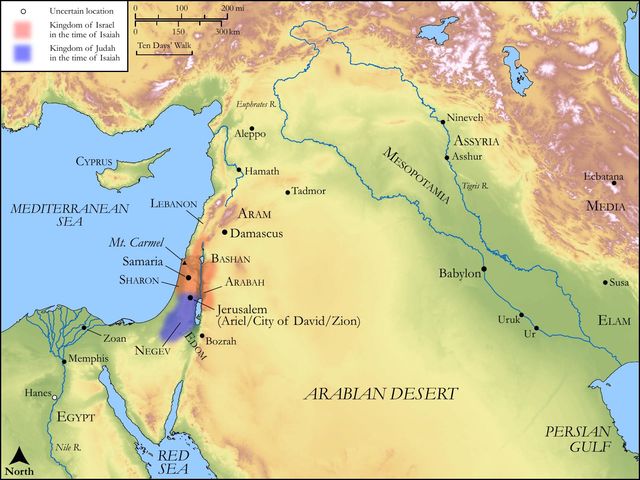
See on the biblical-era map
Study this verse
Public-domain commentary
Matthew Henry
From his Commentary on the Whole Bible. Henry comments on passages, not single verses — this entry covers Isaiah 28:1–8. His four-level outline is real structure in the source text, so it is rendered as structure.
Here, I. The prophet warns the kingdom of the ten tribes of the judgments that were coming upon them for their sins, which were soon after executed by the king of Assyria, who laid their country waste, and carried the people into captivity. Ephraim had his name from fruitfulness, their soil being very fertile and the products of it abundant and the best of the kind; they had a great many fat valleys (Isa 28:1, Isa 28:4), and Samaria, which was situated on a hill, was, as it were, on the head of the fat valleys. Their country was rich and pleasant, and as the garden of the Lord: it was the glory of Canaan, as that was the glory of all lands; their harvest and vintage were the glorious beauty on the head of their valleys, which were covered over with corn and vines. Now observe,
1.What an ill use they made of their plenty. What God gave them to serve him with they perverted, and abused, by making it the food and fuel of their lusts.
(1.)They were puffed up with pride by it. The goodness with which God crowned their years, which should have been to him a crown of praise, was to them a crown of pride. Those that are rich in the world are apt to be high-minded, Ti1 6:17. Their king, who wore the crown, was proud that he ruled over so rich a country; Samaria, their royal city, was notorious for pride. Perhaps it was usual at their festivals, or revels, to wear garlands made up of flowers and ears of corn, which they wore in honour of their fruitful country. Pride was a sin that generally prevailed among them, and therefore the prophet, in his name who resists the proud, boldly proclaims a woe to the crown of pride. If those who wear crowns be proud of them, let them not think to escape this woe. What men are proud of, be it ever so mean, is to them as a crown; he that is proud thinks himself as great as a king. But woe to those who thus exalt themselves, for they shall be abased; their pride is the preface to their destruction.
(2.)They indulged themselves in sensuality. Ephraim was notorious for drunkenness, and excess of riot; Samaria, the head of the fat valleys, was full of those that were overcome with wine, were broken with it, so the margin. See how foolishly drunkards act, and no marvel when, in the very commission of the sin, they make fools and brutes of themselves; they yield,
[1.]To be conquered by the sin; it overcomes them, and brings them into bondage (Pe2 2:19); they are led captive by it, and the captivity is the more shameful and inglorious because it is voluntary. Some of these wretched slaves have themselves owned that there is not a greater drudgery in the world than hard drinking. They are overcome not with the wine, but with the love of it.
[2.]To be ruined by it. They are broken by wine. Their constitution is broken by it, and their health ruined. They are broken in the callings and estates, and their souls are in danger of being eternally undone, and all this for the gratification of a base lust. Woe to these drunkards of Ephraim! Ministers must bring the general woes of the word home to particular places and persons. We must say, Woe to this or that person, if he be a drunkard. There is a particular woe to the drunkards of Ephraim, for they are of God's professing people, and it becomes them worse than any other; they know better, and therefore should give a better example. Some make the crown of pride to belong to the drunkards, and to mean the garlands with which those were crowned that got the victory in their wicked drinking matches and drank down the rest of the company. They were proud of their being mighty to drink wine; but woe to those who thus glory in their shame.
2.The justice of God in taking away their plenty from them, which they thus abused. Their glorious beauty, the plenty they were proud of, is but a fading flower; it is meat that perishes. The most substantial fruits, if God blast them and blow upon them, are but fading flowers, Isa 28:1. God can easily take away their corn in the season thereof (Hos 2:9), and recover locum vastatum - ground that has been alienated and has run to waste, those goods of his which they prepared for Baal. God has an officer ready to make a seizure for him, has one at his beck, a mighty and strong one, who is able to do the business, even the king of Assyria, who shall cast down to the earth with the hand, shall easily and effectually, and with the turn of a hand, destroy all that which they are proud of and pleased with, Isa 28:2. He shall throw it down to the ground, to be broken to pieces with a strong hand, with a hand that they cannot oppose. Then the crown of pride, and the drunkards of Ephraim, shall be trodden under foot (Isa 28:3); they shall lie exposed to contempt, and shall not be able to recover themselves. Drunkards, in their folly, are apt to talk proudly, and vaunt themselves most when they most shame themselves; but they thereby render themselves the more ridiculous. The beauty of their valleys, which they gloried in, will be,
(1.)Like a fading flower (as before, Isa 28:1); it will wither of itself, and has in itself the principles of its own corruption; it will perish in time by its own moth and rust.
(2.)Like the hasty fruit, which, as soon as it is discovered, is plucked and eaten up; so the wealth of this world, besides that it is apt to decay of itself, is subject to be devoured by others as greedily as the first-ripe fruit, which is earnestly desired, Mic 7:1. Thieves break through and steal. The harvest which the worldling is proud of the hungry eat up (Job 5:5); no sooner do they see the prey but they catch at it, and swallow up all they can lay their hands on. It is likewise easily devoured, as that fruit which, being ripe before it has grown, is very small, and is soon eaten up; and there being little of it, and that of little worth, it is not reserved, but used immediately.
II.He next turns to the kingdom of Judah, whom he calls the residue of his people (Isa 28:5), for they were but two tribes to the other ten.
1.He promises them God's favours, and that they shall be taken under his guidance and protection when the beauty of Ephraim shall be left exposed to be trodden down and eaten up, Isa 28:5, Isa 28:6. In that day, when the Assyrian army is laying Israel waste, and Judah might think that their neighbour's house being on fire their own was in danger, in that day of treading down and perplexity, then God will be to the residue of his people all they need and can desire; not only to the kingdom of Judah, but to those of Israel who had kept their integrity, and, as was probably the case with some, betook themselves to the land of Judah, to be sheltered by good king Hezekiah. When the Assyrian, that mighty one, was in Israel as a tempest of hail, noisy and battering, as a destroying storm bearing down all before it, especially at sea, and as a flood of mighty waters overflowing the country (Isa 28:2), then in that day will the Lord of hosts, of all hosts, distinguish by peculiar favours his people who have distinguished themselves by a steady and singular adherence to him, and that which they most need he will himself be to them. This very much enhances the worth of the promises that God, covenanting to be to his people a God all-sufficient, undertakes to be himself all that to them which they can desire.
(1.)He will put all the credit and honour upon them which are requisite, not only to rescue them from contempt, but to gain them esteem and reputation. He will be to them for a crown of glory and for a diadem of beauty. Those that wore the crown of pride looked upon God's people with disdain, and trampled upon them, for they were the song of the drunkards of Ephraim; but God will so appear for them by his providence as to make it evident that they have his favour towards them, and that shall be to them a crown of glory; for what greater glory can any people have than for God to acknowledge them as his own? And he will so appear in them, by his grace, as to make it evident that they have his image renewed on them, and that shall be to them a diadem of beauty; for what greater beauty can any person have than the beauty of holiness? Note, Those that have God for their God have him for a crown of glory and a diadem of beauty; for they are made to him kings and priests.
(2.)He will give them all the wisdom and grace necessary to the due discharge of the duty of their place. He will himself be a spirit of judgment to those that sit in judgment; the privy counsellors shall be guided by wisdom and discretion and the judges shall govern by justice and equity. It is a great mercy to any people when those that are called to places of power and public trust are qualified for their places, when those that sit in judgment have a spirit of judgment, a spirit of government.
(3.)He will give them all the courage and boldness requisite to carry them resolutely through the difficulties and oppositions they are likely to meet with. He will be for strength to those that turn the battle to the gate, to the gates of the enemy whose cities they besiege, or to their own gates, when they sally out upon the enemies that besiege them. The strength of the soldiery depends as much upon God as the wisdom of the magistracy; and where God gives both these he is to that people a crown of glory. This may well be supposed to refer to Christ, and so the Chaldee paraphrast understands it: In that day shall the Messiah be a crown of glory. Simeon calls him the glory of his people Israel; and he is made of God to us wisdom, righteousness, and strength.
2.He complains of the corruptions that were found among them, and the many corrupt ones (Isa 28:7): But they also, many of those of Judah, have erred through wine. There are drunkards of Jerusalem, as well as drunkards of Ephraim; and therefore the mercy of God is to be so much the more admired that he has not blasted the glory of Judah as he has done that of Ephraim. Sparing mercy lays us under peculiar obligations when it is thus distinguishing. Ephraim's sins are found in Judah, and yet not Ephraim's ruins. They have erred through wine. Their drinking to excess is itself a practical error; they think to raise their fancy by it, but they ruin their judgment, and so put a cheat upon themselves; they think to preserve their health by it and help digestion, but they spoil their constitution and hasten diseases and deaths. It is also the occasion of a great many errors in principle; their understanding is clouded and their conscience debauched by it; and therefore, to support themselves in it, they espouse corrupt notions, and form their minds in favour of their lusts. Probably some were drawn in to worship idols by their love of the wine and strong drink which there was plenty of at their idolatrous festivals; and so they erred through wine, as Israel, for love of the daughters of Moab, joined themselves to Baal-peor. Three things are here observed as aggravations of this sin: - (1.) That those were guilty of it whose business it was to warn others against it and to teach them better, and therefore who ought to have set a better example: The priest and the prophet are swallowed up of wine; their office is quite drowned and lost in it. The priests, as sacrificers, were obliged by a particular law to be temperate (Lev 10:9), and, as rulers and magistrates, it was not for them to drink wine, Pro 31:4. The prophets were a kind of Nazarites (as appears by Amo 2:11), and, as reprovers by office, were concerned to keep at the utmost distance from the sins they reproved in others; yet there were many of them ensnared in this sin. What! a priest, a prophet, a minister, and yet drunk! Tell it not in Gath. Such a scandal are they to their coat. (2.) That the consequences of it were very pernicious, not only by the ill influence of their example, but the prophet, when he was drunk, erred in vision; the false prophets plainly discovered themselves to be so when they were in drink. The priest stumbled in judgment and forgot the law (Pro 31:5); he reeled and staggered as much in the operations of his mind as in the motions of his body. What wisdom or justice can be expected from those that sacrifice reason, and virtue, and conscience, and all that is valuable to such a base lust as the love of strong drink is? Happy art thou, O land! when thy princes eat and drink for strength, and not for drunkenness, Ecc 10:17. (3.) That the disease was epidemic, and the generality of those that kept any thing of a table were infected with it: All tables are full of vomit, Isa 28:8. See what an odious thing the sin of drunkenness is, what an affront it is to human society; it is rude and ill-mannered enough to sicken the beholders, for the tables where they eat their meat are filthily stained with the marks of this sin, which the sinners declare as Sodom. Their tables are full of vomit, so that the victor, instead of being proud of his crown, ought rather to be ashamed of it. It bodes ill to any people when so sottish a sin as drunkenness has become national.
Historical interpretation
Historical reception
2 surviving comments on this verse. Each one is dated, so this reads as a timeline rather than a list.
Select a marker to jump to its quote. Markers stagger vertically where authors wrote within a few decades of each other.
In fact, our fathers passed their lives in hunger, thirst and great mortification, by which they acquired purity. Above all they fled the wine habit, which is full of every evil. Troubles, tumults and disorders are caused in our members through the abuse of wine; this is a passion full of sin, it is sterility and the withering of fruit. For sensuality in unquenchable thirst stupefies the understanding, makes conscience overbold and snaps the rein on the tongue. Total joy is when we do not grieve the Holy Spirit, or become deranged by sensuality. As it is said, “The priest and the prophet were deranged by wine.” … Therefore, all who have prepared to become disciples of Jesus should abstain from wine and drunkenness.
(Verse 5 and following) On that day, the Lord of hosts will be a crown of glory and a diadem of rejoicing to the remnant of his people, and a spirit of judgment to the one who sits in judgment, and strength to those who turn back the battle at the gate. But these also reel because of wine and stagger because of strong drink: priest and prophet reel because of strong drink, they are swallowed up by wine, they stagger because of strong drink; they reel while having visions, they totter when rendering judgment. For all the tables were filled with vomit and filth, so that there was no longer any place. LXX: On that day the Lord of hosts will be a crown of glory and a diadem of beauty to the remnant of his people. They shall put away in the spirit of judgment all wickedness and forbid every deed of violence. For they are deceived by wine, they stagger because of strong drink; priest and prophet reel with strong drink, they are confused with wine, they stagger because of strong drink; they err in vision, they stumble in giving judgment. All tables are covered with filthy vomit. No place is clean. After the entire land of Samaria, that is, the ten tribes, was destroyed by the flooding Assyrians and trampled underfoot, the crown of pride of the drunkards of Ephraim, and devoured like a temporary fig tree, then the remaining people of Israel, that is, the two tribes, Judah and Benjamin, will be the crown of victory; and the spirit of judgment will be upon the king who sits in judgment, undoubtedly King Hezekiah of Judah; and their strength, who have avenged all the populated regions and returned from battle, will be their protection within the city. The prophet speaks about what we are going to read in the same passage (below chapter 37), when 185,000 armed soldiers from the Assyrian army were destroyed by an angel striking them. But these people too, that is, Judah and Benjamin, were intoxicated with the wine of idolatry, and having despised the religion of the temple, they worshipped the idols of demons and did not recognize the Lord who sees everything. For all their tables and their whole religion were filled with vomit and filth, so that not only in the temple, but on the top of mountains and in wooded places, they filled everything with the filth of idolatry, and the Lord did not have a place of dwelling in them. Let this be said according to the letter. Furthermore, according to tropology, let us follow the previous understanding and not leave aside the untouched Seventy Interpreters. For the heretics, devoured by the mouth of the devil, who have climbed the mountain of pride, the Lord will be the crown of glory; but for those who dwell in the Church, and compared to the multitude of many wanderers, they are few in number. However, there will be a spirit of judgment over judgment: for the Lord will cleanse the filth of the sons and daughters of Zion with the spirit of judgment. But if anyone has blood, he will be cleansed not by the breath of judgment, but by the fire of purification, and he will be a strength to the people and will prevent them from being killed by those who are intoxicated with the wine of dragons and have gone astray because of their drunkenness. We have often said that wine is made from grapes. But drunkenness refers to any drink that can intoxicate and disturb the mind, which Aquila properly translated as ebriety, whether it is made from wheat, barley, millet, the juice of fruits, the fruit of palm trees, or any other kind. Therefore, the priests and prophets of the heretics lost their minds because of wine, and they were consumed because of alcohol, like Prisca and Maximilla, and their leader Montanus; and they did not know what to say. They are intoxicated by wine when they wrongly understand and distort the holy Scriptures. They are consumed by alcohol when they misuse worldly wisdom and the snares of dialecticians, which should be called not so much chains as phantasms, that is, certain shadows and images that quickly perish and dissolve. Those who believe that profit is piety and do everything out of greed will be cursed. The Apostle spoke about this phantasm, saying: 'Giving heed to seducing spirits, and doctrines of devils, speaking lies in hypocrisy' (I Tim. IV, 1, 2). The third explanation is that after the Lord destroyed the Scribes and the Pharisees and their companion Judas, who was a thief from the beginning, he personally carried the money of the poor in a small wallet (John XII and XIII): then there is hope and a crown of glory for those who believe in the Lord from among the Jews, undoubtedly signifying the apostles, whom he has reserved for the preaching of the Gospel and has not immediately allowed to shed their blood for Christ. For all the scribes and Pharisees, as we have said above, were drunk with wine and cider, both the priests and the false prophets. But their schemes and traps were in vain, for even Judas himself, who betrayed [Jesus], did it for the sake of money, and the priests who corrupted the betrayer with money did it out of fear of their own lowly status. For he himself, making a whip out of cords, cast out of the temple those who were selling oxen and sheep, and overturned the tables of the money changers, saying to them: It is written, 'My Father's house shall be called a house of prayer,' but you have made it a den of thieves (Matthew 21:13). According to that Hebrew interpretation, in which we have said: For all their tables are filled with vomit and filth, so that there is no more room for heretics, scribes, and Pharisees, it can be understood that we say all their doctrine and all their mysteries are filled with vomit and filth, since they do not digest the food of the holy Scriptures, nor do they make it vital for the whole body; but they bring forth unripe and fetid things, so that God finds no place in them. But I wonder what Theodotion meant when he rendered the Hebrew word, Cisoa, which Aquila interpreted as 'vomit of filth,' and Symmachus only as 'vomit.' He said, 'vomit of dysalia,' which word I cannot find in Greek literature, unless he has invented a new term for a new thing. For it is also compounded in the Hebrew language, because vomit is called CI and Soa is filthy (also rendered as filth). Therefore, whatever causes nausea and vomiting can be called δυσαλία.
Continue studying Isaiah 28:7 across the web’s major study libraries — every link below opens this exact verse, chapter, or book on the destination site.
Read & Compare
 BibleGatewayThis verse in more than 200 translations and 70 languages.
 Bible.comThe YouVersion reader — hundreds of translations, reading plans, and highlights.
 ESV.orgCrossway's official English Standard Version reader.
 NET BibleThe NET translation with 60,000+ translators' notes on every rendering decision.
 STEP BibleTyndale House's free study tool — original text, vocabulary, and scholarly resources.
 BibliaLogos Bible Software's free web reader.
 USCCBThe New American Bible (Revised Edition) with the U.S. bishops' study notes.
Commentaries
 BibleHub CommentariesDozens of classic commentaries on this verse, gathered on one page.
 StudyLightMore than 100 commentary sets — the largest collection on the web.
 BibleRefPlain-English commentary on what this verse means, verse by verse.
 Enduring WordDavid Guzik's free commentary on this chapter, widely used by Bible teachers.
 Bible Study ToolsVerse commentary alongside Greek and Hebrew study aids.
Original Language & Research
- BibleHub InterlinearThe verse word by word — original language, transliteration, and English.
- BibleHub LexiconEvery word's original-language definition and Strong's entry.
 Blue Letter BibleDeep-study tools — Strong's numbers, concordance, and word studies.
 SefariaThe Hebrew text with Rashi and centuries of Jewish commentary.
Sermons, Hymns & Audio


TrulyRandomVerse is not affiliated with these sites and doesn’t control their content. They’re linked because they’re genuinely useful.
Summary
Isaiah 28:7 delivers a scathing indictment against the spiritual leaders of ancient Israel, specifically the priests and prophets, who, through their profound indulgence in wine and strong drink, have become spiritually and morally incapacitated. This pervasive intemperance has severely compromised their sacred duties, leading them to err in their prophetic vision and stumble in their judicial discernment, thereby failing to guide God's people righteously and undermining the very foundations of divine communication and justice within the nation.
Context
ShowHideLiterary Context
Isaiah 28:7 is situated within a broader prophetic oracle (Isaiah 28-33) primarily directed against the Northern Kingdom of Israel (Ephraim) and, by extension, Judah. The chapter opens with a severe denunciation of Ephraim, vividly described as "the crown of pride, the drunkards of Ephraim" in Isaiah 28:1. While the initial verses condemn the general revelry and impending judgment upon Samaria, verse 7 pivots sharply to focus on the spiritual elite—the priests and prophets. This shift intensifies the critique, highlighting that even those entrusted with divine revelation and instruction have succumbed to the same vices plaguing the populace. The subsequent verses continue to mock their impaired teaching, comparing their confused utterances to the babbling of infants, a consequence of their spiritual stupor, as seen in Isaiah 28:9-10. This progression underscores the devastating impact of leadership failure on the entire nation.
Historical & Cultural Context
The prophecy of Isaiah was delivered during a tumultuous period in Israel's history, spanning the reigns of Uzziah, Jotham, Ahaz, and Hezekiah (c. 740-687 BC). The Northern Kingdom of Israel was on the brink of Assyrian conquest (which occurred in 722 BC), and Judah faced constant threats and moral decay. In ancient Israel, priests (כֹּהֵן, kôhên) were divinely appointed to mediate between God and the people, offering sacrifices, teaching the Law, and providing moral guidance. Prophets (נָבִיא, nâbîyʼ) served as God's direct spokespersons, receiving divine visions and delivering His authoritative word. Both roles demanded spiritual purity, clear discernment, and unwavering moral integrity. The widespread indulgence in wine and strong drink, as depicted, was not merely a social problem but a profound spiritual crisis, indicating a deep-seated rebellion against God's standards and a catastrophic failure of leadership at the highest levels, directly violating the expectations for those in sacred office, such as those outlined in Leviticus 10:9-10.
Key Themes
ShowHideThis verse powerfully contributes to several overarching themes within Isaiah and the broader prophetic tradition. It underscores the Corruption of Leadership, demonstrating how those in positions of spiritual authority can become the very embodiment of the nation's sin, leading to a catastrophic breakdown of divine order and moral guidance. The theme of Impaired Judgment and Vision is central, illustrating how physical indulgence directly hinders spiritual perception and the ability to render righteous decisions, whether in legal matters or in discerning God's will. This highlights the Consequences of Intemperance, portraying how personal vice can have devastating public and spiritual repercussions, leading to a perversion of justice and truth. Furthermore, it implicitly conveys God's Displeasure with Hypocrisy, as leaders who should exemplify holiness instead wallow in the same sins they are meant to rebuke, leading to spiritual blindness and a perversion of justice, a theme echoed in the broader indictment against Judah's unrighteous leaders in Isaiah 1:23.
Exposition and Analysis
ShowHideKey Word Analysis
ShowHideA primitive root meaning "to stray (causatively, mislead), usually (figuratively) to mistake, especially (morally) to transgress; by extension (through the idea of intoxication) to reel, (figuratively) be enraptured." This word conveys both a physical staggering due to intoxication and a moral deviation from the right path. It implies a loss of control and direction, indicating that the priests and prophets have lost their moral compass and are leading themselves and others astray through their compromised state.
Referring to "an intoxicant, i.e. intensely alcoholic liquor; strong drink, [phrase] drunkard, strong wine." This term denotes a potent alcoholic beverage, distinct from wine (yayin), often made from grains or dates, and known for its higher intoxicating power. Its repeated mention alongside "wine" emphasizes the depth of their indulgence and the severity of their intoxication, highlighting a deliberate pursuit of extreme inebriation that renders them incapable of their sacred duties.
A feminine noun meaning "judicature; judgment." This term refers to the act or process of rendering a verdict, making a legal or moral decision, or exercising discernment. The inability to "stumble in judgment" means a perversion of justice and a failure to provide sound moral and theological guidance to the people. It signifies the complete breakdown of their authoritative function as interpreters of God's law and arbiters of disputes, leading to societal and spiritual chaos.
Verse Breakdown
ShowHide"But they also have erred through wine,"
This clause immediately introduces the central accusation, highlighting that "they"—referring to the spiritual leaders, as clarified later in the verse—have deviated from the righteous path due to their consumption of wine. The word "erred" (H7686) suggests both a moral transgression and a physical reeling, painting a vivid picture of staggering both literally and spiritually.
"and through strong drink are out of the way;"
This phrase reinforces the previous one, emphasizing the role of potent alcoholic beverages ("strong drink," H7941) in causing their deviation. "Out of the way" (H8582) further underscores their loss of direction and moral compass, indicating they have strayed from the path of uprightness and divine command, becoming morally disoriented.
"the priest and the prophet have erred through strong drink,"
This specifies the "they" from the opening, directly identifying the spiritual authorities—the priest (H3548), responsible for teaching and worship, and the prophet (H5030), God's messenger—as the culprits. The repetition of "erred through strong drink" intensifies the indictment, showing that even those most sacredly set apart have fallen into this grievous sin.
"they are swallowed up of wine,"
This powerful imagery (H1104) depicts a complete subjugation to their vice. The wine has not merely influenced them; it has consumed them entirely, indicating a loss of self-control, identity, and the ability to perform their sacred duties. Their very being is absorbed and obliterated by their intemperance.
"they are out of the way through strong drink;"
This phrase repeats the earlier condemnation, creating a sense of inescapable consequence and pervasive influence. The pervasive influence of "strong drink" means they are consistently and fundamentally off the path, unable to find their way back to spiritual integrity or righteous leadership.
"they err in vision,"
This clause points to the direct impact of their intoxication on their prophetic function. "Vision" (H7203) refers specifically to prophetic revelation or divine insight. Their spiritual blindness, caused by drink, prevents them from receiving or accurately interpreting God's messages, rendering them useless as divine communicators and leading the people astray.
"they stumble [in] judgment."
The final clause reveals the consequence for their judicial and moral leadership. "Judgment" (H6417) encompasses legal rulings, moral discernment, and wise decision-making. Their physical and spiritual staggering leads to a failure in delivering justice and providing sound guidance, perverting the very foundation of societal order and righteousness.
Literary Devices
ShowHideIsaiah 28:7 employs several powerful literary devices to convey its sharp rebuke against the compromised leadership. Repetition is prominently used, with phrases like "erred through wine/strong drink" and "out of the way through strong drink" appearing multiple times. This repetition emphasizes the pervasive and debilitating nature of the leaders' intoxication, driving home the point of their consistent failure and the inescapable grip of their vice. The phrase "they are swallowed up of wine" functions as a potent Metaphor, vividly portraying the complete dominance and consumption of the leaders by their indulgence, suggesting they are no longer in control of themselves but are utterly absorbed and obliterated by their intemperance. The verse also utilizes Parallelism, particularly in the final clauses: "they err in vision, they stumble [in] judgment." This structural balance highlights the dual failure of the leaders—their inability to receive divine revelation and their incapacity to render righteous decisions—showing how their spiritual and practical functions are equally compromised. The overall tone is imbued with a strong sense of Irony and even Sarcasm, as those who should be the clearest-sighted and most discerning are depicted as the most blind and stumbling, a stark contrast to their divinely appointed roles.
Theological and Thematic Connections
ShowHideIsaiah 28:7 serves as a profound theological statement on the indispensable link between personal integrity and spiritual authority. It underscores that those called to lead God's people must maintain a high standard of moral and spiritual sobriety, for their personal failings directly impede their capacity to discern and communicate divine truth. The verse highlights God's expectation of holiness and righteousness from His chosen servants, and His severe displeasure when those entrusted with sacred duties betray that trust through self-indulgence. The failure of these leaders to maintain a clear "vision" and sound "judgment" represents a catastrophic breakdown in the covenant relationship, leaving the people without true guidance and exposed to spiritual confusion and moral decay. This prophetic warning resonates throughout Scripture, affirming that true spiritual leadership flows from a life submitted to God, free from the entanglements of sin that cloud discernment and pervert justice.
Reflection and Application
ShowHideIsaiah 28:7 stands as a timeless and sobering warning, particularly for those in positions of leadership, whether in the church, the home, or the public square. It compels us to examine what might be "intoxicating" our own spiritual vision and clouding our judgment. While the immediate context is literal strong drink, the principle extends to anything that dulls our spiritual senses, distorts our perception of truth, or compromises our ability to make decisions aligned with God's will. This could include addiction to power, wealth, comfort, entertainment, unbridled ambition, or even self-righteousness. For every believer, this verse is a call to vigilance and self-control, recognizing that our personal integrity profoundly impacts our capacity to serve God and influence others for good. It reminds us that clear spiritual discernment is a precious gift, easily forfeited through indulgence and neglect, and that the integrity of our walk with God directly correlates with the clarity of our "vision" and the soundness of our "judgment." Our ability to accurately perceive God's truth and apply it righteously in our lives and for others is directly tied to our spiritual sobriety.
Questions for Reflection
ShowHideFAQ
ShowHideWhat does "err in vision" and "stumble in judgment" mean for the priests and prophets?
ShowHideFor the priests and prophets, "err in vision" means their ability to receive and accurately interpret divine revelation (prophetic messages, God's will) was compromised. Their spiritual insight, which was foundational to their role as God's spokespersons, became distorted or entirely absent due to their intoxication. "Stumble in judgment" refers to their failure to make sound, righteous decisions, whether in legal matters, moral guidance, or discerning God's will for the nation. As interpreters of the Law and arbiters of disputes, their impaired state led to perverted justice and unreliable counsel, causing the people to stray. This dual failure highlights the complete breakdown of their sacred functions, rendering them incapable of leading God's people righteously.
Why is the condemnation of priests and prophets so severe in this verse?
ShowHideThe condemnation is severe because priests and prophets held positions of immense spiritual authority and responsibility in ancient Israel. They were meant to be the moral compass and divine communicators for the nation, guiding the people in God's ways and mediating His presence. Their indulgence in "wine" and "strong drink" and subsequent spiritual impairment represented a profound betrayal of their sacred trust. It meant that the very individuals entrusted with upholding God's law and delivering His word were themselves violating it, leading to widespread spiritual decay and a perversion of justice. Their failure was not merely personal but had devastating national consequences, as the people were left without clear divine guidance, as seen in the broader context of Isaiah 28 and the subsequent chapters of the book.
Christ-Centered Fulfillment
ShowHideIsaiah 28:7, with its stark portrayal of compromised leadership and clouded spiritual discernment, finds its ultimate fulfillment and contrast in the person and work of Jesus Christ. Unlike the Old Testament priests and prophets who "erred in vision" and "stumbled in judgment" due to their human frailties and sinful indulgences, Jesus perfectly embodied divine wisdom, infallible vision, and righteous judgment. He is the true Prophet, whose "vision" was never obscured by sin or earthly intoxication, but who perfectly revealed the Father's will and spoke God's truth with unparalleled clarity, as affirmed in John 1:18 and John 14:9. As the Great High Priest, He offered Himself as the spotless Lamb, perfectly mediating between God and humanity, forever abolishing the need for earthly priests whose service was marred by sin, a truth powerfully articulated in Hebrews 4:14-15 and Hebrews 9:11-14. Where the Old Testament leaders became "swallowed up of wine," Christ was "swallowed up" by the will of God, even to the point of death on the cross, offering a perfect sacrifice and establishing a new covenant. Through His Spirit, believers are now empowered to live soberly and righteously, experiencing true spiritual discernment that the Old Testament leaders lacked, as we are called to be "filled with the Spirit" rather than with wine, as instructed in Ephesians 5:18. Christ, the righteous Judge, will one day execute perfect "judgment" for all humanity, as declared in John 5:27, demonstrating the complete antithesis to the stumbling and errant judgment of the ancient priests and prophets.