


Job 11:16
Bible text: King James Version (1769 Blayney text) · Public domain
Bible text: Berean Standard Bible · Public domain
Bible text: American Standard Version (1901) · Public domain
Bible text: World English Bible, Messianic edition · Public domain
Bible text: Geneva Bible (1599) · Public domain
Bible text: Young's Literal Translation · Public domain
- כִּיkiforH3588PrtParticle Conditional
- אַתָּה'A·tahyouH859Pro-2msPronoun Personal 2nd Singular Masculine
- עָמָל'a·MaltroubleH5999N-csNoun Singular common gender Absolute
- תִּשְׁכָּחtish·Kachyou will forgetH7911V-Qal-Imperf-2msVerb Qal Imperfect 2nd Singular Masculine
- כְּמַיִםke·Ma·yimlike watersH4325Prep-k ¦ N-mpNoun Plural Masculine Absoluteכְּlikeמַיִםwaters
- עָבְרוּ'a·ve·Ru[which] they have passed awayH5674V-Qal-Perf-3cpVerb Qal Perfect 3rd Plural common gender
- תִזְכֹּרtiz·Koryou will remember [it]H2142V-Qal-Imperf-2msVerb Qal Imperfect 2nd Singular Masculine
English is a literal word-by-word gloss of the Hebrew, not the KJV's wording. Why?
This is the original text the KJV's translators worked from — each Hebrew word with its own literal English meaning in this verse, prepared by scholars at Tyndale House, Cambridge. The KJV translates whole sentences, not word by word, so its wording differs: one Hebrew word can become several English words, and the KJV may choose “the LORD” where the gloss reads “Yahweh”. Both are faithful — they answer different questions. For the KJV's own rendering, switch to the KJV text.
Details
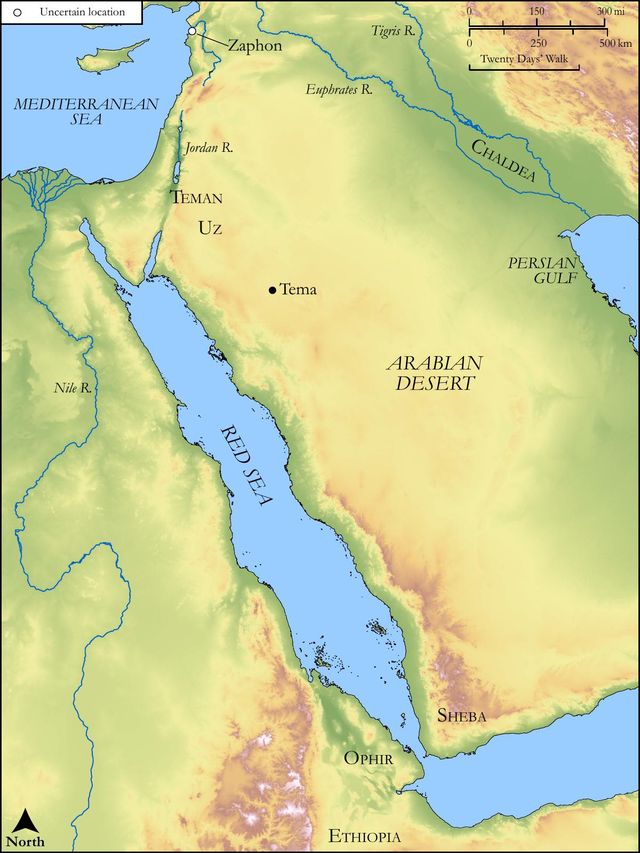
See on the biblical-era map
Study this verse
Public-domain commentary
Matthew Henry
From his Commentary on the Whole Bible. Henry comments on passages, not single verses — this entry covers Job 11:13–20. His four-level outline is real structure in the source text, so it is rendered as structure.
Zophar, as the other two, here encourages Job to hope for better times if he would but come to a better temper.
I.He gives him good counsel (Job 11:13, Job 11:14), as Eliphaz did (Job 5:8), and Bildad, Job 8:5. He would have him repent and return to God. Observe the steps of that return.
1.He must look within, and get his mind changed and the tree made good. He must prepare his heart; there the work of conversion and reformation must begin. The heart that wandered from God must be reduced - that was defiled with sin and put into disorder must be cleansed and put in order again - that was wavering and unfixed must be settled and established; so the word here signifies. The heart is then prepared to seek God when it is determined and fully resolved to make a business of it and to go through with it.
2.He must look up, and stretch out his hands towards God, that is, must stir up himself to take hold on God, must pray to him with earnestness and importunity, striving in prayer, and with expectation to receive mercy and grace from him. To give the hand to the Lord signifies to yield ourselves to him and to covenant with him, Ch2 30:8. This Job must do, and, for the doing of it, must prepare his heart. Job had prayed, but Zophar would have him to pray in a better manner, not as an appellant, but as a petitioner and humble suppliant.
3.He must amend what was amiss in his own conversation, else his prayers would be ineffectual (Job 11:14): "If iniquity be in thy hand (that is, if there be any sin which thou dost yet live in the practice of) put it far away, forsake it with detestation and a holy indignation, stedfastly resolving not to return to it, nor ever to have any thing more to do with it. Eze 18:31; Hos 14:9; Isa 30:22. If any of the gains of iniquity, any goods gotten by fraud or oppression, be in thy hand, make restitution thereof" (as Zaccheus, Luk 19:8), "and shake thy hands from holding them," Isa 33:15. The guilt of sin is not removed if the gain of sin be not restored.
4.He must do his utmost to reform his family too: "Let not wickedness dwell in thy tabernacles; let not thy house harbour or shelter any wicked persons, any wicked practices, or any wealth gotten by wickedness." He suspected that Job's great household had been ill-governed, and that, where there were many, there were many wicked, and the ruin of his family was the punishment of the wickedness of it; and therefore, if he expected God should return to him, he must reform what was amiss there, and, though wickedness might come into his tabernacles, he must not suffer it to dwell there, Psa 101:3, etc.
II.He assures him of comfort if he took this counsel, Job 11:15, etc.
If he would repent and reform, he should, without doubt, be easy and happy, and all would be well. Perhaps Zophar might insinuate that, unless God did speedily make such a change as this in his condition, he and his friends would be confirmed in their opinion of him as a hypocrite and a dissembler with God. A great truth, however, is conveyed, That, the work of righteousness will be peace, and the effect of righteousness quietness and assurance for ever, Isa 32:17. Those that sincerely turn to God may expect,
1.A holy confidence towards God: "Then shalt thou lift up thy face towards heaven without spot; thou mayest come boldly to the throne of grace, and not with that terror and amazement expressed," Job 9:34. If our hearts condemn us not for hypocrisy and impenitency, then have we confidence in our approaches to God and expectations from him, Jo1 3:21. If we are looked upon in the face of the anointed, our faces, that were dejected, may be lifted up - that were polluted, being washed with the blood of Christ, may be lifted up without spot. We may draw near in full assurance of faith when we are sprinkled from an evil conscience, Heb 10:22. Some understand this of the clearing up of his credit before men, Psa 37:6. If we make our peace with God, we may with cheerfulness look our friends in the face.
2.A holy composedness in themselves: Thou shalt be stedfast, and shalt not fear, not be afraid of evil tidings, thy heart being fixed, Psa 112:7. Job was now full of confusion (Job 10:15), while he looked upon God as his enemy and quarrelled with him; but Zophar assures him that, if he would submit and humble himself, his mind would be composed, and he would be freed from those frightful apprehensions he had of God, which put him into such an agitation. The less we are frightened the more we are fixed, and consequently the more fit we are for our services and for our sufferings.
3.A comfortable reflection upon their past troubles (Job 11:16): "Thou shalt forget thy misery, as the mother forgets her travailing pains, for joy that the child is born; thou shalt be perfectly freed from the impressions it makes upon thee, and thou shalt remember it as waters that pass away, or are poured out of a vessel, which leave no taste or tincture behind them, as other liquors do. The wounds of thy present affliction shall be perfectly healed, not only without a remaining scar, but without a remaining pain." Job had endeavoured to forget his complaint (Job 9:27), but found he could not; his soul had still in remembrance the wormwood and the gall: but here Zophar puts him in a way to forget it; let him by faith and prayer bring his griefs and cares to God, an leave them with him, and then he shall forget them. Where sin sits heavily affliction sits lightly. If we duly remember our sins, we shall, in comparison with them, forget our misery, much more if we obtain the comfort of a sealed pardon and a settled peace. He whose iniquity is forgiven shall not say, I am sick, but shall forget his sickness, Isa 33:24.
4.A comfortable prospect of their future peace. This Zophar here thinks to please Job with, in answer to the many despairing expressions he had used, as if it were to no purpose for him to hope ever to see good days again in this world: "Yea, but thou mayest" (says Zophar) "and good nights too." A blessed change he here puts him in hopes of.
(1.)That though now his light was eclipsed it should shine out again, and more brightly than ever (Job 11:17), - that even his setting sun should out-shine his noon-day sun, and his evening be fair and clear as the morning, in respect both of honour and pleasure. - that his light should shine out of obscurity (Isa 58:10), and the thick and dark cloud, from behind which his sun should break forth, would serve as a foil to its lustre, - that it should shine even in old age, and those evil days should be good days to him. Note, Those that truly turn to God then begin to shine forth; their path is as the shining light which increases, the period of their day will be the perfection of it, and their evening to this world will be their morning to a better.
(2.)That, though now he was in a continual fear and terror, he should live in a holy rest and security, and find himself continually safe and easy (Job 11:18): Thou shalt be secure, because there is hope. Note, Those who have a good hope, through grace, in God, and of heaven, are certainly safe, and have reason to be secure, how difficult soever the times are through which they pass in this world. He that walks uprightly may thus walk surely, because, though there are trouble and danger, yet there is hope that all will be well at last. Hope is an anchor of the soul, Heb 6:19. "Thou shalt dig about thee," that is, "Thou shalt be as safe as an army in its entrenchments." Those that submit to God's government shall be taken under his protection, and then they are safe both day and night.
[1.]By day, when they employ themselves abroad: "Thou shalt dig in safety, thou and thy servants for thee, and not be again set upon by the plunderers, who fell upon thy servants at plough," Job 1:14, Job 1:15. It is no part of the promised prosperity that he should live in idleness, but that he should have a calling and follow it, and, when he was about the business of it, should be under the divine protection. Thou shalt dig and be safe, not rob and be safe, revel and be safe. The way of duty is the way of safety.
[2.]By night, when they repose themselves at home: Thou shalt take thy rest (and the sleep of the labouring man is sweet) in safety, notwithstanding the dangers of the darkness. The pillar of cloud by day shall be a pillar of fire by night: "Thou shalt lie down (Job 11:19), not forced to wander where there is no place to lay thy head on, nor forced to watch and sit up in expectation of assaults; but thou shalt go to bed at bedtime, and not only shall non hurt thee, but none shall make thee afraid nor so much as give thee an alarm." Note, It is a great mercy to have quiet nights and undisturbed sleeps; those say so that are within the hearing of the noise of war. And the way to be quiet is to seek unto God and keep ourselves in his love. Nothing needs make those afraid who return to God as their rest and take him for their habitation.
(3.)That, though now he was slighted, yet he should be courted: "Many shall make suit to thee, and think it their interest to secure thy friendship." Suit is made to those that are eminently wise or reputed to be so, that are very rich or in power. Zophar knew Job so well that he foresaw that, how low soever this present ebb was, if once the tide turned, it would flow as high as ever; and he would be again the darling of his country. Those that rightly make suit to God will probably see the day when others will make suit to them, as the foolish virgins to the wise, Give us of your oil.
III.Zophar concludes with a brief account of the doom of wicked people (Job 11:20):
But the eyes of the wicked shall fail. It should seem, he suspected that Job would not take his counsel, and here tells him what would then come of it, setting death as well as life before him. See what will become of those who persist in their wickedness, and will not be reformed.
1.They shall not reach the good they flatter themselves with the hopes of in this world and in the other. Disappointments will be their doom, their shame, their endless torment. Their eyes shall fail with expecting that which will never come. When a wicked man dies his expectation perishes, Pro 11:7. Their hope shall be as a puff of breath (margin), vanished and gone past recall. Or their hope will perish and expire as a man does when he gives up the ghost; it will fail them when they have most need of it and when they expected the accomplishment of it; it will die away, and leave them in utter confusion.
2.They shall not avoid the evil which sometimes they frighten themselves with the apprehensions of. They shall not escape the execution of the sentence passed upon them, can neither out-brave it nor outrun it. Those that will not fly to God will find it in vain to think of flying from him.
Historical interpretation
Two Centuries of Reception
2 surviving comments on this verse. Each one is dated, so this reads as a timeline rather than a list.
Select a marker to jump to its quote. Markers stagger vertically where authors wrote within a few decades of each other.
32. The mind feels the ills of the present life the more severely, in proportion as it neglects to take account of the good that comes after; and as it will not consider the rewards that are in store, it reckons all to be grievous that it undergoes; and hence the blinded imagination murmurs against the stroke of the scourge, and that is taken for an immeasurable woe, which by the days flowing on in their course is daily being brought to an end. But if a man once raise himself to things eternal, and fix the eye of the soul upon those objects which remain without undergoing change, he sees that here below all whatsoever runs to an end is almost nothing at all. He is subject to the adversities of the present life, but he bethinks himself that all that passes away is as nought. For the more vigorously he makes his way into the interior joys, he is the less sensible of pains without. Whence Zophar, not being afraid with boldfaced hardihood to instruct one better than himself, exhorts to righteousness, and shows how little chastening appears in the eyes of the righteous man. As if it were in plain words; ‘If thou hast a taste of the joy which remains within, all that gives pain without forthwith becomes light.’ Now he does well in likening the miseries of the present life to ‘waters that pass away,’ for passing calamity never overwhelms the mind of the Elect with the force of a shock, yet it does tinge it with the touch of sorrow. For it drops indeed with the bleeding of the wound, though it is not dashed from the certainty of its salvation. But it often happens that not only stripes inflict bruises, but that in the mind of each one of the righteous the temptings of evil spirits come in force, so that he is grieved by the stroke without, and is in some sort chilled within by temptation. Yet grace never forsakes him, which same the more severely it smites us in the dealings of Providence, so much the more does it watch over us in pity; for when it has begun to grow dark through temptation, the inward light kindles itself again.
The words “You will be led like passing waters” mean that your tribulations will leave you at once, like the waters of rain which, when it stops raining, disappear as well.
Continue studying Job 11:16 across the web’s major study libraries — every link below opens this exact verse, chapter, or book on the destination site.
Read & Compare
 BibleGatewayThis verse in more than 200 translations and 70 languages.
 Bible.comThe YouVersion reader — hundreds of translations, reading plans, and highlights.
 ESV.orgCrossway's official English Standard Version reader.
 NET BibleThe NET translation with 60,000+ translators' notes on every rendering decision.
 STEP BibleTyndale House's free study tool — original text, vocabulary, and scholarly resources.
 BibliaLogos Bible Software's free web reader.
 USCCBThe New American Bible (Revised Edition) with the U.S. bishops' study notes.
Commentaries
 BibleHub CommentariesDozens of classic commentaries on this verse, gathered on one page.
 StudyLightMore than 100 commentary sets — the largest collection on the web.
 BibleRefPlain-English commentary on what this verse means, verse by verse.
 Enduring WordDavid Guzik's free commentary on this chapter, widely used by Bible teachers.
 Bible Study ToolsVerse commentary alongside Greek and Hebrew study aids.
Original Language & Research
- BibleHub InterlinearThe verse word by word — original language, transliteration, and English.
- BibleHub LexiconEvery word's original-language definition and Strong's entry.
 Blue Letter BibleDeep-study tools — Strong's numbers, concordance, and word studies.
 SefariaThe Hebrew text with Rashi and centuries of Jewish commentary.
Sermons, Hymns & Audio


TrulyRandomVerse is not affiliated with these sites and doesn’t control their content. They’re linked because they’re genuinely useful.
Summary
Job 11:16, a declaration from Zophar the Naamathite, presents a conditional promise of future peace and restoration to Job. Rooted in a rigid retribution theology, Zophar asserts that if Job were to repent and turn to God, his profound suffering and past misery would be utterly forgotten, vanishing like waters that have flowed away, leaving no trace of their former presence or impact. This verse powerfully articulates the human yearning for relief from pain and the hope of a future unburdened by past afflictions, even though it originates from a flawed theological premise regarding the nature of Job's suffering.
Context
ShowHideLiterary Context
This verse is situated within Zophar's first and most unyielding speech to Job, found in Job 11. As one of Job's three friends, Zophar, like Eliphaz and Bildad, operates under the firm conviction that Job's immense suffering is a direct, divinely ordained punishment for unconfessed sin. His speech is characterized by a harsh, dogmatic insistence on God's absolute justice and an unwavering demand for Job's repentance. In the verses immediately preceding Job 11:16, Zophar outlines the glorious blessings that will supposedly follow Job's repentance: a life brighter than noonday, security, and abundant hope (see Job 11:13-15). Therefore, Job 11:16 serves as a vivid, almost poetic, illustration of this promised restoration, emphasizing the complete eradication of past sorrow. It is a rhetorical flourish designed to compel Job to confess his alleged wrongdoing and conform to Zophar's inflexible theological framework.
Historical & Cultural Context
The land of Uz, the setting for the book of Job, was largely influenced by a belief system known as retribution theology. This worldview posited a direct and often simplistic correlation: righteousness led to prosperity and blessing, while sin inevitably resulted in suffering and calamity. While this theology contains an element of truth regarding God's moral order, it was frequently applied rigidly, failing to account for the complexities of human experience, particularly the suffering of the innocent. Job's friends, including Zophar, are staunch proponents of this view. They interpret Job's unparalleled calamities—the loss of his children, wealth, and health—as irrefutable proof of his secret sin, and their counsel is entirely rooted in this prevailing cultural and theological assumption. The imagery of "waters that pass away" would have been particularly resonant in an agricultural society acutely dependent on the transient nature of rainfall, seasonal wadis (dry riverbeds that fill with water during rains), and river flows, making the concept of something vanishing without a trace easily comprehensible.
Key Themes
ShowHideJob 11:16 contributes to several significant themes within the broader narrative of the book of Job. Foremost is the theme of retribution theology, as Zophar's entire argument hinges on the idea that repentance will automatically lead to the removal of suffering and the restoration of blessing. It also profoundly highlights the nature of suffering, particularly the deep human desire for its cessation and the hope for a future free from its memory and lingering effects. The verse implicitly touches on divine justice, though Zophar's understanding of it is later corrected and deemed flawed by God Himself (as seen in Job 42:7). Furthermore, it introduces the theme of conditional blessing, where Zophar posits that God's favor and restoration are contingent upon Job's actions and confession. While Zophar's counsel is ultimately revealed as inadequate and misguided, the verse's powerful imagery of forgetting misery resonates with the broader biblical promise of ultimate peace and the wiping away of tears in God's future kingdom (compare with the vision in Revelation 21:4).
Exposition and Analysis
ShowHideKey Word Analysis
ShowHideThis word (H5999) carries a rich semantic range, encompassing toil, trouble, sorrow, grievousness, and painful labor. It describes a deep, burdensome affliction, often associated with the hard consequences of sin or the general hardship and weariness of life. In Job's context, it perfectly encapsulates the profound physical, emotional, and spiritual distress he was enduring, a state of persistent and wearing effort.
This primitive root (H7911) means to mislay or to be oblivious of, implying a lack of memory or attention. In this context, it signifies more than mere amnesia; it suggests a complete removal of the past misery's influence, its sting, and its power to define the present or future. It denotes that the pain will no longer be a source of active remembrance, emotional burden, or ongoing impact.
This primitive root (H5674) means to cross over, pass through, or go by. When applied to water, it vividly depicts a flow that is transient, non-returning, and irreversible. It emphasizes the finality and irreversible nature of the departure of the misery, much like a river that has flowed past and cannot be recalled or brought back.
Verse Breakdown
ShowHide"Because thou shalt forget [thy] misery"
Zophar presents this as a direct and certain consequence of Job's hypothetical repentance and turning to God. The "forgetting" here is not an act of willed amnesia on Job's part, but rather a divinely orchestrated removal of the misery's lingering effects and oppressive presence. It implies a state of peace and restoration so profound that the past suffering no longer holds sway, causes pain, or casts a shadow over the present or future. It speaks to a deep healing that renders the former anguish irrelevant.
"[and] remember [it] as waters [that] pass away"
This clause provides a powerful simile to clarify the nature of this "forgetting." The misery will be remembered, if at all, as something utterly transient, gone, and irrecoverable, like water that has flowed down a stream or river and is no longer present. The imagery emphasizes the complete cessation of the suffering's impact, its irrecoverable departure, and the fresh, unburdened state that would follow. It signifies that the past pain will hold no power, no emotional residue, and no continuing presence in Job's restored life, having completely dissipated.
Literary Devices
ShowHideThe primary literary device employed in Job 11:16 is Simile, explicitly stated in the phrase "remember [it] as waters [that] pass away." This comparison vividly illustrates the transient, non-returning, and ultimately forgotten nature of the misery Zophar promises will vanish. The Imagery of flowing water effectively conveys the idea of something that moves on relentlessly, leaving no trace behind, and cannot be recalled. This reinforces the concept of complete and irreversible cessation of suffering. Additionally, the verse functions as a Conditional Promise, where the outcome (forgetting misery) is directly linked to an implied condition (Job's repentance and turning to God), forming a core part of Zophar's rhetorical strategy to persuade Job and reinforce his theological viewpoint.
Theological and Thematic Connections
ShowHideWhile Zophar's counsel to Job was ultimately flawed and based on a simplistic, albeit common, understanding of divine justice, the imagery of forgetting misery and remembering it as "waters that pass away" resonates with a profound biblical truth: God's capacity for complete restoration and the ultimate eradication of suffering. Though Zophar incorrectly attributed Job's suffering to sin and offered a conditional promise based on a faulty premise, the deep human desire for such forgetting is universal and finds its true fulfillment in God's redemptive work. The Bible consistently points to a future where past sorrows will not overshadow present joy or future hope, and where God Himself will bring about a state of peace that transcends all former pain. This promise is not contingent on human works or perfect understanding, but on divine grace and faithfulness, culminating in a new creation where the old has genuinely passed away.
Reflection and Application
ShowHideJob 11:16, despite its origin in Zophar's flawed theology, offers a powerful and enduring image of hope for those enduring hardship. It speaks to the deep human yearning for relief from suffering and the desire for past pain to no longer define one's present or future. For believers, this verse can serve as a profound reminder that while suffering is a real and often agonizing part of the human experience, it is not eternal or ultimate. God, in His sovereign grace and redemptive power, has the capacity to bring about healing and restoration so profound that the sting of past sorrows can indeed fade into memory, becoming like "waters that pass away." This does not mean we deny or suppress our pain, but rather that we trust in a God who can redeem and transform our experiences, enabling us to move forward with hope, knowing that our ultimate peace and joy are secured in Him. It encourages a forward-looking perspective, trusting that God's grace can bring about a time when past pain no longer dominates, and true restoration involves a profound healing of the soul, allowing us to embrace the newness God offers.
Questions for Reflection
ShowHideFAQ
ShowHideWas Zophar's promise in Job 11:16 true for Job?
ShowHideNo, not in the way Zophar intended or on the conditions he proposed. Zophar's promise was conditional on Job's repentance for sins Job had not committed, a premise that God later explicitly rebukes (see Job 42:7). While Job was indeed eventually restored to a state of prosperity and peace, it was not because he confessed to specific sins as his friends demanded, but rather because of God's sovereign grace, Job's unwavering integrity, and his persistent faith in the midst of his trials. The "forgetting of misery" ultimately came from God's gracious restoration, not from Job's repentance for a non-existent sin.
How can a person "forget misery" or have it "pass away" in a biblical sense?
ShowHideBiblically, "forgetting misery" doesn't imply literal amnesia or a denial of past suffering, but rather that the past pain loses its power to dominate or define one's present life and future hope. This profound transformation happens through God's healing and redemptive work. It involves genuine repentance for actual sins, the forgiveness received through faith in Christ, and the Holy Spirit's ongoing work in bringing comfort, new perspective, and renewed strength. It is a process of moving forward in faith, trusting God to redeem even the most painful experiences and integrate them into a larger narrative of His grace. The ultimate and complete fulfillment of this promise is found in God's new creation, where He will wipe away every tear, and former things—including all misery and pain—will truly pass away forever (see Revelation 21:4).
Christ-Centered Fulfillment
ShowHideWhile Zophar's words in Job 11:16 were spoken from a flawed theological premise, the deep human longing they express—for misery to be forgotten and to pass away like transient waters—finds its ultimate and perfect fulfillment in the person and work of Jesus Christ. Our true "misery," stemming from the pervasive effects of sin and the brokenness of the world, is precisely what Christ came to address. Through His atoning sacrifice on the cross, He offers not merely the forgetting of past troubles, but the complete removal of sin's guilt and power, enabling a radical new creation in Him (as affirmed in 2 Corinthians 5:17). The Lord Jesus Himself invites all who are weary and burdened by the weight of their misery and sin to come to Him, promising rest for their souls and a light yoke (see Matthew 11:28-30). Furthermore, the glorious New Covenant, established in His precious blood, promises that God will remember our sins no more (as declared in Hebrews 8:12), truly causing our spiritual misery and the record of our transgressions to "pass away." Ultimately, the eschatological vision of a new heaven and a new earth where all tears are wiped away, and death, mourning, crying, and pain are no more (as beautifully described in Revelation 21:4-5) is the glorious, Christ-centered reality where all misery is not just forgotten, but utterly abolished, having passed away forever in the presence of our redeeming God.