


John 16:24
Bible text: King James Version (1769 Blayney text) · Public domain
Bible text: Berean Standard Bible · Public domain
Bible text: American Standard Version (1901) · Public domain
Bible text: World English Bible, Messianic edition · Public domain
Bible text: Geneva Bible (1599) · Public domain
Bible text: Young's Literal Translation · Public domain
- ἕωςhe'ōsUntilG2193PREPPreposition
- ἄρτιartinowG737ADVAdverb
- οὐκouknotG3756PRT-NNegative Particle Negative
- ᾐτήσατεētēsateyou have askedG154V-AAI-2PVerb Aorist Active Indicative 2nd Plural
- οὐδὲνoudenno [thing]G3762A-ASNAdjective Accusative Singular Neuter
- ἐνeninG1722PREPPreposition
- τῷtōtheG3588T-DSNDefinite article Dative Singular Neuter
- ὀνόματίonomatinameG3686N-DSNNoun Dative Singular Neuter
- μου·mouof MeG3165P-1GSPersonal pronoun Genitive 1st Singular
- αἰτεῖτεaiteitedo askG154V-PAM-2PVerb Present Active Imperative 2nd Plural
- καὶkaiandG2532CONJConjunction
- λήμψεσθεlēmpsestheyou will receiveG2983V-FDI-2PVerb Future Middle Deponent Indicative 2nd Plural
- ἵναinathatG2443CONJConjunction
- ἡhētheG3588T-NSFDefinite article Nominative Singular Feminine
- χαρὰcharajoyG5479N-NSFNoun Nominative Singular Feminine
- ὑμῶνhumōnof youG4771P-2GPPersonal pronoun Genitive 2nd Plural
- ᾖēmay beG1510V-PAS-3SVerb Present Active Subjunctive 3rd Singular
- πεπληρωμένηpeplērōmenēfilledG4137V-RPP-NSFVerb Perfect Passive Participle Nominative Singular Feminine
English is a literal word-by-word gloss of the Greek, not the KJV's wording. Why?
This is the original text the KJV's translators worked from — each Greek word with its own literal English meaning in this verse, prepared by scholars at Tyndale House, Cambridge. The KJV translates whole sentences, not word by word, so its wording differs: one Greek word can become several English words, and the KJV may choose “charity” where the gloss reads “love”. Both are faithful — they answer different questions. For the KJV's own rendering, switch to the KJV text.
Details
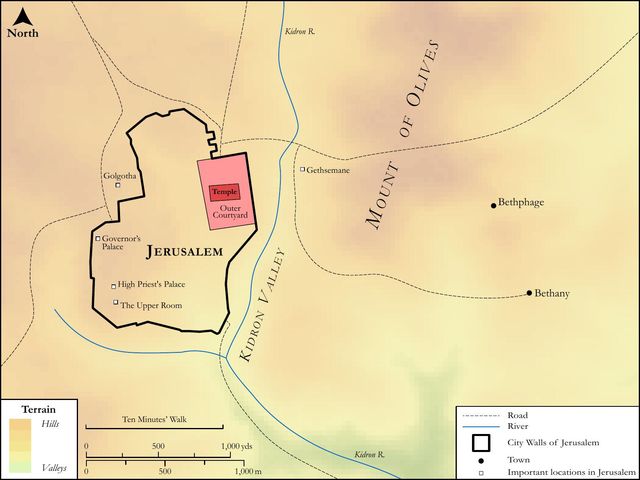
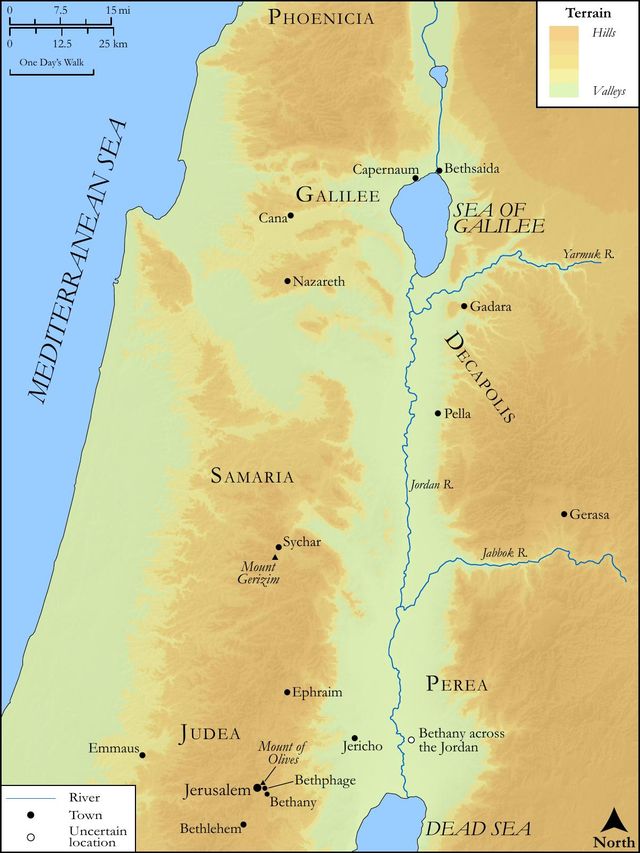
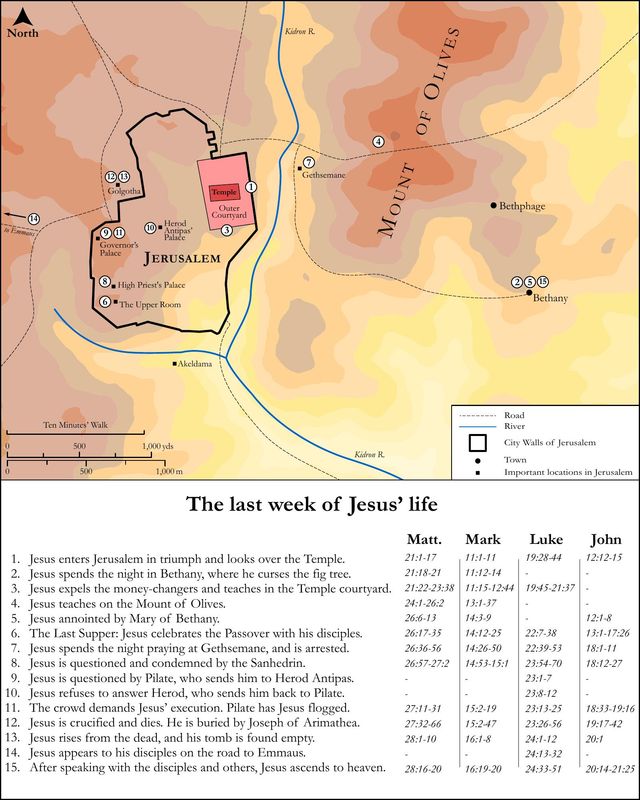
See on the biblical-era maps
Study this verse
Public-domain commentary
Matthew Henry
From his Commentary on the Whole Bible. Henry comments on passages, not single verses — this entry covers John 16:23–27. His four-level outline is real structure in the source text, so it is rendered as structure.
An answer to their askings is here promised, for their further comfort. Now there are two ways of asking: asking by way of enquiry, which is the asking of the ignorant; and asking by way of request, which is the asking of the indigent. Christ here speaks of both.
I.By way of enquiry, they should not need to ask (Joh 16:23):
"In that day you shall ask me nothing;" ouk erōtēsete ouden - you shall ask no questions; "you shall have such a clear knowledge of gospel mysteries, by the opening of your understandings, that you shall not need to enquire" (as Heb 8:11, they shall not teach); "you shall have more knowledge on a sudden than hitherto you have had by diligent attendance." They had asked some ignorant questions (as Joh 9:2), some ambitious questions (as Mat 18:1), some distrustful ones (as Mat 19:27), some impertinent ones, (as Joh 21:21), some curious ones (as Act 1:6); but after the Spirit was poured out, nothing of all this. In the story of the apostles' Acts we seldom find them asking questions, as David, Shall I do this? Or, Shall I go thither? For they were constantly under a divine guidance. In that weighty case of preaching the gospel to the Gentiles, Peter went, nothing doubting, Act 10:20. Asking questions supposes us at a loss, or at least at a stand, and the best of us have need to ask questions; but we should aim at such a full assurance of understanding that we may not hesitate, but be constantly led in a plain path both of truth and duty.
Now for this he gives a reason (Joh 16:25), which plainly refers to this promise, that they should not need to ask questions: "These things have I spoken unto you in proverbs, in such a way as you have thought not so plain and intelligible as you could have wished, but the time cometh when I shall show you plainly, as plainly as you can desire, of the Father, so that you shall not need to ask questions."
1.The great thing Christ would lead them into was the knowledge of God: "I will show you the Father, and bring you acquainted with him." This is that which Christ designs to give and which all true Christians desire to have. When Christ would express the greatest favour intended for his disciples, he tells them that it would, show them plainly of the Father; for what is the happiness of heaven, but immediately and everlastingly to see God? To know God as the Father of our Lord Jesus Christ is the greatest mystery for the understanding to please itself with the contemplation of; and to know him as our Father is the greatest happiness for the will and affections to please themselves with the choice and enjoyment of.
2.Of this he had hitherto spoken to them in proverbs, which are wise and instructive sayings, but figurative, and resting in generals. Christ had spoken many things very plainly to them, and expounded his parables privately to the disciples, but,
(1.)Considering their dulness, and unaptness to receive what he said to them, he might be said to speak in proverbs; what he said to them was as a book sealed, Isa 29:11.
(2.)Comparing the discoveries he had made to them, in what he had spoken to their ears, with what he would make to them when he would put his Spirit into their heart, all hitherto had been proverbs. It would be a pleasing surprise to themselves, and they would think themselves in a new world, when they would reflect upon all their former notions as confused and enigmatical, compared with their present clear and distinct knowledge of divine things. The ministration of the letter was nothing to that of the Spirit, Co2 3:8-11.
(3.)Confining it to what he had said of the Father, and the counsels of the Father. what he had said was very dark, compared with what was shortly to be revealed, Col 2:2.
3.He would speak to them plainly, parrēsia - with freedom, of the Father. When the Spirit was poured out, the apostles attained to a much greater knowledge of divine things than they had before, as appears by the utterance the Spirit gave them, Act 2:4. They were led into the mystery of those things of which they had previously a very confused idea; and what the Spirit showed them Christ is here said to show them, for, as the Father speaks by the Son, so the Son by the Spirit. But this promise will have its full accomplishment in heaven, where we shall see the Father as he is, face to face, not as we do now, through a glass darkly (Co1 13:12), which is matter of comfort to us under the cloud of present darkness, by reason of which we cannot order our speech, but often disorder it. While we are here, we have many questions to ask concerning the invisible God and the invisible world; but in that day we shall see all things clearly, and ask no more questions.
II.He promises that by way of request they should ask nothing in vain.
it is taken for granted that all Christ's disciples give themselves to prayer. He has taught them by his precept and pattern to be much in prayer; this must be their support and comfort when he had left them; their instruction, direction, strength, and success, must be fetched in by prayer. Now,
1.Here is an express promise of a grant, Joh 16:23. The preface to this promise is such as makes it inviolably sure, and leaves no room to question it: "Verily, verily, I say unto you, I pledge my veracity upon it." The promise itself is incomparably rich and sweet; the golden sceptre is here held out to us, with the word, What is thy petition, and it shall be granted? For he says, Whatsoever you shall ask the Father in my name, he will give it to you. We had it before, Joh 14:13. What would we more? The promise is as express as we can desire.
(1.)We are here taught how to seek; we must ask the Father in Christ's name; we must have an eye to God as a Father, and come as children to him; and to Christ as Mediator, and come as clients. Asking of the Father includes a sense of spiritual blessings, with a conviction that they are to be had from God only. It included also humility of address to him, with a believing confidence in him, as a Father able and ready to help us. Asking in Christ's name includes an acknowledgment of our own unworthiness to receive any favour from God, a complacency in the method God has taken of keeping up a correspondence with us by his Son, and an entire dependence upon Christ as the Lord our Righteousness.
(2.)We are here told how we shall speed: He will give it to you. What more can we wish for than to have what we want, nay, to have what we will, in conformity to God's will, for the asking? He will give it to you from whom proceedeth every good and perfect gift. What Christ purchased by the merit of his death, he needed not for himself, but intended it for, and consigned it to, his faithful followers; and having given a valuable consideration for it, which was accepted in full, by this promise he draws a bill as it were upon the treasury in heaven, which we are to present by prayer, and in his name to ask for that which is purchased and promised, according to the true intent of the new covenant. Christ had promised them great illumination by the Spirit, but they must pray for it, and did so, Act 1:14. God will for this be enquired of. He had promised them perfection hereafter, but what shall they do in the mean time? They must continue praying. Perfect fruition is reserved for the land of our rest; asking and receiving are the comfort of the land of our pilgrimage.
2.Here is an invitation for them to petition. It is thought sufficient if great men permit addresses, but Christ calls upon us to petition, Joh 16:24.
(1.)He looks back upon their practice hitherto: Hitherto have you asked nothing in my name. This refers either [1.] To the matter of their prayers: "You have asked nothing comparatively, nothing to what you might have asked, and will ask when the Spirit is poured out." See what a generous benefactor our Lord Jesus is, above all benefactors; he gives liberally, and is so far from upbraiding us with the frequency and largeness of his gifts that he rather upbraids us with the seldomness and straitness of our requests: "You have asked nothing in comparison of what you want, and what I have to give, and have promised to give." We are told to open our mouth wide. Or, [2.] To the name in which they prayed. They prayed many a prayer, but never so expressly in the name of Christ as now he was directing them to do; for he had not as yet offered up that great sacrifice in the virtue of which our prayers were to be accepted, nor entered upon his intercession for us, the incense whereof was to perfume all our devotions, and so enable us to pray in his name. Hitherto they had cast out devils, and healed diseases, in the name of Christ, as a king and a prophet, but they could not as yet distinctly pray in his name as a priest.
(2.)He looks forward to their practice for the future: Ask and you shall receive, that your joy may be full. Here,
[1.]He directs them to ask for all that they needed and he had promised.
[2.]He assures them that they shall receive. What we ask from a principle of grace God will graciously give: You shall receive it. There is something more in this than the promise that he will give it. He will not only give it, but give you to receive it, give you the comfort and benefit of it, a heart to eat of it, Ecc 6:2.
[3.]That hereby their joy shall be full. This denotes, First. The blessed effect of the prayer of faith; it helps to fill up the joy of faith. Would we have our joy full, as full as it is capable of being in this world, we must be much in prayer. When we are told to rejoice evermore, it follows immediately, Pray without ceasing. See how high we are to aim in prayer - not only at peace, but joy, a fulness of joy. Or, Secondly, The blessed effects of the answer of peace: "Ask, and you shall receive that which will fill your joy." God's gifts, through Christ, fill the treasures of the soul, they fill its joy, Pro 8:21. "Ask for the gift of the Holy Ghost, and you shall receive it; and whereas other knowledge increaseth sorrow (Ecc 1:18), the knowledge he gives will increase, will fill, your joy."
3.Here are the grounds upon which they might hope to speed (Joh 16:26, Joh 16:27), which are summed up in short by the apostle (Jo1 2:1): "We have an advocate with the Father."
(1.)We have an advocate; as to this, Christ saw cause at present not to insist upon it, only to make the following encouragement shine the brighter: "I say not unto you that I will pray the Father for you. Suppose I should not tell you that I will intercede for you, should not undertake to solicit every particular cause you have depending there, yet it may be a general ground of comfort that I have settled a correspondence between you and God, have erected a throne of grace, and consecrated for you a new and living way into the holiest." He speaks as if they needed not any favours, when he had prevailed for the gift of the Holy Ghost to make intercession within them, as Spirit of adoption, crying Abba, Father; as if they had no further need of him to pray for them now, but we shall find that he does more for us than he says he will. Men's performances often come short of their promises, but Christ's go beyond them.
(2.)We have to do with a Father, which is so great an encouragement that it does in a manner supersede the other: "For the Father himself loveth you, philei humas, he is a friend to you, and you cannot be better befriended." Note, The disciples of Christ are the beloved of God himself. Christ not only turned away God's wrath from us, and brought us into a covenant of peace and reconciliation, but purchased his favour for us, and brought us into a covenant of friendship. Observe what an emphasis is laid upon this "The Father himself loveth you, who is perfectly happy in the enjoyment of himself, whose self-love is both his infinite rectitude and his infinite blessedness; yet he is pleased to love you." The Father himself, whose favour you have forfeited, and whose wrath you have incurred, and with whom you need an advocate, he himself now loves you. Observe,
[1.]Why the Father loved the disciples of Christ: Because you have loved me, and have believed that I am come from God, that is, because you are my disciples indeed: not as if the love began on their side, but when by his grace he has wrought in us a love to him he is well pleased with the work of his own hands. See here, First, What is the character of Christ's disciples; they love him, because they believe he came out from God, is the only-begotten of the Father, and his high-commissioner to the world. Note, Faith in Christ works by love to him, Gal 5:6. If we believe him to be the Son of God, we cannot but love him as infinitely lovely in himself; and if we believe him to be our Saviour, we cannot but love him as the most kind to us. Observe with what respect Christ is pleased to speak of his disciples' love to him, and how kindly he took it; he speaks of it as that which recommended them to his Father's favour: "You have loved me and believed in me when the world has hated and rejected me; and you shall be distinguished yourselves." Secondly, See what advantage Christ's faithful disciples have, the Father loves them, and that because they love Christ; so well pleased is he in him that he is well pleased with all his friends.
[2.]What encouragement this gave them in prayer. They need not fear speeding when they came to one that loved them, and wished them well. First, This cautions us against hard thoughts of God. When we are taught in prayer to plead Christ's merit and intercession, it is not as if all the kindness were in Christ only, and in God nothing but wrath and fury; no, the matter is not so, the Father's love and good-will appointed Christ to be the Mediator; so that we owe Christ's merit to God's mercy in giving him for us. Secondly, Let it cherish and confirm in us good thoughts of God. Believers, that love Christ, ought to know that God loves them, and therefore to come boldly to him as children to a loving Father.
Historical interpretation
Nine Centuries of Reception
9 surviving comments on this verse. Each one is dated, so this reads as a timeline rather than a list.
Select a marker to jump to its quote. Markers stagger vertically where authors wrote within a few decades of each other.
But He who had said, "Ask, and ye shall receive," gave to them when they asked, that death which each one had wished for.
We should give thanks to God for the good things he gives us and not bear it with bad grace because he measures his giving. Should he grant us to be in union with him, this we shall receive as a most perfect and joyful gift. Should he delay this, let us suffer the loss in patience since he disposes of our lives more perfectly than we could ever order them.
The halcyon is a sea bird that nests by the shore, laying its eggs in the sand and bringing forth its young in the middle of winter when the sea beats violent and frequent storms. But during the seven days while the halcyon broods—for it takes but seven days to hatch its young—all winds sink to rest and the sea grows calm. And as it then is in need of food for its young ones, the most bountiful God grants this little creature another seven days of calm so that it may feed its young. Since all sailors know of this, they give this time the name of the halcyon days.
These things are ordered by the providence of God for the creatures that are without reason so that you may be led to seek of God the things you need for your salvation. And when for this small bird he holds back the great and fearful sea and bids it be calm in winter, what will he not do for you made in his own image? And if he should so tenderly cherish the halcyon, how much more will he not give you [what you need] when you call on him with your heart?
(Hom. lxxix) Hitherto have ye asked nothing in My Name: ask, and ye shall receive, that your joy may be full.
"Hitherto," He says, "ye have not asked anything in my name. Ask, and ye shall receive, that your joy may be full." This that He calls a full joy is certainly no carnal joy, but a spiritual one; and when it shall be so great as to be no longer capable of any additions to it, it will then doubtless be full. Whatever, then, is asked as belonging to the attainment of this joy, is to be asked in the name of Christ, if we understand the grace of God, and if we are truly in quest of a blessed life. But if aught different from this is asked, there is nothing asked: not that the thing itself is nothing at all, but that in comparison with what is so great, anything else that is coveted is virtually nothing. In order, then, that, they may ask in His name, not that which is nothing, but a full joy (since anything different from this that they ask is virtually nothing), He addresses to them the exhortation, "Ask, and ye shall receive, that your joy may be full;" that is, ask this in my name, that your joy may be full, and ye shall receive. For His saints, who persevere in asking such a good thing as this, will in no wise be defrauded by the mercy of God.
(Tr. ci. 4) The word ask here means not only to seek for, but to ask a question: the Greek word from which it is translated has both meanings.
(Tr. cii) But does He love us because we love Him; or rather do not we love Him, because He loved us? This is what the Evangelist says, Let us love God, because God first loved us. (1 John 4:19) The Father then loves us, because we love the Son, (Diligamus Deum, Vulg.) it being from the Father and the Son, that we receive the love from the Father and the Son. He loves what He has made; but He would not make in us what He loved, except He loved us in the first place.
(Tr. cii) He came forth from the Father, because He is of the Father; He came into the world, because He showed Himself in the body to the world. He left the world by His departure in the body, and went to the Father by the ascension of His humanity, nor yet in respect of the government of His presence, left the world; just as when He went forth from the Father and came into the world, He did so in such wise as not to leave the Father. But our Lord Jesus Christ, we read, was asked questions, and petitioned after His resurrection: for when about to ascend to Heaven He was asked by His disciples when He would restore the kingdom to Israel; when in Heaven He was asked by Stephen, to receive his spirit. And who would dare to say that as mortal He might be asked, as immortal He might not? I think then that when He says, In that day ye shall ask Me nothing, He refers not to the time of His resurrection, but to that time when we shall see Him as He is: which vision is not of this present life, but of the life everlasting, when we shall ask for nothing, ask no questions, because there will remain nothing to be desired, nothing to be learnt.
(Tr. cii) The word whatsoever, must not be understood to mean any thing, but something which with reference to obtaining the life of blessedness is not nothing. That is not sought in the Saviour's name, which is sought to the hindering of our salvation; for by, in My name, must be understood not the mere sound of the letters or syllables, but that which is rightly and truly signified by that sound. He who holds any notion concerning Christ, which should not be held of the only Son of God, does not ask in His name. But he who thinks rightly of Him, asks in His name, and receives what he asks, if it be not against his eternal salvation: he receives when it is right he should receive; for some things are only denied at present in order to be granted at a more suitable time. Again, the words, He will give it you, only comprehend those benefits which properly appertain to the persons who ask. All saints are heard for themselves, but not for all; for it is not, will give, simply, but, will give you; what follows: Hitherto have ye asked nothing in My name, may be understood in two ways: either that they had not asked in His name, because they had not known it as it ought to be known; or, Ye have asked nothing, because with reference to obtaining the thing ye ought to ask for, what ye have asked for is to be counted nothing. That therefore they may ask in His name not for what is nothing, but for the fulness of joy, He adds, Ask and ye shall receive, that your joy may be full. This full joy is not carnal, but spiritual joy; and it will be full, when it is so great that nothing can be added to it.
(1. de Trin. c. 8) And this is that full joy, than which nothing can be greater, viz. to enjoy God, the Trinity, in the image of Whom we are made.
(Tr. cii) Whatsoever then is asked, which appertained to the getting this joy, this must be asked in the name of Christ. For His saints that persevere in asking for it, He will never in His divine mercy disappoint. But whatever is asked beside this is nothing, i. e. not absolutely nothing, but nothing in comparison (computatione) with so great a thing as this. It follows: These things have I spoken unto you in proverbs: but the time cometh, when I shall no more speak unto you in proverbs, but I shall show you plainly of the Father. The hour of which He speaks may be understood of the future life, when we shall see Him, as the Apostle saith, face to face, (1 Cor. 13:12) and, These things have I spoken to you in proverbs, of that which the Apostle saith, Now we see as in a glass darkly. But I will show you that the Father shall be seen through the Son; For no man knoweth the Father save the Son, and he to whom the Son shall reveal Him. (Mat. 11:17)
(Tr. cii. c. 3) But this sense seems to be interfered with by what follows: At that day ye shall ask in My name. What shall we have to ask for in a future life, when all our desires shall be satisfied? Asking implies the want of something. It remains then that we understand the words of Jesus going to make His disciples spiritual, from being carnal and natural beings. The natural man so understands whatever he hears of God in a bodily sense, as being unable to conceive any other. Wherefore whatever Wisdom saith of the incorporeal, immutable substance are proverbs to him, not that he accounts them proverbs, but understands them as if they were proverbs. But when, become spiritual, he hath begun to discern all things, though in this life he see but in a glass and in part, ye doth he perceive, not by bodily sense, not by idea of the imagination, but by most sure intelligence of the mind, perceive and hold that God is not body, but spirit: the Son showeth so plainly of the Father, that He who showeth is seen to be of the same nature with Him who is shewn. Then they who ask, ask in His name, because by the sound of that name they understand nothing but the thing itself which is expressed by that name. These are able to think that our Lord Jesus Christ, in so far as He is man, intercedes with the Father for us, in so far as He is God, hears us together with the Father: which I think is His meaning when He says, And I say not unto you that I will pray the Father for you. To understand this, viz. how that the Son does not ask the Father, but Father and Son together hear those who ask, is beyond the reach of any but the spiritual vision.
So what should we pray for? “Ask in my name.” And he did not say what for, but in his words we can understand what we ought to ask for. “Ask, and you will receive, that your joy may be full.” Ask, and you will receive, in my name. But what? Not nothing. What though? “That your joy may be full,” which means, ask for what can finally satisfy you. Because sometimes you ask for nothing. “Whoever drinks of this water will be thirsty again.” You lower the bucket of greed into the well, you pull up something to drink, and you will again be thirsty. “Ask, so that your joy may be full,” that is, so that you may be permanently satisfied, not just so as to enjoy yourselves for a time. Ask for what can satisfy you. Utter Philip’s words, “Lord, show us the Father, and that suffices us.” The Lord says to you, “Have I been with you such a long time, and you do not know me? Philip, whoever sees me also sees the Father.” So give thanks to Christ who took our humanity to himself for you in your weakness. And get your stomachs ready to be satisfied with Christ’s divinity.
He urges the disciples to seek for spiritual gifts and at the same time gives them confidence that, if they ask for them, they will not fail to obtain them. He adds the word Amen, that he might confirm their belief that if they ask the Father for anything they would receive it from him. He would act as their mediator and make known their request and, being one with the Father, grant it. For this is what he means by “in my name.” For we cannot draw near to God the Father in any other way than through the Son. For it is by him that we have access in the one Spirit to the Father. It was because of this that he said, “I am the door. I am the way. No one comes to the Father but by me.” For as the Son is God, he being one with the Father provides good things for his sanctified people and is found to be generous of his wealth to us.… Let us then offer our prayers in Christ’s name. For in this way, the Father will most readily consent to them and grant his graces to those who seek them, that receiving them we may rejoice.
If the Father gives us everything we ask in the name of the Son, what then does it mean that Paul asked the Lord three times and did not deserve to be heard, but it was said to him: "My grace is sufficient for you, for power is made perfect in weakness"? Did not that most excellent preacher ask in the name of the Son? Why then did he not receive what he asked? How then is it true that whatever we ask the Father in the name of the Son, the Father gives us, if the Apostle asked in the name of the Son that the angel of Satan be removed from him, and yet did not receive what he asked? But since the name of the Son is Jesus, and Jesus means savior, or is also called salvation, therefore he asks in the name of the Savior who asks for that which pertains to true salvation. For if something that is not expedient is asked for, the Father is not being asked in the name of Jesus. Hence the Lord says to those same apostles while they were still weak: "Hitherto you have not asked anything in my name." As if it were openly said: You have not asked in the name of the Savior because you do not know how to seek eternal salvation. Hence it is that Paul also is not heard, because if he were freed from the temptation, it would not profit him unto salvation.
Behold, we see, dearest brothers, how many of you have gathered for the feast of the martyr: you bend your knees, you beat your breasts, you utter words of prayer and confession, you wet your faces with tears. But consider, I ask, your petitions; see whether you are asking in the name of Jesus, that is, whether you are seeking the joys of eternal salvation. For in the house of Jesus you do not seek Jesus, if in the temple of eternity you pray inappropriately for temporal things. Behold, one person in prayer seeks a wife, another asks for an estate, another requests clothing, another begs that food be given to him. And indeed when these things are lacking, they should be sought from almighty God. But we ought to remember continually what we have received from the command of our same Redeemer: "Seek first the kingdom of God and his righteousness, and all these things will be added to you." And so to ask these things from Jesus is not to err, provided they are not sought excessively.
For when your prayers shall be fully answered, then will your gladness be greatest.
Continue studying John 16:24 across the web’s major study libraries — every link below opens this exact verse, chapter, or book on the destination site.
Read & Compare
 BibleGatewayThis verse in more than 200 translations and 70 languages.
 Bible.comThe YouVersion reader — hundreds of translations, reading plans, and highlights.
 ESV.orgCrossway's official English Standard Version reader.
 NET BibleThe NET translation with 60,000+ translators' notes on every rendering decision.
 STEP BibleTyndale House's free study tool — original text, vocabulary, and scholarly resources.
 BibliaLogos Bible Software's free web reader.
 USCCBThe New American Bible (Revised Edition) with the U.S. bishops' study notes.
Commentaries
 BibleHub CommentariesDozens of classic commentaries on this verse, gathered on one page.
 StudyLightMore than 100 commentary sets — the largest collection on the web.
 BibleRefPlain-English commentary on what this verse means, verse by verse.
 Enduring WordDavid Guzik's free commentary on this chapter, widely used by Bible teachers.
 Bible Study ToolsVerse commentary alongside Greek and Hebrew study aids.
Original Language & Research
- BibleHub InterlinearThe verse word by word — original language, transliteration, and English.
- BibleHub LexiconEvery word's original-language definition and Strong's entry.
 Blue Letter BibleDeep-study tools — Strong's numbers, concordance, and word studies.
 CNTR CollationThe earliest Greek manuscripts of this verse, collated letter by letter.
Sermons, Hymns & Audio


TrulyRandomVerse is not affiliated with these sites and doesn’t control their content. They’re linked because they’re genuinely useful.
Summary
In this pivotal discourse, Jesus transitions His disciples from a period of direct, physical interaction with Him to a new era of prayer. He reveals that until this point, their requests had not been made in His name, but now, with His impending departure and glorification, they are granted unprecedented access to the Father through Him. This new mode of prayer, offered in His authority and according to His will, is promised to be effective, leading to a profound and complete joy that stems from a deeper, more intimate relationship with God.
Context
ShowHideLiterary Context
John 16:24 is nestled within Jesus' Farewell Discourse (John 13-17), a profound and intimate conversation with His disciples on the eve of His crucifixion. Specifically, it falls within a section where Jesus prepares them for His physical absence, promising the coming of the Holy Spirit (the "Helper") and explaining how their relationship with God will be transformed. He has just spoken of their sorrow turning into joy (John 16:20-22) and the direct access they will have to the Father (John 16:23). This verse, therefore, serves as a direct instruction and promise regarding the efficacy of prayer in the new covenant, building upon the themes of His departure, the Spirit's arrival, and the future of their spiritual life. It directly follows Jesus' declaration that in "that day" (referring to the post-resurrection and Pentecost era), they will ask Him nothing, but will ask the Father in His name.
Historical & Cultural Context
The concept of praying "in the name" of someone was not entirely foreign in that day, often implying acting on someone's authority or as their representative. However, Jesus elevates this concept to an entirely new level. In Jewish tradition, prayer was directed to Yahweh, often with an emphasis on God's covenant relationship with Israel. The disciples, throughout Jesus' earthly ministry, had direct access to Him as their Rabbi and Lord. They would bring their requests directly to Him. Jesus' statement "Hitherto have ye asked nothing in my name" highlights this shift. His impending death, resurrection, and ascension would inaugurate a new covenant, providing a new and living way to approach God (as described in Hebrews 10:19-22). The cultural expectation was that direct access to God was mediated through the temple and priesthood; Jesus redefines this mediation through His own person.
Key Themes
ShowHideThis verse powerfully contributes to several key themes woven throughout John's Gospel and the Farewell Discourse. It underscores the theme of Jesus as the sole mediator between God and humanity, emphasizing that access to the Father is now exclusively "in His name." It also highlights the efficacy of prayer in the new covenant, promising that genuine, Christ-centered requests will be answered. Furthermore, the promise of "full joy" connects to the overarching theme of abundant life that Jesus came to bring (as stated in John 10:10). The disciples' transition from sorrow to joy, from confusion to understanding, and from direct reliance on Jesus' physical presence to reliance on His spiritual authority through the Holy Spirit, is a central motif in this section of John's Gospel.
Exposition and Analysis
ShowHideKey Word Analysis
ShowHideThis adverb denotes a point in time up to the present moment, indicating a past period that is now concluding. Jesus uses it to mark a clear distinction between the disciples' previous mode of prayer and the new era that is about to begin with His departure and glorification. It signifies "up to this point" or "until now," emphasizing a change in the divine economy of prayer.
This verb signifies to "ask," "beg," or "crave," often implying a request made from a position of lesser authority to a greater one, or a petition for something needed. Unlike erotao, which Jesus often uses when speaking to the Father (implying a request between equals or close associates), aitéō is used here for the disciples' petitions to God, highlighting their dependence while simultaneously affirming their privileged access through Christ.
More than a mere label, "name" in biblical thought encapsulates the very essence, authority, character, and reputation of a person. To ask "in my name" (G1722 en G3450 moû G3686 ónoma) means to pray by Jesus' authority, in accordance with His character, as His representative, and for the advancement of His purposes and glory. It implies a deep identification with Christ and His will, rather than a magical incantation.
This verb means "to make replete," "to fill up," "to complete," or "to accomplish." When applied to joy, it suggests a complete, overflowing, and abundant state of gladness, not merely a partial or temporary happiness. It implies a joy that is perfected and brought to its intended completeness through the experience of answered prayer and a living relationship with God through Christ.
Verse Breakdown
ShowHide"Hitherto have ye asked nothing in my name:"
This clause establishes a historical precedent. Prior to Jesus' crucifixion and ascension, the disciples had not yet understood or practiced prayer in the specific manner Jesus was about to introduce. Their requests were made directly to Jesus or to the Father, but not yet with the full understanding of Jesus' mediatorial role and the authority His "name" would carry post-resurrection. It marks a transition point in the economy of salvation and prayer.
"ask, and ye shall receive,"
This is a direct command and a powerful promise. The imperative "ask" (αἰτέω) calls for active, persistent petition. The assurance "ye shall receive" guarantees the efficacy of this new mode of prayer. It implies that the Father is eager to respond to requests made in alignment with the Son's will and authority, demonstrating His readiness to bless His children.
"that your joy may be full."
This final clause reveals the ultimate purpose and blessed outcome of this new prayer paradigm. Answered prayer, particularly when it flows from and contributes to God's purposes, results in a complete and overflowing joy. This joy is not merely superficial happiness, but a deep, abiding contentment and spiritual delight that comes from experiencing God's faithfulness and the reality of His intimate relationship with believers through Christ.
Literary Devices
ShowHideThe verse employs several significant literary devices. Contrast is evident in the "hitherto... now" structure, highlighting a clear demarcation between past and future prayer practices. This sets up the promise of answered prayer, offering assurance and encouragement to the disciples facing Jesus' departure. The phrase "in my name" functions as a powerful metonymy, where "name" stands for the entire person, authority, character, and mission of Jesus. It is not a literal name to be uttered, but a spiritual reality to be embodied in prayer. Finally, the concluding phrase, "that your joy may be full," serves as a statement of purpose or telos, indicating the ultimate, blessed outcome of this new covenant privilege.
Theological and Thematic Connections
ShowHideJohn 16:24 is a cornerstone verse for understanding Christian prayer. It fundamentally shifts the paradigm of access to God, moving from the Old Covenant's mediated access through the temple and priesthood to the New Covenant's direct access through Jesus Christ. This verse emphasizes that prayer is not merely a human endeavor but a divine enablement, made possible by the finished work of Christ. It highlights the Father's willingness to give and the Son's authority in mediating these gifts, all for the ultimate purpose of bringing complete joy to believers. This joy is not self-centered but arises from a deepening relationship with God and participation in His kingdom purposes.
Reflection and Application
ShowHideJohn 16:24 offers profound encouragement for our prayer lives today. It reminds us that our access to God is not based on our own merit or eloquence, but entirely on the authority and finished work of Jesus Christ. To pray "in His name" is to align our desires with His will, to seek His glory above our own, and to trust that He is both able and willing to hear and respond. This promise of "full joy" through answered prayer challenges us to move beyond superficial requests to a deeper engagement with God's purposes, knowing that true joy is found in experiencing His faithfulness and seeing His kingdom advance. It calls us to examine our motives in prayer, ensuring that our petitions reflect Christ's character and contribute to His mission, leading us into a more profound and satisfying relationship with our Heavenly Father.
Questions for Reflection
ShowHideFAQ
ShowHideWhat does Jesus mean by "Hitherto have ye asked nothing in my name"?
ShowHideThis phrase marks a significant transition in the disciples' relationship with God and their practice of prayer. "Hitherto" (Greek, héōs and árti) means "until now" or "up to this point." During Jesus' earthly ministry, the disciples had direct access to Him and typically brought their requests to Him. They were not yet operating under the full authority and mediation of His post-resurrection, ascended status. Jesus is announcing a new era, inaugurated by His death, resurrection, and ascension, where believers would have direct access to the Father through the Son's accomplished work, praying "in His name" as their representative and mediator. This was a privilege not fully available or understood before His glorification.
Christ-Centered Fulfillment
ShowHideJohn 16:24 finds its ultimate fulfillment in the person and work of Jesus Christ, who is the sole mediator between God and humanity. His death on the cross and subsequent resurrection and ascension provided the perfect sacrifice and established Him as our great High Priest, through whom we now have confident access to the Father. The ability to "ask in my name" is a direct consequence of Christ's finished work, which tore the veil (as described in Matthew 27:51) and opened a new and living way into the holiest place (as elaborated in Hebrews 10:19-22). The "full joy" promised is the joy of salvation, the joy of intimate fellowship with God, and the joy of seeing His will accomplished through our prayers, all made possible by the indwelling Holy Spirit, whom Christ sent to empower believers (as promised in John 14:26). Thus, this verse is not merely about a technique for prayer, but a profound declaration of the new covenant reality established by Christ, where believers are brought into a relationship of deep communion and effective intercession with the Father through the Son.