


Matthew 27:51
Bible text: King James Version (1769 Blayney text) · Public domain
Bible text: King James Version with Strong's numbers · Public domain
Bible text: Berean Standard Bible · Public domain
Bible text: American Standard Version (1901) · Public domain
Bible text: World English Bible, Messianic edition · Public domain
Bible text: Geneva Bible (1599) · Public domain
Bible text: Young's Literal Translation · Public domain
- ΚαὶKaiAndG2532CONJConjunction
- ἰδοὺidoubeholdG2400INJInterjection
- τὸtotheG3588T-NSNDefinite article Nominative Singular Neuter
- καταπέτασμαkatapetasmaveilG2665N-NSNNoun Nominative Singular Neuter
- τοῦtouof theG3588T-GSMDefinite article Genitive Singular Masculine
- ναοῦnaoutempleG3485N-GSMNoun Genitive Singular Masculine
- ἐσχίσθηeschisthēwas tornG4977V-API-3SVerb Aorist Passive Indicative 3rd Singular
- ἀπ᾽ap᾽fromG575PREPPreposition
- ἄνωθενanōthentopG509ADVAdverb
- ἕωςhe'ōsuntilG2193PREPPreposition
- κάτωkatōbottomG2736PREPPreposition
- εἰςeisintoG1519PREPPreposition
- δύοduotwoG1417A-NUIAdjective
- καὶkaiandG2532CONJConjunction
- ἡhētheG3588T-NSFDefinite article Nominative Singular Feminine
- γῆgēearthG1093N-NSFNoun Nominative Singular Feminine
- ἐσείσθηeseisthēwas shakenG4579V-API-3SVerb Aorist Passive Indicative 3rd Singular
- καὶkaiandG2532CONJConjunction
- αἱhaitheG3588T-NPFDefinite article Nominative Plural Feminine
- πέτραιpetrairocksG4073N-NPFNoun Nominative Plural Feminine
- ἐσχίσθησανeschisthēsanwere splitG4977V-API-3PVerb Aorist Passive Indicative 3rd Plural
English is a literal word-by-word gloss of the Greek, not the KJV's wording. Why?
This is the original text the KJV's translators worked from — each Greek word with its own literal English meaning in this verse, prepared by scholars at Tyndale House, Cambridge. The KJV translates whole sentences, not word by word, so its wording differs: one Greek word can become several English words, and the KJV may choose “charity” where the gloss reads “love”. Both are faithful — they answer different questions. For the KJV's own rendering, switch to the KJV text.
Details
See on the biblical-era maps
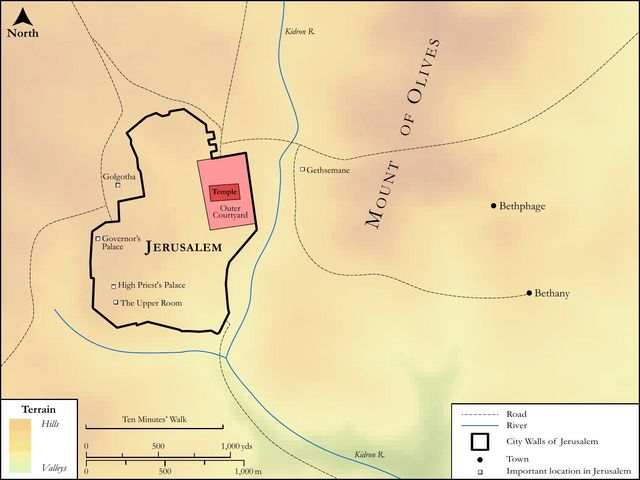
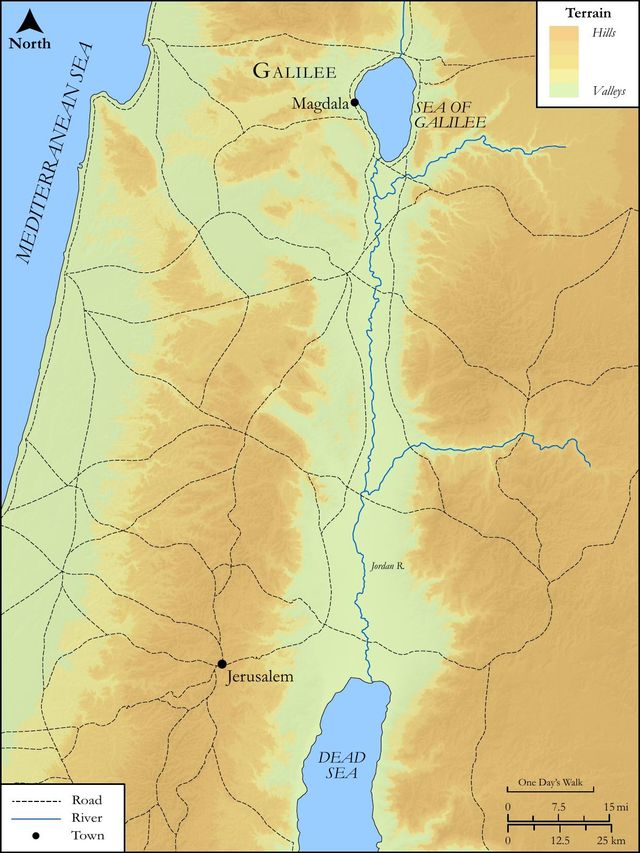
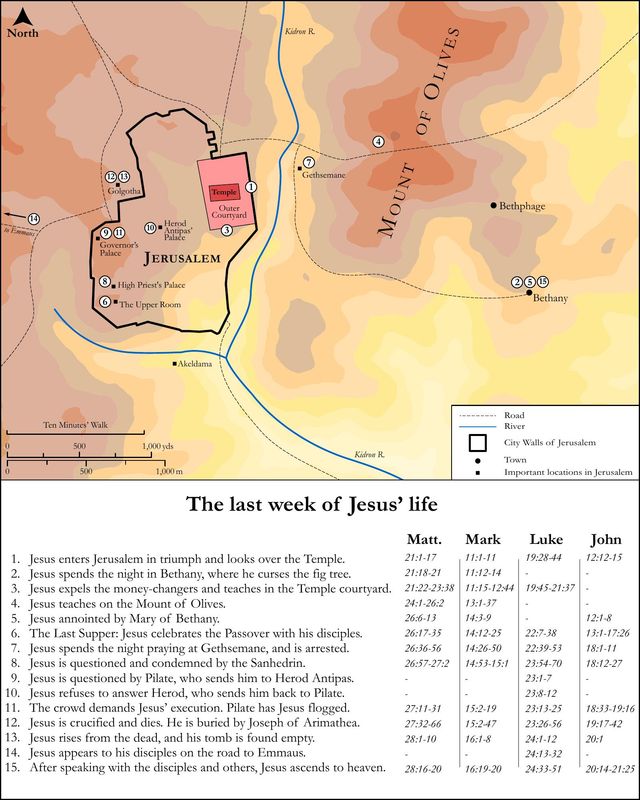
Study this verse
Historical interpretation
Six Centuries of Reception
15 surviving comments on this verse. Each one is dated, so this reads as a timeline rather than a list.
Select a marker to jump to its quote. Markers stagger vertically where authors wrote within a few decades of each other.
"And the earth shook," that is, all flesh trembled when the new word, the realities of the new covenant, the new song and all new heavenly things came upon them. This is what the prophet wrote concerning this very event: "All [namely, the disciples of Christ] who saw these things trembled and every one was afraid."
Anyone who searches the Scriptures with some diligence will see that there were two curtains, an inner curtain which covered the Holy of Holies and another curtain exterior to either the tabernacle or the temple. These two curtains are figures of the holy tabernacle which the Father prepared from the beginning. Of the two curtains, one "was torn into two parts from the top all the way to the bottom." This happened at the time when Jesus "cried out with a loud voice and gave up his spirit." Thereby the divine mystery was revealed that in the Passion of the Lord our Savior the outer curtain was torn from the top, which represents the beginning of the world, to the bottom, representing the end of the world. Thus by the tearing of the curtain the mysteries were disclosed, which with good reason had been hidden until the coming of Christ. Both the outer curtain and inner curtain would have been torn if it had not been the case that we still know only "in part" and if it had not been the case that everything were already revealed to the beloved disciples of Christ who constitute his body. As it is, however, because we are being brought gradually to the knowledge of new things, only the outer curtain is "torn from top to bottom." But "when the perfect comes" and the other things which now remain hidden are revealed, then the second curtain may also be removed. We will then see even the things which were hidden within the second curtain: the true ark of the covenant, the cherubim, the true mercy seat and the storehouse of manna in a golden bowl, and all these clearly—and even things greater than these. All of this has been revealed through the law of Moses when God said to him, "Make everything according to their forms which were shown to you on the mountain."
Great things were done at the moment that Jesus cried with a great voice.
It is understood that there were two veils; one veiling the Holy of Holies, the other, the outer part of the tabernacle or temple. In the Passion then of our Lord and Saviour, it was the outer veil which was rent from the top to the bottom, that by the rending of the veil from the beginning to the end of the world, the mysteries might be published which had been hid with good reason until the Lord's coming. But when that which is perfect is come, (1 Cor. 13:10.) then the second veil also shall be taken away, that we may see the things that are hidden within, to wit, the true Ark of the Testament, and behold the Cherubim and the rest in their real nature.
These same mighty works are still done every day; the veil of the temple is rent for the Saints, in order to reveal the things that are contained within. The earth quakes, that is, all flesh because of the new word and new things of the New Testament. The rocks are rent, i. e. the mystery of the Prophets, that we may see the spiritual mysteries hid in their depths.
Or, He gave up the ghost with a loud voice, in grief that He was not carrying the sins of all men.
Or, The veil of the temple is rent, because from this time the nation was dispersed, and the honour of the veil is taken away with the guardianship of the protecting Angel.
The earth quaked, because it was unequal to contain such a body; the rocks rent, for the Word of God that pierces all strong and mighty things, and the virtue of the eternal Power had penetrated them; the graves were opened, for the bands of death were loosed. And many bodies of the saints which slept arose, for illumining the darkness of death, and shedding light upon the gloom of Hades, He robbed the spirits of death.
Immediately thereafter the curtain of the temple was torn. After that the people were split into factions. The glory of the curtain along with the protection of its defending angel was taken away.
The earth shook. For the earth could not hold this dead man. Rocks were split, for the Word of God and the power of his eternal goodness rushed in, penetrating every stronghold and principality. Graves were opened, for the gates of death had been unlocked. And a number of the bodies of the saints who had fallen asleep arose. Dispelling the shadows of death and illuminating the darkness of hell, Christ destroyed the spoils of death itself at the resurrection of the saints, who saw him immediately. The centurion and the guards who witnessed this disturbance of the entire natural order confessed him to be the Son of God.
This cry rent the veil, and opened the tombs, and made the house desolate. And He did this, not as offering insult to the temple (for how should He, who saith, "Make not my Father's house a house of merchandise," but declaring them to be unworthy even of His abiding there; like as also when He delivered it over to the Babylonians. But not for this only were these things done, but what took place was a prophecy of the coming desolation, and of the change into the greater and higher state; and a sign of His might.
And together with these things He showed Himself also by what followed after these things, by the raising of the dead. For in the instance of Elisha; one on touching a dead body rose again, but now by a voice He raised them, His body continuing up there, on the cross. And besides, those things were a type of this. For that this might be believed, therefore is that all done. And they are not merely raised, but also rocks are rent, and the earth shaken, that they might learn, that He was able to strike themselves blind, and to rend them in pieces. For He that cleft rocks asunder, and darkened the world, much more could have done these things to them, had it been His will. But He would not, but having discharged His wrath upon the elements, them it was His will to save by clemency. But they abated not their madness. Such is envy, such is jealousy, it is not easily stayed. At that time then they were impudent in setting themselves against the actual appearances; and afterwards even against the things themselves, when a seal being put upon Him, and soldiers watching Him, He rose again, and they heard these things from the very guards; they even gave money, in order both to corrupt others, and to steal away the history of the resurrection.
Marvel not therefore if at this time also they were perverse, being thus altogether prepared to set themselves impudently against all things; but observe this other point, how great signs He had wrought, some from Heaven, some on earth, some in the very temple, at once marking His indignation, and at the same time showing that what were unapproachable are now to be entered, and that Heaven shall be opened; and the work removed to the true Holy of Holies. And they indeed said, "If He be the King of Israel, let Him come down now from the cross," but He shows that He is King of all the world. And whereas those men said, "Thou that destroyest this temple, and buildest it in three days," He shows that it shall be made forever desolate. Again they said, "He saved others, Himself He cannot save." but He while abiding on the cross proved this most abundantly on the bodies of His servants. For if for Lazarus to rise on the fourth day was a great thing, how much more for all those who had long ago fallen asleep, at once to appear alive, which was a sign of the future resurrection. For, "many bodies of the saints which slept, arose," it is said, "and went into the holy city, and appeared to many." For in order that what was done might not be accounted to be an imagination, they appear, even to many, in the city. And the Centurion too then glorified God, saying, "Truly this was a righteous man. And the multitudes that came together to that sight, returned beating their breasts." So great was the power of the crucified, that after so many mockings, and scoffs, and jeers, both the centurion was moved to compunction, and the people. And some say that there is also a martyrdom of this centurion, who after these things grew to manhood in the faith.
"And many women were there beholding afar off, which had followed Him, ministering unto Him, Mary Magdalene, and Mary the mother of James, and Joses, and the mother of Zebedee's sons."
These things the women see done, these who were most inclined to feel for Him, who were most of all bewailing Him. And mark how great their assiduity. They had followed Him ministering to Him, and were present even unto the time of the dangers. Wherefore also they saw all; how He cried, how He gave up the ghost, how the rocks were rent, and all the rest.
And these first see Jesus; and the sex that was most condemned, this first enjoys the sight of the blessings, this most shows its courage. And when the disciples had fled, these were present. But who were these? His mother, for she is called mother of James, and the rest. But another evangelist saith, that many also lamented over the things that were done, and smote their breasts, which above all shows the cruelty of the Jews, for that they gloried in things for which others were lamenting, and were neither moved by pity, nor checked by fear. For indeed the things that were done were of great wrath, and were not merely signs, but signs of anger all of them, the darkness, the cloven rocks, the veil rent in the midst, the shaking of the earth, and great was the excess of the indignation.
When He remained on the cross they had said tauntingly, He saved others, himself he cannot save. But what He would not do for Himself, that He did and more than that for the bodies of the Saints. For if it was a great thing to raise Lazarus after four days, much more was it that they who had long slept should now show themselves alive; this is indeed a proof of the resurrection to come. But that it might not be thought that that which was done was an appearance merely, the Evangelist adds, And came out of the graves after his resurrection., and went into the holy city, and appeared unto many.
These women thus watching the things that are done are the most compassionate, the most sorrowful. They had followed Him ministering, and remained by Him in danger, showing the highest courage, for when the disciples fled they remained.
(Verse 51.) And behold, the veil of the Temple was torn in two from top to bottom. The veil of the Temple was torn, and all the sacred mysteries of the Law, which were previously covered, were revealed and passed on to the Gentile people. In the Gospel, which we often mention, we read that the threshold of the Temple, of infinite size, was broken and divided. Josephus also reports that the angelic powers, the former guardians of the Temple, together cried out: Let us leave these seats.
The literal meaning of the great signs is undoubtedly that both heaven and earth and all things within them wished to acclaim their crucified Lord. It seems to me, however, that the trembling earth and other signs also represent a type of believers, namely, those who once were comparable to a graveyard but who, having abandoned the errors of their former ways and having softened their once stony hearts, have come to acknowledge the Creator.
It is not doubtful to any what these great signs signify according to the letter, namely, that heaven and earth and all things should bear witness to their crucified Lord.
As Lazarus rose from the dead, so also did many bodies of the Saints rise again to show forth the Lord's resurrection; yet notwithstanding that the graves were opened, they did not rise again before the Lord rose, that He might be the first-born of the resurrection from the dead. The holy city in which they were seen after they had risen may be understood to mean either the heavenly Jerusalem, or this earthly, which once had been holy. For the city of Jerusalem was called Holy on account of the Temple and the Holy of Holies, and to distinguish it from other cities in which idols were worshipped. When it is said, And appeared unto many, it is signified that this was not a general resurrection which all should see, but special, seen only by such as were worthy to see it.
Observe, that in the very midst of the offence of His passion the Centurion acknowledges the Son of God, while Arius in the Church proclaims Him a creature.
It was a Jewish custom, and held no disgrace, according to the manners of the people of old, for women to minister of their substance, food, and clothing to their teachers. This Paul says, that he refused, because it might occasion scandal among the Gentiles. They ministered to the Lord of their substance, that He might reap their carnal things, of whom they reaped spiritual things. Not that the Lord needed food of the creature, but that He might set an example for the teacher, that He should be content to receive food and clothing from His disciples. But let us see what sort of attendants He had; Among whom was Mary Magdalene, and Mary the mother of James and Joseph, and the mother of Zebedee's children.
(adv. Helvid.) 'See,' says Helvidius, 'Jacob and Joseph are the sons of Mary the Lord's mother, whom the Jews call the brethren of Christ. (Mark 6:3.) He is also called James the less, to distinguish him from James the greater, who was the son of Zebedee.' And he urges that 'it were impious to suppose that His mother Mary would be absent, when the other women were there; or that we should have to invent some other third unknown person of the name of Mary, and that too when John's Gospel witnesses that His mother was present.' O blind folly! O mind perverted to its own destruction! Hear what the Evangelist John says: There stood by the cross of Jesus, his mother, and his mother's sister, Mary the wife of Cleophas, and Mary Magdalene. (John 19:25.) No one can doubt that there were two Apostles called James; the son of Zebedee, and the son of Alpheus. This unknown James the less, whom Scripture mentions as the son of Mary, if he is an Apostle, is the son of Alpheus; if he is not an Apostle, but a third unknown James, how can he be supposed to be the Lord's brother, and why should he be styled 'The Less,' to distinguish him from 'The Greater?' For The Greater and The Less are epithets which distinguish two persons, but not three. And that the James, the Lord's brother, was an Apostle, is proved by Paul, Other of the Apostles saw I none, save James the Lord's brother. (Gal. 1:19.) But that you should not suppose this James to be the son of Zebedee, read the Acts, (Acts 12:1.) where he was put to death by Herod. The conclusion then remains, that this Mary, who is described as the mother of James the less (vid. sup. 13:55.), was wife of Alpheus, and sister of Mary the Lord's mother, called by John, Mary the wife of Cleophas. But should you incline to think them two different persons, because in one place she is called Mary the mother of James the less, and in another place Mary the wife of Cleophas, you will learn the Scripture custom of calling the same man by different names; as Raguel Moses' father-in-law is called Jethro. In like manner then, Mary the wife of Cleophas is called the wife of Alpheus, and the mother of James the less. For if she had been the Lord's mother, the Evangelist would here, as in all other places, have called her so, and not described her as the mother of James, when he meant to designate the mother of the Lord. But even if Mary the wife of Cleophas, and Mary the mother of James and Joses, were different persons, it is still certain, that Mary the mother of James and Joses was not the Lord's mother.
(de Cons. Ev. iii. 19.) The wording sufficiently shows that the veil was rent just when He gave up the ghost. If he had not added, And, lo! but had merely said, And the veil of the temple we as rent, it would have been uncertain whether Matthew and Mark had not inserted it here out of its place as they recollected, and Luke had observed the right order, who having said, And the sun was darkened, adds, And the veil of the temple was rent in twain; (Luke 23:46.) or, on the contrary, Luke had returned to what they had inserted in its place.
('Leo, in Serm. de Pass.' non occ.) The sudden commotion in the elements is a sufficient sign in witness of His venerable Passion, The earth quaked, and the rocks rent, and the graves were opened.
(Serm. 66. 3.) From this example then of the Centurion let the substance of the earth tremble in the punishment of its Redeemer, let the rocks of unbelieving minds be rent, and those who were pent up in these sepulchres of mortality leap forth, bursting the bonds that would detain them; and let them show themselves in the Holy City, i. e. the Church of God, as signs of the Resurrection to come; and thus let that take place in the heart, which we must believe takes place in the body.
But some one will ask, what became of those who rose again when the Lord rose. We must believe that they rose again to be witnesses of the Lord's resurrection. Some have said that they died again, and were turned to dust, as Lazarus and the rest whom the Lord raised. But we must by no means give credit to these men's sayings, since if they were to die again, it would be greater torment to them, than if they had not risen again. We ought therefore to believe without hesitation that they who rose from the dead at the Lord's resurrection, ascended also into heaven together with Him.
Whence with good reason by the Centurion is denoted the faith of the Church, which, when the veil of heavenly mysteries had been rent by the Lord's death, immediately asserts Jesus to be both very Man, and truly Son of God, while the Synagogue held its peace.
Continue studying Matthew 27:51 across the web’s major study libraries — every link below opens this exact verse, chapter, or book on the destination site.
Read & Compare
 BibleGatewayThis verse in more than 200 translations and 70 languages.
 Bible.comThe YouVersion reader — hundreds of translations, reading plans, and highlights.
 ESV.orgCrossway's official English Standard Version reader.
 NET BibleThe NET translation with 60,000+ translators' notes on every rendering decision.
 STEP BibleTyndale House's free study tool — original text, vocabulary, and scholarly resources.
 BibliaLogos Bible Software's free web reader.
 USCCBThe New American Bible (Revised Edition) with the U.S. bishops' study notes.
Commentaries
 BibleHub CommentariesDozens of classic commentaries on this verse, gathered on one page.
 StudyLightMore than 100 commentary sets — the largest collection on the web.
 BibleRefPlain-English commentary on what this verse means, verse by verse.
 Enduring WordDavid Guzik's free commentary on this chapter, widely used by Bible teachers.
 Bible Study ToolsVerse commentary alongside Greek and Hebrew study aids.
Original Language & Research
- BibleHub InterlinearThe verse word by word — original language, transliteration, and English.
- BibleHub LexiconEvery word's original-language definition and Strong's entry.
 Blue Letter BibleDeep-study tools — Strong's numbers, concordance, and word studies.
 CNTR CollationThe earliest Greek manuscripts of this verse, collated letter by letter.
Sermons, Hymns & Audio


TrulyRandomVerse is not affiliated with these sites and doesn’t control their content. They’re linked because they’re genuinely useful.
Summary
Matthew 27:51 records two extraordinary supernatural phenomena immediately following the death of Jesus Christ on the cross: the instantaneous tearing of the temple veil and a profound earthquake accompanied by the splitting of rocks. These events serve as powerful divine declarations, signifying a radical shift in humanity's access to God and underscoring the cosmic magnitude and divine validation of Christ's atoning sacrifice.
Context
ShowHideLiterary Context
This verse is situated at the climax of Matthew's crucifixion narrative, directly following Jesus' final cry and His yielding up of His spirit (Matthew 27:50). The events described here are not mere coincidences but divine responses to the death of the Son of God, immediately preceding the centurion's confession (Matthew 27:54) and the burial of Jesus. The tearing of the veil and the earthquake serve as dramatic, tangible signs confirming the profound spiritual significance of Jesus' death, validating His divine identity and the completion of His redemptive work. The narrative flow emphasizes the immediate and widespread impact of this singular event.
Historical & Cultural Context
The "veil of the temple" refers to the massive, thick curtain that separated the Holy Place from the Holy of Holies within the Jerusalem Temple. This inner sanctuary was considered the most sacred space, symbolizing God's immediate dwelling presence on earth. Access to the Holy of Holies was strictly limited to the High Priest, and only once a year on the Day of Atonement (Leviticus 16:2), when he entered to offer sacrifices for the sins of the people. The veil thus represented the barrier between a holy God and sinful humanity. The earthquake, a common biblical sign of divine presence or judgment, would have been understood by Jewish audiences as a powerful manifestation of God's intervention, further emphasizing the momentous nature of Jesus' death.
Key Themes
ShowHideMatthew 27:51 contributes significantly to several key themes within the Gospel. Firstly, it highlights the fulfillment of prophecy and the inauguration of the New Covenant, signaling the end of the Old Covenant's sacrificial system and priestly mediation, as foreshadowed in passages like Jeremiah 31:31-34. Secondly, it powerfully illustrates direct access to God through Christ's sacrifice, a theme extensively developed in the book of Hebrews. Thirdly, the cosmic disturbances—the earthquake and splitting rocks—underscore the universal and cosmic impact of Jesus' death, demonstrating that creation itself bore witness to the death of its Creator, echoing the darkness that covered the land earlier (Matthew 27:45).
Exposition and Analysis
ShowHideKey Word Analysis
ShowHideFrom a compound of katá (down) and a congener of pétomai (to fly); something spread thoroughly, i.e. (specially) the door screen (to the Most Holy Place) in the Jewish Temple. This word specifically denotes the inner veil, the most significant barrier in the Temple, separating the Holy of Holies from the rest of the sanctuary. Its tearing signifies the removal of this ultimate spiritual barrier.
Apparently a primary verb; to split or sever (literally or figuratively). This word emphasizes the forceful, decisive, and complete nature of the tearing. The passive voice ("was rent") indicates a divine, not human, agent. The tearing "from the top to the bottom" further underscores that this was God's act, not a human attempt to tear it from below.
Contracted from a primary word; soil; by extension a region, or the solid part or the whole of the terrene globe (including the occupants in each application). In this context, it refers to the physical ground, indicating a widespread, literal earthquake that shook the very foundations of the land.
Apparently a primary verb; to rock (vibrate, properly, sideways or to and fro), i.e. (generally) to agitate (in any direction; cause to tremble); figuratively, to throw into a tremor (of fear or concern). This word describes the violent shaking of the earth, a common biblical sign of God's presence, power, or judgment.
Verse Breakdown
ShowHide"And, behold, the veil of the temple was rent in twain from the top to the bottom"
This clause describes the first and most profound supernatural event. The "veil of the temple" refers to the thick curtain separating the Holy Place from the Holy of Holies. Its tearing "in twain" (into two pieces) and specifically "from the top to the bottom" is critical, indicating that this was not a human act, but a divine intervention. This act symbolically and actually removed the barrier that prevented direct access to God's presence, signifying that Jesus' death had opened a new and living way for humanity to approach God.
"and the earth did quake"
This second clause describes a powerful earthquake. The shaking of the earth is a common biblical motif associated with divine revelation, judgment, or significant cosmic events. Here, it underscores the immense, universal, and cosmic significance of Jesus' death, indicating that creation itself reacted to the passing of its Creator. It serves as a divine validation of the monumental event.
"and the rocks rent;"
This final clause provides further detail about the earthquake's intensity, specifying that not just the ground, but even solid rocks were split open. This detail amplifies the supernatural nature of the event, emphasizing its severity and the profound impact of Jesus' death on the natural order. It is another tangible sign of God's direct intervention and confirmation of Christ's identity and finished work.
Literary Devices
ShowHideMatthew employs several literary devices to convey the profound significance of Jesus' death. The tearing of the temple veil is a powerful symbolism, representing the abolition of the old covenant's barriers and the inauguration of direct access to God through Christ. The phrase "from the top to the bottom" emphasizes divine agency, ruling out human intervention and highlighting the miraculous nature of the event. The earthquake and splitting rocks serve as cosmic imagery, portraying the universal impact of Christ's sacrifice. These natural phenomena are also a form of pathetic fallacy, where nature reflects the emotional and spiritual upheaval of the moment. Furthermore, the immediate succession of these events after Jesus' death creates a dramatic juxtaposition, underscoring the direct causal link between His sacrifice and these divine manifestations.
Theological and Thematic Connections
ShowHideThe tearing of the temple veil and the accompanying cosmic disturbances in Matthew 27:51 are replete with profound theological implications. At its core, this verse proclaims the complete and final efficacy of Jesus' atoning sacrifice. The physical barrier separating humanity from God's most sacred presence was supernaturally removed, signifying that the need for a human high priest and the provisional sacrifices of the Old Covenant had been fully satisfied by Christ's once-for-all offering. This event announces a new era of direct, unhindered access to God for all who believe, a testament to the new and living way inaugurated by Christ's blood. The quaking earth and rending rocks further emphasize that this was not merely a local event, but a cosmic declaration, confirming Jesus' divine identity and the universal scope of His redemptive work.
Reflection and Application
ShowHideMatthew 27:51 offers believers an incredibly rich foundation for their faith and daily walk. The tearing of the veil means that the greatest barrier between a holy God and sinful humanity has been removed by Christ's sacrifice. We no longer need to approach God through intermediaries, elaborate rituals, or a system of animal sacrifices. Instead, we are invited into His presence with confidence and boldness, knowing that the way has been fully cleared by the blood of Jesus. This truth should transform our prayer lives, fostering intimacy and freedom rather than fear or hesitation. It assures us of the completeness of our forgiveness and the depth of God's desire for relationship with us. Living in light of the torn veil means embracing our identity as those who have direct access to the Father, empowered to live under His grace and in His presence, no longer bound by the limitations of the old covenant. The cosmic signs remind us that our salvation is not a small, private affair, but an event of universal significance, validated by God Himself.
Questions for Reflection
ShowHideFAQ
ShowHideWhat was the significance of the temple veil being torn "from the top to the bottom"?
ShowHideThe tearing of the temple veil "from the top to the bottom" is profoundly significant because it indicates that the act was not done by human hands, but by divine power. Had it been torn from the bottom, it might suggest human rebellion or an attempt to force entry. However, its tearing from the top demonstrates that God Himself initiated the removal of the barrier. This signifies that the Old Covenant system, with its limited access to God through the High Priest and sacrificial rituals, was now superseded by the New Covenant established through Christ's death. It proclaims that God Himself has opened the way for all people to have direct access to His presence through the sacrifice of His Son.
Why did the earth quake and the rocks split at Jesus' death?
ShowHideThe earthquake and splitting rocks were not random occurrences but powerful supernatural signs accompanying Jesus' death, underscoring its cosmic and divine significance. Earthquakes in the Bible often signal God's presence, judgment, or the inauguration of a new era. In this context, they serve as divine validation of Jesus' identity as the Son of God and the monumental nature of His atoning work. Nature itself reacted to the death of its Creator, mirroring the spiritual upheaval and confirming that this was an event of universal consequence, not merely the execution of a man. It further emphasizes the fulfillment of prophecies and the dawning of a new spiritual reality.
Christ-Centered Fulfillment
ShowHideMatthew 27:51 stands as a monumental declaration of Christ's completed work and the inauguration of the New Covenant. The tearing of the temple veil, a physical manifestation of the spiritual barrier between a holy God and sinful humanity, directly fulfills the purpose of Jesus' sacrificial death. As the perfect Lamb of God (John 1:29), Jesus' offering on the cross abolished the need for the provisional sacrifices of the Old Testament system, which could never truly take away sin (Hebrews 10:4). His body, broken on the cross, became the "new and living way" through the torn veil of His flesh (Hebrews 10:19-20), granting all believers direct, unhindered access to the Father's presence. The accompanying cosmic disturbances—the quaking earth and rending rocks—further testify to Christ's divine authority and the universal impact of His redemptive act, echoing the very moment when the Son of God laid down His life to reconcile the world to Himself (2 Corinthians 5:19). Thus, this verse powerfully proclaims that Christ's death fully accomplished atonement, opened the path to God, and ushered in an era of grace where God's presence is accessible to all who believe in His Son.