


Mark 15:38
Bible text: King James Version (1769 Blayney text) · Public domain
Bible text: Berean Standard Bible · Public domain
Bible text: American Standard Version (1901) · Public domain
Bible text: World English Bible, Messianic edition · Public domain
Bible text: Geneva Bible (1599) · Public domain
Bible text: Young's Literal Translation · Public domain
- ΚαὶKaiAndG2532CONJConjunction
- τὸtotheG3588T-NSNDefinite article Nominative Singular Neuter
- καταπέτασμαkatapetasmaveilG2665N-NSNNoun Nominative Singular Neuter
- τοῦtouof theG3588T-GSMDefinite article Genitive Singular Masculine
- ναοῦnaoutempleG3485N-GSMNoun Genitive Singular Masculine
- ἐσχίσθηeschisthēwas tornG4977V-API-3SVerb Aorist Passive Indicative 3rd Singular
- εἰςeisintoG1519PREPPreposition
- δύοduotwoG1417A-NUIAdjective
- ἀπ᾽ap᾽fromG575PREPPreposition
- ἄνωθενanōthentopG509ADVAdverb
- ἕωςhe'ōsuntilG2193PREPPreposition
- κάτωkatōbottomG2736PREPPreposition
English is a literal word-by-word gloss of the Greek, not the KJV's wording. Why?
This is the original text the KJV's translators worked from — each Greek word with its own literal English meaning in this verse, prepared by scholars at Tyndale House, Cambridge. The KJV translates whole sentences, not word by word, so its wording differs: one Greek word can become several English words, and the KJV may choose “charity” where the gloss reads “love”. Both are faithful — they answer different questions. For the KJV's own rendering, switch to the KJV text.
Details
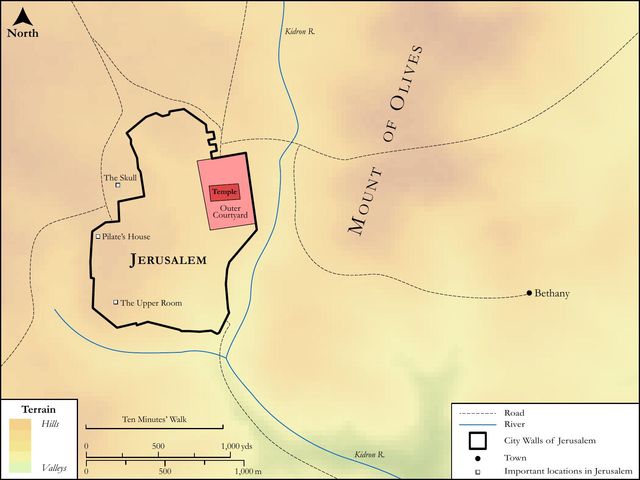
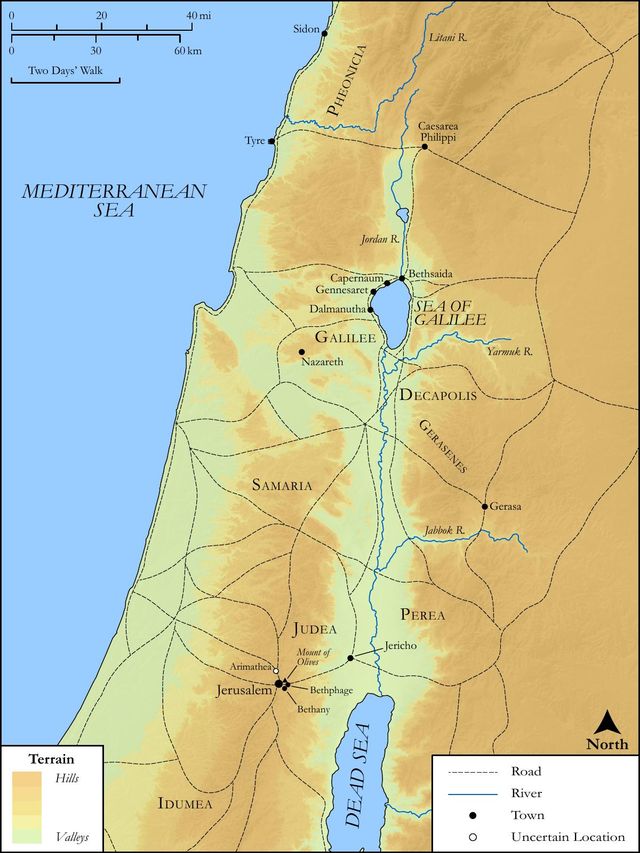
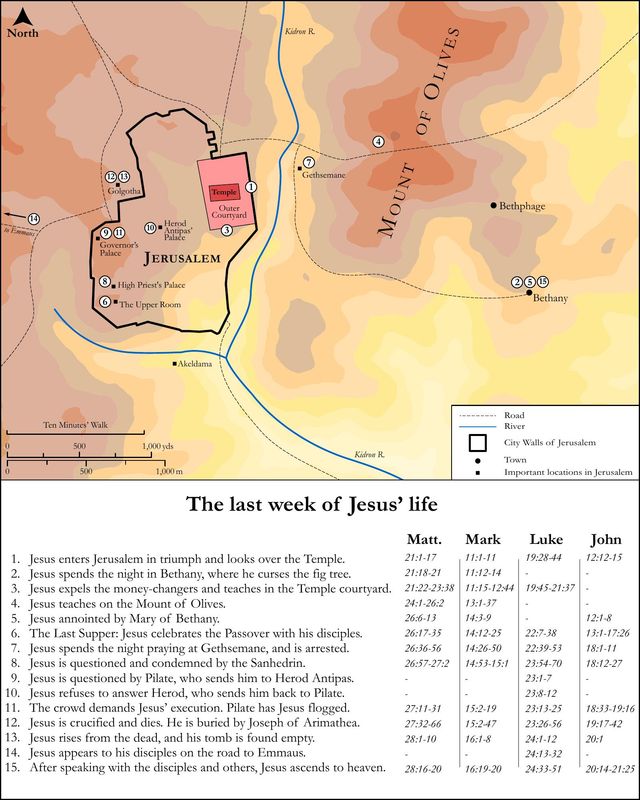
See on the biblical-era maps
Study this verse
Public-domain commentary
Matthew Henry
From his Commentary on the Whole Bible. Henry comments on passages, not single verses — this entry covers Mark 15:33–41. His two-level outline is real structure in the source text, so it is rendered as structure.
Here we have an account of Christ's dying, how his enemies abused him, and God honoured him at his death.
I.There was a thick darkness over the whole land (some think over the whole earth), for three hours, from noon till three of the clock.
Now the scripture was fulfilled (Amo 8:9), I will cause the sun to go down at noon, and I will darken the earth in the clear day; and Jer 15:9, Her sun is gone down while it is yet day. The Jews have often demanded of Christ a sign from heaven; and now they had one, but such a one as signified the blinding of their eyes. It was a sign of the darkness that was come, and coming, upon the Jewish church and nation. They were doing their utmost to extinguish the Sun of righteousness, which was now setting, and the rising again of which they would never own; and what then might be expected among them but a worse than Egyptian darkness? This intimated to them, that the things which belonged to their peace, were now hid from their eyes, and that the day of the Lord was at hand, which should be to them a day of darkness and gloominess, Joe 2:1, Joe 2:2. It was the power of darkness that they were now under, the works of darkness that they were now doing; and such as this should their doom justly be, who loved darkness rather than light.
II.Toward the close of this darkness, our Lord Jesus, in the agony of his soul, cried out, My God, my God, why hast thou forsaken me? Mar 15:34. The darkness signified the present cloud which the human soul of Christ was under, when he was making it an offering for sin. Mr. Fox, in his Acts and Monuments (vol. 3, p. 160), tells of one Dr. Hunter, a martyr in queen Mary's time, who, being fastened to the stake, to be burnt, put up this short prayer, Son of God, shine upon me; and immediately the sun in the firmament shone out of the dark cloud, so full in his face, that he was forced to look another way, which was very comfortable to him. But our Lord Jesus, on the contrary, was denied the light of the sun, when he was in his sufferings, to signifying the withdrawing of the light of God's countenance. And this he complained of more than any thing; he did not complain of his disciples' forsaking him, but of his Father's,
1.Because this wounded his spirit; and that is a thing hard to bear (Pro 18:14); brought the waters into his soul, Psa 69:1-3.
2.Because in this especially he was made sin for us; our iniquities had deserved indignation and wrath upon the soul (Rom 2:8), and therefore, Christ, being made a sacrifice, underwent as much of it as he was capable of; and it could not but bear hard indeed upon him who had lain in the bosom of the Father from eternity, and was always his light. These symptoms of divine wrath, which Christ was under in his sufferings, were like that fire from heaven which had been sent sometimes, in extraordinary cases, to consume the sacrifices (as Lev 9:24; Ch2 7:1; Kg1 18:38); and it was always a token of God's acceptance. The fire that should have fallen upon the sinner, if God had not been pacified, fell upon the sacrifice, as a token that he was so; therefore it now fell upon Christ, and extorted him from this loud and bitter cry. When Paul was to be offered as a sacrifice for the service of saints, he could joy and rejoice (Phi 2:17); but it is another thing to be offered as a sacrifice for the sin of sinners. Now, at the sixth hour, and so to the ninth, the sun was darkened by an extraordinary eclipse; and if it be true, as some astronomers compute, that in the evening of this day on which Christ died there was an eclipse of the moon, that was natural and expected, in which seven digits of the moon were darkened, and it continued from five o'clock till seven, it is remarkable, and yet further significant of the darkness of the time that then was. When the sun shall be darkened, the moon also shall not give her light.
III.Christ's prayer was bantered by them that stood by (Mar 15:35, Mar 15:36); because he cried, Eli, Eli, or (as Mark has it, according to the Syriac dialect) Eloi, Eloi, they said, He calls for Elias, though they knew very well what he said, and what it signified, My God, My God. Thus did they represent him as praying to saints, either because he had abandoned God, or God had abandoned him; and hereby they would make him more and more odious to the people. One of them filled a sponge with vinegar, and reached it up to him upon a reed; "Let him cool his mouth with that, it is a drink good enough for him," Mar 15:36. This was intended for a further affront and abuse to him; and whoever it was that checked him who did it, did but add to the reproach; "Let him alone; he has called for Elias: let us see whether Elias will come take him down; and if not, we may conclude that he also hath abandoned him."
IV.Christ did again cry with a loud voice, and so gave up the ghost, Mar 15:37.
He was now commending his soul into his Father's hand; and though God is not moved with any bodily exercise, yet this loud voice signified the great strength and ardency of affection wherewith he did it; to teach us, in every thing wherein we have to do with God, to put forth our utmost vigour, and to perform all the duties of religion, particularly that of self-resignation, with our whole heart and whole soul; and then, though speech fails, that we cannot cry with a loud voice, as Christ did, yet if God be the strength of the heart, that will not fail. Christ was really and truly dead, for he gave up the ghost; his human soul departed to the world of spirits, and left his body a breathless clod of clay.
V.Just at that instant that Christ died upon mount Calvary, the veil of the temple was rent in twain from the top to the bottom, Mar 15:38. This bespoke a great deal,
1.Of the terror of the unbelieving Jews; for it was a presage of the utter destruction of their church and nation, which followed not long after; it was like the cutting asunder of the staff of beauty (for this veil was exceedingly splendid and glorious, Exo 26:31), and that was done at the same time when they gave for his price thirty pieces of silver (Zac 11:10, Zac 11:12), to break the covenant which he had made with that people. Now it was time to cry, Ichabod, The glory is departed from Israel. Some think that the story which Josephus relates, of the temple door opening of its own accord, with that voice, Let us depart hence, some years before the destruction of Jerusalem, is the same with this; but that is not probable: however, this had the same signification, according to that (Hos 5:14), I will tear, and go away.
2.It bespeaks a great deal of comfort to all believing Christians, for it signifies the consecrating and laying open to us of a new and living way into the holiest by the blood of Jesus.
VI.The centurion who commanded the detachment which had the oversight of the execution was convinced, and confessed that this Jesus was the Son of God, Mar 15:39. One thing that satisfied him, was, that he so cried out, and gave up the ghost: that one who was ready to give up the ghost, should be able to cry out so, was very surprising. Of all the sad spectacles of this kind he never observed the like; and that one who had strength to cry so loud, should yet immediately give up the ghost, this also made him wonder; and he said, to the honour of Christ, and the shame of those that abused him, Truly this man was the Son of God. But what reason had he to say so? I answer,
1.He had reason to say that he suffered unjustly, and had a great deal of wrong done him. Note, He suffered for saying that he was the Son of God; and it was true, he did say so, so that if he suffered unjustly, as it was plain by all the circumstances of his suffering that he did, then what he said was true, and he was indeed the Son of God.
2.He had reason to say that he was a favourite of heaven, and one for whom the almighty power was particularly engaged, seeing how Heaven did him honour at his death, and frowned upon his persecutors. "Surely," thinks he, "this must be some divine person, highly beloved of God." This he expresses by such words as denote his eternal generation as God, and his special designation to the office of Mediator, though he meant not so. Our Lord Jesus, even in the depth of his sufferings and humiliation, was the Son of God, and was declared to be so with power.
VII.There were some of his friends, the good women especially, that attended him (Mar 15:40, Mar 15:41); There were women looking on afar off:
the men durst not be seen at all, the mob was so very outrageous; Currenti cede furori - Give way to the raging torrent, they thought, was good counsel now. The women durst not come near, but stood at a distance, overwhelmed with grief. Some of these women are here named. Mary Magdalene was one; she had been his patient, and owed all her comfort to his power and goodness, which rescued her out of the possession of seven devils, in gratitude for which she thought she could never do enough for him. Mary also was there, the mother of James the little, Jacobus parvus, so the word is; probably, he was so called because he was, like Zaccheus, little of stature. This Mary was the wife of Cleophas or Alpheus, sister to the virgin Mary. These women had followed Christ from Galilee, though they were not required to attend the feast, as the males were; but it is probably that they came, in expectation that his temporal kingdom would now shortly be set up, and big with hopes of preferment for themselves, and their relations under him. It is plain that the mother of Zebedee's children was so (Mat 20:21); and now to see him upon a cross, whom they thought to have seen upon a throne, could not but be a great disappointment to them. Note, Those that follow Christ, in expectation of great things in this world by him, and by the profession of his religion, may probably live to see themselves sadly disappointed.
Historical interpretation
Nine Centuries of Reception
7 surviving comments on this verse. Each one is dated, so this reads as a timeline rather than a list.
Select a marker to jump to its quote. Markers stagger vertically where authors wrote within a few decades of each other.
The veil of the temple is rent, that is, the heaven is opened.
But the last are now made the first. The Gentile people confesses. The blinded Jew denies, so that their error is worse than the first.
As the female sex through the Virgin Mary is not shut out from salvation, so it is not thrust away from the knowledge of the mystery of the cross, and of the resurrection, through the widow Mary Magdalene, and the others, who were mothers.
The curtain was torn. [This was] to show that [the Lord] had taken the kingdom away from them and had given it to others who would bear fruit. An alternative interpretation is: By the analogy of the torn curtain, the temple would be destroyed because his Spirit had gone away from it. Since the high priest had wrongfully torn his robe, the Spirit tore the curtain to proclaim the audacity of the pride [of the Jews], by means of an action on the level of created beings. Because [the high priest] had torn his priesthood and had cast it from him, [the Spirit] also split the curtain apart. Or [alternatively], just as the temple in which Judas had thrown down the gold was dissolved and rejected, so too [the Lord] pulled down and rent asunder the curtain of the door through which [Judas] had entered. Or, [it was] because they had stripped him of his garments that he rent the curtain in two. For the heart of the rock was burst asunder, but their own hearts did not repent.
He surrenders his life, yet he has power to take it again. Yes, the veil is torn, for things of heaven are being revealed, rocks split, and dead men have an earlier awakening.
(ubi sup.) Now the cause of the centurion's wonder is clear, that seeing that the Lord died in that way, that is, sent forth His spirit, he said, Truly this man was the Son of God. For no one can send forth his own spirit, but He who is the Creator of souls.
(ubi sup.) He means by James the Less, the son of Alphæus, who was also called the brother of our Lord, because he was the son of Mary, our Lord's mother's sister, whom John mentions, saying, Now there stood by the cross of Jesus his mother and his mother's sister, Mary of Cleophas, and Mary Magdalene. (John 19:25) And he seems to call her Mary of Cleophas, from her father or some relation. But he was called James the Less, to distinguish him from James the Great, that is, the son of Zebedee, who was called amongst the first of the Apostles by our Lord. Further, it was a Jewish custom, nor was it thought blamable after the manners of an ancient people, that women should furnish to teachers food and clothing out of their substance. Wherefore there follows: Who also when he was in Galilee followed him, and ministered unto him. They ministered unto the Lord of their substance, that He might reap their carnal things whose spiritual things they reaped, and that He might show forth a type for all masters, who ought to be content with food and clothing from their disciples. But let us see what companions He had with Him, for it goes on: And many other women which came up with him into Jerusalem.
And the veil of the temple was torn in two from top to bottom. The veil of the temple is torn, so that the ark of the covenant and all the sacraments of the law, which were covered, may appear and pass on to the people of the nations. For it had been said before: God is known in Judah, his great name in Israel (Psalm 76). But now: Be exalted above the heavens, O God, and your glory over all the earth (Psalm 66). And previously in the Gospel, he said: Do not go into the way of the gentiles (Matthew 10). But after his passion, he said: Go and teach all nations (Matthew 28).
Again, God by the rending of the veil implied that the grace of the Holy Spirit goes away and is rent from the temple, so that the Holy of holies might be seen by all;e also that the temple will mourn amongst the Jews, when they shall deplore their calamities, and rend their clothes. This also is a figure of the living temple, that is, the body of Christ, in whose Passion His garment is torn, that is, His flesh. Again, it means another thing; for the flesh is the veil of our temple, that is, of our mind. But the power of the flesh is torn in the Passion of Christ, from the top to the bottom, that is, from Adam even down to the latest man; for also Adam was made whole by the Passion of Christ, and his flesh does not remain under the curse, nor does it deserve corruption, but we all are gifted with incorruption. And when the centurion who stood over against him saw. He who commands a hundred soldiers is called a centurion. But seeing that He died with such power as the Lord, he wondered and confessed.
And so the order is inverted, for the Jew kills, and the Gentile confesses; the disciples fly, and the women remain. For there follows: There were also women looking on afar off, amongst whom was Mary Magdalene, and Mary the mother of James the less and of Joses, and Salome.
After the Evangelist has related the Passion and the death of Christ, he now goes on to mention those things which followed after the death of our Lord. Wherefore it is said: And the veil of the temple was rent in twain from the top to the bottom.
Continue studying Mark 15:38 across the web’s major study libraries — every link below opens this exact verse, chapter, or book on the destination site.
Read & Compare
 BibleGatewayThis verse in more than 200 translations and 70 languages.
 Bible.comThe YouVersion reader — hundreds of translations, reading plans, and highlights.
 ESV.orgCrossway's official English Standard Version reader.
 NET BibleThe NET translation with 60,000+ translators' notes on every rendering decision.
 STEP BibleTyndale House's free study tool — original text, vocabulary, and scholarly resources.
 BibliaLogos Bible Software's free web reader.
 USCCBThe New American Bible (Revised Edition) with the U.S. bishops' study notes.
Commentaries
 BibleHub CommentariesDozens of classic commentaries on this verse, gathered on one page.
 StudyLightMore than 100 commentary sets — the largest collection on the web.
 BibleRefPlain-English commentary on what this verse means, verse by verse.
 Enduring WordDavid Guzik's free commentary on this chapter, widely used by Bible teachers.
 Bible Study ToolsVerse commentary alongside Greek and Hebrew study aids.
Original Language & Research
- BibleHub InterlinearThe verse word by word — original language, transliteration, and English.
- BibleHub LexiconEvery word's original-language definition and Strong's entry.
 Blue Letter BibleDeep-study tools — Strong's numbers, concordance, and word studies.
 CNTR CollationThe earliest Greek manuscripts of this verse, collated letter by letter.
Sermons, Hymns & Audio


TrulyRandomVerse is not affiliated with these sites and doesn’t control their content. They’re linked because they’re genuinely useful.
Summary
Mark 15:38 records a pivotal event immediately following the death of Jesus Christ on the cross: the dramatic tearing of the temple veil. This massive curtain, which separated the Holy Place from the Most Holy Place (Holy of Holies) in the Jerusalem Temple, was supernaturally ripped in two from top to bottom. This miraculous occurrence served as a profound divine declaration, signifying the abolition of the old covenant system, the opening of direct access to God for all humanity through Christ's atoning sacrifice, and the fulfillment of the sacrificial law.
Context
ShowHideLiterary Context
This verse is strategically placed by Mark immediately after Jesus' final breath and cry, "It is finished" (though Mark doesn't record the words, only the loud cry), and before the Roman centurion's confession of Jesus as the Son of God. The tearing of the veil is presented as a direct, supernatural consequence of Christ's death, linking His sacrifice on the cross to a fundamental shift in humanity's relationship with God. It parallels the darkness that covered the land from noon until three o'clock, indicating a profound, divinely orchestrated moment of eternal and spiritual significance. Both Matthew and Luke also record this event, underscoring its importance in the Synoptic tradition (Matthew 27:51 and Luke 23:45).
Historical & Cultural Context
The Jerusalem Temple was the center of Jewish worship, meticulously designed according to divine instructions (first for the tabernacle, then the temple). The "veil" (Hebrew: parokhet) was a thick, heavy curtain that separated the Holy Place, where priests performed daily rituals, from the Holy of Holies, the innermost sanctuary. This sacred space housed the Ark of the Covenant and was considered the dwelling place of God's presence. Only the High Priest was permitted to enter the Holy of Holies, and then only once a year on the Day of Atonement, to offer blood sacrifices for the sins of the people (Leviticus 16:34). The veil thus served as a physical and symbolic barrier, representing the separation between a holy God and sinful humanity, highlighting humanity's inability to approach God directly due to sin.
Key Themes
ShowHideThe tearing of the veil contributes significantly to several key themes within Mark's Gospel and broader biblical theology. Foremost among these is the theme of Divine Intervention and the Sovereignty of God, as the tearing was clearly a supernatural act, not human. It also powerfully underscores the theme of Fulfillment of the Old Covenant, demonstrating that the sacrificial system and temple rituals, which pointed to a greater reality, had now met their ultimate purpose in Christ's perfect sacrifice. Consequently, the tearing signifies the Opening of Direct Access to God, removing the barrier of sin and mediation, and ushering in the New Covenant, where believers can now approach God directly through Jesus Christ, our great High Priest (Hebrews 4:14-16).
Exposition and Analysis
ShowHideKey Word Analysis
ShowHideThis word specifically refers to the curtain separating the Holy Place from the Most Holy Place in the Jewish Temple. It was a massive, thick barrier, signifying the profound separation between God's holy presence and humanity, due to sin. Its tearing indicates the removal of this barrier.
This primary verb means "to split or sever," implying a violent, decisive, and irreversible tearing. It suggests a powerful, supernatural force at work, not a gradual fraying or human action. The use of this strong verb emphasizes the finality and divine authority of the event.
The phrase "from the top" (ánōthen) means "from above," and "to the bottom" (kátō) means "downwards." This precise detail is crucial, as it emphasizes that the tearing was an act initiated by God from heaven, not by human hands from below. It underscores the divine origin and complete nature of this monumental event, signifying God's direct involvement in opening the way.
Verse Breakdown
ShowHide"And the veil of the temple"
This clause identifies the specific object involved in the miraculous event. The "veil" was the sacred curtain within the Jerusalem Temple that physically and symbolically separated the Holy Place from the Holy of Holies, the innermost sanctuary where God's presence was believed to dwell.
"was rent in twain"
This describes the action that occurred to the veil. "Rent" (from schízō) signifies a forceful, decisive, and complete tearing, while "in twain" (from dýo) clarifies that it was split into two distinct pieces. This immediate and violent rupture indicates a supernatural intervention, not a natural decay or human effort.
"from the top to the bottom"
This crucial detail specifies the direction of the tearing. The fact that it tore from the top downwards powerfully communicates that this was an act initiated by God Himself, from heaven, rather than an attempt by humans to breach the sacred space from below. It underscores the divine authority and intentionality behind the removal of the barrier.
Literary Devices
ShowHideMark's concise description of the veil tearing is rich in literary and theological significance. The primary device is Symbolism: the veil itself is a powerful symbol of the barrier between a holy God and sinful humanity. Its tearing symbolizes the removal of this barrier, signifying that direct access to God is now possible. The specific direction, "from the top to the bottom," functions as a form of Divine Action or Theophany, emphasizing that this was a supernatural act initiated by God, not by human hands. This detail highlights God's sovereignty and His acceptance of Christ's sacrifice. Furthermore, the event serves as a profound Fulfillment of the Old Covenant's sacrificial system, indicating that its purpose has been met in Christ, and it also acts as Foreshadowing for the new and living way that Christ has opened for believers to enter God's presence.
Theological and Thematic Connections
ShowHideThe tearing of the temple veil at the moment of Jesus' death is one of the most profound theological statements in the New Testament. It declares unequivocally that the old covenant system of animal sacrifices, priestly mediation, and restricted access to God's presence has been superseded and fulfilled by the once-for-all sacrifice of Jesus Christ. His death removed the ultimate barrier—sin—that separated humanity from a holy God. The way into the Most Holy Place, symbolizing direct access to God Himself, was now opened for all who believe, not through human effort or ritual, but through the blood of Christ. This event marks the transition from a covenant based on law and ritual to one based on grace and intimate relationship, making every believer a priest with direct access to the Father.
Reflection and Application
ShowHideThe tearing of the temple veil is not merely a historical curiosity but a living truth with profound implications for every believer today. It assures us that through Christ, the chasm of sin that once separated us from God has been bridged, and the way into His very presence is now wide open. We no longer need intermediaries, elaborate rituals, or special days to approach the Divine. This truth should empower us to live with a boldness and confidence in our relationship with God, knowing that we are invited to draw near to His throne of grace at any time, with any need, and with full assurance of His loving welcome. It calls us to abandon any sense of unworthiness that keeps us distant from Him and to embrace the intimacy and freedom that Christ's sacrifice has secured. Our worship, prayer, and daily lives should reflect this direct access, living in constant communion with the God who has torn down every barrier for our sake.
Questions for Reflection
ShowHideFAQ
ShowHideWhat was the significance of the temple veil in Jewish worship?
ShowHideThe temple veil was a massive, thick curtain that separated the Holy Place from the Most Holy Place (Holy of Holies) within the Jerusalem Temple. The Holy of Holies was considered the most sacred space, symbolizing God's immediate presence on earth. Only the High Priest was permitted to enter it, and then only once a year on the Day of Atonement, to offer sacrifices for the sins of the people (Leviticus 16). The veil visually represented the separation between a holy God and sinful humanity, signifying that humanity was barred from direct access to God's presence due to sin.
Why is it important that the veil tore "from the top to the bottom"?
ShowHideThis detail is crucial because it emphasizes that the tearing was not a human act, nor was it accidental or a result of natural wear. It was a supernatural, divine act, initiated by God Himself from above. If a human had attempted to tear it, they would most likely have started from the bottom. The "from the top to the bottom" detail underscores God's sovereignty, His acceptance of Christ's sacrifice, and His intentional declaration that the way to His presence was now opened by His own power, not by human effort (Hebrews 10:19-20).
Christ-Centered Fulfillment
ShowHideThe tearing of the temple veil at the moment of Christ's death is a profound Christ-centered fulfillment of Old Testament prophecy and typology. Jesus, as the ultimate Lamb of God, offered Himself as the perfect, once-for-all sacrifice for sin, rendering the animal sacrifices of the Old Covenant obsolete. He is not merely the one who enables access; He is the new and living way through the torn veil of His own flesh (Hebrews 10:20). As our great High Priest, Jesus has entered the true Holy of Holies—heaven itself—with His own blood, securing eternal redemption and opening a direct path for all believers to approach God's throne of grace with confidence (Hebrews 9:11-12 and Hebrews 4:16). The torn veil is a vivid symbol of Christ's completed work, signifying that in Him, the separation between God and humanity has been fully overcome, and a new era of intimate communion has begun.