


Luke 23:45
Bible text: King James Version (1769 Blayney text) · Public domain
Bible text: Berean Standard Bible · Public domain
Bible text: American Standard Version (1901) · Public domain
Bible text: World English Bible, Messianic edition · Public domain
Bible text: Geneva Bible (1599) · Public domain
Bible text: Young's Literal Translation · Public domain
- καὶkaiandG2532CONJConjunction
- τοῦtouTheG3588T-GSMDefinite article Genitive Singular Masculine
- ἡλίουhēliousunG2246N-GSMNoun Genitive Singular Masculine
- ἐκλιπόντοςeklipontosdarkenedG1587V-2AAP-GSMVerb 2nd Aorist Active Participle Genitive Singular Masculine
- καὶkaiandG2532CONJConjunction
- ἐσχίσθηeschisthēwas tornG4977V-API-3SVerb Aorist Passive Indicative 3rd Singular
- τὸtotheG3588T-NSNDefinite article Nominative Singular Neuter
- καταπέτασμαkatapetasmaveilG2665N-NSNNoun Nominative Singular Neuter
- τοῦtouof theG3588T-GSMDefinite article Genitive Singular Masculine
- ναοῦnaoutempleG3485N-GSMNoun Genitive Singular Masculine
- μέσονmesonin [the] middleG3319A-ASNAdjective Accusative Singular Neuter
English is a literal word-by-word gloss of the Greek, not the KJV's wording. Why?
This is the original text the KJV's translators worked from — each Greek word with its own literal English meaning in this verse, prepared by scholars at Tyndale House, Cambridge. The KJV translates whole sentences, not word by word, so its wording differs: one Greek word can become several English words, and the KJV may choose “charity” where the gloss reads “love”. Both are faithful — they answer different questions. For the KJV's own rendering, switch to the KJV text.
Details
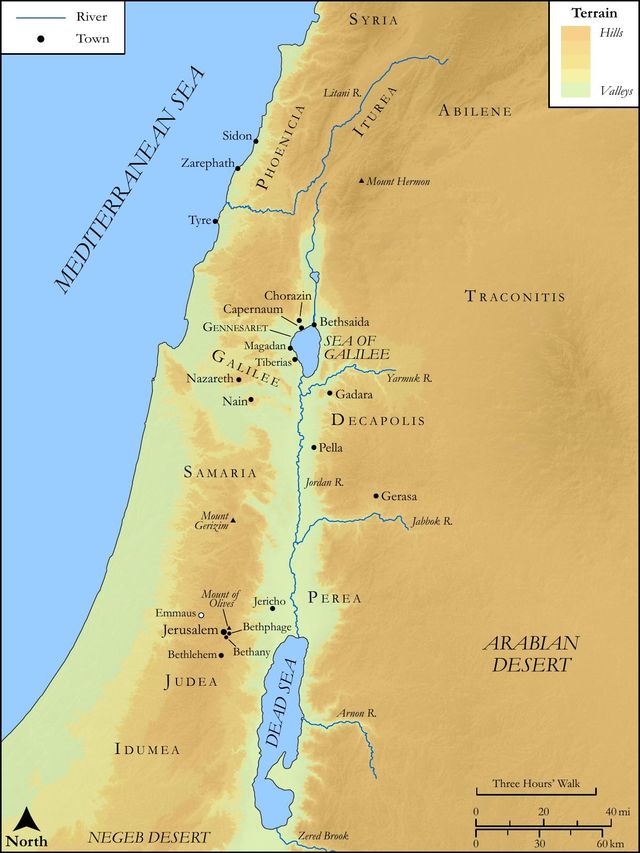
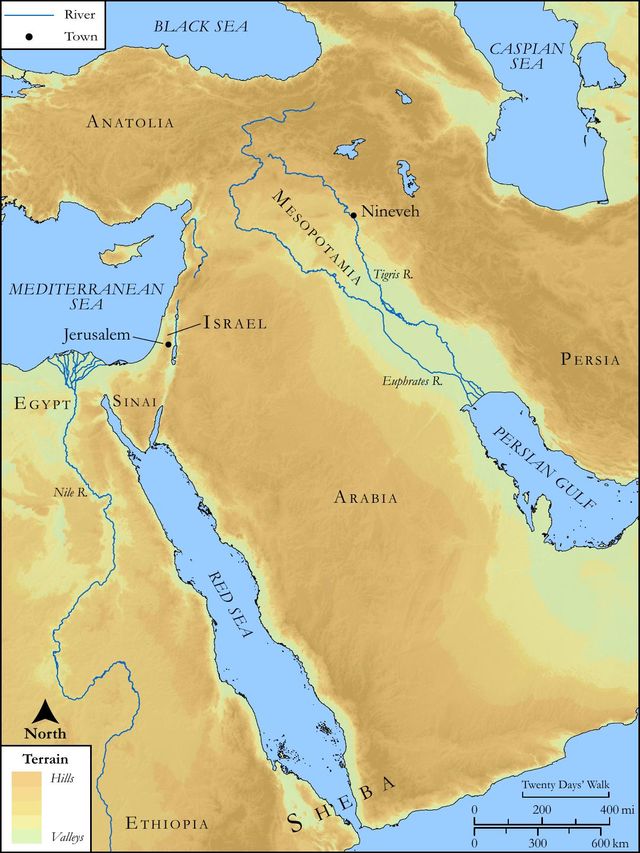
See on the biblical-era maps

Study this verse
Public-domain commentary
Matthew Henry
From his Commentary on the Whole Bible. Henry comments on passages, not single verses — this entry covers Luke 23:44–49. His three-level outline is real structure in the source text, so it is rendered as structure.
In these verses we have three things: -
I.Christ's dying magnified by the prodigies that attended it: only two are here mentioned, which we had an account of before.
1.The darkening of the sun at noon-day. It was now about the sixth hour, that is, according to our computation, twelve o'clock at noon; and there was a darkness over all the earth until the ninth hour. The sun was eclipsed and the air exceedingly clouded at the same time, both which concurred to this thick darkness, which continued three hours, not three days, as that of Egypt did.
2.The rending of the veil of the temple. The former prodigy was in the heavens, this in the temple; for both these are the houses of God, and, when the Son of God was thus abused, they could not but feel the indignity, and thus signify their resentment of it. By this rending of the veil was signified the taking away of the ceremonial law, which was a wall of partition between Jews and Gentiles, and of all other difficulties and discouragements in our approaches to God, so that now we may come boldly to the throne of grace.
II.Christ's dying explained (Luk 23:46) by the words with which he breathed out his soul.
Jesus had cried with a loud voice when he said, Why hast thou forsaken me? So we are told in Matthew and Mark, and, it should seem, it was with a loud voice that he said this too, to show his earnestness, and that all the people might take notice of it: and this he said, Father, into thy hands I commend my spirit.
1.He borrowed these words from his father David (Psa 31:5); not that he needed to have words put into his mouth, but he chose to make use of David's words to show that it was the Spirit of Christ that testified in the Old Testament prophets, and that he came to fulfil the scripture. Christ died with scripture in his mouth. Thus he directs us to make use of scripture language in our addresses to God.
2.In this address to God he calls him Father. When he complained of being forsaken, he cried, Eli, Eli, My God, my God; but, to show that dreadful agony of his soul was now over, he here calls God Father. When he was giving up his life and soul for us, he did for us call God Father, that we through him might receive the adoption of sons.
3.Christ made use of these words in a sense peculiar to himself as Mediator. He was now to make his soul an offering for our sin (Isa 53:10), to give his life a ransom for many (Mat 20:28), by the eternal Spirit to offer himself, Heb 9:14. He was himself both the priest and the sacrifice; our souls were forfeited, and his must go to redeem the forfeiture. The price must be paid into the hands of God, the party offended by sin; to him he had undertaken to make full satisfaction. Now by these words he offered up the sacrifice, did, as it were, lay his hand upon the head of it, and surrender it; tithēmi - "I deposit it, I pay it down into thy hands. Father, accept of my life and soul instead of the lives and souls of the sinners I die for." The animus offerentis - the good will of the offerer, was requisite to the acceptance of the offering. Now Christ here expresses his cheerful willingness to offer himself, as he had done when it was first proposed to him (Heb 10:9, Heb 10:10), Lo, I come to do thy will, by which will we are sanctified.
4.Christ hereby signifies his dependence upon his Father for his resurrection, by the re-union of his soul and body. He commends his spirit into his Father's hand, to be received into paradise, and returned the third day. By this it appears that our Lord Jesus, as he had a true body, so he had a reasonable soul, which existed in a state of separation from the body, and thus he was made like unto his brethren; this soul he lodged in his Father's hand, committed it to his custody, resting in hope that it should not be left in hades, in its state of separation from the body, no, not so long as that the body might see corruption.
5.Christ has hereby left us an example, has fitted those words of David to the purpose of dying saints, and hath, as it were, sanctified them for their use. In death our great care should be about our souls, and we cannot more effectually provide for their welfare than by committing them now into the hands of God, as a Father, to be sanctified and governed by his Spirit and grace, and at death committing them into his hands to be made perfect in holiness and happiness. We must show that we are freely willing to die, that we firmly believe in another life after this, and are desirous of it, by saying, Father, into thy hands I commend my spirit.
III.Christ's dying improved by the impressions it made upon those that attended him.
1.The centurion that had command of the guard was much affected with what he saw, Luk 23:47. He was a Roman, a Gentile, a stranger to the consolations of Israel; and yet he glorified God. He never saw such amazing instances of divine power, and therefore took occasion thence to adore God as the Almighty. And he bore a testimony to the patient sufferer: "Certainly this was a righteous man, and was unjustly put to death." God's manifesting his power so much to do him honour was a plain evidence of his innocency. His testimony in Matthew and Mark goes further: Truly this was the Son of God. But in his case this amounts to the same; for, if he was a righteous man, he said very truly when he said that he was the Son of God; and therefore that testimony of his concerning himself must be admitted, for, if it were false, he was not a righteous man.
2.The disinterested spectators could not but be concerned. This is taken notice of only here, Luk 23:48. All the people that came together to that sight, as is usual upon such occasions, beholding the things which were done, could not but go away very serious for the time, whatever they were when they came home: They smote their breasts, and returned.
(1.)They laid the thing very much to heart for the present. They looked upon it as a wicked thing to put him to death, and could not but think that some judgment of God would come upon their nation for it. Probably these very people were of those that had cried, Crucify him, crucify him, and, when he was nailed to the cross, reviled and blasphemed him; but now they were so terrified with the darkness and the earthquake, and the uncommon manner of his expiring, that they had not only their mouths stopped, but their consciences startled, and in remorse for what they had done, as the publican, they smote upon their breasts, beat upon their own hearts, as those that had indignation at themselves. Some think that this was a happy step towards that good work which was afterwards wrought upon them, when they were pricked to the heart, Act 2:37.
(2.)Yet, it should seem, the impression soon wore off: They smote their breasts, and returned. They did not show any further token of respect to Christ, nor enquire more concerning him, but went home; and we have reason to fear that in a little time they quite forgot it. Thus many that see Christ evidently set forth crucified among them in the word and sacraments are a little affected for the present, but it does not continue; they smite their breasts, and return. They see Christ's face in the glass of the ordinances and admire him; but they go away, and straightway forget what manner of man he is, and what reason they have to love him.
3.His own friends and followers were obliged to keep their distance, and yet got as near as they could and durst, to see what was done (Luk 23:49): All his acquaintance, that knew him and were known of him, stood afar off, for fear lest if they had been near him they should have been taken up as favourers of him; this was part of his sufferings, as of Job's (Job 19:13): He hath put my brethren far from me, and mine acquaintance are verily estranged from me. See Psa 88:18. And the women that followed him together from Galilee were beholding these things, not knowing what to make of them, nor so ready as they should have been to take them for certain preludes of his resurrection. Now was Christ set for a sign that should be spoken against, as Simeon foretold, that the thoughts of many hearts might be revealed, Luk 2:34, Luk 2:35.
Historical interpretation
Eleven Centuries of Reception
19 surviving comments on this verse. Each one is dated, so this reads as a timeline rather than a list.
Select a marker to jump to its quote. Markers stagger vertically where authors wrote within a few decades of each other.
(At noon) the veil of. the temple was rent" by the escape of the cherubim, which "left the daughter of Sion as a cottage in a vineyard, as a lodge in a garden of cucumbers.
(de Incar. et cout. Ar.) For He commends to His Father through Himself all mankind quickened in Him; for we are His members; as the Apostle says, Ye are all one in Christ. (Gal. 3:28.)
God was victorious over the Egyptians, and he lit up the way for the Hebrews with the pillar of fire in the month of Nisan. The sun became dark over them because they had returned evil for goodness. Just as God split the sea, the Spirit split the curtain in half, since they rejected and unjustly crucified the King of glory on the Skull. The curtain of the temple was torn in two for this reason. Created beings suffered with him in his suffering. The sun hid its face so as not to see him when he was crucified. It retracted its light back into itself to die with him. There was darkness for three hours. The sun shined again, proclaiming that its Lord would rise from Sheol on the third day. The mountains trembled, the tombs were opened, and the curtain was torn, as though grieving in mourning over the impending destruction of the place.
If he had been the son of a foreign god, the sun would not have been eclipsed when the Lord was raised on his cross. The Creator would have spread out a more intense light, because his enemy would have been withdrawn from his sight. He would have caused his light to shine on the Jews, because they would have been doing his will. He would have clothed the temple with a curtain of glory, because its enemy’s death would have purified its sad impurities, and the breaker of its law would have gone out from it.
Perhaps the Spirit, when he saw the Son hanging naked, lifted himself up and tore in two the clothing. Perhaps the symbols, when they saw the Lamb of symbols, tore the curtain apart and went out to meet him. Perhaps the spirit of prophecy, which was dwelling in the temple and had come down to herald his coming to humanity, flew away at that very instant to announce in the heights concerning our Lord’s ascent into heaven. “The tombs split apart,” so that he might show that he could have torn the wood of the cross apart. He did not tear apart the cross through which the kingdom would be torn from Israel. He did not shatter the cross through which sin would be chased out from the middle of the Gentiles. Instead, the Spirit tore the curtain apart. To show that the Spirit had came out from the temple, it summoned the righteous that came out of the tombs as witnesses to his going out from the temple. These two departures were proclaiming each other mutually. The Spirit anointed and sanctified the kingship and the priesthood. The Spirit, wellspring of these two offices, therefore went out from there, so that it would be known that both of them had been cut off by him who had taken on both of them.Although we know that by amputation of our finger there is healing for the person who is totally diseased, we still are unwilling to do what we know we should do. God however knew that there would be salvation for humanity through the killing of his Son, and so he did not turn away from doing this.
(Orat. i. de Res.) But it becomes us to enquire how our Lord distributes Himself into three parts at once; into the bowels of the earth, as He told the Pharisees; into the Paradise of God, as He told the thief; into the hands of the Father, as it is said here. To those however who rightly consider, it is scarcely worthy of question, for He who by His divine power is in every place, is present in any particular place.
(ut sup.) There is another explanation, that at the time of His Passion, His Divinity being once united to His humanity, left neither part of His humanity, but of its own accord separated the soul from the body, yet showed itself abiding in each. For through the body in which He suffered death He vanquished the power of death, but through the soul He prepared for the thief an entrance into Paradise. Now Isaiah says of the heavenly Jerusalem, which is no other than Paradise, Upon my hands I have painted thy walls; (Is. 49:16. ap. LXX.) whence it is clear, that he who is in Paradise dwelleth in the hands of the Father.
The veil also is rent, by which is declared the division of the two people, and the profanation of the synagogue. The old veil is rent that the Church may hang up the new veils of faith. The covering of the synagogue is drawn up, that we may behold with the eyes of the mind the inward mysteries of religion now revealed to us.
It took place also at that time when every mystery of Christ's assumed mortality was fulfilled, and His immortality alone remained; as it follows, And when Jesus had cried with a loud voice, he said.
Also, the veil is torn, by which the separation of the two peoples or the desecration of the mysteries of the Synagogue is declared. Therefore, the old veil is torn apart; so that the new Church may hang the sails of its faith. The covering of the synagogues is removed; so that we may see the internal mysteries of religion, with the mind's gaze revealed. Finally, even the centurion who crucified the Son of God confesses.
Now this voice teaches us, that the souls of the saints are not henceforth shut up in hell as before, but are with God, Christ being made the beginning of this change.
(de Con. Ev. lib. iii. c. 17.) What is here said of the darkness, the other two Evangelists, Matthew and Mark, confirm, but St. Luke adds the cause whence the darkness arose, saying, And the sun was darkened.
(de Civ. Dei, l. iii. c. 15.) This darkening of the sun it is quite plain did not happen in the regular and fixed course of the heavenly bodies, because it was then the Passover, which is always celebrated at the full moon. But a regular eclipse of the sun does not take place except at new moon.
When they fastened to the cross the Lord of all, the sun over their heads withdrew and the light at midday was wrapped in darkness, as the divine Amos had foretold. "There was darkness from the sixth hour until the ninth hour." This was a plain sign to the Jews that the minds of those who crucified him were wrapped in spiritual darkness, for blindness in part has happened to Israel. In his love for God, David even curses them, saying, "Let their eyes be darkened, that they may not see."Creation itself mourned its Lord. The sun was darkened, and the rocks were split, and the temple put on the mourners' clothes. Its veil was split from the top to the bottom. This is what God signified to us by the voice of Isaiah, saying, "I clothe the heavens with blackness, and make sackcloth their covering."
As soon as the Lord of all had been given up to be crucified, the whole framework of the world bewailed its rightful Master, and the light was darkened at mid-day, (Amos 8:9.) which was a manifest token that the souls of those who crucified Him would suffer darkness.
(Dion. Areop. ad Polye.) When we were both at Heliopolis together, we both saw at the same time in a marvellous manner the moon meeting the sun, (for it was not then the time of new moon,) and then again, from the ninth hour until evening supernaturally brought back to the edge of the sun's diameter. (ad diametrum solis.) Besides, we observed that this obscuration began from the east, and having reached as far as the sun's western border at length returned, and that the loss and restoration of light took place not from the same side, but from opposite sides of the diameter. Such were the miraculous events of that time, and possible to Christ alone who is the cause of all things.
But Luke, wishing to join miracle to miracle, adds, And the veil of the temple was rent in twain. This took place when our Lord expired, as Matthew and Mark bear witness, but Luke related it by anticipation.
By invoking the Father He declares Himself to be the Son of God, but by commending His Spirit, He signifies not the weakness of His strength, but His confidence in the same power with the Father.
It was about the sixth hour, and darkness came over all the land until the ninth hour, and the sun was obscured. The brightest light of the world withdrew its rays so that it might not see the Lord hanging, or that the impious blaspheming might not enjoy its light. And it is to be noted that the Lord was crucified at the sixth hour, that is, when the sun was about to leave the center of the world; and at dawn, that is, when the sun was already rising, he celebrated the mysteries of his resurrection. For the time signifies what he exhibited by the effect of the work. Because he died for our sins and rose for our justification (Rom. IV). For when Adam sinned, it is written that he heard the voice of the Lord God walking in the garden at the breeze after midday (Gen. III). After midday, indeed, with the light of faith declining, and at the breeze, with the warmth of charity cooling: he was heard walking because he had withdrawn from the sinning man. The order of reason therefore required that at the same time of the day at which he then closed for sinning Adam, now the Lord should open the gate of paradise to the repenting thief.
And the veil of the temple was torn in two. This happened as the Lord expired, as Matthew and Mark attest, but Luke relates it in advance. For, wishing to add miracle to miracle, when he had said "The sun was darkened," he immediately considered it appropriate to add: "And the veil of the temple was torn in two." The veil of the temple is torn, so that the secrets of the covenant and all the sacraments of the law, which were previously covered, may appear and be accessible to the nations. For it had been said before: "God is known in Judah, in Israel His name is great" (Psalm 76). But now: "Be exalted above the heavens, O God, and let your glory be over all the earth" (Psalm 57). And in the Gospel, he first said: "Do not go into the way of the Gentiles" (Matthew 10). But after the passion: "Go and teach all nations" (Matthew 28).
(Hom. de Sabb. San.) Or to speak more expressly, In respect of His body, He was in the grave, in respect of His soul, He was in hell, and with the thief in Paradise; but as God, on the throne with His Father and the Holy Spirit.
By this then our Lord showed that the Holy of Holies should be no longer inaccessible, but being given over into the hands of the Romans, should be defiled, and its entrance laid open.
Whereby it is signified that the veil which kept us asunder from the holy things which are in heaven, is broken through, namely, enmity and sin.
But crying with a loud voice He gives up the ghost, because He had in Himself the power of laying down His life and taking it up again.
This miracle then took place that it might be made known, that He who had undergone death was the Ruler of the whole creation.
Continue studying Luke 23:45 across the web’s major study libraries — every link below opens this exact verse, chapter, or book on the destination site.
Read & Compare
 BibleGatewayThis verse in more than 200 translations and 70 languages.
 Bible.comThe YouVersion reader — hundreds of translations, reading plans, and highlights.
 ESV.orgCrossway's official English Standard Version reader.
 NET BibleThe NET translation with 60,000+ translators' notes on every rendering decision.
 STEP BibleTyndale House's free study tool — original text, vocabulary, and scholarly resources.
 BibliaLogos Bible Software's free web reader.
 USCCBThe New American Bible (Revised Edition) with the U.S. bishops' study notes.
Commentaries
 BibleHub CommentariesDozens of classic commentaries on this verse, gathered on one page.
 StudyLightMore than 100 commentary sets — the largest collection on the web.
 BibleRefPlain-English commentary on what this verse means, verse by verse.
 Enduring WordDavid Guzik's free commentary on this chapter, widely used by Bible teachers.
 Bible Study ToolsVerse commentary alongside Greek and Hebrew study aids.
Original Language & Research
- BibleHub InterlinearThe verse word by word — original language, transliteration, and English.
- BibleHub LexiconEvery word's original-language definition and Strong's entry.
 Blue Letter BibleDeep-study tools — Strong's numbers, concordance, and word studies.
 CNTR CollationThe earliest Greek manuscripts of this verse, collated letter by letter.
Sermons, Hymns & Audio


TrulyRandomVerse is not affiliated with these sites and doesn’t control their content. They’re linked because they’re genuinely useful.
Summary
Luke 23:45 records two profound supernatural phenomena that accompanied the death of Jesus Christ on the cross: the darkening of the sun and the tearing of the temple veil. These events, occurring simultaneously with Jesus' final moments, were not coincidental but divinely orchestrated signs, signaling the eternal significance of Christ's atoning sacrifice, the judgment of God upon sin, and the radical inauguration of a new era of direct access to God for humanity.
Context
ShowHideLiterary Context
Luke 23:45 immediately follows the account of the supernatural darkness that enveloped the land from noon until three in the afternoon, as described in Luke 23:44. This verse sets the stage for Jesus' final cry and subsequent death, detailed in Luke 23:46, and the centurion's confession of Jesus' innocence and divine nature in Luke 23:47. Luke's narrative, consistent with Matthew and Mark, places the darkening of the sun and the rending of the veil at the climax of the crucifixion, emphasizing the profound spiritual implications of Jesus' death for heaven and earth. These events serve as divine commentary, underscoring the gravity and redemptive power of the cross.
Historical & Cultural Context
The events of Luke 23:45 occurred during the Passover festival, a time when Jerusalem would have been bustling with pilgrims. Passover always falls during a full moon, making a natural solar eclipse impossible, thus highlighting the supernatural nature of the sun's darkening. The "temple" refers to Herod's Temple in Jerusalem, the center of Jewish worship and sacrifice. The "veil" was a massive, thick curtain that separated the Holy Place from the Most Holy Place (the Holy of Holies), where God's presence was believed to dwell. Only the High Priest was permitted to enter the Most Holy Place, and only once a year on the Day of Atonement (Yom Kippur), to offer sacrifices for the sins of the nation. This veil symbolized the separation between a holy God and sinful humanity, mediated by the Levitical system.
Key Themes
ShowHideThis verse powerfully contributes to several overarching themes within Luke's Gospel and the broader biblical narrative. It underscores the theme of divine judgment and sorrow, as the darkness signifies God's displeasure with sin and the profound grief of all creation over the suffering of His Son. More significantly, it highlights the theme of new access to God. The tearing of the veil dramatically symbolizes the removal of the barrier between God and humanity, signifying that through Christ's sacrifice, a new and living way has been opened for all believers to approach God directly. This act also points to the fulfillment of the Old Covenant and the inauguration of the New Covenant, where the need for animal sacrifices and a mediating priesthood is superseded by the once-for-all sacrifice of Jesus Christ, as elaborated in the book of Hebrews.
Exposition and Analysis
ShowHideKey Word Analysis
ShowHideMeaning "to obscure (literally or figuratively)." This word emphasizes that the sun's light was supernaturally diminished or blotted out, not by a natural phenomenon like an eclipse, but by a divine act. It conveys a sense of foreboding, judgment, and the profound spiritual reality unfolding.
Referring specifically to "the door screen (to the Most Holy Place) in the Jewish Temple." This is not merely any curtain but the thick, imposing barrier that guarded the very presence of God in the Holy of Holies. Its specific identification underscores the theological weight of its tearing.
Meaning "to split or sever (literally or figuratively)." The use of this verb indicates a violent, complete, and decisive tearing. The implication, especially when considering parallel accounts (e.g., Matthew 27:51), is that it was torn from top to bottom, signifying a divine, rather than human, act.
Verse Breakdown
ShowHide"And the sun was darkened"
This clause describes an event in the heavens, a supernatural obscuring of the sun's light. Occurring from noon to 3 PM (Luke 23:44), it was not a natural eclipse (as Passover occurs during a full moon). This darkness served as a divine sign, echoing Old Testament prophecies of a "day of the Lord" marked by darkness (Amos 8:9), symbolizing God's judgment upon sin, the profound sorrow of creation, and the gravity of the atoning work being accomplished by Christ. It shrouded the earth in a physical manifestation of the spiritual darkness of sin being borne by Jesus.
"and the veil of the temple was rent in the midst"
This clause describes a pivotal event within the Jerusalem Temple. The "veil" was the massive curtain separating the Holy Place from the Most Holy Place, the earthly dwelling place of God's presence. Its tearing "in the midst" (implying from top to bottom, as clarified in Matthew 27:51) signifies a divinely initiated act. This act powerfully symbolizes the removal of the barrier between a holy God and sinful humanity. Through Christ's sacrificial death, the way into God's presence, previously restricted, was now opened to all who believe, rendering the old covenant system of animal sacrifices and priestly mediation obsolete.
Literary Devices
ShowHideLuke's concise report in Luke 23:45 employs several potent literary devices. Symbolism is paramount, with the darkened sun symbolizing divine judgment, the grief of all creation, and the profound spiritual darkness of sin being atoned for. The tearing of the veil is even richer in its Symbolism, representing the abolition of the old covenant's separation and the inauguration of a new, direct access to God through Christ. The events themselves function as Divine Portents or Miracles, supernatural occurrences that validate Jesus' identity and the divine significance of His crucifixion. Their timing, simultaneous with Jesus' death, creates a powerful Juxtaposition between the physical suffering of Christ and the spiritual upheaval in heaven and earth it causes, underscoring the universal impact of His atoning work.
Theological and Thematic Connections
ShowHideLuke 23:45 communicates profound theological truths, primarily centered on the radical shift in humanity's relationship with God brought about by Christ's death. The tearing of the temple veil signifies the immediate and complete removal of the barrier between a holy God and sinful humanity. This act declares that the old covenant system, with its temple rituals, animal sacrifices, and mediating priesthood, has been fulfilled and rendered obsolete by the perfect, once-for-all sacrifice of Jesus Christ. Through His blood, a new and living way into the very presence of God has been opened, allowing believers to approach God directly, with confidence and without fear. The darkness over all the earth, alongside the torn veil, serves as God's own dramatic declaration of the immense spiritual weight and redemptive power of His Son's sacrifice, confirming Jesus' identity as the promised Messiah and the ultimate Lamb of God.
Reflection and Application
ShowHideThe events of Luke 23:45 are not merely historical footnotes but profound declarations of God's redemptive work that have immediate and lasting implications for every believer. The darkening of the sun reminds us of the immense gravity of sin and the divine judgment it incurs, a judgment that Jesus bore on our behalf. The tearing of the veil, however, is a triumphant declaration of grace: the barrier is gone! We no longer need intermediaries, elaborate rituals, or annual sacrifices to approach God. Through Christ, the way is open. This truth should fill us with immense gratitude, confidence, and a profound sense of privilege. We are invited to draw near to God's throne of grace with boldness, knowing that our access is secured by the blood of Jesus. This freedom, however, also calls us to live lives of holy reverence, recognizing the immense cost of our redemption and the sacredness of the relationship we now enjoy with our Creator. It challenges us to fully embrace this direct access in our prayer, worship, and daily walk, living as those who truly dwell in the presence of God.
Questions for Reflection
ShowHideFAQ
ShowHideWas the darkness mentioned in Luke 23:45 a natural solar eclipse?
ShowHideNo, the darkness described in Luke 23:44-45 was not a natural solar eclipse. The crucifixion occurred during the Passover festival, which always takes place at the time of a full moon. A solar eclipse, by definition, can only happen during a new moon when the moon passes directly between the sun and the earth. Therefore, the three hours of darkness were a supernatural event, a divine sign marking the eternal significance of Jesus' death.
Which veil of the temple was torn, and why is that significant?
ShowHideThe veil that was torn was the inner curtain (the katapétasma), which separated the Holy Place from the Most Holy Place (the Holy of Holies) within the Jewish Temple in Jerusalem. This was the most sacred part of the Temple, believed to be the dwelling place of God's presence, accessible only to the High Priest once a year on the Day of Atonement. Its tearing is profoundly significant because it symbolized the removal of the barrier between God and humanity, signifying that direct access to God was now open to all through Christ's sacrifice, rendering the old system of separation and mediation obsolete.
Why is the detail that the veil was "rent in the midst" important?
ShowHideThe phrase "in the midst" (Greek, mésos) implies that the veil was torn from top to bottom. This detail, explicitly stated in parallel accounts like Matthew 27:51 and Mark 15:38, is crucial because it indicates that the tearing was an act of God, not of human hands. If it had been torn from the bottom up, it might suggest human agency or rebellion. But torn from the top down, it powerfully signifies that God Himself initiated the removal of the barrier, opening the way to His presence by His divine power and will through the sacrifice of His Son.
Christ-Centered Fulfillment
ShowHideLuke 23:45 finds its ultimate Christ-centered fulfillment in Jesus Himself, who is the embodiment of the new access to God and the culmination of all Old Testament types and shadows. The darkness at His crucifixion underscores that He bore the full weight of divine judgment against sin, becoming the Lamb of God who takes away the sin of the world. More profoundly, the tearing of the temple veil at the moment of His death signifies that Jesus, through His once-for-all sacrifice, has become the ultimate High Priest and the new "veil," providing direct access to God. The author of Hebrews eloquently explains that Jesus, by His own blood, entered the true Holy of Holies in heaven, securing an eternal redemption (Hebrews 9:11-12). His crucified body is metaphorically described as the "new and living way" through the torn veil (Hebrews 10:19-20), making it possible for all believers to draw near to God's throne of grace with confidence (Hebrews 4:16). Thus, Jesus is not only the one who removed the barrier but is Himself the Way, the Truth, and the Life, through whom alone we can come to the Father (John 14:6).