


Luke 23:44
Bible text: King James Version (1769 Blayney text) · Public domain
Bible text: Berean Standard Bible · Public domain
Bible text: American Standard Version (1901) · Public domain
Bible text: World English Bible, Messianic edition · Public domain
Bible text: Geneva Bible (1599) · Public domain
Bible text: Young's Literal Translation · Public domain
- ἦνēnit wasG1510V-IAI-3SVerb Imperfect Active Indicative 3rd Singular
- δὲdenowG1161CONJConjunction
- ὡσεὶhōseiaboutG5616PREPPreposition
- ὥραhōra[the] hourG5610N-NSFNoun Nominative Singular Feminine
- ἕκτηhektēsixthG1623A-NSFAdjective Nominative Singular Feminine
- καὶkaiandG2532CONJConjunction
- σκότοςskotosdarknessG4655N-NSNNoun Nominative Singular Neuter
- ἐγένετοegenetocameG1096V-2ADI-3SVerb 2nd Aorist Middle Deponent Indicative 3rd Singular
- ἐφ᾽eph᾽overG1909PREPPreposition
- ὅληνholēnallG3650A-ASFAdjective Accusative Singular Feminine
- τὴνtēntheG3588T-ASFDefinite article Accusative Singular Feminine
- γῆνgēnlandG1093N-ASFNoun Accusative Singular Feminine
- ἕωςhe'ōsuntilG2193PREPPreposition
- ὥραςhōras[the] hourG5610N-GSFNoun Genitive Singular Feminine
- ἐνάτηςenatēsninthG1766A-GSFAdjective Genitive Singular Feminine
English is a literal word-by-word gloss of the Greek, not the KJV's wording. Why?
This is the original text the KJV's translators worked from — each Greek word with its own literal English meaning in this verse, prepared by scholars at Tyndale House, Cambridge. The KJV translates whole sentences, not word by word, so its wording differs: one Greek word can become several English words, and the KJV may choose “charity” where the gloss reads “love”. Both are faithful — they answer different questions. For the KJV's own rendering, switch to the KJV text.
Details
See on the biblical-era maps
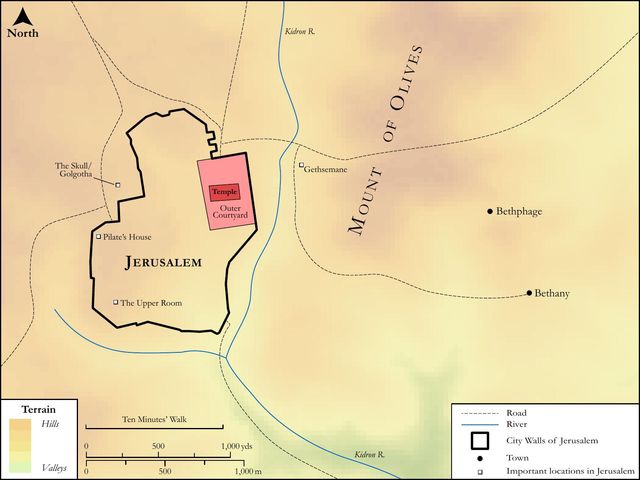
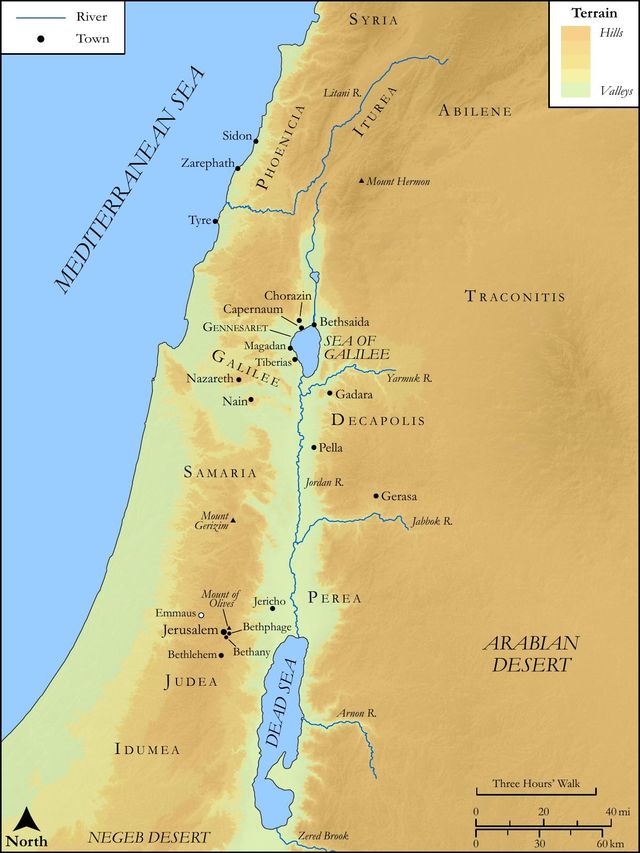
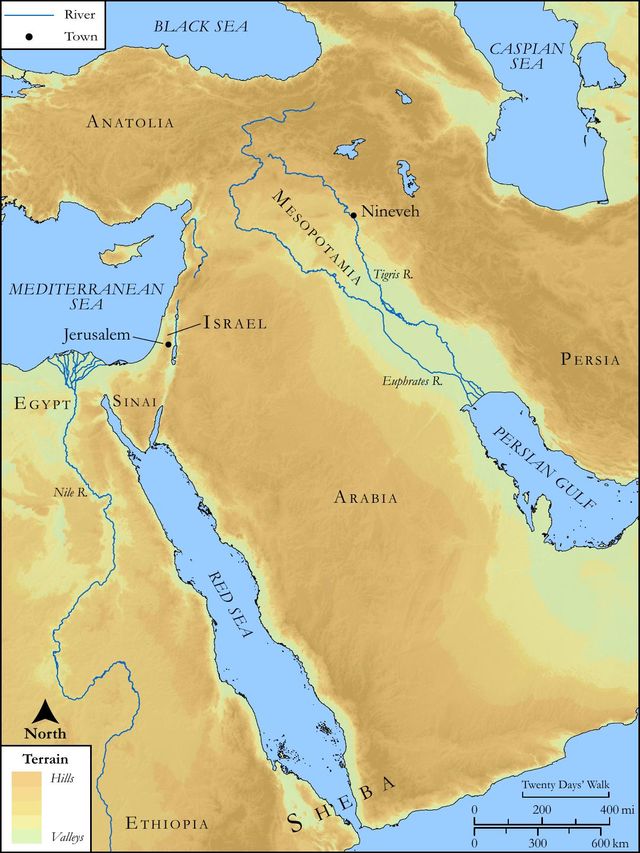
Study this verse
Public-domain commentary
Matthew Henry
From his Commentary on the Whole Bible. Henry comments on passages, not single verses — this entry covers Luke 23:44–49. His three-level outline is real structure in the source text, so it is rendered as structure.
In these verses we have three things: -
I.Christ's dying magnified by the prodigies that attended it: only two are here mentioned, which we had an account of before.
1.The darkening of the sun at noon-day. It was now about the sixth hour, that is, according to our computation, twelve o'clock at noon; and there was a darkness over all the earth until the ninth hour. The sun was eclipsed and the air exceedingly clouded at the same time, both which concurred to this thick darkness, which continued three hours, not three days, as that of Egypt did.
2.The rending of the veil of the temple. The former prodigy was in the heavens, this in the temple; for both these are the houses of God, and, when the Son of God was thus abused, they could not but feel the indignity, and thus signify their resentment of it. By this rending of the veil was signified the taking away of the ceremonial law, which was a wall of partition between Jews and Gentiles, and of all other difficulties and discouragements in our approaches to God, so that now we may come boldly to the throne of grace.
II.Christ's dying explained (Luk 23:46) by the words with which he breathed out his soul.
Jesus had cried with a loud voice when he said, Why hast thou forsaken me? So we are told in Matthew and Mark, and, it should seem, it was with a loud voice that he said this too, to show his earnestness, and that all the people might take notice of it: and this he said, Father, into thy hands I commend my spirit.
1.He borrowed these words from his father David (Psa 31:5); not that he needed to have words put into his mouth, but he chose to make use of David's words to show that it was the Spirit of Christ that testified in the Old Testament prophets, and that he came to fulfil the scripture. Christ died with scripture in his mouth. Thus he directs us to make use of scripture language in our addresses to God.
2.In this address to God he calls him Father. When he complained of being forsaken, he cried, Eli, Eli, My God, my God; but, to show that dreadful agony of his soul was now over, he here calls God Father. When he was giving up his life and soul for us, he did for us call God Father, that we through him might receive the adoption of sons.
3.Christ made use of these words in a sense peculiar to himself as Mediator. He was now to make his soul an offering for our sin (Isa 53:10), to give his life a ransom for many (Mat 20:28), by the eternal Spirit to offer himself, Heb 9:14. He was himself both the priest and the sacrifice; our souls were forfeited, and his must go to redeem the forfeiture. The price must be paid into the hands of God, the party offended by sin; to him he had undertaken to make full satisfaction. Now by these words he offered up the sacrifice, did, as it were, lay his hand upon the head of it, and surrender it; tithēmi - "I deposit it, I pay it down into thy hands. Father, accept of my life and soul instead of the lives and souls of the sinners I die for." The animus offerentis - the good will of the offerer, was requisite to the acceptance of the offering. Now Christ here expresses his cheerful willingness to offer himself, as he had done when it was first proposed to him (Heb 10:9, Heb 10:10), Lo, I come to do thy will, by which will we are sanctified.
4.Christ hereby signifies his dependence upon his Father for his resurrection, by the re-union of his soul and body. He commends his spirit into his Father's hand, to be received into paradise, and returned the third day. By this it appears that our Lord Jesus, as he had a true body, so he had a reasonable soul, which existed in a state of separation from the body, and thus he was made like unto his brethren; this soul he lodged in his Father's hand, committed it to his custody, resting in hope that it should not be left in hades, in its state of separation from the body, no, not so long as that the body might see corruption.
5.Christ has hereby left us an example, has fitted those words of David to the purpose of dying saints, and hath, as it were, sanctified them for their use. In death our great care should be about our souls, and we cannot more effectually provide for their welfare than by committing them now into the hands of God, as a Father, to be sanctified and governed by his Spirit and grace, and at death committing them into his hands to be made perfect in holiness and happiness. We must show that we are freely willing to die, that we firmly believe in another life after this, and are desirous of it, by saying, Father, into thy hands I commend my spirit.
III.Christ's dying improved by the impressions it made upon those that attended him.
1.The centurion that had command of the guard was much affected with what he saw, Luk 23:47. He was a Roman, a Gentile, a stranger to the consolations of Israel; and yet he glorified God. He never saw such amazing instances of divine power, and therefore took occasion thence to adore God as the Almighty. And he bore a testimony to the patient sufferer: "Certainly this was a righteous man, and was unjustly put to death." God's manifesting his power so much to do him honour was a plain evidence of his innocency. His testimony in Matthew and Mark goes further: Truly this was the Son of God. But in his case this amounts to the same; for, if he was a righteous man, he said very truly when he said that he was the Son of God; and therefore that testimony of his concerning himself must be admitted, for, if it were false, he was not a righteous man.
2.The disinterested spectators could not but be concerned. This is taken notice of only here, Luk 23:48. All the people that came together to that sight, as is usual upon such occasions, beholding the things which were done, could not but go away very serious for the time, whatever they were when they came home: They smote their breasts, and returned.
(1.)They laid the thing very much to heart for the present. They looked upon it as a wicked thing to put him to death, and could not but think that some judgment of God would come upon their nation for it. Probably these very people were of those that had cried, Crucify him, crucify him, and, when he was nailed to the cross, reviled and blasphemed him; but now they were so terrified with the darkness and the earthquake, and the uncommon manner of his expiring, that they had not only their mouths stopped, but their consciences startled, and in remorse for what they had done, as the publican, they smote upon their breasts, beat upon their own hearts, as those that had indignation at themselves. Some think that this was a happy step towards that good work which was afterwards wrought upon them, when they were pricked to the heart, Act 2:37.
(2.)Yet, it should seem, the impression soon wore off: They smote their breasts, and returned. They did not show any further token of respect to Christ, nor enquire more concerning him, but went home; and we have reason to fear that in a little time they quite forgot it. Thus many that see Christ evidently set forth crucified among them in the word and sacraments are a little affected for the present, but it does not continue; they smite their breasts, and return. They see Christ's face in the glass of the ordinances and admire him; but they go away, and straightway forget what manner of man he is, and what reason they have to love him.
3.His own friends and followers were obliged to keep their distance, and yet got as near as they could and durst, to see what was done (Luk 23:49): All his acquaintance, that knew him and were known of him, stood afar off, for fear lest if they had been near him they should have been taken up as favourers of him; this was part of his sufferings, as of Job's (Job 19:13): He hath put my brethren far from me, and mine acquaintance are verily estranged from me. See Psa 88:18. And the women that followed him together from Galilee were beholding these things, not knowing what to make of them, nor so ready as they should have been to take them for certain preludes of his resurrection. Now was Christ set for a sign that should be spoken against, as Simeon foretold, that the thoughts of many hearts might be revealed, Luk 2:34, Luk 2:35.
Historical interpretation
Eleven Centuries of Reception
18 surviving comments on this verse. Each one is dated, so this reads as a timeline rather than a list.
Select a marker to jump to its quote. Markers stagger vertically where authors wrote within a few decades of each other.
But My People hath changed their glory: whence no profit shall accrue to them: the heaven turned pale thereat" (and when did it turn pale? undoubtedly when Christ suffered), "and shuddered," he says, "most exceedingly; " and "the sun grew dark at mid-day: " (and when did it "shudder exceedingly" except at the passion of Christ, when the earth also trembled to her centre, and the veil of the temple was rent, and the tombs were burst asunder? "because these two evils hath My People done; Me," He says, "they have quite forsaken, the fount of water of life, and they have digged for themselves worn-out tanks, which will not be able to contain water.
And so the "pressure" must be maintained up to that hour in which the orb-involved from the sixth hour in a general darkness-performed for its dead Lord a sorrowful act of duty; so that we too may then return to enjoyment when the universe regained its sunshine. If this savours more of the spirit of Christian religion, while it celebrates more the glory of Christ, I am equally able, from the self-same order of events, to fix the condition of late protraction of the Station; (namely), that we are to fast till a late hour, awaiting the time of the Lord's sepulture, when Joseph took down and entombed the body which he had requested.
(de Incar. et cout. Ar.) For He commends to His Father through Himself all mankind quickened in Him; for we are His members; as the Apostle says, Ye are all one in Christ. (Gal. 3:28.)
God was victorious over the Egyptians, and he lit up the way for the Hebrews with the pillar of fire in the month of Nisan. The sun became dark over them because they had returned evil for goodness. Just as God split the sea, the Spirit split the curtain in half, since they rejected and unjustly crucified the King of glory on the Skull. The curtain of the temple was torn in two for this reason. Created beings suffered with him in his suffering. The sun hid its face so as not to see him when he was crucified. It retracted its light back into itself to die with him. There was darkness for three hours. The sun shined again, proclaiming that its Lord would rise from Sheol on the third day. The mountains trembled, the tombs were opened, and the curtain was torn, as though grieving in mourning over the impending destruction of the place.
If he had been the son of a foreign god, the sun would not have been eclipsed when the Lord was raised on his cross. The Creator would have spread out a more intense light, because his enemy would have been withdrawn from his sight. He would have caused his light to shine on the Jews, because they would have been doing his will. He would have clothed the temple with a curtain of glory, because its enemy’s death would have purified its sad impurities, and the breaker of its law would have gone out from it.
Perhaps the Spirit, when he saw the Son hanging naked, lifted himself up and tore in two the clothing. Perhaps the symbols, when they saw the Lamb of symbols, tore the curtain apart and went out to meet him. Perhaps the spirit of prophecy, which was dwelling in the temple and had come down to herald his coming to humanity, flew away at that very instant to announce in the heights concerning our Lord’s ascent into heaven. “The tombs split apart,” so that he might show that he could have torn the wood of the cross apart. He did not tear apart the cross through which the kingdom would be torn from Israel. He did not shatter the cross through which sin would be chased out from the middle of the Gentiles. Instead, the Spirit tore the curtain apart. To show that the Spirit had came out from the temple, it summoned the righteous that came out of the tombs as witnesses to his going out from the temple. These two departures were proclaiming each other mutually. The Spirit anointed and sanctified the kingship and the priesthood. The Spirit, wellspring of these two offices, therefore went out from there, so that it would be known that both of them had been cut off by him who had taken on both of them.Although we know that by amputation of our finger there is healing for the person who is totally diseased, we still are unwilling to do what we know we should do. God however knew that there would be salvation for humanity through the killing of his Son, and so he did not turn away from doing this.
(Orat. i. de Res.) But it becomes us to enquire how our Lord distributes Himself into three parts at once; into the bowels of the earth, as He told the Pharisees; into the Paradise of God, as He told the thief; into the hands of the Father, as it is said here. To those however who rightly consider, it is scarcely worthy of question, for He who by His divine power is in every place, is present in any particular place.
(ut sup.) There is another explanation, that at the time of His Passion, His Divinity being once united to His humanity, left neither part of His humanity, but of its own accord separated the soul from the body, yet showed itself abiding in each. For through the body in which He suffered death He vanquished the power of death, but through the soul He prepared for the thief an entrance into Paradise. Now Isaiah says of the heavenly Jerusalem, which is no other than Paradise, Upon my hands I have painted thy walls; (Is. 49:16. ap. LXX.) whence it is clear, that he who is in Paradise dwelleth in the hands of the Father.
The sun also is eclipsed to the sacrilegious, that it may overshadow the scene of their awful wickedness; darkness was spread over the eyes of the unbelieving, that the light of faith might rise again.
Now this voice teaches us, that the souls of the saints are not henceforth shut up in hell as before, but are with God, Christ being made the beginning of this change.
(de Con. Ev. lib. iii. c. 17.) What is here said of the darkness, the other two Evangelists, Matthew and Mark, confirm, but St. Luke adds the cause whence the darkness arose, saying, And the sun was darkened.
(de Civ. Dei, l. iii. c. 15.) This darkening of the sun it is quite plain did not happen in the regular and fixed course of the heavenly bodies, because it was then the Passover, which is always celebrated at the full moon. But a regular eclipse of the sun does not take place except at new moon.
When they fastened to the cross the Lord of all, the sun over their heads withdrew and the light at midday was wrapped in darkness, as the divine Amos had foretold. "There was darkness from the sixth hour until the ninth hour." This was a plain sign to the Jews that the minds of those who crucified him were wrapped in spiritual darkness, for blindness in part has happened to Israel. In his love for God, David even curses them, saying, "Let their eyes be darkened, that they may not see."Creation itself mourned its Lord. The sun was darkened, and the rocks were split, and the temple put on the mourners' clothes. Its veil was split from the top to the bottom. This is what God signified to us by the voice of Isaiah, saying, "I clothe the heavens with blackness, and make sackcloth their covering."
As soon as the Lord of all had been given up to be crucified, the whole framework of the world bewailed its rightful Master, and the light was darkened at mid-day, (Amos 8:9.) which was a manifest token that the souls of those who crucified Him would suffer darkness.
(Dion. Areop. ad Polye.) When we were both at Heliopolis together, we both saw at the same time in a marvellous manner the moon meeting the sun, (for it was not then the time of new moon,) and then again, from the ninth hour until evening supernaturally brought back to the edge of the sun's diameter. (ad diametrum solis.) Besides, we observed that this obscuration began from the east, and having reached as far as the sun's western border at length returned, and that the loss and restoration of light took place not from the same side, but from opposite sides of the diameter. Such were the miraculous events of that time, and possible to Christ alone who is the cause of all things.
But Luke, wishing to join miracle to miracle, adds, And the veil of the temple was rent in twain. This took place when our Lord expired, as Matthew and Mark bear witness, but Luke related it by anticipation.
By invoking the Father He declares Himself to be the Son of God, but by commending His Spirit, He signifies not the weakness of His strength, but His confidence in the same power with the Father.
It was about the sixth hour, and darkness came over all the land until the ninth hour, and the sun was obscured. The brightest light of the world withdrew its rays so that it might not see the Lord hanging, or that the impious blaspheming might not enjoy its light. And it is to be noted that the Lord was crucified at the sixth hour, that is, when the sun was about to leave the center of the world; and at dawn, that is, when the sun was already rising, he celebrated the mysteries of his resurrection. For the time signifies what he exhibited by the effect of the work. Because he died for our sins and rose for our justification (Rom. IV). For when Adam sinned, it is written that he heard the voice of the Lord God walking in the garden at the breeze after midday (Gen. III). After midday, indeed, with the light of faith declining, and at the breeze, with the warmth of charity cooling: he was heard walking because he had withdrawn from the sinning man. The order of reason therefore required that at the same time of the day at which he then closed for sinning Adam, now the Lord should open the gate of paradise to the repenting thief.
(Hom. de Sabb. San.) Or to speak more expressly, In respect of His body, He was in the grave, in respect of His soul, He was in hell, and with the thief in Paradise; but as God, on the throne with His Father and the Holy Spirit.
By this then our Lord showed that the Holy of Holies should be no longer inaccessible, but being given over into the hands of the Romans, should be defiled, and its entrance laid open.
Whereby it is signified that the veil which kept us asunder from the holy things which are in heaven, is broken through, namely, enmity and sin.
But crying with a loud voice He gives up the ghost, because He had in Himself the power of laying down His life and taking it up again.
This miracle then took place that it might be made known, that He who had undergone death was the Ruler of the whole creation.
Continue studying Luke 23:44 across the web’s major study libraries — every link below opens this exact verse, chapter, or book on the destination site.
Read & Compare
 BibleGatewayThis verse in more than 200 translations and 70 languages.
 Bible.comThe YouVersion reader — hundreds of translations, reading plans, and highlights.
 ESV.orgCrossway's official English Standard Version reader.
 NET BibleThe NET translation with 60,000+ translators' notes on every rendering decision.
 STEP BibleTyndale House's free study tool — original text, vocabulary, and scholarly resources.
 BibliaLogos Bible Software's free web reader.
 USCCBThe New American Bible (Revised Edition) with the U.S. bishops' study notes.
Commentaries
 BibleHub CommentariesDozens of classic commentaries on this verse, gathered on one page.
 StudyLightMore than 100 commentary sets — the largest collection on the web.
 BibleRefPlain-English commentary on what this verse means, verse by verse.
 Enduring WordDavid Guzik's free commentary on this chapter, widely used by Bible teachers.
 Bible Study ToolsVerse commentary alongside Greek and Hebrew study aids.
Original Language & Research
- BibleHub InterlinearThe verse word by word — original language, transliteration, and English.
- BibleHub LexiconEvery word's original-language definition and Strong's entry.
 Blue Letter BibleDeep-study tools — Strong's numbers, concordance, and word studies.
 CNTR CollationThe earliest Greek manuscripts of this verse, collated letter by letter.
Sermons, Hymns & Audio


TrulyRandomVerse is not affiliated with these sites and doesn’t control their content. They’re linked because they’re genuinely useful.
Summary
Luke 23:44 records a profoundly significant and supernatural event during the crucifixion of Jesus Christ: a sudden, inexplicable darkness that enveloped the entire land from noon until three in the afternoon. This darkness over all the earth, occurring as Jesus endured the cross, signaled a moment of immense divine intervention and judgment, underscoring the unparalleled spiritual gravity of the atoning work being accomplished.
Context
ShowHideLiterary Context
Luke 23:44 is situated within Luke's detailed account of Jesus' crucifixion, immediately following the mocking of the rulers and soldiers and the interaction with the two criminals crucified alongside Him. It precedes Jesus' final words and His death, which Luke records in Luke 23:46. The darkness serves as a dramatic, divinely orchestrated prelude to the climactic moment of Jesus' surrender of His spirit, emphasizing the eternal significance of His sacrifice. The subsequent tearing of the temple veil in Luke 23:45 further reinforces the theological implications of this darkness, signaling a radical shift in God's relationship with humanity.
Historical & Cultural Context
The crucifixion took place outside Jerusalem, likely at Golgotha, during the Passover festival. Jewish timekeeping, used by Luke, reckoned the day from 6 AM. Thus, the "sixth hour" was noon, and the "ninth hour" was 3 PM. This timing is crucial because Passover occurs during a full moon, making a natural solar eclipse impossible. Therefore, the darkness was not a mere astronomical event but a supernatural occurrence. Ancient sources, such as Thallus (cited by Julius Africanus) and Phlegon (cited by Origen), even mention unusual darkness during this period, suggesting its widespread notice. This extraordinary darkness would have been understood by both Jewish and Gentile observers as a sign of divine displeasure or a significant, ominous event.
Key Themes
ShowHideThe darkness at the crucifixion contributes to several profound themes. Firstly, it highlights Divine Intervention and Eternal Significance, demonstrating that Jesus' death was not merely a human execution but a divinely orchestrated event of immense universal consequence, as also noted in Matthew 27:45 and Mark 15:33. Secondly, it evokes the Old Testament theme of Judgment and Divine Wrath, where darkness often accompanies God's judgment upon sin, as seen in the plague of darkness in Exodus 10:21-23 or prophetic warnings of a "day of the Lord" marked by darkness in Joel 2:31 and Amos 8:9. This suggests that the wrath due to humanity's sin was being poured out upon Jesus. Thirdly, it underscores the Weight of Atonement, signifying the profound spiritual agony and separation Jesus experienced as He bore the sins of the world and faced the full measure of divine judgment, leading to His cry of abandonment in Matthew 27:46.
Exposition and Analysis
ShowHideKey Word Analysis
ShowHideThis term (G4655) refers to shadiness or obscurity, often carrying a deeper theological meaning beyond mere absence of light. In biblical contexts, it frequently symbolizes moral or spiritual obscurity, evil, or a state of divine judgment and wrath. Its application here suggests a supernatural, ominous gloom that reflects the spiritual battle and divine judgment unfolding.
This word (G1093) can refer to soil, a specific region, or the entire terrene globe. In this context, "over all the earth" (G1909 G3650 G1093) implies a widespread, if not universal, phenomenon, emphasizing the vast scale of the event rather than just a localized shadow. It underscores that the events at Calvary had implications for the entire created order.
This verb (G1096) means "to become," "come into being," or "happen." Its use here emphasizes the active, intentional occurrence of the darkness—it "happened" or "came to be"—rather than a passive state. This reinforces the idea that the darkness was a divinely orchestrated event, not a natural phenomenon.
Verse Breakdown
ShowHide"¶ And it was about the sixth hour,"
This clause establishes the precise timing of the event according to Jewish reckoning, which began the day at 6 AM. The "sixth hour" corresponds to noon, indicating that the darkness began at the height of the day, making its occurrence even more striking and unnatural. The "¶" symbol in the KJV often denotes a new paragraph or a significant break in the narrative, highlighting the importance of this moment.
"and there was a darkness over all the earth"
This describes the supernatural phenomenon itself. The use of "darkness" (Greek skótos) suggests a profound, unnatural gloom. The phrase "over all the earth" (or "over all the land") indicates its widespread nature, emphasizing that this was not a localized cloud or a typical eclipse, but a sign from heaven. It points to a divine action impacting the natural order.
"until the ninth hour."
This specifies the duration of the darkness. The "ninth hour" corresponds to 3 PM, meaning the darkness lasted for approximately three hours. This extended period, from noon to mid-afternoon, further underscores its miraculous and divinely imposed nature, serving as a period of intense spiritual significance before Jesus' death.
Literary Devices
ShowHideLuke's account in Luke 23:44 powerfully employs Foreshadowing and Symbolism. The sudden, inexplicable darkness serves as a dramatic Foreshadowing of the profound upheaval in heaven and earth occurring as Jesus bears the world's sin. It signals the approach of the climactic moment of His death and the tearing of the temple veil, which immediately follows. The darkness itself is rich in Symbolism. It symbolizes divine judgment and wrath, echoing Old Testament prophecies where darkness accompanies the "Day of the Lord" and God's intervention in human history. It also symbolizes the spiritual separation Jesus experienced as He became sin for humanity, bearing the full weight of God's holy wrath. Furthermore, the contrast between the midday sun and the sudden, unnatural gloom creates a stark Juxtaposition, emphasizing the extraordinary nature of the event and the gravity of Christ's atoning sacrifice.
Theological and Thematic Connections
ShowHideThe darkness at the crucifixion is a profound theological statement, signifying that the death of Jesus was no ordinary execution but an event of immense spiritual magnitude for all creation. It reveals God's active involvement in the atonement, pouring out His righteous wrath against sin upon His Son. This period of darkness symbolizes the profound spiritual agony and separation Jesus endured as He bore the full weight of humanity's sin, becoming a curse for us. It underscores the holiness of God, who cannot countenance sin, and the depth of His love, as He provided the perfect sacrifice in Christ. The darkness is a visible manifestation of the invisible spiritual reality of judgment and redemption unfolding on the cross.
Reflection and Application
ShowHideThe three hours of darkness surrounding Christ's crucifixion compel us to reflect on the immense cost of our redemption and the unfathomable love of God. This divine intervention serves as a stark reminder of the gravity of sin, which necessitated such a profound and supernatural display of judgment. It was not merely physical suffering that Jesus endured, but the spiritual anguish of bearing the world's sin and experiencing separation from the Father. For us, this means that the full penalty for our transgressions has been paid. We are invited to gaze upon the cross, not just as a historical event, but as the ultimate demonstration of God's justice and mercy converging. This understanding should lead to profound gratitude, deep humility, and a renewed commitment to live in light of such a costly salvation.
Questions for Reflection
ShowHideFAQ
ShowHideWas the darkness at the crucifixion a solar eclipse?
ShowHideNo, the darkness described in Luke 23:44 and corroborated by Matthew 27:45 and Mark 15:33 could not have been a natural solar eclipse. The crucifixion occurred during the Passover festival, which always takes place at the time of the full moon. A solar eclipse, by definition, can only happen during a new moon, when the moon passes between the sun and the earth. Therefore, this three-hour darkness, occurring from noon to 3 PM, was a supernatural event, a divine sign rather than a natural phenomenon.
What is the significance of the darkness lasting three hours?
ShowHideThe three-hour duration of the darkness (from the "sixth hour" to the "ninth hour," or noon to 3 PM) is highly significant. It emphasizes the supernatural and intentional nature of the event, indicating it was not a fleeting or localized occurrence. Theologically, this period likely represents the time when Jesus bore the full weight of God's wrath against sin. It was a time of intense spiritual battle and separation, culminating in Jesus' cry of dereliction, "My God, my God, why have you forsaken me?" as recorded in Matthew 27:46. This extended period underscores the depth of the atonement and the immense suffering Christ endured on behalf of humanity.
Christ-Centered Fulfillment
ShowHideThe darkness at the crucifixion, as described in Luke 23:44, finds its ultimate Christ-centered fulfillment in revealing Jesus as the Lamb of God who truly takes away the sin of the world. This darkness over all the earth symbolizes the moment when the Son of God, who is "the light of the world" (John 8:12), willingly entered into the deepest spiritual darkness—the bearing of divine judgment for sin. Just as the Old Testament prophets foretold a day of darkness as a sign of God's judgment (Amos 8:9), this event demonstrates that Jesus fully absorbed that judgment, becoming "sin for us, so that in him we might become the righteousness of God" (2 Corinthians 5:21). His descent into this spiritual gloom on the cross paradoxically brings about the dawn of salvation, ushering believers out of "darkness into his wonderful light" (1 Peter 2:9). The darkness at Calvary is a powerful testament to the severity of sin and the infinite love of Christ, who endured the ultimate separation from God so that those who believe might have eternal light and reconciliation with the Father (Colossians 1:13-14).