


Mark 15:33
Bible text: King James Version (1769 Blayney text) · Public domain
Bible text: Berean Standard Bible · Public domain
Bible text: American Standard Version (1901) · Public domain
Bible text: World English Bible, Messianic edition · Public domain
Bible text: Geneva Bible (1599) · Public domain
Bible text: Young's Literal Translation · Public domain
- γενομένηςgenomenēswhen was arrivingG1096V-2ADP-GSFVerb 2nd Aorist Middle Deponent Participle Genitive Singular Feminine
- δὲdenowG1161CONJConjunction
- ὥραςhōras[the] hourG5610N-GSFNoun Genitive Singular Feminine
- ἕκτηςhektēssixthG1623A-GSFAdjective Genitive Singular Feminine
- σκότοςskotosdarknessG4655N-NSNNoun Nominative Singular Neuter
- ἐγένετοegenetocameG1096V-2ADI-3SVerb 2nd Aorist Middle Deponent Indicative 3rd Singular
- ἐφ᾽eph᾽overG1909PREPPreposition
- ὅληνholēnallG3650A-ASFAdjective Accusative Singular Feminine
- τὴνtēntheG3588T-ASFDefinite article Accusative Singular Feminine
- γῆνgēnlandG1093N-ASFNoun Accusative Singular Feminine
- ἕωςhe'ōsuntilG2193PREPPreposition
- ὥραςhōras[the] hourG5610N-GSFNoun Genitive Singular Feminine
- ἐνάτηςenatēsninthG1766A-GSFAdjective Genitive Singular Feminine
English is a literal word-by-word gloss of the Greek, not the KJV's wording. Why?
This is the original text the KJV's translators worked from — each Greek word with its own literal English meaning in this verse, prepared by scholars at Tyndale House, Cambridge. The KJV translates whole sentences, not word by word, so its wording differs: one Greek word can become several English words, and the KJV may choose “charity” where the gloss reads “love”. Both are faithful — they answer different questions. For the KJV's own rendering, switch to the KJV text.
Details
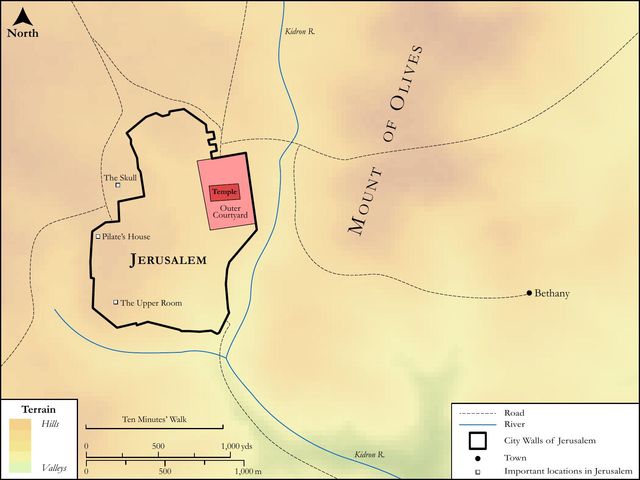
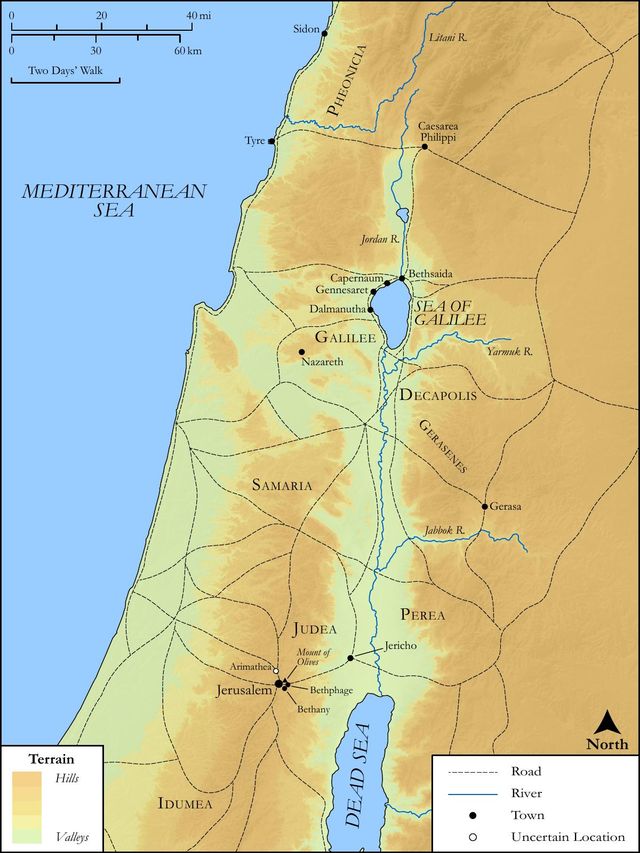
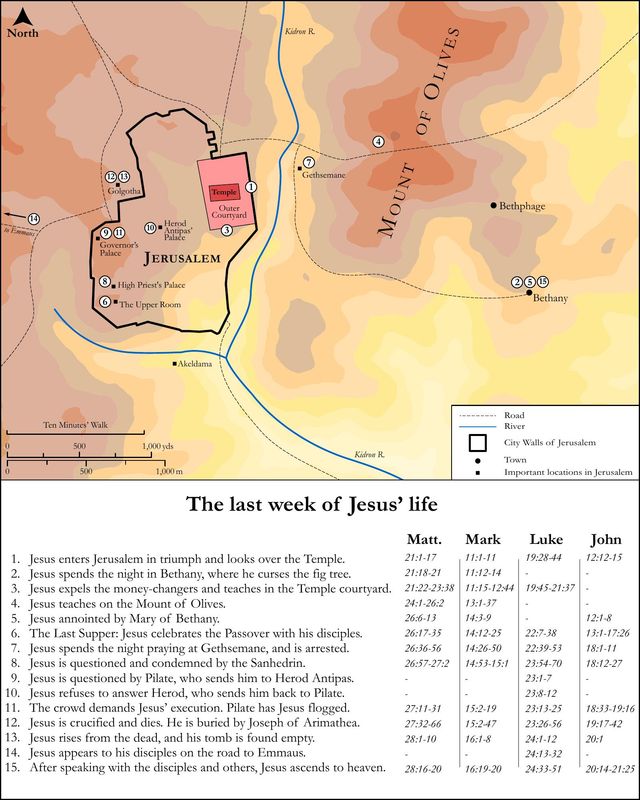
See on the biblical-era maps
Study this verse
Public-domain commentary
Matthew Henry
From his Commentary on the Whole Bible. Henry comments on passages, not single verses — this entry covers Mark 15:33–41. His two-level outline is real structure in the source text, so it is rendered as structure.
Here we have an account of Christ's dying, how his enemies abused him, and God honoured him at his death.
I.There was a thick darkness over the whole land (some think over the whole earth), for three hours, from noon till three of the clock.
Now the scripture was fulfilled (Amo 8:9), I will cause the sun to go down at noon, and I will darken the earth in the clear day; and Jer 15:9, Her sun is gone down while it is yet day. The Jews have often demanded of Christ a sign from heaven; and now they had one, but such a one as signified the blinding of their eyes. It was a sign of the darkness that was come, and coming, upon the Jewish church and nation. They were doing their utmost to extinguish the Sun of righteousness, which was now setting, and the rising again of which they would never own; and what then might be expected among them but a worse than Egyptian darkness? This intimated to them, that the things which belonged to their peace, were now hid from their eyes, and that the day of the Lord was at hand, which should be to them a day of darkness and gloominess, Joe 2:1, Joe 2:2. It was the power of darkness that they were now under, the works of darkness that they were now doing; and such as this should their doom justly be, who loved darkness rather than light.
II.Toward the close of this darkness, our Lord Jesus, in the agony of his soul, cried out, My God, my God, why hast thou forsaken me? Mar 15:34. The darkness signified the present cloud which the human soul of Christ was under, when he was making it an offering for sin. Mr. Fox, in his Acts and Monuments (vol. 3, p. 160), tells of one Dr. Hunter, a martyr in queen Mary's time, who, being fastened to the stake, to be burnt, put up this short prayer, Son of God, shine upon me; and immediately the sun in the firmament shone out of the dark cloud, so full in his face, that he was forced to look another way, which was very comfortable to him. But our Lord Jesus, on the contrary, was denied the light of the sun, when he was in his sufferings, to signifying the withdrawing of the light of God's countenance. And this he complained of more than any thing; he did not complain of his disciples' forsaking him, but of his Father's,
1.Because this wounded his spirit; and that is a thing hard to bear (Pro 18:14); brought the waters into his soul, Psa 69:1-3.
2.Because in this especially he was made sin for us; our iniquities had deserved indignation and wrath upon the soul (Rom 2:8), and therefore, Christ, being made a sacrifice, underwent as much of it as he was capable of; and it could not but bear hard indeed upon him who had lain in the bosom of the Father from eternity, and was always his light. These symptoms of divine wrath, which Christ was under in his sufferings, were like that fire from heaven which had been sent sometimes, in extraordinary cases, to consume the sacrifices (as Lev 9:24; Ch2 7:1; Kg1 18:38); and it was always a token of God's acceptance. The fire that should have fallen upon the sinner, if God had not been pacified, fell upon the sacrifice, as a token that he was so; therefore it now fell upon Christ, and extorted him from this loud and bitter cry. When Paul was to be offered as a sacrifice for the service of saints, he could joy and rejoice (Phi 2:17); but it is another thing to be offered as a sacrifice for the sin of sinners. Now, at the sixth hour, and so to the ninth, the sun was darkened by an extraordinary eclipse; and if it be true, as some astronomers compute, that in the evening of this day on which Christ died there was an eclipse of the moon, that was natural and expected, in which seven digits of the moon were darkened, and it continued from five o'clock till seven, it is remarkable, and yet further significant of the darkness of the time that then was. When the sun shall be darkened, the moon also shall not give her light.
III.Christ's prayer was bantered by them that stood by (Mar 15:35, Mar 15:36); because he cried, Eli, Eli, or (as Mark has it, according to the Syriac dialect) Eloi, Eloi, they said, He calls for Elias, though they knew very well what he said, and what it signified, My God, My God. Thus did they represent him as praying to saints, either because he had abandoned God, or God had abandoned him; and hereby they would make him more and more odious to the people. One of them filled a sponge with vinegar, and reached it up to him upon a reed; "Let him cool his mouth with that, it is a drink good enough for him," Mar 15:36. This was intended for a further affront and abuse to him; and whoever it was that checked him who did it, did but add to the reproach; "Let him alone; he has called for Elias: let us see whether Elias will come take him down; and if not, we may conclude that he also hath abandoned him."
IV.Christ did again cry with a loud voice, and so gave up the ghost, Mar 15:37.
He was now commending his soul into his Father's hand; and though God is not moved with any bodily exercise, yet this loud voice signified the great strength and ardency of affection wherewith he did it; to teach us, in every thing wherein we have to do with God, to put forth our utmost vigour, and to perform all the duties of religion, particularly that of self-resignation, with our whole heart and whole soul; and then, though speech fails, that we cannot cry with a loud voice, as Christ did, yet if God be the strength of the heart, that will not fail. Christ was really and truly dead, for he gave up the ghost; his human soul departed to the world of spirits, and left his body a breathless clod of clay.
V.Just at that instant that Christ died upon mount Calvary, the veil of the temple was rent in twain from the top to the bottom, Mar 15:38. This bespoke a great deal,
1.Of the terror of the unbelieving Jews; for it was a presage of the utter destruction of their church and nation, which followed not long after; it was like the cutting asunder of the staff of beauty (for this veil was exceedingly splendid and glorious, Exo 26:31), and that was done at the same time when they gave for his price thirty pieces of silver (Zac 11:10, Zac 11:12), to break the covenant which he had made with that people. Now it was time to cry, Ichabod, The glory is departed from Israel. Some think that the story which Josephus relates, of the temple door opening of its own accord, with that voice, Let us depart hence, some years before the destruction of Jerusalem, is the same with this; but that is not probable: however, this had the same signification, according to that (Hos 5:14), I will tear, and go away.
2.It bespeaks a great deal of comfort to all believing Christians, for it signifies the consecrating and laying open to us of a new and living way into the holiest by the blood of Jesus.
VI.The centurion who commanded the detachment which had the oversight of the execution was convinced, and confessed that this Jesus was the Son of God, Mar 15:39. One thing that satisfied him, was, that he so cried out, and gave up the ghost: that one who was ready to give up the ghost, should be able to cry out so, was very surprising. Of all the sad spectacles of this kind he never observed the like; and that one who had strength to cry so loud, should yet immediately give up the ghost, this also made him wonder; and he said, to the honour of Christ, and the shame of those that abused him, Truly this man was the Son of God. But what reason had he to say so? I answer,
1.He had reason to say that he suffered unjustly, and had a great deal of wrong done him. Note, He suffered for saying that he was the Son of God; and it was true, he did say so, so that if he suffered unjustly, as it was plain by all the circumstances of his suffering that he did, then what he said was true, and he was indeed the Son of God.
2.He had reason to say that he was a favourite of heaven, and one for whom the almighty power was particularly engaged, seeing how Heaven did him honour at his death, and frowned upon his persecutors. "Surely," thinks he, "this must be some divine person, highly beloved of God." This he expresses by such words as denote his eternal generation as God, and his special designation to the office of Mediator, though he meant not so. Our Lord Jesus, even in the depth of his sufferings and humiliation, was the Son of God, and was declared to be so with power.
VII.There were some of his friends, the good women especially, that attended him (Mar 15:40, Mar 15:41); There were women looking on afar off:
the men durst not be seen at all, the mob was so very outrageous; Currenti cede furori - Give way to the raging torrent, they thought, was good counsel now. The women durst not come near, but stood at a distance, overwhelmed with grief. Some of these women are here named. Mary Magdalene was one; she had been his patient, and owed all her comfort to his power and goodness, which rescued her out of the possession of seven devils, in gratitude for which she thought she could never do enough for him. Mary also was there, the mother of James the little, Jacobus parvus, so the word is; probably, he was so called because he was, like Zaccheus, little of stature. This Mary was the wife of Cleophas or Alpheus, sister to the virgin Mary. These women had followed Christ from Galilee, though they were not required to attend the feast, as the males were; but it is probably that they came, in expectation that his temporal kingdom would now shortly be set up, and big with hopes of preferment for themselves, and their relations under him. It is plain that the mother of Zebedee's children was so (Mat 20:21); and now to see him upon a cross, whom they thought to have seen upon a throne, could not but be a great disappointment to them. Note, Those that follow Christ, in expectation of great things in this world by him, and by the profession of his religion, may probably live to see themselves sadly disappointed.
Historical interpretation
Nine Centuries of Reception
8 surviving comments on this verse. Each one is dated, so this reads as a timeline rather than a list.
Select a marker to jump to its quote. Markers stagger vertically where authors wrote within a few decades of each other.
At the ninth hour, the tenth piece of money which had been lost is found, by the overturning of the house.
Here he points out a similitude for the Jews; a sponge on a reed, weak, dry, fit for burning; they fill it with vinegar, that is, with wickedness and guile.
Though the flesh was weak, yet the heavenly voice, which said, Open me the gates of righteousness, (Ps. 117:19) waxed strong. Wherefore there follows: And Jesus cried with a loud voice, and gave up the ghost. We who are of the earth die with a very low voice, or with no voice at all; but He who descended from heaven breathed His last with a loud voice.
But My People hath changed their glory: whence no profit shall accrue to them: the heaven turned pale thereat" (and when did it turn pale? undoubtedly when Christ suffered), "and shuddered," he says, "most exceedingly; " and "the sun grew dark at mid-day: " (and when did it "shudder exceedingly" except at the passion of Christ, when the earth also trembled to her centre, and the veil of the temple was rent, and the tombs were burst asunder? "because these two evils hath My People done; Me," He says, "they have quite forsaken, the fount of water of life, and they have digged for themselves worn-out tanks, which will not be able to contain water.
Note how clearly was fulfilled the prophecy of our Savior’s passion. It was to be a day in which “there shall be no light.” “From the sixth hour to the ninth hour there was darkness over all the earth.” … This was also fulfilled figuratively by his priestly persecutors, for among them came darkness, cold and ice, following upon their indignities to the anointed One. Their understanding also was darkened, so that the light of the gospel did not shine in their hearts, and their love to God grew cold. Then in the evening the light of the knowledge of the Christ arose, so that they who sat in darkness and the shadow of death saw a great light.
The Lord was crucified at the third hour by the tongues of the populace, at the sixth hour by the hands of the soldiers. When Pilate took his seat before the tribunal, it was “about the sixth hour,” or early in the sixth hour. When Jesus was nailed to the tree between two thieves, it was the end of the sixth hour. It was between the sixth and ninth hour that the sun was obscured and the darkness prevailed, as we have it jointly attested on the authority of the three Evangelists Matthew, Mark and Luke.
(de Con. Evan. 3, 17) Luke added to this account the cause of the darkness, that is, the darkening of the sun.
(ubi sup.) This most glorious light took away its rays from the world, lest it should see the Lord hanging, and lest the blasphemers should have the benefit of its light. Wherefore it goes on: And when the sixth hour was come, there was darkness over the whole land until the ninth hour.
(ubi sup.) For when Adam sinned, it is also written that he heard the voice of the Lord, walking in paradise, in the cool after mid-day; (Gen. 3:8.) and in that hour when the first Adam by sinning brought death into the world, in that same hour the second Adam by dying destroyed death. And we must observe, that our Lord was crucified, when the sun was going away from the centre of the world; but at sunrise He celebrated the mysteries of His resurrection; because He died for our sins, but rose again for our justification. Nor need you wonder at the lowliness of His words, at the complaints as of one forsaken, when you look on the offence of the cross, knowing the form of a servant. For as hunger, and thirst, and fatigue were not things proper to the Divinity, but bodily affections; so His saying, Why hast thou forsaken me? was proper to a bodily voice, for the body is never naturally wont to wish to be separated from the life which is joined to it. For although our Saviour Himself said this, He really showed the weakness of His body; He spoke therefore as man, bearing about with Him my feelings, for when placed in danger we fancy that we are deserted by God.
(ubi sup.) These however I suppose were Roman soldiers who did not understand the peculiarity of the Hebrew tongue, but, from His calling Eloi, thought that Elias was called by Him. But if the Jews are understood to have said this, they must be supposed to do this, as accusing Him of folly in calling for the aid of Elias. It goes on: And one ran and filled a sponge full of vinegar, and put it on a reed, and gave him to drink, saying, Let alone: let us see whether Elias will come to take him down. John shows more fully the reason why the vinegar was given to the Lord to drink, saying, that Jesus said, I thirst, (John 19:28.) that the Scriptures might be fulfilled. They however applied a sponge full of vinegar to His mouth.
And when the sixth hour had come, there was darkness over the whole land until the ninth hour. The most brilliant light of the world withdrew its rays, lest it see the Lord hanging, or the impious blasphemers enjoy its light. And it is to be noted, that the Lord was crucified at the sixth hour, that is, when the sun was about to withdraw from the center of the world; but at dawn, that is, when the sun was rising, He celebrated the mysteries of His resurrection. For He marked with the hour of time what He showed by the effectiveness of the work. Because He died for our sins and rose for our justification. For it is written of Adam sinning that he heard the voice of the Lord God walking in the garden in the cool of the day (Gen. III). In the cool of the day, namely with the light of faith declined; and in the cool, with the fervor of charity cooling. He was heard walking because He had withdrawn from sinful man. Therefore, the order of reason, or rather of divine piety, demanded that at the same time in which He had then closed to the transgressing Adam, now the Lord might open the gates of paradise to the penitent thief, and at the hour at which the first Adam had brought death to this world by sinning, at the same hour the second Adam might destroy death by dying.
If this had been the time for an eclipse, some one might have said that this that happened was natural, but it was the fourteenth moon, when no eclipse can take place. There follows: And at the ninth hour Jesus cried with a loud voice, saying, Eloi, Eloi, lama sabachthani.
Or, He speaks this as man crucified by God for me, for we men have been forsaken by the Father, but He never has. For hear what He says; I am not alone, because the Father is with me. (John 16:32) Though He may also have said this as being a Jew, according to the flesh, as though He had said, Why hast thou forsaken the Jewish people, so that they have crucified Thy Son? For as we sometimes say, God has put on me, that is, my human nature, so here also we must understand thou hast forsaken me, to mean my nature, or the Jewish people. It goes on: And some of them that stood by, when they heard it, said, Behold, he calleth Elias.
He who both rules over death and commands it dies with power, as its Lord. But what this voice was is declared by Luke: Father, into thy hands I commend my spirit. For Christ would have us understand by this, that from that time the souls of the saints go up into the hands of God. (v. note u, p. 217) For at first the souls of all were held in hell, till He came, who preached the opening of the prison to the captives.
Continue studying Mark 15:33 across the web’s major study libraries — every link below opens this exact verse, chapter, or book on the destination site.
Read & Compare
 BibleGatewayThis verse in more than 200 translations and 70 languages.
 Bible.comThe YouVersion reader — hundreds of translations, reading plans, and highlights.
 ESV.orgCrossway's official English Standard Version reader.
 NET BibleThe NET translation with 60,000+ translators' notes on every rendering decision.
 STEP BibleTyndale House's free study tool — original text, vocabulary, and scholarly resources.
 BibliaLogos Bible Software's free web reader.
 USCCBThe New American Bible (Revised Edition) with the U.S. bishops' study notes.
Commentaries
 BibleHub CommentariesDozens of classic commentaries on this verse, gathered on one page.
 StudyLightMore than 100 commentary sets — the largest collection on the web.
 BibleRefPlain-English commentary on what this verse means, verse by verse.
 Enduring WordDavid Guzik's free commentary on this chapter, widely used by Bible teachers.
 Bible Study ToolsVerse commentary alongside Greek and Hebrew study aids.
Original Language & Research
- BibleHub InterlinearThe verse word by word — original language, transliteration, and English.
- BibleHub LexiconEvery word's original-language definition and Strong's entry.
 Blue Letter BibleDeep-study tools — Strong's numbers, concordance, and word studies.
 CNTR CollationThe earliest Greek manuscripts of this verse, collated letter by letter.
Sermons, Hymns & Audio


TrulyRandomVerse is not affiliated with these sites and doesn’t control their content. They’re linked because they’re genuinely useful.
Summary
Mark 15:33 records a profound and supernatural event during Jesus' crucifixion: from the sixth hour (noon) until the ninth hour (3 PM), an inexplicable darkness enveloped the entire land. This sign, occurring while Jesus endured the peak of His suffering on the cross, signaled God's active involvement in the atoning work, highlighting the immense weight of sin being borne by Christ and foreshadowing the divine judgment being poured out upon Him.
Context
ShowHideLiterary Context
This verse is strategically placed within Mark's detailed account of Jesus' crucifixion, immediately following the mocking and torment endured by Christ (Mark 15:21-32) and preceding His final cry and death (Mark 15:34-37). The supernatural darkness serves as a dramatic and somber interlude, shifting the focus from human cruelty to divine intervention. It sets the stage for Jesus' climactic death and the subsequent confession of the centurion in Mark 15:39, who recognizes Jesus as the Son of God. The parallel accounts in Matthew 27:45 and Luke 23:44-45 underscore the historical and theological significance of this event across the Synoptic Gospels, emphasizing its pivotal role in the crucifixion narrative.
Historical & Cultural Context
According to Jewish reckoning, the "sixth hour" corresponds to noon (12 PM), and the "ninth hour" to 3 PM. This three-hour period of darkness was not a natural solar eclipse, as the Passover always occurred during a full moon, making a solar eclipse impossible. Therefore, it was understood by contemporaries as a miraculous, divine intervention. In Scripture, darkness often symbolizes divine judgment, mourning, or a manifestation of God's presence, particularly in moments of significant theological import. Old Testament prophecies frequently associated darkness with the "Day of the Lord" and divine judgment, as seen in Amos 8:9 and Joel 2:31. The "whole land" (Greek: holēn tēn gēn) likely refers to the land of Judea or Palestine, though its supernatural character suggests a broader, universal significance.
Key Themes
ShowHideThe supernatural darkness in Mark 15:33 contributes to several major themes within Mark's Gospel and the broader biblical narrative. Firstly, it highlights the supernatural nature of the crucifixion, affirming that this was not merely a human execution but a divinely orchestrated event of eternal significance. Secondly, it powerfully conveys the theme of divine judgment and wrath against sin, which was being poured out upon Jesus as He bore the iniquities of humanity. This aligns with prophetic themes of God's judgment, as found in passages like Isaiah 53:6. Thirdly, the darkness underscores the gravity of atonement, emphasizing the immense spiritual battle and the cost of redemption. It signifies the moment God turned His face away from the sin being borne by His Son, highlighting the profound separation and suffering Jesus endured on humanity's behalf. This sign validates the theological weight of Christ's sacrifice, linking it to the ultimate triumph over sin and death, a theme that resonates throughout the Gospel of Mark, particularly in its emphasis on Jesus' suffering servanthood in Mark 10:45.
Exposition and Analysis
ShowHideKey Word Analysis
ShowHideDerived from a root meaning "shadiness," this term refers to physical obscurity but can also carry connotations of spiritual or moral darkness. In this context, it unequivocally describes a literal, tangible darkness that covered the land, indicating a supernatural phenomenon rather than a natural occurrence. It signifies a profound, divinely orchestrated absence of light.
This word can refer to soil, a specific region, or the entire terrene globe. The phrase "over the whole land" (Greek: eph' holēn tēn gēn) suggests a widespread phenomenon, likely encompassing the entire region of Judea, though its theological implications extend to the universal scope of Christ's atoning work for all humanity. The breadth of the darkness emphasizes the universal impact of the events unfolding on the cross.
This versatile verb means "to cause to be," "to become," or "to come into being." Its use here ("when the sixth hour was come", "there was darkness") emphasizes the active, unfolding nature of the events. It denotes a divinely initiated occurrence, not a passive happening, highlighting God's direct agency in bringing about this sign.
Verse Breakdown
ShowHide"And when the sixth hour was come"
This clause precisely dates the beginning of the supernatural event. The "sixth hour" in Jewish reckoning is noon (12 PM), a time when the sun is at its zenith, making the ensuing darkness even more stark and unnatural. This timing emphasizes the suddenness and unexpected nature of the phenomenon.
"there was darkness over the whole land"
This is the central declaration of the verse. The darkness was not localized but widespread, covering a significant geographical area. This detail underscores the magnitude and public nature of the event, ensuring it was witnessed by many and could not be easily dismissed as coincidence. The term "darkness" (Greek: skótos) points to a profound, unnatural obscuration of light, signaling a divine act.
"until the ninth hour"
This specifies the duration of the darkness, lasting for three hours, from noon until 3 PM. This period directly coincides with the peak of Jesus' suffering on the cross, culminating just before His death. The specific duration adds to the miraculous nature of the event, indicating a controlled, purposeful act of God.
Literary Devices
ShowHideMark employs several powerful literary devices in this verse. Symbolism is paramount, as the darkness profoundly symbolizes divine judgment and the horror of sin being laid upon Christ. It evokes Old Testament prophecies of the "Day of the Lord," where darkness often accompanies God's wrath and judgment. The event also serves as a clear instance of Divine Intervention, demonstrating God's direct and active hand in the crucifixion. This is not merely a human tragedy but a divinely orchestrated act of atonement. The dramatic shift from the bright midday sun to profound darkness creates a stark Contrast, emphasizing the unnatural and cataclysmic nature of the spiritual transaction occurring on the cross. This sign also functions as Foreshadowing, hinting at the profound spiritual reality of Jesus' atoning work and the ultimate victory over the powers of darkness that His death would achieve.
Theological and Thematic Connections
ShowHideThe darkness at the crucifixion is a profound theological statement, signifying God's active participation in the suffering of His Son. It underscores the immense weight of human sin, which was so offensive to God that it necessitated a response from heaven as His Son endured its full penalty. This darkness represents not merely a physical phenomenon but a spiritual reality: God turning His face away from the sin that Christ was bearing, allowing Jesus to experience the profound separation that sin creates. It is a visible manifestation of the spiritual agony and divine judgment that Jesus bore on behalf of humanity, making His sacrifice the ultimate act of propitiation and reconciliation.
Reflection and Application
ShowHideThe darkness at the crucifixion is a sobering and profoundly moving reminder of the immense cost of our salvation and the depth of God's love. It forces us to confront the gravity of sin, recognizing that our transgressions are so offensive to a holy God that they required such a display of judgment and suffering. Yet, in this very darkness, the light of God's love shines most brightly. It was out of immeasurable love that God allowed His Son to endure this separation and bear the full weight of sin, providing a way for humanity's redemption. For believers, this event offers profound assurance: the darkness lifted, signifying that the penalty for sin had been fully paid, and Christ's atoning work was complete. We are called to live in light of this completed work, embracing the freedom from sin's dominion and living lives that reflect the glory of the One who endured such darkness for our sake.
Questions for Reflection
ShowHideFAQ
ShowHideWas the darkness at the crucifixion a natural solar eclipse?
ShowHideNo, the darkness described in Mark 15:33 and the parallel Gospel accounts was not a natural solar eclipse. The Passover, during which Jesus was crucified, always occurred during a full moon. A solar eclipse happens when the moon passes between the sun and the earth, which is only possible during a new moon. Therefore, a solar eclipse during Passover is astronomically impossible. This means the darkness was a supernatural, miraculous event, a direct divine intervention signifying the immense spiritual significance of Christ's death. It was a sign from God, not a natural phenomenon.
What is the theological significance of the "sixth hour" and "ninth hour" in this context?
ShowHideThe "sixth hour" corresponds to noon (12 PM), and the "ninth hour" to 3 PM, according to Jewish time reckoning. The significance lies in the timing: the darkness began at midday, when the sun is at its highest and brightest, making the sudden onset of profound darkness even more dramatic and unnatural. This three-hour period precisely coincides with the peak of Jesus' suffering on the cross, culminating just before His death. The timing emphasizes that this was a divinely appointed period of judgment and spiritual agony, directly linked to the atoning work Christ was accomplishing for humanity's sin. It underscores the deliberate and purposeful nature of God's involvement in the crucifixion, as seen in John 19:30.
Christ-Centered Fulfillment
ShowHideThe darkness over the land at the crucifixion of Jesus is a profound Christ-centered fulfillment, echoing Old Testament prophecies of a "day of darkness" and judgment, yet uniquely fulfilled in the person of Christ. This darkness symbolizes the moment when Jesus, the Light of the World, became sin for us, bearing the full weight of God's wrath against humanity's transgressions. As the Lamb of God, He was "made sin" for us (2 Corinthians 5:21), experiencing the ultimate spiritual separation from the Father, which is the true essence of hell. This darkness prefigures the spiritual darkness that sin casts over humanity, from which Christ's sacrifice delivers us. His cry of dereliction, "My God, my God, why hast thou forsaken me?" (Mark 15:34), immediately following this period of darkness, reveals the depth of His vicarious suffering. The lifting of the darkness at the ninth hour, just before His triumphant cry "It is finished!" (John 19:30), signifies that the penalty for sin was fully paid, and the victory over the power of darkness was secured. Through His suffering in that darkness, Christ ushered in the new covenant, bringing light and life to all who believe, fulfilling prophecies of a new dawn after the deepest night (Isaiah 9:2).