


Mark 15:25
- ἦνēnIt wasG1510V-IAI-3SVerb Imperfect Active Indicative 3rd Singular
- δὲdethenG1161CONJConjunction
- ὥραhōra[the] hourG5610N-NSFNoun Nominative Singular Feminine
- τρίτηtritēthirdG5154A-NSFAdjective Nominative Singular Feminine
- καὶkaiandG2532CONJConjunction
- ἐσταύρωσανestaurōsanthey crucifiedG4717V-AAI-3PVerb Aorist Active Indicative 3rd Plural
- αὐτόνautonHimG846P-ASMPersonal pronoun Accusative Singular Masculine
English is a literal word-by-word gloss of the Greek, not the KJV's wording. Why?
This is the original text the KJV's translators worked from — each Greek word with its own literal English meaning in this verse, prepared by scholars at Tyndale House, Cambridge. The KJV translates whole sentences, not word by word, so its wording differs: one Greek word can become several English words, and the KJV may choose “charity” where the gloss reads “love”. Both are faithful — they answer different questions. For the KJV's own rendering, switch to the KJV text.
Details
See on the biblical-era map
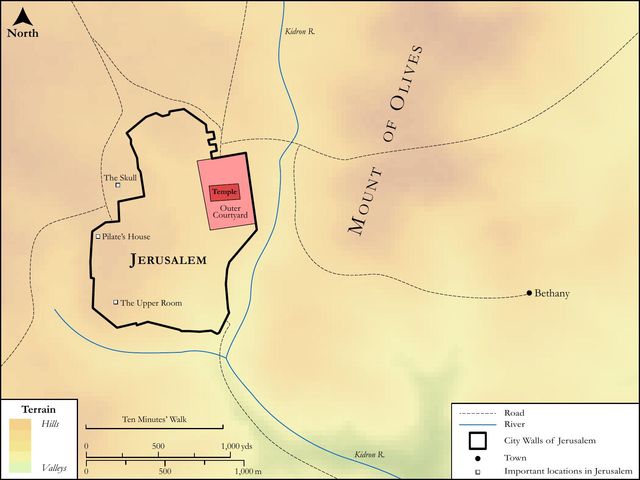
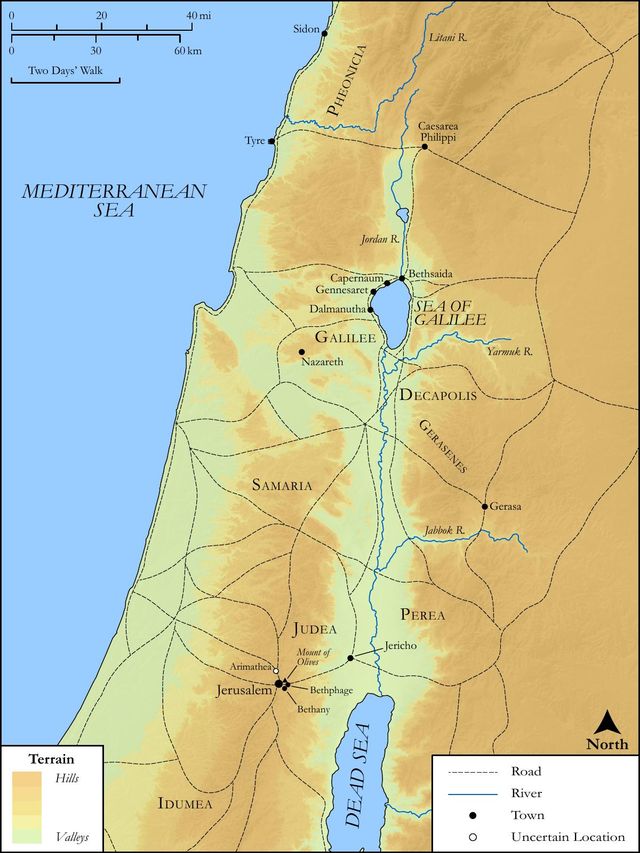
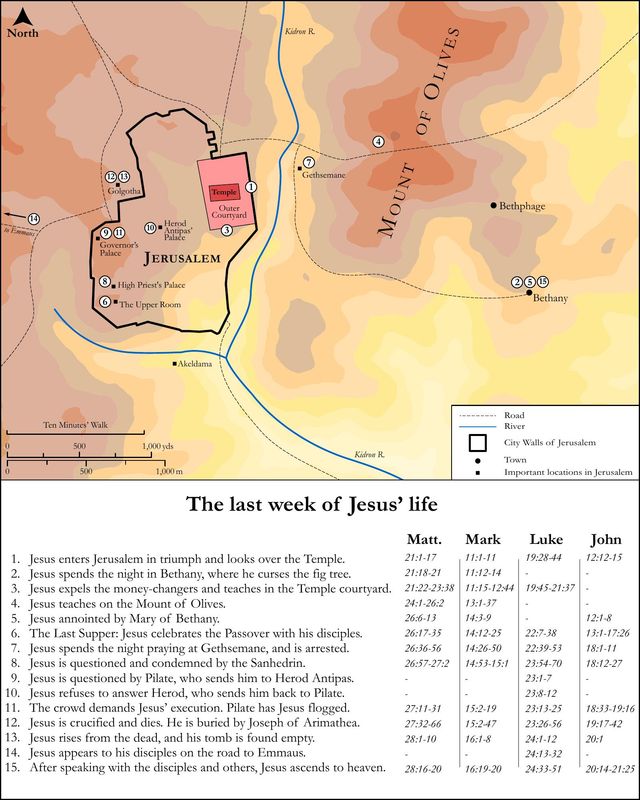
Study this verse
Public-domain commentary
Matthew Henry
From his Commentary on the Whole Bible. Henry comments on passages, not single verses — this entry covers Mark 15:22–32. His three-level outline is real structure in the source text, so it is rendered as structure.
We have here the crucifixion of our Lord Jesus.
I.The place where he was crucified; it was called Golgotha - the place of a scull:
some think, because of the heads of malefactors that were there cut off: it was the common place of execution, as Tyburn, for he was in all respects numbered with the transgressors. I know not how to give any credit to it, but divers of the ancients mention it as a current tradition, that in this place our first father Adam was buried, and they think it highly congruous that there Christ should be crucified; for as in Adam all die, so in Christ shall all be made alive. Tertullian, Origen, Chrysostom, and Epiphanius (great names), take notice of it; nay, Cyprian adds, Creditur piis - Many good people believe that the blood of Christ crucified did trickle down upon the scull of Adam, who was buried in the same place. Something more credible is the tradition, that this mount Calvary was that mountain in the land of Moriah (and in the land of Moriah it certainly was, for so the country about Jerusalem was called), on which Isaac was to be offered; and the ram was offered instead of him; and then Abraham had an eye to this day of Christ, when he called the place Jehovah-jireh - The Lord will provide, expecting that so it would be seen in the mount of the Lord.
II.The time when he was crucified; it was the third hour, Mar 15:25.
He was brought before Pilate about the sixth hour (Joh 19:14), according to the Roman way of reckoning, which John uses, with which ours at this day agrees, that is at six o'clock in the morning; and then, at the third hour, according to the Jews' way of reckoning, that is, about nine of the clock in the morning, or soon after, they nailed him to the cross. Dr. Lightfoot thinks the third hour is here mentioned, to intimate an aggravation of the wickedness of the priests, they were here prosecuting Christ to the death, though it was after the third hour, when they ought to have been attending the service of the temple, and offering the peace-offerings; it being the first day of the feast of unleavened bread, when there was to be a holy convocation. At that very time, when they should have been, according to the duty of their place, presiding in the public devotions, were they here venting their malice against the Lord Jesus; yet these were the men that seemed so zealous for the temple, and condemned Christ for speaking against it. Note, There are many who pretend to be for the church, who yet care not how seldom they go to church.
III.The indignities that were done him, when he was nailed to the cross; as if that had not been ignominious enough, they added several things to the ignominy of it.
1.It being the custom to give wine to persons that were to be put to death, they mingled his with myrrh, which was bitter, and made it nauseous; he tasted it, but would not drink it; was willing to admit the bitterness of it, but not the benefit of it.
2.The garments of those that were crucified, being, as with us, the executioners' fee, the soldiers cast lots upon his garments (Mar 15:24), threw dice (as our soldiers do upon a drum-head), for them: so making themselves merry with his misery, and sitting at their sport while he was hanging in pain.
3.They set up a superscription over his head, by which they intended to reproach him, but really did him both justice and honour, The king of the Jews, Mar 15:26. Here was no crime alleged, but his sovereignty owned. Perhaps Pilate meant to cast disgrace upon Christ as a baffled king, or upon the Jews, who by their importunity had forced him, against his conscience, to condemn Christ, as a people that deserved no better a king than he seemed to be: however, God intended it to be the proclaiming even of Christ upon the cross, the king of Israel; though Pilate know not what he wrote, any more than Caiaphas what he said, Joh 11:51. Christ crucified is king of his church, his spiritual Israel; and even then when he hung on the cross, he was like a king, conquering his and his people's enemies, and triumphing over them, Col 2:15. Now he was writing his laws in his own blood, and preparing his favours for his subjects. Whenever we look unto Christ crucified, we must remember the inscription over his head, that he is a king, and we must give up ourselves to be his subjects, as Israelites indeed.
4.They crucified two thieves with him, one on his right hand, the other on his left, and him in the midst as the worst of the three (Mar 15:27); so great a degree of dishonour did they hereby intend him. And, no doubt, it gave him disturbance too. Some that have been imprisoned in the common gaols, for the testimony of Jesus, have complained of the company of cursing, swearing prisoners, more than any other of the grievances of their prison. Now, in the midst of such our Lord Jesus was crucified; while he lived he had, and there was occasion, associated with sinners, to do them good; and now when he died, he was for the same purpose joined with them, for he came into the world, and went out of it, to save sinners, even the chief. But this evangelist takes particular notice of the fulfilling of the scriptures in it, Mar 15:28. In that famous prediction of Christ's sufferings (Isa 53:12), it was foretold that he should be numbered with the transgressors, because he was made sin for us.
5.The spectators, that is, the generality of them, instead of condoling with him in his misery, added to it by insulting over him. Surely never was such an instance of barbarous inhumanity toward the vilest malefactor: but thus the devil showed the utmost rage against him, and thus he submitted to the greatest dishonours that could be done him.
(1.)Even they that passed by, that were no way concerned, railed on him, Mar 15:29. If their hearts were so hardened, that their compassions were not moved with such a spectacle, yet they should have thought it enough to have their curiosity gratified; but that will not serve: as if they were not only divested of all humanity, but were devils in human shape, they taunted him, and expressed themselves with the utmost detestation of him, and indignation at him, and shot thick at him their arrows, even bitter words. The chief priests, no doubt, put these sarcasms into their mouths, Thou that destroyest the temple, and buildest it in three days, now, if thou canst, save thyself, and come down from the cross. They triumph as if now that they had got him to the cross, there were no danger of his destroying the temple; whereas the temple of which he spoke, he was now destroying, and did within three days build it up; and the temple of which they spoke, he did by men, that were his sword and his hand, destroy not many years after. When secure sinners think the danger is over, it is then most ready to seize them: the day of the Lord comes as a thief upon those that deny his coming, and say, Where is the promise of it? much more upon those that defy his coming, and say, Let him make speed, and hasten his work.
(2.)Even the chief priests, who, being taken from among men and ordained for men, should have compassion even on those that are out of the way, should be tender of those that are suffering and dying (Heb 5:1, Heb 5:2), yet they poured vinegar instead of oil into his wounds, they talked to the grief of him whom God had smitten (Psa 69:26), they mocked him, they said, He saved others, healed and helped them, but now it appears that it was not by his own power, for himself he cannot save. They challenged him to come down from the cross, if he could, Mar 15:32. Let them but see that, and they would believe; whereas they would not believe, when he gave them a more convincing sign than that, when he came up from the grave. These chief priests, one would think, might now have found themselves other work to do: if they would not go to do their duty in the temple, yet they might have been employed in an office not foreign to their profession; though they would not offer any counsel or comfort to the Lord Jesus, yet they might have given some help to the thieves in their dying moments (the monks and priests in Popish countries are very officious about criminals broken upon the wheel, a death much like that of the cross); but they do not think that their business.
(3.)Even they that were crucified with him, reviled him (Mar 15:32); one of them did, so wretchedly was his heart hardened even in the depth of misery, and at the door of eternity.
Historical interpretation
Nine Centuries of Reception
10 surviving comments on this verse. Each one is dated, so this reads as a timeline rather than a list.
Select a marker to jump to its quote. Markers stagger vertically where authors wrote within a few decades of each other.
(Quæst. Vet. et Nov. Test. 65) Therefore he wishes to imply that it was the Jews who passed sentence concerning the crucifixion of Christ at the third hour; for every condemned person is considered as dead, from the moment that sentence is passed upon him. Mark therefore showed that our Saviour was not crucified by the sentence of the judge, because it is difficult to prove the innocence of a man so condemned.
Here Abel is brought out into the field by his brother, to be slain by him. Here Isaac comes forth with the wood, and Abraham with the ram caught in the thicket. Here also Joseph with the sheaf of which he dreamed, and the long robe steeped in blood. Here is Moses with the rod, and the serpent hanging on the wood. Here is the cluster of grapes, carried on a staff. Here is Elisha with the piece of wood sent to seek for the axe, which had sunk, and which swam to the wood; that is, mankind, which by the forbidden tree, fell down to hell, but by the wood of the cross of Christ, and by the baptism of water, swims to paradise.z Here is Jonah out of the wood of the ship sent down into the sea and into the whale's belly for three days. There follows: And they compel Simon a Cyrenian, who passed by, coming out of the country, the father of Alexander and Rufus, to bear his cross.
Now since some men are known by the merits of their fathers, and some by those of their sons, this Simon, who was compelled to carry the cross, is made known by the merits of his sons, who were disciples. By this we are reminded, that in this life, parents are assisted by the wisdom and the merits of their children, wherefore the Jewish people is always held worthy of being remembered on account of the merits of the Patriarchs, Prophets, and Apostles. But this Simon who carries the cross, because he is compelled, is the man who labours for human praise. For men compel him to work, when the fear and love of God could not compel him.
But the Jews relate, that in this spot of the mountain the ram was sacrificed for Isaac, and there Christ is made bald1, that is, separated from His flesh, that is, from the carnal Jews. There follows: And they gave him to drink wine mingled with myrrh.
Or else, wine mingled with myrrh, that is, vinegar; by it the juice of the deadly apple is wiped away.
He also refused to take sin for which He suffered, wherefore it is said of Him, I then paid the things that I never took. There follows: And when they had crucified him, they parted his garments, casting lots upon them, what every man should take. (Ps. 68:5. Vulg.) In this place salvation is figured by the wood; the first wood was that of the tree of knowledge of good and evil; the second wood is one of unmixed good for us, and is the wood of life. The first hand stretched out to the wood caught hold of death; the second found again the life which had been lost. By this wood we are carried through a stormy sea to the land of the living, for by His cross Christ has taken away our torment, and by His death has killed our death.b With the form of a serpent He kills the serpent, for the serpent made out of the rod swallowed up the other serpents. But what means the shape itself of the cross, save the four quarters of the world; the East shines from the top, the North is on the right, the South on the left, the West is firmly fixed under the feet. Wherefore the Apostle says: That we may know what is the height, and breadth, and length, and depth. (Eph. 3:18) Birds, when they fly in the air, take the shape of a cross; a man swimming in the waters is borne up by the form of a cross. A ship is blown along by its yards, which are in the shape of the cross. The letter Tau is written as the sign of salvation and of the cross.
Now the garments of the Lord are His commandments, by which His body, that is, the Church, is covered; which the soldiers of the Gentiles divide amongst themselves, that there may be four classes with one faith, the married, and the widowed, those who bear rule, and those who are separatec. They cast lots for the undivided garment, which is peace and unity. It goes on: And it was the third hour, and they crucified him. Mark has introduced this truly and rightly, for at the sixth hour darkness overspread the earth, so that no one could move his head.
He wrote it in three languages, in Hebrew, Melech Jeudim; in Greek, βασιλεὺς ἐξομολογητῶν in Latin, Rex confessorum. These three languages were consecrated to be the chief, in the superscription on the cross, that every tongue might record the treachery of the Jews.
Truth was numbered with the wicked; He left one on His left hand, the other He takes on the right, as He will do at the last day. With a similar crime they are allotted different paths; one precedes Peter into Paradise, the other Judas into hell. A short confession won for him a long life, and a blasphemy which soon ended is punished with endless pain.
Let your prayers be made at “the third hour”; for then it was that Pilate gave sentence upon our Lord and savior to have him crucified…. Let your prayers be made also at the sixth hour; for at that time he was crucified…. We observe also “the ninth hour” of prayer; for at that time the sun was darkened and the earth shaken with horror, as being not able to look upon those bitter cruelties.
(de Con. Evan. iii. 13) If Jesus was given up to the Jews to be crucified, when Pilate sat down at his tribunal about the sixth hour, as John relates, how could He be crucified at the third hour, as many persons have thought from not understanding the words of Mark? First then let us see at what hour He might have been crucified, then we shall see why Mark said that He was crucified at the third hour. It was about the sixth hour when He was given up to be crucified by Pilate sitting on his judgment seat, as has been said, for it was not yet fully the sixth hour, but about the sixth, that is, the fifth was over, and some of the sixth had begun, so that those things which are related of the crucifixion of our Lord took place after the finishing of the fifth, and at the commencement of the sixth, until, when the sixth was completed and He was hanging on the cross, the darkness which is spoken of took place. Let us now consider, why Mark has said, It was the third hour. He had already said positively, And when they had crucified him, they parted his garments; as also the others declare, that when He was crucified His garments were divided. Now if Mark had wished to fix the time of what was done, it would have been enough to say, And it was the third hour, why did He add, and they crucified him, unless it was that he wished to point to something which had gone before, and which if enquired into would be explained, since that same Scripture was to be read at a time, when it was known to the whole Church at what hour our Lord was crucified, by which means any error might be taken away, and any falsehood be refuted. But because he knew that the Lord was fixed to the cross not by the Jews but by the soldiers, as John very plainly shows, he wished to intimate that the Jews had crucified Him, since they cried out, Crucify Him, rather than those who executed the orders of their chief according to their duty. It is therefore implied, that it took place at the third hour when the Jews cried out, Crucify Him, and it is most truly shown that they crucified Him, when they so cried out. But in the attempt of Pilate to save the Lord, and the tumultuous opposition of the Jews, we understand that a space of two hours was consumed, and that the sixth hour had begun, before the end of which, those things occurred which are related to have taken place from the time when Pilate gave up the Lord, and the darkness overspread the earth. Now he who will apply himself to these things, without the hard-heartedness of impiety, will see that Mark has fitly placed it at the third hour, in the same place as the deed of the soldiers who were the executors of it is related. Therefore lest any one should transfer in his thoughts so great a crime from the Jews to the soldiers, he says it was the third hour, and they crucified him, that the fault might rather by a careful enquirer be charged to them, who, as he would find, had at the third hour cried out for His crucifixion, whilst at the same time it would be seen that what was done by the soldiers was done at the sixth hourd.
(ubi sup.) Still there are not wanting persons who assert that the preparation, mentioned by John, Now it was the preparation about the sixth hour, was really the third hour of the day. For they say that on the day before the sabbath day, there was a preparation of the passover of the Jews, because on that sabbath, they began the unleavened bread; but however that the true passover, which is now celebrated on the day of our Lord's Passion, that is, the Christian not the Jewish passover, began to be prepared, or to have its parasceue, from that ninth hour of the night, when His death began to be prepared by the Jews; for parasceue means preparation. Between that hour therefore of the night and His crucifixion occurs the sixth hour of preparation, according to John, and the third hour of the day, according to Mark. What Christian would not give in to this solution of the question, provided that we could find some circumstance, from which we might gather that this preparation of our Passover, that is, of the death of Christ, began at the ninth hour of the night? For if we say that it began when our Lord was taken by the Jews, it was still early in the night, but if when our Lord was carried away to the house of the father in law of Caiaphas, where also He was heard by the chief priests, the cock had not crowed; but if when He was given up to Pilate, it is very plain that it was morning. It remains therefore that we must understand the preparation of our Lord's death to have commenced when all the Chief Priests pronounced, He is guilty of death. For there is nothing absurd in supposing that that was the ninth hour of the night, so that we may understand that Peter's denial is put out of its order after it really happened.
He who was able not to die unless he willed it, did die because he willed it. So he made a show of principalities and powers, openly triumphing over them in himself. By his death the one and most real sacrifice was offered up for us. Whatever were the charges by which the principalities and powers held us under bondage, he cleansed, abolished, extinguished. .
One Evangelist says that the Lord was crucified at the sixth hour, and another at the third hour. Unless we understand it, we are left wondering. When the sixth hour was already beginning, Pilate is said to have sat on the judgment seat. In reality when the Lord was lifted up upon the tree, it was the sixth hour…. They had killed him already at the time when they were crying out. The government officials at the sixth hour crucified, the transgressors of the law at the third hour cried out. That which some did with hands at the sixth hour, others did with tongue at the third hour. More guilty are they that with crying out were raging, than they that in obedience were serving.
(ubi sup.) Or, since this Simon is not called a man of Jerusalem, but a Cyrenian, (for Cyrene is a city of Libya,) fitly is he taken to mean the nations of the Gentiles, which were once foreigners and strangers to the covenants, but now by obedience are heirs of God, and joint heirs with Christ. Whence also Simon is fitly interpreted 'obedient,' and Cyrene 'an heir.' But he is said to come from a country place, for a country place is called 'pagos' in Greek, wherefore those whom we see to be aliens from the city of God, we call pagans. Simon then coming out from the country carries the cross after Jesus, when the Gentile nations leaving pagan rites embrace obediently the footsteps of our Lord's Passion. There follows: And they bring him unto the place Golgotha, which is being interpreted, the place of Calvary. There are places without the city and the gate, in which the heads of condemned persons are cut off, and which receive the name of Calvary, that is, of the beheaded. But the Lord was crucified there, that where once was the field of the condemned, there the standards of martyrdom might be lifted up.
(ubi sup.) Bitter the vine which bore the bitter wine, set before the Lord Jesus, that the Scripture might be fulfilled which saith, They gave me gall to eat, and when I was thirsty, they gave me vinegar to drink. (Ps. 69:22)
(ubi sup.) Or else, in the transverse beam of the cross, where the hands are fixed, the joy of hope is set forth; for by the hands we understand good works, by its expansion the joy of him who does them, because sadness puts us in straits. By the height to which the head is joined, we understand the expectation of reward from the lofty righteousness of God; by the length, over which the whole body is stretched, patience, wherefore patient men are called long-suffering; by the depth, which is fixed in the ground, the hidden Sacrament itself. As long therefore as our bodies work here to the destruction of the body of sin, it is the time of the cross for us.
(ubi sup.) But this superscription on the cross shows, that they could not even in killing Him take away the kingdom over them from Him who was about to render unto them according to their works. There follows: And with him they crucify two thieves, the one on his right hand, the other on his left.
(ubi sup.) Mystically, however, the thieves crucified with Christ signify those, who by their faith and confession of Christ undergo either the struggle of martyrdom, or some rules of a stricter discipline. But those who do these deeds for the sake of endless glory, are signified by the faith of the right hand robber; those again who do them for worldly praise copy the mind and the acts of the left hand robber.
It was the third hour, and they crucified him. There are those who believe that the Lord was crucified at the third hour, but that darkness came from the sixth hour until the ninth, so that the three hours from when He was crucified until the darkness came are understood to have passed. And this could indeed be very rightly understood, except that John says that Pilate sat on the judgment seat in a place called the Stone Pavement, in Hebrew Gabbatha, at about the sixth hour (John 19). He continues: "It was the Day of Preparation of the Passover, about the sixth hour. And he said to the Jews: 'Behold your King,'" etc. Therefore, if at about the sixth hour, when Pilate was seated on the judgment seat, He was handed over to the Jews to be crucified, how was He crucified at the third hour, as some have misunderstood the words of Mark? For Mark had surely said: "And when they crucified him, they divided his garments." Therefore, if he wanted to mention the time when the event took place, it would suffice to say: “And it was the third hour”; why did he add: “And they crucified him,” unless he wanted to signify something by recapitulating, which would be found upon investigation, since the Scripture was read at a time when the whole Church knew at what hour the Lord was hung on the wood, from which either this error could be corrected or the lie refuted? But because he knew that the Lord was crucified by soldiers and not by Jews, he wanted to reveal secretly that those who shouted for Him to be crucified were more responsible for the crucifixion than those who performed their service according to the duty assigned by their ruler. Therefore, it is understood that it was the third hour when the Jews cried out for the Lord to be crucified. And it is very rightly shown that they crucified Him when they cried out, especially since they did not want to appear to have done it, and therefore they handed Him over to Pilate, as their words clearly indicate according to John. Thus, what they especially did not want to appear to have done, Mark shows they did at the third hour, very rightly indicating that the tongue of the Jews was more the killer of the Lord than the hands of the soldiers.
Now John says that He Himself bare His cross, for both took place; for He first bore the cross Himself, until some one passed, whom they compelled, and who then carried it. But he mentioned the name of his sons, to make it more credible and the affirmation stronger, for the man still lived to relate all that had happened about the cross.
THEOPHYLACT.a Or, they may have brought different things, in order, some vinegar and gall, and others wine mixed with myrrh.
But their casting lots for His garments was also meant as an insult, as though they were dividing the clothes of a king; for they were coarse and of no great value. And John's Gospel shows this more clearly, for the soldiers, though they divided every thing else into four parts, according to their number, cast lots for the coat, which was without seam, woven from the top throughout. (John 19:23)
They wrote this superscription, as the reason why He was crucified, thus wishing to reprove His vainglory in making Himself a king, that so the passers by might not pity Him, but rather hate Him as a tyrant.
They did this that men might have a bad opinion of Him, as though He also were a robber and a malefactor. But it was done by Providence to fulfil the Scriptures. There follows: And the Scripture was fulfilled which saith, And he was numbered with the transgressors.
Or else; the two robbers were meant to point out the two people, that is, the Jews and the Gentiles, for both were evil, the Gentile as transgressing natural law, but the Jew by breaking the written law, which the Lord had delivered to them; but the Gentile was penitent, the Jew a blasphemer unto the end. Between whom our Lord is crucified, for He is the corner stone, which binds us together.
(non occ.) After the condemnation of Christ, and the insults heaped upon Him when He was condemned, the Evangelist proceeds to relate His crucifixion, saying, And led him out to crucify him.
Continue studying Mark 15:25 across the web’s major study libraries — every link below opens this exact verse, chapter, or book on the destination site.
Read & Compare
 BibleGatewayThis verse in more than 200 translations and 70 languages.
 Bible.comThe YouVersion reader — hundreds of translations, reading plans, and highlights.
 ESV.orgCrossway's official English Standard Version reader.
 NET BibleThe NET translation with 60,000+ translators' notes on every rendering decision.
 STEP BibleTyndale House's free study tool — original text, vocabulary, and scholarly resources.
 BibliaLogos Bible Software's free web reader.
 USCCBThe New American Bible (Revised Edition) with the U.S. bishops' study notes.
Commentaries
 BibleHub CommentariesDozens of classic commentaries on this verse, gathered on one page.
 StudyLightMore than 100 commentary sets — the largest collection on the web.
 BibleRefPlain-English commentary on what this verse means, verse by verse.
 Enduring WordDavid Guzik's free commentary on this chapter, widely used by Bible teachers.
 Bible Study ToolsVerse commentary alongside Greek and Hebrew study aids.
Original Language & Research
- BibleHub InterlinearThe verse word by word — original language, transliteration, and English.
- BibleHub LexiconEvery word's original-language definition and Strong's entry.
 Blue Letter BibleDeep-study tools — Strong's numbers, concordance, and word studies.
 CNTR CollationThe earliest Greek manuscripts of this verse, collated letter by letter.
Sermons, Hymns & Audio


TrulyRandomVerse is not affiliated with these sites and doesn’t control their content. They’re linked because they’re genuinely useful.
Summary
Mark 15:25 succinctly records the precise moment of Jesus' crucifixion, stating, "And it was the third hour, and they crucified him." This terse declaration marks the commencement of the most pivotal event in human history, the atoning sacrifice of God's Son. The specificity of the time (9:00 AM) underscores the divine orchestration of this profound act, while the stark statement of the crucifixion highlights the brutal reality of Christ's suffering and the culmination of God's redemptive plan for humanity.
Context
ShowHideLiterary Context
This concise verse is strategically placed within Mark's fast-paced passion narrative, serving as the dramatic climax. It immediately follows Jesus' unjust condemnation by Pontius Pilate (Mark 15:15), the brutal scourging, and the soldiers' cruel mockery, where they dressed Him in a purple robe and crowned Him with thorns (Mark 15:16-20). The narrative then transitions to Jesus being led out to Golgotha, the place of the skull, where He is offered wine mixed with myrrh, which He refuses (Mark 15:21-23). Mark 15:25 thus marks the beginning of the actual crucifixion, setting the stage for the subsequent events on the cross, including the casting of lots for His garments, the mocking by passersby, and the final moments leading to His death at the ninth hour (Mark 15:24-37).
Historical & Cultural Context
The crucifixion was a horrific method of execution employed by the Roman Empire, designed to inflict maximum pain, humiliation, and public deterrence. It was typically reserved for slaves, rebels, and the lowest class of criminals. The victim was nailed or tied to a cross, often dying slowly from asphyxiation, shock, or exhaustion. The "third hour" refers to approximately 9:00 AM, as the Roman day was typically divided into twelve hours of daylight, beginning around 6:00 AM. This precise timing indicates the early morning start of Jesus' six-hour ordeal on the cross. Golgotha, the site of the crucifixion, was located outside the city walls of Jerusalem, a common practice for executions, making it a public spectacle. The Jewish Passover festival was underway, a time when Jerusalem was crowded with pilgrims, amplifying the public nature of Jesus' execution.
Key Themes
ShowHideThe verse profoundly contributes to several key themes within Mark's Gospel and the broader biblical narrative. Firstly, it highlights the Precision of God's Timing, emphasizing that even amidst human injustice and brutality, God's sovereign plan was unfolding with meticulous accuracy. The specific mention of "the third hour" underscores the divine orchestration of Jesus' sacrifice, a testament to the meticulous fulfillment of God's redemptive agenda, as seen throughout biblical prophecy, such as in Isaiah 53. Secondly, the stark declaration "and they crucified him" encapsulates the Depths of Christ's Suffering, revealing the immense physical and spiritual agony Jesus endured. This was not merely an execution but a profound act of self-sacrifice, where the Son of God bore the sins of humanity, showcasing the immense cost of redemption and the immeasurable love that motivated Jesus to endure such torment. Lastly, it signifies the Culmination of God's Redemptive Plan, as the crucifixion is the central event through which humanity's salvation is achieved, fulfilling the Old Testament's sacrificial system and prophetic declarations.
Exposition and Analysis
ShowHideKey Word Analysis
ShowHideThis word, referring to an "hour" or "season," is significant here for its precision. Mark's specific mention of "the third hour" (9:00 AM) emphasizes the exact timing of Jesus' crucifixion, suggesting a divinely appointed moment rather than a random event. It highlights the meticulous unfolding of God's plan.
As an ordinal number, "third" precisely locates the event within the daily cycle. This detail is crucial for understanding the chronology of the passion week and for harmonizing the Gospel accounts, even with apparent discrepancies, as it underscores the historical rootedness and specificity of the event.
Derived from the word for "cross," this verb means "to impale on the cross." It is a direct and unvarnished statement of the brutal method of execution. The use of this word immediately conveys the horror and suffering involved, but also, in a theological sense, points to the act of atonement and the extinguishing of sin's power.
This reflexive pronoun refers unequivocally to Jesus. Its inclusion emphasizes that the entire, brutal act of crucifixion was directed at Him personally, underscoring His unique identity as the one who endured this suffering for humanity.
Verse Breakdown
ShowHide"And it was the third hour"
This clause establishes the precise time of the crucifixion's commencement, approximately 9:00 AM. This detail is not merely chronological but carries theological weight, suggesting the divine orchestration of events. It marks the beginning of Jesus' final, agonizing six hours on the cross, culminating in His death at the ninth hour (3:00 PM).
"and they crucified him"
This stark and concise statement describes the brutal act itself. "They" refers to the Roman soldiers who carried out the execution under Pilate's command. The passive voice for "him" underscores Jesus' submission to this fate, yet it was a willing submission to God's sovereign plan. This clause encapsulates the immense suffering and humiliation Jesus endured, making explicit the method of His atoning death.
Literary Devices
ShowHideMark's Gospel is known for its concise and direct style, and Mark 15:25 exemplifies this Brevity and Conciseness. The verse delivers a profound event with minimal words, focusing on the action and its timing without elaborate description, which serves to heighten the dramatic impact. There is an implicit Irony in the scene: the King of the Jews, the Son of God, is being executed as a common criminal, a stark contrast between His true identity and the humiliating circumstances. The event itself is also rich in Symbolism, with the cross becoming the ultimate symbol of suffering, sacrifice, and redemption, a powerful emblem of Christian faith. The entire passion narrative, leading up to this verse, employs Foreshadowing, as Jesus repeatedly predicted His suffering and death, making this verse the fulfillment of those prophecies.
Theological and Thematic Connections
ShowHideMark 15:25 stands as the theological epicenter of the Christian faith, declaring the commencement of Christ's atoning work on the cross. The precision of "the third hour" underscores God's meticulous sovereignty, demonstrating that even the darkest moment of human injustice was perfectly aligned with His eternal plan for redemption. This was not a random act but the fulfillment of divine prophecy and the ultimate demonstration of God's profound love for humanity, where the innocent Son of God bore the full weight of human sin. The crucifixion reveals the immense cost of salvation and the depth of Christ's obedience to the Father's will, establishing the foundation for reconciliation between God and humanity.
Reflection and Application
ShowHideMark 15:25, though brief, demands profound reflection. It calls us to gaze upon the cross, not as a historical artifact, but as the living testament to God's unfathomable love and the immense cost of our salvation. The precision of "the third hour" reminds us that God is sovereign over all circumstances, even the most agonizing, and that His perfect plan unfolds with divine timing. We are invited to contemplate the "they crucified him" with deep gratitude, recognizing that Jesus willingly endured the most brutal and humiliating death imaginable to bear our sins and reconcile us to God. This verse compels us to live lives of humble devotion, acknowledging that our redemption came at an immeasurable price. It should inspire us to trust in God's perfect timing even in our own trials and to live out the sacrificial love that Christ exemplified.
Questions for Reflection
ShowHideFAQ
ShowHideWhy is the "third hour" significant in Mark's account?
ShowHideThe "third hour" (approximately 9:00 AM) is significant because it marks the precise beginning of Jesus' crucifixion. According to Roman timekeeping, the day began at 6:00 AM, making the third hour 9:00 AM. Mark's Gospel emphasizes this specific timing to underscore the historical reality and the divine orchestration of this pivotal event. It highlights that Jesus' suffering and death were not random occurrences but part of God's predetermined plan, unfolding with meticulous accuracy. This specific detail sets the stage for the six-hour ordeal on the cross, culminating in Jesus' death at the ninth hour (Mark 15:33-37).
Who are "they" who crucified Jesus?
ShowHide"They" primarily refers to the Roman soldiers who carried out the execution under the direct orders of Pontius Pilate, the Roman governor (Mark 15:15). However, from a broader theological perspective, the responsibility for Jesus' crucifixion extends to various groups: the Jewish religious leaders who conspired against Him and demanded His death (Mark 14:53-65), the crowd who chose Barabbas over Jesus (Mark 15:6-15), and ultimately, humanity's sin, which necessitated His sacrifice. The New Testament teaches that Jesus was delivered up by God's "definite plan and foreknowledge" (Acts 2:23), indicating that while human agents were responsible, the event itself was part of God's sovereign redemptive purpose.
How does Mark's timing of the crucifixion compare with John's Gospel?
ShowHideMark 15:25 states that Jesus was crucified at "the third hour" (around 9:00 AM). In contrast, John 19:14 mentions that Pilate brought Jesus out for judgment "about the sixth hour" (around 12:00 PM). This apparent discrepancy has been a subject of scholarly discussion. Some propose that John might be using a different timekeeping system (e.g., Roman military time, where the day started at midnight, or a Jewish system that began earlier). Others suggest that John's "sixth hour" refers to the completion of the trial and the delivery of Jesus for crucifixion, while Mark's "third hour" refers to the actual commencement of the crucifixion itself. Another view is that John's timing refers to the entire process of Pilate's final judgment and public display, which could have extended until noon, while Mark focuses on the moment the nails were driven. Regardless of the precise reconciliation, both Gospels agree on the historical fact of the crucifixion and its profound significance.
Christ-Centered Fulfillment
ShowHideMark 15:25, though brief, stands as the stark and pivotal moment of Christ-centered fulfillment. It records the beginning of the ultimate sacrifice, where Jesus, the promised Messiah, was "crucified." This act was the culmination of God's redemptive plan, foreshadowed throughout the Old Testament. Jesus, the true Passover Lamb, was led to the slaughter, fulfilling prophecies such as those found in Isaiah 53, where the suffering servant bears the iniquities of many. His crucifixion at "the third hour" was not a random tragedy but the precise execution of God's sovereign will, demonstrating that He is the Lamb of God who takes away the sin of the world. Through this brutal act, Jesus disarmed the powers and authorities, triumphing over them by the cross (Colossians 2:14-15). His death on the cross, initiated at this precise hour, was the necessary shedding of blood for the forgiveness of sins (Hebrews 9:22), establishing the new covenant. Thus, Mark 15:25 points directly to the heart of the Gospel: Christ's substitutionary atonement, through which believers are granted new life and reconciliation with God, ultimately leading to His glorious resurrection and ascension, which validate His completed work on the cross (Romans 6:4).