


Matthew 27:45
- ἈπὸApoFromG575PREPPreposition
- δὲdethenG1161CONJConjunction
- ἕκτηςhektēs[the] sixthG1623A-GSFAdjective Genitive Singular Feminine
- ὥραςhōrashourG5610N-GSFNoun Genitive Singular Feminine
- σκότοςskotosdarknessG4655N-NSNNoun Nominative Singular Neuter
- ἐγένετοegenetowasG1096V-2ADI-3SVerb 2nd Aorist Middle Deponent Indicative 3rd Singular
- ἐπὶepioverG1909PREPPreposition
- πᾶσανpasanallG3956A-ASFAdjective Accusative Singular Feminine
- τὴνtēntheG3588T-ASFDefinite article Accusative Singular Feminine
- γῆνgēnlandG1093N-ASFNoun Accusative Singular Feminine
- ἕωςhe'ōsuntilG2193PREPPreposition
- ὥραςhōras[the] hourG5610N-GSFNoun Genitive Singular Feminine
- ἐνάτηςenatēsninthG1766A-GSFAdjective Genitive Singular Feminine
English is a literal word-by-word gloss of the Greek, not the KJV's wording. Why?
This is the original text the KJV's translators worked from — each Greek word with its own literal English meaning in this verse, prepared by scholars at Tyndale House, Cambridge. The KJV translates whole sentences, not word by word, so its wording differs: one Greek word can become several English words, and the KJV may choose “charity” where the gloss reads “love”. Both are faithful — they answer different questions. For the KJV's own rendering, switch to the KJV text.
Details
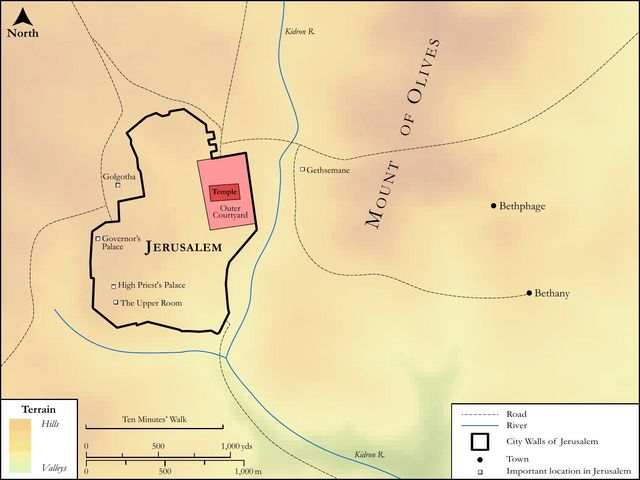
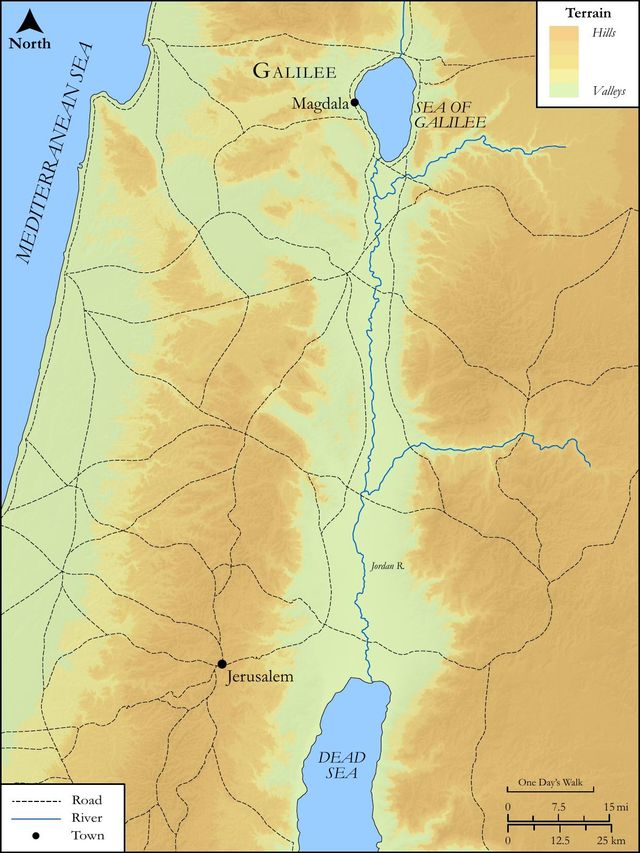
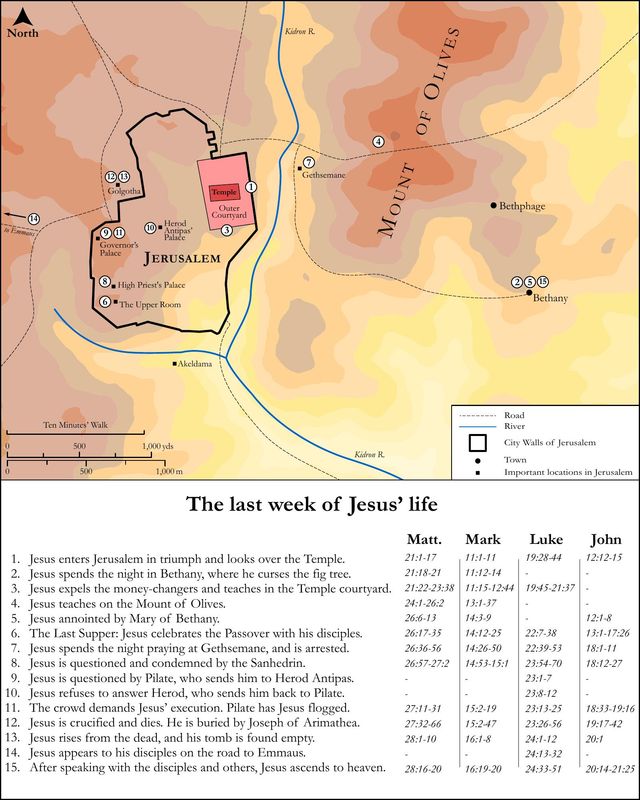
See on the biblical-era map
Study this verse
Historical interpretation
Eleven Centuries of Reception
19 surviving comments on this verse. Each one is dated, so this reads as a timeline rather than a list.
Select a marker to jump to its quote. Markers stagger vertically where authors wrote within a few decades of each other.
And so the "pressure" must be maintained up to that hour in which the orb-involved from the sixth hour in a general darkness-performed for its dead Lord a sorrowful act of duty; so that we too may then return to enjoyment when the universe regained its sunshine. If this savours more of the spirit of Christian religion, while it celebrates more the glory of Christ, I am equally able, from the self-same order of events, to fix the condition of late protraction of the Station; (namely), that we are to fast till a late hour, awaiting the time of the Lord's sepulture, when Joseph took down and entombed the body which he had requested.
But My People hath changed their glory: whence no profit shall accrue to them: the heaven turned pale thereat" (and when did it turn pale? undoubtedly when Christ suffered), "and shuddered," he says, "most exceedingly; " and "the sun grew dark at mid-day: " (and when did it "shudder exceedingly" except at the passion of Christ, when the earth also trembled to her centre, and the veil of the temple was rent, and the tombs were burst asunder? "because these two evils hath My People done; Me," He says, "they have quite forsaken, the fount of water of life, and they have digged for themselves worn-out tanks, which will not be able to contain water.
Certain believers, wishing to offer some defense of the gospel in a few brief words, have said that if no new miracle had been performed at the time of Christ’s Passion but everything happened in the normal manner, then it would also have to be believed that the eclipse of the sun occurred as usual. Since it is agreed, however, that other prodigies which happened at that time were not customary events but new and wondrous (for the veil of the temple was torn in two from top to bottom and the earth shook and rocks were split apart and graves were opened and many bodies of the saints rose from the dead), it follows that neither did the eclipse of the sun happen as it normally does.
It is my opinion that just as the other signs which accompanied Christ’s Passion were performed only in Jerusalem, so also the darkness which covered the land until the ninth hour occurred only in Judea. For in Jerusalem alone was the veil of the temple rent asunder and the earth shook and rocks split apart and graves opened. … By the power of Christ, however, darkness fell upon all the land of Judea for three hours, but the light which illumines every church of God in Christ shone upon the rest of the land. Although darkness fell upon Judea until the ninth hour, it is clear that the light shone on it again, “until the full number of Gentiles come in, and so all Israel will be saved.” The fact that darkness fell upon the land of Judea for three hours demonstrates that it was because of its sins that Judea was deprived of the light of three moments, that is, the light of God the Father, the splendor of Christ and the illumination of the Holy Spirit.
Some take occasion from this text to cavil against the truth of the Gospel. For indeed from the beginning eclipses of the sun have happened in their proper seasons; but such an eclipse as would be brought about by the ordinary course of the seasons could only be at such time as the sun and moon come together, when the moon passing beneath intercepts the sun's rays. But at the time of Christ's passion it is clear that this was not the case, because it was the paschal feast, which it was customary to celebrate when the moon was full. Some believers, desiring to produce some answer to this objection, have said, that this eclipse in accordance with the other prodigies was an exception to the established laws of nature.
Against this the children of this world urge, How is it that of the Greeks and Barbarians, who have made observations of these things, not one has recorded so remarkable a phenomenon as this? Phlegon indeed has recorded such an event as happening in the time of Tiberius Caesar, but he has not mentioned that it was at the full moon. I think therefore that, like the other miracles which took place at the Passion, the rending of the veil, and the earthquake, this also was confined to Jerusalem. Or, if any one chooses, it may be extended to the whole of Judæa; as in the book of Kings, Abdias said to Elias, As the Lord thy God liveth, there is no nation or kingdom whither my lord hath not sent to seek thee, (1 Kings 18:10.) meaning that he had been sought in the countries round about Judæa. Accordingly we might suppose many and dense clouds to have been brought together over Jerusalem and Judæa, enough to produce thick darkness from the sixth to the ninth hour. For we understand that there were two creatures created on the sixth day, the beasts before the sixth hour, man on the sixth; and therefore it was fitting that He who died for the salvation of man should be crucified at the sixth hour, and for this cause that darkness should be over the whole earth from the sixth to the ninth hour. And as by Moses stretching out his hands towards heaven darkness was brought upon the Egyptians who held the servants of God in bondage, so likewise when at the sixth hour Christ stretched out his hands on the cross to heaven, darkness came over all the people who had cried out, Crucify him, and they were deprived of all light as a sign of the darkness that should come, and that should envelop the whole people of the Jews. Further, under Moses there was darkness over the land of Egypt three days, but all the children of Israel had light; so under Christ there was darkness over all Judæa for three hours, because for their sins they were deprived of the light of God the Father, the splendour of Christ, and the illumination of the Holy Spirit. But over the rest of the earth there is light, which every where illumines the Church of God in Christ. And if to the ninth hour there was darkness over Judæa, it is manifest that light returned to them again after that; so, when the fulness of the Gentiles shall have entered in, then all Israel shall be saved. (Rom. 11:25.)
(de Trin. x. 50 &c.) From these words heretical spirits contend either that God the Word was entirely absorbed into the soul at the time it discharged the function of a soul in quickening the body; or that Christ could not have been born man, because the Divine Word dwelt in Him after the manner of a prophetical spirit. As though Jesus Christ was a man of ordinary soul and body, having His beginning then when He began to be man, and thus now deserted upon the withdrawal of the protection of God's word cries out, My God, my God, why hast thou forsaken me? Or at least that the nature of the Word being transmuted into soul, Christ, who had depended in all things upon His Father's support, now deserted and left to death, mourns over this desertion, and pleads with Him departing. But amidst these impious and feeble opinions, the faith of the Church imbued with Apostolic teaching does not sever Christ that He should be considered as Son of God and not as Son of Man. The complaint of His being deserted is the weakness of the dying man; the promise of Paradise is the kingdom of the living God. You have Him complaining that He is left to death, and thus He is Man; you have Him as He is dying declaring that He reigns in Paradise; and thus He is God. Wonder not then at the humility of these words, when you know the form of a servant, and see the offence of the cross.
Vinegar is wine, which has turned sour either from neglect, or the fault of the vessel. Wine is the honour of immortality, or virtue. When this then had been turned sour in Adam, He took and drunk it at the hands of the Gentiles. It is offered to Him on a reed and a spunge; that is, He took from the bodies of the Gentiles immortality spoiled and corrupted, and transfused in Himself into a mixture of immortality that in us which was spoiled.
Or, He gave up the ghost with a loud voice, in grief that He was not carrying the sins of all men.
Now a certain Phlegon, a philosopher among the Greeks, recollects this darkness as an incredible occurrence in the fourteenth [night] of the moon, when an eclipse should not have appeared … for eclipses occur at the time when these two stars [the sun and the moon] draw near to one another. An eclipse of the sun happens at the conjunction of the sun and the moon as it runs into its way. This is not the time of the full moon, when the sun is diametrically opposed to the moon. But the eclipse occurred as creation mourned over what had happened, signifying that the drunken behavior of the Jews was linked to a darkened mind. The sunshine of the intellect had departed from them. For if they had been considering him—for that darkness found its source in the wrathful one and was evidence of what was about to overtake the murderers.
(Hom. lxxxviii.) This darkness lasted three hours, whereas an eclipse is transient, and not enduring, as they know who have studied the matter.
Or otherwise; The wonder was in this, that the darkness was over the whole earth, which had never come to pass before, save only in Egypt what time the Passover was celebrated; for the things done then were a type of these. And consider the time when this is done; at mid-day, while over the whole world it was day, that all the dwellers on the earth might perceive it. This is the sign He promised to them that asked Him, An evil and adulterous generation seeketh a sign, and there shall no sign be given it save the sign of Jonas the Prophet, (Matt. 12:39.) alluding to His cross and resurrection. And it was a much greater marvel that this should come to pass when He was fastened to the cross, than when He was walking at large on the earth. Surely here was enough to convert them, not by the greatness of the miracle alone, but because it was done not till after all these instances of their frenzy, when their passion was past, when they had uttered all that they would, and were satiated with taunts and gibes. But how did they not all marvel and conclude Him to be God? Because the human race was at that time plunged in exceeding sluggishness and vice, and this wonder was but one, and quickly past away, and none cared to search out its cause, or perhaps they attributed it to eclipse, or some other physical consequence. And on this account He shortly afterwards lifts up His voice to show that He yet lives, and Himself wrought this miracle; And about the ninth hour Jesus cried with a loud voice, &c.
He uttered this word of prophecy, that He might bear witness to the very last hour to the Old Testament, and that they might see that He honours the Father, and is not against God. And therefore too, He used the Hebrew tongue, that what He said might be intelligible to them.
Also for this reason He cried out with a loud voice to show that this is done by His own power. For by crying out with a loud voice when dying, He showed incontestably that He was the true God; because a man in dying can scarcely utter even a feeble sound.
This is the sign which before He had promised to give them when they asked it, saying, "An evil and adulterous generation seeketh after a sign, and there shall no sign be given to it, but the sign of the prophet Jonas;" meaning His cross, and His death, His burial, and His resurrection. And again, declaring in another way the virtue of the cross, He said, "When ye have lifted up the Son of Man, then shall ye know that I am He." And what He saith is to this purport: "When ye have crucified me, and think ye have overcome me, then, above all, shall ye know my might."
For after the crucifixion, the city was destroyed, and the Jewish state came to an end, they fell away from their polity and their freedom, the gospel flourished, the word was spread abroad to the ends of the world; both sea and land, both the inhabited earth and the desert perpetually proclaim its power. These things then He meaneth, and those which took place at the very time of the crucifixion. For indeed it was much more marvellous that these things should be done, when He was nailed to the cross, than when He was walking on earth. And not in this respect only was the wonder, but because from heaven also was that done which they had sought, and it was over all the world, which had never before happened, but in Egypt only, when the passover was to be fulfilled. For indeed those events were a type of these.
And observe when it took place. At midday, that all that dwell on the earth may know it, when it was day all over the world; which was enough to convert them, not by the greatness of the miracle only, but also by its taking place in due season. For after all their insulting, and their lawless derision, this is done, when they had let go their anger, when they had ceased mocking, when they were satiated with their jeerings, and had spoken all that they were minded; then He shows the darkness, in order that at least so (having vented their anger) they may profit by the miracle. For this was more marvellous than to come down from the cross, that being on the cross He should work these things. For whether they thought He Himself had done it, they ought to have believed and to have feared; or whether not He, but the Father, yet thereby ought they to have been moved to compunction, for that darkness was a token of His anger at their crime. For that it was not an eclipse, but both wrath and indignation, is not hence alone manifest, but also by the time, for it continued three hours, but an eclipse takes place in one moment of time, and they know it, who have seen this; and indeed it hath taken place even in our generation.
And how, you may say, did not all marvel, and account Him to be God? Because the race of man was then held in a state of great carelessness and vice. And this miracle was but one, and when it had taken place, immediately passed away; and no one was concerned to inquire into the cause of it, and great was the prejudice and the habit of ungodliness. And they knew not what was the cause of that which took place, and they thought perhaps this happened so, in the way of an eclipse or some natural effect. And why dost thou marvel about them that are without, that knew nothing, neither inquired by reason of great indifference, when even those that were in Judaea itself, after so many miracles, yet continued using Him despitefully, although He plainly showed them that He Himself wrought this thing.
He employed the beginning of the twenty-first Psalm. (Ps. 22:1. Vulg.) That clause in the middle of the verse, Look upon me, is superfluous; for the Hebrew has only 'Eli, Eli, lama sabachthani,' that is, My God, my God, why hast thou forsaken me? It is impiety therefore to think that this Psalm was spoken in the character of David or Esther or Mardocheus, when passages taken out of it by the Evangelist are understood of the Saviour; as, They parted my garments among them, and, They pierced my hands.
It follows, Some of them that stood by, &c.; some, not all; whom I suppose to have been Roman soldiers, ignorant of Hebrew, but from the words Eli, Eli, thought that He called upon Elias. But if we prefer to suppose them Jews, they do it after their usual manner, that they may accuse the Lord of weakness in thus invoking Elias.
It was a mark of Divine power in Him thus to dismiss the Spirit as Himself had said, No man can take my life from me, but I lay it down and take it again. (John 10:18.) For by the ghost in this place we understand the soul; so called either because it is that which makes the body quick or spiritual, or because the substance of the soul itself is spirit, according to that which is written, Thou takest away their breath, and they die. (Ps. 104:29.)
(Verse 45) But at the sixth hour, darkness came over the whole land until the ninth hour. Those who wrote against the Gospels suspect a solar eclipse, which usually occurs at certain fixed times, as the reason for the disciples of Christ being misunderstood about the resurrection of the Lord: since a solar eclipse only occurs when the moon is rising. However, there is no doubt that during the time of Passover, the moon was full. And so it would not seem that the shadow of the earth, or the opposite side of the moon, made brief and rusty darkness, is placed in a space of three hours, so that every opportunity of causing harm is removed. And I think this was done in order to fulfill the prophecy, saying: The sun shall go down at noon, and it shall be dark over the earth in broad daylight (Amos 8:9); and in another place: The sun went down while it was still day (Jeremiah 15:9). And it seems to me that the most radiant light of the world, that is, the greater luminary, withdrew its rays so as not to see the Lord hanging, or so that the wicked blasphemers might not enjoy their own light.
Those who write against the Gospels suppose that it is out of ignorance that the disciples of Christ have interpreted the eclipse of the sun (a phenomenon which usually happens at certain, established times) in accordance with the resurrection of the Lord, whereas an eclipse of the sun normally occurs only at the rising of a new moon. Now there is no doubt that at the time of the Passover the moon was full. Lest we believe that the shadow of the earth or the movement of the moon’s orb across the sun had produced a brief twilight, a duration of three hours is specified in order to preclude all other explanations. I am persuaded that this happened in fulfillment of the prophecies: “The sun will set at noon, and the light in the day will become dark over the earth,” and in another place, “The sun set when it was still the middle of the day.” And it seems quite clear to me that the light of the world (this is a greater heavenly body) had held back its beams so that neither would the Lord be seen hanging nor would the wicked blasphemers take any delight while the sun was still shining.
(Vigil. cont. Felicianum. 14.) Far be from the faithful any suspicion that Christ experienced our death in such sort that life (as far as it can) ceased to live. Had this been so, how could aught have been said to live during that three days, if the Fountain of Life itself was dried up? Therefore Christ's Godhead experienced death through its partaking of humanity or of human feeling, which it had voluntarily taken on it; but it lost not the properties of its nature by which it gives life to all things. For when we die, without doubt the loss of life by the body is not the destruction of the soul, but the soul quitting the body loses not its own properties, but only lets go what it had quickened, and as far as in it lays produces the death of somewhat else, but itself defies death. To speak now of the Saviour's soul; it might depart without being itself destroyed from His body for this three days' space, even by the common laws of death, and without taking into account the indwelling Godhead, and His singular righteousness. For I believe that the Son of God died not in punishment of unrighteousness which He had not at all, but according to the law of that nature which He took upon Him for the redemption of the human race.
(Pseudo Chrys. in Hom. de Cruce et Latr. ubi sup.) Creation could not bear the outrage offered to the Creator; whence the sun withdrew his beams, that he might not look upon the crime of these impious men.
(Hom. vi. in Pass. [vol. iii. p. 733.]) Thus the Source of living water is made to drink vinegar, the Giver of honey is fed with gall; Forgiveness is scourged, Acquittance is condemned, Majesty is mocked, Virtue ridiculed, the Bestower of showers is repaid with spitting.
(ad Polycarp. Ep. 7.) When we were together at Heliopolis, we both observed such an interference of the moon with the sun quite unexpectedly, for it was not the season of their conjunction; and then from the ninth hour until evening, beyond the power of nature, continuing in a direct line between us and the sun. And this obscuration we saw begin from the east, and so pass to the extreme of the sun's orb, and again return back the same way, being thus the very reverse of an ordinary eclipse.
Or otherwise; The Jews as degenerating from the wine of the Patriarchs and Prophets were vinegar; they had deceitful hearts, like to the winding holes and hollows in spunge. By the reed, Sacred Scripture is denoted, which was fulfilled in this action; for as we call that which the tongue utters, the Hebrew tongue, or the Greek tongue, for example; so the writing, or letters which the seed produces, we may call a reed.
(de Fid. Orth. iii. 27.) Although He died as man, and His holy soul was separated from His unstained body, yet His Godhead remained inseparate from either body or soul. Yet was not the one Person divided into two; for as both body and soul had from the beginning an existence in the Person of the Word, so also had they in death. For neither soul nor body had ever a Person of their own, besides the Person of the Word.
Or, The Saviour said this as bearing about with Him our feelings, who when placed in dangers think ourselves forsaken by God. Human nature was forsaken by God because of its sins, and the Son of God becoming our Advocate laments the misery of those whose guilt He took upon Himf; there in showing how they who sin ought to mourn, when He who never sinned did thus mourn.
The soldiers misunderstanding the sound of the Lord's words, foolishly looked for the coming of Elias. But God, whom the Saviour thus invoked in the Hebrew tongue, He had ever inseparably with Him.
(non occ.) God is said to have forsaken Him in death because He exposed Him to the power of His persecutors; He withdrew His protection, but did not break the union.
Continue studying Matthew 27:45 across the web’s major study libraries — every link below opens this exact verse, chapter, or book on the destination site.
Read & Compare
 BibleGatewayThis verse in more than 200 translations and 70 languages.
 Bible.comThe YouVersion reader — hundreds of translations, reading plans, and highlights.
 ESV.orgCrossway's official English Standard Version reader.
 NET BibleThe NET translation with 60,000+ translators' notes on every rendering decision.
 STEP BibleTyndale House's free study tool — original text, vocabulary, and scholarly resources.
 BibliaLogos Bible Software's free web reader.
 USCCBThe New American Bible (Revised Edition) with the U.S. bishops' study notes.
Commentaries
 BibleHub CommentariesDozens of classic commentaries on this verse, gathered on one page.
 StudyLightMore than 100 commentary sets — the largest collection on the web.
 BibleRefPlain-English commentary on what this verse means, verse by verse.
 Enduring WordDavid Guzik's free commentary on this chapter, widely used by Bible teachers.
 Bible Study ToolsVerse commentary alongside Greek and Hebrew study aids.
Original Language & Research
- BibleHub InterlinearThe verse word by word — original language, transliteration, and English.
- BibleHub LexiconEvery word's original-language definition and Strong's entry.
 Blue Letter BibleDeep-study tools — Strong's numbers, concordance, and word studies.
 CNTR CollationThe earliest Greek manuscripts of this verse, collated letter by letter.
Sermons, Hymns & Audio


TrulyRandomVerse is not affiliated with these sites and doesn’t control their content. They’re linked because they’re genuinely useful.
Summary
Matthew 27:45 recounts a profound supernatural event during the crucifixion of Jesus Christ: a three-hour period of inexplicable darkness that enveloped the land from noon until 3 PM. This cosmic phenomenon underscored the immense spiritual gravity of Christ's atoning sacrifice, signaling divine judgment against sin and the unique suffering of the Son of God as He bore the world's iniquity on the cross. It marked a pivotal moment, revealing the universal significance of the crucifixion not merely as a historical execution but as a divinely orchestrated act of redemption.
Context
ShowHideLiterary Context
Matthew 27:45 is strategically placed within Matthew's Passion narrative, immediately following the mocking of Jesus by the chief priests, scribes, and elders, and the taunts of the criminals crucified alongside Him (Matthew 27:39-44). This sudden, enveloping darkness serves as a stark, dramatic shift in the narrative, preceding Jesus' cry of dereliction (Matthew 27:46) and His subsequent death (Matthew 27:50). Its placement emphasizes the cosmic and divine significance of Jesus' suffering, transforming the scene from a mere human execution into a moment of profound theological import. The event is corroborated by the other Synoptic Gospels, Mark 15:33 and Luke 23:44-45, highlighting its historical weight and shared tradition among early Christian communities.
Historical & Cultural Context
The "sixth hour" in Roman timekeeping corresponds to noon, and the "ninth hour" to 3 PM, indicating that the darkness lasted for three hours in the middle of the day. This timing is crucial because the crucifixion occurred during the Passover festival, which always took place at the full moon. A solar eclipse, which causes darkness during the day, is astronomically impossible during a full moon. This fact strongly suggests that the darkness was not a natural phenomenon but a supernatural intervention, a direct act of God. In ancient Near Eastern cultures, darkness often symbolized divine judgment, the presence of God in a terrifying way, or a period of mourning and distress. For instance, the plagues in Egypt included a plague of darkness (Exodus 10:21-23), and Old Testament prophets frequently associated darkness with the "Day of the Lord," a time of divine wrath and judgment (Amos 8:9-10; Joel 2:31). The widespread nature of the darkness, "over all the land," would have been a terrifying and undeniable sign to all present.
Key Themes
ShowHideThe darkness at the crucifixion contributes significantly to several key themes within Matthew's Gospel and the broader biblical narrative. Firstly, it underscores the theme of Divine Judgment and Wrath. As Jesus bore the sins of humanity, He experienced the Father's righteous wrath against sin, symbolized by the enveloping gloom. This connects to prophetic themes of darkness as a sign of God's displeasure and a prelude to judgment. Secondly, it highlights the Cosmic Significance of the Cross. The entire creation seemed to react to the death of its Creator, emphasizing that the crucifixion was not merely a local event but an act with universal implications, impacting all of existence. This cosmic response foreshadows the new creation brought about by Christ's redemptive work. Thirdly, it points to the theme of Atonement and Sacrifice. During these hours of darkness, Jesus was performing the ultimate work of atonement, becoming sin for humanity (2 Corinthians 5:21). The darkness may have served to veil the full extent of the spiritual battle and separation from the Father that Jesus endured as He bore the world's sin, a unique moment of divine abandonment for the sake of human redemption.
Exposition and Analysis
ShowHideKey Word Analysis
ShowHideThis term, G4655, refers to shadiness or obscurity, literally or figuratively. In biblical contexts, skótos frequently carries connotations of spiritual blindness, moral depravity, judgment, or the absence of divine light and presence. Here, it signifies more than just a natural lack of light; it points to a supernatural, oppressive gloom, indicative of divine displeasure and the gravity of the spiritual transaction occurring on the cross. It is the antithesis of God's light and truth.
A verb meaning "to cause to be," "to become," or "to come into being." The use of gínomai here emphasizes that the darkness was not merely present but actively came into being or happened. It suggests a dynamic, divinely orchestrated event rather than a passive state. It signifies a supernatural occurrence, a direct intervention of God causing this profound atmospheric change.
Meaning "soil," "region," or "the solid part or the whole of the terrene globe." While gē can refer to the entire earth, in this context, "all the land" (Greek: pasēn tēn gēn) most likely refers to the entire region of Judea or Palestine. This emphasizes the widespread and undeniable nature of this miraculous event to those living in the area, rather than a global phenomenon, though its theological implications are certainly global. It signifies the immediate scope of the observable miracle.
Verse Breakdown
ShowHide"Now from the sixth hour"
This phrase establishes the precise commencement of the supernatural event. The "sixth hour" (noon) marked the middle of the day, a time when the sun is at its zenith, making the ensuing darkness all the more unnatural and striking. This immediate shift from bright daylight to profound gloom would have been unsettling and indicative of a divine intervention.
"there was darkness"
This clause describes the central phenomenon. The verb "was" (Greek egeneto from gínomai) implies that the darkness actively came into being, rather than simply existing. This was not a gradual dimming but a sudden, pervasive, and supernatural obscuration of light, signaling a moment of profound spiritual significance and divine action.
"over all the land"
This specifies the scope of the darkness. While "land" (Greek gē) can sometimes mean the whole earth, in this context, it most likely refers to the entire region of Judea or Palestine. This indicates that the darkness was widespread enough to be a public, undeniable sign to all who witnessed the crucifixion, emphasizing its miraculous and divinely orchestrated nature.
"unto the ninth hour"
This indicates the duration of the darkness, lasting for three hours until 3 PM. This prolonged period of unnatural gloom, occurring during the brightest part of the day, further underscores its supernatural origin and the intense, sustained nature of the spiritual battle being waged on the cross during these critical hours of Jesus' suffering.
Literary Devices
ShowHideMatthew employs several literary devices in this verse to convey its profound significance. The most prominent is Symbolism: the darkness itself is a potent symbol. It represents divine judgment against sin, the wrath of God being poured out, and the spiritual agony of Christ as He bore the world's iniquity. It also symbolizes the mourning of creation in response to the death of its Creator, echoing Old Testament prophecies where darkness accompanies the "Day of the Lord" (Amos 8:9). There is also an element of Dramatic Irony, as Jesus, the "light of the world" (John 8:12), is plunged into darkness, signifying His descent into the deepest spiritual abyss to conquer it. The event also serves as a Fulfillment of Prophecy, aligning with Old Testament predictions of the sun being darkened on the day of the Lord's judgment (e.g., Joel 2:31, Isaiah 13:10). The sudden and prolonged nature of the darkness also creates a sense of Awe and Foreboding, intensifying the dramatic tension of the crucifixion narrative and emphasizing the cosmic stakes of the events unfolding.
Theological and Thematic Connections
ShowHideThe darkness at the crucifixion is a profound theological statement, signifying the unique and unparalleled nature of Christ's suffering. It represents the moment when Jesus, the sinless Son of God, bore the full weight of humanity's sin and experienced the righteous wrath of God against that sin. This was not merely physical suffering, but a spiritual agony of separation from the Father, as He became "sin for us" (2 Corinthians 5:21). The darkness veiled this sacred and terrible transaction, a divine judgment enacted upon the Son in place of humanity. It underscores the infinite cost of redemption and the depth of God's love that would allow such a sacrifice. This event serves as a stark reminder of the gravity of sin and the absolute necessity of Christ's atoning work to reconcile humanity to a holy God.
Reflection and Application
ShowHideThe darkness at the crucifixion invites us to profound contemplation on the gravity of sin and the immeasurable cost of our salvation. It vividly portrays the spiritual reality that when Jesus hung on the cross, He was not merely a victim of human injustice but was actively bearing the divine judgment due to humanity's rebellion against God. This intense, three-hour period of cosmic gloom serves as a stark reminder that our sin is so grievous that it required the Son of God to endure the Father's wrath on our behalf. It calls us to a deeper appreciation of God's holy character, which cannot tolerate sin, and His boundless love, which provided the ultimate sacrifice. This event compels us to acknowledge the finished work of Christ, recognizing that in His darkness, we find light, and in His separation, we find reconciliation. It should lead us to repentance, gratitude, and a renewed commitment to live in light of such a costly redemption, understanding that our salvation was purchased at an unimaginable price.
Questions for Reflection
ShowHideFAQ
ShowHideWas the darkness at the crucifixion a natural solar eclipse?
ShowHideNo, it was not a natural solar eclipse. The crucifixion of Jesus occurred during the Passover festival, which always takes place at the full moon. A solar eclipse can only happen during a new moon, when the moon passes directly between the sun and Earth, blocking the sun's light. Therefore, a solar eclipse would have been astronomically impossible during the Passover. This fact underscores that the darkness described in Matthew 27:45 was a supernatural event, a direct divine intervention.
What does "over all the land" mean in this context?
ShowHideThe Greek phrase "pasēn tēn gēn" (πᾶσαν τὴν γῆν) literally means "all the earth" or "all the land." While the term "gē" (land/earth) can sometimes refer to the entire globe, in this specific historical and literary context, it is most commonly understood to mean "all the land" or "all the region" of Judea or Palestine. This interpretation suggests that the darkness was widespread and observable throughout the immediate geographical area where the crucifixion took place, making it an undeniable and terrifying sign to all who witnessed or heard about it. It emphasizes the public and miraculous nature of the event rather than necessarily a global phenomenon.
Why did God send darkness during the crucifixion?
ShowHideThe darkness served multiple profound theological purposes. Firstly, it symbolized God's righteous judgment and wrath against sin, which Jesus was bearing on the cross. It echoed Old Testament prophecies where darkness signified the "Day of the Lord" and divine judgment (Amos 8:9). Secondly, it underscored the cosmic significance of the crucifixion, indicating that the entire creation was reacting to the death of its Creator. Thirdly, it may have veiled the unique spiritual agony Jesus endured as He was separated from the Father while becoming sin for humanity (2 Corinthians 5:21). The darkness emphasized the solemnity, gravity, and divine nature of the atoning work being accomplished.
Christ-Centered Fulfillment
ShowHideThe darkness at the crucifixion of Jesus Christ is a profound Christ-centered fulfillment of Old Testament prophecy and a vivid demonstration of His unique identity and mission. While Jesus is proclaimed as the "light of the world" (John 8:12), paradoxically, at the moment He bore the world's sin, the world was plunged into darkness. This supernatural gloom signifies that Jesus, the radiant Son of God, was experiencing the full weight of divine judgment against sin, becoming "sin for us" (2 Corinthians 5:21) so that we might become the righteousness of God in Him. He entered into the deepest spiritual darkness, the very realm of God's wrath and separation, to conquer it. This act foreshadows His victory over the "domain of darkness" (Colossians 1:13) and His ultimate triumph as the one who brings light and life to those who sit in darkness and the shadow of death (Luke 1:79). The temporary darkness on the cross highlights the eternal light that dawned through His resurrection, making believers "light in the Lord" (Ephesians 5:8) and a "peculiar people" called out of darkness into His marvelous light (1 Peter 2:9). Thus, the darkness at Calvary is a powerful testament to Christ's substitutionary atonement, transforming the deepest hour of human sin into the brightest moment of divine redemption.